INTRODUCTION
Remobilization is the translocation of soluble organic molecules (water soluble carbohydrates (WSC), amino acids, soluble proteins, etc.) between plant organs, possibly after hydrolysis. Remobilized assimilates, or translocated reserves, differ from newly formed assimilates arising from photosynthesis: they mainly correspond to non-structural matter. The present paper will focus on carbon pools, though this process has also been studied for nitrogen pools (Vizoso et al. Reference Vizoso, Gerant, Guehl, Joffre, Chalot, Gross and Maillard2008; Dordas & Sioulas Reference Dordas and Sioulas2009) and strong correlations exist between them. This process concerns all plants but is of particular importance for crops, either for yield production or for ensuring plant survival during adverse conditions (winter, drought, etc.).
Remobilization has been thoroughly studied in relation to the filling process of harvested storage organs. Carbohydrate reserves accumulated before grain filling, and particularly before anthesis by cereal plants, are translocated from organs such as stems, roots or leaves to storage organs and contribute to grain yield (Papakosta & Gagianas Reference Papakosta and Gagianas1991; Tahir et al. Reference Tahir, Nakata and Yamaguchi2005). In the case of perennial plants, both herbaceous and woody, a carbon reservoir built up at the end of the growing season, mainly located in the root system (Teng et al. Reference Teng, Tanabe, Tamura and Itai1999), is remobilized after winter to stimulate the onset of photosynthetic activity and vegetative growth in spring. Sugar beet, which is biennial, seems to behave like a perennial plant, using its root as a storage organ from which carbohydrates can be translocated to support vegetative regrowth. Indeed, remobilization has been suggested to explain sugar beet's good water use efficiency (Rubino et al. Reference Rubino, Cantore and Mastro1999) and adaptability to stress (Rossi et al. Reference Rossi, Meriggi, Biancardi and Rosso2000), but this phenomenon has never been demonstrated. Owen & Watson (Reference Owen and Watson1956) reported that small amounts of rainfall after prolonged drought caused rapid leaf growth in sugar beet and that these plants temporarily grew faster than irrigated ones that had never been submitted to severe water stress. Milford et al. (Reference Milford, Pocock and Riley1985) showed that rainfall was able to slow leaf senescence of rainfed sugar beet crops, unlike irrigated crops. Perata et al. (Reference Perata, Poggiolini, Poggi, Meriggi and Ribeyre2004) demonstrated by means of a field experiment coupled with a molecular probe that young sugar beet leaves behaved like sink tissues, whereas the root system acted as a source organ.
To demonstrate this remobilization process, many methods have been used: biomass balance, isotopic tracers, and more recently molecular biology. Defoliation or shoot excision were used in experiments on perennial crops to artificially induce remobilization (Gordon et al. Reference Gordon, Ryle, Mitchell, Lowry and Powell1986; Sakai & Sakai Reference Sakai and Sakai1998; El Omari et al. Reference El Omari, Aranda, Verdaguer, Pascual and Fleck2003). Molecular approaches are common, sometimes associated with isotopic methods, and they reveal hormonal regulation and proteolytic activity involved in carbohydrate storage and remobilization (Teng et al. Reference Teng, Tanabe, Tamura and Itai1999; Yang et al. Reference Yang, Zhang, Wang, Zhu and Liu2004; Ebrahim Reference Ebrahim2005). Perata et al. (Reference Perata, Poggiolini, Poggi, Meriggi and Ribeyre2004) showed that the expression of the sucrose transporter mRNA of sugar beet (BvSUT1) was restricted to fully expanded leaves and roots, excluding young growing leaves. In well-watered and well-fertilized field conditions, the excessive leaf renewal probably resulted in competition between sink tissues (root and growing young leaves) and affected the sugar content in the root. As roots exhibit a noteworthy pattern of accumulation of BvSUT1, this result could support the reasonable hypothesis of a sucrose backflow to the production of new leaves, requiring the translocation of sucrose as an energy source from the root system.
Modelling approaches to remobilization have also been attempted in order to explain the carbon balance in various plant organs. More or less mechanistic sub-models have been introduced into crop models such as those based on SUCROS (Spitters et al. Reference Spitters, Van Keulen, Van Kraalingen, Rabbinge, Ward and van Laar1989), e.g. SUCROS for sugar beet (Smit & Struik Reference Smit and Struik1995; Launay & Guérif Reference Launay and Guerif2003), LINTUL for potatoes (Spitters & Schapendonk Reference Spitters and Schapendonk1990) and LINGRA for grasslands (Schapendonk et al. Reference Schapendonk, Stol, Van Kraalingen and Bouman1998), or APSIM (McCown et al. Reference McCown, Hammer, Hargreaves, Holzworth and Freebairn1996) and STICS (Brisson et al. Reference Brisson, Gary, Justes, Roche, Mary, Ripoche, Zimmer, Sierra, Bertuzzi, Burger, Bussiere, Cabidoche, Cellier, Debaeke, Gaudillere, Henault, Maraux, Seguin and Sinoquet2003) models. All these models assume that a storage pool is replenished when the photosynthetic supply exceeds the demand and possibly complements photosynthetic assimilate income later on. In the LINGRA model, this storage pool is remobilized during the first few days after defoliation. In APSIM-Nwheat (Probert et al. Reference Probert, Keating, Thompson and Parton1995), if grain growth demand during the grain filling period exceeds assimilate supply from photosynthesis, the difference can be supplied from assimilates stored prior to grain filling and remobilized. In SUCROS, as modified by Launay & Guérif (Reference Launay and Guerif2003), it is assumed that when water availability is increasing after a drought stress period, a fraction of dry matter is taken from the storage root and redirected to the above-ground organs. In STICS (Brisson et al. Reference Brisson, Gary, Justes, Roche, Mary, Ripoche, Zimmer, Sierra, Bertuzzi, Burger, Bussiere, Cabidoche, Cellier, Debaeke, Gaudillere, Henault, Maraux, Seguin and Sinoquet2003, Reference Brisson, Launay, Mary and Beaudoin2009), which is a sink model where organs have their own growth rate, reserves are calculated daily as the difference between the total biomass and the accumulated biomass of leaves and the structural part of stems and harvested organs. In the case of crops for which there is significant trophic competition between vegetative organs and harvested organs, because of an overlap between the vegetative phase and the reproductive phase, the trophic competition is considered as a driving force for production. A trophic stress index is then calculated, as a source/sink ratio, and reserves built up during the vegetative cycle contribute to this.
Whereas remobilization has been formalized in some models, it is often regarded as an adjustment component, rarely tested or used as interesting output. However, there are at least two modelling studies dealing with remobilization itself. Asseng & van Herwaarden (Reference Asseng and Van Herwaarden2003) evaluated the APSIM-Nwheat model routine of remobilization using published data, while Schapendonk et al. (Reference Schapendonk, Stol, Van Kraalingen and Bouman1998) used LINGRA to simulate regular defoliation due to grazing or cutting on a subset of the FAO database. The predictions agreed well with the experimental data: new leaves could only develop when carbohydrates were remobilized from the storage pool to compensate for low photosynthetic rates after defoliation and the storage pool was replenished when photosynthetic rates increased due to steadily increasing light interception.
The objective of the present paper is to demonstrate with experimental and modelling approaches the ability of sugar beet to remobilize carbohydrates from its storage root to support leaf re-growth after stress release. Firstly, experiments were carried out in northern and southern France aimed at showing sugar beet remobilization from a biomass balance point of view after drought stress release or defoliation. Secondly, the STICS model was used by testing the relevance of pre-existing remobilization sub-model for sugar beet.
MATERIALS AND METHODS
Field trials
Experimental sites, soils and climates
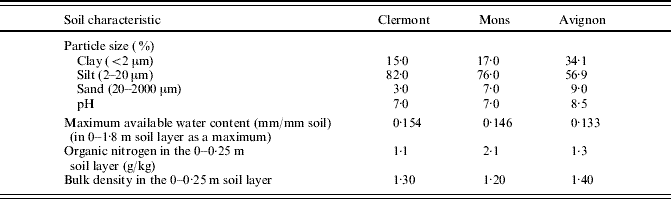
Two field trials were set up in northern France: in 1994 at Clermont (49°40′N, 3°56′E) and in 1995 at Mons (49°53′N, 3°E), and another in southern France in 2005 (Avignon, 43°57′N, 4°49′E). At Clermont and Mons, the soil was a 1·8 m deep silt loam (orthic luvisol, FAO classification; FAO 2006) and at Avignon it was a silt clay loam (1·7 m deep, a fluvisol in the FAO classification). Soil information for all field trials is given in Table 1. The Avignon soil was particularly clayey (35% by volume), and the Mons soil had the highest organic nitrogen content, with 2·1 g/kg organic nitrogen in the 0–250 mm layer.
Soil characteristics for all field trials

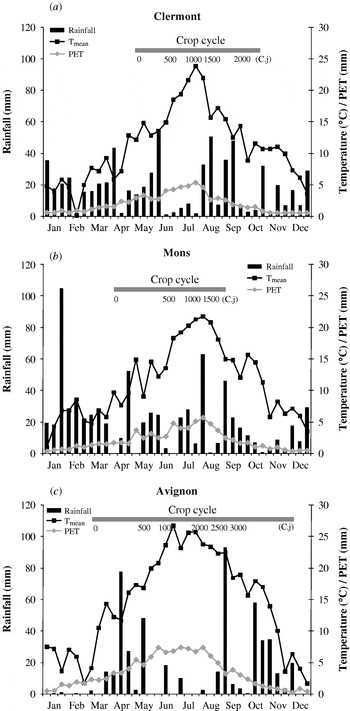
Meteorological data were obtained from weather stations located less than 0·2 km from the field trials, except for global radiation in Clermont, which was measured less than 10 km from the field trial. Avignon had the driest climate (496 mm of cumulative rainfall in 2005 as against 659 mm in Clermont in 1994 and 721 mm in Mons in 1995), with the highest temperatures (mean maximum temperature was c. 20°C in Avignon in 2005, 16°C in Clermont in 1994 and 15°C in Mons in 1995) and the highest potential evapotranspiration (PET), averaging 7–8 mm/day during summer (Fig. 1). In Clermont and Mons, drought conditions occurred around 1200°C days after emergence (°Cdae), when PET reached 5 mm/day.
Cumulative rainfall and averages of minimum and maximum air temperatures at (a) Clermont, (b) Mons and (c) Avignon (T min and T max) per decade. The thick grey line contains the crop cycle period.

Plant management and treatments
Sugar beet was sown on 25 April 2004 in Clermont, 10 April 1995 in Mons and 10 March 2005 in Avignon, the preceding crops being winter wheat in Clermont and Mons and oilseed rape in Avignon. Plant densities were 11 (Mons and Avignon) and 14 plants/m2 (Clermont). Mineral nitrogen fertilizer was applied according to the soil N content before sowing in all experiments, in order to avoid nitrogen deficiency during crop growth (no nitrogen was applied in Avignon, whereas 150 kg was given, in one application, at both Mons and Clermont).
In Avignon, two different water regimes were applied. Before the drought period all plants were kept well watered (until 31 May 2005). Then, treatments and drought stress imposition were: Avignon continuous irrigation (CI), Avignon defoliated (DE) and Avignon discontinuous irrigation (DI). Avignon CI and Avignon DE were both kept well watered and the treatment DE was defoliated on 11 August 2005. In Avignon DI, the irrigation was stopped to induce two strong drought stress periods: first, the irrigation was stopped for a period of 28 days, from 31 May to 28 June 2005, then irrigation was reinstated for a period of 13 days. Finally, irrigation was stopped again for 17 days, from 11 to 28 July 2005.
Experimental designs, sampling and analytical methods
In Avignon, each main plot was 76 rows×22 m and its location was chosen according to the irrigation equipment constraints and wind direction. Experimental plots (two rows×1·5 m) were laid out in a randomized design with three replicates. From mid-May to the end of August, plant measurements were made once or twice a week (24 measurement dates) and a late measurement date was added on 13 December. In Clermont and Mons, experimental plots (two rows×2 m) were laid out in a randomized block design with five or six replicates and plant measurements were made at 7–14-day intervals during the growing season. At every measurement date, 25 plants per replicate were dug up at Mons and Clermont and 10 at Avignon, and their total fresh weight and storage root fresh weight were measured. After planimeter leaf area index (LAI) measurement, the plant samples were dried at 70°C for 2 days and total dry matter, green leaf (lamina and petiole) and storage root dry matter were determined as well as specific leaf area (SLA). Storage root sugar content was determined in Avignon with a polarimeter.
Soil water content was measured at 10-day intervals from mid-May to the end of August in Avignon, using a neutron probe. Aluminium access tubes were installed to a depth of 1·2 m at three positions in all treatment plots. To calibrate the neutron probe, two soil samples were collected from 0 to 0·1, 0·1 to 0·2 and 0·2 to 1·2 m layers, at locations 0·3 m from each access tube, to determine gravimetric soil moisture contents, which were converted to volumetric values using bulk density values determined with a neutron-gamma probe. During the Mons trial, the soil water content of eight soil layers (0–1·6 m) was measured at 7-day intervals, whereas it was measured three times in Clermont for six soil layers (0–1·2 m), using a neutron probe at six positions in the experimental plot, with some additional gravimetric measurements for calibration. Experimental designs and sampling methods were described by Guérif et al. (Reference Guérif, Machet and Droulin1995) and Ceotto et al. (Reference Ceotto, Guérif, Duke, Donatelli, Stockle, Villalobos and Villar Mir1999).
Model
The STICS growth model (Brisson et al. Reference Brisson, Gary, Justes, Roche, Mary, Ripoche, Zimmer, Sierra, Bertuzzi, Burger, Bussiere, Cabidoche, Cellier, Debaeke, Gaudillere, Henault, Maraux, Seguin and Sinoquet2003, Reference Brisson, Launay, Mary and Beaudoin2009) simulates the behaviour of the soil–crop system over one or several crop cycles, using a daily time step. Crops are modelled in terms of their total above-ground dry matter and N content, LAI, and the number and biomass (and N content) of harvested organs. The soil is divided into a number of horizontal layers, each of which is characterized in terms of its water, mineral N and organic N content. Soil and crop interact via the roots, which are defined by their density distribution in the soil profile. The main simulated processes are crop growth and development, water and N balance. Crop growth is driven by the plant's carbon metabolism: solar radiation interception by the foliage and its incorporation into above-ground dry matter that is directed to the harvested organs during the final phase of growth. Crop development is driven by thermal time and is used to make the leaf area evolve and to define the harvested organ filling phase. Potential water and/or N stress are taken into account through indices that can reduce leaf growth, root growth and biomass accumulation under water- or nutrient-limited growing conditions. The water stress index is calculated as the ratio between actual and potential transpiration and the N stress index corresponds to the N nutrition index (NNI) as defined by Lemaire & Meynard (Reference Lemaire, Meynard and Lemaire1997), calculated as the ratio of actual to critical plant N content.
Trophic competition, leaf growth and harvested organ growth
Simulation options allow significant trophic competition between vegetative organs and harvested organs. This trophic competition is taken into account through two trophic stress indices, varying between 0 and 1, that reduce harvested organ daily growth rate (SOURCEPUITS) and leaf daily growth rate (SPLAI). SPLAI is calculated from the reference source/sink ratio SOURCEPUITS (Eqn 1)

where DLTAMS is the daily accumulated biomass from photosynthesis, REMOBILJ is the amount of biomass remobilized daily from the carbon pool reserves, FPV is the sink strength of vegetative organs, defined as the ratio between daily foliage growth and the minimum ratio of leaf surface area to shoot biomass and FPFT is the harvested organ sink strength related to a potential harvested organ growth.
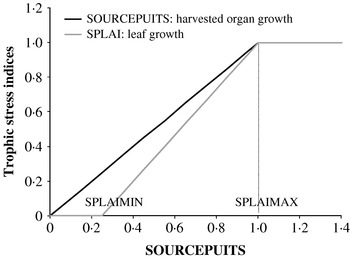
The SPLAI variable is defined by the SPLAIMIN and SPLAIMAX parameters (Fig. 2). The trophic stress indices cannot be considered as equivalent to coefficients of biomass allocation because they are not all applied to biomass. Consequently the relative position of the functions SOURCEPUITS and SPLAI do not indicate any priority between harvested organs and leaves: the priority needs to be calculated in terms of biomass and depends largely on the relative sink strengths of the organs.
Trophic stress indices (SOURCEPUITS and SPLAI) as a function of the source/sink ratio (SOURCEPUITS) using the parameters SPLAIMIN and SPLAIMAX. In this example, SPLAIMIN=0·25 and SPLAIMAX=1 (from Brisson et al. Reference Brisson, Launay, Mary and Beaudoin2009).

The leaf area growth rate is driven by phasic development, temperature and stresses. A daily potential LAI growth rate is first calculated, related to the phenological key stages corresponding to emergence and to the end of leaf onset. This value is then multiplied by the effective crop temperature, the plant density multiplied by a density factor, assumed to represent inter-plant competition, and the water and nitrogen stress indices. Finally, it is multiplied by the trophic stress index SPLAI.
The harvested organ growth rate is driven by phasic development and trophic competition. It is calculated daily from the phenological stage corresponding to the beginning of harvested organ filling until physiological maturity when the harvested organs stop dry matter growth. This duration is defined by the DUREEFRUIT parameter, expressed as thermal time. During growth, the harvested organs go through n compartments corresponding to increasing physiological ages. The time harvested organs spend in a given compartment is DUREEFRUIT/n. In each compartment, harvested organ growth is equal to the product of the ‘sink strength’ function FPFT and the source–sink ratio SOURCEPUITS. The FPFT function is the derivative of a logistic function that takes the genetic growth potential of the harvested organ into consideration (Bertin & Gary Reference Bertin and Gary1993), the genetic-dependent maximal weight of the harvested organ being defined by the parameter PGRAINMAXI.
Carbon pool reserves and remobilization
Carbon pool reserves are calculated daily as the difference between the total biomass and the accumulated biomass of leaves, stems and harvested organs. They represent the non-structural biomass that can be remobilized. Indeed, reserves built up during the vegetative cycle may be reused later on, the maximal proportion of carbon reserve remobilizable daily being defined by the parameter REMOBRES. This parameter is involved every day in the calculation of the REMOBILJ variable (Eqn 1).
Model adaptation to sugar beet: modelling storage root as a source and sink organ
The model was first adapted to sugar beet using data from literature and results obtained in sugar beet trials (Launay & Brisson Reference Launay, Brisson, Jacobsen, Jensen and Porter2004). The storage root was regarded as a harvested organ and its growth was simulated as described above: it was assumed that harvest occurred before the end of root filling and leaf area growth because the sugar beet cycle is usually interrupted by harvest.
It was also assumed that the carbon pool reserves are located in the storage root, which is able to switch from a sink to a source organ. The storage root dry weight is now the sum of the harvested organ and the carbon pool reserve dry weights. A preliminary calibration stage was necessary to include reserve biomass into the storage root. Because of the close link between LAI and storage root growth through the simulated trophic relationship, parameters for the two processes had to be re-estimated simultaneously. Moreover, the radiation use efficiency parameters determining the potential growth rate of above-ground biomass from intercepted radiation (and thus dependent on the LAI) were re-estimated. Finally, parameters involved in (i) foliar and storage root phenological development and growth, (ii) trophic competition, (iii) remobilization and (iv) radiation use efficiency were estimated by optimization. The Nelder–Mead simplex method (Nelder & Mead Reference Nelder and Mead1965) was implemented on the experimental database including the field trials of Avignon (treatments CI, DI and DE), Mons and Clermont.
Result evaluation
In order to evaluate the model, two kinds of evaluation criteria were calculated:
1. The mean difference between simulated ŷ i and measured y i:
 , where n is the number of replicates. MD indicates the under- or over-estimate.
2. The relative root mean square error (RRMSE):
, where ӯ is the average of observed values y i.
 , where n is the number of replicates. MD indicates the under- or over-estimate.
 , where ӯ is the average of observed values y i.
Further analyses of variance were carried out, using the AOV procedure of the S-PLUS software (S-PLUS 2001). The significance of differences between treatments was estimated using F-tests at P<0·05, and the means were compared using the Student t test at P<0·05.
RESULTS
Sugar beet behaviour in the field experiments
Leaf re-growth after stress release
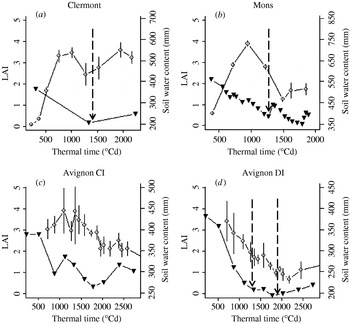
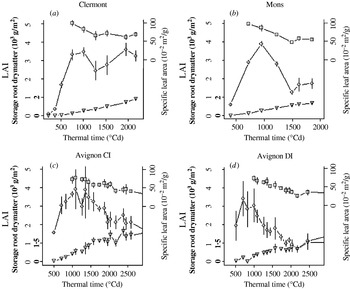
The trials were done in various water conditions both in terms of soil moisture dynamics and atmospheric demand. These situations led to water stress, as indicated by a decreasing LAI, of varying extent: LAI losses of 1·0 in Clermont (Fig. 3 a) and 3·0 in Mons and Avignon DI (Fig. 3 b, d), corresponding to a 200 mm decrease in soil moisture. In Avignon CI (Fig. 3 c), two periods of about 100 mm water depletion resulted in LAI losses of 1·0 and 1·5. Conversely, soil re-hydration periods following rainfall or irrigation allowed leaf re-growth: in Clermont and Mons (Fig. 3 a, b), rainfalls of 37 and 68 mm provoked LAI increases of about 1 and 0·5 LAI units, respectively. In Avignon CI, the two periods of soil water increase were associated with LAI increases of 1·0 and 0·5. A similar increase was observed after the second irrigation in Avignon DI; the first irrigation interrupted the LAI decrease temporarily. In some cases the two processes were not concomitant; the LAI regrowth was later than the soil recharge. Moreover, in the Avignon trial, the last measurements were made on 13 December 2005, 3800°Cdae, and green leaf biomass was between 243 and 440 g/m2 depending on the treatment.
Measured LAI (○) and soil water content (mm) (▾) in (a) Clermont, (b) Mons, (c) Avignon treatment CI (continuous irrigation) and (d) Avignon treatment DI (discontinuous irrigation). Soil water content was measured in the 0–1·2 m soil layer in Avignon and Clermont, and in the 0–1·8 m soil layer in Mons. Values are means±s.e. Arrows indicate major summer rainfalls in Clermont and Mons and irrigation resumptions in Avignon DI.

Figure 4 shows changes in SLA, which parallel the changes in LAI during the onset of drought. After the stress release, the increase in LAI was generally independent of SLA dynamics. Indeed in treatments CI and DI at Avignon, SLA remained constant or decreased during LAI regrowth, except in CI during the second period of soil water recharge (Fig. 4 c). However, in this case and in Clermont and Mons (Fig. 4 a, b), brief small SLA increases occurred, but they were not significant at P<0·05. Moreover, in all field trials, LAI increases were invariably linked to leaf dry matter increases (data not shown), refuting the possibility that the LAI re-growth was due to SLA increase. Finally, in the Avignon treatment CI where a 1·0 LAI unit increase was measured (Fig. 4 c), an estimate was made of the potential assimilates formed during these 4 days. The solar radiation intercepted by the crop during this period was calculated by interpolating LAI linearly between the two measurement dates, and using the following equation (Eqn (2)):

where Rgi is the solar radiation intercepted by the crop, Rgo is the global radiation and k is the radiation interception coefficient, equal to 0·53 for sugar beet (Varlet-Grancher et al. Reference Varlet-Grancher, Gosse, Chartier, Sinoquet, Bonhomme and Allirand1989).
Measured LAI (○), specific leaf area (SLA; 10−2 m2/g) (□) and storage root dry weight (103 g/m2) (▾) in (a) Clermont, (b) Mons, (c) Avignon treatment CI and (d) Avignon treatment DI. Values are means±s.e.

Assuming a high radiation use efficiency of 1·8 g/MJ (Scott & Jaggard Reference Scott and Jaggard1993), the potential biomass production during this period was estimated at about 170 g/m2, which may not offset the measured leaf biomass production of 116 g/m2. If it is assumed that the proportion of assimilates allocated to the shoot is at most 0·5 (Webb et al. Reference Webb, Werker and Gilligan1997), then the new dry matter is not sufficient to account for the 116 g/m2 increase in the leaf dry weight.
Finally, there was no decrease in storage root dry weight (Fig. 4) at Clermont, Mons and Avignon DI, whereas two periods of about 0·5×103 g/m2 root biomass loss (significant at P<0·05) appeared in Avignon CI (Fig. 4 c), those periods being not exactly concomitant with LAI re-growth.
Leaf regrowth and sugar content decrease in storage roots after defoliation
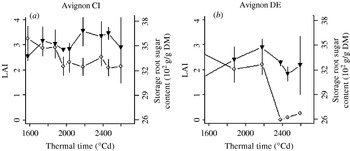
After total defoliation in Avignon treatment DE at 2200°Cdae, leaves suddenly grew again, LAI recovering to 0·25 in about 350°Cd (Fig. 5 b), which corresponds to a growth rate of 0·06 g/m2/°C. Just after defoliation, sugar beet plants produced new leaves with large laminae and short petioles, representing 0·86 and 0·14, respectively, of the total green leaf dry weight (measurements made 400°Cd after defoliation). However, in the late autumn (3800°Cdae), green leaf dry weight was mostly attributable to large petioles, whose weight represented 0·90 of the total green leaf dry weight.
Measured LAI (○) and sugar content in storage root (102 g/g of storage root dry matter) (▾) in (a) Avignon treatment CI and (b) Avignon treatment DE (defoliated). Values are means±s.e.

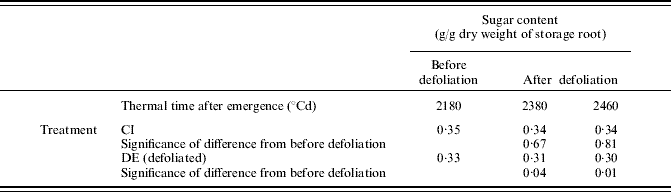
A simultaneous decrease in sugar content was measured in storage roots of treatment DE, from comprising 0·33 to 0·30 of the storage root dry weight in 240°Cd (Fig. 5 b). Sugar contents of storage roots were significantly different before and after defoliation in treatment DE, while there was no difference in the non-defoliated treatment CI (Fig. 5 a and Table 2). Before defoliation, sugar contents were similar in treatments CI and DE (P=0·17).
Sugar content in storage roots, before and after defoliation, in treatment CI and DE at Avignon

Remobilization assumption tested through an heuristic modelling approach
Other evidence was sought for the role played by remobilization in sugar beet through the STICS crop model formalizations.
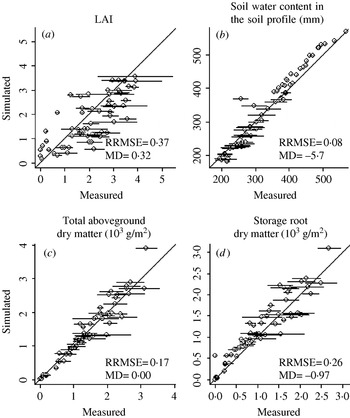
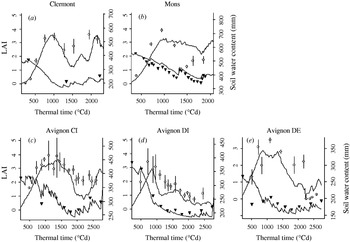
Key variables indicating the model's ability to simulate partitioning and translocation of biomass in source and sink organs (LAI, above-ground and storage root dry weights), as well as to reproduce the source of drought stress (i.e. soil water content), are presented in Fig. 6 together with the observed values. Simulated LAIs were under-estimated by the model with a mean deviation (MD) of about 0·32 (Fig. 6 a), whereas soil water content (Fig. 6 b) and total above-ground biomass (Fig. 6 c) were estimated without bias (MD=−5·7 mm and 0·003×103 g/m2, respectively) and good accuracy (RRMSE=0·08 and 0·17, respectively). However, the slight over-estimation of soil water content in wet conditions (more than 400 mm in the whole soil profile) could be attributed to the under-estimation of LAI, especially at Mons for LAI values of 3–4 (Fig. 7 b), in turn leading to an under-estimation of plant transpiration. The storage root dry weight (Fig. 6 d) was estimated with no bias (MD=−0·97) but considerable scatter (RRMSE=0·26) and the measurements were noticeably variable.
Evaluation of the model by comparing observed and simulated (a) LAI, (b) soil water content in the soil profile (mm), (c) total above-ground dry matter (103 g/m2) and (d) storage root dry weight (103 g/m2). Values are means±s.e. (— line 1:1). Respective RRMSE and MD are given.

Daily simulated LAI and soil water contents (mm), and LAI and soil water content measurements in (a) Clermont, (b) Mons and (c–e) Avignon trials. Measured values are means±s.e.

LAI values were reproduced by the model, especially the leaf regrowth when drought stress ceased in Clermont at 1500°Cdae (Fig. 7 a), in Avignon CI around 2200°Cdae (Fig. 7 c), in Avignon CI around 1300°Cdae (Fig. 7 d), or after defoliation at 2300°Cdae for Avignon DE (Fig. 7 e). In Mons (Fig. 7 b), the LAI decrease and subsequent increase from 1000 to 2000°Cdae was not reproduced in terms of the range of values, but the soil re-wetting at 1800°Cdae induced a clear leaf regrowth. In Avignon DI (Fig. 7 d), the model also failed to reproduce leaf regrowth after the second irrigation at 1900°Cdae, which seemed to be linked with the poor simulation of the soil rehydration on this date. Moreover, LAI was particularly under-estimated when drought stress occurred during the second half of the crop cycle in Clermont (Fig. 6 a) and Avignon CI (Fig. 6 c), and throughout crop growth in Avignon DI (Fig. 6 d).
The re-estimation of model parameters, regarding the storage root as a carbon reservoir, led to the following values: the phenological parameters driving leaf and storage root growth durations were estimated at about 6000°Cdae from emergence to the end of leaf growth and at about 11000°Cdae from emergence to the end of storage root filling; the PGRAINMAXI parameter, corresponding to the genetic-dependent maximal weight of the harvested organ, was estimated at 1060 g; the trophic stress parameters SPLAIMIN and SPLAIMAX were estimated at −0·84 and 1·06, respectively; the maximal proportion of carbon reserve remobilizable daily (REMOBRES parameter) was estimated to represent 0·30 of the total carbon pool reserves.
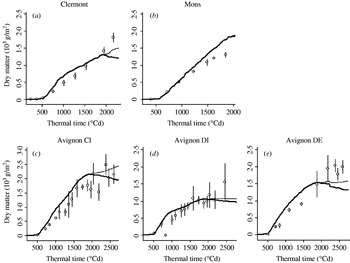
Finally, the model allowed quantification of the remobilized amounts of storage dry matter. As shown in Fig. 8, the simulated total storage root dry weight was similar to the measurements. The model simulated the carbon pool reserve as the majority of storage root dry weight. During the drought in summer, this simulated pool decreased because of remobilization, but the total storage root dry matter kept on increasing. In the Avignon DE trial (Fig. 8 e), throughout the 10 days after defoliation, the simulated remobilized dry weight was 0·12 103 g/m2, which represented around 0·08 of the total storage root dry weight and nearly 0·70 of the new leaf dry weight. In other trials, simulated carbon pool reserves represented from 0·50 (Avignon) to 0·80 (Mons) of the total storage root dry weight, and accumulated remobilized dry matter was simulated from 0·06 (Mons) to 0·30 (Avignon DI) of the final storage root dry weight.
Measured (○) and daily simulated (—) storage root dry weight (103 g/m2), and simulated ( ) carbon pool reserve dry weight (103 g/m2) in (a) Clermont, (b) Mons and (c–e) Avignon trials. Measured values of storage root dry weights are means±s.e.

DISCUSSION
The objective of the present paper was to demonstrate, with experimental and modelling approaches, the ability of sugar beet to remobilize carbohydrates from its storage root to support leaf regrowth after stress release. In the field trials, leaf regrowth was observed after drought stress was relieved. This ability of sugar beet has already been described by Owen & Watson (Reference Owen and Watson1956) and Milford et al. (Reference Milford, Pocock and Riley1985). The primary explanation is of a botanical nature: the sugar beet crop is cultivated during its vegetative phase only, i.e. no ontogenic signal prevents leaves from growing during this period (Perata et al. Reference Perata, Poggiolini, Poggi, Meriggi and Ribeyre2004). Milford et al. (Reference Milford, Pocock and Riley1985) showed, on a series of distinct sugar-beet crops grown during five consecutive seasons, that a linear relationship could be fitted between leaf number and thermal time until 2000°C after sowing, with no plateau, suggesting that it could increase at the same rate for longer. This result was confirmed in the present work by the last measurements made in December in the Avignon trial, illustrating sugar beet's ability to produce new leaves throughout its life. Secondly, as previously shown that leaf regrowth could not be explained by SLA increase or resumption of photosynthetic activity, this leaf renewal property must rely on the possibility of remobilizing stored resources to support this energy-consuming activity. However, the measurements in field trials in the present work were not relevant to accurately quantify the remobilization process and could not reveal storage root dry weight decrease, together with LAI regrowth after stress release. However, a defoliation treatment demonstrated the simultaneous leaf regrowth and sugar content decrease in storage roots after defoliation, showing that storage roots can be sources as well as sinks. This phenomenon occurs not only in a phenological time-dependent way (sinks during the vegetative stage and sources during the reproductive stage), but also even during the vegetative stage, the switch between source and sink being triggered by environmental stress. This property, shown in the present work by an artificial stress induced by defoliation, may explain sugar beet's plasticity to cope with drought. It brings the sugar beet crop closer to perennial ones, thanks to this functional similarity. Like grassland ecosystems (Volenec et al. Reference Volenec, Ourry and Joern1996; Frankow-Lindberg Reference Frankow-Lindberg2001) or woody plants (Sakai & Sakai Reference Sakai and Sakai1998; Teng et al. Reference Teng, Tanabe, Tamura and Itai1999; Wong et al. Reference Wong, Baggett and Rye2003; Cheng et al. Reference Cheng, Xia and Bates2004), sugar beet is able to accumulate and subsequently use carbohydrates to supply biomass and energy for re-growth. This is of particular importance in the case of sugar beet because the source/sink organ is the harvested one, and indeed a balance should be maintained in relation to environmental conditions in order to maximize yield.
The experimental approach, designed in order to reveal remobilization, was supplemented by a heuristic use of the crop model STICS to validate the assumption of this process. Two main results indicated that the model could simulate sugar beet's capacity for remobilization fairly well and therefore confirmed the hypothesis: first, the model's ability to simulate the output variables involved in sugar beet remobilization and second, the re-estimation of model parameters when treating the storage root as a carbon pool, which led to establish a single set of parameters.
First, the agreement between measurement and simulated trends in LAI and soil water content, and especially the reproduction of leaf regrowth when drought stress ceased, supported the model's ability to simulate remobilization. However, the under-estimation of LAI when drought stress occurred brought out the model's limitations. As the soil moisture was correctly simulated for these trials, it can be assumed that the effect of drought stress on LAI growth was over-estimated, as noticed previously (Launay & Brisson Reference Launay, Brisson, Jacobsen, Jensen and Porter2004). Thus, although the LAI simulation has already been improved by taking remobilization into account, its accuracy should now be increased, especially when daily variations are important. This may be particularly interesting when coupling a crop model with remote sensing data (Baret et al. Reference Baret, Houlès and Guérif2007). Moreover, it can help when attempting to simulate foliar re-growth after pest damage, when pests either consume leaf tissue or accelerate abscission (Boote et al. Reference Boote, Jones, Mishoe and Berger1983).
Secondly, re-estimation of model parameters led to similar sets of physiologically meaningful parameter values. The single solution values obtained in this way demonstrated the value of the model to simulate leaf dynamics in these trials. The estimated values of the phenological parameters driving leaf and storage root growth durations were large, which is consistent with sugar beet's biennial cycle and its ability to extend storage root growth and to maintain leaf cover during the first year. The estimated value of the genetic-dependent parameter corresponding to the maximal weight of the harvested organ was in accord with this phenological duration of storage root growth. The trophic stress parameter values expressed the smaller effect of trophic competition on leaf actual growth than on storage root potential growth. They were relevant to the need to simulate leaf regrowth during a drought stress release, but could penalize storage root growth rate at other times.
Finally, the simulation results of carbon pool reserves were comparable to the measurements of Lawson et al. (Reference Lawson, Kelly and Sale2000) on white clover cultivars, which showed that the combined utilization of starch and water-soluble carbohydrate reserves in the first 14 days after defoliation was equivalent to 0·15 of the plant weight at defoliation, and to 0·95 of the new leaf produced during that period. However, the structural part of the simulated total storage root dry weight was obviously under-estimated. Ecophysiological approaches in controlled conditions, possibly supplemented by isotopic tracing, would allow structural and non-structural parts of the storage root to be distinguished, remobilized amounts to be measured, and the contribution of remobilized carbohydrates to leaf regrowth to be estimated. This approach could rely on the previous study by Monti et al. (Reference Monti, Brugnoli, Scartazza and Amaducci2006), who determined carbon isotope discrimination on soluble sugars and bulk dry matter of different parts of sugar beet biomass. Similar studies have been attempted on other species for which the harvested organ was not the source organ, and led to very differing results: Royo et al. (Reference Royo, Voltas and Romagosa1999) measured contributions of pre-anthesis reserves to triticale grain yield ranging from 0·18 to 0·67 of grain dry weight, whereas Subbarao et al. (Reference Subbarao, Nam, Chauhan and Johansen2000) showed that the contribution of non-structural carbohydrates from stem reserves to pigeon pea grain yield under water deficit conditions never exceeded 0·05 of grain yield. Indeed, as remobilization contributions to harvested organ dry weight may be very different according to species, sugar beet could be taken as a plant model to study remobilization in species for which the harvested organ is a sink as well as a source. However, the focus in the present study was on drought stress. Further agronomic studies are now needed to define the environmental and internal factors limiting the sugar beet remobilization process.
The model's generality was a great asset in the present study, since relationships already introduced for other species proved to be relevant for sugar beet, showing the functional similarity between species that are very different botanically. Moreover, the simulation results showed the robustness of the model to forecast sugar beet biomass production, especially when drought stress occurs during summer and then is released in autumn. Lastly, the agronomic experiments and the modelling approach both provided a strong hypothesis that should be now tested with ecophysiological experiments and molecular methods.
We gratefully acknowledge the technical support of the INRA staff at the experimental farms of INRA-Laon and INRA-Avignon. We thank M. Lejealle from Deleplanque Compagny for providing seeds and technical support in the Avignon trial. This programme received funding from the Institut Technique de la Betterave Industrielle.