Mine rescue teams (MRTs) are mainly in charge of emergency response during mine disasters and have gradually participated in handling some natural disasters in recent years. Before new MRT members are allowed to participate in a mine rescue, they must complete training on rescue theory, rescue skill and equipment, medical first aid and psychological quality, and must obtain the mine rescue certificate. In China alone, there were 32,731 full-time MRT members at the end of 2014. In America, there were 3609 MRT members at the end of 2011. The health of MRT members deserves wide attention. MRTs might be exposed to blast injury, burns, suffocation, poisoning, and blunt trauma due to the high risk of the industries.Reference Kilinc, Monaghan and Powell 1 The environment in disaster areas is dark, narrow, hot, humid, and complex, which could easily lead to the occurrence of casualties.Reference Tomaskova, Jirak and Lvoncik 2 – Reference Stewart, Mcdonald and Hunt 4 For example, 7 MRT members died due to a blast injury in the Shanmushu Coal Mine on July 23, 2013. Three MRT members died because of suffocation from discharging gas after opening up a seal in the Tongshengtongji Coal Mine on October 26, 2017. Nevertheless, some of the injured, for instance, poisoned persons, can be saved with effective, timely treatment. For example, the only survivor in the Sago mine explosion in January 2006 was successfully treated.Reference Roberts, Bailes and Dedhia 5 However, a low level of preparedness for medical emergencies in the mining industry can be found in many countries.Reference Engström, Angrén and Björnstig 6
Understanding the causes of mine rescue teams’ casualties (MRTC) can help improve injury prevention and medical emergency preparedness. On the one hand, good injury prevention can reduce the pressure induced by medical emergencies. On the other hand, improving medical emergency response through injury knowledge can cut down on the mortality of the injured. Thus, the risk of injury faced by the MRT will decrease.
Previous studies focused on the types of MRTC causes but lacked attention to the mechanisms by which the causes affect casualty incidents and the severity of MRTC. Therefore, these studies contribute little to medical emergency preparedness and the health of MRTs.Reference Zhang, Liu and Wang 7 , Reference Lan, Pan and Li 8 In this study, the focus was on the mechanism underlying the impact of the causes on MRTC, the severity of MRTC, and the injury types. The objective was to enhance medical emergency preparedness and injury prevention.
METHODS
The frequency of accidents within a certain period of time has been used to analyze industry accidents by quite a few scholars.Reference Wang, Cheng and Liu 9 , Reference Dubaniewicz 10 A similar method was used in this paper to analyze MRTC from 1953 to 2013. A panel of 4 rescue experts (numbered 1 to 4) who were from the MRTs mentioned in Materials was established to assist us in analyzing these cases to ensure the reliability of the study. The number 1 expert was responsible for the analysis of gas or coal dust explosion accident rescues, the number 2 expert was responsible for the analysis of fire rescues, the number 3 expert was responsible for the analysis of roof accident rescues and poisoning and suffocation rescues, and the number 4 expert was responsible for the analysis of exploring the disaster area, discharging gas, and other accident rescues. The fault tree analysis method was used by these experts to determine the main causes of the casualty incidents and to discuss the main injury types.
Materials
Eighty-one cases of MRTC spanning the years 1953–2013 were collected from MRTs (ie, National Mine Rescue Pingdingshan Team, National Mine Rescue Datong Team, National Mine Rescue Furong Team, and Hebi Coal Group Mine Rescue Team) and the related literature.Reference Ni, Zhang and Zhu 11 – 15 The data from these cases helped us acquire the basic scenario of MRTC with regard to the time of occurrence, causes, rescue work type, and number of casualties.
RESULTS
Causes of MRTC
The causes of MRTC can be divided into 6 types (Table 1): organizational and personal factors (C1), rescue skill and equipment factors (C2), illegal command and disposal factors (C3), irrational rescue measure factors (C4), irrational decision-making and command factors (C5), and others (C6). C1 describes the organizational behaviors and personal behaviors that caused casualties; C2 describes the skill and equipment problems that caused casualties; C3 describes the violation of relevant laws by command and disposal that caused casualties; C4 describes measures that did not aid in rescue; C5 describes decision-making and leadership that were not in line with the laws of disaster development; and C6 describes other factors not yet mentioned. Overall, organizational and personal factors account for 41.98% of the total causes and are the primary cause. Rescue skill and equipment factors account for 16.05% and seriously affect the security of mine rescue. Illegal command and disposal factors account for 14.81%, demonstrating that complying with the relevant regulations is imperative to ensure the security of team members. Irrational rescue measure factors account for 12.35%, highlighting the significance of protective actions for mine rescue. Irrational decision-making and command factors account for 4.94%. Additionally, in some cases, some special causes could also result in casualty incidents, such as lack of medical emergency knowledge, high temperatures, unexpected explosions, misuse of rescue signals.
Causes of Mine Rescue Team Casualties

Some new features have appeared as causes of MRTC using comparative analysis (1953–2008 and 2008–2013). From 2008 to 2013, the percentage of organizational and personal factors decreased by 10.15%, and that of rescue skill and equipment factors decreased by 18.84%, dropping to 0 (see Table 1). Nevertheless, the impact of 3 factors (ie, C3, C4, and C5) on MRTC all increased significantly. These 3 factors increased by 2.18%, 14.86%, and 3.98%, respectively, which underlines that mine rescue must formulate actions to avert illegal command and disposal, increase the rationality of emergency decision-making and command, and focus on developing protective measures. Simultaneously, the percentage of other causes did not fall off with the standardization of mine rescue (the standardization being that inappropriate rescue operations were forbidden by mine rescue regulation, and a more appropriate rescue operation was enforced) but increased by 7.97%, indicating that other causes, such as high temperature, are still crucial aspects of MRTC prevention.
Severity of MRTC
The 81 casualty incidents took the life of a total of 236 MRT members and primarily occurred in 7 types of rescue work: gas or coal dust explosion accident rescues, fire rescues, roof accident rescues, poisoning and suffocation rescues, exploring the disaster area, discharging gas, and others. The influence of the cause and type of rescue work on the severity of the casualty incident was analyzed based on the average death toll. The average death toll of MRTC caused by illegal command and disposal factors reached up to 6 to 7 people, which is essentially the number of members in a rescue unit, as Chinese mine rescue regulation (2007) stipulates that rescue units must number no fewer than 6 people when executing rescue missions. The average death toll of MRTC induced by irrational decision-making and command factors reached up to 5 to 6 people, which again approximates the number of members in a rescue unit. However, the average death toll of MRTC caused by the other 4 causes was 2 to 3 people. Therefore, illegal command and disposal factors and irrational decision-making and command factors result in more severe accident consequences than the other 4 causes and should therefore command more attention. In some cases, the other 4 causes also led to terrible MRTC, such as the casualty incident in the Shanmushu Coal Mine on July 23, 2013, in which 7 team members were killed due to irrational rescue measures.
Casualty incidents that occurred in fire rescues were the most severe, with an average of 3 to 4 fatalities, followed by casualty incidents that occurred in gas or coal dust explosion accident rescues, which averaged 2 to 3 fatalities. However, the average death toll of MRTC in the other 5 types of rescue work was just 1 to 2 people. The reason why inappropriate fire rescues caused severe casualties is the high frequency of illegal commands and disposals, which can trigger explosion incidents, such as the explosion incidents in the Babao Coal Mine on March 29 and April 1, 2013, killing 26 MRT members. Among roof accident rescues, poisoning and suffocation rescues, exploring the disaster area, and discharging gas, the likelihood of any kind of explosion is relatively small. Even so, the fatalities occurring in those 4 types of rescue work exceeded 3, in some cases, and the frequency of these casualties also needs to be given considerable attention.
Injury Types
Six main injuries that caused death were blast injury, burns, poisoning, suffocation, blunt trauma, and overwork injury, for which good medical emergency plans need to be prepared. Blast injury, known as impact injury, is caused by shock waves from mine explosions and damages the ears, lungs, abdomen, brain, and so forth, often resulting in multiple injuries. Burn injury is the tissue injury caused by mine fires or explosions and includes skin and mucous membrane damage, as well as subcutaneous or submucosal tissue damage in severe cases. These can be divided into severe burns and minor burns. On March 15, 2009, the Yichun rescue team encountered fatal explosions when handling a fire area. One of 2 team members injured by severe blast injuries and burns died due to failed medical treatment, whereas the other survived. Poisoning refers to the dysfunction of the tissue or structure and metabolic disorders caused by inhalation of massive chemicals, such as carbon monoxide (CO), and can lead to disease or death. Suffocation manifests as dyspnea or cessation of breathing due to insufficient oxygen, excessive exposure to other gases, or respiratory disorders. The largest risk faced by MRT is poisoning and suffocation. Most of the injured died because of failed medical treatment. In particular, the treatment of poisoning and suffocation requires good preparedness, such as the construction of an emergency medical team. On August 1, 2008, a member of the Xuanwei rescue team was poisoned when his mask kept falling off while handling an explosion and ultimately died due to longtime poisoning and failed medical treatment. On January 2, 2010, a member of the Jincheng Coal Group rescue team encountered suffocation when discharging gas. The injured was given first aid by cardiopulmonary resuscitation, artificial respiration, and oxygen inhalation therapy and was then taken to a hospital to receive further treatment. However, the emergency medical treatment failed. Blunt trauma refers to physical injury to the human body by rocks or other materials and can develop into contusions, abrasions, lacerations, or bone fractures. These often result in multiple injuries. On December 1, 2008, 3 members of the Qitaihe Mining Group MRT were hit by falling rocks from a tunnel roof while handling the Changlong Coal Mine explosion and ultimately died due to blunt trauma. Overwork injury refers to a series of dysfunctions and pathological changes created when the workload exceeds the human body’s capacity. On July 6, 2011, 3 members of the Zaozhuang Mining Group rescue team died due to heatstroke and physical exhaustion when exploring a disaster area.
DISCUSSION
According to the results, organizational and personal factors, rescue skill and equipment, decision-making and command and irrational rescue measures merit closer attention by rescuers. What calls for special attention are oxygen rebreather factors, which have existed in organizational and personal factors and rescue skill and equipment factors and have led to many MRTC. Thus, further analysis was given to these factors.
Organizational and Personal Factors
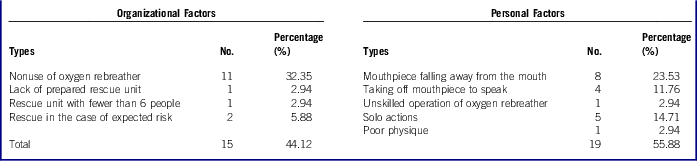
There were 15 MRTC caused by organizational factors and 19 MRTC caused by personal factors, and they represented 18.52% and 23.46% of the total, respectively. Further analysis demonstrates the influence of organizational and personal factors on MRTC (Table 2). Nonuse of oxygen rebreathers in asphyxiated areas, mouthpieces falling away from the mouth, taking off mouthpieces to speak, and solo actions have had significant influence on the occurrence of casualty incidents, with injuries of poisoning or suffocation. Moreover, personal factors have had a greater influence on the occurrence of MRTC than have had organizational factors. A valuable conclusion is that organizational and personal factors are crucial causes of injuries for MRTs with poor physique, poor rescue capability, and outdated rescue equipment. Even so, organizational and personal factors can be controlled more easily than other causes by specific management means, such as meeting quality standards for constructing MRTs and providing good emergency medical service.
Classification of Organizational and Personal Factors

Rescue Skill and Equipment Factors
Rescue skill and equipment are mainly used by MRT members for executing rescue missions. In particular, the rescue unit’s skill and equipment are extremely crucial for the safety of team members. Casualty incidents could occur during missions if the rescue unit’s equipment or personnel is insufficient or unqualified. The issue of insufficient equipment is partially triggered by the rescue unit having fewer than 6 people. Moreover, the accuracy of the gas detector is directly tied to the emergency decision-making and command. In the case of inaccurate data, rescuers might make unscientific decisions, which could lead to injury. Much attention should be paid to the rescue unit’s equipment for maintenance in daily training. Mastering the requisite rescue skills (like proper use of the oxygen rebreather and medical first aid) is a basic requirement for MRT members to participate in a mine rescue. Weak rescue skills comprise 15.38% of rescue skill and equipment factors. An injury caused by deficient personal skills or equipment is related only to himself, whereas that caused by the rescue unit’s skills and equipment is related to the whole rescue unit. The resulting injury might be blast injury, burns, or blunt trauma.
Decision-Making and Command Factors
The percentage of MRTC caused by illegal command and disposal factors and irrational decision-making and command factors between 2008 and 2013 reached up to 25% and had increased by 6.16%. This shows that the causes of MRTC have increasingly entailed more troublesome factors, such as decision-making and command, which have become the typical feature of MRTC currently and could cause massive casualties, mainly by blast injury, as proven by the explosion incident in the Yuxin No.1 Coal Mine on July 5, 2014. That failed rescue operation resulted in 17 fatalities, including several MRT members, and revealed that unscientific decision-making and command is a serious threat to MRT members.
Irrational Rescue Measure Factors
Fire rescues and gas or coal dust explosion accident rescues are the main work types in which the irrational rescue measures are distributed, and they are associated with 80% of casualty incidents caused by irrational rescue measures. There were explosions in half of the above fire rescues due to irrational rescue measure factors. Lack of support measures in roof accident rescues accounted for approximately 10% of casualty incidents caused by irrational rescue measure factors. The remaining 10% was related to “other” work types. Lack of action for explosion prevention is the primary cause for accident deterioration, and some team members lost their life due to blast injury. In fact, irrational rescue measures manifest as unscientific rescue measures and the absence of safety measures, accounting for 80% and 20%, respectively. Unscientific rescue measures mostly entail developing rescue measures that are not in accordance with the disaster situation for extinguishing fires (eg, small closed region, short distance from fire zone, poor sealing wall quality), rescuing without mastering the gas situation, as well as a lack of necessary preventive actions. The absence of safety measures mostly concern ignoring the monitoring of safety situations and non-execution of measures to eliminate potential threat. All of these factors could threaten lives by blast injury, burns, poisoning, or suffocation.
Oxygen Rebreather Factors
Oxygen rebreathers are an important life support system for MRT members in the disaster area. The operational capacity of oxygen rebreathers and the quality of the oxygen rebreathers are directly related to the safety of MRT members. The injuries caused by oxygen rebreather factors are mainly poisoning and suffocation, which can easily lead to the death of MRT members. These injuries always involve 1 to 2 people, and the injured can be rescued effectively if there are prepared oxygen rebreathers and other rescuers can find them in time. Thirty MRTC are associated with oxygen rebreathers, accounting for 37.04% of the total, thus stressing the severity of MRTC occurrences due to the impertinent use of oxygen rebreathers. The oxygen rebreather factors include 6 types (Table 3). Nonuse of an oxygen rebreather in an asphyxiated area is the primary factor behind casualties, mainly because MRT members did not pay sufficient attention to the danger posed by the disaster area.
Classification of Oxygen Rebreather Factors

Strengthening environmental monitoring of the danger area and increasing safety education can help reduce MRTC. It is noteworthy that the reasons for mouthpieces falling away from the mouth and taking them off for speaking purposes are not only that some MRT members ignore their security and deliberately take off their mouthpiece, but also because of physical strength attenuation, falling ill, feeling bad on account of overwork, as well as the misuse of rescue signal. All of these situations appeared in 40% of MRTC triggered by oxygen rebreather factors. Moreover, it is worth noting that factors like the mouthpieces falling away from the mouth and taking them off to speak, in many cases, are related to the negative pressure oxygen rebreathers, such as the AHG-4 Oxygen Rebreather, produced by the Fushun Coal Mine Safety Instrument General Factory and used by the majority of Chinese MRTs for a long period of time.
CONCLUSIONS
The anatomy of MRTC, which was based on the frequency of accidents, focused on medical emergency preparedness and injury prevention. To reduce mortality caused by inadequate medical treatment, this work emphasizes setting up an emergency medical team that can work in the underground rescue base, treating not only injured MRT members but also injured miners. This action can shorten the rescue time required to carry the injured out of the coal mine; thus, the injured can receive timely treatment. Meanwhile, it is advised that medical preparedness for blast injury, burns, poisoning, suffocation, blunt trauma, and overwork injury be strengthened. For the purpose of MRTC prevention, actions in accordance with MRTC causes need to be considered systematically by MRTs.
Acknowledgments
The authors thank the following mine rescue teams for providing mine disaster information: National Mine Rescue Pingdingshan Team, National Mine Rescue Datong Team, National Mine Rescue Furong Team, and Hebi Coal Group Mine Rescue Team.
Supplementary material
To view supplementary material for this article, please visit https://doi.org/10.1017/dmp.2018.140