FOCUS POINTS
• Modified-release formulations are designed to release drug in a controlled and predictable manner that allows for a particular efficacy and safety profile.
• The main technologies used for oral modified-release psychotropic agents are matrix systems, reservoir systems, multiparticulate agents, and coating technology.
• The mechanisms selected will affect transit time in the gastrointestinal (GI) tract, location of drug release, dissolution of the active molecule, permeation through the GI membrane, whether or not the drug goes through first-pass metabolism, and intestinal degradation.
• As drug delivery technology progresses, it is increasingly possible to use formulation to optimize the therapeutic profile of a particular medication.
Introduction
A medication's pharmacokinetic properties can be as important as its efficacy in determining how successful a treatment is.Reference Stahl and Wets1 Formulation plays a critical role in absorption, distribution, and elimination of a drug, which in turn can influence the clinical profile of a medication, including onset and duration of action, consistency of plasma levels, ability to cross the blood-brain barrier, and other factors.Reference Stahl2 The importance of formulation is clearly demonstrated by the variety of stimulants used to treat attention deficit hyperactivity disorder (ADHD). The majority of approved treatments for ADHD are formulation variations of either amphetamine or methylphenidate: Their differences lie not in the active ingredient but rather in how that active ingredient is delivered. That is, the delivery system determines that the drug reaches the brain at the right dose at the right time.Reference Stahl and Wets1 Additional examples can be found in the antidepressant class. Two commonly prescribed oral agents—venlafaxine and bupropion—can have notable differences in safety and tolerability depending on formulation (venlafaxine vs. venlafaxine XR; bupropion vs. bupropion SR vs. bupropion XL). Likewise, the use of a transdermal delivery system for the monoamine oxidase inhibitor (MAOI) selegiline has enabled this agent to be used to treat depression without the “tyramine effects” of traditional MAOIs.
Advances in drug delivery technology mean that formulation is now an integral component in the development of a drug. Likewise, formulation is one of the factors that may influence selection of a medication to suit the needs of a particular patient. This article briefly reviews the technologies commonly applied in the development of psychotropic medications, with emphasis on the various oral modified-release formulations, and discusses how formulation can be used to optimize the efficacy and tolerability of psychotropic drugs.
Advances in Medication Formulations: Modified Release
Modified-release formulations are designed to release drug in a controlled and predictable manner that allows for a particular efficacy and safety profile.Reference Chen, Shah and Ganes3 For example, a modified-release formulation may provide delayed release, extended release, pulsatile release, chrono-release, or targeted delivery of the drug to a particular location in the body. Modifying the release of drug can improve tolerability by eliminating peaks and troughs in plasma concentration, and can improve efficacy by increasing duration of action as well as by eliminating peaks and troughs.Reference Stahl2 The improved clinical profile, as well as the potential for less frequent dosing, may in turn enhance adherence.
The main technologies used for oral modified-release psychotropic agents are matrix systems, reservoir systems, multiparticulate agents, and coating technology. The mechanisms selected will affect transit time in the gastrointestinal (GI) tract, location of drug release, dissolution of the active molecule, permeation through the GI membrane, whether or not the drug goes through first-pass metabolism, and intestinal degradation.Reference Chen, Shah and Ganes3
Matrix System
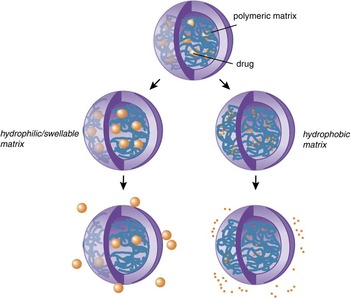
A matrix system is one in which the drug and excipients are dispersed within polymers (Figure 1). Drug transport occurs through both diffusion-controlled and dissolution-controlled mechanisms. With a hydrophilic swellable matrix, water diffuses in, swelling the polymer and thus allowing the drug to diffuse out, with the rate of diffusion determined by the dissolution rate of the polymer (Figure 1, left).Reference Brannon-Peppas4–Reference Wen and Park6 This is the most common type of matrix, particularly for poorly soluble drugs. This type of formulation can be affected by food/alcohol, so there is some potential for dose dumping. It also requires a large amount of excipient, so dose loading can be relatively low.Reference Tiwari and Rajabi-Siahboomi7 With a hydrophobic polymer-based matrix, the matrix becomes inert in the presence of water and GI fluid, and the drug dissolves and then diffuses through a network of channels between the polymer particles (Figure 1, right).Reference Frutos, Pabon, Lastres and Frutos8 Thus, a hydrophobic matrix has greater physical stability than a hydrophilic matrix, making drug release less variable and reducing the risk of dose dumping in the presence of food.
Matrix system.

Reservoir System
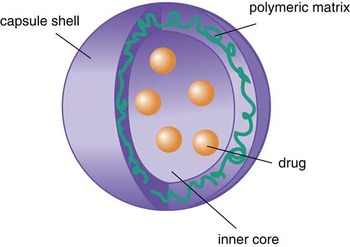
A reservoir system is one in which a drug-containing core is enclosed within a polymeric membrane.Reference Tiwari and Rajabi-Siahboomi7 There are two major types: simple diffusion/erosion systems and osmotic systems. With diffusion/erosion systems, water diffuses through the polymeric membrane and dissolves the drug, which then diffuses out at a rate determined by the porosity and thickness of the membrane, the solubility of the drug, and the membrane area (Figure 2).Reference Tiwari and Rajabi-Siahboomi7, Reference Roy and Shahiwala9 Because the polymers used to create the coated membrane have low permeability, this technique is mostly used on small pellets to increase the total membrane area.Reference Siepmann, Hoffman, Leclercq, Carlin and Siepmann10 Osmotic systems have a semipermeable membrane with a laser-drilled hole. Typically, both drug and an osmotically-active agent are contained within the core. As gastric fluid flows in through the semipermeable membrane, this creates osmotic pressure, leading to release of the drug through the hole.Reference Tiwari and Rajabi-Siahboomi7 An advantage of osmotic systems is that they are not heavily affected by food, and thus risk of dose dumping is low.
Reservoir system.

Multiparticulate System
Drug formulations can be either single-unit or multiparticulate. In a multiparticulate formulation, the dose of the drug is divided among several discrete delivery entities. Although more difficult to formulate, there are many advantages to this. Gastric transit time is shorter and more predictable, with less dependence on gastric emptying rate; therefore, there is less subject variability.Reference Roy and Shahiwala9 The drug is also more widely distributed in the GI tract, reducing any tendency for local irritation.Reference Roy and Shahiwala9 In addition, because each unit functions individually, the failure of a few units has less overall effect than the failure of a single-unit system, reducing the possibility of dose dumping.Reference Roy and Shahiwala9 Multiparticulate systems also allow for a more complex release profile, as the individual beads can have different release rates.
Coating Technology
Different types of coating technology can be used to affect the rate and location of drug release. Coating can do so by enhancing mechanical strength and/or protecting against environmental factors.Reference Felton11 Depending on the requirements for the particular formulation, coating can be insoluble, pH dependent, or slowly erodible. One of the most commonly known coating types is an enteric coating, in which dissolution does not occur until the drug reaches a portion of the GI tract where pH exceeds a certain value.
Non-oral Modified-Release Formulations
Drug delivery technology has also evolved in terms of the ability to deliver medications through non-oral routes. Two major routes of administration used to deliver psychotropic medications in a rate-controlled manner include transdermal systems and long-acting injectables. Transdermal systems use the skin as a controlled route of entry into the systemic circulation, and can be designed with a reservoir system overlain by an adhesive-coated membrane, a drug-in-adhesive layer, or a matrix system.Reference Stahl and Wets1, Reference Ball and Smith12 Like other modified-release systems, transdermal administration allows for steady plasma concentrations and longer duration of action; in addition, these systems can be advantageous for medications that undergo extensive first-pass metabolism and/or that have short half-lives.Reference Stahl and Wets1 Disadvantages include the potential for local skin irritation, particularly with prolonged use and/or high doses, the possibility that the patch may inadvertently come off, the size/visibility of the patch, and concern regarding proper disposal of used patches (which still contain some drug).
Most long-acting injectable psychotropic formulations contain drug that is esterified to a long-chain fatty acid, dissolved in an oil-based solution, and administered intramuscularly. This can contain excipients that delay uptake from the injection site, so that the drug disperses gradually over one or more weeks, depending on the particular formulation.Reference Keith13 Other delivery technologies for long-acting injectables are available, including encapsulation of drug in biodegradable polymeric microspheres.Reference Keith13 Long-acting injectables allow for reduced frequency of dosing while still providing steady plasma concentrations, remove bioavailability problems related to absorption and first-pass metabolism, enhance adherence, and decrease risk of overdose in suicidal patients.Reference Keith13, Reference Muramatsu, Litzinger, Fisher and Takeshita14 With injectables there is some risk of injection site reaction, infection, and hematoma; another potential disadvantage is the lack of dosing flexibility.
Proprietary vs. Generic Formulations
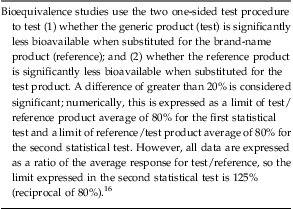
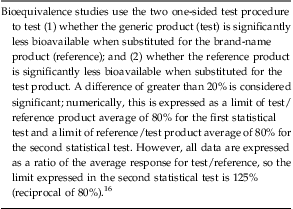
The importance of formulation is also apparent in the comparison of proprietary and generic medications. According to the Food and Drug Administration (FDA), a generic drug is the same as a brand-name drug in “dosage form, safety, strength, route of administration, quality, performance characteristics, and intended use.”15 To be approved, a generic formulation must meet the FDA definition of therapeutic equivalence to the proprietary drug, which is broken into two major parts: pharmaceutical equivalence and bioequivalence.16 The FDA criteria for pharmaceutical equivalence are that the generic and proprietary drugs must contain the same active ingredient and be the same dosage form, route of administration, and strength or concentration.16 The FDA criteria for bioequivalence are that the generic and proprietary drug must have comparable bioavailability (the rate and extent to which the active ingredient is absorbed and becomes available at the site of action). Bioequivalence is typically determined with two single-dose pharmacokinetic (PK) studies--one under fasting and one under fed conditions-- that are conducted using a small number of healthy volunteers.Reference Chen, Shah and Ganes3 Statistical comparison is performed for area under the curve (AUC) to the last measurable concentration, AUC to time infinity, and concentration peak (Cmax).16 Bioavailability is considered comparable if the 90% confidence intervals (CI) of the log-transformed ratios of the generic to proprietary compound for AUC and Cmax fall within 80% to 125% (Table 1).16
Why 80% to 125%?
Generic formulations can differ from the proprietary drug in shape, scoring configuration, release mechanisms, packaging, excipients, expiration time, and, within certain limits, labeling.16
In contrast to a generic formulation, a pharmaceutical alternative is a formulation that contains the same therapeutic moiety as a proprietary drug, but that is a different salt, ester, or complex of that moiety (e.g., bupropion hydrochloride vs. bupropion hydrobromide) and/or is a different dosage form or strength (e.g., tablet vs. capsule).16
Evaluating the Criteria for Therapeutic Equivalence
The current criteria for approval of generic formulations were established to allow for faster entry of these less expensive options into the market. Thus, as long as bioequivalence can be demonstrated, it is possible to rely on the efficacy and safety data for the proprietary drug and forego expensive and long-term clinical studies. Indeed, for most medications, therapeutic equivalence can be assumed based on established bioequivalence, and generic medications can be reasonably expected to substitute without loss of efficacy or adverse effects.
For some medications, however, the allowed difference in the extent and rate of absorption may combine with other differentiating factors to cause therapeutic variations.Reference Sankar and Glauser17 This has been seen for anticonvulsant medications, with generic substitution associated with increased seizure activity and side effects.Reference Sankar and Glauser17–Reference Gilman19 Medications for which the allowed differences could potentially be clinical significant include narrow therapeutic index drugs (e.g., anticonvulsants), agents with nonlinear pharmacokinetics, agents with low water solubility, and medications that are formulated using complex modified-release technology.Reference Chen, Shah and Ganes3, Reference Sankar and Glauser17
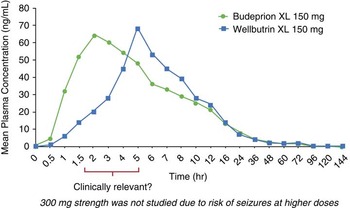
With respect to modified-release formulations, the current criteria may be sufficient in some cases, but warrant reevaluation for drugs with rapid onset/offset of therapeutic/side effects, dose/plasma level-dependent side effects, or narrow therapeutic index.Reference Chen, Shah and Ganes3 Dose dumping, or premature release of medication, is also a particular consideration for modified-release formulations, depending on the controlled-release technology used. For example, a small study compared proprietary and pharmaceutical alternative formulations of venlafaxine XR that used different release technologies. They found that, at initiation of treatment, the pharmaceutical alternative exhibited faster release and higher plasma levels than the proprietary formulation, with associated increase in side effects.Reference Chenu20 Similarly, numerous postmarketing reports have cited loss of antidepressant effect and/or emergence of side effects when patients were switched from a proprietary formulation of bupropion XL (using a reservoir system) to an approved generic formulation (using a matrix system).21 Evaluation of the bioequivalence data revealed small PK differences that were within the equivalence boundaries and an earlier Tmax that was similar to that of bupropion SR (Figure 3).
Wellbutrin XL vs. Budeprion SL.21

In consideration of situations such as this, potential limitations of the current criteria have been cited, including the facts that bioequivalence studies (1) are conducted in healthy volunteers; (2) measure parent drug and active metabolites, but not the ratio; (3) compare single-dose administration rather than therapeutic doses over time; (4) depend on a single in vitro test to predict in vivo dissolution; (5) do not include a statistical requirement for time to maximum concentration (Tmax) or shape of plasma concentration-time curve; and (6) only require comparison of the generic to the proprietary drug (i.e., generic drugs are not tested against each other).Reference Chen, Shah and Ganes3, Reference Desmarais, Beauclair and Marolese22
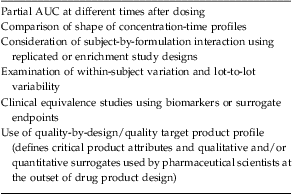
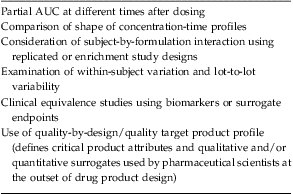
To strengthen the bioequivalence criteria for more complex formulations, additional measures have been suggested (Table 2).Reference Chen, Shah and Ganes3 Chief among them is the inclusion of partial AUC at different times after dosing as well as comparison of the shape of the concentration-time curve.Reference Chen, Shah and Ganes3, Reference Endrenyi and Tothfalusi23 In fact, the FDA is currently considering the additional requirement of partial AUC for modified-release formulations of some psychotropic drugs, including extended-release zolpidem and modified-release methylphenidate.Reference Endrenyi and Tothfalusi23 If partial AUC is added as a criterion for certain formulations, it will be necessary to set the time interval individually, based on the therapeutic relevance of the drug concentration-time pattern for each agent.Reference Endrenyi and Tothfalusi23
Suggested additional measures for FDA criteria for bioequivalenceReference Chen, Shah and Ganes3, Reference Raw, Lionberger and Yu24
Conclusion
As drug delivery technology progresses, it is increasingly possible to use formulation to optimize the therapeutic profile of a particular medication. To that end, formulation should be an integral component of drug design and development. From a clinical perspective, this has the potential to enhance efficacy and tolerability, minimize safety concerns, and improve adherence.
Acknowledgment of Financial Support
The activity is supported by an educational grant from Valeant Pharmaceuticals International, Inc.
Disclosures
Meaghan Grady's disclosure information: Meghan Grady does not have anything to disclose.
Stephen Stahl's disclosure information: Stephen M. Stahl, MD, PhD is an Adjunct Professor of Psychiatry at the University of California, San Diego School of Medicine and an Honorary Visiting Senior Fellow at the University of Cambridge, UK. Over the past 12 months (December 2010 – December 2011), Dr. Stahl has served as a Consultant for Acadia, Astra Zeneca, Avanir, Biomarin, BristolMyers Squibb, Cenerex, Dey, Eli Lilly, Forest, GenoMind, GlaxoSmith Kline, J & J, Jazz, Lundbeck, Merck, Neuronetics, Novartis, Noven, ONO, Orxigen, Otsuka, PamLabs, Pfizer, PgXHealth, RCT Logic, Rexahn, Roche, Servier, Shire, Solvay, Sunovion, Trius and Valeant. He has served on speakers bureaus for Arbor Scientia, Astra Zeneca, Eli Lilly, Forest, J & J, Merck, Neuroscience Education Institute, Pfizer, Servier and Sunovion, and he has received research and/or grant support from Astra Zeneca, Cenerex, Eli Lilly, Forest, GenOmind, Merck, Neuronetics, PamLabs, Pfizer, Roche, Schering Plough, Sepracor, Servier, Shire, Sunovion, Torrent and Trovis.
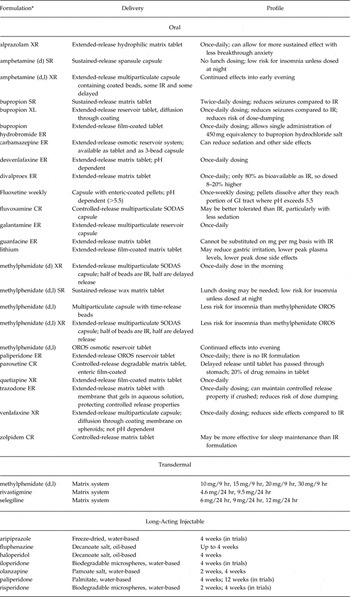
Psychotropic medications using modified-release technologies

*Generic formulations may use different delivery technologies.
SODAS: spheroidal oral drug absorption system. OROS: osmotic controlled-release oral delivery system.