Introduction
The worldwide scientific community, as well as commercial fishermen, are well aware of considerable biomass fluctuations of small pelagic fish species, these having been observed over quite a long period of time. Throughout this time, scientists have attempted to reveal the triggers for these oscillations, but have actually discovered the wide complexity of the observed issue. All discovered biotic or abiotic factors that might or might not act in synergy during the fishes' lifetimes lead to this inter- and intra-annual small pelagic biomass variability (Agostini & Bakun, Reference Agostini and Bakun2002; Santojanni et al., Reference Santojanni, Arneri, Bernardini, Cingolani, Di Marco and Russo2006; Zorica et al., Reference Zorica, Vilibić, Čikeš Keč and Šepić2013, Reference Zorica, Čikeš Keč, Brzulja and Kraljević2014; Bonanno et al., Reference Bonanno, Giannoulaki, Barra, Basilone, Machias, Genovese, Goncharov, Popov, Rumolo, Di Bitetto, Aronica, Patti, Fontana, Giacalone, Ferreri, Buscaino, Somarakis, Pyrounaki, Tsoukali and Mazzola2014; Grbec et al., Reference Grbec, Morović, Matić, Ninčević Gladan, Marasović, Vidjak, Bojanić, Čikeš Keč, Zorica, Kušpilić and Matić-Skoko2015). Hence, a better understanding of each part of the pelagic ecosystem, including the distribution of early life stages, should take us closer to resolving this puzzle.
Anchovy Engraulis encrasicolus (L.), as a small pelagic fish species, is generally well-known as an extremely important component of the marine ecosystem either viewed from an ecological or an economic perspective. This coastal euryhaline pelagic fish species is a batch spawner that has a protracted spawning season. In the Adriatic, its spawning takes place near the coast within quite wide ranges of temperature (11.6–27.6°C) and salinity (9.1–39.6) (Regner, Reference Regner1996). Spawning of anchovy in this study area lasts from early spring to late summer, peaking from April to July (Zorica et al., Reference Zorica, Vilibić, Čikeš Keč and Šepić2013). Its eggs are pelagic and frequently found in the plankton from April to September, with a peak in June–July, and sometimes from March to December (Vučetić, Reference Vučetić1964; Varagnolo, Reference Varagnolo1965; Zavodnik, Reference Zavodnik1970; Piccinetti et al., Reference Piccinetti, Regner and Specchi1980; Regner, Reference Regner1985; Palomera, Reference Palomera1992; Regner, Reference Regner1996; Zorica et al., Reference Zorica, Čikeš Keč, Brzulja and Kraljević2014; Mandić et al., Reference Mandić, Regner, Đurović, Joksimović, Pešić and Krpo-Ćetković2015). Consequently, its early life stages can be found in that period, more or less distributed along the Adriatic continental shelf. By the time spawning is completed and sea temperatures decrease, adults start to migrate towards open seawaters, forming large shoals (Vučetić, Reference Vučetić1964; Piccinetti, Reference Piccinetti1970; Regner, Reference Regner1972; Gamulin & Hure, Reference Gamulin and Hure1983; Sinovčić, Reference Sinovčić2000). In contrast, juveniles mainly remain closer to the coast until winter or until the time they reach first sexual maturity (Betulla Morello & Arneri, Reference Betulla Morello and Arneri2009). In the eastern part of the Adriatic, anchovy is mainly caught with purse seiners that use light to attract and aggregate the fish near the surface (Cingolani et al., Reference Cingolani, Giannetti and Arneri1996; Kraljević et al., Reference Kraljević, Čikeš Keč and Zorica2014). Although the eastern Adriatic coast fisheries generally show a higher preference for sardine (Kraljević et al., Reference Kraljević, Čikeš Keč and Zorica2014), in the last 10 years, probably due to changes in the market, fishermen tend to fish anchovy as well. So, in the last 10 years its official catches show a slightly increasing trend (STECF, 2013).
Although some investigations concerning the distribution pattern of anchovy early life stages in the Adriatic Sea have been presented by Betulla Morello & Arneri (Reference Betulla Morello and Arneri2009), many parameters need to be determined to complement the information that in future could be used as a diagnostic tool for fishery sustainability. Hence, the purpose of this study is to describe the spatial distribution and abundance of anchovy early life stages referring to observed oceanographic features.
Materials and methods
Study area
The Adriatic Sea is the northernmost semi-enclosed basin in the Mediterranean with a cyclonic circulation caused by the estuarine conditions mainly driven by the northern Adriatic rivers (Cushman-Roisin et al., Reference Cushman-Roisin, Gačić, Poulainć and Artegiani2001). The West Adriatic Current outflows along its western side, while on its eastern side the East Adriatic Current (Orlić et al., Reference Orlić, Dadić, Grbec, Leder, Marki, Matić, Mihanović, Beg Paklar, Pasarić, Pasarić and Vilibić2007) brings Levantine Intermediate Water (Robinson et al., Reference Robinson, Malanotte-Rizzoli, Hecht, Michelato, Roether, Theocharis, Ünlüata, Pinardi, Artegiani, Bergamasco, Bishop, Brenner, Christianidis, Gačić, Georgopoulos, Golnaraghi, Hausmann, Junghaus, Lascaratos, Latif, Leslie, Lozano, Oguz, Öszoy, Papageorgiou, Paschini, Rozentroub, Sansone, Scarazzato, Schlitzer, Spezie, Tziperman, Zodiatis, Athanassiadou, Gerges and Osman1992; Malanotte-Rizzoli et al., Reference Malanotte-Rizzoli, Manca, D'Alcala, Theocharis, Bergamasco, Bregant, Budillon, Civitarese, Georgopoulos, Michelato, Sansone, Scarazzato and Souvermezoglou1997) from the Ionian and Levantine Seas. Occasionally, Levantine Intermediate Water can flood the Adriatic in the so-called ingression years (Buljan, Reference Buljan1953) when increases in salinity, temperature and nutrients in intermediate layers are detected (Buljan & Zore-Armanda, Reference Buljan and Zore-Armanda1974; Tziperman & Malanotte-Rizzoli, Reference Tziperman and Malanotte-Rizzoli1991; Vilibić & Orlić, Reference Vilibić and Orlić2001, Reference Vilibić and Orlić2002). The water column is homogenized in the Adriatic during winter, due to substantial wind-mixing and winter surface cooling, while in summer when wind mixing is very mild, the Adriatic waters become highly stratified (Buljan & Zore-Armanda, Reference Buljan and Zore-Armanda1974).
Ichthyoplankton sampling
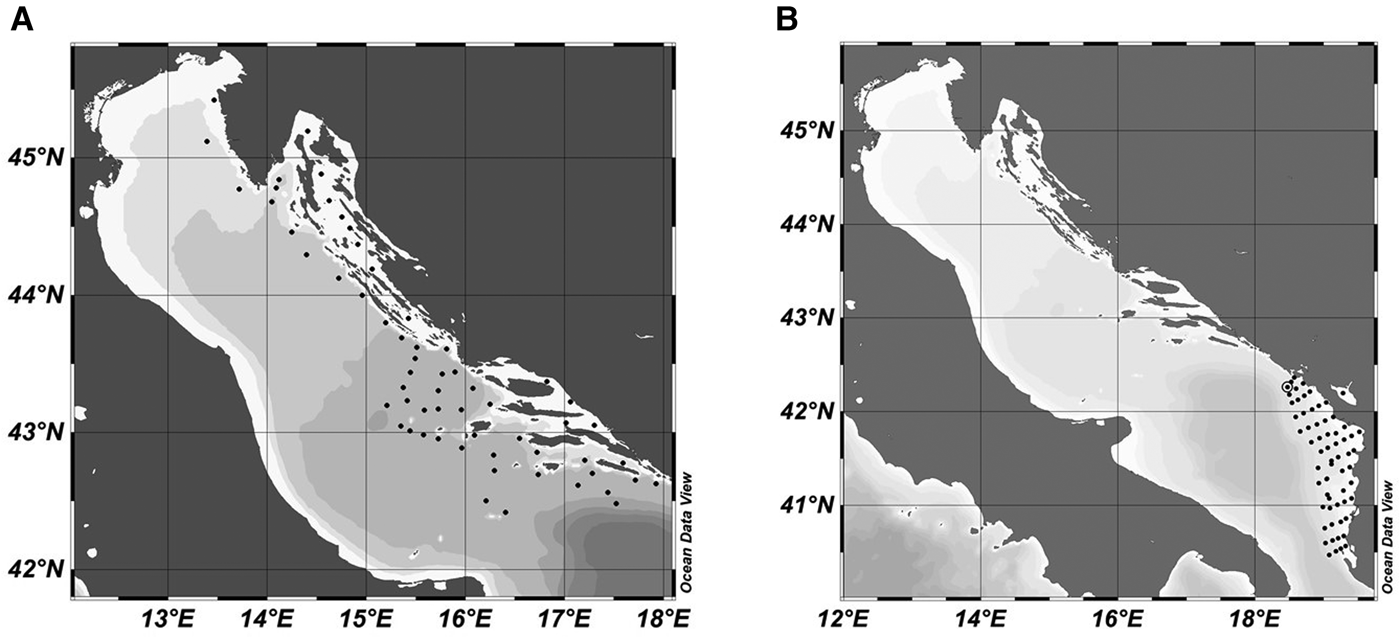
During the summer of 2013, in July, two scientific surveys were carried out along the entire eastern Adriatic Sea. A northern survey, which covered the Croatian part of the eastern Adriatic, was carried out within the scientific expedition ‘Mediterranean International Bottom Trawl-Surveys (MEDITS)’ from 3–18 July (Figure 1A). Throughout this survey, 60 ichthyoplankton samples were collected on board the RV ‘Bios Dva’. The southern survey covered the Montenegrin and Albanian part of the Adriatic Sea (Figure 1B) and was carried out by Italian RV ‘Dallaporta’ from 24 to 29 July. Northern ichthyoplankton samples were taken at the MEDITS stations determined by MEDITS protocol (N = 60). Southern ichthyoplankton samples were collected from a dense station grid (N = 64), which followed the MEDiterranean International Acoustic Survey (MEDIAS) protocol, as this survey was done as a collaboration of Montenegro and Albania with Italy throughout the MEDIAS project. On the northern survey, sea surface temperature (mean value obtained for the first 10 m depth) was measured at each station using a temperature probe (Star-Oddi data logging probe; http://www.star-oddi.com) attached to a WP2 sampler (custom made by artisan manufacturer Zoran Jurić, Dubrovnik), while sea surface temperature (a mean value obtained for the first 10 m depth) and salinity on the southern survey were obtained for every second station with a CTD probe (SeaBird Electronics Model 9, Bellevue, WA, USA) along each transect, and temperature and salinity of missing stations were determined as the means of two neighbouring ones.
Map of the Adriatic Sea showing the sampling stations of the survey MEDITIS (July 2013) in the north (A) and survey MEDIAS (July 2013) in the south (B).

Ichthyoplankton samples were obtained with the same net and identical methodology was applied, with only one exception – samples collected in the Croatian part were taken only during daylight hours, while those in the southern part were collected over a 24 h period. Standard vertical plankton tows were made using a WP2 sampler (mouth opening, 0.255 m2; mesh size, 0.200 mm). The WP2 net was put vertically down during a calm sea to a depth of 100 m or to 5 m above the seabed in marine areas with less than 100 m depth. Plankton samples were put in a marked plastic container, preserved in 4% buffered formalin and transported to the laboratory.
Biological analysis
In the laboratory, anchovy eggs and larvae were isolated from the ichthyoplankton samples and their abundance was standardized to numbers per square metre using the function given by Tanaka (Reference Tanaka1973). Obtained egg and larvae abundance values for positive stations were log-transformed and their mean values were calculated as the geometric mean with its 95% confidence limit (CL).
Estimation of anchovy egg development time (D o) was calculated using the function given by Regner (Reference Regner1985):
 $$D_o = {\rm} 1/1.012896\,(1 + {\rm e}^{(4.914322 - (0.257451T))})$$
where T refers to a sea surface temperature (°C).
The standard length of anchovy larvae was recorded with a precision of ±0.1 µm under the stereomicroscope (Nikon SMZ 800) equipped with a Motic camera. All the recorded larval lengths were corrected due to formalin fixation shrinkage with a correction factor of 1.03 (Somarakis & Nikolioudakis, Reference Somarakis and Nikolioudakis2007). According to Regner's findings (1985) and morphological features of each larval specimen, the recorded standard lengths were sorted into length classes given by that author as follows: L1 (L t < 2.38 mm), L2 (2.39 < L t < 3.03 mm), L3 (3.04 < L t < 3.68 mm), P1 (3.34 < L t < 3.99 mm), P2 (4.00 < L t < 5.99 mm), P3 (6.00 < L t < 7.99 mm), P4 (8.00 < L t < 9.99 mm) and P5 (10.00 < L t < 11.99 mm), and spatial distribution of obtained length classes was carried out. In order to define the age of anchovy larvae (up to the yolk sac resorption) the von Bertalanffy equation was applied, with constants previously published by Regner (Reference Regner1985) for anchovy inhabiting the Adriatic:
 $$L_{\rm t} = 3.69\ndash 1.96{\rm e}^{{\rm - ct}}$$
where L t is larval standard length (mm) in time t, t is time/age defined in days and c is a growth constant. Taking into account that larval growth up to yolk sac resorption is mostly driven by sea temperature, this growth constant was calculated by the equation:
 $$ - c = 5.4314\ndash 0.3984{\rm T} \,{\rm (Regner, 1985)}$$
where T refers to a sea surface temperature (°C).
Age of the collected postlarvae was determined by the Gompertz equation given for the Adriatic anchovy by Regner (Reference Regner1985):
 $$L_{\rm t} = 27.31{\rm e}^{ - 2.0517{\rm e}\ndash 0.08925{\rm t}}$$
where L t is postlarvae standard length (mm) in time t, t is time/age defined in days.
Furthermore, for all the collected anchovy larvae and postlarvae, time of mouth opening and eye pigmentation (D) as well as time of yolk sac resorption (D 1) were calculated by a power equation in respect of sea temperature (T in °C) measured at each station of the survey given by Regner (Reference Regner1985; D = 412,428.585T−4.1562; D 1 = 270,065.2774T−3.8079).
Data analysis
Diagrams of anchovy eggs and larvae spatial distribution were made using the Ocean Data View 4.Ink program (Schlitzer, http://odv.awi.de, 2014). In order to test whether there was a statistically significant difference between ichthyoplankton samples taken during the day and night, a Kruskal–Wallis test was applied. Biological (eggs and larvae abundances) and environmental (temperature and salinity) data sets were tested for normality and correlations among them were explored (Pearson's or Spearman's Rank-order). All statistical analyses were done within the software package PAST (Version 3.20).
Results
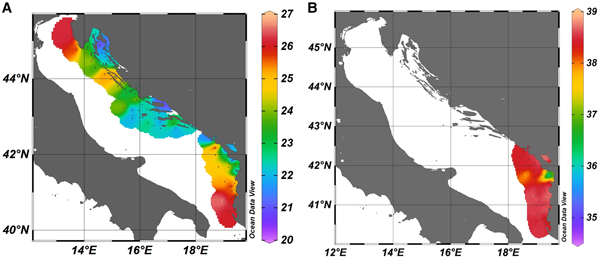
Throughout the two summer surveys in July 2013 along the eastern Adriatic, the measured sea surface temperature ranged from 20.2 to 27.2°C (Figure 2A; northern survey 20.8–26.2°C, southern survey 20.2–27.2°C), while the values of surface salinity were taken only on the southern survey and here values ranged from 34.8 to 38.8 (Figure 2B).
Interpolation display of sea surface temperature (A) and salinity (B) measured along the eastern Adriatic Sea, July 2013.

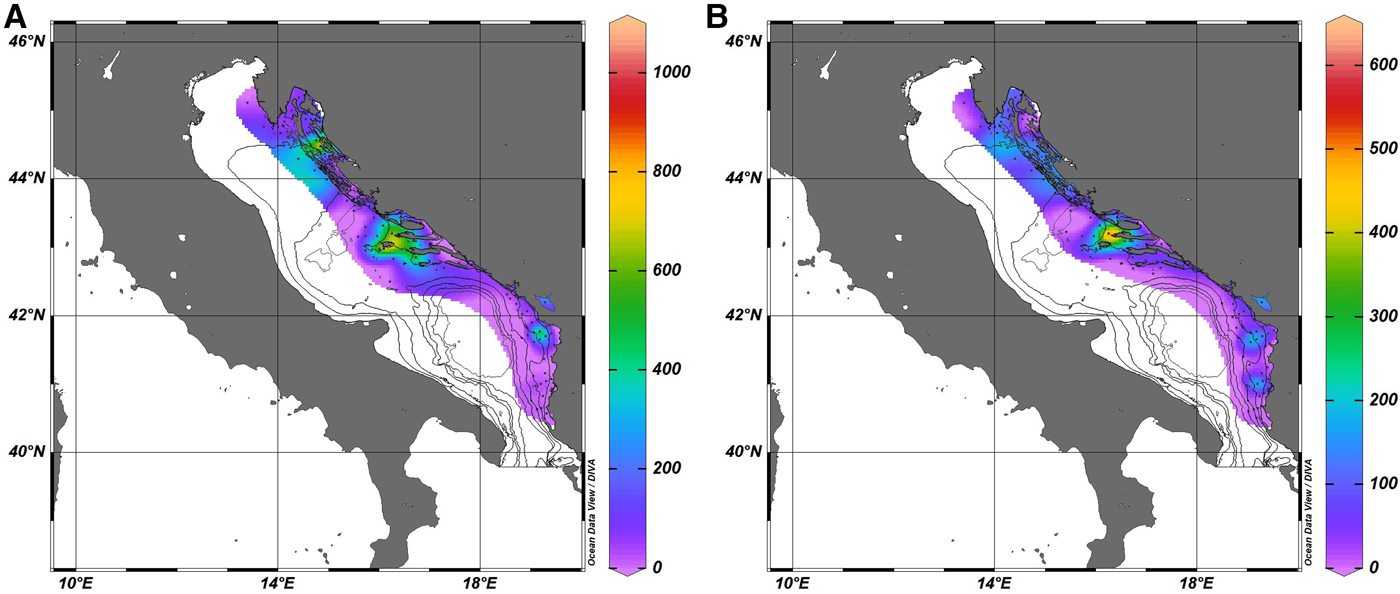
Out of 124 collected ichthyoplankton samples, presence of anchovy eggs was noted in 73 stations (north – 41 stations; south – 32 stations). During these two surveys 2184 anchovy eggs (north – 1489 anchovy eggs; south – 695 anchovy eggs) were collected. Egg abundance across the whole investigated area varied from 2.61 to 1040.24 eggs m−2, while its geometric mean and confidence limit values were 25.43 ± 1.48 eggs m−2. Comparing the two areas of investigation, higher geometric mean anchovy egg abundance was noted in the northern (mean: 45.86; CL: 1.49 eggs m−2) than in the southern (mean: 13.37; CL: 1.57 eggs m−2) area of the eastern Adriatic (Figure 3A). Average time of anchovy egg incubation from fertilization to hatching on the eastern side of the Adriatic was D o = 1.29 days (CL: 0.02 days), while average time of anchovy egg incubation in the northern part (D o = 1.35 days; CL: 0.03 days) was slightly higher than in the southern part (D o = 1.23 days; CL: 0.03 days) of the investigated area.
Interpolation display of abundance of (A) anchovy eggs (eggs m−2) and (B) larvae (larvae m−2) along the areas of sampling carried out during July 2013 in the Adriatic Sea.

Overall, 1568 anchovy larvae were sorted from the collected ichthyoplankton samples. Out of 124 stations, 75 were positive for anchovy larvae – 36 northern and 39 southern stations along the eastern Adriatic Sea. The proportion of anchovy larvae was significantly higher (χ2 = 162, df = 1, P < 0.05) in the northern (66%; N = 1036) than in the southern sites (34%; N = 532) of the eastern Adriatic. The geometric mean abundance of anchovy larvae for positive stations was 17.07 larvae m−2 (CL: 1.3 larvae m−2) and the abundance ranged between 2.73 larvae m−2 and 611.14 larvae m−2. Considering each survey separately, the geometric mean values of abundance and its range were higher in the northern (mean: 26.78; CL: 1.41 larvae m−2; abundance range: 2.73–611.14 larvae m−2) than in the southern (mean: 11.90; CL: 1.42 larvae m−2; abundance range: 3.13–292.74 larvae m−2) survey (Figure 3B).
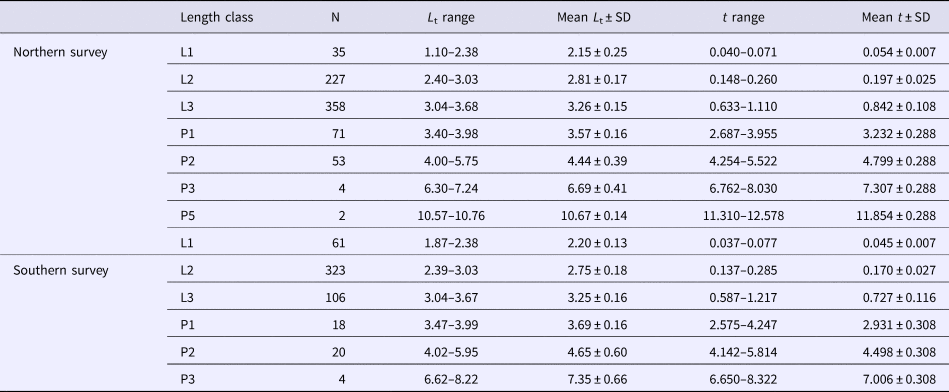
All the measured anchovy larvae (N = 1282; 286 anchovy larvae were set aside due to observed damage) varied in standard length from 1.64–10.76 mm with a mean of 3.13 ± 0.703 mm. The length of anchovy larvae collected on the northern survey varied between 1.64 and 10.76 mm (mean ± SD: 3.21 ± 0.688 mm), whereas anchovy larvae collected on the southern survey varied between 1.87 and 8.23 mm (mean ± SD: 3.02 ± 0.711 mm) (Table 1). Comparison of anchovy length classes revealed that the same length classes (L2, L3) were the most abundant in the northern – L2 (30.3%), L3 (47.7%) as well as in the southern L2 (60.7%), L3 (19.9%) Adriatic. Spatial distribution by length classes revealed that anchovy larvae collected in the first half of July in the northern part of the Adriatic were longer than the ones sampled in the southern part by the end of July (Table 1).
Length class and age distribution of anchovy larvae specimens collected in July 2013 on northern and southern eastern Adriatic Sea

L t, total body length (mm); SD, standard deviation; t, age (day).
Age estimation of the observed anchovy larvae highlighted that the majority of collected larvae were less than one day old (94.4%), with 81.6% less than 12 h old in the whole investigated area as well as separately survey by survey (Table 1). Slightly, but not statistically significant (Kolmogorov–Smirnov test, P > 0.1), older larval and post-larval specimens were collected during the first half of July in the northern part of the eastern Adriatic.
The average time of mouth opening and eye pigmentation, as well as the time of complete yolk sac resorption with its 95% confidential limits, were 0.79 ± 0.004 days or 1.55 ± 0.014 days, respectively.
Since no statistically significant difference was observed between sampling done during the day and during the night (Kruskal–Wallis test, H = 0.28, P = 0.3069), data from two surveys were combined. Spearman's rank-order correlation disclosed a statistically significant negative relationship between anchovy egg abundance and temperature (r = −0.380, P < 0.05) as well as anchovy egg abundance and depth (r = −0.321, P < 0.05). More than 75% of anchovy eggs were collected at stations with a depth range between 71–120 m, while the lowest values of egg abundance were recorded for shallower (10–30 m) and deeper stations (>150 m). A positive correlation between egg and larvae abundance (r = 0.453, P < 0.05) was established.
Discussion
Over the last few decades, abundance of the anchovy population in the Adriatic and worldwide has been highly variable (Lluch-Belda et al., Reference Lluch-Belda, Crawford, Kawasaki, MacCall, Parrish, Schwartzlose and Smith1989; Chavez et al., Reference Chavez, Ryan, Lluch-Cota and Ñiquen2003; Vilibić et al., Reference Vilibić, Čikeš Keč, Zorica, Šepić, Matijević and Džoić2016). Those variations might be linked not only to the growing anchovy fisheries industry (Cingolani et al., Reference Cingolani, Giannetti and Arneri1996; Mustać, Reference Mustać2014), but also to the fact that its reproduction traits and recruitment success are environmentally driven (Agostini & Bakun, Reference Agostini and Bakun2002; Santojanni et al., Reference Santojanni, Arneri, Bernardini, Cingolani, Di Marco and Russo2006; Zorica et al., Reference Zorica, Vilibić, Čikeš Keč and Šepić2013). In the last decade, the state of the anchovy fish population inhabiting the Adriatic is considered to be overexploited, with low values of biomass in comparison to those observed in the past in the late 1970s (FAO General Fisheries Commission for the Mediterranean, 2014). Hence, scientists were strongly recommended to continue exploring this species and its interaction with the environment, which has exhibited obvious climate shifts in the last two decades (Grbec et al., Reference Grbec, Morović, Matić, Ninčević Gladan, Marasović, Vidjak, Bojanić, Čikeš Keč, Zorica, Kušpilić and Matić-Skoko2015).
During July 2013 ichthyoplankton samples of anchovy eggs and larvae were collected along almost the whole continental shelf of the eastern Adriatic Sea. Abundance of the collected anchovy early life stages were within the range previously given for the same area and month (Gamulin & Hure, Reference Gamulin and Hure1983; Regner, Reference Regner1985; Mandić et al., Reference Mandić, Regner, Đurović, Joksimović, Pešić and Krpo-Ćetković2015). Slightly higher abundance of anchovy eggs/larvae in the northern part of the Adriatic were achieved, as has previously been observed (Gamulin & Hure, Reference Gamulin and Hure1983). Spatial distribution of the anchovy early life stages indicated that anchovy eggs and larvae appeared in almost the same areas as these studies (Figure 3). In the southernmost part of the investigated area, anchovy larvae were not accompanied by their eggs, but this was in line with previous studies in which the absence of anchovy eggs in the southern Adriatic trench was documented (Gamulin & Hure, Reference Gamulin and Hure1983; Regner, Reference Regner1985; Casavola et al., Reference Casavola, Marano, De Martino and Saracino1987; Mandić et al., Reference Mandić, Regner, Đurović, Joksimović, Pešić and Krpo-Ćetković2015). Supporting the idea that anchovy eggs and larvae congregate here, a statistically significant correlation was established between their abundances (P = 0.000004) within this study and the previous ones of Regner (Reference Regner1985), Agostini & Bakun (Reference Agostini and Bakun2002) and Malavolti et al. (Reference Malavolti, De Felice, Costantini, Biagotti, Canduci, Grilli, Marini, Tirelli, Borme, Caputo Barucchi and Leonori2018). Considering the spatial distribution, few areas with higher abundance could be distinguished (Figure 3). Highlighted areas in the northern part of the Adriatic are in accordance with the findings obtained by Regner (Reference Regner1985). Furthermore, all emphasized areas with greater eggs/larval abundance noted within this study are known as areas of upwelling, according to Bergamasco & Gačić (Reference Bergamasco and Gačić1996), Gačić et al. (Reference Gačić, Marullo, Santoleri and Bergamasco1997) and Mauri & Paulain (Reference Mauri and Poulain2001) who observed that from July until September large patches of relatively cold water occurred along the eastern shore in the central Adriatic area and on the Albanian shelf. These patches were most probably related to the winds that reverse the transversal temperature gradient and makes the eastern shelf waters colder than the western ones, i.e. areas of induced coastal upwelling. Therefore, the presence of anchovy early life stages in those areas is expected due to enrichment, food aggregations and physical processes (Richardson et al., Reference Richardson, Mitchell-Innes, Fowler, Bloomer, Verheye, Field, Hutchings, Painting, Pillar, Moloney, Payne and Shillington1998; Agostini & Bakun, Reference Agostini and Bakun2002; Lafuente et al., Reference Lafuente, García, Mazzola, Quintanilla, Delgado, Cuttitta and Patti2002) that in general increase survival of any larvae.
The majority of the collected anchovy larvae (N = 1282) belonged to two length classes (L2, L3) that were less than 12 h old. Portions of those two length classes and all others were not equally represented in the northern and southern study area (Table 1). Namely, somewhat larger and therefore older specimens, although not statistically significant, were collected in the northern part of the Adriatic. Taking into account the timing of those two surveys (northern at the beginning and southern at the end of July) along with the fact that the northern Adriatic is shallower and more productive than its oligotrophic southern part due to the nutrient-enriched River Po discharge, which has an influence all the way up to the open sea of the middle eastern Adriatic (Marasović et al., Reference Marasović, Pucher-Petkovic and Alegria-Hernandez1988; Revelante & Glimartin, Reference Revelante and Glimartin1992; Kršinić, Reference Kršinić2010), leads to the assumption that a shift of anchovy in its spawning centres during its protracted spawning season has occurred. Namely, it seems that anchovy first started to spawn in the northern part of the eastern Adriatic as favourable conditions were reached there earlier. This kind of shift, apparently due to location of optimal trophic conditions for spawning and egg, larval and post-larval survival, was previously reported not only for the Adriatic (Varagnolo, Reference Varagnolo1965; Regner, Reference Regner1974; Vučetić, Reference Vučetić1975; Gamulin & Hure, Reference Gamulin and Hure1983; Coombs et al., Reference Coombs, Giovanardi, Conway, Manzueto, Halliday and Barrett1997), but also in the Mediterranean (Palomera, Reference Palomera1992; Lloret et al., Reference Lloret, Palomera, Salat and Sole2004; Basilone et al., Reference Basilone, Bonanno, Patti, Mazzola, Barra, Cuttitta and McBride2013).
The average time of anchovy egg incubation (D o = 1.29; CL: 0.02 days), time of mouth opening and eye pigmentation (D = 0.79; CL: 0.004 days) as well as the time of complete yolk sac resorption (D 1 = 1.55; CL: 0.014 days) coincided with previously published data obtained for the same population inhabiting the eastern Adriatic by Regner (1985; experimentally obtained for the range of temperatures 17.14–24.10°C) and Mandić et al. (Reference Mandić, Regner, Đurović, Joksimović, Pešić and Krpo-Ćetković2015; D o = 1.36). Slightly higher values than the observed ones were given for the anchovy early life stages collected in the area of Boka Kotorska Bay (south-eastern Adriatic) and reported by Mandić (Reference Mandić2011; July 2006 – D = 2.30 and D 1 = 4.15 days; August 2007 – D = 1.54 and D 1 = 2.88 days). Observed aberrations might be linked to different temperature regimes in the investigated areas. In addition, attention has to be drawn to the fact that within this study sea temperature showed statistically significant negative correlation with anchovy egg abundances (P = 0.00099), as was also previously confirmed by Specchi et al. (Reference Specchi, Cassetti and Orlandi1998) and Palomera et al. (Reference Palomera, Olivar, Salat, Sabatés, Coll, García and Morales-Nin2007). Furthermore, a statistically significant negative correlation between anchovy egg abundances and sea depths was established (P = 0.0386) and the sea depth range from 71–120 m seems to be the most suitable for anchovy spawning. This is completely in line with findings of Malavolti et al. (Reference Malavolti, De Felice, Costantini, Biagotti, Canduci, Grilli, Marini, Tirelli, Borme, Caputo Barucchi and Leonori2018) who reported a preferred depth range of 91–120 m for anchovy spawning in the same area. More or less similar depth ranges were reported for the area of the Mediterranean by Saraux et al. (Reference Saraux, Fromentin, Bigot, Bourdeix, Morfin, Roos, Van Beveren and Bez2014; Gulf of Lion, depth range 70–100 m), Zarrad et al. (Reference Zarrad, García, Alemany and Jarboui2012; off the 100 m isobaths near the shelf break) and Giannoulaki et al. (Reference Giannoulaki, Iglesias, Tugores, Bonanno, Patti, De Felice, Leonori, Bigot, Tičina, Pyrounaki, Tsagarakis, Machias, Somarakis, Schismenou, Quinci, Basilone, Cuttitta, Campanella, Miquel, Oñate, Roos and Valavanis2013; depth range 40–150 m). Generally, anchovy specimens proved once again their preference for spawning activity over the area of the continental shelf (Betulla Morello & Arneri, Reference Betulla Morello and Arneri2009 and references therein).
Bearing in mind that the anchovy has a protracted spawning season, which entails high tolerance of sea temperatures and salinity values (Betulla Morello & Arneri, Reference Betulla Morello and Arneri2009; peak of spawning occurs between 18 and 28°C, anchovy eggs were found within salinities from 9.1 to 38.7), definition of its preferred environmental and oceanographic conditions for spawning and nursery grounds is difficult. Reviewing the literature shows that many researchers have tried to link environmental parameters with anchovy spawning and its early life stage survival (Malavolti et al., Reference Malavolti, De Felice, Costantini, Biagotti, Canduci, Grilli, Marini, Tirelli, Borme, Caputo Barucchi and Leonori2018 and references therein), but that common agreement could not be achieved. Namely, some authors define sea temperature, salinity, chlorophyll-a or other physical parameters as crucial (Motos et al., Reference Motos, Uriarte and Valencia1996; Kideys et al., Reference Kideys, Gordina, Bingel and Niermann1999; Basilone et al., Reference Basilone, Guisande, Patti, Mazzola, Cuttitta, Bonanno, Vergara and Maneiro2006, Reference Basilone, Bonanno, Patti, Mazzola, Barra, Cuttitta and McBride2013; Zarrad et al., Reference Zarrad, Missaoui, Alemany, Romdhane, Garcia, M'rabet, Jarboui and El Abed2006, Reference Zarrad, Alemany, Rodriguez, Jarboui, Lopez-Jurado and Balbin2013; Goarant et al., Reference Goarant, Petitgas and Bourriau2007; Palomera et al., Reference Palomera, Olivar, Salat, Sabatés, Coll, García and Morales-Nin2007; Sabatés et al., Reference Sabatés, Olivar, Salat, Palomera and Alemany2007; Somarakis and Nikolioudakis, Reference Somarakis and Nikolioudakis2007; Huret et al., Reference Huret, Bourriau, Gatti, Dumas and Petitgas2016), but in the end it seems that only a combination of many abiotic and biotic factors might bring us closer to understanding this flexible small pelagic fish species.
Nevertheless, the presented results concerning spatial and temporal distribution of anchovy early life stages contribute to a better understanding of its biology. Since anchovy seems able to adapt to changes in its ecosystem, as Basilone et al. (Reference Basilone, Bonanno, Patti, Mazzola, Barra, Cuttitta and McBride2013) stated, further research needs to establish how to explain these complex relationships among anchovy early life stages and different environmental parameters in order to get closer to an ecosystem-based approach in fisheries biology.
Acknowledgements
The authors gratefully acknowledge the captain and crew of RV ‘Dallaporta’ and the researchers and technical personnel, from CNR of Ancona (Italy), involved in the scientific survey in Montenegrin and Albanian waters. Referees’ comments and suggestions are greatly appreciated.
Financial support
This study was supported by the Ministry of Agriculture of the Republic of Croatia, as a part of the research study ‘Pelagic fish studies in the Republic of Croatia’ and FAO Regional project AdriaMed ‘Scientific Cooperation to Support Responsible Fisheries in the Adriatic Sea’.