Introduction
The burden of Alzheimer's disease (AD) and other dementias is enormous, affecting the individual, their families, and friends on personal, emotional, financial, and social levels. The cost of illness for dementia worldwide was estimated to be US$604 billion in 2010 (Alzheimer's Disease International (ADI), 2010). Given the aging profile of western populations, and the resulting projected increases in prevalence levels (Ferri et al., Reference Ferri2005), concerns are growing over the future caring needs of affected individuals and the coping ability of resource-constrained formal and informal care systems (Comas-Herrera et al., Reference Comas-Herrera, Northey, Wittenberg, Knapp, Bhattacharyya and Burns2011). Such concerns have led to a growing field of research on the costs and cost-effectiveness of care for AD and other dementias in order to inform planning for service provision to meet care needs in the future.
Within this literature, disease severity, typically described by factors that are linked to disease burden and care need, has been shown to be an important driver of resource use and costs (Gustavsson et al., Reference Gustavsson2010). That is, as the disease progresses, the patient's functional capacity to undertake cognitively demanding and even basic physical activities of daily living (ADLs) worsens and they become increasingly dependent on others to complete such tasks (Zhu et al., Reference Zhu2008a). A number of studies have explored the relationship between disease severity and costs, expressing severity in terms of function, dependence on others, or both. The majority of this literature has examined the effect of functional capacity on costs and has consistently reported a positive relationship between increasing functional deficits and higher costs (Taylor et al., Reference Taylor, Schenkman, Zhou and Sloan2001; Jonsson et al., Reference Jonsson2006; Small et al., Reference Small, McDonnell, Brooks and Papadopoulos2002; Zhu et al., Reference Zhu2006a; Reference Zhu2006b; Gustavsson et al., Reference Gustavsson2010; Reference Gustavsson2011; Rapp et al., Reference Rapp2012; Gervès et al., Reference Gervès, Chauvin and Bellanger2014). While the effect of dependence is less well known, the literature also suggests a positive relationship between increasing dependence and higher costs (Murman et al., Reference Murman, Von Eye, Sherwood, Liang and Colenda2007; Zhu et al., Reference Zhu2008a; Reference Zhu2008b; Gustavsson et al., Reference Gustavsson2010; Reference Gustavsson2011). Moreover, Zhu et al. (Reference Zhu2008a; Reference Zhu2008b) and Gillespie et al. (Reference Gillespie2013) found that dependence on others, measured using the Dependence Scale (DS) (Stern et al., Reference Stern1994), was an independent predictor of cost over and above the effects of function. The latter studies highlight the importance of exploring the effect of dependence and functional disability in dementia separately, even if the relationship between the two measures is strong.
The aim of this paper is to estimate and explore resource use and costs of care based on longitudinal data from the Enhancing Care in Alzheimer's Disease (ECAD) study in Ireland. In doing so, this study builds upon previous cross-sectional analysis, which found that levels of dependence on others and functional capacity were independently and significantly associated with costs of care for AD and amnestic mild cognitive impairment (MCI) in Ireland (Gillespie et al., Reference Gillespie2013). Notably, a limitation of the previous analysis was its cross-sectional nature, which restricted more definitive conclusions to be drawn. Moreover, recent evidence highlights the importance of analyzing costs over time, suggesting that the timeliness of intervention is likely to have an important impact on the cost and cost-effectiveness of treatments for AD and other dementias (Barnett et al., Reference Barnett, Lewis, Blackwell and Taylor2014). To address these and other issues, this paper uses longitudinal data on the ECAD cohort to estimate costs of formal and informal care for a sample of community dwelling individuals with AD and MCI at two time points: baseline and follow-up, two years later.
Methods
Data collection
Data collected as part of the ECAD study, which has been described in detail elsewhere (Gallagher et al., Reference Gallagher2010), were used in the analysis. In brief, community dwelling participants were identified from referrals to the memory clinic of a university teaching hospital in Dublin and recruited for the study. Inclusion criteria required patients to have received a diagnosis of probable or possible AD or MCI and to be aged >50 years. A diagnosis of dementia was made according to the Diagnostic and Statistical Manual of Mental Disorders, Fourth Edition, Text Revision (DSM-IV-TR; American Psychological Association, 1994). Probable or possible AD was diagnosed according to the NINCDS–ADRDA criteria (McKhann et al., Reference McKhann, Drachman, Folstein, Katzman, Price and Stadlan1984). MCI was diagnosed according to international consensus criteria (Winblad et al., Reference Winblad2004). Diagnoses were made through team consensus (neuropsychologist and consultant geriatrician or psychiatrist) in the memory clinic following neuropsychological assessment together with relevant haematological and neuroimaging investigations. Patients were excluded if they had comorbid illness, which was a significant independent cause of disability (e.g. Parkinson's disease or dense hemiplegia), if they lived distant from the hospital, or if they did not have a caregiver who was willing and able to complete the required assessments.
A range of data was collected for each participant via medical assessments and structured questionnaires. All medical assessments were completed by a trained nurse and doctor in the patient's home or hospital according to the circumstances. All remaining data on socio-demographic and other clinical details, health, and social care utilization and caregiving hours were collected via structured caregiver questionnaires. Data collected at two time points, baseline and follow-up, were used in the analysis. The baseline data collection was conducted in 2010 with the follow-up data collection conducted in 2012. The average time between data collection points was 2.02 years (Standard Deviation (SD): 0.81). Ethical approval for the study was granted by the respective ethics committees at St James Hospital Dublin and Trinity College Dublin.
Cost variables
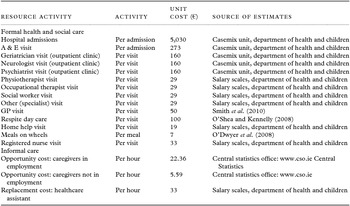
Formal health and social care costs were estimated for a set of resource activities, including general practice visits, hospitalizations, outpatient clinic consultations, accident and emergency visits, respite care, meals on wheels services, and additional health and social care professional consultations (registered nurse, physiotherapist, psychologist, chiropodist, occupational therapist, social worker, and home help aides). Data on utilization over a six-month period were collected at each time point using structured questionnaires completed by the primary caregiver, and the total cost of care was estimated by applying the appropriate unit cost estimate for each resource activity. Unit cost data were calculated from a variety of national Irish data sources and were adjusted to constant Euros in 2008 prices (to maintain a consistent valuation approach across each time point) using an appropriate inflation index (see Table 1).
Unit cost estimates

Note: Unit costs are presented in 2008 prices. Where necessary, unit costs were inflated using the medical component of the consumer price index (www.cso.ie).
Informal care costs were estimated by extrapolating estimates of daily informal care over a six-month period. Daily informal care costs were calculated from estimates of caregiving hours provided by the primary caregiver for each patient as measured by the Resource Utilization in Dementia Lite instrument (Wimo and Winblad, Reference Wimo and Winblad2003). This includes the total number of hours dedicated to basic ADLs, instrumental ADLs (IADLs), and supervising the patient over the previous month. Hours of care per task per caregiver were summed to obtain an estimate of total daily caregiving hours per patient.
The issue of valuing informal care is a complicated one. In this study, informal care was valued using the opportunity cost method, as data were available on the labor force participation status for each caregiver. On this basis, caregivers were categorized as “employed” or “unemployed.” For the “employed” category, the opportunity cost of time was valued at the average industrial wage in Ireland for 2008 of €22.36 per hour (Central Statistics Office, 2010). For the “unemployed” category, the opportunity cost of time was valued at leisure time, proxied as a percentage (25%) of the average industrial wage or €5.59 per hour. The valuation of leisure time at 25% of work time wage rates is based on the travel cost methodology originating from within transport economics and used extensively, although not without controversy, in recreation demand analysis (Parsons, Reference Parsons, Champ, Boyle and Brown2003). The daily informal care cost per patient was calculated by multiplying total care hours by the relevant hourly wage rate.
Other variables
A range of other data was collected on socio-demographic characteristics, patient dependence, patient function, cognitive function, neuropsychiatric symptoms, and comorbidity status.
Demographic and socio-economic data included current age, sex, educational attainment, medical card status, and private health insurance status. The latter two variables reflect socio-economic status and have been shown to influence the utilization of healthcare services in Ireland (MacGregor and O'Neill, Reference MacGregor, O’Neill and Nolan2007). Only those in the lowest income brackets are eligible for a medical card, which entitles them to free primary care services. In addition, individuals may voluntarily purchase private health insurance, which provides access to private care services that are not available to public patients.
Patients’ dependence on others was measured using the DS (Stern et al., Reference Stern1994), a continuous index ranging from 0 to15, with higher scores indicating greater dependence. Patient function was measured using the Disability Assessment for Dementia (DAD) scale (Gelinas et al., Reference Gelinas, Gauthier, McIntyre and Gauthier1999), a continuous index ranging from 0 to 40, with higher scores indicating greater functional capacity. Cognitive function was measured using the Mini-Mental State Examination (MMSE) scale (Folstein et al., Reference Folstein, Folstein and McHugh1975), which provides a continuous index ranging from 0 to 30, with lower scores indicating greater levels of cognitive impairment. Neuropsychiatric symptoms were assessed with the Neuropsychiatric Inventory (NPI; Cummings et al., Reference Cummings, Mega, Gray, Rosenberg-Thompson, Carusi and Gornbein1994). The NPI provides a continuous index ranging from 0 to 144, with higher scores indicating greater frequency and severity of neuropsychiatric symptoms. Comorbidity status was defined as having one or more co-existing chronic conditions from a list, including ischemic heart disease, diabetes, congestive heart failure, chronic lung disease, musculoskeletal disease, hypertension, psychosis, and cerebrovascular disease.
Statistical analysis
A range of descriptive, univariate, and multivariate statistical analyses were conducted. Descriptive statistics, in the form of mean values and SDs for continuous variables and percentages (%) for categorical variables, are presented to summarize sample characteristics, resource use, and costs at each time point.
A series of univariate analysis, consisting of t-tests for continuous variables and χ 2 tests for categorical variables, was undertaken. First, given the longitudinal nature of the dataset, the issue of attrition was considered by comparing baseline demographic and clinical characteristics of participants who did complete follow-up with those who did not. Second, to explore costs of care over time, univariate analysis was undertaken to compare individual resource use costs and total costs of care at baseline versus follow-up. Third, to explore patient independence over time, univariate analysis was undertaken to compare measures of dependence (DS), function (DAD), cognitive impairment (MMSE), and neuropsychiatric symptoms (NPI) at baseline versus follow-up.
Multivariate analysis, consisting of a generalized linear model (GLM) regression framework, was undertaken to explore the effects of a range of independent variables on the following three dependent cost variables: (i) formal health and social care costs; (ii) informal care costs; and (iii) total formal and informal care costs. The primary goal of the multivariate analyses was to explore the relative magnitude of DS and DAD as determinants for total costs of care after adjusting for baseline costs and other potentially important cost drivers. The choice of independent variables to be included in the final set of models was informed by the primary research question, the existing literature, clinical opinion, and statistical tests. Given the limited sample size and statistical power, and the implications of adding further covariates and factors to each model, the decision was taken to adopt the most parsimonious regression model on the basis of the Akaike Information Criterion (AIC). The final model of choice was that estimated controlling for DS score, DAD score, age, gender, and baseline cost.
In the analysis, a GLM regression with a γ variance function and log link was applied to address concerns surrounding the distributional form of the total cost variables (Drummond et al., Reference Drummond, Sculpher, Torrance, O’Brien and Stoddart2005). As a result, the regression coefficients for continuous independent variables estimated the percentage change in cost for a unit change in that variable. For dichotomous variables, the coefficient estimated the percentage change in cost relative to the reference group for that variable. In all analyses, statistical significance was explored in terms of two levels of α: 0.05 and 0.10. All analyses were performed using STATA 11.
Results
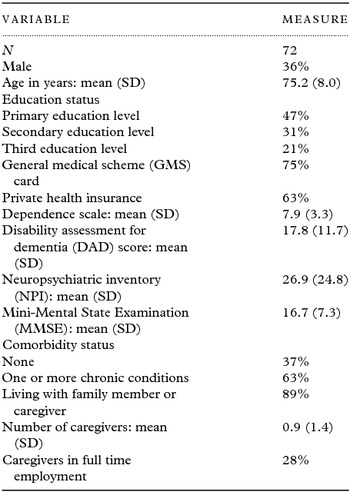
Summary statistics for the characteristics of study participants are presented in Table 2. The sample for the longitudinal analysis consists of 72 participants, with an average age of 75.2 years (SD: 8.0), 36% of whom were males. In terms of socio-economic status, 31% completed secondary level education and 21% third level. In addition, 75% of the sample had a GMS medical card and 63% had private health insurance. The mean level of dependence on others, as measured by the DS ranging from 0 to 15, was 7.9 (SD: 3.3) and the mean level of functional capacity, as measured by the DAD scale ranging from 0 to 40, was 17.8 (SD: 11.7). With respect to cognitive impairment and neuropsychiatric symptoms, the mean MMSE score from the scale ranging from 0 to 30 was 16.7 (SD: 7.3), while the mean score on the NPI scale ranging from 0 to 144 was 26.9 (SD: 24.8). Of the total sample, 63% had one or more comorbidities. In terms of living arrangements, 89% of the sample was living with a family member. The average number of caregivers was 0.9 (SD: 1.4), of whom 28% were in full time employment at follow-up.
Descriptive analysis: sample characteristics

Note: Standard deviation = SD.
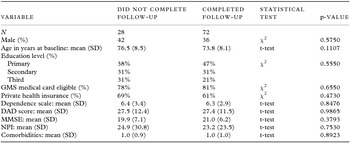
Table 3 reports the results from the univariate analyses to examine the baseline characteristics of participants who did and did not complete follow-up. The results indicate that there was no systematic difference between those 72 participants who completed study follow-up and those 28 who did not. This suggests that the follow-up sample was not systematically different from the cross-sectional sample at baseline. However, it is possible that the limited sample size may have restricted the power to detect differences in the characteristics of participants and non-participants.
Univariate analysis: baseline characteristics of participants who completed and did not complete follow-up

Note: Standard deviation = SD.
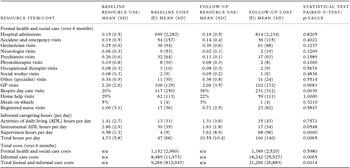
In Table 4, the results from the descriptive analysis of service use and costs of care at the baseline and follow-up time points are presented. When individual resource use was costed and summed, the mean cost of formal health and social care over six months was €1,389 (SD: 2,520) at follow-up compared with €1,152 (SD: 2,960) at baseline. In respect of daily informal care, participants received an average of 1.31 (SD: 3.6) hours for basic ADLs, 1.61 (SD: 1.8) hours for IADLs, and 7.62 (SD: 8.9) hours for supervision at follow-up. This compared with 1.41 (SD: 2.7), 2.86 (SD: 2.9), and 0.58 (SD: 1.3) hours at baseline. This translated into a mean cost per patient of €100 (SD: 140) per day and €18,242 (SD: 25,527) over six months at follow-up compared with €47 (SD: 66) per day and €8,489 (SD: 11,973) over six months baseline. Notably, there was a large variation with respect to the reporting of informal caregiving at follow-up versus baseline. Combining the formal and informal components of care resulted in a mean cost estimate of €21,266 (SD: 26,883) at follow-up compared with €9,266 (SD: 12,947) at baseline.
Descriptive analysis and univariate analysis: resource use and costs

Note: Unit costs are presented according to 2008 prices.
SD = Standard deviation; N = 72.
Table 4 also presents the results from the univariate analyses, using paired sample t-tests, to explore whether costs of care changed over time between baseline and follow-up. With respect to formal care, only one individual resource cost significantly increased between baseline and follow-up: the cost of respite care. The mean cost increased from €117 (SD: 250) at baseline to €231 (SD: 312) at follow-up (p = 0.0039). There was no statistically significant difference in total formal health and social care costs between the two time points. In respect of informal care, there was a marginally significant decrease in one component of care: IADL hours per day. The mean cost of daily IADLs decreased from €30 (SD: 39) at baseline to €17 (SD: 34) at follow-up (p = 0.0548). Conversely, there was a significant increase in another component of informal care: supervision hours per day. The mean cost of daily hours of supervision increased from €4 (SD: 9) at baseline to €68 (SD: 98) at follow-up (p = 0.000). Overall, the increase in supervision led to a significant increase in total informal care costs from a mean cost of €8,489 (SD: 11,973) at baseline to €18,242 (SD: 25,527) at follow-up (p = 0.0065). There was also a significant increase in combined formal and informal care costs from a mean cost of €9,266 (SD: 12,947) at baseline to €21,266 (SD: 26,883) at follow-up (p = 0.0014). This increase was primarily driven by the increase in informal care costs.
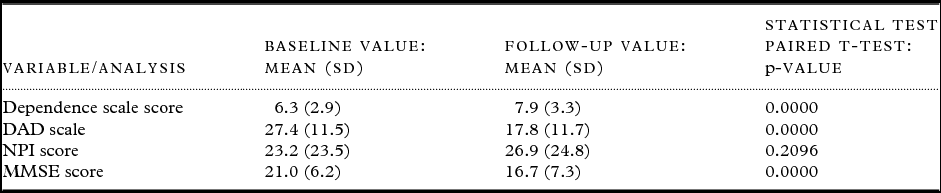
Table 5 reports the results from the paired sample t-tests to explore whether patient independence changed over time. These results indicate that both dependence on others, as measured by the DS, and functional capacity, as measured by the DAD scale, worsened significantly between the two time points. Mean DS score increased from 6.3 (SD: 2.9) at baseline to 7.9 (SD: 3.3) at follow-up (p = 0.0000). Similarly, mean DAD score fell from 27.4 (SD: 11.5) at baseline to 17.8 (SD: 11.7) at follow-up (p = 0.0000). Notably, cognitive impairment worsened over time from a mean MMSE score of 21.0 (SD: 6.2) at baseline to 16.7 (SD: 7.3) at follow-up (p = 0.0000). There was no significant change in neuropsychiatric symptoms over time.
Univariate analysis: dependence, function, neuropsychiatric symptoms, and cognitive impairment

Note: SD = Standard deviation; N = 72.
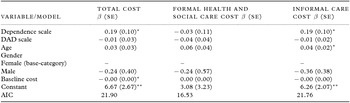
The results from the multivariate analyses for the three total cost-dependent variables are presented in Table 6. In the combined formal and informal care analysis, two independent variables reached statistical significance: DS score and baseline cost. In particular, a one point increase in DS score, that is a one-unit increase in patient dependence on others, was associated with a 19% increase in total costs (p = 0.0610). Examining the results for formal care costs reveal that no independent variable was statistically significant. In respect of informal care costs, two independent variables reached statistical significance in the multivariate analysis: DS score and age. A one-point increase in DS score was associated with a 19% increase in costs (p = 0.0500) and a one-year increase in age was associated with a 4% increase in costs (p = 0.0910).
Multivariate analysis

Note: Statistical significance was explored in terms of two levels of α: **0.05 and *0.10.
Discussion
This study analyzed longitudinal data on costs of formal and informal care for a sample of patients with AD and MCI living in the community in Ireland. Total formal and informal care costs rose from an average of €9,266 over six months at baseline to €21,266 at follow-up, two years later. This constituted a statistically significant increase in cost over time and was driven primarily by the increase in estimated informal care costs. The mean cost of informal care at follow-up was €18,242 compared with €8,489 at baseline, once again representing a statistically significant increase over time. The increase in informal care was driven by the increased supervision hours provided by caregivers. This more than offset the marginal reduction in IADL caregiver hours as ADL hours remained relatively similar over time. While it may be argued that supervision hours are not as intensive as ADL or IADL hours, allowing for the simultaneous conduct of alternative productive tasks, the increase in daily supervision hours from 0.58 at baseline to 7.62 at follow-up represents a significant increased resource burden on the caregivers. Notably, there was no significant difference in the cost of formal health and social care services over time, with the mean cost of €1,389 over six months at follow-up compared with €1,152 at baseline, two years earlier. Moreover, these cost patterns occurred in tandem with worsening dependence, function, and cognitive impairment among study participants over time.
These results suggest that as dependence increased and function declined, more was expected of families; the latter took up much of the slack in terms of increased supervision in particular. Given this finding, it may be surmised that keeping an eye on the person with dementia living in the community became the default caring position, suggesting that person-centered, professionally led care interventions became less likely as the disease progressed. The observed results for the formal care sector may simply reflect existing and binding resource constraints in the Irish setting which are prohibiting any expansion of formal services to deal with increased dependence and more limited function in people with dementia. It might also reflect a priority-setting approach, based on an erroneous and reductionist philosophy, that if nothing more can be done for the person with dementia as the disease progresses, then scarce public resources were better off being expended elsewhere in the health care sector. Whatever the origins, families ended up providing more care hours as dementia worsened. This notwithstanding, it is important to note that our analysis was limited to those still living in the community at follow-up and it may be the case that formal resources were focused more on the care of those now living in institutionalized care settings. Unfortunately, we did not have access to data on formal and informal care resource use for those study participants who did not complete follow-up because they transitioned to institutional care or elsewhere. As a result, our findings are limited to community dwelling individuals with AD over time.
The multivariate analyses was undertaken to explore the effects of dependence and function on costs of care over time. The objective of these analyses was to extend the previous cross-sectional study which found that both dependence and function variables had significant and independent effects on costs of care (Gillespie et al., Reference Gillespie2013). That is, the longitudinal analysis provides the opportunity for more robust estimation by accounting for those unobservable individual characteristics that may influence the cost outcomes of interest but are excluded from the cross-sectional analysis. The results indicate that a one-point increase in the DS score, that is a one-unit increase in patient dependence on others, was associated with a 19% increase in informal care costs and total care costs over six months. The results for functional capacity did not reach statistical significance in the longitudinal analysis.
In general, the results from this study reflect those from the recent Irish and international literature for the effects of patient independence on costs of care. That is, there is a positive relationship between increasing dependence and higher costs of care, given that as the disease progresses the patient's functional capacity worsens and they become increasingly dependent on others (Murman et al., Reference Murman, Von Eye, Sherwood, Liang and Colenda2007; Zhu et al., Reference Zhu2008a; Reference Zhu2008b; Gustavsson et al., Reference Gustavsson2010; Reference Gustavsson2011). Moreover, dependence on others is confirmed as an independent predictor of cost over and above the effects of function (Zhu et al., Reference Zhu2008a; Reference Zhu2008b; Gillespie et al., Reference Gillespie2013). Finally, informal care is the major driver of costs of care for people with AD and other dementias (Gerves et al., Reference Gervès, Chauvin and Bellanger2014).
A major limitation of this study is that the sample size for the analysis is small. There are also legitimate concerns about collinearity between the independent variables in the analysis, given that measurement tools such as the DS score, DAD scale, MMSE, and NPI capture similar information. For DS, correlation was −0.62 with DAD, −0.55 with MMSE, and 0.38 with NPI. For DAD, correlation was 0.51 with MMSE and −0.26 with NPI. For MMSE, correlation was −0.23 with NPI. As stated, the study sample included only community-based individuals with mostly mild-to-moderate AD attending a memory clinic in the east of Ireland, the majority of whom were relatively highly educated and privately insured. Therefore, the study findings are not readily extrapolated to those living in the community with more severe impairment, to those who do not attend such clinics, to low or zero users of services, many of whom remain undiagnosed and unknown to service providers, or to those living in institutionalized care settings. Data on patient resource use were reported by caregiver informants only, thereby opening up the possibility of bias, but there were no opportunities to validate this data from alternative sources. In addition, controversy surrounds the approaches available for the valuation of caregiver time and results are sensitive to the approach adopted. Notably, the adopted approach here is viewed as conservative if consistent with economic theory and ignores any possible utility gains from caregiving (McDaid, Reference McDaid2001). An alternative approach for valuing informal care is the replacement cost method, whereby all care hours are costed at the level of remuneration required to hire an equivalent professional; for example, a healthcare assistant in the Irish health setting would be valued at a rate of €33 per hour. The adoption of such an approach would be reflected in a much greater increase in informal care costs to those presented here. Moreover, given that the increase in informal care hours was predominantly driven by the increase in supervision hours, it may be argued that we overestimate the opportunity cost of supervision hours as caregivers could potentially have simultaneously been engaged in other productive tasks. Finally, the process of conducting economic analysis on social care provision in Ireland is always complicated by the lack of a national database of unit cost data. While not ideal, we endeavored at all times to be conservative in the assumptions adopted.
To conclude, the findings from this longitudinal study suggest that levels of dependence in patients with AD are significantly associated with increased costs of care as the disease progresses over time. Thus, interventions that seek to improve patient independence may be associated with significant cost savings, particularly with respect to the resource requirements placed on informal caregivers. Formal health and social care services do not seem to respond to increased dependence in people with dementia, leaving it to families to fill the caring gap through increased supervision as the disease progresses. Much more work is required to see if this result holds for longitudinal studies with more participants, for people with AD in different care settings, and for countries other than Ireland.
Conflict of interest
The authors declare no conflicts of interest with respect to this paper. The authors received financial support for this research from Elan Pharmaceuticals (Janssen acquired the Alzheimer's Immunotherapy Program from Elan in September 2009) and Wyeth (which was acquired by Pfizer in October 2009).
Description of Authors’ roles
Brian Lawlor, Damien Gallagher, Aine Ni Mhaolain, Loretto Lacey, Jacqui Buchanan, and Joel Bobula conceived the study. Paddy Gillespie, John Cullinan, and Eamon O’Shea undertook the acquisition, analysis, and interpretation of the health economic data and the drafting of the research paper. All authors participated in a critical revision of the manuscript and approved the final version.
Acknowledgments
The authors would like to thank all the study participants.