Introduction
Depression is one of the most prevalent psychiatric disorders in the elderly population (Chen et al. Reference Chen, Hu, Qin, Xu and Copeland2004; Wetterling & Junghanns, Reference Wetterling and Junghanns2004). The prevalence of geriatric depression (GD) varies depending on the method of ascertainment used. Steffens et al. (Reference Steffens, Skoog, Norton, Hart, Tschanz and Plassman2000) assessed 4559 elderly residents (aged 65–100 years) in Cache County, Utah, using a modified version of the Diagnostic Interview Schedule (DIS) and found the point prevalence of major depression was 4.4% in women and 2.7% in men. [In this paper point prevalence refers to the percentage of a population who have the given illness at a single point in time; period prevalence is the same concept relative to an extended period of time (O'Brien et al. Reference O'Brien, Goeree and Streiner1994).] Jongenelis et al. (Reference Jongenelis, Pot, Eisses, Beekman, Kluiter and Ribbe2004) investigated 333 nursing-home residents (aged ⩾55 years) in The Netherlands using the Geriatric Depression Scale (GDS) and established diagnoses according to DSM-IV criteria. The point prevalence of major depression and minor depression was 8.1% and 14.1% respectively.
GD is a major public health problem that has far-reaching treatment implications and a serious impact on patients' quality of life (Chen et al. Reference Chen, Hu, Qin, Xu and Copeland2004). The outcome of GD is not favorable. Cole et al. (Reference Cole, Bellavance and Mansour1999) performed a meta-analysis of the 24-month outcome of GD and found that only 33% of patients were well, 33% were still depressed, and 21% had died. In addition, GD was related to high risk of suicide (Chiu et al. Reference Chiu, Yip, Chi, Chan, Tsoh and Kwan2004), high utilization of health-care services (Katon et al. Reference Katon, von Korff, Lin, Bush and Ormel1992), and high costs (Unutzer et al. Reference Unutzer, Patrick, Simon, Grembowski, Walker and Rutter1997).
Over the past few decades in China, low birth rates, due to the one-family-one-child policy, and an increase in life expectancy have resulted in the proportion of the aging population increasing rapidly (Zhang, Reference Zhang1999). It might therefore be expected that the prevalence of GD would also be increasing. However, to our knowledge, only a few studies using stringent methods and published in local and international journals have assessed the prevalence of GD in China. Li et al. (Reference Li, Chen, Zhang, Jia, Liu and Xu1999) interviewed 1593 subjects aged ⩾60 years in the urban areas of Beijing using the GDS and found that the point prevalence of GD was 1.57%. Chen et al. (Reference Chen, Hu, Qin, Xu and Copeland2004) interviewed 1736 subjects aged >65 years in Hefei, Anhui province with the Chinese version of the Automated Geriatric Examination for Computer Assisted Taxonomy (AGECAT-CHN) and reported a point prevalence of 2.2% for GD. Tang et al. (Reference Tang, Liu, Han, Tang, Wang and Zhang2001) examined 5385 elderly patients (⩾55 years) in the rural and urban regions of Chengdu, Sichuan province with the Center for Epidemiological Studies of Depression (CES-D) interview schedule and established diagnoses according to DSM-III-R. The point prevalence rates for dysthymia and major depressive disorder (MDD) were 0.76% and 0.45% respectively. Lee et al. (Reference Lee, Tsang, Zhang, Huang, He, Liu, Shen and Kessler2007) examined urban samples (n=5201) in both Beijing and Shanghai using the Composite International Diagnostic Interview Version 3 (CIDI-3). The lifetime prevalence of an MDD and dysthymia in the 65+ age group was 2.6% and 0% respectively. The results of these epidemiological surveys cannot be compared because the different sampling methods, the lack of standardized diagnostic criteria, and the different definitions of GD that these investigators used confound the exploration of the risk factors of GD. Therefore, it is important to further investigate the prevalence of GD in both urban and rural regions in China using standardized diagnostic instruments and criteria.
We set out to investigate (1) the 12-month and lifetime prevalence rates of GD in residents living in the urban and rural areas of Beijing, China (Beijing is a municipality that includes both urban and rural areas); (2) the sociodemographic correlates of GD; and (3) the treatment preference of subjects with GD. To compare our results with those of other surveys from China, in this study GD included cases of both MDD and dysthymia occurring in persons aged ⩾60 years following a definition of GD (Yan & Li, Reference Yan and Li2000) used in previous Chinese studies.
Method
Subjects and sampling
This study was part of a large-scale epidemiological survey of the prevalence of psychiatric disorders in subjects aged ⩾15 years in Beijing, China that was conducted between 1 April and 24 April 2003. The sampling method followed a stratified, multi-stage systematic selection design based on the Beijing population census data of 2002 (National Bureau of Statistics of China, 2003), with an equal probability of each eligible person being selected from the target population.
The inclusion criteria of the study were as follows: (1) all persons aged ⩾60 years who (2) lived with their family members and were (3) registered as permanent residents in Beijing. Exclusion criteria included: (1) a diagnosis of learning disability or dementia based on a review of the subjects' out-patient medical record or health card issued by the local mental health-care institute and (2) a diagnosis of learning disability or dementia by a brief screening diagnostic interview immediately prior to the administration of the CIDI.
Based on a previous survey (Li et al. Reference Li, Chen, Zhang, Jia, Liu and Xu1999) that found a 1.57% prevalence of GD in the urban areas of Beijing, the minimum number of subjects needed for interviews to achieve a power of 0.9 at a significance level of 0.05 (two-tailed) was calculated as 380 according to Cohen's method (Cohen, Reference Cohen1988).
Interviews were conducted at the subjects' homes. The steps of the selection process were as follows:
(1) Neighborhood and village communities (NCs and VCs) in urban and rural regions respectively are community-based organizations of several hundred households in China (Shen et al. Reference Shen, Zhang, Huang, He, Liu, Cheng, Tsang, Lee and Kessler2006). One hundred and twenty-six NCs/VCs were selected using a random number table that took into account the whole population and the ratio of urban to rural residents in each district/county (n=18) in Beijing.
(2) A total of 6267 households were randomly selected from the household registration list in all NCs/VCs.
(3) The person in each selected household aged >15 years whose date of birth was closest to 1 April was invited to participate in the study. The project had to be terminated earlier than scheduled because of the outbreak of Severe Acute Respiratory Syndrome (SARS) in Beijing in the spring of 2003. A total of 6251 persons were approached and 1691 subjects were aged ⩾60 years. Of these, 1665 (98.5%) agreed to participate in the study. Finally, 1601 met the above-mentioned study criteria.
The study protocol was approved by the Human Research and Ethics Committee of Beijing An Ding Hospital. Written consent was obtained from each subject.
Assessment tools and procedures
Sociodemographic and clinical data were collected with a questionnaire designed for the study that also inquired about major medical conditions affecting the cardiovascular, respiratory, digestive, hematological, endocrine, urinary, connective tissue and nervous systems. Suicide attempts were verified by a medical practitioner. All of the data obtained were confirmed by family members. To minimize the influence of cognitive impairment on the CIDI assessment, a brief screening diagnostic interview was carried out by the interviewers immediately prior to the CIDI assessment. All subjects with a learning disability or dementia were excluded.
GD was assessed with the World Health Organization (WHO) CIDI 1.0, a structured diagnostic interview schedule for the assessment of psychiatric disorders (Robins et al. Reference Robins, Wing, Wittchen, Helzer, Babor, Burke, Farmer, Jablenski, Pickens, Regier, Sartorius and Towle1988) that can generate diagnoses according to the DSM-III-R (APA, 1987). The original version of the CIDI 1.0 was translated into Chinese using the standard WHO protocol and validated (Zou et al. Reference Zou, She, Shen, Wang and Feng1995). Both the original and the validated Chinese versions of the CIDI 1.0 have satisfactory psychometric properties (Robins et al. Reference Robins, Wing, Wittchen, Helzer, Babor, Burke, Farmer, Jablenski, Pickens, Regier, Sartorius and Towle1988; Zou et al. Reference Zou, She, Shen, Wang and Feng1995).
The interviews were conducted by 102 qualified psychiatrists with at least 2 years of clinical experience selected from 18 mental health institutes in Beijing. They were trained in epidemiological fieldwork in a 10-day workshop that offered an overview of the project and covered its design and procedures, the use and review of the assessment tools, the processes and techniques of the field interviews and their potential difficulties, mock interviews, and quality assessment.
To minimize false-negative responses and non-responses, two measures were adopted: (1) public education about the importance and anonymity of the project was delivered to the residents in the target NCs/VCs; and (2) the interviewers were responsible only for subjects residing in the catchment areas of their hospitals because of good public relations between the mental health services and the local NCs/VCs. In addition, each interviewer practiced techniques on how to gain entry to a household, seek support from the community, and maintain a rapport with the subjects.
Prior to the study, the interviewers attended an inter-rater reliability exercise involving 10 patients with depressive disorders. The κ value between interviewers was 0.795. To assess the feasibility of the study and the consistency of interviews, a pilot study of 100 households was carried out. The 12-month prevalence of MDD in the pilot study was 7% for all age groups.
Statistical analysis
Data were analyzed using SPSS version 13.0 (SPSS Inc., Chicago, IL, USA). Data analyses in this study were performed on the sample weighted according to the age and sex distribution of Beijing's population in 2002. Logistic regression analysis with the stepwise method was used to calculate the crude and adjusted odds ratios for the sociodemographic correlates of GD. Crude odds ratios examined the association between GD and each of the sociodemographic factors separately. Adjusted odds ratios were used to measure the relationship between GD and each variable after controlling for the effects of other variables using multiple logistic regression analysis. Current GD was the dependent variable, and the independent variables were one or more of the basic sociodemographic variables. A comparison between the rural and urban GD patients with regard to preferred treatment was performed by the χ2 test. The level of significance was set at 0.05 (two-tailed).
Results
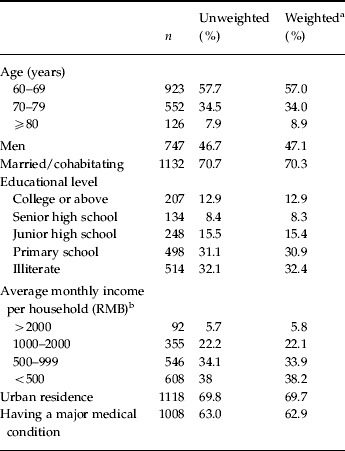
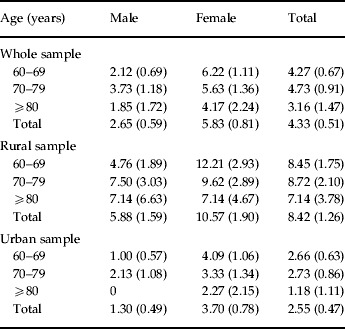
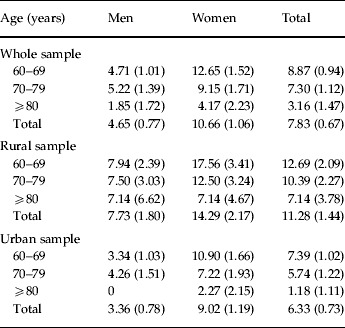
A total of 127 subjects were diagnosed with GD. Their sociodemographic characteristics are presented in Table 1. The 12-month and lifetime prevalence rates of GD by sex, age and residence (rural and urban) are shown in Tables 2 and 3 respectively. The overall 12-month and lifetime prevalence rates of GD were 4.33% and 7.83% respectively. Both the 12-month and the lifetime rates were higher for women than for men in the entire sample.
Sociodemographic characteristics of the subjects (n=1601)

a Weighted according to the age and sex distribution of Beijing's population in 2002.
b US$1≈RMB7.40.
The 12-month prevalence of geriatric depression by age, sex and region (urban versus rural)

Values are % (standard error).
Lifetime prevalence of geriatric depression by age, sex and region (urban versus rural)

Values are % (standard error).
The overall 12-month prevalence rates of MDD and dysthymia were 4.09% [95% confidence interval (CI) 3.11–5.06) and 0.24% (95% CI 0–0.49) respectively; the corresponding figures for overall lifetime prevalence were 7.03% (95% CI 5.78–8.29) and 0.79% (95% CI 0.36–1.23).
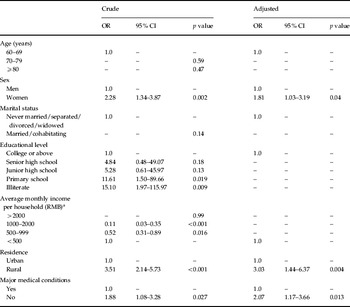
The crude and adjusted odds ratios for the relationship between sociodemographic variables and GD are shown in Table 4. Women were significantly more likely to have GD than were men, and so were subjects with low educational levels. Middle household income (RMB500–2000/month) significantly reduced the likelihood of GD. Rural subjects were more likely to have GD than their urban counterparts. Those with major medical conditions were more likely to suffer from GD, but age and marital status did not affect the risk.
Crude and adjusted odds ratios for the past 12-month prevalence of geriatric depression according to basic sociodemographic characteristics

OR, Odds ratio; CI, confidence interval.
Significance level was set at 0.05, two-sided test.
a US$1≈RMB7.40.
Only 25.2% of the subjects with GD sought professional help from medical practitioners, and a mere 4.7% attended mental health specialists.
Discussion
Kessler et al. (Reference Kessler, Berglund, Demler, Jin, Merikangas and Walters2005) carried out a large-scale epidemiological survey that administered face-to-face CIDIs in the USA, and the lifetime prevalence rates of MDD and dysthymia were 10.6% and 1.3% respectively in the group of subjects aged ⩾60 years (Kessler et al. Reference Kessler, Berglund, Demler, Jin, Merikangas and Walters2005). These rates are slightly higher than those of our study. The lifetime prevalence rates of MDD and dysthymia in the ⩾65 years age group in metropolitan China were 2.6% and 0% (Lee et al. Reference Lee, Tsang, Zhang, Huang, He, Liu, Shen and Kessler2007), somewhat lower than the corresponding figures [4.74% (95% CI 3.27–6.21) and 0.61% (95% CI 0.07–1.15)] in the urban group in this study. The 12-month prevalence was not reported in the two aforementioned studies, which precludes a comparison with our results.
The overall 12-month prevalence rate of GD in this study (4.33%) is somewhat higher than the point prevalence figures for urban Beijing (1.57%, Li et al. Reference Li, Chen, Zhang, Jia, Liu and Xu1999), Hefei (2.2%, Chen et al. Reference Chen, Hu, Qin, Xu and Copeland2004) and Chengdu (2.62%, Tang et al. Reference Tang, Liu, Han, Tang, Wang and Zhang2001), but lower than those found in the Chinese populations of Singapore (5.7%; Kua, Reference Kua1992) and Taiwan (1-month prevalence: 5.9%; Chong et al. Reference Chong, Tsang, Chen, Tang, Chen, Yeh, Lee and Lo2001). The prevalence of GD in the rural subjects in this study (8.42%) was also higher than the earlier findings from the rural Anhui province of China (7.2%, Ma et al. Reference Ma, Qin, Chen and Hu2006; 6.0%, Chen et al. Reference Chen, Hu, Qin, Xu and Copeland2004).
In view of the worldwide prevalence of GD, which ranges from 3.5% to 24.1% (Cole & Dendukuri, Reference Cole and Dendukuri2003), the lifetime and 12-month prevalence rates found in this study are still very low. The discrepancies between the findings of this study and earlier reports might be explained by the following:
(1) Different diagnostic assessment methods, incompatible time-frames (point versus period prevalence) and criteria for GD. Some studies only assessed the presence of depressive symptoms (e.g. Geerlings et al. Reference Geerlings, Beekman, Deeg and Van Tilburg2000), rather than depressive disorders; therefore, their prevalence rates for GD are much higher than ours. Despite the use of the CIDI in this survey, the prevalence of GD was still very low. Phillips et al. (Reference Phillips, Shen, Liu, Pritzker, Streiner, Conner and Yang2007) speculated, somewhat controversially, that this discrepancy could be attributed to the relative insensitivity of Western diagnostic instruments when applied in non-Western cultures, even though their psychometric properties had been validated before administration.
(2) In general, Chinese people may be less willing than their Western counterparts to report psychological symptoms during face-to-face interviews with unfamiliar mental health professionals because of a fear of discrimination and stigmatization (Kleinman, Reference Kleinman1986). In this study, interviewers were responsible only for subjects residing in the catchment areas of their hospitals. This approach could lower refusal rates and false-negative responses because of good relations between the hospitals and the local NCs/VCs. We suggest that this particular aspect of the study design partially explains the higher lifetime prevalence rate of GD compared to the study of Lee et al. (Reference Lee, Tsang, Zhang, Huang, He, Liu, Shen and Kessler2007).
(3) In China, patients with depression are more likely to somatize depressive symptoms than are their Western counterparts (Kleinman, Reference Kleinman1986).
(4) There has been a real increase in the prevalence of depression in recent decades in both adult and elderly populations of China. This trend may be related to the dramatic shift to a market economy, which has led to a growing number of social problems, such as social and economic disparities, unemployment, uncontrolled domestic migration, and the breakdown of extended family networks (Chen et al. Reference Chen, Hu, Qin, Xu and Copeland2004), thus facilitating the upward trend of depression prevalence (Lee et al. Reference Lee, Tsang, Zhang, Huang, He, Liu, Shen and Kessler2007).
(5) Chinese sociocultural traditions seem to be protecting the elderly against GD (Chen et al. Reference Chen, Copeland and Wei1999, Reference Chen, Hu, Qin, Xu and Copeland2004). Jiang et al. (Reference Jiang, Zhang, Guo and Fang2005) reported that the most important social support comes from the family, and elderly people with less social support are more likely to become depressed. In this study, all of the subjects lived with their family members, and 96.3% of them had one or more children, which could partly explain the low prevalence of GD in China.
The higher prevalence of GD among women in both rural and urban areas in this study is consistent with previous findings in both China and Western countries (Li et al. Reference Li, Chen, Zhang, Jia, Liu and Xu1999; Heikkinen & Kauppinen, Reference Heikkinen and Kauppinen2004). The reason for this disparity is unknown. In China, older women generally have lower educational levels and incomes, poorer social support, fewer social activities, and a higher rate of widowhood compared to men, which contributes to the higher morbidity of depression in women (Ma et al. Reference Ma, Qin, Chen and Hu2006).
Low educational level was a strong correlate of GD in this study, which confirms the results of other investigations (Chen et al. Reference Chen, Hu, Qin, Xu and Copeland2004; Lin, Reference Lin2006). In agreement with earlier findings (Woo et al. Reference Woo, Ho, Lau, Yuen, Chiu, Lee and Chi1994; Chen et al. Reference Chen, Hu, Qin, Xu and Copeland2004; Lin, Reference Lin2006), high monthly income (RMB 500–2000) was a strong protective factor against GD.
In this study the rural elderly were more likely to have GD than were city dwellers, confirming earlier findings (Twelve-Region Psychiatric Epidemiological Study Work Group, 1986; Wang et al. Reference Wang, Wang, Shen, Zhang, Li and Chen1998). The reason for the discrepancy between rural and urban regions in China with respect to GD needs to be explored. A relatively lower socio-economic status, a poorer health-care system, and fewer social activities for the Chinese rural elderly compared to their urban counterparts may increase the risk for GD (Chen et al. Reference Chen, Hu, Qin, Xu and Copeland2004; Ma et al. Reference Ma, Qin, Chen and Hu2006).
Subjects with major medical conditions were also more likely to suffer from GD, which is in agreement with earlier studies conducted in China and Hong Kong (Woo et al. Reference Woo, Ho, Lau, Yuen, Chiu, Lee and Chi1994; Li et al. Reference Li, Chen, Zhang, Jia, Liu and Xu1999).
Only about 25% of the subjects with GD in this study received any kind of treatment, and a mere 4.7% attended mental health clinics. These figures are considerably lower than the corresponding 81.4% and 10.4% reported from the USA (Cole & Yaffe, Reference Cole and Yaffe1996). The low rate of help-seeking behavior may be explained by the following: (1) many Chinese people do not believe that depression is a treatable psychiatric disorder (Zhang & Ji, Reference Zhang and Ji2004); (2) psychiatric stigmatization and discrimination stop psychiatric patients from using mental health services in China (Phillips & Pearson, Reference Phillips and Pearson1994); and (3) there is inadequate access to community-based psychiatric services in Beijing.
The major strength of this study is the fairly large, randomly selected, ethnically homogeneous sample in both urban and rural areas and the standardized clinical diagnostic tool used. Because of the following methodological limitations, the results of this study should be interpreted with caution. First, the survey involved only registered permanent residents of one of the most developed Chinese cities, and thus the results may not apply to other parts of China. Second, elderly people living alone were not investigated, which could lead to selection bias, as those living alone are more likely to have poor social support and, as a consequence, a higher rate of depression (Jiang et al. Reference Jiang, Zhang, Guo and Fang2005). Third, the CIDI is not suitable for thorough cognitive assessment. Therefore, although subjects with advanced cognitive impairment were excluded, an unknown proportion of participants may have had mild cognitive impairment, which may have influenced the validity of the interviews. This problem exists in other epidemiological studies using the CIDI (Shen et al. Reference Shen, Zhang, Huang, He, Liu, Cheng, Tsang, Lee and Kessler2006; Lee et al. Reference Lee, Tsang, Zhang, Huang, He, Liu, Shen and Kessler2007). Fourth, because of their important practical implications, relationships between sociodemographic factors (except for sex, residence and major medical conditions) and GD were discussed but the data were derived from ‘crude’ logistic regression analysis. Fifth, the study was not completed because of the outbreak of SARS. Nevertheless, the sample size was much larger than that needed according to standard sample size estimation. In addition, the ratio between the urban and rural samples was essentially the same as scheduled because only one target NC and VC could not be approached. Finally, the use of SUDAAN software (RTI, Research Triangle Park, NC, USA) for weighted analysis is recommended in future epidemiological studies with a stratified, multi-stage design.
In conclusion, given the heavy personal and social burden of GD as well as its low treatment rate found in this survey, policy makers and mental health professionals in China should make serious attempts to improve access to treatment, conduct further national surveys to explore the situation in areas outside major centers, and carry out longitudinal studies to investigate the predictors of GD.
Declaration of Interest
None.
Acknowledgments
This study was supported by a grant from the Beijing Municipal Science and Technology Commission (No. 200100528). The use of the Chinese version of CIDI 1.0, which was validated at the Institute of Mental Health, Beijing University, was authorized by the World Health Organization. We thank the mental health professionals and subjects who were involved in the project.