On 23 December 1957 the Daily Graphic reported that a Kingsway Department Store security man had apprehended ‘an Irish housewife’ named Bridgett Mary Ryan for stealing ‘two packets of ice-cream, half a pound of butter, meat, ham bacon, pork sausage and cake, valued at a total of £2 2s 1d’.Footnote 1 Ryan claimed she was simply putting the items aside and offered to pay double the price of the goods if the store manager released her. The manager refused Ryan's offer and handed her over to the police. At her court hearing, Ryan denied the charges and argued that she was on her way to collect money from her husband, and fully intended to pay for the items. The senior court magistrate, E. A. L. Bannerman, argued that Ryan had been in Ghana for almost a year and ‘should be quite conversant with the self-service operation at Kingsway’. To prove to the public that shoplifting ‘does not pay’, Bannerman sentenced Ryan to three months’ imprisonment with hard labour.Footnote 2
Ryan's case was not unique, and similar stories about shoplifting expatriate housewives appeared in the local press. For instance, a month after Ryan's case, an Accra court found 34-year-old Welsh housewife Dorothy Gwendoline Elliot guilty of stealing a pint of gin valued at 12s 10d.Footnote 3 While Accra Appellate courts ended up reducing the sentences of both women to one day in prison and fines, these incidents stirred up angry debates in the local press.Footnote 4 Local journalists criticized the racialized, classist attitudes of white shoppers who believed they could easily swindle what they considered unassuming and inefficient Ghanaian employees. Daily Graphic contributor Gloria Lamptey wrote:
It is unfortunate that most of these housewives, particularly the white ones, tend to use their seemingly superior social standing to play all sorts of dirty tricks in the hope of evading challenge by the naturally friendly and accommodating Ghanaian salesman and saleswoman. … This is not an idle accusation. It is a trick which has been seen through. The sooner this nasty practice is stopped, the better it will be for good relations. Ghanaians are not so credulous as they seem.Footnote 5
Lamptey's article not only conveyed a sense of disgust at white shoppers’ behaviour, but also revealed a determination to shed any colonial holdover that devalued African abilities as either workers or trustworthy consumers.
This article examines Kingsway Department Store as a site of political and social tension in Ghana's capital city, Accra, in the period leading up to and following the country's independence in 1957. Although the city was home to other department stores, such as the Union Trading Company (UTC), Glamour, and later Ghana National Trading Company (GNTC), the new Accra Kingsway was one of the largest and the history of its construction was notably shaped by nationalist politics. It was the United Africa Company (UAC) – one of the largest merchant trading firms in twentieth-century West Africa – that owned and operated the new Kingsway (Figure 1).
Exterior, Kingsway Stores, Accra, c. 1957 (Reproduced with kind permission of Unilever from originals at the Unilever Archives, UAC/1/11/9/46/1)

While, under colonialism, the UAC had imposed its distribution and retail systems on local markets for profit, this was not the motivation behind the building of its new Kingsway.Footnote 6 In fact, private letters to and from the UAC's executive director, Frederick Pedler, and general manager, Patrick H. Fitz-Gerald, revealed that the company considered the project a huge economic liability.Footnote 7
Plans for the construction and opening of Kingsway were fuelled by competing political and economic interests and were intimately intertwined with the rhetoric of modernization and debates about what constituted the modern. As scholars have argued, in colonial societies technologies, as well as infrastructure, were not neutral objects but invested with dense – if unstable – symbolic meaning (Larkin Reference Larkin2008). For the UAC the building of Kingsway was a sign of goodwill and an opportunity to shed its identity as an old colonial trading firm. The country's first Prime Minister and later President, Kwame Nkrumah, positioned the department store as a symbol of the new, independent nation, as well as a sign of overseas confidence in his Convention People's Party (CPP) government. In addition, he hoped that Kingsway's modernist architecture would contribute to Accra's image as an international city.Footnote 8 Local residents and government officials also weighed in on debates about Kingsway's construction and location. While residents had been pressuring the UAC to ‘update’ Accra's shopping facilities for years, local officials rejected the idea that a department store should be a central feature of any developing city.
Rather than ‘setting straight or correcting modernization discourse’, this article offers what anthropologist James Ferguson (Reference Ferguson1994) called for almost two decades ago: ‘an analysis that shows what it does’. As scholars have argued, the promise of modernity and the route to it – modernization – was one of the most powerful and popular discursive strategies for emerging African nations in the 1950s and 1960s (Miescher and Tsikata Reference Miescher and Tsikata2009/2010: 16). In his recent study on Dar es Salaam, Andrew Ivaksa (Reference Ivaska2011) demonstrates how debates about modernity and the modern were central to post-colonial cultural politics. The modern in particular became a ‘claim-making’ category that was key to social struggles around gender, generation and wealth. While scholars have rightly distinguished between the use of the terms modern, modernity and modernization, this article privileges how Ghanaian men and women understood and appropriated such terms between the 1950s and the 1970s.
Drawing on UAC company records, on Kingsway staff and inspection reports, as well as on local newspapers, advertising and oral interviews, I argue that tensions surrounding the construction, promotion and everyday operation of Kingsway exposed the contradictions of post-colonial modernization rhetoric. First, Kingsway did not seek to attract ‘all Ghanaians’. Advertising and marketing campaigns clearly targeted urban middle- and upper-class Africans. Second, Kingsway did not usher in a ‘new era’ of shopping. Instead, retailers and consumers integrated Kingsway into the local economy through practices of reselling and remaking ‘Kingsway-like’ goods. Lastly, the ‘modern department store’ that valued convenience and technological know-how, as well as order and efficiency, was actually a site of uncertainty and negotiation. Salaried women on staff, younger managers supervising older employees, and incidents like the shoplifting Irish housewife disrupted cultural norms that, in the past, had granted authority to individuals based on gender, age and race.
In Ghana, as elsewhere, commercial developments like department stores often highlighted and exacerbated the social, political and economic debates of the time.Footnote 9 Regularly ignored, however, in studies of African consumption, West African department stores are dismissed as either the preserve of European expatriates or as catering exclusively to elites. To some extent, both these statements are true. Kingsway advertisers and marketers did target mostly urban elite and middle-class consumers. The store's employees, including former Kingsway manager, Deborah Quartey, considered ‘regular customers’ to be people like ‘lawyers, judges and housewives’.Footnote 10 Similarly, G. A. Attoh, another former employee, explained that the store's location allowed it to construct its identity as a ‘first-class shop’. According to Attoh, shoppers considered other stores, like the UTC, ‘second-class’, because they were closer to the city's central market and High Street, and therefore very popular with market women.Footnote 11 These descriptions suggest that Kingsway's history highlights not only the importance of the city as a privileged space for the construction of the ‘African consumer’, but also specific places within the city as key to shaping this process.Footnote 12 However, as Abdoumaliq Simone argues in his book about ‘cityness’, no matter how hard planners and policy makers might try, ‘at the heart of city life is the capacity for its different people, spaces, activities, and things to interact in ways that exceed any attempts to regulate them’ (2010: 3).
This article therefore examines the intersections between post-colonial urban space and the construction of consumer identities, as well as the strategies undertaken by local residents and those considered non-‘regular customers’ to include themselves in these discourses. As consumer historian Frank Trentmann (Reference Trentmann, Brewer and Trentmann2006) argues, the consumer ‘did not automatically or naturally emerge from the world of goods’. Rather, consumers are products (and agents) of specific historical processes. The last section of the article thus addresses the question of how those excluded from consumer discourses still participate in shaping them. Information and news about Kingsway circulated beyond the urban elite imagination, namely through news, advertisements, store exhibitions and word-of-mouth. Kingsway was more than just a place to shop; the store became part of everyday discourse in socially meaningful ways. For example, among Ga women attractive, well-behaved children became known as ‘Kingsway babies’.Footnote 13 The history of Kingsway Department Store therefore illuminates the importance of consumer politics in shaping debates not only about the post-colonial city, but also about ongoing tensions concerning access to goods and the privileged status of ‘consumer’.
‘POLITICALLY TIMES ARE CHANGING’
Claiming to carry the ‘latest and best’ from London, Kingsway Stores began as a shopping place enabling Europeans to maintain, as fully as possible, their ‘home’ lifestyles in a West African environment.Footnote 14 Opened by the Miller-Swanzy group in 1920, the first Kingsway Department Store was located on the Accra High Street and was named after the company's headquarters in Africa House on the Kingsway in London (Pedler Reference Pedler1974).Footnote 15 In 1929, the UAC took control of Miller-Swanzy, expanded its operations, and used the name ‘Kingsway’ to start a chain of urban department store/supermarkets throughout British West Africa. Where Kingsway Stores did not exist, the UAC opened smaller versions called ‘E.D.s’ or ‘European Department Stores’. Published for European readers, early depictions of Africans visiting Kingsway focused on their amazement and ‘misuse’ of Western goods. One description reads: ‘facing the main entrance is a large mirror, which is in the nature of a Ju Ju to primitive people from the bush who have never before beheld themselves in so extensive a looking-glass’ (Macmillan 1968: 173). As Brian Larkin argues, colonial officials were invested in having Africans react to technology as a sublime force and making sure these reactions were recorded and circulated (Larkin Reference Larkin2008). Thus what he terms the ‘colonial sublime’ was based on maintaining ideas about racial difference and supremacy.
Although originally aimed at European colonials and their families, ‘E.D.s’ and Kingsway Stores increasingly attracted elite and emerging middle-class African shoppers. By 1954, UAC Ghana's general manager Fitz-Gerald observed that ‘almost as many Africans are customers of [E.D.s] as Europeans’. Further recognizing that ‘politically times are changing’, he ordered all UAC district managers to replace the term ‘European Department Store’ with the name ‘K store’ that same year.Footnote 16 The post-war period in Ghana was a major turning point in the way that British business began to understand its African consumers. This shift was closely linked to the emerging status of Africans as citizens of newly independent nations and is visible in the company's advertising campaigns and employment practices (Stockwell Reference Stockwell2000; Decker Reference Decker2007; Murillo Reference Murillo2011). The opening of the new Kingsway Store in 1957, the year of Gold Coast independence, reflects not only transformations in UAC retail policies, but also an effort to appeal to African audiences and promote company goodwill.
With self-rule quickly approaching, company executives agreed that the new Kingsway in Accra should target African consumers directly. However, plans focused mostly on attracting the elite and emerging middle class. In a private letter, Fitz-Gerald argued that, while department stores in Africa were not the most profitable system of retailing, the project was in the UAC's best interests since
a business of this nature, properly conducted will bring prestige and goodwill to the Company from the particular section of society where the greatest influence is going to lie in the future … . African Ministers and their wives and families, senior African Civil Servants, [and] the ever-increasing class of professional men of all kinds, will provide the main section of society from which our customers will be drawn.Footnote 17
The building of Kingsway was thus part of larger public relations efforts to combat negative criticisms and assure members of the African elite that the company was committed to supporting a new independent Ghana. The new Kingsway was one of several large public works projects undertaken by the UAC to promote company goodwill in the years leading up to independence. In addition to the £500,000 Kingsway project, the company financed £65,000 to build a sports stadium in Kumasi, constructed the Accra Community Centre, and donated large amounts to public charities, scholarships and various community development projects (Jones Reference Jones2005: 194).Footnote 18
Goals to appeal to African shoppers, as well as plans to update existing Kingsways, initiated a series of research visits to popular department stores in cities around the world.Footnote 19 The UAC's executive director, Frederick Pedler, led these investigations, observing and interviewing store managers and supervisors in Britain, Germany, Switzerland and the United States. In Britain, Pedler's itinerary included Selfridges, Harrods, Marks and Spencer, Jessups, Sainsbury's, Bentalls, John Lewis, and Kendal Milne & Co. in urban centres including London, Nottingham, Eastbourne and Manchester. In Germany, he visited Frowein and Nolden in Dusseldorf and Kaufhalle in Cologne. In Switzerland, Pedler spent time in Zurich and visited St Anna Co-op and Migros stores. In the USA, he toured Marshall Fields in Chicago, Bloomingdales and Abraham and Strauss in New York, and Wieboldt's in Evanston, Illinois.Footnote 20 In addition to visiting these stores himself, Pedler arranged for Kingsway managers, both European and African, to spend time at selected sites. For instance, David Aninakwa – who would later become the first African general manager of Kingsway Stores of Ghana – spent a year-long attachment at John Lewis, London. To further pursue his goal of making the UAC's department stores in West Africa top-notch, Pedler also studied retail stores and potential competitors in other African cities including Nairobi, Mombasa, Dakar and Leopoldville.Footnote 21
Pedler's major areas of research included advertising, market research and self-service. However, an analysis of his observation notes and interviews reveals that security procedures in London's John Lewis, as well as the black consumers and staff in US department stores, interested Pedler the most. At John Lewis, Pedler met with management to discuss not only the prevention of general shoplifting, but also how to monitor customers and staff.Footnote 22 He noted that John Lewis hired an outside firm who specialized in store detection to visit periodically, but also employed their own in-store detectives. Pedler concluded that John Lewis's policies should be applied to Kingsway Stores and advised managers to employ ‘intelligent African boys with Standard VII certificate’ as in-store detectives. These boys, he wrote in his final report, were to spend their time watching both customers and sales assistants.Footnote 23
Another major area of interest was the presence of ‘black employees and many black customers’ in US department stores. While Pedler initially approached US stores as a potential key to unlocking the needs and wants of black consumers, he was surprisingly mistaken. After his 1952 US tour, he wrote, ‘I enquired everywhere whether goods are bought specifically for black customers, and whether conscious effort is made to develop a special appeal to draw in black people. This possibility had not crossed the mind of any of the persons to whom I addressed my questions.’Footnote 24 US department stores like Marshall Field's and Bloomingdale's did not feel any special need to seek African American consumers, possibly because white buyers did not imagine their potential clients as anything but white consumers.Footnote 25 It is important to note that all Pedler's US visits were made to department stores in the north. In southern stores, African Americans faced tougher challenges because of Jim Crow legislation. Blacks were often banned from entering certain department stores and restricted from trying on items like hats or shoes that could potentially come in contact with white consumers. Despite later attempts in the 1960s to attract middle- and upper-class black women with certain lines of beauty products, US department stores were not initially interested in making special appeals to African Americans (Weems Reference Weems1998).
Investment in the department store trade further allowed the UAC to combat negative criticisms and publicize its new retail policies. During the late 1940s and throughout the 1950s, the UAC began to withdraw from smaller retailing activities and focused more on wholesaling and department stores. This shift spoke directly to ongoing allegations that the UAC was monopolistic and forced African retailers out of the market (Stockwell Reference Stockwell2000). The UAC publicized its new retail policies in company publications, such as the Statistical and Economic Review and its in-house employee magazine, the Unicorn.Footnote 26 Articles stressed the company's identity as a wholesaler and ‘specialty dealer’ and claimed that Kingsway was part of its withdrawal from general retailing.Footnote 27 ‘Department stores formed no part of the indigenous system of trading in West Africa’, it reasoned, and thus did not ‘trespass in the field of the African trader’.Footnote 28
KINGSWAY, MODERNITY AND THE NATION
Demands from nationalist leaders, pressure from Accra residents and opposition from local officials also surrounded the construction of the new Kingsway. In his personal papers, Pedler noted that several Accra residents had been urging the company to build an ‘up-to-date’ retail facility for years.Footnote 29 According to Pedler, Gold Coasters had become jealous of the UAC's investments in Nigeria and felt neglected. This was a rather crude assumption. While unequal distribution of UAC funds between the Gold Coast and Nigeria may have sparked some attention, ongoing public pressure to build a new department store in Accra also suggests an increasing sophistication among Gold Coast consumers who asserted their rights to a larger variety of better-quality goods. This correlation appears in UAC merchandising reports. For instance, in 1950 the company reported a marked improvement in the sales of consumer goods including sheets, blankets, children's wear and leather footwear.Footnote 30
In the decades following the Second World War Accra's landscape had also changed dramatically. Its population had more than doubled, increasing from 133,192 in 1948 to 337,828 in 1960, and a number of new landmarks and buildings had been completed.Footnote 31 As historian Nate Plageman (Reference Plageman2010) has demonstrated, enthusiasm for infrastructural development also filled the pages of local newspapers. Through published photographs, readers’ letters and editorials, ‘the city rather than the countryside’ was positioned as a ‘blueprint for national prominence’. According to Plageman, local employees of the Daily Graphic (the dominant newspaper of the period) in particular used the newspaper to ‘vigorously promote an urban ideal that could become the basis of the entire nation’.Footnote 32 Images, articles and advertisements featuring Kingsway Stores appeared frequently in the Graphic, further linking ideas of national prestige with commercial buildings and consumerism among readers.
Local residents, however, were not the only source of pressure on the UAC. In public speeches and private conversations, Kwame Nkrumah, who was then the Leader of Government Business, rearticulated the historical relationship between the UAC and the Gold Coast, and strategically used it to make demands on the company. In his private papers Pedler explained, ‘Nkrumah told us that it was [the UAC's] duty’ to provide a modern department store in time for independence.Footnote 33 He further demanded that that the store should be the finest in all of Africa and that all distinguished visitors should ‘go back home saying that Accra had shopping facilities that were equal to anything in the world’.Footnote 34 According to Nkrumah, it was the UAC's responsibility to help transform Accra into a modern international city.
Invited to give the inaugural speech at the store's grand opening on 31 January 1957, Nkrumah argued that the new Kingsway represented the ‘future peace, progress, prosperity and stability’ of the new nation and a space where all Ghanaian citizens could have their ‘every want met’.Footnote 35 According to press advertisements, Kingsway was to usher in a ‘new era of shopping luxury’.Footnote 36 In addition, self-service, a friendly sales staff and a wide variety of quality goods promised Ghanaian consumers ‘the modern shopping experience’.Footnote 37 An analysis of Nkrumah's papers reveals that he shopped avidly at UAC stores and ran up huge tabs on items ranging from fine suits to socks.Footnote 38 However, his conversations with UAC executives and speeches suggest that the store represented more than just a place for Ghanaians to fulfil consumer desires or become more ‘like’ the West. This was an important shift from the past, when the colonial government used technology and infrastructural projects to demonstrate colonial authority and produce a particular sort of modern African subject. While Nkrumah saw new development projects, including Kingsway, as tools to refashion modern Ghanaian citizens, he also hoped they would help shed the country's image as a colonial dependency, attract further foreign investment, and assert a sense of global membership (Bhabha Reference Bhabha and Bhabha1994; Ferguson Reference Ferguson2006; Prestholdt Reference Prestholdt2008; Alhman Reference Alhman2012).
The UAC agreed to Nkrumah's and the public's demands, but received little support from local authorities. Initially, the Minister of Local Government (Edward Asafu-Adjaye), the permanent secretary at the Ministry of Works, and the Commissioner of Lands rejected the UAC's proposed site proposals and plans. Pedler commented that plans to construct Kingsway in downtown Accra towards the city centre ‘horrified them’ and that local planning authorities did ‘not recognize retail trade as a facility which deserved consideration’ in the development of an expanding city.Footnote 39 After learning of the UAC's failed attempts, Nkrumah contacted the ministry and took it upon himself to secure a large enough piece of property in Accra for UAC to start the project. Nkrumah designated a hilltop property known as Adjabeng Lodge. Pedler writes that ‘the planning office [was] in a state of consternation’ at Nkrumah's message. The area was to be part of a new major road development project through Accra intended to connect Station and Nsawam roads. The new road was to become the ‘principal thoroughfare of the town, bearing the name Independence Avenue’.Footnote 40 According to Nkrumah, consumerism on display would help legitimize Ghana as a new nation and establish Accra as a desirable destination.
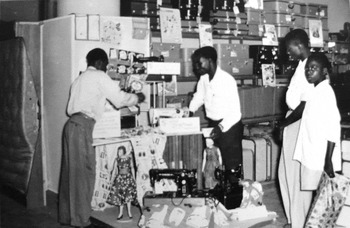
Plans to construct the new Kingsway in Accra also emanated from the UAC's desire to update its own corporate image and align itself with retailing developments taking place in other parts of the world.Footnote 41 For example, in 1955 Fitz-Gerald stated that it was about time the company adopted ‘improved techniques in buying and selling, which included the use of modern equipment, like accounting machines, cash registers, and refrigerators, as well as self-service, merchandise displays, and staff training courses’ (Figure 2).Footnote 42 Justifying its continued role in a new independent Ghana, UAC directors positioned their investment in Kingsway as a public service. In addition, they emphasized Kingsway as a model for modern methods of selling and argued that Kingsway Stores could act as a ‘general standard of shop keeping’ for the entire country.Footnote 43
Salesmen preparing a display for the electric Singer sewing machine, c. 1960, Kingsway, Accra (Reproduced with kind permission of Unilever from originals at the Unilever Archives, UAC/1/11/9/46)

After almost four years of negotiating plans and two years of construction, Kingsway, Accra officially opened its doors on 31 January 1957.Footnote 44 The four-storey building and large car park occupied just over two acres on a hilltop on what is now known as Kwame Nkrumah Avenue. Kingsway, Accra surpassed the Lagos store in size and variety of services. In addition to three floors of retail space, the Accra store housed a restaurant, barbershop, pharmacy, photograph and laundry service, and shoe repair.Footnote 45 Other departments included women's and children's clothing, furniture, textiles and materials, menswear, hardware, stationery and books, floor coverings, electrical, toys, food and provisions, and an air-conditioned cold store selling fresh meat and fish. Modern technologies and an abundance of goods attracted many visitors who flocked to Accra out of both curiosity and excitement. One of the most memorable features was the store's escalator, the first of its kind in West Africa. Older men and women reminisced about riding it for fun as children. ‘My family lived close by,’ Esther Addai remembers, ‘and after school I would come here with my cousins and play on the escalator. One of my cousins was afraid and I would hold her.’Footnote 46
Stories from older men and women also capture the thrill of visiting Accra and seeing Kingsway for the first time. Alice van der Staaij-Ghartey, originally from Takoradi, remembers her first visit: ‘We just had independence … in those early days, my goodness, you had people coming from the bush who had never been to Accra before and they want to come and see, even those of us from Takoradi we came to Accra.’Footnote 47 Kingsway not only symbolized promises for a better future and opportunities for many Ghanaians to improve their standard of living; it also represented a sense of national pride. Nkrumah himself, as a personal favour, requested that the store always be kept illuminated. According to Pedler, Nkrumah ‘loved to look over the roofs of Accra and see it, brightly lit on its hill’.Footnote 48 In addition, the building's premises, especially designed by chartered architects T. P. Bennett and Son of London, reflected a type of architectural modernism that, art historian Janet Hess has argued, ‘emphasized volume, avoided ornamentation, and was constructed in an international style’ (2000: 45).Footnote 49 While Kingsway's modernist design, according to Hess, underscored the central role of Nkrumah's government – to construct a ‘homogeneous community’ – it also exhibited a sense of national pride.
In its initial years, Kingsway was a premier visitors’ destination. Images and descriptions of Kingsway featured in tourist handbooks and government officials brought visiting politicians and other important personalities to the store for tours.Footnote 50 Additionally, for Ghanaians living outside of Accra, Kingsway was an exciting attraction. As a commercial school student in the mid-1960s, Nana Anwasi Agyemang remembered purchasing Kingsway suiting material. ‘I'm from the Eastern Region,’ he explained, ‘and I want to know Accra, you know, as a young guy from school to go to the city, to buy something.’Footnote 51 According to Agyemang ‘to buy something’ signified his desire to consume city life and Kingsway became a place where he could fulfil his desires. The purchase of suiting material as a young student, which would most likely be made into a pair of trousers or a full suit, also reflected his aspirations of social mobility. To Agyemang the city represented a place of affirmation, as well as possibility.
Among middle- and upper-class Ghanaians, Kingsway was also a place to socialize and ‘be seen’. Alice van der Staaij-Ghartey remembers socializing at Kingsway's restaurant, and that she and her friends would dress up specifically to go shopping. ‘[B]ecause the shop is beautiful you would … you are not going to the market so you put on something real nice … in those days we wanted to be seen.’Footnote 52
According to van der Staaij-Ghartey, ‘dressing up’ was also a strategy to counter imperial and racist assumptions about Ghanaians. ‘Look, here was a nation where the ideas that we are primitive, we are uncivilized … but in that short period of time we really wanted to show the world we are capable of doing things better … hence dressing up.’Footnote 53 Her comments suggest that strategies of ‘dressing up’ extend beyond the local context. By stating that ‘we really wanted to show the world’, she situates her fashion practices within a larger, global framework. Dressing up and shopping at Kingsway Department Store after independence was her version of subverting or challenging colonial ideas of African inferiority.
However, not all consumers enjoyed visiting Accra's large department stores. For some, namely the poorer or less educated consumers, fixed pricing, self-service and written product information in stores like Kingsway exacerbated anxieties about shopping. As Sadiku Musah, a former UAC driver, explained:
[Literates] have book knowledge when they enter a shop, they know what to do, but the illiterates most of the time fear to enter the shop. When you are illiterate there are some places you want to go, but your conscience will tell you, it's only big men that go there. [For instance] anyone who has been to school, he knows what a bank does … the UAC was also like that.Footnote 54
Literate consumers who could read product information and pricing navigated large department stores comfortably, while the less literate felt shut out. Fixed pricing and unfamiliar goods could deter non-literate shoppers from entering larger stores, where most information appeared in writing. Similar to other urban spaces, Kingsway became a popular site of post-colonial ‘elite culture’. In the first decades of independence, as historian Emmanuel Akyeampong argues, divisions between commoner and elite cultures sharpened. New African politicians and bureaucrats spent their leisure hours in plush state hotels and exclusive social clubs inherited from British colonial servants (1996: 145–8). Kingsway was also one of these spaces. Similar to drinking bars and social clubs, department stores intensified notions that where one shopped and what items one bought were accurate indicators of class status. Nkrumah's hope that stores like Kingsway could cater to ‘all Ghanaians’ fell short and, as Musah's recollection reveals, such spaces heightened class awareness and distinctions between those who had access to formal education and those who did not.
KINGSWAY STAFF AND IN-STORE CONFLICTS
Kingsway also tried to assert its image as an ‘up-to-date’ modern department store through its employment practices and staff training. Although Kingsway employees comprised a small section of the population, this group of about 400 men and women were themselves part of the store's main attraction.Footnote 55 The UAC's promotion of what they defined as modern salesmanship and customer service placed its management and sales staff at the centre of store operations. UAC shopkeeper George Darkwa Kwakye's most vivid memory of Kingsway was that ‘there were so many clerks’.Footnote 56 As a shopkeeper himself, he read the abundance of clerks as a sign of the wealth and grandness of Kingsway. To be able to hire and pay that many employees, when the average shopkeeper at best had a single paid assistant, was impressive.
Contributing to its image of grandness was Kingsway's hiring of high-profile personalities. For instance, Emmanuel Chris Briandt, the first captain of Ghana's national football team, the Black Stars, became an Accra store manager, and the company hired several children of prominent Ghanaian politicians.Footnote 57 These well-known men and women could both assist with the store's promotion and be used by the UAC to gain favour with the new politically and economically influential Ghanaian elite. Of course, employment at Kingsway also came with various benefits. Stable salaries, discounts, hire-purchase privileges, and staff dances and social functions were attractive incentives for workers.Footnote 58
From its beginning, the UAC focused on providing its African clerical staff and managers with professional training and certifications. However, it was not until the 1950s that the company offered formal courses on salesmanship. Early on, staff trainers screened films taken in US and British department stores, and used role playing to demonstrate proper greetings and techniques to show merchandise.Footnote 59 By the 1960s, methods improved and the company invited instructors to teach formal courses and provide support on-site.Footnote 60 This new attention grew out of broader transformations in retailing, especially in the USA, that positioned salesmanship as ‘the science and art of creating demand’ (Friedman Reference Friedman2004). Former Kingsway manageress Deborah Quartey recalled:
We had in-service training … so all these check-out operators, sales girls, sales men, everybody went through training before you were given a little place of a department to handle. You even learnt how to operate a machine, you learnt customer service, how the customer was king, you needn't argue or fight with the customer, the customer was king without him you wouldn't be there.Footnote 61
While ideas about service and salesmanship were nothing new in Ghana, what was new was the authority given to the consumer and the systematized selling techniques that the UAC turned into classroom lessons and lectures.Footnote 62
In addition to emphasizing sales skills, company training stressed the importance of personal appearance and hygiene. Kingsway employee handbooks emphasized further the connection between physical appearance and salesmanship, implying that the more attractive a sales person appeared, the better their ability to sell.Footnote 63 This correlation was applied to both male and female sales staff. The company instructed women on how to apply make-up and fingernail polish, and reminded them to wash their hands and feet. Men were encouraged to shave daily, wear leather shoes and ‘crisp white shirts’, and keep their hair short. Frequent customer van der Staaij-Ghartey recalled the impeccable appearance of Kingsway sales staff and was especially taken with the women, who had ‘excellent style’.Footnote 64
The store also used Kingsway staff as models in in-store fashion shows and as subjects of market research. Hired by the company in 1959 to study African female consumers, Eleanor MacDonald commented that when she needed ideas for developing new lines, she would ‘go around each [Kingsway] department and ask the opinions of [the] African staff’.Footnote 65 It is ironic that British and Ghanaian newspapers referred to MacDonald as the UAC's ‘fashion expert’ when she was, in fact, receiving her cutting-edge fashion advice from African women, including Kingsway's shop girls.Footnote 66
In addition to being praised for their fashion sense and style, Kingsway staff found themselves at the centre of gender and generational conflicts. In the local press, salesgirls in particular received much public attention. Young, beautiful, and decked out in the latest fashions and hairstyles, they became objects of both desire and disgust.Footnote 67 In an open newspaper forum, ‘Are Ghana's salesgirls courteous?’ the Sunday Mirror argued that although the average salesgirl was beautiful and smart, most were rude and discourteous.Footnote 68 While one younger man claimed that salesgirls needed more training, another forcefully commented, ‘Damn those salesgirls … they are real thorns in the flesh of customers. Why, they find it lip-splitting to smile at a customer. All these girls should be drafted to the kitchen. That is the place for them.’Footnote 69 In another response, a younger woman, perhaps a salesgirl herself, wrote that it was often ‘the ungentlemanly behaviour of some of the customers’ that was intolerable.Footnote 70
Although not focused solely on Kingsway staff, this newspaper forum sheds light on how Ghanaian shoppers employed gender ideologies to criticize the behaviour of female sales staff and question their abilities to hold such positions. The most critical voices against salesgirls were young male consumers, which demonstrated the disruption of gender roles achieved in the elevation of young women's work status. Young men may have been threatened by the young salesgirls who had at least secondary school educations and enjoyed stable wages.Footnote 71 These educated women may also have resisted young male shoppers who ordered them to fetch items or demanded services. The department store became a space where men and women attempted to define proper gender roles. The discourse surrounding ‘customer service’ was both informed by and an influence on sexist attitudes toward young working women.
Generational conflict also came to a head on the selling floor. As early as the 1950s, the UAC personnel department began initiating plans to hire young African graduate trainees instead of promoting from below.Footnote 72 This move caused significant tension between older and younger staff, as well as among lower-level employees who had served the company for decades and now found younger men and women as their superiors. Moreover, this shift caused a rift between what the company categorized as ‘old school’ and ‘graduate’ employees. While the UAC considered ‘old schoolers’ to be loyal, reliable and very enthusiastic, they did not expect them to ‘rise to any greater heights’. The company described graduates, on the other hand, as ‘young, energetic, well informed, and articulate’.Footnote 73
It was difficult for Kingsway managers to enforce staff hierarchies as the company hired more young graduates to fill supervisory positions. Deborah Quartey, who applied as a university graduate through the UAC's recruitment scheme, revealed difficulties working with older women who had different job expectations and did not see her education as trumping their work experience. ‘We had a lot of staff who were non-graduates … they had worked for maybe 20–25 years before I joined and I was earning more … by virtue of going to university … so all those elderly women who could pass for my mother were already there and I was this little girl earning more than they were.’Footnote 74 As a young manageress, Quartey faced challenges in acting as a superior to older saleswomen.
I had difficulty giving them instructions and they didn't want to take it so you had to do the job yourself at times … so if you felt too old and you didn't want to take instructions from me I would do it … I remember I used to tell them, you wait til your son or daughter comes out from the university and then see if you will like it if he or she is treated the way you are treating me.Footnote 75
Although she admitted to reporting some of the difficult older employees, Quartey often opted to diffuse conflicts by doing their jobs herself. She stated several times that she chose to operate checkout machines and attend to customers when older staff refused to take her directions.
Quartey's experiences emerged directly from cultural ideologies about age and life experience. In some sense, Quartey, who was then in her early twenties, submitted to older staff even though she was in a senior position. Rather than battle with them, she found that doing the job herself when they became difficult was more productive. In addition, Quartey's age intersected with her education level and unmarried status. For Ghanaian women, marriage and motherhood brought a certain amount of social prestige and also signified a transition into adulthood. As Carmel Dinan (Reference Dinan and Oppong1983) argues in her study of ‘white collar' women workers in Accra in the 1970s, unmarried working women were suspected by men of being harsh and selfish and by women of being immoral and a lure to their husbands. However, Quartey sympathized with the older women she supervised. By referring to herself during that time as a ‘little girl’, Quartey ended up legitimizing the attitudes of the same women about whom she complained.Footnote 76
KINGSWAY AND SHOPPING CULTURE
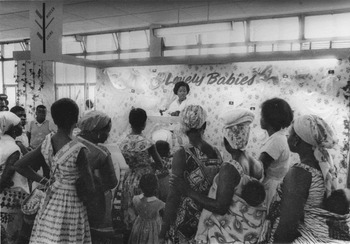
For the most part, Kingsway catered to upper- and middle-class consumers. Print and radio advertisements, as well as other promotional campaigns – including talks and lectures at society groups like the Young Women's and Men's Christian Associations (YWCA and YMCA), domestic training colleges and professional women's clubs – targeted upper- and middle-class women in particular. However, entrance and admission to store events was not limited to them. Kingsway beauty contests, baby and fashion shows, and home demonstrations were free and open to the public. For instance, a photograph taken at Kingsway's Modern Living Promotion in 1961 depicts a diverse audience including school girls, professional women, mothers and curious youngsters attending the Lovely Babies Competition (Figure 3).Footnote 77
‘Lovely Babies’ competition, Kingsway Stores, Accra, 29 May–10 June 1961 (Reproduced with kind permission of Unilever from originals at the Unilever Archives, UAC/2/10/B1/8/1)

To some extent, advertisers constructed Kingsway as a gender-neutral space. For men, shopping at Kingsway was deemed more acceptable than local outdoor markets, which in southern Ghanaian cities were predominantly female spaces. While men sold specific goods, like electrical goods, hardware and shoes, women controlled most retail trade in essentials like foodstuffs, toiletries and other domestic goods. This gender division is clearly described in Christine Oppong's study of middle-class marriage in the 1960s. Interviews with husbands and wives about about the division of household labour reveal that men abhorred market shopping. Oppong noted that ‘Some of the wives laugh about this saying that their husbands are only willing to shop in the market when there is no one around to see them. If they go they may be teased by market sellers’ (Oppong Reference Oppong1981: 110). The Kingsway environment and self-service system worked to gender-neutralize shopping. The modern man could also be a shopper. Contests like Kingsway's ‘Smart Man’ competition targeted young men and awarded prizes, including clothing valued up to ₤25, to the best-dressed contestants.Footnote 78 In addition, the local press jumped at opportunities to snap photos of Kwame Nkrumah, labelled the ‘citizen among citizens’ by the Evening News, on his many Kingsway shopping trips.Footnote 79 Advertisements portrayed Kingsway as a place for both men and women. Furthermore, it promoted shopping as a joint activity for couples (Figure 4).Footnote 80
‘Shopping is such a pleasure at Kingsway,’ c. 1955 (Reproduced with kind permission of Unilever)

Despite the UAC's efforts to promote new ways of shopping, divisions between older and newer practices remained fluid. While Kingsway presented itself as a ‘one-stop’ department store/supermarket, this concept proved impossible to realize in practice. For instance, elite women like van der Staaij-Ghartey, who had the means to purchase goods at large department stores, describes still shopping at local markets: ‘We [still] went to the market to buy our indigenous foodstuff, plantain, fresh tomatoes, cassava, smoked fish, kontomire, garden eggs, anything to do with Ghanaian cooking. … So sometimes we went to the market to buy these things because they are there and they are cheaper. And fresh.’Footnote 81 Her explanation suggests fluidity between urban shopping spaces. Although she shopped at large stores like Kingsway and UTC, she also shopped weekly at Accra markets like Makola to buy food and to compare prices of other items to make sure she was getting the best deals.
Additionally, although it claimed to be the leader in modern living and fashion, Kingsway was never the only place that Ghanaian shoppers could come into contact with new products and styles.Footnote 82 Other department stores such as UTC and Glamour carried the same items, and Ghanaian-owned companies offered similar products at cheaper prices than Kingsway.Footnote 83 Films, magazines and mail-order catalogues also gave rise to new ideas about home furnishings and fashion. Even school children found different ways to consume. As a young student in the early 1950s, Edward Akurang Dankwa remembered that he and his friends found penpals from the USA, Europe and Britain with whom they could exchange gifts. He remembers asking for department store catalogues and smaller items like sunglasses.Footnote 84
The process of ‘remaking’ imported fashions and goods was another strategy used by those who did not have the money or means to shop at places like Kingsway. Nate Plageman (Reference Plageman2008) notes that financially marginalized groups like labourers, students and migrants found ways to participate in forms of commercialized leisure and nightlife in the city by producing their own versions of the fashions, including gowns and suits, on sale in large department stores.Footnote 85 He noted that young women in particular sewed their own dresses, which they explained was cheaper than purchasing a ‘store-bought item’ and allowed them to ‘exercise individual taste and style’. Because stores like Kingsway also published descriptive weekly announcements about new stock in the local press, those with access to newspapers could get an idea of what was in the store without actually setting foot in it.
The practice of reselling was also widespread. The UAC openly admitted that it was impossible to know which buyers were end-use consumers as opposed to small retailers who resold items for profit.Footnote 86 While fixed pricing and written product information and price tags may have deterred customers who preferred to bargain in markets for lower prices, or may have intimidated customers who could not read, these same customers could buy from retailers selling the goods outside. Reselling was also beneficial for those who desired items, but were not eligible for store credit. For instance, though the UAC's larger retail stores had credit options, they only accommodated the wealthier, ‘regular’ customers. Van der Staaij-Ghartey commented that the only reason Accra department stores gave her credit was because she was married to a European from another well-known firm.Footnote 87
Cases of remaking and reselling of goods further reveal that divisions between large-scale, foreign-operated commercial institutions and local retailing systems were blurred. Former manager Michael N. Ankumah remembers touring rural areas in the late 1960s to sell UAC shares and educate people about shareholding. He remembered vividly one old man who fell asleep at the presentation and woke by responding ‘UAC shirts, it would be a very good shirt. I'll buy one.’Footnote 88 While the prospective buyer had clearly misunderstood that Ankumah was selling stocks, not shirts, it is clear from his encounter that customers in the rural areas were familiar with UAC products and with people transporting and reselling goods from cities. Instead of accepting Kingsway as the ‘general standard of shopkeeping’, as intended by UAC's directors, Ghanaian retailers and consumers integrated the store and the goods inside into their own practices of selling, so shaping Kingsway's participation in the local economy.Footnote 89
‘WORLD-CLASS SHOPPING’ IN ACCRA
The Kingsway story does not end here, for its history has very important contemporary implications. In 2007, I was in Ghana to witness the country's fiftieth anniversary as an independent nation. Throughout the year, Ghana hosted several events to celebrate independence, including cultural exhibitions and performances, the 2007 International Trade Fair, and the ninth African Union summit in Accra, which brought together various African heads of state. A part of all these celebrations was the opening of what developers described as Ghana's first ‘world class shopping centre’ – the long-awaited Accra Mall.Footnote 90 Located north of the capital's original city centre, the new Accra Mall is situated at the intersection of Tetteh Quarshie Roundabout and Spintex Road, just off the Tema Motorway. It is surrounded by middle- and upper-class residential areas and is a short distance from several up-market tourist hotels and the Kotoka International Airport.
Through local newspapers, radio and television commercials, developers promoted the mall as a safe and congenial shopping environment, as well as a site of entertainment and leisure.Footnote 91 The mall houses 65 retail shop spaces, including restaurants, a nightclub and a movie theatre. It is also home to two large South African chain stores, ShopRite, a mega-supermarket, and Game, a big-box general merchandiser. In his inaugural address, Joseph Owusu-Akyaw, an initiating partner and the mall's main spokesperson, argued that the Accra Mall would not only serve as a national symbol of modernization and progress, but would also raise the standard of living, act as a major tourist destination, and help boost foreign investment. Additionally, he argued that the mall would cater to the upper and growing middle-income groups, foster the development of ‘middle-class taste’, and encourage Ghanaians to shop in more ‘formalized shopping facilities’.Footnote 92
Throughout the year, I followed the mall's press coverage and publicity and spoke to several Accra residents. While some visited the mall out of curiosity or as something fun to do with friends, most still did their shopping in and around their own neighbourhoods or at one of Accra's 28 larger open-air markets, often complaining that the mall's location was inconvenient (Darkwah Reference Darkwah2002: 22). In addition, others I spoke to revealed intentions to buy items at stores like ShopRite and resell them for small profits. While weekly ShopRite circulars clearly stated, ‘We reserve the right to limit quantities. No traders’, these women mentioned goods ranging from glassware to candy in their potential resale plans.Footnote 93 Owusu-Akyaw's claims that the Accra mall would provide Ghanaians with their ‘first local modern shopping experience’ echoed those made by Kwame Nkrumah fifty years earlier at the opening of the new Kinsgway. Nkrumah had also positioned Kingsway as a symbol of national development, promising Ghanaian consumers ‘the modern shopping experience’.
Today, large-scale urban retail developments still function as symbols of modernization, as African politicians and businessmen use ideologies of consumerism to attract foreign investment, as well as gain political and financial support from the upper and middle classes. Though contemporary developers claimed that the construction of the Accra mall would increasingly attract Ghanaian consumers to more formalized shopping facilities, they failed to recognize that these establishments have existed for decades. Not only is this developer discourse strategic, it is also dangerous. The focus on ‘modernization’ and ‘progress’ mask the realities of most people's everyday lives. The majority of Ghanaians, and many other consumers living in poorer countries, do not shop at ‘formalized shopping centres’, not because they don't exist, but because of local and global economic constraints, lack of quick reliable public transportation, family obligations, and daily responsibilities that leave no time for travel or leisurely shopping trips. Links between Kingsway and the Accra Mall reiterate the importance of a historical approach in understanding contemporary commercial developments and the role of consumer politics in shaping discourses about Africa cities.
CONCLUSION
Despite the perception that department stores in West Africa are a recent phenomenon, modern indoor retail spaces have existed in its major cities since the mid-twentieth century. Furthermore, African consumer practices are not simply copies of processes that originated in Europe and North America. Rather, they are products of specific historical processes, including the expansion of colonial capitalism, struggles for political independence, increased urbanization, and negotiations over what has constituted the ‘modern’. In post-colonial Ghana, these processes fuelled the multiple economic and political motivations behind the building of the new Kingsway in Accra. For the UAC, agreeing to invest in the ₤500,000 department store was a public relations strategy and an attempt to legitimize the company's activities in a future independent Ghana. In addition, it was a means for the UAC to shed its past as an old colonial merchant firm and align itself with larger retail developments happening around the world. Kwame Nkrumah's intervention was also a major factor in the construction of Kingsway. While local authorities were divided on whether a large-scale retail development should be part of an expanding post-colonial city, Nkrumah supported Kingsway as an addition to a long list of large-scale development projects he foresaw as key to the building of a new modern nation.
However, beneath the new store's sleek exterior, various social and cultural conflicts emerged on the selling floor. The presence of white-collar working women, young managers supervising older employees, and the mixing of white expatriate and middle- and upper-class African shoppers challenged pre-existing local and colonial notions of authority based on race, gender and age. In addition, fixed-price labels, written product information and self-service catered to literate, more educated consumers. The new Kingsway became a space for upper and emerging middle-class Ghanaians to distinguish themselves from the lower classes and participate in a shared sociability. To some extent, the new Kingsway exacerbated social inequalities and illuminated the limitations of large-scale development projects intended by the post-colonial government to benefit ‘all Ghanaians’. A historical analysis of urban commercial centres in West Africa therefore demonstrates the importance of consumer politics to post-colonial urban development, as well as to understanding debates about consumerism in Ghana today.
ACKNOWLEDGEMENTS
This research was funded by Fulbright-Hays and the University of California President's Dissertation fellowship. I am extremely grateful to former UAC employees and Kingsway shoppers who graciously shared their time and knowledge with me. I am also grateful to panelists and participants at the ‘Tuning into African Cities’ Conference at the Centre for West African Studies, University of Birmingham (2010) and the ‘Revising Modernization’ Conference at the University of Ghana, Legon (2009) for their comments and suggestions. Stephan Miescher, Erika Rappaport, Dmitri van den Bersselaar, Stephanie Decker, Kobina Dodoo, Hajara Musah, Hannah Serwah Bonsu, Diane Backhouse, Karin Barber and an anonymous Africa reader have also helped me along the way.