I. INTRODUCTION
With the rapid development of information technology, the miniaturization and high frequency tendency of electronic systems become the main steam. Thus, the downsizing of electronic components must keep pace with the miniaturization trend, while the multilayer chip inductors (MLCIs) have achieved great success. In this way, more and more efforts begin to focus on the preparation of low temperature sintered ferrites, which are the fundamental materials for the MLCIs. Reference Jia, Luo, Zhang, Xue and Jing1,Reference Wang, Li, Yue and Su2 As we all know, Ag is always chosen as the inner conductor of MLCIs to ensure high Q value because of its low resistivity. Reference Wang, Li, Yue and Su2,Reference Wang, Li, Su and Yue3 So it is important to develop ferrites having low sintering temperature below 960 °C and being able to be co-fired with the Ag electrode. In recent years, the spinel NiZn ferrites have been widely used in MLCIs industry. Compared with the spinel ferrites, the planar hexagonal ferrites possess higher Snoek product, which is beneficial to improve the application frequency. Reference Jia, Luo, Zhang, Xue and Jing1–Reference Zhang, Bai, Han, Wang, Lu, Qiao, Cao and Guo9 Therefore, the hexagonal ferrites become ideal soft magnetic materials for the MLCIs. Among these ferrites, the well performed magnetic property of Co2Z (Ba3Co2Fe24O41) has attracted the most attention. Reference Wang, Li, Yue and Su2,Reference Kimura, Shoji and Maiwa5,Reference Zhang, Zhou, Wang, Li, Yue and Gui10 Since the Co2Z ferrites have a very high sintering temperature of about 1250 °C, works to lower the sintering temperature of Co2Z are necessary. Considering the demand of keeping the relatively high initial permeability of Co2Z at low sintering temperature, the Zn2+ substitution was reported to be a useful way. Reference Wang, Li, Yue and Su2,Reference Wang, Li, Su and Yue3,Reference Zhang, Zhou, Wang, Li, Yue and Gui10 In previous works, the BaCu(B2O5) (BCB) has been proven as a highly effective sintering aids to lower the sintering temperature of various materials. Reference Kim, Lim, Kim, Nahm, Paik, Kim and Park11–Reference Chen, Zhou, Fang, Liu and Wang14 In this study, a small amount of BCB is utilized as the sintering aids to decrease the sintering temperature of (Co0.4Zn0.6)2Z ferrite. The influences of different BCB amounts on the sintering behavior, phase composition, microstructure, dielectric and magnetic properties of Z-type hexagonal ferrite are investigated.
II. EXPERIMENTAL
(Co0.4Zn0.6)2Z was synthesized by the solid-state reaction. Raw materials, analytical grade oxide powders (≥99, Sinopharm Chemical Reagent, Shanghai, China) BaCO3, Fe2O3, CoO, ZnO were weighed according to the stoichiometric proportion, powders were mixed and milled for 4 h using a planetary mill with the ZrO2 milling media, the mixed powders were dried and then calcined at 1250 °C in air for 4 h. To synthesize the BaCu(B2O5) ceramic powders, Ba(OH)2·8H2O (≥98, Sinopharm Chemical Reagent., Shanghai, China), CuO (≥99, Sinopharm Chemical Reagent, Shanghai, China), and H3BO3 (≥99, Sinopharm Chemical Reagent, Shanghai, China) were mixed in a ball mill for 4 h, then dried and calcined at 800 °C in air for 4 h. Reference Chen, Zhou, Fang, Liu and Wang14 The powders of the system of (Co0.4Zn0.6)2Z + x(BCB), where x = 0.5, 1, 3, 5 wt%, were further mixed using a planetary mill with the ZrO2 milling media, and the mixed powders were pressed into disk-shaped pellets (10 mm in diameter with thickness of 1–2 mm) and toroidal samples (outside diameter of 15 mm, inside diameter of 9 mm, and thickness of 1–2 mm) with 5 wt% polyvinyl alcohol. Final sintering was carried out at 925 °C in air for 4 h with the heating rate of 3 °C/min. For compatibility test, 20 wt% silver powder was mixed with ferrite powder that contains 5 wt% BCB and then sintered at 925 °C in air for 2 h.
Phase compositions of all the sintered samples were detected by x-ray diffraction (XRD) with Cu Kα radiation (D/MAX-2400 x-ray diffractometer, Rigaku, Tokyo, Japan) in the range of 2θ = 10°–70°. The microstructures of the sintered samples were observed using a scanning electron microscope (SEM, JSM-6360, JEOL, Tokyo, Japan). The low frequency dielectric properties of the ceramics were measured from 100 Hz to 1 MHz, 1–100 MHz by impedance analyzers of 4980A, 4294A (Agilent, Palo Alto, CA), respectively. The complex permeability and permittivity in high frequency range (1 MHz–1 GHz) of the samples were measured by an impedance analyzer (4291B, Hewlett Packard, Palo Alto, CA) with a 16454L magnetic test fixture and a 16453A dielectric material test fixture. The magnetic hysteresis loops of the samples were detected using a vibrating sample magnetometer 735 (Lake Shore 7300, Westerville, OH). The DC resistivities were measured by a high resistance meter (4339A, Hewlett Packard, Palo Alto, CA). The bulk densities of the sintered specimens were determined by the Archimedes method.
III. RESULTS AND DISCUSSIONS
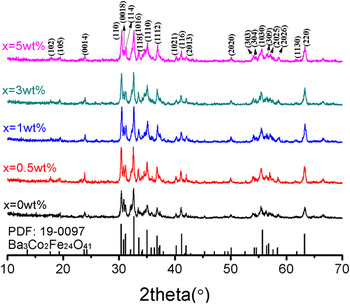
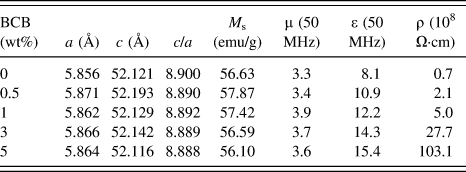
Figure 1 shows the XRD patterns of the sintered Z-type hexagonal ferrites with different amounts of BCB. Compared with the JCPDS card of Ba3Co2Fe24O41 (#19-0097), the major phase of all the samples can be determined as Z-phase without any secondary phase, no peaks for BCB second phase were detected in the XRD patterns, it was attributed to the fact that the BCB existed as a liquid phase and kept amorphous phase during cooling. Reference Kim, Lim, Kim, Nahm, Paik, Kim and Park11 It can be seen from the Table I that the ratio of the lattice parameter c/a can be regarded more or less unchanged, indicating that the small amount of BCB (0.5 –5 wt%) in this system acting as fluxing agent.
XRD patterns of the samples (Co0.4Zn0.6)2Z + xBCB (x = 0, 0.5, 1, 3, and 5 wt%) sintered at 925 °C for 4 h.

Lattice parameters and main electromagnetic properties of the samples (Co0.4Zn0.6)2Z + xBCB (x = 0, 0.5, 1, 3, and 5 wt%) sintered at 925 °C for 4 h.

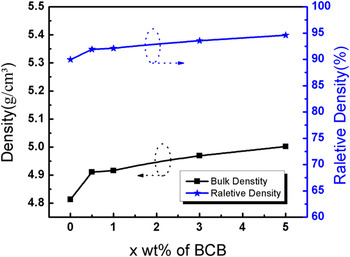
Figure 2 presents the variation of bulk density and relative density of the (Co0.4Zn0.6)2Z + xBCB ceramics, where x = 0, 0.5, 1, 3, 5 wt%. It can be found that the bulk density of the samples increases with the BCB amount increasing from 0 to 5 wt%. This variation is caused by the liquid phase emerged with BCB additions, which can promote the grain growth of the ferrites at a low sintering temperature. It indicates that the introduction of BCB sintering aids is effective to lower the sintering temperature of (Co0.4Zn0.6)2Z.
Density of the samples (Co0.4Zn0.6)2Z + xBCB (x = 0, 0.5, 1, 3 and 5 wt%) sintered at 925 °C for 4 h.

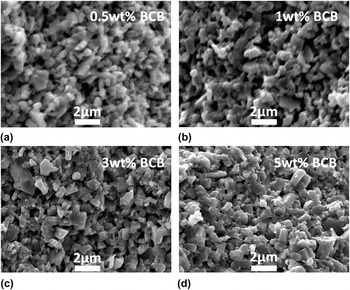
Figure 3 presents the SEM micrographs (fracture surface) of the low temperature sintered samples. For the sample with 0.5 and 1 wt% BCB, many pores exist and the grain size is too small to form a dense ceramic. With the increasing of BCB amount, grain growth is promoted by the liquid phase caused by BCB. As Fig. 3 points out, the 5 wt% BCB added sample has a homogeneous microstructure with few pores existing.
SEM micrographs (fracture surface) of samples with BCB of (a) 0.5 wt%, (b) 1 wt%, (c) 3 wt%, (d) 5 wt%. The samples were sintered at 925 °C/4 h.

The BCB addition also affects the DC resistivity (ρ) of the low temperature sintered (Co0.4Zn0.6)2Z. It can be seen from Table I that the BCB added samples have higher resistivities than 108 Ω·cm, therefore meeting the demand of MLCIs manufacturing well. Reference Wang, Li, Yue and Su2 The resistivity increases significantly with the increasing of BCB amounts, this is related to the particular structure of the ferrites, which is regarded to consist of well-conducting grains and poorly-conducting grain boundaries. Reference Wang, Li, Yue and Su2,Reference Koops15 With the BCB addition promoting the grain growth, pores can be removed with the improvement of densification and the proportion of grain boundaries increases. So the increase of poorly-conducting grain boundaries can lead to an increase on resistivity.
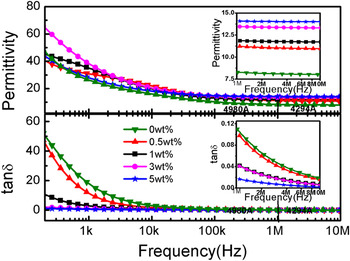
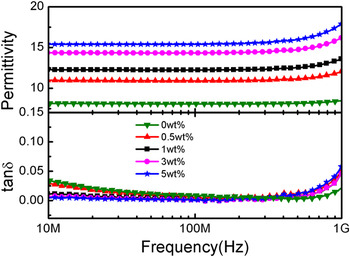
Figures 4 and 5 show the frequency dependency of dielectric properties of all the samples in a wide frequency range (200 Hz–1 GHz). It can be seen from Fig. 4 that the samples exhibit dielectric dispersion at low frequency range. This dielectric behavior of the ferrites is attributed primarily to the Maxwell–Wagner type interfacial polarization caused by their heterogeneous structure comprising low resistivity grains separated by high resistivity grain boundaries as described by the Koop's phenomenological dispersion theory. Reference Koops15–Reference Khetrea, Jadhav, Jagadale, Kulal and Bamane17 The dielectric behavior of the present materials can also be explained on the basis of polarization mechanism, which is similar to the conduction process. Reference Köseoğlu, Bay, Tan, Baykal, Sözeri, Topkaya and Akdoğan18 In ferrites, with the electron exchanging between Fe2+ and Fe3+, the Fe2+ ↔ Fe3+ dipoles align themselves with the alternating field and thus determine the polarization. At higher frequencies, the dielectric constant is independent of frequency because the polarization from the electron exchange cannot follow up the fast variation of the alternating field. Also, it can be seen from the Fig. 4 that the dielectric loss of the hexagonal ferrites decreases significantly with the increasing BCB amount, especially in low frequency range. This is attributed to the fact that the BCB addition leads to an obvious increase in the resistivity of the hexaferrites, as presented above. As we know, an alternating electric field causes both polarization loss and leakage loss to the dielectric materials, thus the dielectric losses can be derived from two parts, the polarization part and the leakage part,
 $$D = {D_{\rm{P}}} + {D_{\rm{G}}} = {{\left( {{\varepsilon _{\rm{s}}} - {\varepsilon _\infty }} \right)\omega \tau } \over {{\varepsilon _{\rm{s}}} + {\varepsilon _\infty }{\omega ^2}{\tau ^2}}} + {\gamma \over {\omega {\varepsilon _0}}}\left( {{1 \over {{\varepsilon _{00}} + {{{\varepsilon _{\rm{s}}} - {\varepsilon _\infty }} \over {1 + {\omega ^2}{\tau ^2}}}}}} \right)\quad ,$$
where D is the dielectric loss, D P is the polarization loss, D G is the leakage loss. It can be seen that at low frequency range, the dielectric loss mainly caused by leakage loss and can be described as follow Reference Yang, Wang, Xiang and Yao19 :
 $$D \cong {\gamma \over {\omega {\varepsilon _0}{\varepsilon _{\rm{s}}}}}\quad ,$$
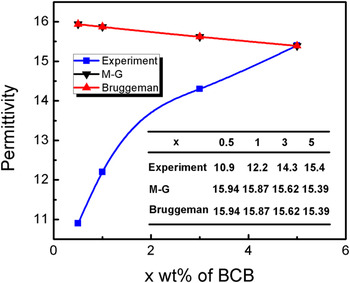
where γ is the conductivity, whose value is in inverse proportion to that of resistivity, so the dielectric loss at low frequency decreases significantly with the increasing of BCB amount. Meanwhile, the pores decrease with the BCB amount increasing from 0 to 5 wt%, which is beneficial to the decreasing extrinsic loss of the materials. It can be seen from Fig. 5 that with the increasing BCB amount, the permittivity of the hexagonal ferrites increases gradually. As we know, the variation of permittivity is influenced by many factors, including composition stoichiometry, microstructure, and density, etc. Reference Jia, Luo, Zhang, Xue and Jing1,Reference Zheng, Zhang, Xiao and Bai20 In this system, the permittivity changed in a manner similar to that of the relative density. Moreover, the permittivities of all the samples keep a stable value within a wide frequency range from 1 MHz to 800 MHz. Besides, Fig. 6 presents the comparison of permittivity between experimental data and theoretical data. The theoretical data are obtained via the Maxwell–Garnett (M–G) formula and the Bruggeman formula. It can be seen from Fig. 6 that the fitting curves go through a little value change, for the small amount of BCB addition (≤5 wt%) lead to a small decrease of permittivity in this composite. In contrast, the experimental data show a great change, as analyzed afore, the permittivity increases gradually with the relative density increasing from 91.9 to 94.6%. As shown in Fig. 6, only for the 5 wt% added sample, which has achieved the highest density, the experimental data fit the theoretical data well. The experimental value is consistent with both the M–G model and the Bruggeman model.
Frequency dependency of dielectric properties of the samples in low frequency range of 200 Hz–10 MHz. Inset shows the frequency dependency of dielectric properties of the samples from 1 to 10 MHz. The samples (Co0.4Zn0.6)2Z + xBCB (x = 0, 0.5, 1, 3, and 5 wt%) were sintered at 925 °C for 4 h.

Frequency dependency of dielectric properties of the samples in high frequency range of 10 MHz–1 GHz. The samples (Co0.4Zn0.6)2Z + xBCB (x = 0, 0.5, 1, 3 and 5 wt%) were sintered at 925 °C for 4 h.

Comparison of experimental and theoretical permittivities of the samples (Co0.4Zn0.6)2Z + xBCB (x = 0.5, 1, 3, and 5 wt%) sintered at 925 °C for 4 h. The theoretical values were calculated by Effective Medium Theory (M–G, Bruggeman) with quantities expressed in volumic%, the wt% had been converted into volumic% to meet the formula.

Moreover, the Z-type hexaferrites, which possess both magnetic and dielectric properties, often act as a double-medium material, so the parasitic capacity will lead to an LC resonant circuit when they are used in a circuit as an inductor and the resonant frequency (F r) is described by following equation:
 $${F_{\rm{r}}} = {1 \over {\left( {2\pi \sqrt {LC} } \right)}}\quad ,$$
where L is the inductance and C is the capacitance. Reference Wang, Li, Yue and Su2 Therefore, a lower permittivity can reduce the parasitical capacity and thereby extends the useful frequency range. Compared with the well sintered (Co0.4Zn0.6)2Z, which possesses a permittivity of about 16, Reference Jia, Luo, Zhang, Xue and Jing1,Reference Wang, Li, Yue and Su2 the BCB additions lead to a decrease in permittivity. This is attributed to the low permittivity of BCB (7.4). So in this system, the decreasing of permittivity caused by BCB additions makes the hexaferrite a better choice when used for inductor in a circuit.
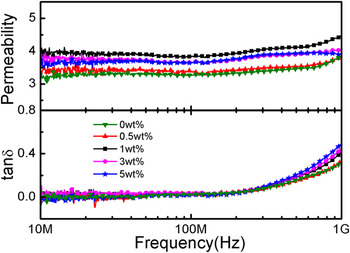
The frequency dependence of the magnetic properties of the specimens with different BCB concentrations is shown in Fig. 7. Compared with the pure Co2Z, there is a decrease of the initial permeability, which is attributed to the grain refinement caused by the BCB additions. It can be seen that for the specimen with 1 wt% BCB, the permeability reaches the maximum value of 3.9, and the permeability decreases with further addition of BCB from 3 to 5 wt%. In general, the initial susceptibility is involved with the spin rotational magnetization and the domain wall motion. It can be expressed as follow Reference Mu, Liu, Zhang, Song, Wen and Shen21 :
 $${\chi _{{\rm{iDW}}}} \approx {{{\mu _0}M_{\rm{s}}^2{D_{\rm{m}}}} \over {{K_1}\delta {\beta ^{{1 \over 3}}}}}\quad ,$$
 $${\chi _{{\rm{iSP}}}} = {{{\mu _0}M_{\rm{s}}^2} \over {2{K_1}}}\quad ,$$
where M
s is the saturation magnetization, D
m is the average grain size, K
1 is the magnetocrystalline anisotropy, β is the volume concentration of impurity, and δ is the thickness of the domain wall. For these high frequency ferrites with low permeability, the permeability is determined mainly by the spin rotation magnetization.
Reference Zhang, Zhou, Wang, Li, Yue and Gui22–Reference Nakamura24
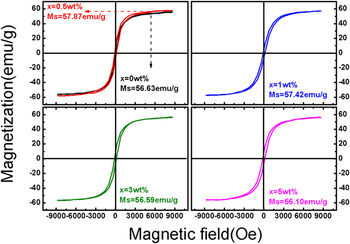
As shown in Fig. 8 and Table I, with the BCB amount increasing from 1 to 5 wt%, the M
s reduces from 57.42 to 56.10 emu/g. So the permeability changes in a direct proportion to
 $M_{\rm{s}}^2$
. For the specimen with 0 and 0.5 wt% BCB, although they possess relatively higher saturation magnetization, the poor densification gives rise to relatively lower permeability.
Reference Zhang, Zhou, Wang, Li, Yue and Gui22,Reference Xia, Su, Shen, Pan, Zhang, Zhang and Tang25
It also can be found from the Fig. 5 that the complex permeability of all the samples keeps a stable value within a wide frequency range and the cut-off frequency of them is all above 1.8 GHz. Moreover, with the BCB increasing from 0 to 5 wt%, the M
s increases first and then decreases as shown in Fig. 8 and Table I, it is attributed to the fact that appropriate BCB liquid phase promotes the grain growth during sintering, leading to an increase of magnetic moments. However, once the nonmagnetic liquid phase excesses in the magnetic system, the M
s will decrease with the decreasing of magnetic moment amount.
Frequency dependency of magnetic properties of the samples (Co0.4Zn0.6)2Z + xBCB (x = 0, 0.5, 1, 3, and 5 wt%). The samples (Co0.4Zn0.6)2Z + xBCB (x = 0, 0.5, 1, 3, and 5 wt%) were sintered at 925 °C for 4 h.

Magnetic hysteresis loops of the samples (Co0.4Zn0.6)2Z + xBCB (x = 0, 0.5, 1, 3, and 5 wt%). The samples were sintered at 925 °C for 4 h.

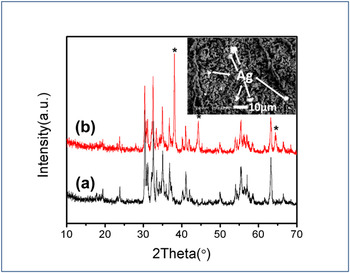
Figure 9 presents the XRD pattern and backscattered electron image of the 5 wt% BCB added (Co0.4Zn0.6)2Z ceramics co-fired with 20 wt% Ag powders at 925 °C for 2 h. Both the XRD pattern and backscattered electron image reveal that no reaction occurs between the ceramics and the Ag powders. Therefore, it indicates that this low temperature sintered ferrite can be co-fired with the Ag electrode and is a good candidate for MLCIs application.
XRD patterns of (a) 5 wt% added (Co0.4Zn0.6)2Z ceramic sintered at 925 °C for 4 h, (b) 5 wt% added samples co-fired with 20 wt% Ag powders at 925 °C for 2 h. Inset shows backscattered electron image of 5 wt% added samples co-fired with 20 wt% Ag powders at 925 °C for 2 h. (*-Ag, JCPDS card #65-2871).

IV. CONCLUSIONS
The (Co0.4Zn0.6)2Z + xBCB ceramics, where x = 0, 0.5, 1, 3, 5 wt%, were synthesized via the solid-state reaction method. The results indicate that the BCB addition with appropriate amount can be effective to lower the sintering temperature of (Co0.4Zn0.6)2Z. Meanwhile, the microstructures and electromagnetic properties of the samples are greatly influenced by the BCB additions. It is found that the BCB addition makes a contribution to the low loss of this low temperature sintered hexaferrites. Especially for the sample with 5 wt% BCB, the tan δμ is suppressed below 0.1 until 350 MHz and the tan δε keeps below 10−2 from 2 to 450 MHz. Also, the low temperature sintered ferrites possess both a good compatibility with the silver electrode and a resistivity higher than 108 Ω·cm. These properties meet the requirement of MLCIs industry and make this material a promising candidate for MLCIs application.
ACKNOWLEDGMENTS
This work was financially supported by National Science Foundation of China (61471290) and the SRFDP-RGC Joint Research Scheme 2013/14 (20130201140002).