Introduction and aims
Evolving technology and the growth of internet use in society has endowed medical educators and students with new ways to teach and to learn. E-learning is now a frequently and increasingly used mode of medical education, often existing in parallel with more traditional forms of learning.Reference McKendree and Swanwick1 Geriatric medicine, amongst other medical specialties, already makes use of internet technology for educational activities such as undergraduate teaching, specialty-trainee assessment and interdisciplinary clinical training, but there remain key opportunities and challenges for geriatric medicine to be able to make the most of e-learning. This review aims to summarize the evolving nature of e-learning including the significant advantages and the potential problems, examine the evidence base for the efficacy of e-learning, and map the current use of e-learning in geriatric medicine. Examples of the professional groups who might benefit from further use of e-learning are reviewed in turn, and suggestions made for good practice in the use of e-learning for geriatric medical education.
Background
Definitions
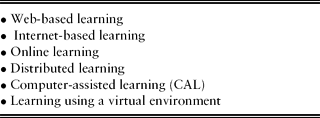
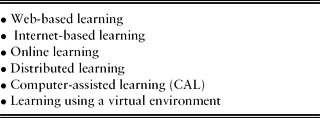
E-learning or ‘electronic learning’ is a catch-all term describing the use of computers in educational delivery,Reference McKendree and Swanwick1 and with the rise of the World Wide Web it has now come to mean internet-based education.Reference Ruiz, Mintzer and Leipzig2 In the UK the commonly used definition is that of the Joint Information Systems Committee (JISC): ‘learning facilitated and supported through the use of information and communications technology (ICT)’.3 However, more recent scholarship defines e-learning in the context of constructivist theories of education: ‘electronically mediated asynchronous and synchronous communication for the purpose of constructing and confirming knowledge’.Reference Garrison4 Terminology related to e-learning may at first appear daunting – particularly as e-learning is synonymous with a number of other descriptive terms (Table 1).
Synonyms for e-learning
Advantages of e-learning
The many advantages of e-learning relate to the mode of delivery.Reference Ruiz, Mintzer and Leipzig2 Content of e-learning courses can be standardized, and updating is carried out with ease and flexibility as it can potentially be done by any faculty member.Reference Cook5 E-learning courses are easily distributed worldwide with standardized delivery thanks to the internet, and there is potential for geriatricians to collaborate internationally in the development and use of resources.
E-learning can be harnessed to create a constructivist learning environment by building interactivity into course material. This leads to increased motivation as the learners become more active, rather than existing as ‘depositories’ to be filled with knowledge.Reference Freire6 Compared with traditional classrooms where knowledge transmission and testing is the norm, and 80% of the material is lost over a month, online learning provides a better environment for individual cognitive interaction to occur.Reference Clark7 It has been shown that ‘little and often’ learning is more effective than single full days spent in the classroom,Reference Clark7 thus e-learning may fit better in the acute clinical environment where learning must occur in tandem with service commitments and opportunities for engagement with computers may be brief.
E-learning students have 24-hour accessibility to their learning materials with control over the pace and time they studyReference Ruiz, Mintzer and Leipzig2, Reference Cook5 – for junior doctors, including specialty trainees in geriatric medicine, this allows the flexibility to access materials during night and weekend shifts where time allows. ‘Just in time’ delivery can occur, with e-learning allowing delivery at point-of-care in the medical field,Reference Fordis, King, Ballantyne, Jones, Schneider, Spann, Greenberg and Greisinger8 which in turn allows immediate application of evidence-based knowledge. An example of ‘just in time’ learning for a geriatrician might be to access an internet database to convert the dose of an anti-convulsant to a rectal or intravenous preparation for an elderly patient who could not swallow.
Potential disadvantages of e-learning
Many e-learning students describe a feeling of isolation; they do not have the social interaction available to them in traditionally taught courses.Reference Cook5 This can be overcome by creating online learning communities with interaction via asynchronous or synchronous tools such as discussion boards and online chat-rooms. In the context of geriatric medicine, specialty-specific forums are available and may be an important source of learning and support for healthcare professionals.9 Collaborative discourse resulting from engagement with such resources enables deeper learning.Reference Garrison4
Technical problems can mar the e-learning experience and put learners off further exploration of available resources. Moreover, in comparison with face-to-face traditional teaching, e-learning is expensive to create and may require on-going technical support or tutor interaction to respond to the needs of individual learners.Reference Cook5 However, in the longer term, there is evidence that e-learning can result in overall cost savings in comparison with traditional teaching methods.Reference Ruiz, Mintzer and Leipzig2 It is acknowledged that quality control of e-learning materials can be problematic, and that educational resources are rarely formally peer-reviewed in the same way as published journal articles.Reference Ruiz, Candler and Teasdale10
The evidence base for e-learning
It is hard to make direct comparisons on the effectiveness of e-learning versus traditional face-to-face teaching as each group is so heterogeneous. These variations do not allow us to know which component of which course resulted in better learning.Reference Cook5 According to a 2002 review, students preferred e-learning but there was little evidence to show that they learnt more than traditionally taught students.Reference Chumley-Jones, Dobbie and Alford11 A meta-analysis by Bernard et al.Reference Bernard, Abrami and Lou12 found that e-learning and classroom instruction were comparable, but that some aspects of e-learning such as asynchronous discussion out-performed classroom-based courses, whilst e-learning with synchronous communication under-performed in comparison with traditional teaching. ClarkReference Clark7 cites studies by Fletcher and Tobias,Reference Fletcher and Tobias13 Fletcher,Reference Fletcher14 KulikReference Kulik, Baker and O'Neil15 and Willett et al.,Reference Willett, Yamashita and Anderson16 all of which found that more is learnt by students using e-learning than traditional methods. It was concluded that this was due to interactivity of the learning materials leading to increased cognitive engagement. This underlines the importance of considering both appropriate content, and the extent of interactive components when designing and developing e-learning materials.
More recent studies have shown improved results with e-learning compared with conventional teaching. Kulier et al.Reference Kulier, Hadley, Weinbrenner, Meyerrose, Decsi, Horvath, Nagy, Emparanza, Coppus, Arvanitis, Burls, Cabello, Kaczor, Zanrei, Pierer, Stawiarz, Kunz, Mol and Khan17 found measurable changes in both knowledge and attitudes of postgraduates who had studied e-learning modules in evidence-based medicine, delivered in different languages in five different countries. Fordis et al.Reference Fordis, King, Ballantyne, Jones, Schneider, Spann, Greenberg and Greisinger8 measured behavioural change as well as knowledge in a study comparing live interactive continuing medical education (CME) with online CME. The online learning was superior, with suggested reasons being the ability to self-structure learning and several rather than single sessions. The impact of e-learning interventions in geriatric medicine is discussed with regard to specific professional groups below.
Current provision of e-learning in geriatric medicine
Innovative ways of using computers to teach and learn geriatric medicine have grown in parallel with the expansion of e-learning in general. In the US, where recruitment of trainees to geriatric posts is problematic,18 there is significant concern that there are simply not enough geriatricians to deliver care to the growing population of older people,19 or to provide specialist teaching to other healthcare providers.Reference Ruiz, Teasdale, Hajjar, Shaughnessy and Mintzer20 E-learning, now recognized to be at least as effective as traditional teaching methods and potentially cheaper, has been cited as a significant opportunity to roll out geriatrics training for non-specialist professional groups looking after older people,Reference Ruiz, Teasdale, Hajjar, Shaughnessy and Mintzer20 including distance-learning opportunities for hard to reach rural areas.Reference Johnson21, Reference Tompkins and Siegel22 A 2007 survey of US institutions providing geriatric medical education (undergraduate and postgraduate) found that 79% used the internet in some form to deliver teaching.Reference Hajjar, Ruiz, Teasdale and Mintzer23
The US has witnessed significant investment of funds in the development of e-learning resources for geriatric medicine teaching for professional groups, and the creation of repositories where resources can be shared internationally. The Portal of Geriatric Online Education (POGOe), a web-based facility for the sharing of geriatrics teaching materials, allows medical educators free access to a broad range of resources appropriate for undergraduate and postgraduate medicine, nursing and other professional groups.24 In response to the need to provide high-quality resources for medical education and to recognize the importance of educational scholarship, the Association of American Medical Colleges (AAMC) has established an internet database of learning materials, including examples relevant to geriatrics, that are rigorously peer-reviewed.25
In the UK, where recruitment of geriatrics trainees is currently not as problematic as that in the US,26, Reference Tullo and Colburn27 there is nevertheless similar appreciation that there is a growing population of older people who need appropriate care. Better training for all healthcare professionals who provide care for older people is warranted;Reference Ebrahim28, Reference Singh and Hubbard29 whilst some training can be directly provided by specialists in geriatric medicine, e-learning resources could be used to extend education to larger groups. In comparison with the US there is a paucity of published examples of the use of e-learning to teach geriatrics in the UK, and it is unclear to what extent e-learning contributes to teaching and learning in geriatric medicine in the undergraduate or postgraduate environment.
Professional groups that could benefit from e-learning
The opportunities and challenges to the delivery of robust medical education about geriatric medicine vary between different professional groups and stages of training.Reference Singh and Hubbard29 Consequently, the ways in which e-learning could enhance geriatric education, and the potential barriers to be overcome, will be considered for each group in turn.
Undergraduate medical students
Key challenges to improving undergraduate medical education about geriatrics include the difficulty of embedding specialist geriatrics teaching in an ever-crowded, increasingly integrated curriculum,Reference Lally and Crome30 the loss of academic departments specializing in geriatric medicine,Reference Bartram, Crome, McGrath, Corrado, Allen and Crome31 and paucity of evidence as to effective teaching methods.Reference Tullo, Spencer and Allan32 Some of the features inherent to e-learning can be harnessed to mitigate such challenges.
Where traditional teaching methods such as lectures and seminars require the regular attendance of trained faculty to deliver face-to-face teaching, e-learning (once constructed and established) can reduce the on-going demand for teaching staff. Many e-learning resources allow students to self-pace, allowing for variation in speed of learning and thus giving students more autonomy than is possible in a tutor-led session such as a lecture.Reference Clark7 Topics relevant to geriatric medicine that have been traditionally absent from teaching, for example, continence or falls, may be introduced through an e-learning tutorial before being considered in more depth in the specialist clinical environment. Andrews et al.Reference Andrews, Schwarz and Helme33 found that a computer-assisted learning (CAL) package on dementia, undertaken during a 2-week clinical geriatrics course, improved participants’ knowledge of dementia more than a control group who did not use the CAL package during the same course.
In circumstances where it can be difficult to co-ordinate the exposure of large groups of students to important groups of older people such as older people with psychiatric disorders, e-learning can at least provide students with basic introduction.Reference Rathod, Rosenvinge and Martin34 Online videos of patient testimony can be a powerful tool for educating groups of students about the personal lives of patients that does not necessitate the co-ordination of multiple visits to hospital and community settings.35
Another way to simulate clinical contact with older people is to use e-learning to construct ‘virtual patients’ (VPs) – this allows students to work through the decision-making process when confronted by a computer-simulated patient with a particular set of clinical symptoms in a safe environment. Clinical information such as examination findings, test results and imaging can be introduced to the student as they progress though the case, and dynamic feedback given throughout.Reference Tan, Mulhausen and Ruiz36 Although VPs can be expensive and complex to set up initially, there is evidence that VPs are a useful educational medium for teaching and assessment in geriatric medicine and are rated highly by students.Reference Orton and Mulhausen37, Reference Bautista, Meuleman, Shorr and Beyth38 VPs are an illustration of learning in a realistic context, and are an example of ‘situated learning’, which is known to achieve deeper cognitive results.Reference Ally, Anderson and Elloumi39
The potential advantages of portfolio learning have led to an expansion in their use in undergraduate medicine,Reference Buckley, Coleman, Davison, Khan, Zamora, Malick, Morley, Pollard, Ashcroft, Popovic and Sayers40 often making use of computer technology for efficiency. Supiano et al.Reference Supiano, Fantone and Grum41 used a web-based portfolio to link geriatrics-specific learning outcomes with the rest of the curriculum and encourage medical students to map their achievement of these learning outcomes throughout the undergraduate course. Duque et al.Reference Duque, Finkelstein and Roberts42 found that medical students who were trained to use a web-based portfolio during a geriatrics rotation achieved higher assessment scores following the rotation than a control group who did not have the training, suggesting that portfolios may be an effective adjunct to other forms of geriatric medicine teaching.
Geriatric medicine specialty trainees
In the UK, specialty trainees in geriatric medicine are expected to present evidence of learning and achievement of competencies based on the content of a national curriculum.43 E-learning guides this process as trainees use an e-portfolio to collate and display data for formative educational review with supervisors, and later for summative assessment of competencies. However, it can be challenging for specialty trainees to demonstrate all of the competencies set out in the curriculum, particularly with regard to subspecialist areas such as continence.Reference Wardle44 Online tutorials and web-based short courses on subspecialty topics are one way for a trainee to demonstrate evidence of learning, and to pursue topics of personal interest, although availability of such resources is patchy and they may not be peer-reviewed or evidence-based.
Despite the evidence for e-learning as an effective educational approach in general, it remains unclear whether e-learning in the postgraduate medical environment is any more effective than activities such as self-directed reading of journal articles. Westmoreland et al.Reference Westmoreland, Counsell, Tu, Wu and Litzelman45 compared the performance of residents (junior doctors) rotating through a geriatric medicine placement randomized to a web-based or paper-based programme of geriatric education. Each group had 2 half-day educational sessions during their rotation, and were later assessed in terms of their knowledge, and in terms of their clinical assessment of standardized patients who were blinded to the type of education their clinician had received. Although the knowledge scores of both groups improved, knowledge improved more for the group who took part in the web-based educational sessions. However, there was no discernible difference in clinical assessment of standardized patients.
E-learning is also becoming integral for assessment of knowledge of specialty trainees in geriatric medicine. Although the e-portfolio can be used a method of formative and summative assessment throughout training, the recently introduced specialty certificate examination (SCE) in geriatric medicine is now mandatory for progression to becoming a consultant.46 The SCE is a computer-based test, comprising 200 ‘best of five’ questions, and is a criterion-referenced test designed to ensure adequate specialty-specific knowledge. This type of e-assessment has a number of advantages including instant marking, tracking and storage of scores for quantitative analysis, and scope for systematic audit and quality assurance.Reference Ellaway and Masters47
Consultant geriatricians (continuing professional development)
Consultants in geriatric medicine are required to demonstrate their on-going competence to care for older people and that they are sufficiently up-to-date with evolving clinical evidence. Like specialty trainees, consultant geriatricians may choose to make use of online resources to recap on subspecialist areas or for more generic professional areas such as research, communication and management skills. Online databases, for example Medline®/Pubmed®, are helpful tools for accessing relevant clinical trials and reviews. A key challenge to consultants is finding time for educational activities alongside clinical commitments. The inherent flexibility of e-learning makes it advantageous for clinicians who are limited to engaging in educational activities in a sporadic and irregular fashion.
Furthermore, the e-portfolio format, now used by the majority of trainees, also has some utility for consultant geriatricians in terms of collation of evidence of learning and continuing professional development (CPD). An e-portfolio or diary can be used both informally by consultants to direct their own CPD and formally at their annual appraisal as evidence of learning,48 and will constitute a valuable resource with the advent of revalidation.
Other healthcare professionals working with older people
The changing demographics of society have increased the number of older people coming into contact with healthcare professionals (HCPs) of all disciplines including nursing, physiotherapy and dentistry. The advantages of e-learning for postgraduate medics such as flexibility in terms of engagement, and the use of e-portfolios for CPD and formal evaluation/revalidation, are shared by these other professional groups. There is evidence that e-learning is already used by dentists, nurses, social workers and physio-therapists internationally,Reference Hills, Brallier, Palm and Graham49–Reference Gainor, Goins and Miller52 although evidence for its effectiveness is lacking. Clearly, e-learning resources concentrating on generic aspects of geriatric medicine may be highly relevant to multiple groups.
Formal postgraduate qualifications in geriatrics and gerontology are available at various UK institutions, and are relevant to HCPs from different backgrounds (in addition to doctors). However, the face-to-face format of such courses precludes many staff from attending due to clinical commitments. The e-learning format can provide far greater flexibility for participants, but courses with a geriatrics-specific focus using are rare.53, 54 Better availability of formal accredited qualifications in gerontology and geriatrics using e-learning is likely to be of value for the continuing education of professionals in multiple disciplines.
It is widely acknowledged that the care of older people requires the simultaneous input of multiple disciplines rather than parallel but isolated services. Interdisciplinary education is an evolving field that has been shown to have multiple positive outcomes,Reference Hammick, Freeth, Koppel, Reeves and Barr55 including in the field of geriatric medicine.Reference Fulmer, Hyer and Flaherty56 E-learning may have a place in the delivery of interdisciplinary education, although there is currently meagre evidence as to whether e-learning is an appropriate format for interdisciplinary education about geriatrics. Coogle et al.Reference Coogle, Parham, Welleford and Netting57 showed that a mixed-methods distance-learning course in geriatrics improved the attitudes of participants towards working in interdisciplinary teams. Juntunen et al.Reference Juntunen and Heikkinen51 gathered feedback from participants and tutors involved in delivering an interdisciplinary e-learning course in geriatrics that required collaborative working between professions. Although feedback from students and tutors indicated that collaboration was possible via e-learning, students felt that there was a lack of appropriate supervision by tutors and the course had a participant drop-out rate of 25%.
Conclusions
The highlighted advantages of e-learning make a case for expanding its remit in order to improve education in geriatric medicine in the undergraduate, postgraduate and interdisciplinary environment. In terms of successfully introducing new e-learning material into a geriatrics-based programme, blended learning, an approach combining e-learning technology with more traditional tutor-led methods, could be adopted by institutions less familiar with e-learning as a way of beginning to integrate these modes of learning.Reference McKendree and Swanwick1 Training should be offered for staff members and students new to e-learning to help them become more confident in engaging with the material. There is scope for the content of existing postgraduate courses relevant to geriatric medicine to be transformed into the e-learning format, which may also widen participation by allowing distance learning.
Key points

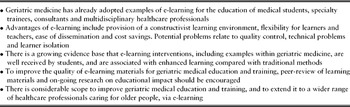
To maximize the benefits of e-learning, the quality of new materials should be evaluated by the designers and, ideally, through peer-review. On-going efforts to research the impact of e-learning materials on student performance is required within geriatric medicine to add to the existing evidence base. Design, delivery and evaluation of e-learning materials are likely to be enhanced if given recognition as valuable academic scholarship, in a similar manner to publishing biomedical literature.Reference Ruiz, Candler and Teasdale10 Peer-reviewed learning resources relevant to geriatric medicine should continue to be stored in electronic repositories and shared in order to disseminate to a larger population of learners.
The multiple advantages of e-learning are reflected in a growing evidence base in terms of student satisfaction, enhanced learning and cost savings. Geriatric medicine has already made some gains from the opportunities inherent to e-learning. However, there is considerable scope to improve geriatric medical education and training, and to extend it to a wider range of healthcare professionals caring for older people, via e-learning.
Conflict of interest
All three authors contribute to postgraduate e-learning courses at Newcastle University. The same institution is cited in the text as an example of an institution providing ageing-specific e-learning courses.