





1. Introduction
The epistemic side-effect effect (ESEE) is one of the more puzzling findings in experimental epistemology: people are more willing to attribute knowledge of a side effect when that side effect is harmful or norm-violating than when it is helpful or norm-conforming (Beebe and Buckwalter Reference Beebe and Buckwalter2010). The effect has proven robust (Maćkiewicz et al. Reference Maćkiewicz, Kuś, Paprzycka-Hausman and Zaręba2024), but its interpretation remains contested (Alfano et al. Reference Alfano, Beebe and Robinson2012; Dalbauer and Hergovich Reference Dalbauer and Hergovich2013; Paprzycka-Hausman Reference Paprzycka-Hausman2020; Wilkenfeld and Lombrozo Reference Wilkenfeld and Lombrozo2020; Maćkiewicz et al. Reference Maćkiewicz, Kuś, Zaręba and Paprzycka-Hausman2026). The central question is what participants take themselves to be attributing when they say that an agent knew or did not know.
This issue is especially important because ESEE appears even where ordinary predictive knowledge should be difficult to attribute, including false-outcome cases (Turri Reference Turri2014) and low-probability harm cases (Beebe and Jensen Reference Beebe and Jensen2012; Paprzycka-Hausman Reference Paprzycka-Hausman2020). It also persists under conditions designed to encourage reflection and reduce performance errors (Maćkiewicz et al. Reference Maćkiewicz, Kuś, Zaręba and Paprzycka-Hausman2026). Yet the attribution rates reported in these studies leave open whether participants understood the knowledge claim as a prediction that the outcome would occur, as awareness that it might occur, or as a more practically loaded attribution concerning risk and responsibility.
The present study addresses this interpretive question through semi-structured interviews examining how participants understand and justify their knowledge attributions. Section 2 develops the theoretical rationale for the study; Section 3 presents the research questions; Section 4 describes the method; Section 5 analyses participants’ interpretations and justifications across ESEE scenarios; and Section 6 discusses what these findings imply for understanding ESEE and for methods in experimental philosophy.
2. The interpretive problem of ESEE
The standard ESEE paradigm compares two closely matched cases. In the harm version, a company vice-president tells the CEO that a profit-making programme will harm the environment; in the help version, the corresponding side effect will help the environment. The CEO says that he does not care about the environment, implements the programme for profit, and the announced side effect occurs. Participants are then asked whether the CEO knew that the programme would harm or help the environment. Knowledge is attributed more often in the harm case, although the CEO receives parallel information and displays the same indifference in both versions. This divergence is theoretically puzzling because evidence, stated probability, outcome, and source reliability are ordinarily treated as epistemically relevant, whereas the moral valence of a side effect is not.
Explanations of this sensitivity differ in where they locate the relevant influence. Some treat normative valence as directly affecting knowledge attribution; others take it to operate through belief attribution, perceived probability, pragmatic or performance-related responding, or awareness of possible consequences.
2.1. Probability, consequence awareness, and competing explanations
Probability is one of the central challenges in explaining ESEE. A natural explanation is that participants may simply regard harmful side effects as more likely than helpful ones. Dalbauer and Hergovich (Reference Dalbauer and Hergovich2013) develop this idea in terms of a probabilistic side-effect effect: negative outcomes may be judged more probable even when objective probabilities are held constant. This raises the question of what happens to knowledge attributions when the harmful outcome is explicitly described as unlikely.
In such cases, a small stated chance would ordinarily seem insufficient for attributing knowledge that the outcome will occur. Nevertheless, Beebe and Jensen (Reference Beebe and Jensen2012) found that knowledge-attribution ratings were higher in the slight-chance harm condition than in the very-strong-chance help condition. Paprzycka-Hausman (Reference Paprzycka-Hausman2020) compared harm and help under both slight- and strong-chance conditions. In the slight-chance conditions, 83% of participants attributed knowledge in the harm condition, compared with 56% in the help condition. Thus, knowledge attribution remained common despite the low probability of harm, while the harm–help asymmetry persisted when the stated probability was matched across conditions. In that study, participants who attributed knowledge predominantly justified their responses by appealing to the agent’s awareness of a possible consequence rather than to grounds for predicting that the outcome would occur. A recent meta-analysis likewise found that chance manipulations did not significantly moderate the size of ESEE (Maćkiewicz et al. Reference Maćkiewicz, Kuś, Paprzycka-Hausman and Zaręba2024). Taken together, these findings suggest that probability alone explains neither why knowledge is attributed in low-probability harm cases nor why attribution rates differ between harm and help.
The question of what participants take the agent to know is central to two competing explanations of ESEE: the doxastic heuristic account and the consequence account. According to the doxastic heuristic account, ESEE derives from an asymmetry in belief attribution. People are more willing to say that the agent believed that a bad side effect would occur than that the agent believed that a good side effect would occur, and this asymmetry then carries over to knowledge (Alfano et al. Reference Alfano, Beebe and Robinson2012; Robinson et al. Reference Robinson, Stey and Alfano2015). The consequence account locates the effect in a different kind of epistemic attribution. In norm-violating cases, participants may attribute awareness that harm is a possible consequence of the action without attributing knowledge that harm will in fact occur (Paprzycka-Hausman Reference Paprzycka-Hausman2020; Paprzycka-Hausman et al. Reference Paprzycka-Hausman, Maćkiewicz, Kuś and Zaręba2023). On this account, possible harmful consequences are especially salient and relevant to action, which makes this consequence awareness reading more available in harm cases. The same distinction applies to false-outcome cases: when harm does not occur, the agent cannot have known that it would occur, although awareness that it was a possible consequence can remain intact.
2.2. Polish-language evidence on ESEE
ESEE is not confined to English-language research. The effect has also been reported in German (Dalbauer and Hergovich Reference Dalbauer and Hergovich2013), Korean and Mandarin Chinese (Yuan and Kim Reference Yuan and Kim2023), and Polish (Kuś et al. Reference Kuś, Maćkiewicz, Zaręba and Paprzycka-Hausman2026). A meta-analysis found no significant effect of language on the magnitude of ESEE (Maćkiewicz et al. Reference Maćkiewicz, Kuś, Paprzycka-Hausman and Zaręba2024). The available evidence therefore supports a degree of cross-linguistic robustness, although the limited number of languages studied and the predominance of close replications do not warrant a claim of linguistic universality.
In addition to evidence that ESEE occurs in Polish-language materials (Kuś et al. Reference Kuś, Maćkiewicz, Zaręba and Paprzycka-Hausman2026), a nationwide Polish panel study examined whether the asymmetry depends on the stated probability of the outcomes. The harm–help asymmetry was found both when the two outcomes were described as unlikely and when they were described as likely (Paprzycka-Hausman et al. Reference Paprzycka-Hausman, Maćkiewicz, Kuś and Zaręba2026, chapter 3).
A separate question is whether ESEE in Polish depends on the formulation of the knowledge probe. Kuś et al. (Reference Kuś, Maćkiewicz, Zaręba and Paprzycka-Hausman2026) replicated the effect across several Polish formulations: knowledge that the CEO would harm or help the environment, knowledge that implementing the program would have that effect, and knowledge that the environment would worsen or improve. These formulations differ in whether they frame the knowledge claim in terms of the CEO’s action, the consequences of implementing the program, or a change in the state of the environment. The asymmetry observed across these formulations suggests that the Polish-language effect does not depend on any one formulation, although greater variability in help cases indicates that wording may still shape responses. Taken together, these findings provide an empirical basis for using Polish-language ESEE materials in the present interview study.
2.3. Why a qualitative study?
Quantitative survey studies are well suited to establishing that ESEE occurs, estimating its size, and testing effects of manipulations such as probability, wording, order, or reflection. However, the same distribution of responses may be compatible with different understandings of the knowledge question and with different considerations that participants take to support their judgements.
Qualitative approaches are especially useful for examining how participants interpret philosophical questions, what distinctions they draw, and how they explain or qualify their judgements (Andow Reference Andow2016; Moss Reference Moss2017). They can reveal that identical answers to a closed question may reflect philosophically different positions, bring out commitments that standard survey responses do not capture, and identify readings of a scenario that differ from the researcher’s intended reading (Thompson Reference Thompson2023; Hansen et al. Reference Hansen, Francis, Greening, Knobe and Nichols2024).
Maćkiewicz et al. (Reference Maćkiewicz, Kuś, Zaręba and Paprzycka-Hausman2026) found the harm–help asymmetry even when participants could compare the two cases directly, were prompted to justify and reconsider their answers, or were explicitly informed about the asymmetry and the similarities between the cases. Most participants who answered the cases differently did not think their judgements needed revision. This makes ESEE difficult to dismiss as a readily correctable performance error. Qualitative analysis complements quantitative research by identifying the recurring interpretations participants use to make sense of ESEE.
3. Research questions
Building on the interpretive problem outlined above, the study examines how Polish-speaking participants interpret and justify knowledge attributions in ESEE scenarios and how these interpretations vary across scenario contexts. These aims are captured by three research questions:
-
1. How do participants justify attributing or denying knowledge in Knobe-style ESEE scenarios?
-
2. How do participants interpret the knowledge claim itself? In particular, do they treat it as a claim about knowing that the outcome would occur, knowing that it might occur, being informed about it, being aware of a risk or opportunity, or having practically relevant information?
-
3. How do justificatory and interpretive patterns vary across moral valence, probability level, scenario order, and comparison tasks?
4. Method
Our analysis focuses on the reasons participants gave for attributing or denying knowledge. We use ‘justification’ for participants’ responses to questions about why they made a particular knowledge judgement in a given scenario. These responses may involve post hoc rationalization and are not assumed to provide transparent reports of the psychological mechanisms underlying the initial judgement. We analyse how participants used them to interpret, defend, revise, and explain their judgements during the interview.
4.1. Design and interview protocol
Each interview comprised three ESEE vignettes presented in sequence. The study used four vignette sequences, corresponding to groups A–D. The sequences varied the valence and probability of the first vignette and the order of the later vignettes. Within each interview, vignette 2 changed valence while retaining the probability level of vignette 1, and vignette 3 changed probability while retaining the valence of vignette 1. Table 1 lists all four sequences.
Interview groups and order of ESEE vignettes.

Table 1. Long description
A table with four rows and three columns. The columns are labeled Group, Scenarios, and Number of participants. The rows are labeled with groups A, B, C, and D. Group A includes scenarios Harm low, Help low, and Harm high with 17 participants. Group B includes scenarios Help low, Harm low, and Help high with 13 participants. Group C includes scenarios Harm high, Help high, and Harm low with 21 participants. Group D includes scenarios Help high, Harm high, and Help low with 12 participants.
The interview materials drew on the established Polish version of Knobe’s harm and help vignettes, first published by Kuś and Maćkiewicz (Reference Kuś and Maćkiewicz2016) in research on the Knobe effect and subsequently used in Polish research on a range of side-effect effects.Footnote 1 ESEE was replicated with these materials in a nationwide, quota-based sample of Polish adults (N = 1,310; Kuś et al. Reference Kuś, Maćkiewicz, Zaręba and Paprzycka-Hausman2026). The high- and low-probability versions employed in the interviews were additionally tested in a separate study of Polish adults (N = 679; Paprzycka-Hausman et al. Reference Paprzycka-Hausman, Maćkiewicz, Kuś and Zaręba2026, chapter 3).
The interview protocol elicited knowledge attributions and then explored how participants interpreted, justified, defended, and sometimes revised them. The first vignette block was the most extensive. After an initial knowledge judgement, participants retold the story in their own words, providing indirect evidence about which elements were salient before comparison with later variants. They then justified their answer, reconstructed possible reasons for the opposing view, and explained whether those reasons were convincing.
The later vignette blocks were designed to probe comparison and change. The second vignette changed the valence of the side effect while holding the probability level constant, allowing us to examine how participants understood harm and help cases in relation to one another. The third vignette changed the probability level while preserving the valence of the first vignette, allowing us to examine whether and how probability shaped participants’ knowledge attributions in relation to other features of the case.
Additional comparison tasks clarified particular features of participants’ understanding of knowledge. The newspaper comparison examined how participants assessed the CEO’s knowledge when the information came from an explicitly expert source. The judge or award-committee prompt made the practical stakes of attribution explicit in harm and help contexts. A general question about future knowledge and a final dice comparison examined whether participants applied ordinary standards for probabilistic prediction to ESEE cases or connected probability to the CEO’s action, responsibility, and the valence of the consequence. Table 2 summarizes the sequence; Appendix gives the complete interview questions.
Sequence of interview tasks.

Table 2. Long description
A table summarizing the sequence of interview tasks across three stages. The table has three rows and two columns. The first column is labeled ‘Stage’ and the second column is labeled ‘Sequence of tasks’. Row 1: First ESEE vignette; Initial knowledge judgement; retelling; justification; opposing-view reconstruction; newspaper comparison; judge or award-committee prompt. Row 2: Second ESEE vignette; Comparison with the first vignette under a change in valence; knowledge judgement and justification; reflection on whether valence affected the judgement; opposing-view reconstruction. Row 3: Third ESEE vignette; Comparison with the first vignette under a change in probability; knowledge judgement and justification; reflection on whether probability affected the judgement; future-knowledge question; dice comparison.
4.2. Participants and recruitment
The final corpus consisted of sixty-three semi-structured interviews with native speakers of Polish. The sample included thirty-nine women and twenty-four men. Age data were available for fifty-eight participants; their ages ranged from 16 to 64 years (M = 25.74, SD = 10.38).
Participants were recruited through snowball sampling, online advertisements, announcements posted on a research laboratory website, and social media. Each participant received a gift card worth PLN 50 for taking part in the study.
The sample was relatively young and highly educated. Twenty-one participants had completed higher education, twenty-nine were students at the time of the interview, six had secondary or technical secondary education, and three had lower levels of formal education; education data were missing for four participants. Participants with philosophical training were excluded at the recruitment stage because prior exposure to philosophical debates about knowledge could have influenced how they interpreted the knowledge question. One participant reported prior familiarity with Knobe-style cases, but no participant reported familiarity with the ESEE.
4.3. Procedure and data collection
Data were collected in two waves. The first wave ran from June to October 2020, and the second from September 2022 to June 2023. In the first wave, participants were randomly assigned to group A or B; in the second, they were randomly assigned to group C or D. Random assignment was therefore applied within each wave rather than across all four groups. Given the qualitative design and small group sizes, comparisons between groups are descriptive and interpretive; they do not estimate causal effects or population-level differences.
All interviews were conducted face to face, in Polish, and in quiet settings suitable for one-on-one interview research. Eight trained interviewers conducted the interviews, all of whom had at least a basic background in epistemology. Their epistemological background facilitated informed follow-up questions while potentially shaping which tensions, ambiguities, and distinctions they pursued.
All interviewers received the same instructions on how to conduct the interviews and ask follow-up questions. The order of the core questions was the same within each interview group, while follow-up questions were used when participants’ answers required clarification or when they introduced distinctions relevant to the knowledge question.
The study received a positive ethics opinion from the Rector’s Committee for the Ethics of Research Involving Human Participants at the University of Warsaw (application no. 38/2019). At the beginning of each session, participants gave informed consent and completed a short demographic questionnaire. They then read the vignettes themselves, in the order assigned to their group, and answered the interview questions orally. Each interview lasted between 20 and 50 minutes, depending on how extensively the participant discussed their judgements, possible counterarguments, and alternative interpretations of the scenarios.
Each participant was assigned a unique identifier, which was used to label the audio recording, transcript, and demographic questionnaire. The interviews were audio-recorded and transcribed verbatim in full. The transcripts were checked against the recordings for accuracy, anonymized at the transcription stage, and imported into MAXQDA for structural and thematic coding. All sixty-three interviews were included in the analysis.
4.4. Analytic strategy and coding
Given our interest in recurring patterns of justification and in participants’ understandings of the stories and the knowledge question, we conducted a thematic analysis using a structured, theory-informed coding approach. Coding combined data-driven category development with concept-driven categories derived from prior research, research questions, and the interview protocol (Schreier Reference Schreier2012; Kuckartz Reference Kuckartz2014, Reference Kuckartz, Kaiser and Presmeg2019; Braun and Clarke Reference Braun and Clarke2021). The analysis was therefore theory-informed without relying on a fixed, theoretically predetermined coding frame.
The primary unit of analysis was an argumentative move or thematic unit within participants’ responses. We adopted this flexible unit after initial coding trials, when it became clear that participants often developed a single justification across more than one sentence or shifted between different grounds for knowledge attribution within the same paragraph. A coded segment could therefore vary in length, depending on where the participant developed a coherent justification, introduced a different reason for attributing or denying knowledge, or reformulated the meaning of the knowledge claim.
The coding process combined structural and thematic coding. First, structural codes were used to map the organization of the interview protocol. They identified the vignette number, moral valence, probability level, and type of interview task, including initial judgements, retellings, justifications, opposing-view tasks, and additional comparison tasks. These codes made it possible to locate comparable passages across the four groups while preserving the order and function of each interview task.
In the second step, we developed focused codes for participants’ understandings of knowledge. We examined a purposive sample of four or five interviews from each group to identify recurring grounds for knowledge attributions and denials. We refined the emerging codes in light of the theoretical issues raised by ESEE and philosophical discussions of knowledge, probability, certainty, evidence, and action. After initial coding trials, we revised the codebook and recoded the earlier interviews. The final codes represented recurring ways of understanding and applying the knowledge claim; a response could instantiate more than one code.
The final knowledge-coding scheme included codes for treating knowledge as requiring certainty or factuality, treating high probability as sufficient, understanding knowledge as awareness of a risk or possibility, and grounding knowledge in being informed or told. Additional codes captured information uptake, action relevance, responsibility or blame, well-grounded information, and semantic ambiguity in the knowledge claim. These codes were then applied to the full corpus as analytic tools for comparing how participants reasoned about knowledge across scenario type, probability level, moral valence, and order of presentation.
One author carried out the coding in MAXQDA. The other author contributed to the development of the coding scheme and discussed difficult cases and emerging interpretations throughout the analysis. We did not calculate formal inter-coder reliability because the analysis sought interpretively coherent categories for examining how participants understood knowledge claims in ESEE cases, rather than a numerical estimate of coding agreement. For consistency, we used a shared codebook, revisited earlier interviews after revisions, compared cases across all four groups, and returned to the surrounding transcript before selecting quotations or drawing interpretations.
Only participants’ utterances were coded thematically, although interviewers’ questions and prompts were taken into account as part of the local context in which a given response was produced. For excerpts selected for thematic knowledge coding, short paraphrases were prepared in MAXQDA to summarize the role of the passage in the developing analysis. Analytic memos were used selectively to record interpretive decisions, difficult cases, and emerging connections across interviews.
5. Results
5.1. Pattern of knowledge ascriptions and denials
Overall, the distribution of knowledge ascriptions and denials was broadly consistent with previous quantitative work on ESEE: knowledge ascriptions were generally more frequent in harm than in help cases (see Table 3). For the first scenario, this appeared as a between-group contrast: a larger proportion of participants attributed knowledge when they received a harm vignette first than when they received the structurally parallel help vignette first, under both low probability (groups A and B) and high probability (groups C and D).
Knowledge ascriptions by interview group and scenario order.

Table 3. Long description
A table with five columns and five rows, including a header row. The columns are labeled Group, N, First scenario, Second scenario, and Third scenario. The rows present data for groups A, B, C, and D, along with a header row. Row 1: Group, N, First scenario, Second scenario, Third scenario. Row 2: A, 17, Harm low: 11 (65 percent), Help low: 9 (53 percent), Harm high: 13 (76 percent). Row 3: B, 13, Help low: 4 (31 percent), Harm low: 3 (23 percent), Help high: 9 (69 percent). Row 4: C, 21, Harm high: 18 (86 percent), Help high: 15 (71 percent), Harm low: 8 (38 percent). Row 5: D, 12, Help high: 8 (67 percent), Harm high: 8 (67 percent), Help low: 3 (25 percent). The table shows the distribution of knowledge ascriptions.
Note: Cells report n (% within interview group). Percentages are rounded to the nearest whole number. Ascriptions were counted only when asserted or maintained after immediate clarification.
Within-interview comparisons were mixed, and the small numerical differences do not support qualitatively different interpretations. In group A, 11 of 17 participants attributed knowledge in low-probability harm and 9 of 17 in low-probability help, a difference of two participants. In group B, the corresponding counts were 3 of 13 for the later harm case and 4 of 13 for the initial help case, a difference of one participant in the opposite direction. Both patterns are compatible with sampling variation in these small qualitative groups. The interviews are more informative about how answers changed: some participants moved towards attribution in harm cases and then qualified or withdrew the answer by distinguishing awareness that harm might occur from knowledge that it would occur.
The high-probability comparisons likewise failed to yield a consistent within-interview pattern. In group C, stabilized knowledge ascriptions remained higher in harm than in help, though the contrast was smaller once immediate withdrawals were taken into account (18/21 vs. 15/21). In group D, the proportions were identical across the two cases (8/12 in both help and harm). Thus, within-interview comparisons yielded a less consistent harm–help pattern than the between-group results, especially when high probability already made knowledge attribution relatively plausible.
Overall, first-vignette responses were directionally consistent with ESEE in both waves: harm received more knowledge attributions than help in the low-probability comparison between groups A and B and in the high-probability comparison between groups C and D. The within-interview comparisons, however, yielded no consistent harm–help asymmetry. Retellings were also examined in a supplementary semantic coding pass that recorded the structural and evaluative elements participants retained from the first vignette.
5.2. Retelling: which story elements remained salient?
Immediately after answering the knowledge question about the first vignette, participants were asked to turn the text face down and retell the story in their own words. The task was administered only for the first vignette, before participants justified their answer, considered an opposing view, or compared the case with later variants. The elements they spontaneously retained therefore provide indirect evidence about which features were salient around the time of their initial knowledge judgement and which aspects of the case were available for the justifications and comparisons that followed.
To examine these reconstructions systematically, the supplementary semantic coding pass recorded the main structural and evaluative elements included in each retelling: communication of the programme or its environmental consequence, the CEO’s profit-oriented goal or motive, environmental valence, modal or probability language, the high/low probability level, the CEO’s indifference, the decision to implement the programme, the actual environmental outcome, the programme’s actual financial outcome, and incidental or ‘by-the-way’ framing (see Table 4).
Elements included in retellings of the first vignette.

Table 4. Long description
A table with five columns and eleven rows, including a header row, comparing elements included in retellings of a vignette across different conditions. The columns are labeled Retold element, Harm low (n = 17), Help low (n = 13), Harm high (n = 21), and Help high (n = 12). The rows are labeled with different elements such as Communication of programme or consequence, Profit goal or motive, Correct environmental valence, Modal or probability language concerning the environmental effect, Correct high/low probability level, CEO’s indifference or disregard, Decision to proceed or programme implementation, Actual environmental outcome, Actual financial outcome, and Incidental or secondary framing. Each cell contains a value representing the number and percentage of retellings that included the corresponding element.
Note: Cells report n (% within first-vignette condition). Percentages are rounded to the nearest whole number.
The retellings reveal a clear contrast between the elements that remained stable and those that were omitted or generalized. Participants consistently retained whether the environmental effect was harmful or helpful, the CEO’s indifference or disregard, and the profit-oriented structure of the decision. The specified high or low probability level was much less stable. Although modal or probability language often remained, participants tended to reduce the specified level to a generic possibility, chance, or risk.
Participants often omitted or generalized the exact probability level in retelling, yet harm and help remained narratively different. Environmental improvement was frequently described as additional, secondary, occurring ‘by the way’, or as a side effect, particularly under low probability. Comparable framing was virtually absent in harm retellings. Under low probability, participants readily reconstructed improvement as an incidental benefit, while harm remained part of the risk created by the CEO’s decision. Incidental framing was less frequent in high-probability help.
A further contrast concerned purpose and outcome. Participants retained the CEO’s profit-oriented goal or motive far more consistently than the programme’s actual financial outcome, whereas the actual environmental outcome was comparatively salient. Their retellings centred primarily on why the CEO acted and what happened to the environment, rather than presenting a complete account of two parallel outcomes. The precise institutional roles were sometimes blurred, but the central relation remained recognizable: someone within the company communicated the programme and its environmental implications to the decision-maker.
Participants sometimes clarified or revised their initial answer in the discussion following the retelling. This suggests that initial verdicts could change when participants reconstructed and revisited the case. Overall, the task revealed both selective retention and interpretive movement: valence and the practical structure of the decision were preserved more reliably than exact probability, and some participants reconsidered their initial knowledge judgement while reconstructing the scenario.
5.3. Interpreting the knowledge question
The interviews show variation in how the knowledge question was understood. A bare ‘yes’ or ‘no’ left the participant’s interpretation implicit, whereas elaborated answers and subsequent justifications sometimes revealed that participants had reformulated the question. Although they were asked whether the CEO knew that the programme would harm or help the environment, some responses addressed whether the CEO was certain, knew that there was a chance, was aware of a risk, took the possibility into account, or should have known (‘he did not know it one hundred percent’, A_08, harm low; ‘he knew that there was a chance’, A_11, harm low; ‘he acquired information about an existing risk’, A_14, harm low). We treat these shifts as evidence that participants interpreted the knowledge question in different ways.
One recurring interpretation treated the knowledge question as a question about certainty. Participants who adopted this reading resisted the move from probability to knowledge even when they acknowledged that the CEO had received relevant information. One participant explained that the CEO ‘understood that there was a chance, not that it was certain’ (A_01, harm low). In a high-probability help case, another participant maintained that the CEO ‘did not know for sure, but could suppose’ that improvement would occur, because a high chance meant ‘not 100% certainty, only high probability’ (D_06, help high). In such cases, ‘knowing’ was interpreted as being certain, not merely as having probabilistic grounds for expecting the outcome.
Some participants did not deny knowledge altogether but relocated its object from the outcome to its possibility. One participant reported having ‘a problem’ with the word ‘knew’ and preferred to say that the CEO ‘acquired information about an existing risk’ (A_14, harm low). In a help case, another reasoned: ‘If he knew there was a chance, then I think he knew’ (B_05, help low). A third participant explicitly clarified that what was at issue was ‘knowledge that it might happen, not that it would happen’ (C_17, harm low). In these answers, knowledge consisted in knowing, registering, or considering that the outcome might occur, rather than knowing that it would occur.
A third interpretation introduced a normative expectation into the knowledge question. Some participants treated the question as partly asking whether the CEO should have known, given his role and responsibilities. For instance, one participant argued that, as a company director, he ‘should know what he is doing’ and should know what consequences his decisions may have (A_09, harm low). Another said that if there was any chance of harm, the CEO ‘should have taken an interest in it’ and done something to prevent harm (A_02, harm high). Here, knowledge talk becomes entangled with responsibility: the CEO is treated as someone who ought to know, ought to investigate, or ought not to ignore the relevant possibility.
These interpretive shifts help explain why participants’ answers sometimes appear unstable. A participant could say ‘the CEO knew’ while meaning that he knew there was a possibility, knew there was a high chance, or should have treated the risk as relevant to his decision. Conversely, a participant could deny knowledge because the CEO lacked certainty while still acknowledging that he had been informed about the chance. The qualitative complexity of ESEE therefore concerns both the grounds participants offered for attributing knowledge and what they understood the knowledge claim to mean. Participants sometimes interpreted that claim in terms of certainty, consequence awareness, or normative expectation.
5.4. Justifying knowledge ascriptions and denials across scenarios
The qualitative material shows that participants drew on varying criteria when explaining why the CEO did or did not know. Different considerations became salient in different scenario types, including being informed, information uptake, risk awareness, probability, certainty, evidential grounding, source reliability, action relevance, and the incidental character of the environmental effect. The same consideration could be decisive in one scenario, secondary in another, or used to support different conclusions.
For this reason, the following sections organize participants’ justifications by scenario type rather than by abstract grounds for ascription and denial. The analysis draws on every occurrence of a given scenario, whether it was presented first or later in the interview. Presentation order and comparisons with earlier scenarios are considered local context when they become relevant to participants’ reasoning.
5.4.1. Low-probability harm: distinguishing outcome knowledge from risk awareness
The low-probability harm scenario brought two interpretations of the knowledge claim into tension. The small chance of harm provided a basis for denying that the CEO knew harm would occur. At the same time, the CEO had been informed of a harmful possibility and explicitly stated that he did not care about its environmental consequences. Under a different interpretation of the knowledge claim, even a small chance could therefore constitute a risk that the CEO had been informed about, understood, and should have taken seriously.
Participants who denied knowledge distinguished knowing that harm would occur from knowing that there was a chance that it would occur. One participant said: ‘He knew that there was a chance that the state of the environment would deteriorate’, but answered, ‘No, he did not know that’, when asked whether the CEO knew that it would deteriorate (A_11, harm low). Another maintained that the CEO ‘did not know that one hundred percent; he knew that such a risk existed’ and ‘could not predict it one hundred percent, but he was aware that it could be harmful’ (A_08, harm low). The distinction also appeared when this scenario was encountered later: after discussing high-probability cases, the participant in C_17 denied that the CEO knew the environment would be harmed while allowing that he knew harm was possible (C_17, harm low). For these participants, risk awareness did not support the stronger attribution that the CEO knew harm would occur.
A competing line of reasoning treated awareness of a communicated risk as sufficient to answer the knowledge question affirmatively because that risk was tied to the CEO’s decision. The same interview in A_08 illustrates this tension particularly clearly: the participant denied that the CEO knew ‘one hundred percent’, but also explained that the CEO had received information that the programme ‘threatens the environment’ and was therefore aware that it might be harmful. The participant then emphasized that ‘he is the person making the decision and he is taking that risk’ (A_08, harm low).
The CEO’s reply was also treated as evidence of information uptake. In A_11, the participant noted that the information was communicated ‘directly’ and presented ‘in the simplest possible way’: if A is done, there is a chance of B. The CEO ‘had to understand’ because he responded to the environmental point by saying that he did not care about it (A_11, harm low). Similarly, the participant in A_02 reasoned that the CEO probably had such awareness but did not want the information to matter to him or to accept responsibility for it (A_02, harm low).
Across these responses, participants generally agreed that the CEO had registered the communicated risk and proceeded despite it. The knowledge question was often interpreted in terms of this risk awareness and its relevance to the CEO’s decision, rather than solely as asking whether he knew that harm would occur. Participants differed, however, on whether such awareness warranted an affirmative answer given the low probability of harm.
5.4.2. Low-probability help: chance and incidental benefit
In the low-probability help scenario, participants commonly justified knowledge denials by appealing to two mutually reinforcing considerations: the small chance of environmental improvement and their tendency to treat the possible benefit as incidental. Participants could acknowledge that the CEO had heard about a possible benefit while denying that he knew it would occur.
The most direct basis for denial was the small chance itself. One participant reasoned that the CEO ‘could not be certain that it would actually improve’ because ‘it was more likely not to happen than to happen’ (B_08, help low). Another similarly treated the positive outcome as more likely not to occur, while acknowledging that it remained possible (B_06, help low). Here, participants distinguished knowing that improvement was possible from knowing that it would occur.
A related line of reasoning separated being informed from knowing. In B_05, the participant initially leaned towards knowledge because the CEO’s vice-president had told him there was a chance of improvement. The participant then distinguished the two possible objects of knowledge, became more cautious, and eventually rejected both a simple ascription and denial: ‘Neither knew nor did not know. He was informed. Full stop’ (B_05, help low). The formulation captures a recurring tension: ‘knowledge’ appeared too strong, while ‘no knowledge’ overlooked the information the CEO had received.
The positive side effect was also readily treated as accidental or incidental, especially when linked to the CEO’s profit orientation. Participants described the improvement as occurring ‘by the way’, ‘by chance’, or as a ‘side effect’. One explained that because the CEO did not care about, focus on, or analyse the environmental effect, ‘it just happened by chance’ (B_11, help low). Another described the improvement as uncertain and ‘accidental’ and suggested that the CEO ‘did not pay attention to it’ (B_01, help low). Unlike in harm cases, where disregarding a risk could heighten responsibility, in help cases the same profit focus weakened the connection between receiving information and knowing the beneficial outcome.
Knowledge attribution could also rest on information transmission or uptake. The participant in B_03 initially said that the CEO knew because he ‘was informed by the vice-president that [the environment] could probably improve’. When confronted with the CEO’s indifference, the participant rejected the inference from not caring to not knowing: profit mattered more, but the CEO still ‘accepted this information’ (B_03, help low). B_07 likewise argued that even a small chance gave the CEO awareness that improvement might occur. These ascriptions often concerned knowledge of the possibility rather than knowledge that improvement would occur.
The award for ‘environmentally friendly company’ task made the relation between knowledge and credit particularly visible. Participants said that a committee should examine the CEO’s intentions, plans, and documentation and determine whether the improvement had occurred accidentally. One referred to ‘clear intentions’ and asked whether the benefit ‘did not happen by accident’ (B_03, help low); another emphasized project documentation, goals, and whether it occurred ‘completely by chance’ (B_06, help low). In this task, attributing knowledge of a positive side effect could suggest that the benefit was planned, endorsed, or creditworthy.
Taken together, the low-probability help responses show why participants were often reluctant to say that the CEO knew the environment would improve. The small chance of improvement made the outcome appear uncertain and encouraged participants to interpret the eventual benefit as accidental rather than as something the CEO had intended or planned. Receiving information could support awareness that improvement was possible, but participants often stopped short of saying that the CEO knew it would occur. An affirmative answer could also seem to give him undeserved credit for a benefit unrelated to his aims.
5.4.3. High-probability harm: probability, uptake, and responsibility
The high-probability harm scenario brought together three considerations that strongly supported knowledge ascription: the high stated probability, evidence that the CEO had taken up the communicated information, and his responsibility to act in light of a serious risk. Unlike in low-probability harm, the stated probability itself provided grounds for expecting the outcome, while risk and action relevance remained salient.
For several participants, high probability made it reasonable to say that the CEO knew the environment would be harmed. One explained that ‘it was rational to assume that [the program] would harm the environment, since he received information that there was a high chance of this’ (C_17, harm high). A participant who had also attributed knowledge in low-probability harm described the present case as more unequivocal: ‘Because this is a negative event with a higher probability. So he knew. I mean, he knew that it would probably end this way’ (A_13, harm high). Similarly, D_04 reasoned that ‘if the risk is high, then he knew that in most cases the state of the environment would deteriorate’ (D_04, harm high). For these participants, high probability made the outcome something the CEO could reasonably expect without treating it as certain.
Probability was rarely the only consideration. Participants also treated the CEO’s reply as evidence that he had taken up the information. In C_08, his response that he did not care about the environment meant that he ‘took in the information passed on by the vice-president’ (C_08, harm high). His indifference could thus function as evidence of comprehension: responding to the environmental consequence indicated that he had registered it.
Responsibility was also especially salient in participants’ justifications. In C_01, the participant acknowledged a possible denial based on the absence of ‘hard facts’ but still insisted that the CEO should bear responsibility because he had been informed of the chance and ‘could have asked’ (C_01, harm high). C_17 made the connection institutionally: if the CEO had evidence of a high risk and failed to address it, this supported knowledge ascription because his role required him to consider such consequences (C_17, harm high). These responses linked the information available to the CEO with the obligations attached to his position as the decision-maker.
Knowledge denials, however, drew on two recurring considerations: the absence of certainty and insufficient evidential support. In D_06, the participant acknowledged that the CEO had grounds to expect harm and should have taken precautions but rejected knowledge because ‘high chance is not certainty’. She compared the case to the high risk of lung cancer from smoking, which does not make the outcome certain (D_06, harm high). Concerns about evidential support focused, for example, on whether the vice-president’s statement was sufficiently reliable and whether merely hearing someone’s opinion amounted to knowing (C_03, harm high). These participants did not deny that the CEO had received relevant information. They questioned whether high probability, testimony, and his response licensed the stronger claim that he knew harm would occur.
Overall, the likelihood of harm, evidence that the CEO had understood the warning, and his responsibility to respond to it jointly supported knowledge ascription in this scenario. Participants who denied knowledge required certainty or stronger evidential grounding; for them, even serious and highly probable harm remained a predicted outcome rather than something the CEO knew would occur.
5.4.4. High-probability help: stronger probability, weaker credit
In the high-probability help scenario, the high probability of environmental improvement supported knowledge attribution. The fact that the benefit was unintended, however, made some participants reluctant to treat the CEO as deserving credit for it.
High probability provided one basis for an affirmative answer. D_04 moved from saying that the CEO ‘could have known’ to attributing knowledge because the outcome was highly likely and he ‘had such information beforehand’ (D_04, help high). D_12 treated a ‘high chance’ as ‘almost certainty’ that the environment would benefit (D_12, help high). After denying knowledge in low-probability help, B_13 changed the judgement when the probability was high: with a ‘90% chance’, the outcome would ‘most likely’ occur, and the CEO ‘lived with this awareness’ (B_13, help high). High probability thus strengthened the move from awareness of a possible benefit to an affirmative answer to the knowledge question.
Information transmission and uptake provided another basis for attribution. D_02 attributed knowledge because the CEO ‘was informed’ and argued that denying knowledge on the basis of his profit orientation placed too much weight on intention and too little on the information received (D_02, help high). D_10 summarized the relation as: ‘He knows, but he does not care’ (D_10, help high). Positive valence did not itself block knowledge attribution.
Knowledge denials drew on stricter certainty requirements and doubts about the CEO’s own expectations. D_06 maintained that the CEO ‘did not know for sure, but could suppose’ that improvement would occur: a high chance meant ‘not 100% certainty, only high probability’. Although the participant acknowledged that others might ‘take [it] as certain’, she insisted that ‘high chance is not certainty’ (D_06, help high). D_01 also initially denied knowledge, interpreting the CEO’s focus on profit as evidence that he did not treat environmental improvement as an outcome that would occur (D_01, help high). In this scenario, ‘high chance’ remained too vague for some participants: without a percentage, mechanism, or further detail, it strengthened expectation without settling the knowledge question.
A distinctive feature of participants’ responses to the high-probability help scenario was the way they connected the CEO’s environmental aims with both their knowledge judgements and assessments of environmental credit. Even those who attributed knowledge often resisted treating the CEO or the firm as environmentally praiseworthy. D_12 argued that an environmentally friendly label requires environmental protection to be part of the firm’s policy or business model. A benefit occurring only ‘by the way’, rather than being ‘planned’, ‘intended’, or something the firm ‘aims at’, carried less significance (D_12, help high). D_01 likewise maintained that an award should reflect genuine concern for the planet and future generations, not profit-seeking that happens to produce a beneficial side effect (D_01, help high). Knowledge of the positive outcome could thus be attributed without treating the CEO as creditworthy.
When participants compared high-probability help with high-probability harm, their responses revealed both epistemic symmetry and differences in the practical significance attached to knowledge. Epistemic symmetry appeared, for example, when D_12 placed a ‘sign of equality’ between help and harm because both involved a high chance communicated before action (D_12, help high/harm high). Differences in practical significance appeared in responses such as C_17’s: the participant allowed knowledge in help but argued that ignored harmful knowledge was ‘burdened with responsibility’, whereas ignored beneficial knowledge lacked the same consequences (C_17, help high).
The high-probability help responses reflected two main sources of disagreement: whether a high chance and prior information were sufficient for knowledge, and whether the CEO’s lack of an environmental aim counted against knowledge attribution. Probability and information could be treated as sufficient even when participants regarded the CEO as lacking environmental concern and undeserving of credit. Denials rested on requirements for certainty or stronger evidential grounding, or on doubts that the CEO expected environmental improvement.
5.4.5. The newspaper comparison: source and grounding
Once participants had discussed the first vignette, interviewers introduced a newspaper comparison: the CEO read in a serious, trustworthy newspaper that scientists predicted environmental deterioration (groups A and C) or improvement (groups B and D). The prediction was thus presented through a trustworthy publication and explicitly attributed to experts. The predicted environmental change was unrelated to any decision or action by the CEO. Participants judged whether the CEO knew that the environmental change would occur in the newspaper case and explained their answer. They then compared this judgement with their answer to the original ESEE vignette. If the two judgements matched, they considered whether they had attributed or denied knowledge in the same sense and for the same reasons in both cases. If the judgements differed, they explained why the CEO knew in one case but not in the other.
In the original ESEE vignettes, some participants questioned whether the CEO had adequate grounds for knowing that a future outcome would occur. Their responses to the newspaper case showed how an unqualified statement supported by scientific authority could address these doubts. The contrast was particularly salient in the low-probability groups. In group A, one participant denied knowledge in the low-probability harm vignette because it stated only that there was a small chance but treated the newspaper comparison as stronger: ‘here it only says that there is a small chance, whereas there it says that it will deteriorate’ (A_01, newspaper comparison/harm after harm low). Another participant explained the difference more directly: ‘scientists know more than such a vice-president’ (A_17, newspaper comparison/harm after harm low). In group B, where participants first encountered low-probability help, the same contrast appeared: knowledge in the newspaper comparison was supported by ‘the authority of scientists’, rather than merely by ‘what the vice-president thinks’ (B_02, newspaper comparison/help after help low).
The high-probability groups showed that a high stated probability in the original ESEE vignette did not eliminate questions about evidential grounding. Some participants attributed knowledge in high-probability ESEE cases because the CEO had been warned and the outcome was likely. Yet the newspaper comparison still prompted reflection on grounding. One participant said that if the article came from a scientific publication based on environmental analyses, wind forecasts, and pollution data, then the CEO could be said to know that there was a very high probability that the event would occur (C_10, newspaper comparison/harm after harm high). In group D, one participant shifted from denying knowledge in the high-probability help vignette to attributing knowledge in the newspaper comparison because the magazine had a good reputation and ‘theoretical backing from recognized scientists’ (D_01, newspaper comparison/help after help high).
The newspaper report was not uniformly regarded as epistemically stronger than the information in the ESEE vignette. Some participants treated the vice-president’s warning as especially significant because it concerned the consequences of a decision the CEO himself was about to make. In one group C interview, direct interpersonal communication was described as more salient than a general newspaper report because the CEO could see the person providing the information and ask follow-up questions (C_09, newspaper comparison/harm after harm high). This example illustrates how information from a less formal source can acquire epistemic importance when it directly concerns the consequences of the CEO’s own decision.
Overall, the newspaper comparison showed that participants attended to source quality and evidential grounding when assessing the CEO’s knowledge. Vague or weakly supported information often led them to describe the CEO as aware, notified, or knowing only that something might happen. Information attributed to scientists, supported by data or reports, or presented in a reputable publication provided stronger support for knowledge attribution. A less formal source could nevertheless remain epistemically significant when it directly warned the CEO about the consequences of his own action.
5.4.6. Dice comparison: formal probability and real-world consequences
At the end of the interview, after participants had discussed all three ESEE vignettes and had been asked more generally about knowledge of the future, interviewers introduced a final dice comparison. Participants were asked whether one can know, before throwing a fair die, that a particular number will come up and whether one can know that one of the numbers from one to six will come up. They were then asked to relate this probability contrast to their earlier knowledge judgements in ESEE cases where the environmental outcome was presented as having a high or low chance of occurring and to explain how those cases differed from the die case. The comparison made probability explicit in a context very different from ESEE: the outcome space was fixed, the mechanism was random, and no one was responsible for the result in the way the CEO was responsible for implementing a company programme.
Participants generally endorsed the contrast presented in the prompt. C_11, who had attributed knowledge in the low-probability harm case, denied that one could know in advance that a particular die result would occur when its probability was one in six but allowed that one could know that one of the six results would occur. When asked to relate this contrast to the ESEE vignette, the participant explained that the CEO ‘knew that there was a chance’ and ‘knew that it could happen’ but ‘did not know that it would happen’ (C_11, harm low and dice comparison). This exchange illustrates a broader tendency to move between saying that the CEO knew that harm would occur and saying that he knew that it could occur as though the two were interchangeable; only under further questioning did the distinction become explicit.
Other participants distinguished the low-probability ESEE cases from the die case by emphasizing the consequences at stake and the CEO’s position as the decision-maker. A small stated chance could be insufficient for knowing that the outcome would occur while still indicating a risk that he was responsible for considering. A_16 explained that in a die throw ‘you are not juggling the fate of something bigger’, whereas in the ESEE vignette, the CEO occupied a position of responsibility, faced possible legal consequences, and was expected to investigate the risk ‘whether the risk is large or small’ (A_16, dice comparison). B_04 made a similar contrast: throwing dice ‘for fun’ risks nothing, whereas in the ESEE vignette, one may harm the environment, oneself, or someone else; the case was therefore closer to taking a risk than to a harmless random event (B_04, dice comparison).
In the high-probability groups, the comparison elicited different standards for moving from likelihood to knowledge. D_04 attributed knowledge in both high-probability ESEE cases but denied it when the probability of help was low. In the die comparison, the participant likewise denied knowledge of a one-in-six outcome and allowed knowledge that one of the six outcomes would occur, while noting that ‘high probability’ could denote different numerical values, such as 80%, 90%, or 99% (D_04, help high, harm high, help low, and dice comparison). D_06 made certainty the decisive standard, so even a high chance remained insufficient (D_06, help high/harm high and dice comparison).
Participants also used the dice comparison to distinguish formal probability from real-world prediction. In D_03, the die case involved ‘concrete proof’ of the outcome space: there are six numbers, and one of them must come up. Environmental probability was different. D_03 treated a high- or low-chance statement as information worth taking into account but not as a sufficient basis for knowledge (D_03, dice comparison). D_01 made a related point: the die case was more tangible and its possible outcomes easier to identify, whereas the environmental stories describe real situations with real consequences and ‘many other factors’ that may affect the outcome (D_01, dice comparison).
The dice comparison clarifies the role of probability in ESEE. Participants did not treat probability as a single abstract quantity that mechanically determines knowledge attribution. In dice cases, the probability structure is formal and the outcome space closed, while no practical responsibility comparable to that attached to the CEO’s decision is at stake. In ESEE cases, the stated chance concerns a consequential outcome linked to the information available to the CEO and his decision to proceed. Participants also considered the specificity and evidential basis of the probability information and the complexity of environmental prediction. Low probability may be insufficient for attributing knowledge that the outcome would occur while leaving intact an attribution of awareness that it was possible, particularly when the risk was relevant to the CEO’s responsibilities. High probability may support knowledge attribution when the outcome seems practically expectable, but it may still fall short when participants require certainty.
5.5. Explaining harm–help asymmetries at the same probability level
The scenario-by-scenario analysis suggests that the same probability level could acquire different epistemic significance in harm and help cases. In several interviews, participants recognized the structural similarity between the paired vignettes and explained why the same probability information mattered differently for knowledge attribution in harm and help cases. Their justifications contrasted a risk that should have been prevented with a possible benefit that could appear incidental or insufficient to warrant credit for the CEO.
This was especially clear in low-probability comparisons. One participant explained that a small chance of a positive effect does not exert the same normative pressure as a small chance of harm: ‘if there is some small chance of a positive effect, […] one cannot quite accuse someone or moralize about not taking that action, because the chance was not large anyway; but if there is a small chance of harming someone, then […] responsibility falls in a somewhat different way’ (B_10, low-probability help/harm comparison). Here, the participant connected the knowledge judgements to what the CEO was expected to do in response to each possibility. Even a small chance of harm presented a risk that the CEO was responsible for considering; the same chance of help created no comparable reason to act. These different expectations could, in turn, support knowledge attribution in harm and denial in help despite the matched probability level.
The connection between prevention and knowledge attribution also appeared when participants compared high-probability harm and help cases. In C_20, the participant initially felt less inclined to attribute knowledge in the help case than in the harm case, even though the situations were structurally analogous. The difference was that possible harm was perceived as ‘something he could have been aware of and prevented’, whereas possible help was ‘only a chance that something positive would happen’ (C_20, high-probability harm/help comparison). The participant later conceded that, ‘in the context of analysing the state of his knowledge’, there should in principle be no difference between the two cases. This shift suggests that the salience of preventing harm shaped the participant’s initial judgement, while explicit reflection on the CEO’s epistemic position supported a symmetric assessment.
A second consideration that could contribute to the harm–help asymmetry was the pragmatic force of saying that the CEO ‘knew’. In harm cases, attributing knowledge could sound like an accusation; in help cases, it could sound like granting undeserved credit. One participant put this contrast directly: ‘in the first story, even if he knew, we do not want to grant him this merit; in the second, that he knew […] is an accusation’ (B_05, low-probability help/harm comparison). C_10 explicitly separated knowledge from credit while comparing high-probability help with harm: the participant attributed knowledge in help because the CEO had been informed but insisted that the environmental benefit was ‘not the director’s merit’, since the environment had not been his priority (C_10, high-probability help comparison). The possibility of granting undeserved credit could discourage knowledge attribution in help, even though participants such as C_10 could distinguish knowing from deserving credit.
The interviews also contain symmetric responses. Some participants explicitly rejected the idea that moral valence should affect knowledge attribution. A_11 described the help case as ‘exactly analogous’ to the harm case, with ‘only the word harm replaced by help’, and therefore found it difficult to justify a different epistemic judgement (A_11, low-probability harm/help comparison). Symmetry could also emerge during reflection, as in C_20’s movement from an initially asymmetric response to the conclusion that the two cases should be assessed alike with respect to knowledge. These responses show that participants could distinguish knowledge from moral evaluation. What varied across interviews was whether responsibility, blame, credit, and prevention were treated as relevant to knowledge attribution.
The harm–help asymmetry cannot be reduced to a shift in perceived probability. Participants often recognized that the stated probability level was the same across cases yet assigned it different roles. In harm cases, the stated chance was readily interpreted as marking a risk that the CEO should investigate, seek to prevent, or otherwise take seriously. In help cases, the possible benefit was more often treated as a by-product that did not reflect the CEO’s environmental concern or provide grounds for crediting him. Participants’ knowledge judgements therefore reflected both their assessment of the CEO’s evidence and their interpretation of the possible side effect as a risk requiring a response or an incidental benefit.
5.6. What counts as knowledge in ESEE
Participants used several recurring standards of knowledge across the ESEE vignettes. In some responses, knowledge required certainty or near-certainty that the environmental outcome would occur; on this standard, information about a chance, even a high chance, did not establish knowledge of the outcome. Other responses reflected an action-oriented standard under which being informed about a serious possibility, understanding it, and acting despite it could support knowledge attribution, especially for harmful outcomes.
Across the results, harm and help cases differed in both the frequency of knowledge attribution and the aspects of the vignettes that became salient. In harm cases, information about a possible environmental effect was often treated as a warning or risk signal. In help cases, similar information was more readily treated as a prediction of a possible benefit and the benefit itself as something that occurred ‘by the way’. This difference helps explain the divergent patterns of ascription and denial across otherwise parallel scenarios.
The additional comparison tasks brought further standards for knowledge attribution into view. The newspaper comparison showed that source quality and evidential grounding mattered: predictions supported by scientists, data, or a reputable source provided stronger grounds for knowledge attribution. The dice comparison showed that participants could treat probability formally, whereas their ESEE judgements also depended on how probability related to prediction, risk, responsibility, and certainty. Across the vignettes and comparison tasks, what counted as knowledge depended on the required degree of certainty, the grounding of the information, whether the claim concerned an actual or possible outcome, and how that information related to the CEO’s decision.
6. Discussion
6.1. Harm and help as different contexts for knowledge attribution
The qualitative findings indicate that the knowledge claim was interpreted differently in harm and help cases. Although the cases were parallel in their formal epistemic structure, they made different features salient and encouraged different readings of what it meant to say that the CEO knew.
In harm cases, participants often treated the information given to the CEO as a warning. Responses differed in whether they focused on certainty that the harmful outcome would occur or on whether he had enough information to recognize a risk, take it seriously, and bear responsibility for proceeding. The risk-oriented reading was especially visible in low-probability harm cases, where participants could deny knowledge that the outcome would occur while attributing awareness of a possible harmful consequence.
In help cases, the same probabilistic information was more often treated as a prediction of a possible benefit than as a warning. In low-probability help cases, the information could be treated as too weak to support knowledge attribution, while the possible benefit appeared incidental to the CEO’s aims. Even when probability was high, participants often separated knowing about the likely benefit from deserving credit for it. The possibility that saying the CEO ‘knew’ would grant him undeserved credit for a benefit he neither cared about nor aimed at could discourage knowledge attribution.
These patterns indicate that the conversational function of ‘knows’ varied with the valence of the side effect. In harm cases, attributing knowledge could emphasize that the CEO had received and disregarded a warning; in help cases, it could suggest that he had anticipated the benefit or deserved credit for it.
6.2. The context-dependent role of probability in ESEE
The findings clarify why a purely probabilistic explanation of ESEE is insufficient. Participants may sometimes perceive harmful side effects as more likely than helpful ones even when the scenarios state the same probability for both outcomes (Dalbauer and Hergovich Reference Dalbauer and Hergovich2013). The interviews leave that possibility open. They also include responses in which participants recognized the matched probability level but still treated harm and help differently. Differences in perceived probability therefore cannot account for the full range of responses.
Participants used low probability as a reason to deny knowledge when they understood the question as asking whether the CEO knew that the outcome would occur (Sections 5.3 and 5.4.1). The dice comparison showed that they could also reason in terms of formal probability (Section 5.4.6). Within the ESEE vignettes, the relevance of the stated chance depended on what participants took the CEO to know and how they understood the information in relation to his decision.
The role assigned to probability differed across help and harm cases. In help cases, probability usually functioned as predictive evidence: a higher chance supported knowledge attribution, while a low chance provided weaker grounds for expecting improvement and made the benefit easier to regard as incidental. In harm cases, even low probability could matter because it marked a risk created by the CEO’s decision. For some participants, receiving a sufficient warning and becoming responsible for disregarding it could support knowledge attribution without a high-confidence prediction of harm.
The retelling analysis supports this interpretation. In their first-vignette retellings, participants preserved the CEO’s profit-oriented motive, his indifference, and the valence and occurrence of the environmental effect more reliably than whether the chance had been described as high or low (Section 5.2). This pattern may help explain why ESEE persists under explicit probability manipulations: even when participants omitted or generalized the probability level, their retellings retained features that could sustain different readings of the knowledge question.
The interviews therefore qualify the probabilistic explanation. Probability remained relevant to participants’ knowledge judgements. Its bearing on attribution depended on the object of the knowledge claim and on whether the stated chance functioned as predictive evidence or as a warning relevant to the CEO’s decision.
6.3. Philosophical implications for understanding ESEE
The present findings suggest that ESEE has both a distributional and an interpretive dimension: it concerns the frequency of knowledge attribution and the content participants assign to that attribution. In an ESEE case, participants may take the question to ask whether the agent knew that the outcome would occur or only that it might. The question may also be understood as concerning whether the agent had been informed, registered the warning, understood the risk, or had enough practically relevant information to be responsible for acting. ESEE may therefore involve variation in the object and function of knowledge attribution alongside variation in judgements about whether the available evidence warrants the attribution.
Experimental philosophers disagree about what divergent responses to knowledge cases establish. In response to evidence of interpersonal variation in epistemic judgements (Weinberg et al. Reference Weinberg, Nichols and Stich2001), Sosa (Reference Sosa2007, Reference Sosa, Murphy and Bishop2009) argues that verbal disagreement need not amount to disagreement about a fixed content, because participants may interpret the case or epistemic claim differently. The interviews show that variation also occurred within participants: across closely related cases and during clarification, participants sometimes shifted between different objects or functions of the knowledge claim. This movement cannot be explained solely by stable conceptual differences between speakers. Machery (Reference Machery2017) argues that differences in how a term is applied do not by themselves establish differences in meaning. Some of the within-participant shifts observed in the interviews may therefore reflect context-sensitive changes in how participants construed the knowledge claim. Such shifts do not by themselves establish that participants possessed different concepts of knowledge.
Knobe’s (Reference Knobe2026) conflicting-intuitions hypothesis identifies another possible source of within-participant variation: aggregate response patterns may conceal opposing intuitive pulls within individuals. In some interviews, participants moved between considerations supporting attribution and denial, a pattern consistent with the hypothesis. Other apparent shifts became intelligible once participants distinguished knowledge that the outcome would occur from awareness that it might. Forced-choice responses do not by themselves show whether within-participant variation reflects competing considerations or a change in how the knowledge claim is understood.
The same contrast can be seen in the ESEE interviews. Many harm-case ascriptions fit consequence-based interpretations: participants treated the CEO as aware that harm might occur without claiming that he knew it would occur. Across the interviews, participants also weighed certainty, probability, source reliability, scientific grounding, being informed, information uptake, and the relation between knowledge and credit when deciding whether to attribute knowledge. These considerations played different roles in participants’ judgements. Some concerned what the CEO knew, others whether the information available to him was sufficient for knowledge, and still others what attributing knowledge would imply.
Knowledge attribution carried different practical and evaluative associations in harm and help cases. In harm cases, saying that the CEO ‘knew’ could block an excuse of ignorance: he had been warned, understood enough, and proceeded. In help cases, the same attribution could appear to grant epistemic or moral credit for a benefit he neither sought nor valued. Participants could nevertheless distinguish knowledge from blame and praise. ESEE therefore shows how evaluative associations can shape the use of ‘knows’ without fixing its epistemic content in contexts of risk, side effects, and responsibility.
6.4. Methodological implications for experimental philosophy
Quantitative studies establish whether ESEE occurs and how it responds to experimental manipulations. The philosophical interpretation of these findings depends on what participants took the knowledge probe to ask. The interviews show that an affirmative response may reflect the view that the CEO knew the outcome would occur, was aware that it might, had been informed about the possibility, or had taken in a warning. Participants could understand the knowledge question in the same way yet answer differently because they applied different standards for attributing knowledge or made different background assumptions about the case.
Participants sometimes interpreted formally matched vignettes differently. In harm cases, the stated chance could function as a warning about a risk; in help cases, it more often served as evidence for predicting an incidental benefit. Retellings often preserved this contrast while reducing high or low probability to a generic chance or possibility. Some initial attributions were also qualified or withdrawn after participants distinguished knowing that the outcome would occur from awareness that it might. Counts of initial answers and counts of answers maintained after clarification therefore describe participants’ judgements at different points in the interview.
In-depth, semi-structured interviews can invite participants to retell, compare, and discuss cases, making it possible to examine how they elaborate or qualify their answers. Analysis of this material can identify candidate readings and recurring distinctions in participants’ reasoning. Because these activities also form part of the context in which later answers are given, task order and the point at which a response is recorded bear on what can be inferred from those answers. Estimating how prevalent the identified readings are and assessing whether they contributed to the initial judgement require targeted tests using more specific probes and controlled manipulations.
The distinction between establishing a response pattern and interpreting its philosophical content extends beyond ESEE. Short probes about intention, responsibility, obligation, or causation may likewise support different readings. Machery (Reference Machery2017) illustrates this problem with cases in which an apparently simple probe allowed more than one reading, and follow-up studies used disambiguated formulations to determine whether the response pattern persisted. Replication across samples and manipulations establishes the robustness of a response pattern, but evidence about participants’ readings is still needed to determine what that pattern means philosophically. A wider use of in-depth interviews and other qualitative methods would provide a firmer basis for interpreting response patterns when their philosophical significance depends on how participants understood the probe.
Data availability statement
Study materials, codebooks, processed coding data, verification scripts, and supporting documentation, including the ethics approval, are openly available in the Open Science Framework repository at https://doi.org/10.17605/OSF.IO/V8JEH.
Acknowledgements
We are grateful to Katarzyna Paprzycka-Hausman and Marta Zaręba, members of our research team, for their support at all stages of this project. We also thank Agnieszka Karwacka, Aleksandra Kownacka, Aleksandra Szwed, Aleksandra Wojsz, Joanna Andrusiewicz, Katarzyna Kubik, Maciej Mitręga, Michał Węgierski, Sabina Kozłowska, Wiktoria Drzazga, and Zofia Ponulak for their help in conducting and/or transcribing the interviews. We are also grateful to the participants of the 3rd European Experimental Philosophy Conference, held at the University of Zurich in 2023, for their comments on an earlier version of this work. The authors used ChatGPT, based on OpenAI’s GPT-5, in June 2026 to support language correction and proofreading. The tool was not used to generate research data, conduct analysis, or produce substantive scholarly claims. The authors reviewed and approved all changes and take full responsibility for the content of the manuscript.
Author contributions
Katarzyna Kuś and Bartosz Maćkiewicz jointly developed the idea for this study. Katarzyna Kuś led the project, developed the interview protocol and materials, coordinated data collection and transcription, conducted the primary qualitative analysis, interpreted the findings, and drafted the manuscript. Bartosz Maćkiewicz contributed to the conceptual development of the interview scenarios, the development of the codebook, the interpretation of the analysis, and the writing and revision of the manuscript. Both authors reviewed and approved the final manuscript.
Financial support
This work was supported by the National Science Centre, Poland, under grant no. 2018/29/B/HS1/02861.
Competing interests
The authors declare none.
Appendix
Interview protocol for groups A–D.

Table A1. Long description
Interview protocol for groups A, C, B and D, presented in that column order. Rows are organized into the first, second and third scenarios. Shared questions span the relevant group columns, while separate cells give the harm/help or high/low probability variants. All four groups receive interview questions and follow-up prompts, including knowledge judgements, justification, opposing-view reconstruction and comparison tasks.
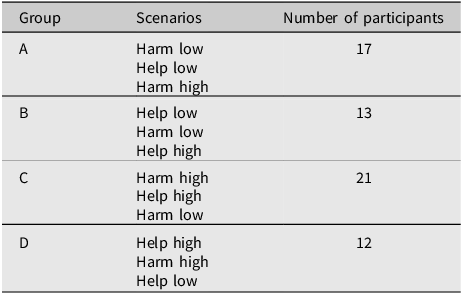
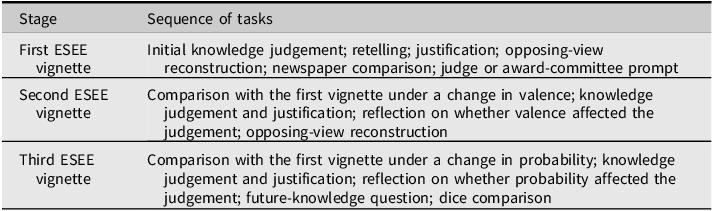
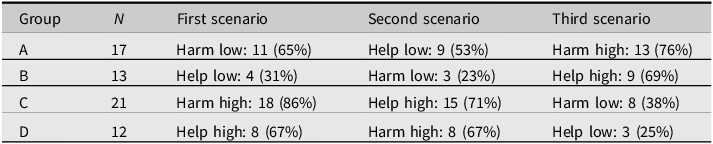
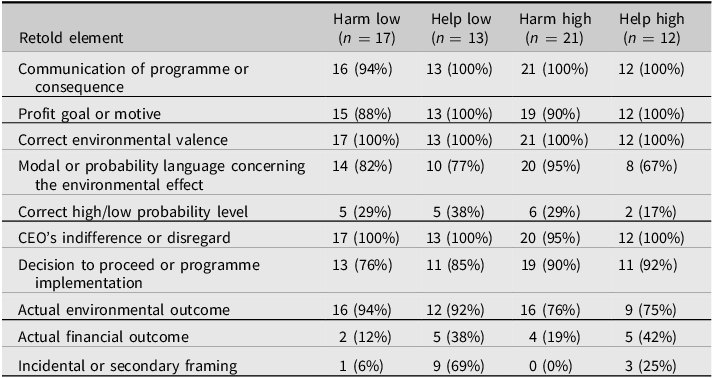


 Open access

