What is the State? It is the Democratic party … Whenever there were political questions involved, … we looked to the interests of the party, because they are the interests of the State.
—Judge Thomas J. Semmes, delegate at Louisiana's constitutional convention, 1898Footnote 1[T]he conversion of the South into a democracy in the sense that the mass of people vote and have a hand in their governance poses one of the most staggering tasks for statesmanship in the modern world.
—Valdimer Orlando Key, Jr., Southern Politics in State and Nation,1949Footnote 2I tried to be a Democrat, but they wouldn't let me.
—Black activist Reverend William A. Bender, after attempting to vote in Mississippi's primary, 1946Footnote 3In April 1944, culminating more than two decades of struggle by black litigants in Texas, the U.S. Supreme Court in Smith v. Allwright struck down the all-white state Democratic primary, the South's most effective device for maintaining one-party politics. The ruling presented southern politicians with some big decisions. Should they simply acquiesce and incorporate blacks into their parties? Should they risk defying the federal government and continue to prevent blacks from voting in these primaries, the only game in town when it came to electoral politics? Could they shore up existing devices to suppress black voter registration (or develop new ones)? Were their career and policy goals more effectively pursued through a different party? The region's black activists—most of them registered Republicans, if registered to vote at all—had choices to make, too. Should they launch registration drives and try to join the party, or should they organize politically outside the “The Democracy”? Across the region, the ruling triggered a fascinating and complex burst of grassroots mobilization and repression, party building and party privatization, tumultuous floor fights and dramatic courtroom scenes, and peaceful rallies and electoral violence. A range of actors had their say: black activists of all stripes, white “good government” advocates in the region's cities, the county courthouse gangs in its hinterlands, assassins, brave federal judges, night-riders, and, of course, state Democratic politicians.
Smith and the politics it sparked were soon eclipsed by the “Dixiecrat” revolt in 1948, Brown v. Board of Education in 1954 and the “massive resistance” that followed, the direct action of the early 1960s, and the landmark federal civil and voting rights legislation of the mid-1960s. Today, the decision does not much register in the public memory. However, despite most scholars' inattention to Smith, we have learned a good deal about the period.Footnote 4 From Darlene Clark Hine's Black Victory to more recent treatments, historians and legal scholars have begun to excavate the black grassroots effort to topple the white primary and capitalize upon its demise. Charles Zelden has brought into focus the long struggle by local and national NAACP litigants. Michael J. Klarman has highlighted the important role of federal district judges in implementing the decision and the ruling's impact on black voting in urban areas. Political scientists Kevin McMahon and Richard Valelly have argued that the Roosevelt administration, usually framed as unwilling or unable to assist black activists, actually prodded the Court to abolish the white primary and the Justice Department to enforce the ruling.Footnote 5 Scholars have disentangled the complex jurisprudence of the attack on the white primary and asserted the decision's consequences for black mobilization, but they have not connected the politics of the white primary's abolition to subsequent events, outcomes, and processes. How does the ruling fit into our larger narratives of the black freedom struggle, of southern politics, and of American political development?
I argue that Smith v. Allwright marked the beginning of a long process that ended, in the early 1970s, with the consolidation of democracy in America.Footnote 6 During the 1890s, determined politicians in the former states of the old Confederacy used state Democratic Parties to construct not only “Jim Crow” white supremacy and one-party politics, but eleven remarkably durable enclaves of authoritarian rule.Footnote 7 Southern Democrats—jealously guarding their historic project of cheap, docile labor and white supremacy—governed these enclaves by party-states—conflations of the state apparatus with those institutions regulating political ambition. They maintained these enclaves for one-half century by capitalizing on their influence in the federal government and the national party. But from Smith until the early 1970s, these enclaves were battered by a succession of challenges from within and without and were ultimately destroyed. The region's democratization—a complex macrohistorical process occurring amidst great social, cultural, and economic change—is the most important development in American politics since World War II. It re-enfranchised millions of Americans, now able to practice a new mode of politics; it reconfigured Congress and remapped presidential elections; and it accelerated elite polarization, among many other things.Footnote 8
Smith v. Allwright transformed the politics of all eleven enclaves, invoking rulers in their roles as party officials and as lawmakers. However, filtered through various configurations of intraparty conflict, political institutions, and black insurgency, the ruling shaped the politics of each enclave differently and positioned them in different ways to absorb the next shock to the southern body politic: President Truman's commitment of the national Democratic Party to racial equality in 1947 and 1948. Facing several other democratization challenges over the next three decades, southern enclaves ultimately took divergent paths out of Dixie. Different democratization trajectories matter. They are critical for understanding why southern states since the 1970s have varied in their pace of Republican Party advancement, economic development, and racial politics. Understanding the South today means grappling with the different ways in which these states navigated the transition to democratic rule.
Viewing southern states as authoritarian enclaves improves our understanding of Smith in three main respects. First, by acknowledging that these enclaves were governed by party-states, we can fully appreciate the ruling's significance. In a broad sense, an attack on the party was an attack on the state. Southern rulers would have to retool not only the party but also state institutions if they wanted to maintain power over their polities. Thus, while the aspects of the white primary's abolition emphasized in the literature—jurisprudence and black mobilization—are critical (and discussed in detail below), the perspective developed here highlights Smith's importance for these states' governance more broadly. Second, a careful consideration of the institutional configurations of party and state helps explain the often puzzling cross-state variation in both rulers' responses to Smith and in the decision's effects. Third, by coming to grips with the South's authoritarian politics, we can appreciate the central role of Smith in initiating the region's long democratization process.
In this article, I compare the ruling's effects on three similarly situated enclaves—Georgia, Mississippi, and South Carolina. Almost all enclave rulers preferred to retain the white-only primary. In South Carolina and Mississippi, there was a general consensus on defiance, evasion, and then adjustment. But South Carolina took the radical step of privatizing their ruling party, whereas Mississippi politicians attempted but failed a comprehensive policy reform to shore up one-party rule. In Georgia, the ruling struck the state during a period of bitter factional conflict. In the process, one-party rule was almost destroyed. However, skillful political repression by the ruling party's strongly white supremacist faction won out, and broke the back of the progressive faction for almost two decades. In all three enclaves, Smith sparked efforts by black activists to draw on and expand existing protest networks, but they differed in the initiatives they undertook. In each enclave, rulers' responses to Truman's challenge in 1947 and 1948 would be shaped by the politics wrought by Smith. What explains the different white primary politics that unfolded in each state? Why did enclave rulers make the choices they did, and with what consequences for the future?
Georgia, Mississippi, and South Carolina are well suited for comparison. Relative to those in the Peripheral South, these Deep South states began the transition poorer and less urbanized. They had economies more deeply rooted in what Barrington Moore termed “labor-repressive agriculture,” and had populations with a greater share of blacks.Footnote 9 Ruling Democratic Parties in these enclaves faced effectively no opposition and highly demobilized white electorates. These commonalities make it more difficult to attribute differences in responses to Smith to structural features, such as demographics, culture, opposition party development, or levels of economic development. Conversely, they make it easier to highlight the agency of enclave rulers and the institutions that constrained and enabled them.Footnote 10
First, I characterize the eleven southern states as authoritarian enclaves and situate the abolition of the white primary in the long transition to democracy. Second, I describe the emergence of the Supreme Court's ruling. Third, I present narratives of white primary politics in each of these three enclaves. The narratives are based on archival research, as well as newspaper accounts, contemporaneous interviews, elections data, and a large and often unheralded secondary literature on southern political history.Footnote 11 I close with a discussion of how Smith helped produce different modes of democratization and how the reframing of southern political history developed here engages with recent research on America's distinctive democratic development.Footnote 12
Southern States as Authoritarian Enclaves
Here, I employ a proceduralist and dichotomous definition of democracy; democracies feature “fully contested elections with full suffrage and the absence of massive fraud, combined with effective guarantees of civil liberties, including freedom of speech, assembly, and association.” Moreover, political institutions must be sufficiently autonomous from social and economic power such that these elections are meaningful.Footnote 13 After democratic polities are constructed, there often remains substantial variation subnationally in political practices. Authoritarian enclaves are areas—usually states or provinces in a federal polity—in democratic polities marked by the absence, or unreliability, of the components of democracy.
The developing literature points to some important regularities about subnational authoritarian enclaves.Footnote 14 First, embedded in democratic polities—usually federal ones—they are governed by hegemonic state- (or province-) level parties.Footnote 15 This is because they cannot openly disavow mass political participation—citizens and elites outside these enclaves would not countenance a blanket rejection of democracy. Thus, enclave rulers must pursue their goals within a polity featuring substantial popular control of office holding in the form of one-party rule. Second, their survival depends on the inability or unwillingness of the central state or the national party to intervene against them. To this end, they must project their power effectively in national institutions and the national party in order to maintain a protective wall around their borders.Footnote 16 Third, once established, they are difficult to topple; domestic insurgencies likely will not defeat them on their own. Their opponents must reach beyond enclave boundaries for assistance from central state officials, politicians, and “outside agitators” to weaken the regime.
The Founding of Southern Enclaves
Before the 1890s, southern Democrats had not yet established what would become the pillars of enclave rule: one-party politics, racially segregated public spheres, and the political exclusion of blacks. Southern authoritarianism emerged from a coordinated, region-wide movement by Democratic Party leaders in the 1890s to develop institutions that could safeguard their attainment of policy and career goals. These leaders would come to construct enclaves governed by party-states—conflations of the state apparatus with those institutions regulating political ambition. The state apparatus oversaw the hegemonic Democratic Party, while the Party staffed, guided, and exploited local, county, and state governments.Footnote 17
During Reconstruction, emancipated blacks, indigenous southern Republicans, and federal administrators worked to construct robust, democratic polities that could guarantee order after federal troops withdrew from the region. But, often riven by conflicts between progressive and conservative factions, southern Republican Parties remained fragile throughout Reconstruction. Democratic Party elites sanctioned waves of electoral violence that severely reduced turnout by their opponents and helped them recapture most southern statehouses and congressional seats. In doing so, they signaled to national Republicans, federal authorities, and non-southern publics that the costs of reconstructing the South were prohibitively high. The infamous Hays-Tilden Compromise of 1877 ratified, rather than precipitated, declining Republican and northern support for freedmen and white loyalists. Southern Democrats seemed safely entrenched.Footnote 18
But they were not. Despite massive electoral fraud and violence, blacks and anti-Democratic whites continued to organize, and vote, in large numbers. Conservative Democrats perceived a future marked by substantial electoral volatility; moreover, the costs of intermittent electoral violence were increasingly at odds with the efforts of “New South” boosters to attract capital investment from outside the region. In the 1880s and 1890s, agrarian movements challenged conservatives' control of state Democratic Parties from inside and out, and politics grew more chaotic. Republicans, Populists, other third parties and fusion movements experimented with different coalitions of partially incorporated freedmen and agrarian radicals while often using white supremacist rhetoric to attract other voters.
With their interests persistently endangered by this uncertain electoral environment, planters and a growing number of urban boosters, merchants, and “New South” industrialists in each state organized through Democratic channels what amounted to a “public conspiracy.” They alternately co-opted and repressed Populists, seized control of the state apparatus, redesigned political institutions, and effectively ended credible partisan competition. From 1890 to 1908—usually after defusing partisan threats—Democrats in eight states rewrote state constitutions via Democrat-dominated conventions or popular referenda on constitutional amendments. Republicans, third-party politicians, and black leaders often opposed these changes. In no state did a majority of Populist voters back disenfranchisement referenda.Footnote 19
In these moments, new regimes were founded. Southern states disenfranchised black citizens and many whites through several innovative techniques.Footnote 20 All of these devices—in addition to several others secured by statute—delegated substantial discretion to local officials who could choose whether to disenfranchise potential voters because of race, faction, or other criteria. These constitutions also weakened local governments, converted many elective offices into appointive positions, and further insulated state judiciaries from popular input. In establishing these regimes, this generation of southern Democrats “laid the lasting foundations in matters of race, politics, economy, and laws for the modern South.”Footnote 21
Dominating office-holding channels and policymaking required some unity of purpose. Until 1966, the seal on the ballot of the Democratic Party of South Carolina offered one such purpose: “White Supremacy—For the Right.” Asking “which whites' supremacy?”, Key answered, that by the 1940s “the Black Belt counties … ha[d] … managed to subordinate the entire South to the service of their particular needs.”Footnote 22 For large landowners, merchants, and their economic and political dependents, white supremacy and political repression were inextricably bound up with concerns about guaranteeing a steady supply of cheap and reliable black labor and a favorable distribution of landownership. Southern rulers resembled oligarchs in other agrarian polities by relying on “extra-economic coercion of labor by the state for [securing] income superior to that possible under more liberal, market-based arrangements.”Footnote 23 Black Belt elites and emerging New South boosters developed and maintained mutually beneficial policies in a wide range of areas, such as state subsidies for attracting low-wage manufacturing. Indeed, over the coming decades, white southern progressives accepted wage discrimination, anti-unionism, and Jim Crow in the service of industrial and capital recruitment.Footnote 24
Protecting Enclave Rule from External Attacks
The founding of enclave rule was possible only because of propitious national conditions, especially a favorable federalism—defined as a particular distribution of warrants of authority and responsibility across levels of the polity. Only conditionally independent of federal oversight, however, rulers had to design regime features—most especially, suffrage restriction and Jim Crow—within the parameters of the region's “special constitutional status.” A key element of this status was a judicial innovation known as the state action doctrine. It held that the Fourteenth and Fifteenth Amendments only served to ban racially discriminatory action by the state; private individuals and organizations were not subject to these amendments. This doctrine would be critical for providing constitutional protection to the white primary.Footnote 25
Two other tools helped build fences around southern enclaves. Southern federal officeholders developed extraordinary influence in Congress through seniority, control of committees, and usually unified voting. The Senate's more elaborate arsenal of weapons available for motivated minorities, including the filibuster, further enhanced their power.Footnote 26 They traded their support for Roosevelt's New Deal measures for his noninterference in enclave rule and for financial assistance for their benighted region. They modified federal social and labor policy in order to maintain control over black agricultural labor and labor markets more generally, and they stifled serious consideration of civil rights legislation for decades.
Additionally, southern Democrats exploited their position in the national party to protect enclave rule. In the confederally structured Democratic Party, state parties delivered electoral votes in exchange for substantial autonomy over their own affairs.Footnote 27 The “national party”—as a distinct institution at least partially independent of state parties—lacked the capacity to do much more than service states' patronage requests. State parties were thus free to oversee their primaries, conventions, and delegate selection. Moreover, during the “System of 1896,” they contributed a large share of the party's Electoral College vote. This influence and the party's long-standing “two-thirds” rule provided a southern veto over presidential nominations.Footnote 28 Enclave rulers skillfully protected their prerogatives in the face of potential outside interference, but they also relied on lucky timing and the kindness—and timorousness—of strangers.
Internal Pillars of Enclave Rule
Enclave rulers limited the dangers of domestic insurgencies and intraelite conflict with six institutions and practices. These were largely institutional means to materialist ends.Footnote 29 First, suffrage restriction of blacks and poorer whites was central to ruling party stability. Targeting voter registration, black participation in state Democratic Parties, and turnout, enclave rulers accomplished suffrage restriction through constitutional provisions, statutes, party procedures—such as the white primary—and informal practices.Footnote 30 Suffrage restriction had partisan aims and consequences. It deterred party building, especially by eliminating the plausibility of building opposition parties through appeals to blacks and many of the poorest whites. Turnout and partisanship rates for opposition forces were high before, and declined precipitously after, the turn-of-the-century constitutional conventions that codified enclave rule.Footnote 31 Following suffrage restriction, southern Democrats adopted the direct, and white-only, primary, which reduced further the possibility of interparty competition.Footnote 32 In turn, one-party rule fashioned a political environment most favorable for producing their preferred policies. Just as voting rights are fundamental to securing and safeguarding other rights and goods, suffrage restriction was fundamental to safeguarding authoritarian rule.Footnote 33 Neither Jim Crow nor one-party rule would survive long without suffrage restriction. Worse still, the loss of one-party rule would mean the loss of influence in the federal government and the national party.
Second, Jim Crow—the formal and informal regulation of interracial contact in bedrooms, schools, public accommodations, and the workplace—greatly facilitated enclave rule. It demarcated territories and jurisdictions over which rulers exercised authority, stabilized until-then shaky racial categories, and ordered much of the daily contact between the races.Footnote 34 It also greatly reduced the prospects for organized dissent for individuals of all races. A version of white supremacist ideology was certainly embraced by enclave founders and most of their white subjects, but it is important to understand Jim Crow's instrumental dimension.Footnote 35 Although racist attitudes were most strongly held in the South, it was the region's authoritarian politics that differentiated it from the rest of the country.Footnote 36
Third, legislative malapportionment provided Black Belt whites and their clients with a commanding presence in state legislatures, which controlled many more political resources than did executives. Enclaves failed to update 1890s apportionments for seven decades. Thus, as urban business interests grew in importance and embarked on political and economic modernization projects that impinged on the interests of rural elites, malapportionment provided a veto against these projects. By 1940, it was the most important source of the Black Belt's domination of southern enclaves. Furthermore, the apportionment of other key institutions—such as the party's executive committee and party conventions—was often based on that of the legislature. The effects of malapportionment reverberated through the party-state.
Fourth, and least appreciated, enclaves used restrictions on free and fair political contestation to disadvantage opposition party builders.Footnote 37 Several states, by party rule or statute, barred previously “disloyal” candidates, or those who failed to pledge themselves to the values of the Democratic Party, from running for office—even as independents. In seven of the eleven southern states, statutes forced parties to nominate statewide candidates by primary, thus making Republican Party building very expensive.Footnote 38 Moreover, in a region where several states did not use secret ballots until after World War II, individuals attempting to vote Republican risked jobs, clients, positions in valuable social networks, and even life and limb.Footnote 39 In preventing free and fair elections, southern states were authoritarian.
Fifth, like authoritarian polities everywhere, enclave rulers constricted civil society. Public authorities conducted propaganda campaigns, surveillance, investigations, and legal attacks on the activities of scores of groups, such as the NAACP, biracial discussion groups, labor organizers, liberal and popular front associations, and even black fraternal orders. The threat of such harassment deterred countless other efforts. In preventing public manifestations of biracial civil society, enclave rule substantially curtailed the associational freedoms of whites, as well as blacks. Before the onset of the transition to democracy, there was, of course, organized white and biracial reformist activity in all southern states.Footnote 40 These provided important talking shops for those dissatisfied with some (or all) elements of enclave governance, as well as networks for becoming involved with the Roosevelt administration. As incubators of minor reform initiatives, however, they rarely challenged the central pillars of enclave rule before Smith.Footnote 41
Sixth, rulers supplemented restrictions on civil liberties by directing, endorsing, or acquiescing in the physical coercion of their subjects. All modern regimes construct and rely upon coercive institutions to maintain order, but authoritarians—usually suffering from a more serious legitimacy deficit—are especially dependent on an effective (if rarely employed) coercive apparatus. In the South, coercion took many forms, from imprisonment, expulsion, and destruction of property to torture, murder, and state execution. Rulers relied on (threatened) violence to deter and repress opposition movements, black protest and political mobilization, unions, and others challenging the party project. Public authorities and organized white supremacists threatened violence in many ways, from whisper campaigns to signs posted in cotton fields to stump speeches. Partisan and later “establishment” violence stabilized enclaves at key moments; some violence, such as carefully planned public lynchings in front of massive crowds, served civic-educative functions for black and white audiences.
Parties or “No-Parties” of One-Party Rule?
After vibrant, chaotic, often violent, but hotly contested electoral politics, popular participation under enclave rule sank to abysmal levels. Deep South voter turnout in presidential elections remained below 20 percent for five decades; in South Carolina it sometimes dipped below one in ten voting-age adults.Footnote 42 Lacking interparty competition, general elections were little more than formalities. Party nominations—effectively elections—were often issueless affairs that turned on “friends-and-neighbors” voting patterns and colorful personalities. Enclave founders had been successful in removing many major questions from the political agenda; when issues arose, they were often cultural in nature (such as prohibition).Footnote 43 At the height of stable enclave rule in the 1920s and 1930s, full-throated electoral appeals to defend white supremacy subsided, given the implausibility of black insurgency.
Democrats did not develop partisan, vote-seeking operations; usually failed to hold issue-oriented campaigns; and often lacked durable factions. State party machinery rarely mattered in channeling resources among primary nominees. Given the absence of anything like “responsible party government” and the weakness of factions, Key concluded that the South “really ha[d] no political parties.”Footnote 44 These parties, however, regulated political ambition. They constrained the position taking of all contestants through the party label of “White Supremacy.” They breathed life into this label by conflating the state with the party, and party disloyalty with state treason. These parties were very powerful institutions, no matter how little they resembled the textbook party.
For about one-half century, external and internal regime supports combined to sustain the South's authoritarian enclaves. Easily caricatured as demagogic rubes, southern politicians have long provided targets for lampooning.Footnote 45 Indeed, Deep South elites occasionally threatened to settle political disputes with one another physically.Footnote 46 However, beyond lacking features of democratic polities, southern enclaves—like all stable, authoritarian polities—constituted governance achievements. They reconciled the interests of urban elites, New South boosters, industrialists, and large landowners into a single regime and equipped it with institutions to demobilize white electorates, stifle black political engagement, and forestall workers' challenges to state institutions and policies. Enclave rulers managed warrants of conditional autonomy and skillfully deployed federal officeholders to block potential interference, especially concerning voting rights and state-sponsored violence. Put differently, these politicians successfully completed key tasks required of modern polities, including maintaining order, regulating political ambition, delivering minimal economic performance, and balancing diverse interests. Acknowledging this trains our gaze on the governance challenges faced by rulers as they defended suffrage restriction and Jim Crow. Although whites outside the South could afford to view southern politics as comic opera, it was, in Key's words, “deadly serious business.”Footnote 47
Enclaves and Democratization Challenges
Like enclaves elsewhere, those in the U.S. South were secure enough, and productive enough for their main clients, that elite-driven reform or domestic insurgencies were highly unlikely to upend them. Because of their lack of resources and their weak connections to allies “abroad,” dissidents on the ground were in all likelihood necessary but not sufficient for toppling enclaves. Rather, a combination of external interventions and insurgencies would be needed to dismantle them. Moreover, the fact that enclaves were governed by party-states meant that democratizing them required dismantling both components: the ruling party and state institutions. Of course, the transition was a highly complex period that featured many acute challenges from “abroad”—important “exogenous” shocks such as World War II, as well as important secular change, such as urbanization and the mechanization of agriculture, altered the influence of different ruling interests.
At the onset of external challenges to enclave rule, the ruling party has a strong disposition toward the status quo, despite the potential diversity of interests within a ruling party. Rulers seek to deter, or at least defer, these challenges. Over time, democratization challenges and responses to them may shift the factional balance and alter rulers' capacities to implement preferred strategies. And individuals may conclude that the ruling party is no longer the most effective means to advance their careers and policy goals. One faction's dominance may enable a more cohesive response to a democratization challenge, whereas a severe split may frustrate the implementation of rulers' strategies.Footnote 48 The shape of party institutions could do so, as well.Footnote 49
Besides elite conflict and party institutions, the fit between rulers' preferred responses to democratization challenges and state institutions affects their ability to adjust to serious pressures. Important features may include the degree to which public authority is centralized, the quality of the coercive apparatus, and fiscal and administrative capacities needed for developing and implementing programs to co-opt opponents or develop new bases of support.Footnote 50
After Smith, five highly similar and simultaneous external interventions challenged the South's eleven enclaves. These were not purely exogenous “shocks” to the southern body politic. Southern blacks and their white allies both inspired and compelled outside actors to pose these challenges. Conversely, enclaves' responses to previous challenges and the degree of anticipated enclave resistance shaped their timing and content. Still, framing the transition as a series of external shocks facilitates comparisons across enclaves. More important, the periodization developed here is theoretically consistent with the enclaves framework. By emphasizing party-states, I am approaching democratization narrowly in institutional terms: as a period of attacks on, and ultimately the destruction of, the institutions propping up authoritarian politics. Thus, while Smith did not cause the process to begin—as I suggest below, the effects of the war are perhaps paramount here—the ruling is usefully seen as the beginning of the process.Footnote 51
Smith v. Allwright Strikes the Deep South
On the eve of Smith, southern authoritarians had reason to be concerned about the stability of enclave rule. Over the preceding decade, they witnessed the Great Textile Strike of 1934 and other workers' protests, the emergence of the radical Huey Long in Louisiana, and the coddling of white southern liberals by an increasingly unreliable Roosevelt administration.Footnote 52 In 1936, the national party repealed the “two-thirds” rule.Footnote 53 Moreover, in 1938 Roosevelt attempted to “purge” a few conservative Democratic incumbents in House and Senate primaries, including two Deep South senators.Footnote 54 The onset of war sparked further concern among enclave rulers, especially about federal interference in southern labor markets. The Fair Employment Practices Committee (FEPC) threatened, albeit unsuccessfully, to monitor “fairness” in employment. Moreover, it symbolized and further encouraged the influence of national black protest organizations in national policymaking and the national party.
The war brought additional problems; most important were increasingly assertive southern black publics and the growing discomfort of nonsouthern elites facing the ideological contradiction of their long-standing coddling of enclave rule with a war to preserve democracy.Footnote 55 This discomfort helped bring about congressional attempts (which were ultimately unsuccessful) to interfere with southern suffrage restriction.Footnote 56 Still, as their private papers suggest, in the early 1940s, most southern politicians were confident in enclave defenses and did not perceive enclave rule under serious threat, either from within or without.
But in just a few years, two external challenges battered these enclaves. First, the Supreme Court's 1944 ruling in Smith struck at suffrage restriction and one-party rule. Second, the national Democratic Party's turn toward racial equality in 1948 challenged local rulers. Truman's suggested use of the central state apparatus to dismantle white privilege threatened rulers' ability to dominate labor relations, interracial social contact, and law enforcement. Most important, it called into question—for the first time in fifty years—the national party's status as the most suitable vehicle for pursuing career and policy goals. Viewing this federal interference as eminently reversible, Deep South enclaves sought to defy it.Footnote 57
The Prelude to Smith v. Allwright
By the 1930s, the white-only primary was Dixie's most powerful legal tool for preserving one-party rule. Deep South politicians revered the institution. In the absence of black participation, party factions had no incentive to court black votes and thereby endanger white supremacy. Furthermore, blacks had little incentive to run the gauntlet of institutional devices and coercion to register and vote for a hapless Republican Party. By the early 1900s, the white primary appeared in most party rules, having emerged usually at the local level in the 1870s. There was never full compliance with white primary rules.Footnote 58 Black voter registration, however, remained below five percent of the voting-age population across the region, and below two percent in the Deep South. Thus, black participation in primaries was effectively non-existent.Footnote 59
Perhaps reflecting the seeming impregnability of the institution, neither southern white progressives nor national black protest organizations considered the abolition of the white-only primary a high priority. However, black activists on the ground resisted the white primary for decades; Texas NAACP activists led the way. Texas law allowed county parties to determine whether to require qualifications for primary voting in addition to those required by statute for general elections.Footnote 60 In 1923, amidst factional conflict in San Antonio politics, the state legislature passed a law forbidding blacks from voting in the state's Democratic primaries. El Paso's NAACP branch quickly filed suit, and in 1927 the Supreme Court struck down the statute on equal protection grounds. Here, state action—a statute—was unquestionably present. However, because the case dealt with a state statute, rather than the party's regulations, the Court did not have to consider a much more vexing issue: whether a state—in which a political party that by its own rules restricted its membership on a racial basis—violated the constitution.
The Texas legislature quickly passed a statute allowing executive committees of political parties to determine their own membership qualifications. The state party's executive committee quickly forbade blacks from participating in party affairs, including primary voting. Texas NAACP activists filed suit challenging this arrangement, and in 1932, the Supreme Court struck down the statute on the grounds that the state improperly involved itself in parties' internal affairs. Again, the Court punted on the much more difficult issue.Footnote 61 The cat-and-mouse game between black litigants, the Texas party-state, and the federal courts continued. The state party, meeting in convention, quickly barred blacks from membership. For the Court, the role of the state could no longer be found in this membership choice; thus, still drawing on the state action doctrine, this version of the white primary passed constitutional muster in Grovey v. Townsend.Footnote 62
Soon, a new opening emerged. In 1921, the U.S. Supreme Court had limited Congress' power to regulate the general elections component of congressional races on the view that primaries were not “elections.” But in 1941, the Court—now dominated by Roosevelt appointees—reversed itself. Without confronting Grovey, it ruled in U.S. v. Classic that primaries implicated Fourteenth and Fifteenth Amendment rights if state law had made the primary “an integral part of the procedure of choice,” or if “the primary effectively [controlled] the choice.”Footnote 63 Given that white-only primaries satisfied both criteria, some commentators concluded that Grovey would soon be overturned and invalidated.Footnote 64
After an election official denied a Houston NAACP activist a ballot in the 1940 congressional primary, the national NAACP—prodded by its state branches—helped with a new suit that capitalized on Classic. In June 1943, the U.S. Supreme Court granted certiorari, thus alerting southern enclaves to a new challenge to the white primary. In oral argument, NAACP litigators Thurgood Marshall and William H. Hastie claimed that the results of the Texas primary effectively determined the outcome of the general election—that election officials operated under color of law and that in previous rulings, the Court's conception of party was wrong. They wrote that Texas party should be treated not as a voluntary association but as a “loose-jointed organization” with no clear membership; “state election laws provided the only rules that governed the party and its elections.”Footnote 65
On 3 April 1944, the Court announced its 8-1 ruling in Smith v. Allwright. By excluding losing primary candidates from general elections, and by requiring election officials to withhold ballots from those not qualified by party conventions, Texas had designated the party primary an integral feature of its elections. “State action” was discovered; the Texas government was found to have participated in disenfranchisement, and thus the all-white primary was invalidated. Blacks and Hispanics in Texas could now participate as Democrats. The Court also warned that new versions of the white primary would be struck down.
Black groups and opinion leaders hailed the ruling, whereas the Roosevelt Administration had little public reaction.Footnote 66 “South's Devices Run Thin,” declared the New York Times's Arthur Krock who noted that southern congressional leaders were pessimistic about the prospects of evading Smith legally. Southern politicians' reactions ranged from mild concern to outrage and declarations of defiance. Many sincerely doubted that the decision applied beyond the borders of Texas. Several papers in the Peripheral South supported the decision. Other southern white observers were anxious, especially insofar as it seemed to be part of a broader attack on southern suffrage restriction, given indigenous campaigns against the poll tax.Footnote 67 Some suggested that parties return to the nomination of candidates by convention (which, presumably, could remain white-only). Alabama Governor Chauncey Sparks suggested that, instead of openly defying the court's ruling, states could “adapt” by determining voter qualifications.Footnote 68 Generally, Deep South party leaders announced their opposition to Court interference and their determination to maintain the status quo. Several state parties—all five in the Deep South and Florida—stated that their 1944 primaries would remain white-only.Footnote 69
In the short term, Smith v. Allwright raised the possibility that parties would have to allow blacks to vote in the summer's primaries. Also, depending upon candidates' preferences, backgrounds, and campaign styles, it spelled more trouble for some officeseekers than others. Some could easily out-flank opponents on white supremacy; others would need to articulate immediate policy responses to the ruling. Most important, black activists would likely seek to exploit the ruling through voter registration and turnout campaigns and might be met by white supremacist counter-mobilizations and violence. Increasing racial tensions during the war had already put authorities in many southern states on alert, as the narratives below indicate.Footnote 70
Enclave rulers could acquiesce and allow blacks to vote as members in good standing of their party, as Texas and some Peripheral South states did.Footnote 71 On the other hand, they could evade the ruling and continue to prevent black participation in party affairs, or they could concede the death of the white primary and work instead to buttress their devices to prevent black registration and turnout. As would be true of responses to later democratization challenges, between these poles of acquiescence and defiance lay intermediate options, such as using courts or bureaucracies to stall compliance and deploying intimidating rhetoric and other behaviors that might raise the perceived costs for insurgents of exploiting the ruling or for federal officials of securing compliance.
On the eve of Smith, the enclaves under study had much in common compared to the more urbanized, industrialized, and whiter enclaves of the Peripheral South. Each featured two million to three million residents, a black population share ranging from 35 percent to 47 percent, and a swath of “Black Belt” counties.Footnote 72 Their similarities cast enough doubt on structural accounts of variation in enclave responses to Smith to make room for an account emphasizing elite agency. These accounts, reviewed elsewhere, could emphasize political economy, political culture, and prospects for black insurgency.
Of course, Deep South states were not identical. As the narratives below detail, on a number of dimensions, Georgia and Mississippi were bookends; they were the most and least urbanized and industrialized, and their black populations were most and least prepared to exploit a democratization pressure such as Smith v. Allwright. On these dimensions, South Carolina lay between them. The magnitude of differences across these enclaves, however, was not great.Footnote 73 Black protest capacity is obviously important, but it is unclear how it would affect rulers' responses to democratization challenges.Footnote 74 Two other features of Deep South enclaves require mention: the centralization of authority and intraparty conflict.
Issued by state constitutions, statutes, regulations, and party rules, formal political authority helped determine which enclave actors were empowered to manage various governance tasks. This authority would make actors at different levels of the polity relevant at key moments. Deep South enclaves shared weak governorships, weak fiscal and administrative capacities, and powerful, malapportioned, unprofessional legislatures.Footnote 75 Their three most powerful chambers were the Georgia House, the Mississippi House, and the South Carolina Senate. As the narratives detail, these enclaves differed in the degree to which they centralized authority. South Carolina's Senate reigned supreme over the state's 46 counties, thus centralizing political authority in a small, Black Belt-dominated institution. Relative to South Carolina, authority in Mississippi was diffused from the center to its eighty-two county governments, due in part to the powerful office of county sheriff. Georgia, shaped by a highly malapportioned electoral system, 159 counties, and a fairly strong executive, mixed centralizing and decentralizing features.
Elite conflict also differed somewhat across these enclaves. In all three, elite disagreements rooted in ideological differences, sectional grievances, or clashing ambitions occurred only within the confines of the state party. Each state could boast of its powerful federal officeholders (who did not involve themselves a great deal in internal party conflicts).Footnote 76 In Mississippi and South Carolina, however, intraparty conflict was much less organized into durable factions than was the case in Georgia. Ruling parties also differed in their sectional, class, and cultural interests, and in the party institutions that refracted these interests as parties struggled to respond to democratization challenges. The narratives trace how these differences—in institutions of state and party, and intraelite conflict—helped shape rulers' responses to Smith.
SOUTH CAROLINA
On the eve of Smith v. Allwright, factional conflict within South Carolina's ruling party lay dormant. Politicians were united in their pragmatic and principled commitment to the white primary. Observing increasingly emboldened black political mobilization and restive white supremacist groups in a wartime atmosphere of heightened racial tensions, rulers anticipated numerous immediate problems if the white primary were abolished. These included racial violence, black penetration of the party at the county level, and the disruption of rent-seeking arrangements. Most important, by threatening one-party rule, the end of a white-only Democratic Party threatened the policies desired by the party's Black Belt elites.
Capitalizing on the state's lack of factional conflict and pliant state party, enclave rulers quickly fashioned a radical solution—by repealing all statutes and state regulations pertaining to party primaries, the state effectively privatized its only mode of political competition. Through this massive deregulation, rulers blocked the incorporation of blacks into the state party, reactivated sectional conflict, and delayed political reforms.
In the short term, the privatization response prevented both the rapid entry of black politicians and voters into the party that occurred in Texas and short-circuited the rise of a white supremacist “Southern Democratic Party” opposed to the national party. Taking advantage of the “new” white primary system, black activists built a proto-party, the Progressive Democratic Party (PDP), and registered and mobilized thousands of voters. By 1948, federal courts had invalidated South Carolina's privatization response to Smith. By then, however, privatization—and the reforms it delayed—helped position South Carolina Democrats to take a leadership role in the Dixiecrat revolt.
South Carolina's Senate Dominance
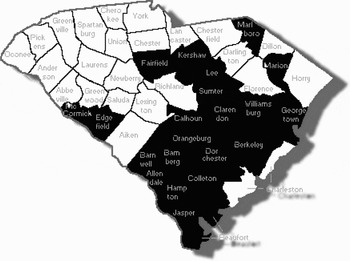
South Carolina featured a strange mix of a completely dominant legislature, a weak executive, and counties ruled as the personal fiefdoms of senators. Senate districts corresponded exactly to county boundaries, thus yielding one senator for each of the state's 46 counties. Almost one-half of these counties were majority-black (see Figure 1), meaning that Black Belt interests dominated the Senate. And the Senate effectively governed counties.Footnote 77 Legislative delegations from each county, dominated by its senator, controlled the mode of governance, appointments, appropriations, and administrative decisions of their counties. The result was a remarkable fusion of the state's executive and legislative functions. In this administration-by-legislature, annual “supply bills” for each county directed its activities. They often took extreme forms; one specified whom would be hired as the ladies' restroom attendant at the county courthouse.Footnote 78 Patronage and other rent-seeking opportunities abounded for senators, who, given the circumstances, were understandably content to remain in the Senate rather than pursue more prestigious offices. State Senator Edgar Brown—for decades the state's most powerful politician—remarked that “[governors come and go, but] I go on forever.”Footnote 79 The state's domination by the upper chamber provided additional power for the lowcountry, even as it declined over time in population and socioeconomic influence. Defeating upcountry reform efforts, the Black Belt-run Senate effectively centralized political authority.
South Carolina counties by majority-black status, 1940. Shaded counties have majority-black population.

Party Factionalism
On the eve of Smith, South Carolina's party-state seemed firmly in the hands of the economically and socially isolated lowcountry, despite the increasing industrialization of the state's upcountry. South Carolina's intraparty strife climaxed in the 1930s. Traditional upcountry antipathy for the aristocratic and condescending airs of lowcountry politicians were manifest in battles over the regulation of child labor, prohibition laws, and other issues on which upcountry voters preferred cultural autonomy instead of a middle-class “progressive” ethos. By the time of the New Deal, one-fifth of voters in the upcountry were textile workers, and their votes were up for grabs. While culturally conservative and suspicious of the state, these textile workers were open to appeals from labor organizers and strongly backed the New Deal.Footnote 80 In the 1930s, upcountry/lowcountry conflict took on a sharper class cast. Former millhand (or “linthead”) Governor Olin Johnston, whose political base lay in the upcountry, battled with increasingly cohesive cliques of lowcountry legislators over control of the Highway Department, state budgets, constitutional reform, upcountry labor conflicts, electoral fraud, and much else. Johnston sought labor-friendly social and employment policies and backed striking textile workers in the bloody confrontations of the 1930s.Footnote 81
The nascent “Barnwell Ring” of lowcountry solons—led by Edgar Brown in the Senate and Sol Blatt in the House—forced the upcountry to subsidize road building elsewhere in the state. By the early 1930s, the Highway Department's annual budget exceeded all other state agencies combined.Footnote 82 After a comical but potentially violent standoff between the state militia and embattled highway officials beholden to the state senate, lowcountry legislators eventually beat back Johnston's attempt to wrest control of the state apparatus and the Highway Department.Footnote 83 They had fashioned a political equilibrium well suited for pursuing their rent-seeking goals and for protecting the interests of large landowners and the larger textile manufacturers. These forces increasingly embraced federal assistance and state-sponsored economic development.Footnote 84 When Johnston returned as governor in 1943—the year before Smith v. Allwright—he no longer pushed his populist-labor program, or challenged conservatives' hold on the state apparatus. Observers declared that factional conflict in the state had ceased.Footnote 85
Finally, South Carolina's State Democratic Executive Committee (SDEC) reinforced the lowcountry's numerical advantages in the Senate because one member per county was elected to the committee. As the upcountry's share of the state's population increased over the decades, about one-half of the executive committee remained in the hands of lowcountry representatives. Except for the floor's election of the chair, it was difficult for outside forces to overtake party machinery. Deep South SDECs would long be critical sites of enclave decision making.
Anticipating Smith v. Allwright
Politicians and resource holders of both races viewed the white primary as, by far, the most significant barrier to black voting and as the key institutional bulwark of one-party rule.Footnote 86 Officeholders, white civic organizations and opinion leaders agreed on the importance of preserving it.Footnote 87 Some saw biracial discussions about black voting as a useful way to gather information about black elite preferences.Footnote 88 Others thought highly constricted black suffrage—limited to the well-educated—might effectively co-opt black elites and legitimate the status quo. Black registration and voting were miniscule.Footnote 89
In 1935, following the Grovey decision, powerbrokers in the state senate introduced legislation to repeal all state regulation of political parties. On their legislators' logic, if the state code were scrubbed of all references to party activity, the primary would be rendered invulnerable to federal judicial challenge.Footnote 90 In addition, however, primary elections would no longer be subject to criminal laws regarding fraud, corruption, electoral violence, and other chicanery. Even by southern standards, South Carolina's elections during and since Reconstruction produced high levels of violence, disorder, and corruption. Governors had relied on the National Guard to deter or halt primary election violence in Charleston more than once in the 1930s. Thus, Democratic Party Chair Ben T. Leppard worried that the privatization solution could lead to elections over which “the state would be without authority.”Footnote 91
In 1938, the General Assembly empowered “the state convention of any political party, organization, or association to add to or limit the qualifications for membership therein for voting in any state, county, or municipal primary election.” After this law's passage, the party eliminated the Hampton Rule, which had allowed into the primary a small number of black men who had long backed the Democrats.Footnote 92 This change amounted to easy position taking by upcountry “millhand” Governor Olin Johnston, who sought the U.S. Senate seat of the state's preeminent white supremacist demagogue, Sen. Ellison D. “Cotton Ed” Smith. Like most whites, and all white politicians, Johnston was committed to white supremacy. However, he was not yet a racial demagogue. Preparing for his race against Smith, he worried about appearing “soft” on white supremacy. During the campaign he took credit for eliminating the Hampton rule, declared the possibility of black suffrage dead, and tried to dismiss the issue. However, he still lost to the very popular Smith, then the longest-serving member of the U.S. Senate.Footnote 93
In 1943, Johnston, again governor, planned to challenge Smith in the 1944 Democratic senatorial primary.Footnote 94 In the interim, factional conflict had subsided. However, elites grew more concerned about the ruling party's ability to safeguard its historic project. World War II disrupted agricultural labor markets and sparked divisive mill strikes, and the national party appeared increasingly unreliable on these and other matters. More serious, white supremacy seemed everywhere under threat. Black organization of NAACP branches increased sharply. In 1930, only two branches existed (in Columbia and Charleston). By 1943 fifteen branches were scattered across the state, totaling some one thousand members.Footnote 95
War production sparked rapid growth in several cities and small towns, particularly as blacks left rural areas for more lucrative manufacturing positions, often to compete with whites for jobs. This was, for South Carolina's whites, a new phenomenon.Footnote 96 The newly established FEPC exacerbated matters. In 1942 elections, “work or fight” legislation—which threatened black men with military service if they did not work the land—took center stage. Interracial tensions in cities, especially Charleston, often exploded into racial violence. As the specter of an emboldened black population loomed, white supremacist groups such as the Ku Klux Klan grew in size and assertiveness.
Enclave rulers threatened both black agitators and these organized white supremacists in an effort to deter racial disorder.Footnote 97 Many state politicians worried over possible black mobilization, which provided electoral opportunities for white supremacists. Black groups had already demanded entry into the Democratic primaries. Furthermore, in 1943, the state's NAACP announced the equalization of teachers' salaries as its main goal and initiated a federal lawsuit in Charleston. The state's most virulent white supremacist politicians exploded at this demand and began quietly in late 1943 to bring together the rougher progeny of past Governors “Pitchfork” Ben Tillman and Cole Blease with lowcountry aristocrats increasingly troubled by the national party's alleged embrace of blacks. They hoped to build a “Southern Democratic Party” (SDP) that would capture the state Democratic Party machinery and lead a region-wide revolt against Roosevelt. If blacks were successful in breaching the state party, the SDP would preserve all-white, one-party rule.Footnote 98
In the 1940s, fueled by better-paying war jobs and army service, South Carolina's NAACP continued to grow rapidly. By 1946, the number of branches increased from 15 to 49 and paid membership exceeded 10,000.Footnote 99 In January 1944, the state NAACP conference scheduled a black voter registration drive and initiated a call for the formation of “Fourth Term for Roosevelt Clubs” throughout the state. John McCray, editor of the black newspaper Lighthouse and Informer and the effort's spokesman, then called for the creation of a South Carolina Negro Democratic party (later, the Progressive Democratic Party) to parallel the official state party until the latter's racial integration. Thus, two weeks before the Supreme Court announced its ruling in Smith, activists began to plan this auxiliary party.Footnote 100
Worried by the 1941 U.S. v. Classic ruling, state party elites had begun considering in 1942 how to evade an invalidation of the white primary. As he left office in January 1943, Governor Jefferies “noted that the ‘best thought of the state’ believed that the dangers of federal control and Negro participation outweighed the costs of unregulated primaries.” He recommended that “all primary election rules now in our statutes … be repealed and the only laws which should remain on the statute books should be laws designed to prevent [and punish election] fraud.” Governor Olin Johnston's inaugural address echoed the recommendation.Footnote 101
Party officials—most of them legislators—immediately introduced legislation to repeal primary laws and provide that each political party “shall be the sole judge of the qualification of its members.” Signed by Johnston in April 1943, the statutes would go into effect in June 1944. However, statutes criminalizing primary election fraud and regulating primaries in local elections remained; some worried that their presence would lead to the invalidation of the (private) white primary that Grovey reversed. This legislation provided a ready-made solution to Smith v. Allwright; moreover, it would serve to limit discussion of alternatives.Footnote 102
Senator “Cotton Ed” Smith, Johnston's opponent in the U.S. senatorial primary just a few months away, called the ruling “the greatest crisis in the history of the South, far worse than even Reconstruction since the Democratic party had now betrayed the South.” Media responses varied from the apocalyptic to the calm embrace of a multi-party system. The Charleston News and Courier immediately called for a return to the favored method of aristocrats—the use of party nominating conventions, the apportionment of which would greatly advantage lowcountry elites. Johnston denounced this as a ploy against the common white people of the state.Footnote 103
Johnston convened a special session eleven days after the ruling.Footnote 104 It launched Johnston's Senate campaign against Smith, the state's standard bearer of white supremacy, and black activists responded angrily.Footnote 105 State legislators, and especially lowcountry and Barnwell Ring senators and House leaders, were concerned mainly about Smith's longer-term implications for the party and its project. The decision did not threaten them personally in the short term. All had seniority and regularly ran unopposed. None had progressive political ambitions, in part, perhaps, because of the great rent-seeking opportunities they arranged for themselves through large public spending projects in the lowcountry. Legislators in majority-black counties seemed electorally secure; thus far, black mobilization efforts occurred mainly in Charleston, Columbia, and upcountry towns. Those interested in statewide or federal offices were more worried about the short-term implications.
However, even electorally secure lowcountry legislators feared that black voting would disrupt the rent seeking that sustained their domination of their home counties. As with Mississippi's Delta planters, they had good reason to worry. County party organizations in the Black Belt were so demobilized that the development of even a small black voting bloc might translate into significant black influence over county executive committees, platforms, and possibly delegations to the state party convention. Thus, rulers differed in their reasons for concern, and in their perception of the urgency of the problem, but there was a consensus on the need for a strong response to Smith.
Options open to special session participants were quite narrow. Some legislators now suggested that black political participation be limited from another angle: tighter educational requirements for voter registration. Such proponents, including the state's most powerful politician, state Senator Edgar Brown, hailed from the lowcountry, preferred fewer upcountry “lintheads” in statewide elections and hoped that educational requirements would eliminate many white voters. Other legislators voiced the criticism of privatization raised in 1935: a private party meant that there could be no criminalization of electoral fraud. Given the state's record of fraud and violence, some worried that the result would be a party riven by conflict and disorder.
Support for privatization trumped such concerns, however, and legislators lined up behind the governor. Practically unanimously, the legislature repealed more than 150 bills relating to party primaries in the six-day session.Footnote 106 With a few strokes of Governor Johnston's pen, the Democratic Party had been converted into a private club. A few liberal white South Carolinians registered their dissent, but a broad consensus favored the move.Footnote 107
The Black Party Challenge
South Carolina's black leadership was a small and relatively cohesive group of leaders of groups, such as the NAACP, the Negro Citizens' Committee (NCC), the Progressive Democratic Party (PDP), and the black wing of the state Republican Party. These organizations pursued distinct but overlapping goals, and many leaders were active in several (or even all) of them.Footnote 108 Following party privatization, blacks in Columbia, the state capital, sought unsuccessfully to register in the primary in order to establish a fact pattern for litigation against the party.
The PDP demanded that the state party award it eight of its eighteen delegates to the upcoming national Democratic convention; when denied, it announced it would send its own delegation to Chicago. In August, the PDP held its own state convention and voted to back the national ticket of Roosevelt and its own slate of statewide candidates. This was a remarkable, and unprecedented, development in the twentieth-century South. In order to boost morale and build more local-level club organizations, charismatic black activist Osceola McKaine announced his PDP candidacy for the U.S. Senate.Footnote 109
Racial tensions roiled the lowcountry. Two companies of the Home Guard were dispatched to Florence County to quell potential disturbances by black voters. Ultimately, McKaine officially received about 3,200 votes, most of which came from lowcountry counties such as Charleston, Sumter, and Florence. Although he lost, the 1944 election was pivotal in paving the way for a regular black challenge to the state party. From 1940 to 1947, black voter registration increased from .8 percent to 13 percent. Enclave rulers now had to reckon with the prospect of growing black political mobilization supported by resurgent protest organizations.Footnote 110
Back to the Courts
The 1944 South Carolina senatorial election launched a complex legal fight over the constitutionality of the state's privatized primary and the exclusion of blacks from voting and participation in party affairs. This long battle activated latent sectional splits between upcountry and lowcountry county parties, and within the party's executive committee. Upcountry county parties agreed to comply with court rulings to allow blacks to vote and participate in party decision-making institutions, whereas the party's executive committee, still controlled by lowcountry representatives, ordered all county parties to defy court orders. These splits frustrated efforts by party officials to restrict black voting through new educational requirements.
In 1947, black groups filed an injunction in federal court to nullify the Democratic Party's white primary. Arguing that the case should be dismissed, party attorneys called the party primary “a private nominating venture.” U.S. Federal District Court Judge Waties Waring—a Charleston aristocrat and recent convert to racial equality—quickly struck down the white primary, arguing that “to say that there is any material difference in the governance of the Democratic party in this state prior to, or subsequent to, 1944, is pure sophistry … It is time for South Carolina to rejoin the Union.”Footnote 111 Assuming their appeal would fail, party leaders discussed other options to bar blacks from the party, including nomination of candidates by convention, and adding further education or property requirements to voter registration laws. Meanwhile, the Fourth Circuit Court of Appeals affirmed the ruling, and the Supreme Court refused to review it.Footnote 112
Although Governor Strom Thurmond professed to be “shocked” by the decision and predicted that all Americans would rue the day it was made, the Columbia Record actually welcomed it as a motor for the state's transition to a two-party system.Footnote 113 Party leaders, however, still fought to maintain a white party. In 1948, when blacks contested party posts in Columbia, five lowcountry gubernatorial candidates withdrew from the race in disgust.Footnote 114
Prominent journalist William D. Workman condemned Waring for his “usurpation of party prerogatives,” but rejected further legal challenges given Waring's threat to jail non-compliant party officials. Workman also rejected a call to surrender the Democratic Party to “blacks and scalawags.” Rather, he advocated “rigid educational or property qualifications” for all voters. Given abysmally low absolute levels of—and massive racial inequalities in—literacy and per capita school expenditures, such an “objective” standard would provide for only the most gradual extension of suffrage to blacks and the poorest whites.
The state party interpreted court rulings as allowing only “qualified” blacks—those registered to vote in the general election—to vote in the primary. It claimed compliance with this, but denied blacks “party membership.”Footnote 115 This meant that blacks could vote only by presenting registration certificates demonstrating that they were qualified voters. It also meant that blacks could not participate in party decision making, such as precinct meetings or county or state conventions. However, Democrats in (upcountry) Greenville County permitted blacks to vote in primaries and dropped a loyalty oath that the state party had just instituted to weed out black voters. As the state's most populous county, Greenville posed a real challenge to the state party's executive committee, as did Democrats in five other upcountry counties that defied the state party and complied with federal law. Observers noted that upcountry whites had begun capitalizing on black votes in statewide elections.
Waring's new preliminary injunction ordered the Democratic Party to open enrollment of party membership rolls to blacks. Waring also struck down the party's loyalty oath. Higher courts affirmed his rulings and also invalidated Alabama's requirement that applicants for registration interpret passages from the state constitution. In 1950, the General Assembly began restoring laws regulating primaries. Soon, four blacks won seats on the Columbia Democratic Party executive committee. Thus ended South Carolina's period of formal legal guarantees of white supremacy in statutes and party rules.Footnote 116
Implications for the Future
In South Carolina, privatization was one of several possible responses; others included an abandonment of nominations by primary and stiffer educational qualifications. These other options would have heightened factional conflict within the ruling party by disadvantaging poorer whites in the state's upcountry. In the short term, privatization prevented a rapid incorporation of ambitious black politicians and resource holders, as occurred in Texas. By avoiding this incorporation, the ruling party therefore avoided a significant split. Moreover, the adoption of privatization was in tension with efforts to modernize the state's electoral administration through the introduction of the secret ballot and repeal of the poll tax.Footnote 117
Both reforms might have aided movements such as the PDP and SDP. However, as long as enclave rulers sought to lobby for the constitutionality of privatization, they could not afford to draft legislation securing these reforms without reasserting the role of the state in the administration of primary elections.Footnote 118 Thus, the state party would be able to consider abandoning the national party in 1948 without jeopardizing its hegemonic status vis-à-vis other political movements. Blacks were blocked from the party only until 1948 and 1949, but this was long enough that Thurmond would be able to place the state in a leadership role in the Dixiecrat revolt. In South Carolina—unlike Mississippi, the other leader of the movement—the Dixiecrat movement would hasten, rather than stall, Republican party building.Footnote 119
MISSISSIPPI
As in South Carolina, Mississippi's rulers sought to evade Smith v. Allwright. The effectiveness of an especially onerous poll tax, continued repression of blacks, and weak black protest capacity meant that the ruling had little immediate impact on black registration or voting. Rulers agreed on the need to preserve the white primary. However, sectional differences and the relatively decentralized nature of party-state authority meant that Mississippi rulers made few institutional changes to strengthen their capacity to weaken black mobilization—despite the preferences of powerful actors. As in South Carolina, the political ambitions of the governor shaped enclave responses to the Court's invalidation of the white primary.
Mississippi's Sharp Decentralization of Authority
In contrast to South Carolina, Mississippi's polity was highly decentralized. Although its constitution did not feature “home rule” provisions, the state's eighty-two counties retained significant formal authority and informal power relative to state-level actors and institutions. A powerful, five-member Board of Supervisors governed each county.Footnote 120 The state also featured a unique sheriff's office.Footnote 121 Over time, the state's sheriff lobby grew increasingly powerful and for decades prevented the decoupling of the office's taxation and policing functions, thus frustrating efforts by governors to enact reforms, such as centralizing the state's coercive apparatus.
Mississippi's governor, referred to as the state's “chief observer,” was perhaps the nation's weakest.Footnote 122 The legislature featured a powerful House in which Deltan legislators, led by long-time Speaker Walter Sillers, benefited from seniority and legislative expertise.Footnote 123 For decades, advocates of government reorganization sought both a reduction in the crazy quilt of overlapping departments and a strengthened executive. State lobbies of sheriffs and other county officials, fearing a loss of autonomy, fought these efforts. Black Belt legislators worried that the calling of a constitutional convention could open the door for legislators from majority-white counties to reapportion the legislature. Others feared that constitutional revision might invite federal judicial attacks on its disenfranchisement provisions.Footnote 124
Factions in Mississippi
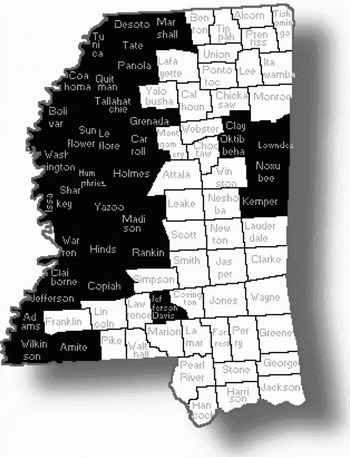
Like South Carolina, Mississippi politics featured a sectional divide on prohibition, public spending, and other issues, but no durable factions. In 1903, Hills legislators secured the passage of a law requiring the use of statewide primaries for party nominations. This helped their counties elect a string of farmer-friendly governors and secure some taxation and education policies that benefited these “white” counties. (Delta counties were then about 70 percent black. See Figure 2.) Although the “Delta vs. Hills” cleavage characterized statewide elections in the 1930s, sharp factional conflict within party or legislature was rare.Footnote 125
Mississippi counties by majority-black status, 1940. Shaded counties have majority-black population.

As elsewhere, the Mississippi Democratic Party was a creation of the state. Statutes regulated virtually all aspects of the state's political parties. This extended to requiring—in contrast to South Carolina—a fairly apportioned SDEC, which determined the party's relationship with the national party, methods of candidate nomination and national convention delegate selection, and the party's platform. The SDEC was comprised of three representatives from each of five districts and was thus less vulnerable to capture by a particular sectional interest. Thus, because no one region could dominate the SDEC, party machinery did not serve in Mississippi as a site of strong authority over party-state affairs. The party only rarely involved itself in nomination struggles or in the electoral disputes more common in Georgia and South Carolina. Furthermore, the large supply of numerous statewide elective offices reduced problems in regulating ambition within the party.Footnote 126
Still, the party was dominated by a politically cohesive Delta that drew on malapportionment, legislative seniority, unofficial planter control of legislative nominations, influential campaign donations in statewide elections, and the greater competence of its legislators.Footnote 127 Planters sought cheap, docile agricultural labor; federal flood assistance and agricultural price supports; and a reduced tax burden for Delta counties. Already well represented in the legislature, the region's interests were best articulated by the Delta Council, a quasi-public pressure group that conducted research and planning, lobbied in Jackson, and infiltrated and surveilled unionization efforts by black sharecroppers in the Delta.Footnote 128
Many Delta planters, south Mississippi industrialists and mill owners, and urban professionals began to coalesce around an agenda of state-facilitated, low-wage, industrial development. Where sectional and ideological cleavages once overlapped fairly neatly, by the late 1930s, many Delta politicians helped Governor Hugh White pass the innovative Balancing Agriculture With Industry (BAWI) plan for enticing external capital into the state.Footnote 129 Ecological analysis of voting patterns in gubernatorial elections revealed that on the eve of the transition, factionalism had sunk to its lowest point in decades.Footnote 130
As with South Carolina, Mississippi lacked an indigenous white liberalism. No important political or civic organizations organized the state's white progressives. The local American Federation of Labor (AFL) was very conservative, and the state's CIO organizers and unions faced incessant hounding and red baiting. Also similar to South Carolina, the state lacked a discursive space for reconsidering the ruling party's project. The state's two dailies, the Jackson Daily News and Jackson Clarion-Ledger, rhetorically safeguarded white supremacy.Footnote 131 By 1944, Mississippi's rulers presided over a relatively issueless, demobilized polity.Footnote 132 Although cultural and class differences separated Hill and Delta, and although political-economic interests varied with the state's topography, strife was reduced within the party by complicated alliances, personal feuds, and a Delta-dominated House.
Prelude to Smith v. Allwright
As war clouds appeared on the horizon, the state's white rulers foresaw no real threats to the white primary or one-party rule. They sincerely believed that “their” blacks had no desire to participate in electoral politics. In the event that the white primary or other barriers to black suffrage weakened, these rulers believed that low educational levels, apathy, and intimidation would prevent blacks from capitalizing on such changes.
The state's black protest capacity remained weak. In 1943, the state had only six NAACP branches with a paid membership of 143.Footnote 133 Mississippi's small class of “respectable” blacks developed some statewide organizations, such as the Committee of One Hundred. Its county affiliates negotiated with white elites to reduce indiscriminate racial violence, improve educational funding and social welfare provisions for blacks, and structure interracial elite bargaining. However, it did not attempt to confront segregation or white supremacy in the political sphere.Footnote 134
However, some Democrats expressed concern. Generally, politicians from the Delta, home to black majorities, were more concerned about lowering barriers to suffrage. While coordinating to secure better black schooling, Delta elites actively opposed educational reforms that might awaken black political aspirations. For example, in 1940, they unsuccessfully sought to amend legislation providing free textbooks (a staple of Mississippi populism) by preventing black schools from receiving civics textbooks that discussed democratic rights and duties. Additionally, they defeated attempts from 1935 to 1940 by U.S. Senator Theodore “The Man” Bilbo and Governor Paul B. Johnson—Hills populists—to repeal the state's poll tax. True, there were many reasons why Delta politicians might have wanted to maintain the poll tax—by the 1930s, it dampened white Hills turnout much more than black turnout. However, the fact that Delta legislators could strategically invoke the repeal's implications for black voting testified to the greater political salience of these dangers.Footnote 135
Mississippians had good reason to think that the war was disrupting their state's thoroughly racialized political economy; in some senses, it was. First, the substantial share of the state's black population inducted into the armed forces—some 78,000—combined with growing consciousness raising across black America to change black elite goals. Rather than seeking marginal policy improvements, black educators began to call for the equalization of teachers' salaries and to consult with Thurgood Marshall and the national NAACP concerning the pursuit of lawsuits on their behalf. In 1942, the conservative Committee of One Hundred vowed to pursue more aggressive policy demands, including voting rights. Second, service in the armed forces and black female participation in better-paying industrial jobs in the booming Gulf Coast and the nearby factories of Memphis raised incomes for locals; this fueled, as elsewhere, a sharp rise in the number of NAACP branches statewide. Membership increased from fewer than 200 to more than 2,500 from 1943 to 1945.Footnote 136
Third, throughout the Black Belt, tighter labor markets for black agricultural laborers and domestic servants and growing concerns about a decline in black deference toward whites and Jim Crow norms, made a return to the pre-war status quo seem less likely to blacks and whites. Interviewers from the Bureau of Agricultural Economics found that many white Deltans sincerely believed popular rumors of region-wide and coordinated black rebellions fomented by outsiders, including Eleanor Roosevelt. Delta planters' influence in federal manpower agencies and on draft boards allowed them to secure a de facto “work or fight” policy during the war.Footnote 137
Fourth, friction between off-duty black servicemen and whites in small towns near military training bases, as well as between blacks and whites on these bases, fueled deadly skirmishes at Camp Shelby, Camp McCain, and Camp Van Dorn.Footnote 138 Fifth, in 1944 and 1945, returning black servicemen transformed local protest patterns. Their very presence in some towns and cities sparked assaults by uniformed white policemen. Such incidents led Percy Greene, editor and publisher of the (black) Jackson Advocate, and the Committee of One Hundred and other organizations to demand the hiring of black police.Footnote 139 In general, the war produced social and economic dislocation, white fears of an unreliable black labor supply, emboldened returning veterans, and larger, more ambitious black protest organizations. However, the means by which rulers maintained white supremacy in the political sphere remained effective. The white primary, the poll tax, and literacy and residency requirements secured an effectively all-white Democratic electorate.Footnote 140
Responding to Smith
In Mississippi, the party-state's responses to Smith v. Allwright were predictable. Fiercely conservative former Governor Mike Conner remarked that the decision was “in accord with the policies and purposes of the New Deal,” which had “repudiated the principles of the Democratic Party.” Governor Tom Bailey, while highly conservative, was more closely aligned with the Roosevelt administration and remained fairly quiet. Firebrand U.S. Representative John Rankin, whose Tupelo district had few blacks, declared, “One of my greatest fears has been realized.” Mississippi's white press shared his indignation.Footnote 141
Other party elites were more subdued. Because statewide elections were held in odd-numbered years, Mississippi rulers—unlike those in most enclaves—faced little pressure to develop a quick response to the ruling. Other than a few municipal elections, Mississippi's blacks could not seek to capitalize on the ruling in 1944.Footnote 142 Because of this, rulers lacked electoral incentives to stake out potentially difficult positions on the issue, as occurred in South Carolina. This fact, combined with the absence of pressure on the ruling party by white supremacist groups, encouraged the party to delay its response. Relative to other Deep South states, the Klan remained dormant. Thus, like other southern states, Mississippi's party proceeded as if the decision applied only to Texas and changed none of its practices.Footnote 143
Inspired by the decision, younger black activists inside and outside the NAACP considered a legal challenge to the state's white primary. Some worried that the NAACP was too far ahead of black public opinion. Eventually, they decided to accede to Thurgood Marshall's advice and wait for a federal election to challenge the state party's rejection of Smith.Footnote 144 In December 1944, Percy Greene's Jackson Advocate began publishing a series of editorials that cited discrimination by registrars and other practices—but not the poll tax—as the main barriers to black voting. Throughout 1945, more black veterans returned to Mississippi, many enrolling at Jackson State, Tougaloo and other black colleges. In January 1946, some founded a Mississippi branch of the regional Progressive Voters League (PVL) and chose T.B. Wilson as its president. Because of its status as an indigenous and non-partisan educational organization, the PVL was considered by white politicians to be less threatening than the NAACP. Better able to secure support from black church and fraternal lodge leaders, its membership grew quickly. As elsewhere, Mississippi's PVL shared leadership, members, and tactics with the state's NAACP.Footnote 145
Black activists in early 1946 delivered a public statement to Governor Bailey and the legislature that seemed to wake up legislators to the need to act. The statement “accused the legislature of neglecting to provide improvements in black educational and voting privileges and threatened court action if nothing was done.”Footnote 146 The PVL board asked the state party's executive committee (SDEC) to clarify party rules regarding black voting in the upcoming primary.
Although the SDEC met with the PVL board, it failed to answer the PVL request or to announce a change in policy. Privately, it concluded that blacks were legally permitted to participate in the party's primary, and considered means of deterring black voters. However, it failed to issue instructions to county parties or election commissioners.Footnote 147 Black veterans in Jackson led efforts to help others read and interpret the constitution, and inform other veterans about their voting rights. Because of the understandable fears many blacks had about traveling to county courthouses to register to vote and pay their poll taxes, veterans organized large groups to travel together. None, however, traveled to the Delta, which they considered too dangerous.Footnote 148
Legislators clearly differed over the urgency of crafting a state-level response to the ruling. Deltan Fielding Wright, an influential member of the state senate and future Dixiecrat leader, sought the passage of a statute along the lines of the South Carolina plan that would privatize state regulations of the primary.Footnote 149 Wright had already planned to run for governor in 1947, and hoped to demonstrate his leadership to the Delta. However, most legislators bypassed privatization because they did not fear black suffrage.Footnote 150 Indeed, the legislature exempted veterans from paying poll taxes for one year. In signing the law, Governor Bailey claimed that other suffrage restrictions would prevent black primary voting. Legislators allied with Senator Bilbo had long sought a full repeal of the poll tax, and the veterans' exemption served as a useful way to advance the cause. Thus, sectional interests led to differing perceptions of the threat of black voting. However, these differences did not extend to electoral politics. At the end of the session, the entire Senate issued a proclamation endorsing Wright's gubernatorial bid. Given the traditional election of a non-Delta governor, this proclamation underscored the fact that sectional conflict in the legislature had subsided.
The 1946 Senatorial Election
In 1946, Senator Bilbo's re-election campaign proved the state's most important political event. Long the Senate's most infamous racist demagogue, as well as one of the South's most reliable New Dealers, he had never campaigned primarily on white supremacy. But Bilbo's rhetoric, and the reactions it sparked, marked a turning point in the party's response to Smith v. Allwright. From town to town, Bilbo stoked white fears of insurgents and outside agitators. As the primary drew nearer, he also warned blacks not to vote.Footnote 151 The University of Michigan-trained Bilbo rejected the NAACP's call for federal election observers and promised to provide legal assistance himself to any whites facing legal reprisals for protecting white supremacy. He scoffed at the possibility of federal prosecutors securing convictions in Mississippi.Footnote 152
The headline of the Jackson Daily News warned blacks, “DON'T TRY IT!”Footnote 153 Many leading politicians and journalists viewed Bilbo's rhetoric as counterproductive, for it might hasten federal interference in state elections.Footnote 154 One of Bilbo's opponents charged that were it not for Bilbo's race-baiting rhetoric, “there would be no registered Negroes and no attempt by them to vote on July 2.” This was wrong, of course; efforts to mobilize black voting preceded the campaign. Rather, the view summed up ruling politicians' surprising lack of political intelligence about black activists' preferences and behaviors. Ultimately, about 2,500 blacks voted in the primary, about one-third of all registered blacks—not many fewer than had voted in South Carolina for a black U.S. Senate candidate two years earlier (see above). Abuses of blacks and their ballots varied considerably.Footnote 155 In some areas, whites allowed black voting. In others, including the all-black community of Mound Bayou, law enforcement officers attempted to void black votes on the grounds that the voters were not actually loyal party members. Black voters faced threats of violence and beatings, before and after voting, by sheriffs, police, and others.Footnote 156
Bilbo won a huge victory, including a majority of the Delta, the traditional base of his opposition. Elite interviews and newspaper reports all concurred that Bilbo's opposition to the FEPC and to black voting convinced thousands of Delta whites, including planters and other economic elites, to support him for the first time.Footnote 157 The 1946 senatorial primary was the first federal election in Mississippi since 1944, and black activists used eyewitness reports to file complaints of voting rights violations with the Justice Department. They sent approximately thirty affidavits, but U.S. Assistant Attorney General Thomas Caudle announced that no investigation would occur due to “insufficient evidence.” Blacks and two white voters, soon joined by national black protest groups, then filed a formal complaint with the U.S. Senate's Special Committee to Investigate Senatorial Campaign Expenditures, charging that Bilbo's rhetoric created a climate of violence and intimidation.Footnote 158
The Committee, featuring Republicans motivated to embarrass their counterparts, held an extraordinary set of hearings in Jackson. This public examination of black suffrage restriction was unprecedented at either the state or national level since the late nineteenth century, and initiated a long period of at least intermittent federal and media attention on the state. Almost 200 blacks registered to testify, and almost 70 did so. In his defense, Bilbo cited a state law requiring primary voters to have been in accord with party principles over the previous two years. However, a party official refuted this claim, revealing that the SDEC had privately ruled to permit black voting.
The hearings were significant in other ways. They informed rulers of black organizing efforts, especially the critical role of veterans in exploiting the temporary poll tax exemption.Footnote 159 Many county-level politicians knew of black mobilization efforts, but state leaders often did not. This knowledge helped build support among party politicians for a state legislative response to the white primary's abolition—along the lines of Wright's privatization proposal. In addition, the hearings revealed a split within the party on membership and voting requirements. They also sparked much larger voter registration efforts by black veterans.
If rulers were complacent from 1944 to 1946, they now snapped to attention and began to deliberate seriously about their response to Smith. At this early stage, it may seem obvious that rulers were united in their preferences about outcomes—the continued exclusion of blacks from party affairs. In Mississippi, rulers were indeed unified in preferring an all-white party. However, as we will soon see, this assumption would be incorrect when applied to Georgia.Footnote 160
Most estimates of the number of black voters in the 1946 primaries hovered between 2,500 and 4,000, but—due to the failure to collect and maintain centralized registration statistics—politicians' guesses differed widely. (The highest estimate was 40,000.) Party leaders differed significantly in their expectations concerning the magnitude of the threat of black insurgency, the efficacy of various suffrage restrictions, and legislative support for various options. This led to divergent estimates of the efficacy of different approaches to disenfranchisement, such as registrars' use of the ‘understanding’ clause; interracial elite negotiation, voter intimidation, and violence; and electoral fraud.
There was also uncertainty over the possibility of defying Smith through party privatization, as in South Carolina, then being litigated. Some politicians even despaired of finding any effective method of suffrage restriction and called for a countermobilization of white voters. Acting Governor Fielding Wright—soon to be Strom Thurmond's running mate on the 1948 States' Rights Party ticket—traveled the state to sound out solons on their views. Finding significant support for his privatization plan, Wright convened a special session. In his opening address, he surveyed the high stakes, lambasted Smith v. Allwright, and criticized outsiders' interference. He declared that Mississippi “shall ever vigorously defend [its] right” to provide for voting qualifications and that the state would “preserve and maintain the dignity and integrity of the Democratic party in this State.” On policy options, though, he deferred to constitutional experts. With an eye to avoiding the potential damage caused by overheated rhetoric in lawsuits defending enclave practices, Wright carefully avoided discussing race.Footnote 161
As elsewhere, options varied by level of governance (county or state), by their bluntness (i.e., the likelihood of restricting white suffrage), and by their subsequent impact on party-state capacities to fend off further threats to enclave rule. Before the special session, viable strategies included: doing nothing (on the view that county officials would manage local challenges); privatization; the enforcement or tightening of existing constitutional requirements of literacy and education; and even the return to nomination by convention. The latter was a non-starter, as white farmers viewed the primary as the signal achievement of the Populist revolt.Footnote 162
Regardless of strategy, most party politicians sought to avoid a choice that necessitated a constitutional convention. Governors frequently made such calls and always were rejected; sometimes the opposition argued in terms of white supremacy.Footnote 163 Usually, county officials feared reversing the state's relatively sharp decentralization of power from which they benefited.
State-level solutions could have differential effects by region. For instance, the liberalization of primary voting rules would probably increase voting by both blacks and poorer whites, thus likely weakening the political power of Delta planters. The converse was also plausible; tightened suffrage requirements applied equally to both races might well advantage Delta elites. Although white elites and most voters throughout the state backed white supremacy, the likely electoral consequences of the white primary's abolition worried Delta politicians much more than those elsewhere.
Privatization would be much more difficult in Mississippi than in South Carolina, for the state's constitution required that the legislature regulate primaries; privatization could not go into effect without a constitutional amendment, and this could not occur until November at the earliest, after the gubernatorial election. This delay, combined with its uncertain constitutional validity, rendered privatization unpopular. Some legislators favored waiting to allow time for federal courts to rule on the South Carolina plan and also to consider more thoroughly various options. Delta legislators, as well as Governor Wright, rejected this option. Others sought better implementation of educational restrictions; this meant restricting voter registration, not party participation. Still others wanted to empower county commissioners to develop difficult qualifications on their own that would not be subject to appeal, such as adopting Arkansas' requirement of fealty (punishable by perjury) to party principles, and allowing county parties to conduct annual registrations during which voters' qualifications might be challenged.
The House quickly passed a bill allowing parties to administer an oath to party at polling places. Senate opposition focused on the possibility that a party faction seizing a county's party executive committee could require the re-registration of all primary voters in order to disenfranchise the opposing faction.Footnote 164 The party principles bill passed, as did legislation authorizing county executive committees to undertake new registrations, whenever they deemed it necessary to their “welfare,” and to challenge applicants on their loyalty to party principles.Footnote 165 Party chair Judge Hubert Holmes, addressing the SDEC, declared that “there are those who have participated in our primaries who were of a different political faith … Let us tighten up the belt of democracy and exclude from our party those who are not in accord with the principles as enunciated by Thomas Jefferson and Woodrow Wilson.” A Delta-dominated party subcommittee then enumerated the party's principles.Footnote 166
The state and state party behaved as one. With the party principles clarified, county parties sought fealty to them. However, as the SDEC‘s secretary admitted privately, the state party, lacking the administrative capacity to do so, would not attempt to enforce county- and local-level compliance with this requirement.Footnote 167 Delegating these choices to county politicians allowed the SDEC to avoid the politically difficult task of developing a single statewide policy.
Black political organizations, already featuring overlapping memberships, now began coordinating their activities. In an extraordinary meeting in Jackson, black leaders decided to ask black voters to affirm the SDEC's party principles.Footnote 168 The national Progressive Voters’ League (PVL) approved a platform that clashed directly with the SDEC‘s soon-to-be-announced party principles, thereby making life difficult for the state's branch of the PVL. At the same meeting, black leader T. B. Wilson urged blacks to vote in the Democratic primaries. However, he also acknowledged that some voters preferred Republican candidates, despite the fact that black activists in Mississippi did not consider using the Republican Party as a political vehicle, unlike some southern compatriots. Black Republicans confided to V. O. Key's researcher and co-author, Alexander Heard, that they had blocked voter registration efforts in their two strongholds, Vicksburg and Natchez. Meanwhile, veterans in Jackson trained voters on registration regulations and publicized Truman's address to the NAACP convention in Washington. Despite these efforts, black voter registration rose from .4 percent to only about 1 percent of the state's black voting-age population. It seemed that the state's highly onerous poll tax dampened voter registration and turnout (see conclusion below).
In August 1947—on the eve of the gubernatorial primary—about 12,000 blacks were registered, and about one-half of them voted.Footnote 169 The PVL recommended that blacks report themselves to be in accordance with party principles and added that “we believe that such things as the FEPC, poll tax, and lynching laws should be left to the states.” Rejecting the view that the principles were chosen to lower black voting, SDEC chair Herbert Holmes stated that the principles requirement would be required of all voters and that he expected that some whites would be challenged. Election officials generally did not administer the oath requirement to black voters, who faced less resistance than in 1946.Footnote 170
In a special election to replace the now-deceased Bilbo, Circuit Judge John C. Stennis defeated U.S. Representatives John Rankin and William Colmer by about 5,000 votes. Black turnout was lower than in the August primary. Mississippi's few white liberals and black voters strongly backed the relative moderation of Stennis.Footnote 171 Significantly, there was no “party” decision or behavior regarding black voting—only some counties “tightened their belts.”
In 1948, during the burgeoning Dixiecrat revolt, U.S. Senator James O. Eastland privately prodded legislators to push through a proposed state constitutional amendment that would require voters to be of “good moral character.” As a suffrage restriction device, this would be a very powerful county-level tool to be used at the discretion of registrars. Eastland worried about the prospects of black voting, especially in the Delta, if federal anti-poll tax legislation were passed. After the amendment was passed and prepared for popular ratification that fall, however, opposition grew among many county-level politicians who worried that factions would be able to punish one another with such a flexible instrument. Leaders, such as House Speaker Sillers, did not to campaign for it and the amendment failed by a large margin.Footnote 172
Implications for the Future
Unlike other southern enclaves, Mississippi's party and state remained relatively decentralized. Moreover, state party machinery—including the all-important SDEC—was fairly apportioned among Delta and Hills counties and—given disagreement in devising new methods of suffrage restriction—not prone to quick, decisive action. In order to balance sectional differences in threat assessments and preferences about strategies, ambitious politicians empowered county-level party actors to allow (or disallow) black voting.
Given the fact that rulers were not pressured to act in 1944, and, given the belated black organizing effort, by the time a majority of party politicians determined they had to act, the privatization plan seemed riskier. As the South Carolina case revealed, the stakes were higher than merely black voting. An issue never much discussed in Mississippi during this period was the possibility of black participation in precinct meetings, county conventions, and so on. However, given the lesser ability of black protest organizations to capitalize on the court's ruling, threats to political white supremacy—while attractive to some as a campaign issue—did not loom on the horizon for most Mississippi politicians. The party would approach coming democratization pressures with similarly decentralized institutions.
GEORGIA
Of all Deep South enclaves, Georgia was most affected by the abolition of the white primary. In the context of sharp factional conflict within the ruling party, Smith sparked an impressive statewide black mobilization. This mobilization, coupled with relatively progressive state leadership, raised the possibility of the end of enclave rule. However, coordination problems within the more progressive faction and skillful use of electoral violence and voter repression resulted in a triumph for the white supremacist Talmadge faction in the gubernatorial election of 1946. Subsequent efforts by progressives and moderates to build alternative political movements almost fractured the ruling party. By 1947, Smith v. Allwright had induced such chaos within the ruling party that Talmadgeite leaders, preoccupied with the fate of their faction, opted to keep the party on the sidelines of the Dixiecrat revolt. This brief, four-year period would play a large role in shaping Georgia's path out of Dixie.
Georgia's Mixture of Centralizing and Decentralizing Elements
Georgia's enclave was established after Reconstruction culminated in violence, the collapse of the state's government, and the fleeing of its governor into exile. Georgia planters and “New South” townsmen and professionals cemented their alliance and political hegemony. The Constitution of 1877—crafted mostly by unreconstructed Confederate elites and fiscally conservative farmers—constrained public borrowing, as well as state-sponsored economic development, and established a highly malapportioned legislature.Footnote 173 After Democratic politicians repressed and co-opted agrarian radicals in the 1890s, Atlanta elites secured the passage of disfranchising provisions that obliterated black voting. White voter turnout also plummeted and did not recover for decades.Footnote 174
In Georgia, county governance remained fairly autonomous from the state legislature. Although special legislation established the size and shape of boards of county commissioners, weak oversight of the implementation of this special legislation resulted in a “total absence of state control over county affairs.” Decentralized governance was problematic. Almost three-quarters of the state's counties had fewer than 20,000 residents and were thus too small and poor to be effective, especially as new policy demands emerged in health, welfare, and education.Footnote 175
In many of the state's rural counties, courthouse “rings,” composed of economically influential individuals, officials, and their networks of families and friends, dominated politics. These so-called key men brought poorer whites—beholden to these elites for loans, mortgages, fertilizer, and so on—to the polls to vote as instructed. In so doing, county leaders could credibly commit their county's vote in gubernatorial elections and thus improve their returns on rent-seeking. The state's electoral laws facilitated this control of county voting. Courthouse cliques marked ballots for voters outside polling booths and monitored their choices.Footnote 176 South Georgia legislative delegations fended off the adoption of a statewide, mandatory secret ballot until 1949, and the state's punitive poll tax provided additional opportunities for controlling votes.Footnote 177 Through both its formal and informal powers, Georgia's governor was one of the South's strongest. The governor served as ex-officio budget director and chose presiding officers and chairs of key committees in both legislative chambers.Footnote 178 While the legislature—highly malapportioned in favor of rural Georgia—served to block many political reforms pressed by urban politicians, the governor's legislative powers weakened the body somewhat.
The County-Unit System
By far the most important institution affecting the dispersion of authority in Georgia—and indeed in the entire Deep South—was its “county-unit system,” a highly malapportioned electoral system for the nomination of statewide Democratic candidates. It developed in the late nineteenth century as a response to electoral corruption by urban conservatives that robbed famed agrarian radical Tom Watson and his white farmer base of a congressional nomination.Footnote 179
In this system, each county received twice its number of seats in the General Assembly. Thus, the 8 largest counties (home to 34 percent of Georgia's whites) each received 6 “unit votes,” whereas the next 30 largest received 4 votes, and the smallest 121 counties (home to 40 percent of the state's whites) received 2 votes. Gubernatorial candidates needed a majority of the 410 county-unit votes. If rural counties united behind a gubernatorial candidate, he could win nomination without receiving a single vote in the state's 56 largest counties. Figure 3 labels the “six-unit” counties, home to the state's largest cities, such as Fulton County's Atlanta and Chatham's Savannah. Since the legislature refused to reapportion itself from 1877 until federal courts ordered it to do so in 1963, the county-unit system reinforced, in gubernatorial and other statewide elections, the extremely powerful rural bias in legislative politics. The result was, in Key's phrase, the “Rule of the Rustics.”Footnote 180 Because the system encouraged gubernatorial and other statewide candidates merely to seek county pluralities, it substantially lowered the costs of campaigning for the support of elites who “delivered” their counties and heightened corruption. More moderate politicians throughout the state privately opposed the system, but, given their need to win “two-unit counties,” supported it publicly. Once established, the county-unit system perpetuated itself. Legislators from two-unit counties had no reason to abolish it.Footnote 181
Georgia's county-unit system, by number of unit votes, 1940. Blackened are 6-unit “city” counties. Shaded are 4-unit “town” counties. Remaining are two-unit counties.

Given this state of affairs, urban actors, progressives, and many newspaper editors and other “good government” advocates sought to revise substantially or replace the Constitution of 1877. They sought a stronger executive, legislative reapportionment, greater state borrowing and taxation powers, county consolidation, and other centralizing reforms; but, as in Mississippi and South Carolina, these efforts failed.
Thus, Georgia mixed a dispersion of political power across 159 counties with a strong executive, thus frustrating predictions about the implications of this distribution of political authority defending enclave rule. Because of the executive's strength and influence over state party machinery, a more centralized party-state would seem to promise coherent, unitary responses to democratization pressures framed quickly and decisively by powerful executives. However, the power of two-unit counties over the legislature and statewide nominations posed a counterweight to executive dominance. Compared to other southern governors, Georgia's executive held greater power over state governance and party machinery.Footnote 182 However, the use of the county-unit system in nominating statewide candidates, combined with the fact that convention delegates were apportioned on the county-unit basis, meant that—regardless of the candidate—rural Georgia retained substantial influence in party machinery.Footnote 183
Factionalism in Georgia
On the eve of the transition, the Deep South's sharpest factional conflict existed within Georgia's ruling party. Eugene “Gene” Talmadge, a charismatic white supremacist demagogue, led a coalition of county courthouse rings and poorer white farmers against a much less cohesive “anti-Talmadge” faction of so-called urban moderates and progressives across the state. Talmadge harkened back to his Populist hero, Tom Watson, in railing against the “moneyed interests” of the cities. Of course, the county-unit system allowed him to limit his appeal to “two-unit” counties, but Talmadge also relied on Atlanta corporations to finance his campaigns.
The Talmadge faction advocated and implemented much more conservative policies than those of the Populists. Amidst the general textile strike of 1934—during which almost 40,000 Georgia workers struck—Talmadge called out the National Guard and declared martial law. He ordered the detention of hundreds of workers in what one journalist called a “barbed-wire concentration camp” at Fort McPherson, near Atlanta. On some afternoons, Talmadge would stroll up to the fence and read aloud to the strikers from Mein Kampf.Footnote 184 His several terms as governor, during which Talmadgeites controlled the state legislature, featured no substantive policy initiatives. Instead, these years were marked by severe fiscal mismanagement, staunch opposition to the New Deal and governmental reforms, the use of the state's coercive apparatus to intimidate political opponents, and the personal manipulation of state agencies.Footnote 185
A shifting constellation of social groups, patronage and personalistic networks, and interest groups comprised the looser anti-Talmadge faction. These included business leaders and professionals, “good government” whites represented by the League of Women Voters (LWV), most media outlets, and various county courthouse gangs co-opted by gubernatorial candidates who, for various reasons, remained outside the Talmadge faction.Footnote 186 Atlanta was home to many moderate and progressive civic groups. As such, it was the center of anti-Talmadge forces. Besides supporting various state modernization projects and minor policy provisions for blacks, and decrying the worst abuses of white supremacy—especially those which attracted attention from the North, such as lynching and the state's infamous penal system—anti-Talmadge politicians failed to challenge publicly the major pillars of white supremacy.Footnote 187 Later, black voters (many of them vets), returning white war veterans, and many union members joined this constellation.Footnote 188 For decades, Talmadge opponents remained bedeviled by their failure to coordinate consistently behind a single gubernatorial candidate.Footnote 189
In 1900, in an effort to attract Populist voters back to their party, conservative Georgia Democrats codified an all-white primary in party rules.Footnote 190 Observing state politics from Atlanta University, W. E. B. Du Bois declared that the white primary's real victims were not blacks—who by then were already disenfranchised by other devices and practices—but poor whites.Footnote 191 By the 1920s, state law regulated party primaries, primary voter qualifications and registration requirements. However, unlike general elections, state law did not require county parties to use a secret ballot for primary elections, and few did so.
Compared to those of its neighbors, Georgia's ruling party was much more strife-ridden, unstable, and prone to crisis. Numerous times in the prewar period, governors and others manipulated the state's coercive apparatus for partisan purposes, declared martial law and even a financial “dictatorship” over control of highway funds, and were themselves arrested in standoffs over personal feuds, battles over control of the Highway Department patronage, and schemes to empty state coffers. At several moments in the bizarre narrative that follows, Georgia's ruling party—and with it, stable enclave rule—risked collapse.Footnote 192
Black Party Participation Before Smith v. Allwright
By 1940, Georgia's black population was the nation's largest. It comprised more than one-third of the state's voting-age population, and about one-third of the state's 159 counties were majority-black (see Figure 4). White supremacy in the political sphere relied on the white primary and county-unit system, as well as the county-level implementation of the poll tax and other constitutionally established requirements. Although Georgia's electoral administration was highly decentralized, its rulers—unlike those in Mississippi—had a good estimate of black registration since poll tax receipts, forwarded to the Secretary of State, were categorized by race.
Georgia counties by majority-black states, 1940. Shaded counties have majority-black population.

Blacks voted only, and sparingly, in general elections for Republican candidates and in municipal elections in Atlanta, Savannah, and other cities.Footnote 193 Black registration and voting, in fact, declined over the first four decades of the century, even as the share of blacks living in cities increased. By 1940 registration stood at 3 percent of the state's black voting-age population (see Table 1). Also, as in Mississippi, black Georgia's “organizational readiness” diminished over the century's first decades, as the number and size of NAACP urban branches shrank from 16 in 1920 to fewer than 10 by 1940. By 1940, black Georgia lacked statewide networks that could be activated.Footnote 194 Still, black Atlanta remained an important regional center of black civic associationalism, higher education, capital formation, mass demonstrations, and other protest. This infrastructure sometimes bore fruit, as Atlanta blacks exploited electoral rules for referenda to defeat proposed bond issues in the 1920s and 1930s.Footnote 195 However, Atlanta would be outpaced in black insurgency in the 1940s by Savannah.Footnote 196 As occurred elsewhere, World War II energized and spatially expanded black protest organizations. Black soldiers based at Fort Benning and in Atlanta organized NAACP membership and voter registration drives, and better-paying industrial jobs drew blacks to cities and supported membership dues.
Black Voting-Age Population Registered to Vote, 1940–1970

Sources: Garrow, Protest at Selma, 7, 11, 19, 189, 200; Harold Stanley, Voter Mobilization and the Politics of Race (NY: Praeger, 1987), 97; U.S. Commission on Civil Rights, The Voting Rights Act: Unfulfilled Goals, 19.
Factional Conflict on the Eve of Smith
In 1942, two years before Smith, incumbent Governor Talmadge was seeking the state's first four-year gubernatorial term in his ninth statewide campaign. The anti-Talmadge faction successfully coordinated support for one candidate—Attorney General Ellis Arnall. Capitalizing on several scandals and miscues, and benefiting from financial support from the oil industry (then feuding with Talmadge), Arnall upset him. Arnall benefited from Talmadge's reputation as an “imitation Hitler,” but when necessary he countered Talmadge's white supremacist appeals with his own.Footnote 197 Nevertheless, Arnall had a reputation among Georgia's black protest leaders and media and those elsewhere as racially progressive, and the Pittsburgh Courier and Chicago Defender interpreted his victory as proving that the “Race Issue is Dead in Dixie” and signaling a democratic reawakening.Footnote 198 As governor from 1943 to 1947, the nationally ambitious Arnall won one stunning legislative success after another. He repaired the state's higher education and penal systems, secured numerous state governmental administrative and budgetary reforms, restored (with the benefit of the war) the state's fiscal health, and repealed the state's poll tax. Others also credited him with lowering the state's voting age to eighteen and implementing the federal Soldiers’ Voting Act.Footnote 199 Georgia was first in the nation to accomplish each of these reforms. Against long odds, he also convinced state solons to establish a commission to draft a new constitution. Arnall won national praise, and he took a leadership role among southern governors.Footnote 200
On the eve of Smith, key members of both party factions did not actually view white supremacy as threatened. Precious few blacks paid their poll tax, and party leaders did not substantially alter party regulations in the years leading up to Smith.Footnote 201 Arnall was clearly less devoted to white supremacy compared to Talmadge and his faction; his election and popularity among legislators also suggest that those members of Georgia's ruling class who cared to scan the sky saw few clouds of racial threat looming. Factional conflict in the early forties persisted, but Arnall's skillful leadership seemed to have weakened the Talmadge faction. Even so, anti-Talmadgeites expressed no desire to depart from the consensus on white supremacy.
Immediately after Smith, Arnall remained silent, while Talmadge decried both the ruling and Governor Arnall's inaction. Meanwhile, the ongoing Constitutional Revision Commission—chaired by Arnall—examined existing provisions pertaining to primary elections; its private deliberations suggest that leading politicians, including the governor, endorsed South Carolina's privatization plan.Footnote 202 Several thousand blacks had registered in an orchestrated campaign, but the SDEC announced that they would not be eligible to participate in the upcoming primary.
Meanwhile, Arnall called Smith “a blow to liberalism” and claimed that black attempts to join the party and federal anti-poll tax legislation would backfire by weakening the state's own reform efforts. He continued to support segregation as “conducive to the welfare” of both races.Footnote 203 The NAACP branch in Columbus filed a test suit against county officials to apply Smith in Georgia. The party demurred, concluding that it was not party to the ruling.Footnote 204
Rulers' Beliefs and Preferences
If the new constitution remained unratified, they could do nothing and leave the issue in the hands of federal courts to rule on King's challenge. They could choose the privatization option, as endorsed by Arnall and the commission. Other options included adopting new, ostensibly non-racial qualifications for party “membership,” or delegating to county parties the authority to restrict black turnout. Finally, as some black groups suggested in a compromise, the state legislature could adopt new qualifications for voter registration.
A few institutional features of Georgia's party-state structured the debate. Given the governor's legislative influence, it would be more difficult than in other enclaves for a rural-dominated legislature to overwhelm Arnall's preferences. More importantly, the county-unit system effectively insulated gubernatorial elections from the possible harms of black voting. Although blacks had voting-age majorities in approximately 47 counties (see Figure 3), the vast majority of registered blacks inhabited the largest cities, which were in the electorally anemic six-unit counties. Thus, there was less urgency than there would have been in the absence of the county-unit system. Moreover, Talmadgeite concerns about the maintenance of the county-unit system were in tension with a privatization response. This tension played a critical role in the state's deliberations and deserves a closer look.
In 1917, legislators from small counties safeguarded the system by changing it from a party rule to state law. Talmadgeite politicians feared that party regulations barring electoral fraud and establishing rules for settling contested legislative elections—then quite common—were vulnerable to attack by their opponents, who might someday control state party machinery. Thus, after a resounding victory in 1940, the Talmadge-dominated party, in response to the heavily corrupt governorship of New Dealer Eurith D. “Ed” Rivers, quickly secured recount and other anti-fraud rules into statutory form. Privatizing the party would mean transferring the county-unit system and anti-fraud statutes governing primaries from state law to party regulation, and thus, in the eyes of the Talmadge faction, placing them at greater risk. Although some members of the faction would come to support privatization, many had serious concerns along these lines.Footnote 205
Regarding Smith, Arnall's decision was basically to do nothing. He did not call a special session to devise a response. Even his 1945 State of the State address did not mention the white primary. In calling for repeal of the poll tax, he saw “no danger” that, in its absence, black voting posed a threat to the party, and he refused to articulate a plan for retaining the white primary.Footnote 206 Arnall's political ambitions shaped his response to Smith. In early 1945, he almost succeeded in attempting to convince the legislature to amend the constitution so that governors could serve consecutive terms. Had he done so, his incumbency advantages and great popularity would have assured him re-election. We could imagine at least one counterfactual Georgia. Here, spurred on by his national ambitions and aided by the state's anti-Talmadge faction, Arnall might have crafted a very different, and much earlier, incorporation of blacks into the party, with massive implications for the state's subsequent political development.
However, the anti-Talmadge faction failed to work out a stable leadership succession. Its most powerful political operative, House Speaker Roy Harris, had been instrumental in Arnall's election (as well as several other gubernatorial candidates) and in the passage of his legislative program. Harris expected to be anointed the faction's gubernatorial candidate for the 1946 election. However, he felt betrayed when Arnall attempted to seek re-election by amending the constitution and disagreed with Arnall's failure to safeguard political white supremacy. Harris exited the faction and helped defeat the constitutional amendment providing for successive gubernatorial terms. He then became one of the top strategists for white supremacy in the Talmadge faction.Footnote 207 Arnall attempted to burnish his national image, mainly through more liberal position taking on black voting and an assault on the resurgent Klan.Footnote 208 More important, he sought the election of an anti-Talmadge candidate in the 1946 gubernatorial race; otherwise, his political future would be in jeopardy.
In late 1945, a federal judge ruled that blacks could vote in the 1946 primary.Footnote 209 Several prominent Georgia newspapers backed the decision. However, Arnall warned blacks not to vote, and the state appealed the decision, to the disappointment of black leaders. In January, however, the Arnall-controlled SDEC relented, agreeing to let blacks vote.Footnote 210 The U.S. Fifth Circuit Court of Appeals soon upheld King, but the majority opinion suggested complete privatization as a way out. House Speaker Roy Harris called for a special session to repeal the state's primary laws, à la South Carolina. Talmadge, preparing for another run for governor, agreed.Footnote 211
Arnall faced a serious dilemma. His national political prospects would be damaged by non-compliance with Smith and King; however, embracing these rulings and publicly backing black incorporation into the party would greatly help Talmadge and thereby possibly destroy Arnall's future in state politics. He took a strong stand and announced his opposition to any scheme to evade the courts and, further, that privatization would risk both the county-unit system and free and fair elections. He also vowed to block a special session called by the legislature. Arnall informed the SDEC that the white primary was dead. The committee altered party rules to permit black voting in the upcoming 1946 gubernatorial primary.Footnote 212
Black Georgia's Response to Smith
In early 1946, black Georgia achieved astonishing results. As in other states, a small black protest leadership populated several overlapping groups, including the state's Republican Party, the NAACP, and other statewide black networks.Footnote 213 A. T. Walden, state secretary of the Georgia NAACP conference of branches, was also president of the Georgia Association of Citizen Democratic Clubs (CDCs). Soon, there were about seventy-five such clubs statewide, totaling 15,000 to 20,000 members. The CDC endorsed statewide candidates, whereas local clubs backed local candidates as they chose. In 1946, the organization boasted twenty-five full-time paid organizers.
The (white) Committee for Georgia, an organization affiliated with the progressive Southern Committee on Human Welfare, coordinated with black organizations and helped finance field workers in all counties to spur black voter registration and campaign against Talmadge, even before the anti-Talmadge candidate(s) became known. The state's CIO, then involved in a large, region-wide effort to unionize non-agricultural labor, also participated. In Atlanta, a large registration drive brought together several black political and civic organizations. Black registered voters in 1946 increased from about 3,000 to about 21,000 (or from about 4 percent to 27 percent of the city's electorate).Footnote 214 Statewide, about 125,000 registered—more than 100,000 outside Atlanta—in a remarkable, and remarkably quick, mobilization that propelled black voters from a negligible presence to about 20 percent of Georgia's electorate.Footnote 215
A Turning Point: The 1946 Gubernatorial Election
Georgia's 1946 gubernatorial election amounted to a critical juncture in the state's political development. A victory of the now-biracial anti-Talmadge faction would effect a statewide incorporation of blacks into the ruling party and likely ended enclave rule in Georgia. The faction was hampered, however, by two related problems: its leadership succession dispute in 1945 and its candidate coordination problem in the 1946 primary. Relying on an impressive, systematic repression of black voting, Gene Talmadge won the 1946 primary with a minority of the popular vote but a narrow county-unit plurality. The Talmadge faction, exploiting the bizarre Three-Governors Controversy (see below), expanded its control over party machinery and then navigated the enclave through the critical 1950s and early 1960s.
In declaring his candidacy, Gene Talmadge promised to restore the white primary, “the One Issue in This Race.”Footnote 216 He invoked South Carolina's privatization plan as a model. Talmadge attacked his opponent indirectly by campaigning against Ellis “Benedict” Arnall. Now-Talmadgeite House Speaker Roy Harris condemned Arnall and announced he would either run for governor himself or help elect a candidate devoted to saving the white primary. Arnall, meanwhile, assisted reformers in attacking Harris's “Cracker Party” machine organization in Augusta. In a stunning result, on the strength of black voters and a large voter registration drive organized by white reformers—many of them war veterans—Speaker Harris lost his seat.Footnote 217
Given Harris' defeat, the field of gubernatorial candidates narrowed. Arnall pegged young business moderate James V. Carmichael as his successor; Carmichael agreed that the white primary was dead and opposed efforts to repeal statutes regulating primaries. Were Carmichael to prevail, many thought Arnall could control the state delegation to the 1948 National Democratic Convention. Notably corrupt former Governor “Ed” Rivers jumped in the race. Apparently paid to enter the race by Talmadgeite forces (a not uncommon practice), he split the anti-Talmadge vote.Footnote 218
Soon after Talmadge's paper, The Statesman, announced Talmadge's candidacy, it offered a blueprint for restricting black suffrage. It cited rarely invoked sections of the state code that held that any Georgia citizen could challenge the registration of any registrant by claiming that the registrant was, for reasons specified in the challenge, unqualified to vote. Talmadge's campaign mailed thousands of challenge forms to supporters in every county.Footnote 219
Talmadge campaign officials traveled across the state to interrogate witnesses at these purge hearings.Footnote 220 Those who had been challenged could request a hearing to restore their registration, but in many counties, the burden of proof lay with the challenged voter. Failure to appear at hearings often resulted in disqualifications.Footnote 221 The practices of relevant officials—usually tax collectors who served as registrars—seemed to track factional lines, with pro-Talmadge authorities much more likely to purge blacks in larger numbers. Ultimately, more than 16,000 registered blacks were disenfranchised.Footnote 222 In the Black Belt, Talmadge supporters intimidated and coerced blacks, with acts ranging from night riding to cross-burnings to murder. Carmichael accused Talmadge and “his henchmen” of promoting white crowd violence against blacks on the eve of the primary. Indeed, the summer of 1946 featured a wave of racial violence throughout the South, much of it targeting black veterans. Georgia played host to much of it.Footnote 223
An analysis of the disenfranchised by county suggests that the election turned on the Talmadge campaign's suppression of black voters and the failure of anti-Talmadge forces to coordinate behind a single candidate.Footnote 224 A loss by the popular vote winner was almost unprecedented, and state and national media expressed outrage, as well as fear about what a Talmadge-controlled Democratic Party would become once the state got out of the election administration business.Footnote 225 Governor-elect Talmadge (technically just the Democratic nominee) announced that the party would arrange for a “white man's primary” under the county-unit system and called on the legislature to repeal primary statutes in order to comply with federal courts. Urban moderates began the first of a long series of unsuccessful lawsuits, also in federal court, claiming that the county-unit system violated the Fourteenth Amendment.Footnote 226
The Three-Governors Controversy
Just before the perfunctory general election, Talmadge died. Thence began a confusing and tragicomic conflict during which, over the course of less than three months, three governors presided over Georgia: Talmadge's son Herman; Arnall; and the duly elected Lieutenant Governor, Melvin Thompson. Vague rules of gubernatorial succession allowed the Talmadge-dominated legislature to anoint young Herman Talmadge governor. A special election in November 1948 (with a Democratic primary in September) would determine who would finish out the second half of the late Gene Talmadge's four-year term (1947–1951).Footnote 227
The legislature quickly passed the (Gene) Talmadge white primary bill, which was even more radical than South Carolina's. It combined South Carolina's privatization plan—complete repeal of primary-related statutes—with stricter enforcement of registration laws and new, periodic re-registration of voters. In signing the legislation, Governor Herman Talmadge argued for the importance of attacking black suffrage by restricting registration, noting that blacks could vote in general elections, which did not feature the county-unit system.Footnote 228
Soon, white progressives and moderates outraged by the legislature's actions formed the “Aroused Citizens of Georgia.” The group announced plans “to maintain a true Democratic party” under the name “the Democratic Party of Georgia.” It declared that the party's leadership had forfeited the right to use the party name by their “efforts … to perpetuate their rule by a series of unlawful, unconstitutional and undemocratic actions” culminating in the white primary bill.Footnote 229
The possibility that white supremacists could be defeated in a general election by a party of white progressives and moderates and blacks was, for Talmadgeites, all too real. General elections were decided by a simple popular vote, not by the county-unit vote. Thus, the anti-Talmadge whites and blacks marooned in six-unit counties would finally exert real influence on statewide elections. For Talmadge forces, this made the extension of the county-unit system to general elections even more urgent. House moderates defeated a proposal to submit to the voters for ratification a constitutional amendment that would do so.
In March 1947, Georgia's Supreme Court named Lieutenant Governor Melvin Thompson governor until a special election could be held in November 1948. Sixty-three days after the crisis began, Gene Talmadge's son Herman left the governor's office, and Harris immediately announced Talmadge's candidacy for the special election. Thompson declared that Talmadge and his forces “now have no right to speak for the Democratic Party” and that “today, again, law and order prevails in Georgia.” He vowed to veto the party privatization act passed during Herman Talmadge's short tenure as governor.Footnote 230
Thompson—and anti-Talmadge moderates—faced a real dilemma. If Thompson vetoed the legislation, he would deliver a ready-made issue to young Herman, who had inherited control of the party machinery. If he signed it, he could remove the issue, run as a candidate for a separate Democratic Party, and defeat Talmadge with the help of black voters in a general election. Thompson sought to establish his bona fides on white supremacy and promised to carry out the Talmadgeite party platform without disturbing it.Footnote 231 He called for the legislature to require racially segregated ballot boxes—well-suited for suffrage restriction—and the state regulation of primaries and established educational requirements for registration applicants.Footnote 232
Talmadge forces were intent on blocking any legislation that might allow Thompson to claim credit for protecting white supremacy. Theirs was a risky strategy—to accept potential gains in black suffrage in order to improve the chances of recapturing the governor's mansion and passing more satisfactory legislation. Factional conflict left both chambers gridlocked, and the legislature adjourned without passing any laws involving party primaries.Footnote 233
At the 1946 party convention, dominated by the newly triumphant (but increasingly frail) Gene Talmadge, Talmadgeites had gained control of the SDEC, whose members would serve until 1948.Footnote 234 Thus, even after the governorship was awarded to Thompson, Roy Harris, young Herman Talmadge, party chair Jim Peters, and other Talmadgeites would control party machinery throughout 1947 and 1948. Control over the powerful executive committee would have a large bearing on the 1948 special gubernatorial election (also, as luck would have it, on the decision of the ruling party to join the Dixiecrat revolt). Thus, the moderate “Democratic Party of Georgia” held a state convention. Thompson forces labeled Peters and other members of the SDEC as “bolters” from the Democratic Party and formed their own SDEC.
Talmadge-chosen House Speaker Fred Hand then demanded that Thompson call a special session to pass Thompson's proposal for educational requirements on voter registration. The Democratic National Committee recognized Governor Thompson as the titular head of the party. Both Democratic “Parties” scheduled meetings to arrange for the 1948 primaries, leaving it to state courts to decide which faction controlled the party.Footnote 235 The Georgia Supreme Court ruled that Talmadgeite James Peters was the rightful legal chair of the Democratic executive committee.Footnote 236 Progressives had failed to seize the party machinery.
Anticipating the 1948 Gubernatorial Election
Understandably, politicians were very uncertain about the stability of the ruling party and of one-party rule. Whether a second party would be a bolting, black, more urban, and progressive faction or a bolting, white-only, more rural, and white supremacist faction would depend on the outcome of the 1948 gubernatorial primary. It was also unclear whether Talmadge could win a general election. White supremacists did not (merely) fear black suffrage. In the words of House Speaker Fred Hand, “What we don't want ‘em to do is to get in a position in our party so they can be manipulated. [L]et ‘em have their own party, a black Democratic Party if they want.”Footnote 237
Other Talmadgeites did not expect the development of a second party and deplored black incorporation attempts. Noteworthy here is the rhetorical abandonment of white supremacists’ dedication to one-party rule. This speaks to the degree to which Smith and the black mobilization it sparked had imperiled the state party. Talmadgeite strategist Roy Harris thought a second party in Georgia would be a Republican Party,
unless you want to go along with the Henry Wallace pinks. … I don't know whether the niggers will go Republican or not. I do know we're going to have a white man's party in Georgia. … It won't make any difference what the Supreme Court decides on the South Carolina primary. The Negro is going to motivate Georgia politics for years to come. Under a two-party system the Negro would be the balance of power. … We can't let the niggers run Georgia. They'll do it … if Thompson gets elected next year.Footnote 238
Unlike elsewhere, Georgia's ruling party faced serious possibilities of collapse. A second “Democratic” Party that incorporated blacks might battle the white supremacist rump party in general elections—and thus outside the confines of the county-unit system. Given the statewide nature of Georgia's black insurgency, such a party would be highly competitive and would likely transform enclave rule and hasten the state's democratization. The political repression of 1946 suggested that the Talmadge faction would not concede enclave rule without a fight.
Implications for the Future
In contrast to their counterparts in South Carolina and Mississippi, Georgia's rulers divided sharply along factional lines and disagreed on how to respond to Smith. This fact, in conjunction with the enormously important county-unit system and the progressive political ambitions of key actors, produced acquiescence to, and then defiance of, Smith. From 1944 to 1946, acquiescence facilitated the impressive rise in black registration and voting. In the aftermath of electoral violence and voter repression, the 1946 gubernatorial election and ensuing Three-Governors Controversy, anti-Talmadgeites considered developing a separate, biracial party loyal to the national party.
Legal control over the “Democratic” label remained unclear, and neither Talmadgeites nor their opponents were at all sure that one-party rule—and with it, stable enclave rule—would continue. The progressive ambitions of key faction members, coupled with the uncertainties surrounding “ownership” of the party, would convince Talmadge faction leaders to take the safe route and avoid the Dixiecrat revolt. In the longer run, the critical 1946 gubernatorial election wrecked the party's more progressive faction for almost two decades. These developments ensured Talmadgeite rule during the critical decade of the 1950s. In Georgia, Smith produced the region's most profound effects; these would reverberate throughout its democratization.
DISCUSSION AND IMPLICATIONS
The narratives offered here all point to the contingency and complexity of rulers' efforts to manage threats to their rule. Outcomes could not be predicted with reference to structural features of the polity; instead, outcomes were bound up in the political ambitions of some rulers, as well as conflict and cooperation across sectional and factional divides. Political institutions, often with sharp sectional biases, refracted how socioeconomic power would be converted into rulers' responses, thus constraining and enabling different authorities as they managed democratization challenges. Furthermore, the perception of the threat to enclave rule posed by blacks was paramount across all three enclaves. Importantly, these perceptions did not always conform with reality. Rulers differed in the quality of their intelligence about goings-on in black communities, as Jim Crow's parallel public spheres and civic institutions frustrated their ability to “see like states.” Even as the transition progressed, rulers would continue to misinterpret the scope of black protest and the preferences of black leaders.
Two other features of these narratives deserve mention. First, the bluntness of policy instruments aimed at black political participation complicated enclave defenses. Some policy options were opposed because they would repress poorer whites; other lawmakers favored such options for this very reason. Thus, policy discussions could both raise factional tensions and alter the balance of power among factions. Second, although it may be too strong a claim to argue that the seeds of the enclaves' demise were sown in their founding, the constitutions of the late nineteenth century limited enclaves' fiscal and administrative capacities and the legal authority of actors, especially governors. When developing new capacities required constitutional revision, it posed a double threat to many: it could disrupt balances of power among section and faction by altering sectional biases in institutional arrangements; and it might expose the enclave to further federal judicial oversight.
These narratives point to some real puzzles, too. For instance, what explains the flurry of attempts at party building during this period? Blacks, white progressives and moderates, and motivated white supremacist ideologues all considered and often worked diligently to build organizations that used the “party” moniker. How should we characterize the organizations that waited in the wings for recognition by the national party, or lay in ambush of it?Footnote 239 Is there a subterranean history of such efforts in other parts of the country? Further, how should we square this moment with the seeming solidity of the two-party system?Footnote 240 The very different patterns of black mobilization across these states are puzzling as well. From a common take-off point, black protest diverged very quickly, not reversing until the late 1960s (e.g., Table 1). This divergence is not easily accounted for by any measure of black protest capacity antecedent to the transition. Although there were differences in this capacity, their magnitude was vastly outweighed by the magnitude of the ensuing changes.
By the early 1970s, enclaves had exited authoritarian rule via different paths. Their democratization experiences differed in terms of the orderliness of compliance with federal directives, the timing and nature of black incorporation into the ruling party, and the timing and nature of its reconciliation with the national party.Footnote 241 The manner in which the abolition of the white primary unfolded did not determine these paths, but still shaped them.
Three Paths Out of Dixie
After some two decades of forthright resistance to any racial reforms, as well as attacks on white civil society and black protest, South Carolina's rulers exploited cohesive elite networks and an effective coercive apparatus to navigate safely the desegregation crisis at Clemson. This outcome provided increasing returns to rulers' strategic accommodation to democratization pressures. They capitalized on the state's external reputation to maintain order, deter interventions by national civil rights organizations, and limit federal oversight of party-state compliance with federal directives. By doing so, rulers accelerated the exit of white supremacist activists from the ruling party, and sped the party's incorporation of blacks and its reconciliation with the national party. Limiting democratization's disruptive effects, South Carolina successfully harnessed the revolution.
Mississippi also resisted early democratization pressures. However, during the 1950s, the state's decentralization of authority stymied reformers' attempts to overhaul the state's policing apparatus and pursue other governmental reforms. The party faction's dominance by Citizens' Council forces, coupled with the state's disorganized law enforcement, resulted in the debacle at Oxford. This massive military operation induced white supremacist violence that further corroded law enforcement, thereby sparking a massive intervention from national civil rights organizations. The ensuing spiral of interventions and disorder resulted in substantial federal oversight of Mississippi's compliance with federal directives. Blacks in Mississippi mobilized quickly, and did so outside the confines of the ruling party. In the chaos of a fissured state Democratic Party, relations with the national party became estranged—and remained so into the mid-1970s. In sum, Mississippi's rulers stumbled through the 1960s. By failing to deter white supremacist violence, they unwittingly induced the violations of Mississippi “sovereignty” against which they had long railed.
Georgia's white supremacist rulers narrowly escaped a collapse of the ruling party in the late 1940s. With the dominance of the Talmadge faction secured, they pursued a “massive resistance” to democratization pressures through the 1950s. In doing so, they decimated statewide networks of black protest. By the time black direct action movements swept the state, the likely engine of statewide black insurgency—black Atlanta—had accommodated to corporate interests by trading critical support in mayoral elections for meager policy benefits. This accommodation effectively neutralized the development of statewide insurgency networks. Instead, Georgia's Black Belt activists were left largely on their own to deal with powerful county interests and state-sponsored violence. Atlanta's carefully developed reputation as a “dignified,” compliant city reaped benefits for north Georgia and helped deter substantial interventions by civil rights organizations and the federal government into south Georgia. The “two Georgias” quickly diverged, as north Georgia experienced a harnessed revolution and south Georgia, a protracted democratization.
These different paths generated important legacies that still shape the present. In South Carolina and north Georgia, accommodation to democratization pressures garnered greater success in capital accumulation and accelerated economic growth. Conversely, Mississippi and south Georgia, where accommodation failed, suffered greatly on this score. Ironically, however, by managing to incorporate blacks and reconcile smoothly with the national party, South Carolina's rulers were soon unable to maintain a “brand name” for the state party that differed sufficiently from that of the national party. They thus doomed state Democrats over the long run. In Mississippi, by failing to accommodate strategically to democratization pressures, rulers positioned the rump state party such that Republicans had nowhere to run. In doing so they unintentionally benefited state Democrats for more than two decades. Besides existing questions of economic development and electoral change, the democratization perspective articulated here poses new questions about topics such as transitional justice, controversies over state-sponsored art, and the wave of constitution writing and political modernization projects that followed closely on the heels of the transition to democracy.Footnote 242
Another American Exceptionalism?
With this research, I hope to contribute to an important new line of inquiry that disrupts traditional narratives of American democracy and suggests a different kind of American exceptionalism. Putting aside—at least for the moment—the “why-no-socialism” query, several scholars have persuasively argued that we have long underestimated the degree to which American democracy has been contested. In particular, building on the work of southern historians, they show that suffrage—the lynchpin of democratic rule—has been contested throughout our history, that its expansion has been anything but linear, and that retractions and expansions have been contingent throughout.Footnote 243 Triumphalist narratives of the inevitability of universal suffrage in America are left reeling. Indeed, suffrage remains contested even today; witness the current debate over felon disenfranchisement.Footnote 244 Others have raised important questions about the support for democracy over the history of U.S. political and legal thought.Footnote 245
My understanding of the South fits with this line of research. I also emphasize suffrage and suggest a different periodization of America's democratic development.Footnote 246 My work is a departure as well, because it concerns not just suffrage but democratic governance. On my view, not only universal suffrage but also a fully consolidated democracy is a recent American achievement. A whole host of requirements of democratic rule, including associational freedoms and the rule of law, have been consolidated only since the early 1970s. Richard Valelly argues that the U.S. is distinct among democracies for having enfranchised, disenfranchised, and re-enfranchised groups of its citizens while remaining a democracy.Footnote 247 Similarly, Richard Bensel motivates his masterwork on the politics of American industrialization by wondering how the U.S. managed to undergo rapid industrialization while remaining democratic. My work suggests that the country did undergo a change in regime type—it transformed itself from a federal democracy at the turn of the century into one featuring stable enclaves of authoritarian rule.Footnote 248
One implication of this perspective is that American political development scholars might reorient their comparisons. Rather than looking solely to Europe—the preoccupation of scholars of the welfare state—we might benefit from looking southward to Latin America where several other polities have wrestled with questions of racial hierarchies, labor, and politics in a post-emancipation context. The U.S. differs, of course—it was a federal democracy before the abolition of slavery, and it tolerated pockets of authoritarianism for three-quarters of a century. Contemporary Argentina, Brazil, and Mexico are grappling with the presence of enclaves just after their recent democratizations and are doing so in a completely different historical moment.Footnote 249 It is at the very least, however, an open question whether accounting for America's status as a “late, late, democratizer” is best understood by focusing on Western Europe, rather than the polities with which in some respects it shares a good deal more.Footnote 250
If the consolidation of democracy across the entire polity took so long to occur, and was so complex and contingent, should we view it as permanent? Certainly we can imagine new restrictions on associational freedoms and on suffrage.Footnote 251 More broadly, this study reminds us of the importance of the partisan environment in safeguarding—or threatening—democracy well after it seems secured. Many other questions need answering if we are to understand the causes of America's belated democratization. How robust have been America's cultural commitments to democratic rule? What kinds of such commitments outside the South both sustained democratic rule there and enclave rule elsewhere? How should we assess institutions such as federalism and confederally structured parties?Footnote 252
This research opens up another set of questions about the consequences of America's belated democratization. As Lord James Bryce noted, democratizers usually have materialist motivations—they seek to eradicate the “tangible evils” confronting them.Footnote 253 Given the dramatic shift in policy provision and subsequent increases in inequality as rulers founded enclaves, there is good reason to expect that the fruits of democracy would be substantial.Footnote 254 Southern blacks have benefited from the dismantling of racist law enforcement, the desegregation of labor markets, schools, and medical facilities, and the end of white supremacist rhetoric on the campaign trail and beyond. Whites have likewise benefited from sharp increases in public investment in education, infrastructure, and other policy provisions, and from the restoration of their associational freedoms. As one observer exclaimed in the early 1970s, “By God, the white Mississippian is free.”Footnote 255
However, the stubborn poverty, deprivation, and inequality long characteristic of the rural South persist today, as well as in the urban South, as Hurricane Katrina brought to national light. Placed in a cross-national context, this outcome may not be too surprising. Scholars of regime change have offered several complementary explanations of the empirical regularity that democratic transitions tend not to result in substantial redistribution. Rulers are more likely to concede to democratization pressures when the expected costs of regime change are lower.Footnote 256 Still, the recent achievement of American democracy deserves a fuller accounting of its winners and losers. This includes the re-entry into the national electorate of millions of the South's citizens, whose influence—given institutions such as the Electoral College and particular partisan settings—cannot be taken for granted.Footnote 257
An explanation of the rather meager fruits of democracy earned in the South needs to deal with the performance of authoritarian rulers, and their defiance, delay, adjustment, and accommodations to democratic challenges over the long transition. It could be argued that enclave rulers held out long enough that, by the early 1970s, many of the broader questions about the region's political economy had been settled. Here, Reinhard Bendix' famous claim about the sequencing of industrialization and democratization in Europe may need revising. In the South, important decisions about the structure of the region's postwar economic development took place before democratic rule was consolidated.Footnote 258
A related implication is that scholars must free the study of black politics from the confines of the “social movement” perspective in which it has too long been trapped. It is perhaps a continuing victory of the region's authoritarian rulers that we refer almost exclusively to these democratizers as movement activists. Through their long adjustment to democratization pressures, these rulers helped to narrow our gaze from wide-ranging “tangible evils” to abstracted “rights.”Footnote 259 By focusing attention on the stars of Key's stage—southern Democratic politicians—the true achievement of southern blacks and Hispanics and their white allies can be fully appreciated. This focus allows us to see these actors not as movement activists, but as domestic insurgents fighting to tear down and rebuild political regimes; not as seekers of “rights,” but as democratizers. If this interpretation is persuasive, Smith and the politics of the white primary deserve pride of place as the beginning of the end for authoritarian rule in America.