Introduction
Azathioprine is a purine analogue. It is usually used in combination with a calcineurin inhibitor, plus or minus a corticosteroid, as a maintenance therapy to prevent acellular rejection after organ transplantation.Reference Lee and Gabardi1 In the context of otology, azathioprine is used in combination with steroids in the treatment of sudden sensorineural hearing loss (SNHL) and for treating autoimmune SNHL.
We present a case where a patient developed significant SNHL after commencing azathioprine for immunosuppression following renal transplantation. This is a hitherto unreported adverse effect, which was reversed following cessation of the drug.
Case report
A 47-year-old female developed end stage renal failure secondary to lupus nephritis. After five years of haemodialysis, the patient underwent cadaveric renal transplantation in 2008. She required a second cadaveric transplant after vascular rejection of the graft in 2009. The patient was maintained on an immunosuppressive regime of mycophenolate 500 mg twice daily, cyclosporine 100 mg twice daily and prednisolone 5 mg once daily.
On this regime, the patient developed significant diarrhoea and weight loss. The findings for flexible sigmoidoscopy to the splenic flexure were normal, and a contrast magnetic resonance imaging scan showed a normal small bowel and no sinister pathology. Her symptoms were attributed to gastrointestinal malabsorption secondary to immunosuppressive therapy. Mycophenolate was thus stopped and replaced by azathioprine (75 mg once daily), and her other medications were continued.
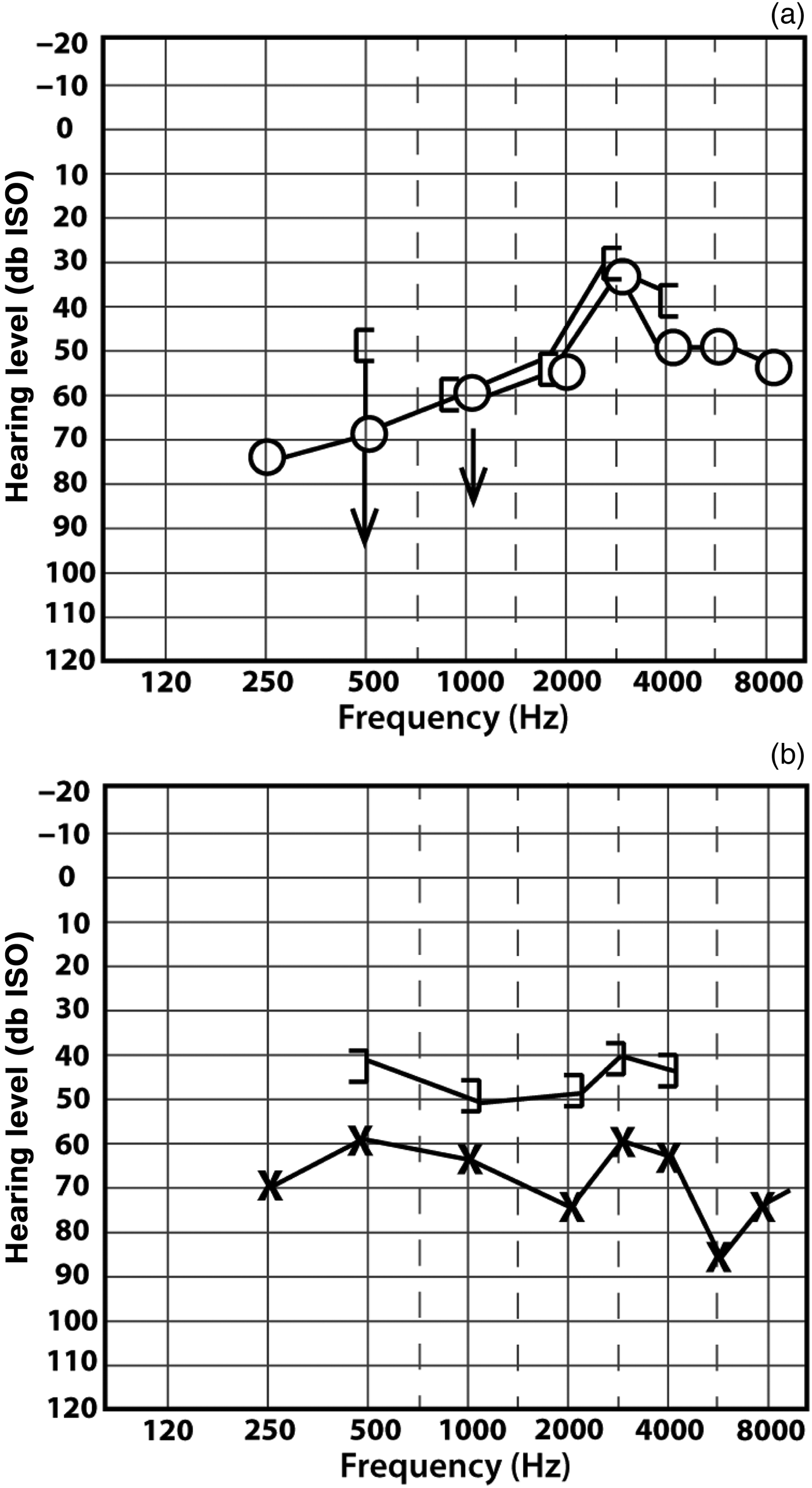
Ten days after being commenced on azathioprine, the patient noticed progressive dullness in her hearing bilaterally, without any other otological symptoms. She was thus referred to the local ENT department. The findings of clinical examination including neurological examination were unremarkable. Pure tone audiometry was performed (Figure 1), which revealed bilateral moderate to severe SNHL, with air conduction thresholds in the range of 50–90 dB. Tympanometry findings were normal. After one week, the patient was reviewed and clinical examination findings were again normal. A repeat audiogram at this point showed no improvement.
Pure tone audiograms for the right (a) and left (b) ears, obtained two weeks after azathioprine was started.

After joint consultation with the nephrology and otolaryngology departments, azathioprine was stopped. Prednisolone was increased to 30 mg daily for one week and then reduced back to 5 mg. Mycophenolate was re-introduced at 360 mg twice daily. In total, the patient had taken azathioprine for three weeks.
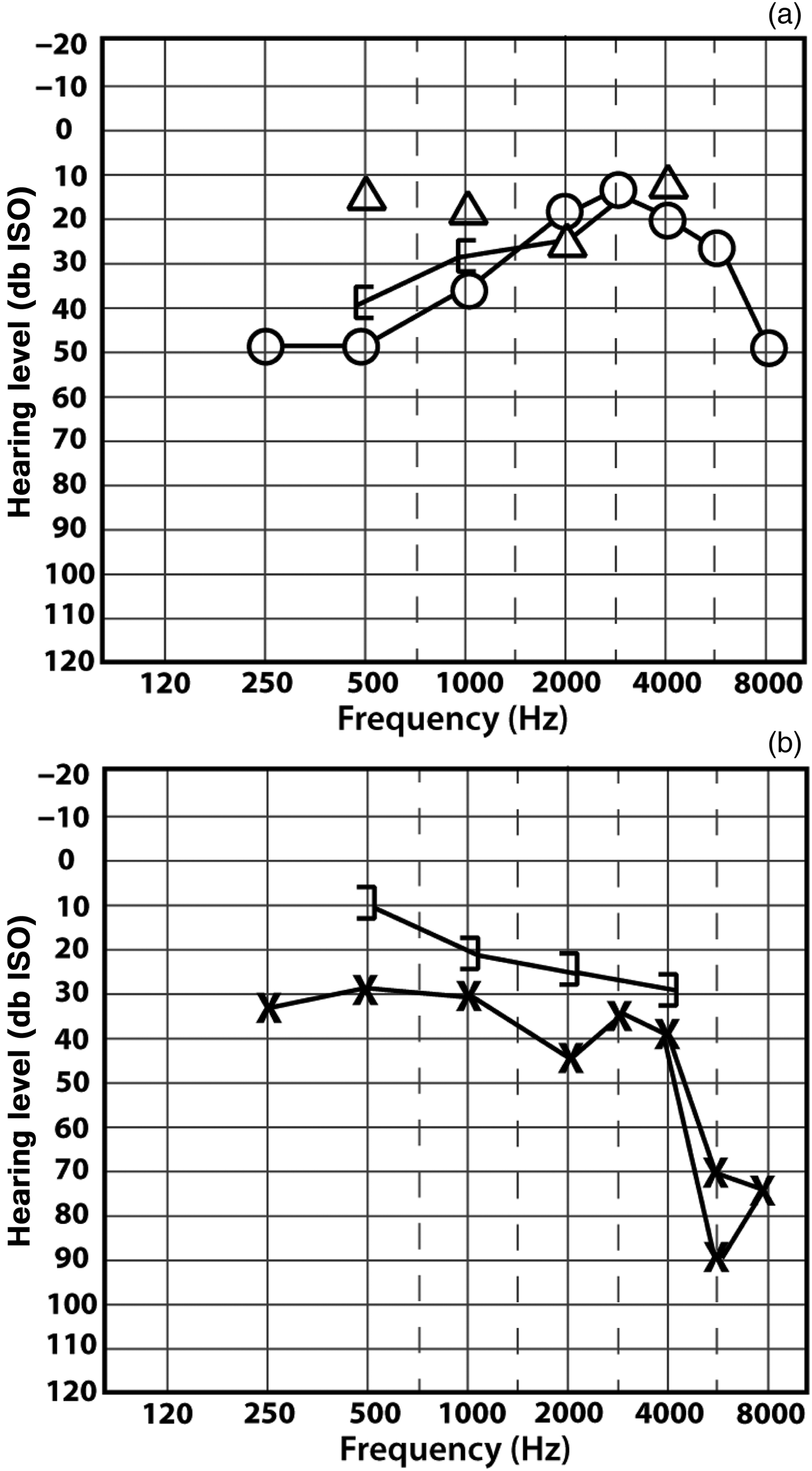
The patient was reviewed one month after stopping azathioprine. She reported a significant improvement in hearing. Repeat clinical examination findings were again unremarkable. Pure tone audiometry results showed a significant improvement in hearing (Figure 2), with average air conduction thresholds between 30 and 50 dB.
Pure tone audiograms for the right (a) and left (b) ears, obtained four weeks after the first audiograms (azathioprine had been stopped for three weeks).
The patient's renal function remained stable. She developed recurrence of her diarrhoea after restarting mycophenolate; this was subsequently well controlled with loperamide.
The patient was recalled for another audiogram after four weeks; however, she cancelled the appointment, stating that her hearing had totally recovered.
Discussion
In the case we have described, there is a clear sequence of events: the commencement of azathioprine therapy, followed rapidly by symptomatic bilateral SNHL (confirmed on pure tone audiometry) which resolved after withdrawal of the azathioprine therapy (again confirmed on pure tone audiometry). This clearly points to azathioprine as the most likely cause for the SNHL as this was the only medication changed, and following its stoppage the hearing loss improved.
• Azathioprine is often used in combination with steroids to prevent organ transplant rejection
• In otology, it is used in the treatment of sudden idiopathic and autoimmune sensorineural hearing loss (SNHL)
• This paper describes a case where a patient presented with bilateral SNHL after being commenced on azathioprine
• This is a previously unreported adverse effect that was reversed on stopping the drug
• This report aimed to increase awareness amongst clinicians of this previously unreported adverse effect
A thorough search of the literature published in the last 20 years (of PubMed, Embase and Cochrane databases) showed no previously documented cases of azathioprine causing SNHL.
The reason for the patient's transplant was end stage renal failure due to lupus nephritis. Systemic lupus erythematosus (SLE) has been associated with an increased risk of sudden SNHL compared with the general population.Reference Lin, Lin, Weng and Lin2 There have been published cases reporting this. Khalidi et al. reported a case of SNHL in a patient with SLE that was actually treated with a combination of steroids and azathioprine with some degree of success.Reference Khalidi, Rebello and Robertson3
Azathioprine has been employed as a treatment for SNHL caused by several conditions; it is often used in conjunction with corticosteroids with varying effectiveness. Azathioprine has been described as being an effective treatment for autoimmune SNHL, although its use has only been reported in a small, uncontrolled observational study of 12 patients.Reference Saraçaydin, Katircioglu, Katircioglu and Karatay4 Azathioprine has also been described in case reports as a treatment of SNHL associated with systemic autoimmune conditions including autoimmune pancreatitisReference Naitoh, Nakazawa, Ohara, Sano, Ando and Hayashi5 and propylthiouracil-induced antineutrophil cytoplasmic antibody associated vasculitis.Reference Thamprajamchit, Jariengprasert and Rajatanavin6 In addition, azathioprine was reported to be an unsuccessful treatment in a case of bilateral SNHL associated with Crohn's disease.Reference Weisert, Veraguth and Probst7
Conclusion
We have reported the first clinical case where azathioprine resulted in progressive SNHL, which was reversed on stopping the drug. This is a significant side effect of the drug, as early recognition and withdrawal of the drug can help reverse the hearing loss. By reporting this case, we aimed to increase awareness amongst clinicians of this previously unreported side effect.