Introduction
Prangos Lindl. (Apiaceae) has 34 species worldwide (Herrnstadt & Heyn, Reference Herrnstadt and Heyn1977; Pimenov & Tikhomirov, Reference Pimenov and Tikhomirov1983), with its centre of diversity in the Irano-Turanian phytogeographic region, especially Turkey, Iran and Central Asia. The genus has been revised for the Flora of Turkey and the East Aegean Islands (Herrnstadt & Heyn, Reference Herrnstadt, Heyn and Davis1972; Davis et al., Reference Davis, Mill and Tan1988) and a further seven taxa have been described in Turkey since then (Duman & Watson, Reference Duman and Watson1999; Duran et al., Reference Duran, Sağiroğlu and Duman2005; Pimenov et al., Reference Pimenov, Akalin and Kljuykov2005; Şenol et al., Reference Şenol, Yildirim and Seçmen2011; Menemen, Reference Menemen and Güner2012). With the new species described below, there are 20 taxa of Prangos in Turkey and 12 of them are endemic. Twelve species belong to the Irano-Turanian element, six to the Mediterranean element and two are widespread (Menemen, Reference Menemen and Güner2012).
An interesting specimen of Prangos was collected from C3 Antalya (Akseki Province) by the first author in 1997; the plants were old and had mature fruit but lacked basal leaves and flowers for description. The fruit shape was intriguing, particularly the fruit wings which seemed to be of a new species but they were in poor condition. Ten years later, in 2007, this species was collected in the same area by A. Duran and, in 2010, fruiting and vegetative material was collected again in the same area by H. Duman. The species was morphologically close to Prangos heyniae H.Duman & M.F.Watson and P. ferulacea (L.) Lindl. in the morphology of its fruit and basal leaf segments, and furthermore, the type locality of P. heyniae is close to the area where this new species was found.
After checking the literature mentioned above and examining the type and other specimens of Prangos heyniae and P. ferulacea in GAZI, we decided that the three collections from Antalya represented a new species.
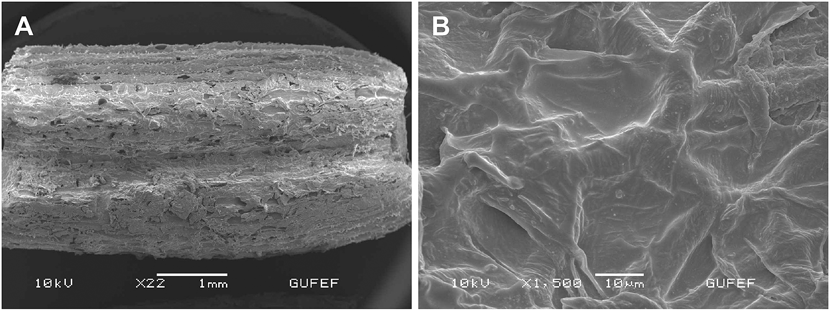
The seed morphology of the new species was examined by scanning electron microscopy (SEM) at GAZI. The SEM photomicrographs were taken with the JEOL JSM 6060 SEM at Gazi University.
Abbreviations of the authors of plant names follow Brummitt & Powell (Reference Brummitt and Powell1992).
Species Description
Prangos abieticola Aytaç & H.Duman, sp. nov.
Prangoti heyniae H.Duman & M.F.Watson sectionis Intactarum Kuzmina affinis, sed foliis 4–6-pinnatis (nec 4–5-pinnatis), segmentis ultimis 5–7 mm longis (nec 2–3 mm); bracteolis 5–8 mm longis (nec 3–5 mm); fructibus maturis 20–25 mm longis, oblongis vel ellipsoideis, alis undulatis praeditis (nec 12–20 mm, late ellipsoideis vel globosis, alis rectis praeditis) differt. Prangoti ferulaceae (L.) Lindl. affinis, sed caulibus 40–50 cm longis (nec 50–150 cm), pilis brevibus crispis vestitis (nec glabris vel papillosis); foliis basalibus 35–50 cm longis (nec 60–80 cm); fructibus maturis oblongis vel ellipsoideis (nec ellipsoideis vel globosis) differt. – Type: Turkey, C3 Antalya: Akseki–Seydişehir, 38th km, 1600 m, in open forest of Abies cilicica and Pinus nigra, calcareous rocks, 23 vii 2010, H. Duman 10209 (holo GAZI; iso ANK, HUB). Fig. 1.
Prangos abieticola: A, type material, showing fibrous collar at root; B, cross section of mericarp.

Perennial herb. Stem erect, 40–50 cm long, loosely covered with short curly hairs below and above, with a well-developed fibrous collar 5–10 cm long and 1–2 cm in diameter at base. Basal leaves oblong to elliptic in outline, 35–50 × 20–35 cm (including 15 cm petiole), petiole with 5–7 cm long sheath, sheaths 40–50 × 10–15 mm, slightly inflated; lamina 4–6-pinnate; ultimate segments linear-oblong, 5–7 × 0.5–0.7 mm, apiculate, sparsely curly hairy; rachis glabrous; lower cauline leaves oblong to elliptic in outline, 25–40 × 15–20 cm (including 5–15 cm petiole), lamina 4–5-pinnate; middle and upper cauline leaves similar to lower leaves; ultimate segments longer than basal. Branches opposite, leaves at base of lateral branches similar to cauline leaves, but smaller and 3–4-pinnate. Flowers hermaphrodite, central umbels shortly pedunculate, 1–1.5 cm long in fruit or sessile, rays 8–12, 4–10 cm long when ripe; lateral umbels with 2–5 rays at most, sterile. Bracts linear-lanceolate, 7–12 mm, usually 5, often caducous; bracteoles linear-lanceolate, 5–8 mm, usually 5, often caducous. Umbellules 5–10-flowered, when ripe 3–6. Pedicels 5–15 mm, always shorter than mature fruit. Sepals obsolete. Petals yellow, 1–2 mm, glabrous, with deflexed apex. Stylopodium slightly angular-terete longitudinally, with undulate margin, mericarps always well developed. Mature fruit compressed dorsally, oblong to ellipsoid, 20–25 × 10–15 mm; wings undulate, about 3 mm wide. Seeds brownish, oblong, 12.37 × 3.45 mm with reticulate ornamentation (Fig. 2).
SEM photomicrographs of Prangos abieticola seed: A, general view; B, reticulate ornamentation.
Additional specimens examined. Turkey. C3 Konya: Seydişehir–Süleymaniye, 1600 m, in open Abies cilicica forest, 20 vi 1997, Aytaç 7567 (GAZI); ibid., 17 vii 2007, A. Duran 6662 (GAZI).
Phenology. Flowering: June–July; fruiting: July–August.
Distribution and ecology. Prangos abieticola is endemic in the Middle Taurus Mountains (Seydidşehi-Konya and Akseki-Antalya Province), South Anatolia and is a Mediterranean element (Fig. 3). It grows on calcareous rocks on shady slopes in open forest of Abies cilicica, Pinus nigra subsp. nigra var. caramanica, Juniperus oxycedrus L. and Dryopteris sp., at 1600 m altitude.
Distribution map of Prangos abieticola (○), P. heyniae (▲) and P. ferulacea (■).
Recommended IUCN Threat Category Listing. Prangos abieticola is known from three collections gathered in the same area, C3 Antalya: Akseki Province (Fig. 3). The estimated range of the species is less than 10 km2. The population is unhealthy due to grazing, with fewer than 250 individuals, and is threatened with extinction in the wild. Therefore, we recommend that this species should be considered ‘Critically Endangered’ (CR) (criteria B2ab(i,iii) of IUCN, 2013).
Etymology. This species is named ‘abieticola’ because it grows in Abies cilicica forests.
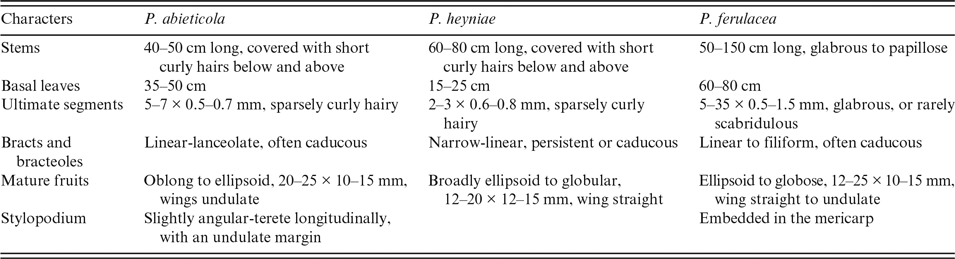
Notes. Prangos abieticola is closely related to P. heyniae and to P. ferulacea. A comparison of Prangos abieticola with these species is given in Table 1.
Comparison of Prangos abieticola with P. heyniae and P. ferulacea
Key to Prangos abieticola and its related species
1a. Stem and leaf covered with short curly hairs; ultimate leaf segments to 7 mm long 2
1b. Stem and leaf glabrous to papillose; ultimate leaf segments 5–35 mm long P. ferulacea
2a. Mature fruit wings undulate; ultimate segments 5–7 mm long, basal leaves 35–50 × 20–35 cm P. abieticola
2b. Mature fruit wings straight; ultimate segments 2–3 mm long, basal leaves 15–25 × 8–12 cm P. heyniae
Acknowledgements
We would like to express our gratitude to the Scientific and Technical Research Institution of Turkey (TUBİTAK) for funding the ‘Endemic Plants of Turkey Project’ (TBAG) during which this new species was collected. We also thank Bahar Kaptaner for illustrating the fruit of the new species.