





1. Introduction
This article focusses on the identity effect found in reduplication and how it can be accounted for in a formal theory, contributing to the ongoing debate on the role of correspondence in reduplication. Since the beginning of Base–Reduplicant Correspondence Theory (henceforth BRCT; McCarthy & Prince Reference McCarthy and Prince1995, Reference McCarthy and Prince1999), a debate over the past decades has been about whether reduplicative identity should be handled by correspondence in a parallel architecture of grammar. In BRCT, a phonologically empty morpheme, red, triggers reduplication and copies phonological material from the base, and there exists BR correspondence between red and base, through which BR Identity is enforced.
With this architecture, a special prediction of BRCT is backcopying. That is, when red meets a structural description and undergoes a phonological change, the change can be imposed back on the base through BR Identity. A classic example is from Tagalog. For the underlying form /paN-red-puːtul/, where N represents a placeless nasal, the output form [pa-mu-muːtul] is said to exhibit backcopying (McCarthy & Prince Reference McCarthy and Prince1999: 252). In this example, the red copies the onset /p/ of the following syllable, which is assimilated to and fused with its preceding nasal. The assimilation and fusion of [Np] as [m] in the output is copied back to the base, producing [pa-mu-muːtul] rather than *[pa-mu-puːtul] (cf. Inkelas & Zoll Reference Inkelas and Zoll2005: 181–185).
However, some reported cases of backcopying were later found to be unreliable (e.g., Gurevich Reference Gurevich2000; Kiparsky Reference Kiparsky, Uyechi and Wee2010), and almost all the other instances of backcopying, including the Tagalog example above, can be reanalysed without using BR correspondence (e.g., Zoll Reference Zoll2002; Inkelas & Zoll Reference Inkelas and Zoll2005; McCarthy et al. Reference McCarthy, Kimper and Mullin2012; Paschen Reference Paschen2018). These two kinds of evidence cast doubt on the so-called backcopying, and consequently on the necessity of BR correspondence. Therefore, in the past two decades, other theories of reduplication have been proposed to replace BRCT, including Morphological Doubling Theory (MDT; Inkelas & Zoll Reference Inkelas and Zoll2005), Minimal Reduplication (MR; Saba Kirchner Reference Saba Kirchner2010, Reference Saba Kirchner2013) and Serial Templatic Satisfaction (McCarthy et al. Reference McCarthy, Kimper and Mullin2012), among others. Each of these theories uses a different strategy to address the phonology–reduplication interaction, including Cophonology Theory (Inkelas & Zoll Reference Inkelas and Zoll2005), Stratal OT (Kiparsky Reference Kiparsky2000, Reference Kiparsky, Vaux and Nevins2008, Reference Kiparsky, Uyechi and Wee2010) and Harmonic Serialism (McCarthy Reference McCarthy2000).
While the debate on the role of correspondence in reduplication continues, this article provides new data from diminutive reduplication in Huozhou Chinese that will contribute to this issue. Some data are previewed in (1), where tones are temporarily omitted; the reduplicant is underlined throughout.

In (1), the reduplicant is consistently in the shape of a C(G)V syllable (‘G’ for glide; nonmoraic in prenuclear position) without any glide/nasal ending. For w-ending nouns, however, the base also undergoes modification, resulting in two open syllables in the reduplicated form, though the moraic structure of the root is preserved (e.g., [pɑμwμ] becomes [poːμμ.poμ ], not *[pɑμwμ.poμ ] or *[poμwμ.poμ ]). In contrast, the base of j-ending and ŋ-ending nouns remains intact in the reduplicated forms. Additionally, the nuclear vowel demonstrates stepwise raising in w-ending nouns (e.g., [ɑ] becomes [o]; [o] becomes [u]) while only mid vowels are raised to high in the reduplicant in j-/ŋ-ending nouns. Thus, the main puzzles of the data include 1) what motivates base modification in w-ending nouns and how the reduplicative identity is maintained, and 2) how to account for the asymmetry in vowel raising between w-ending nouns and j-/ŋ-ending nouns.
Drawing upon Huozhou diminutive reduplication, this article aims to advocate for the utility of correspondence in reduplication. However, instead of relying on BR correspondence, the analysis will show that the patterns observed in (1) are best analysed through Agreement by Correspondence (henceforth ABC; Hansson Reference Hansson2001, Reference Hansson2010; Rose & Walker Reference Rose and Walker2004; Bennett Reference Bennett2013, Reference Bennett2015a,Reference Bennettb, among others), thereby highlighting ABC as a more versatile grammatical mechanism.
1.1. Agreement by Correspondence and its predictions
ABC was first proposed for long-distance consonant agreement (Walker Reference Walker2000a,Reference Walkerb, Reference Walker2001; Hansson Reference Hansson2001, Reference Hansson2010; Rose & Walker Reference Rose and Walker2004). While various versions of ABC exist, the core insight is that Gen provides a surface correspondence (SCorr) relation between phonological elements on the surface, which is evaluated by Corr constraints, and the corresponding segments are impelled to be identical by a set of Ident constraints. ABC and SCorr have also been extended to other phenomena beyond long-distance consonant assimilation, including vowel harmony (e.g., Sasa Reference Sasa2009; Rhodes Reference Rhodes2012; Walker Reference Walker, Albright and Fullwood2015), consonant dissimilation (Bennett Reference Bennett2013, Reference Bennett2015a,Reference Bennettb), local assimilation (Inkelas & Shih Reference Inkelas and Shih2014) and tone assimilation/dissimilation (Shih & Inkelas Reference Shih and Inkelas2019).
The basic mechanisms of ABC in predicting long-distance assimilation are illustrated in (2). Since the definition and evaluation of Corr and Ident vary in the literature, for the purpose of illustration, I use Corr-CC to require SCorr between consonants, and Ident-CC to enforce the identity of the corresponding consonants. The subscript letters indicate SCorr relations.

The winner (2a) undergoes assimilation, which satisfies both Corr-CC and Ident-CC at the cost of Ident-IO(F). The candidate in (2c) is ruled out by Corr-CC due to the absence of corresponding consonants, indicated by different subscript letters. The candidate in (2b) fails to assimilate corresponding segments, violating Ident-CC.
However, there exists another feasible yet unconventional way to fulfill the top-ranked constraints. In (3), for instance, when Max-seg is ranked lower than Ident-IO(F), the candidate [s…], where the input /ʃ/ is deleted, vacuously satisfies both Corr-CC and Ident-CC.Footnote 1

This effect is uncommon in harmony systems, but Inkelas & Shih (Reference Inkelas and Shih2014) analyse Lithuanian nasal deletion in NC clusters with the ranking schema {Corr-CC, Ident-CC} ≫ Ident-IO ≫ Max-seg.Footnote 2 Instead of assimilation, the grammar of Lithuanian opts for deletion as the repair strategy to address the non-identity of corresponding segments in NC sequences. This suggests that the interaction between SCorr constraints and faithfulness constraints other than Ident-IO(F) can lead to different predictions. The effect of SCorr in predicting segment deletion can potentially be used to explain the reduplicative identity observed in the Huozhou data.
1.2. The potential extension of ABC to reduplication
As previously mentioned, various proposals have questioned the role of BR correspondence on the grounds that it predicts unattested patterns, particularly backcopying (e.g., Saba Kirchner Reference Saba Kirchner2010; McCarthy et al. Reference McCarthy, Kimper and Mullin2012). Furthermore, many of the cases that were used to support BR correspondence have been re-interpreted or found to be unreliable (e.g., Gurevich Reference Gurevich2000; Zoll Reference Zoll2002; Kiparsky Reference Kiparsky, Uyechi and Wee2010).
Nevertheless, eliminating correspondence in reduplication is not without problems. For instance, although MR does not employ red or BR correspondence, a case study in Saba Kirchner (Reference Saba Kirchner2010: 149–151) still resorts to Zuraw’s (Reference Zuraw2002) ‘coupling’ relation, which is also a type of relation on the surface. Also, Chaha reduplication was originally treated as backcopying and analysed with BRCT by Kenstowicz & Banksira (Reference Kenstowicz and Banksira1999), but Inkelas & Zoll (Reference Inkelas and Zoll2005: 177–178) argue that it can be adequately addressed by ABC and SCorr, which makes BRCT unnecessary. Both examples indicate that some alternative correspondence(-like) relations can be employed to replace BR correspondence in dealing with certain patterns in reduplication.
The case of Chaha, in particular, suggests that SCorr can be a viable alternative. In addition, the role of SCorr in related phenomena, especially in compensatory reduplication and copy-epenthesis, has been discussed by Yu (Reference Yu2003, Reference Yu2005) and Inkelas (Reference Inkelas2008; cf. Kitto & de Lacy Reference Kitto and de Lacy1999; Stanton & Zukoff Reference Stanton and Zukoff2018). Since SCorr has been well supported as a component of grammar, it is expected to play a role in various other phenomena that may also require certain correspondence relations between surface elements. ABC itself is not a theory of reduplication, but SCorr is in ABC, and the basic mechanism should not be ‘switched off’ in reduplication. Given that ABC can potentially be imposed on reduplicated forms, and that ABC can drive segment deletion as in (3), the analysis of base modification in Huozhou diminutive reduplication could be approached using ABC. While this prediction has not been previously explored, the case study of Huozhou will confirm that ABC and SCorr yield additional patterns beyond long-distance assimilation/dissimilation of segments and tones, which establishes ABC as a more general and adaptable theory.
To summarise, this article aims to achieve three main goals. First, it introduces new data on Huozhou diminutive reduplication, presenting a special case of reduplicative identity. Second, it seeks to demonstrate that a correspondence-based approach can better handle the reduplicative patterns in Huozhou. Third, compared to BR correspondence, the extension of ABC to reduplication has its advantages, and the analysis provides additional support for a less-explored prediction of ABC, as discussed in §1.1. Given the utility of ABC and SCorr demonstrated in various phenomena, if SCorr can also supplant BR correspondence as a versatile theoretical mechanism, it will lead to a more economical grammar. The case study specifically demonstrates that SCorr provides a straightforward and reasonable analysis of Huozhou reduplication, whereas BRCT cannot properly account for certain aspects of the observed patterns.
For the rest of the article, §2 introduces the patterns of Huozhou diminutive reduplication; §3 analyses the data and demonstrates how ABC and SCorr account for the base modification observed in w-ending nouns; §4 discusses several notable alternative analyses; finally, §5 concludes the article.
2. Huozhou diminutive reduplication
2.1. Background on Huozhou phonology
To start with, I present the aspects of Huozhou phonology that are relevant to the analysis in this article. Huozhou Chinese is a variety of Mandarin, spoken in south-central Shanxi Province. I posit that Huozhou Chinese has six underlying vowels, /i, y, u, ɯ, ə, a/ (but see Duanmu Reference Duanmu2007 and Zhang Reference Zhang2023b for discussion of a five-vowel system in Standard Chinese).Footnote 3 Huozhou Chinese has five lexical tones: low-level, rising, mid-level, high-level and falling, which are transcribed using Chao’s (Reference Chao1968) numerical notation as ‘11’, ‘35’, ‘33’, ‘55’ and ‘53’ in this article.Footnote 4
Huozhou Chinese has the same syllable structure as Standard Chinese. The maximal template for a syllable is CGVX, where G represents a prenuclear glide ([j], [ɥ] or [w]), and X can be only an offglide ([j] or [w]) or a velar nasal ([ŋ]) in Huozhou. Both onglides and offglides are derived from their corresponding vowels (/i/ → [j]; /y/ → [ɥ]; /u/ → [w]). Regarding the moraic structure, I follow the proposal that all full Mandarin syllables – that is, those that carry a full tone – are bimoraic (e.g., Duanmu Reference Duanmu1990, Reference Duanmu1993, Reference Duanmu1994, Reference Duanmu2007; Wu & Kenstowicz Reference Wu and Kenstowicz2015). Thus, the nuclear vowel in an open syllable is represented as a long vowel on the surface to bear the lexical tone (e.g., [pʰaːμμ]). Meanwhile, moraicity does not extend to the prenuclear glide (e.g., [tɕjɑμŋμ]). Further, the reduplicant in nominal reduplication is usually treated as a monomoraic and neutral-toned syllable, such as [kwɑμŋμ.kwɑμ ] (e.g., Duanmu Reference Duanmu1993, Reference Duanmu1999, Reference Duanmu2007; Sui Reference Sui2013).
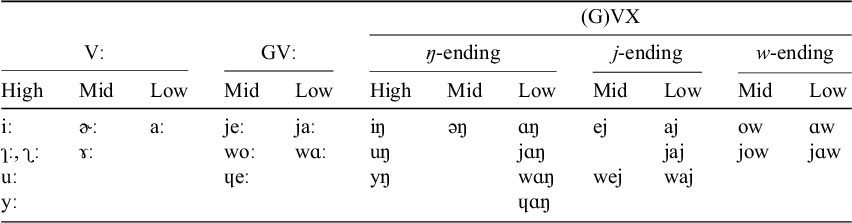
In traditional Chinese phonology, the constituent called the final is usually described as a whole unit, referring to the combination of the prenuclear glide and rime in a syllable (i.e.,  ). The inventory of Huozhou basic finals is listed in Table 1, where ‘low’, ‘mid’ and ‘high’ refer to the quality of the nuclear vowel. All the surface forms without an offglide or nasal coda are represented with a length mark
$\langle $
 ː
$\rangle $
 for reasons explained above. As a side note, the symbols
$\langle $
 ɿ
$\rangle $
 and
$\langle $
 ʅ
$\rangle $
 are not standard IPA symbols, but they are often used to represent the ‘apical vowels’ in various Chinese languages and dialects.Footnote
5
Inventory of basic finals in Huozhou.

Table 1 Long description
The table is organized into two primary categories of finals.
1. The first category is V long and G V long.
- Under V long, High vowels include i long, ɿ long, ʅ long, u long, and y long. Mid vowels include ɚ long and ɤ long. The Low vowel is a long.
- Under G V long, Mid vowels include j e long, w o long, and ɥ e long. Low vowels include j a long and w ɑ long.
2. The second category is G V X, subdivided by coda endings.
- ŋ-ending: High vowels are i ŋ, u ŋ, and y ŋ. Mid vowel is ə ŋ. Low vowels are ɑ ŋ, j ɑ ŋ, w ɑ ŋ, and ɥ ɑ ŋ.
- j-ending: Mid vowels are e j and w e j. Low vowels are a j, j a j, and w a j.
- w-ending: Mid vowels are o w and j o w. Low vowels are ɑ w and j ɑ w.
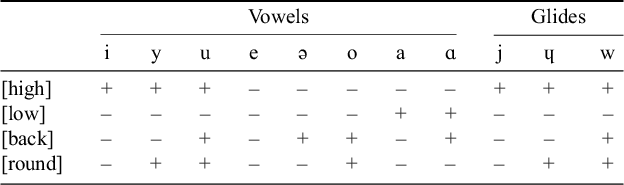
Certain cooccurrence restrictions account for the gaps in Table 1. For instance, it is not possible for a high vowel to be followed by a glide on the surface. Additionally, the offglide and onglide cannot both be [α back] or [α round], except in the case of [jaj].Footnote 6 It is noteworthy that these combinations also exhibit local assimilation of vowel qualities. The underlying vowel /a/ surfaces as front [a] or back [ɑ], agreeing in backness with the postvocalic element, as in [jɑŋ] (*[jaŋ]) and [waj] (*[wɑj]). Likewise, /ə/ surfaces as [o], [e] and [ə] when it is followed by [w], [j] and [ŋ], respectively, which is a common phenomenon in Chinese syllables (e.g., Lin Reference Lin2015).Footnote 7 To facilitate discussion, the feature specifications of major surface vowels and glides are given in Table 2.
Feature specifications of major surface vowels and glides.

Table 2 Long description
The table is divided into two main categories: Vowels (i, y, u, e, ə, o, a, ɑ) and Glides (j, ɥ, w). The rows define four phonetic features using plus and minus symbols.
* [High]: Positive for i, y, u, j, ɥ, and w. Negative for e, ə, o, a, and ɑ.
* [Low]: Positive for a and ɑ. Negative for i, y, u, e, ə, o, j, ɥ, and w.
* [Back]: Positive for u, ə, o, ɑ, and w. Negative for i, y, e, a, j, and ɥ.
* [Round]: Positive for y, u, o, ɥ, and w. Negative for i, e, ə, a, ɑ, and j.
2.2. Data sources
Huozhou diminutive formation was first introduced into the linguistic literature by Satoh & Feng (Reference Satoh and Feng1989), followed by Tian (Reference Tian1992), Hou & Wen (Reference Hou and Wen1993), Shen et al. (Reference Shen, Feng and Tsumura2010) and Feng & Zhao (Reference Feng and Zhao2014), among others. The data presented in this article are mainly based on the author’s consultation with three speakers (one male, two female) from the town of Bailong in Huozhou, aged between 50 and 65.
The author compiled a list that consists of the examples reported in the literature, and additional noun roots (Chinese characters) based on Feng & Zhao’s (Reference Feng and Zhao2014: 116–169) list. Feng & Zhao list the common characters for each syllable in Huozhou Chinese, including 2,346 characters for w-/j-/ŋ-ending syllables.Footnote 8 The author selected 244 out of the 2,346 characters (72 w-ending, 49 j-ending, 123 ŋ-ending), including those reported in previous literature. These characters (morphemes) can be used as concrete nouns and have the potential to form diminutives through reduplication, based on the author’s knowledge of Chinese.Footnote 9
The data were collected through interviews. This approach was chosen because diminutive forms are highly colloquial and involve phonological changes, while the written forms do not clearly reflect pronunciation and are usually associated with formal contexts, which could interfere with natural production. The author asked the speakers whether these nouns can express smallness and/or cuteness through sound changes or reduplication, and asked about their pronunciations. The author also attempted to elicit the forms by demonstrating the potential pronunciations based on the rules from previous literature. In interviews with three speakers, a total of 70 nouns with reduplicated diminutives were identified (25 w-ending; 12 j-ending; 33 ŋ-ending), covering all the combinations in Table 1 except for [jaj] and [iŋ].
One reason for the limited number is that both reduplication and rime change are often found in the most frequently used nouns, which are related to daily objects and agricultural activities. Although these reduplicated forms seem to be limited in number, there is evidence to suggest that they are still rule-governed. Some nouns have been claimed not to have any reduplicated diminutives, but during the interviews, if the speakers were forced to produce a reduplicated form, they would automatically produce an output that followed the patterns in (4)–(6). This suggests that the speakers possess a certain level of phonological grammar that governs the reduplicated outputs and makes the forms predictable. Additional discussion regarding the productivity issue can be found in Yang (Reference Yang2024).
The pronunciations were transcribed by the author during the interviews and later double-checked using the recordings. Due to the colloquial nature of these forms, it was difficult to elicit well-controlled data for acoustic analyses, but the possibility remains open for future research. Thus, the moraic structure of these forms is proposed based on theoretical considerations about Chinese phonology, as outlined in §2.1.
2.3. Diminutives in Huozhou Chinese
There are two ways to form a diminutive in Huozhou Chinese: reduplication and rime change.Footnote
10
Rime change modifies the rime of a syllable to express certain meanings. Although rime change is not the primary focus of this article, it is included to provide a comprehensive overview of Huozhou diminutive formation and contribute to a well-rounded discussion on the alternative analyses of reduplication. The examples are listed in (4)–(6), where superscript digits indicate tones. (The non-IPA symbol
$\langle $
 ȵ
$\rangle $
 in (4g) represents an alveolo-palatal nasal.) More examples are presented in Yang (Reference Yang2024).


The formation of diminutives involves changes of prosodic structure, vowel quality and tone.Footnote 11 In terms of reduplication, the reduplicant is always a C(G)V syllable. However, the w-ending nouns stand out, because the base undergoes modification, resulting in two open syllables in the reduplicated form, though the moraic structure of the noun is preserved in the base (as described in §2.1, the reduplicant is considered a light syllable). In contrast, the ŋ-ending and j-ending nouns in (5) and (6) undergo partial reduplication, where the base remains intact (e.g., [saj11] → [saj11.sa33 ], not *[sa11.sa33 ]). In rime change, the nouns in (4)–(6) take on a C(G)Vː structure. The changed forms are represented with a length mark to indicate bimoraicity, since they still carry a full tone, following the assumption in previous literature on Chinese, as mentioned in §2.1.Footnote 12
Both reduplication and rime change also involve vowel alternations. For w-ending nouns, both the diminutive forms in (4) exhibit stepwise raising in relation to the noun, namely, [ɑ] becomes [o], while [o] is raised to [u] or [y].Footnote
13
Meanwhile, in reduplication, these vowel alternations are found in both the base and the reduplicant. For j-/ŋ-ending nouns, however, only mid vowels are raised to high (e.g., [pej11] → [pej11.pu33
], but [pʰaj35] → [pʰaj35.pʰa55
]), and vowel raising is found only in the reduplicant (e.g., [pej11.pu33
], not *[puː11.pu33
]). It is worth noting that the [a]
$\sim $
 [ɑ] alternation in these examples is related to the local assimilation process (recall §2.1).
Finally, since rime change only takes place for nouns that end with [ŋ, j, w], diminutive forms for nouns without an ending can be expressed through full reduplication, as in (7).

Based on my consultations, there are no significant semantic differences between reduplication and rime change in most cases. In addition, there are a few discrepancies between the data presented above and those described in earlier work, likely due to idiosyncratic variations. While some nouns have both rime change and reduplication forms, some others commonly use only one of these. The nature of the gaps and the factors influencing the choice between the two forms require further investigation. Nevertheless, these issues do not influence the current focus and analysis of this article.
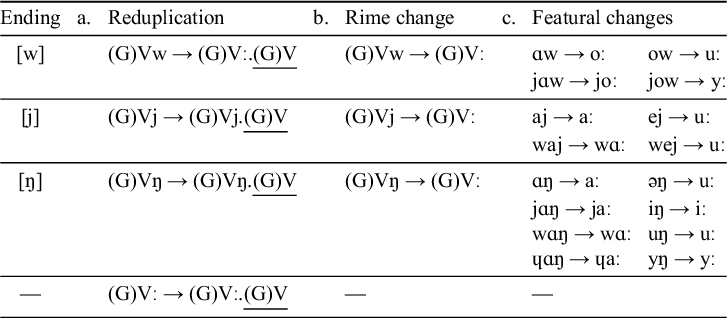
Recalling Table 1, there are 17 (G)VX finals in Huozhou Chinese, and except for [jaj], diminutive forms can be found for every final. Without delving into analytical details, a descriptive summary of the patterns of Huozhou diminutive formation is as follows. In Table 3, the changes during reduplication and rime change are presented in columns (a) and (b), with specific featural changes associated with both reduplication and rime change shown in column (c). Overall, diminutives in Huozhou can be formed through reduplication or rime change when a noun has an offglide or nasal coda, while there is no rime change in (C)(G)Vː syllables.
Summary of Huozhou diminutive formation.

Table 3 Long description
The table is organized into four main rows based on the syllable ending: [w], [j], [ŋ], and a null ending represented by a dash.
Column a, Reduplication:
- For [w] ending, the pattern is (G)V plus [w] yields (G)V colon followed by a dot and an underlined (G)V. For [j] and [ŋ] endings, the pattern is (G)V plus the ending yields (G)V plus the ending followed by a dot and an underlined (G)V.
- For the null ending, (G)V colon yields (G)V colon followed by a dot and an underlined (G)V.
Column b, Rime change:
- For [w], [j], and [ŋ] endings, the pattern is (G)V plus the ending yields (G)V colon.
- The null ending has no entry for rime change.
Column c, Featural changes:
- For [w] endings: alpha w yields o colon; j alpha w yields j o colon; o w yields u colon; j o w yields y colon.
- For [j] endings: a j yields a colon; w a j yields w alpha colon; e j yields u colon; w e j yields u colon.
- For [ŋ] endings: alpha ŋ yields a colon; i alpha ŋ yields j a colon; w alpha ŋ yields w alpha colon; y alpha ŋ yields ɥ a colon; schwa ŋ yields u colon; i ŋ yields i colon; u ŋ yields u colon; y ŋ yields y colon.
- The null ending has no entry for featural changes.
Summing up, three issues need to be addressed regarding the patterns observed in Huozhou diminutive reduplication. First, the reduplicated form of w-ending nouns exhibits an identity effect between base and reduplicant. In (4), the reduplicant is an open syllable ending with a monophthong, and [w] in the base drops as well, as in [poː11.po33 ] (not *[pɑw11.po33 ] or *[pow11.po33 ]). Conversely, [j] and [ŋ] are preserved in the base, as shown in (5) and (6) (e.g., *[saː11.sa33 ], *[pʰaː35.pʰa55 ]). Second, when the nuclear vowel is followed by [w], a stepwise raising occurs after reduplication, both in the reduplicant and in the base. The vowel is raised from low to mid (e.g., [ɑ] → [o]) or from mid to high (e.g., [o] → [u]/[y]). Third, although vowel quality alternations are also present in j-ending and ŋ-ending nouns, only mid vowels are raised in the reduplicant (e.g., [pʰəŋ35.pʰu55 ], not *[pʰəŋ35.pʰə55 ]) while a low vowel remains low in both the base and the reduplicant (e.g., [pʰɑŋ35.pʰa55 ], not *[pʰɑŋ35.pʰo55 ] or *[pʰɑŋ35.pʰu55 ]). In addition, the same featural change patterns are observed in both reduplication and rime change.
The description so far does not make any analytical assumptions, but there exist different interpretations for the patterns of reduplication and rime change. The vowel alternations involved in diminutive formation, in particular, appear to result from coalescence. Coalescence can be defined in a descriptive way as a phenomenon where two segments in the input become one in the output. However, there is a longstanding debate between different analytical views of coalescence, including a deletion-and-assimilation view and a fusional view (McCarthy Reference McCarthy2007: 89; see also Zaleska Reference Zaleska2018: 2–3, and the references cited there). In this article, I will analyse the reduplication of w-ending nouns as segment deletion with feature preservation, departing from the fusional view. The rime change patterns, though not the primary focus of this article, can be treated in a similar manner. Nevertheless, regardless of the view adopted, the central issue of this article is the role of ABC and SCorr in enforcing reduplicative identity. The implications of the fusional view will be further discussed in §4.
3. Analysis
This section aims to demonstrate how ABC handles both the identity effect observed in w-ending nouns and other featural changes during reduplication. Although the variation between reduplication and rime change is also worth discussion, the main focus will be on reduplication. The rime change patterns will be briefly discussed in §3.5.2.
As a preliminary, this article adopts the idea that reduplication serves as a repair strategy for deficient prosodic templates, aligning with the principles of MR (Saba Kirchner Reference Saba Kirchner2010, Reference Saba Kirchner2013; see also Bermúdez-Otero Reference Bermúdez-Otero2012 and Bye & Svenonius Reference Bye and Svenonius2012, among others). When the input to phonology contains an empty prosodic template, it can be fulfilled through segment fission, resulting in reduplication and violating Integrity-IO. The process is typically driven by the markedness constraints that penalise floating or unheaded prosodic units, including MaxFlt (Wolf Reference Wolf2007) and Headedness(X) (Selkirk Reference Selkirk1995).
In this analysis, the reduplicative template of the diminutive is a mora (μ), which serves as the input. In addition, MR and similar theories (e.g., Paschen Reference Paschen2018) are often couched in Stratal OT (Kiparsky Reference Kiparsky2000, Reference Kiparsky, Vaux and Nevins2008, Reference Kiparsky, Uyechi and Wee2010) to account for reduplication–phonology interactions (see also Bermúdez-Otero Reference Bermúdez-Otero2012). In what follows, I assume that a noun root has undergone a cycle for optimisation and prosodification, during which syllable roles have been established.Footnote 14 The relevant constraints are defined in (8), followed by an example in (9).


In (9), reduplication is driven by MaxFlt and Headedness(μ). The mora template is populated by copying the existing segments in /kwaμjμ/. Although not shown in the tableau, the copying of the onset and non-moraic onglide can be achieved through L-Anchor(Affix, Stem) and Contiguity (Bye & Svenonius Reference Bye and Svenonius2012). The constraint L-Anchor(Affix, Stem) requires that the left edge of the reduplicative affix is identical to that of the stem, while Contiguity ensures that the copied portion forms a contiguous string. Additionally, another competing candidate [k1w2aμ 3jμ 4.k1u2 μ ] can be ruled out by Ident-IO-SRole (after McCarthy & Prince Reference McCarthy and Prince1993; Gafos Reference Gafos1998; Rose & Walker Reference Rose and Walker2004) since the segments [w2] and [u2] do not share the same syllable role. It should also be noted that the alternation between [a] and [ɑ] in (9a) is context-dependent and subject to local assimilation (recall the discussion in §2.1). Additionally, the empty prosodic template can potentially be fulfilled by epenthesis. This will be ruled out by the ranking Dep-IO ≫ Integrity-IO.Footnote 15 Different from BRCT, the current analysis does not assume an underlying red morpheme or BR correspondence. However, the BRCT model will be further discussed in §4.2 as an alternative to the proposed analysis.
For the rest of this section, §3.1 introduces the version of ABC adopted in this article; §3.2 focusses on the effect of SCorr in handling reduplicative identity; §3.3 addresses the issue of stepwise raising in w-ending nouns; and §3.4 discusses the changes of vowel quality in j-/ŋ-ending cases, further demonstrating the utility of ABC. Finally, §3.5 provides a summary and remarks on relevant issues.
3.1. ABC with feature-restricted identity constraints
The version of ABC that I adopt here is the one developed by Walker (Reference Walker, Albright and Fullwood2015). This particular version of ABC was first proposed to address the issue of discrete triggers, which occurs when two triggers of harmony operate on targets at different distances. In this model, a unified feature-blind Corr constraint is used to ensure correspondence between segments in general. This proposal is in line with the work of McCarthy (Reference McCarthy2010) and Shih (Reference Shih2013; see also Hansson Reference Hansson2014; Bennett & DelBusso Reference Bennett and DelBusso2018; Sande Reference Sande2019). The definition of the constraint in (10) follows Walker (Reference Walker, Albright and Fullwood2015).

In ABC, the limiter constraints evaluate the well-formedness of segments that stand in SCorr. A core limiter constraint in classic ABC is Ident-XX(F), which demands identity between corresponding segments (e.g., Walker Reference Walker2000a,Reference Walkerb, Reference Walker2001; Hansson Reference Hansson2001, Reference Hansson2010; Rose & Walker Reference Rose and Walker2004; see also Bennett Reference Bennett2013, Reference Bennett2015a,Reference Bennettb). In this article, the formulation of Ident-XX(F) incorporates a trigger feature [γG], as in (11) (after Walker Reference Walker, Albright and Fullwood2015; cf. Hansson Reference Hansson2014; Sande Reference Sande2019).

In this definition, ‘consecutive’ refers to adjacent corresponding segments, but it is further restricted by [γG], which can be a single feature or a feature bundle. One of the core insights of ABC is that segments with greater similarity are more likely to interact through SCorr. In other words, agreement between segments is sensitive to similarity, which is conditioned by shared features. In the current version of ABC, similarity is encoded as [γG] in Ident-XX [γG](F). Thus, the constraint mandates that corresponding segments exhibiting similarity in [G] should also be similar in [F].
The function of this constraint and Corr-XX is demonstrated with a hypothetical input /s…p…z/. The violation profile of Ident-XX [+cont](voice), Ident-XX(voice) and Corr-XX is as follows. Superscript digits indicate input–output correspondence.

The segments that stand in SCorr belong to a correspondence chain. However, within a chain of corresponding segments, there can be sub-chains that are defined by restrictive features. For example, in (12a), all the segments form a chain of correspondence denoted by the same subscript x, but [
$\text {s}_{x}^1$
 …
$\text {z}_{x}^3$
 ] forms another chain defined by the feature [+cont]. Thus, the feature-restricted constraint Ident-XX
[+cont](voice) evaluates the subset of segments in a correspondence chain that share the feature [+cont]. This constraint requires that any consecutive pair of [+cont] segments must agree in [voice]. In (12a), the pair [
$\text {s}_{x}^1$
 …
$\text {z}_{x}^3$
 ] incurs one violation of Ident-XX
[+cont](voice), since the two [+cont] segments do not match in [voice]. These two segments are considered as consecutive since the intervening segment does not meet the condition [+cont]. Although this candidate also violates Ident-XX(voice) once, that violation is caused by [
$\text {p}_{x}^2$
 …
$\text {z}_{x}^3$
 ] rather than [
$\text {s}_{x}^1$
 …
$\text {z}_{x}^3$
 ], since the latter pair is not considered consecutive when a [+cont] restriction is not in effect. These two constraints also differ in the evaluation of (12b). In (12b), the pairs [
$\text {z}_{x}^1$
 …
$\text {p}_{x}^2$
 ] and [
$\text {p}_{x}^2$
 …
$\text {z}_{x}^3$
 ] do not meet the condition [+cont], so they satisfy Ident-XX
[+cont](voice) vacuously. However, Ident-XX(voice) is violated by both pairs. Finally, in (12c), the corresponding segments [
$\text {s}_{x}^1$
 …
$\text {p}_{x}^2$
 ] satisfy Ident-XX(voice) and vacuously satisfy Ident-XX
[+cont](voice) since they do not meet the condition [+cont]. This candidate violates Corr-XX twice, as indicated in the tableau.
Although there are various other versions of ABC (e.g., Hansson Reference Hansson2007; Bennett Reference Bennett2013, Reference Bennett2015a,Reference Bennettb; Inkelas & Shih Reference Inkelas and Shih2014; Shih & Inkelas Reference Shih and Inkelas2019), I will not present the debate on these variations since the primary focus of this article is the role of SCorr in reduplication.
3.2. Reduplicative identity and the effect of SCorr
A main motivation for exploring the role of SCorr in reduplication is that there is no reason to deactivate this mechanism for a specific construction. This section uses the introduced constraints and demonstrates how the interaction results in the identity effect observed in the Huozhou data.
To handle the case of Huozhou diminutive reduplication, I further elaborate Ident-XX [γG](F). I adopt Krämer’s (Reference Krämer2003) proposal that surface identity can be enforced between moraic elements, which is implemented as Ident-XX [μ, γG](F). The purpose of limiting surface identity over moraic segments is to exclude the onglide from triggering any unexpected identity enforcement. The definitions of relevant constraints are given in (13). The constraint Ident-IO(F) will be discussed in §3.3, since its role becomes more important when examining the changes in vowel quality.

In (13), Ident-XX [μ, α back](round) and Ident-XX [μ, +round](high) drive the corresponding segments to be identical, both of which are feature-restricted. While the feature combinations in these constraints may appear arbitrary, both of them can be evidenced by other phenomena. First, backness and roundness harmony often coexist in harmony systems, as seen in languages such as Turkish, Tuvan and Ewe (Krämer Reference Krämer2003; Rose & Walker Reference Rose, Walker, Goldsmith, Riggle and Yu2011). Additionally, [α back, α round] vowels are less marked in general. These observations suggest that [α back] segments have a tendency to agree in roundness, as encoded in the constraint Ident-XX [μ, α back](round).
Regarding Ident-XX [μ, +round](high), further support for this constraint can be found in the rounding restriction in Kisa (Bantu) height harmony. In Kisa, if the target vowel is /u/, it undergoes height harmony and lowers to /o/ only if the trigger is also [+round]. This demonstrates an identity effect that involves both roundness and height (Hyman Reference Hyman1998; Rose & Walker Reference Rose, Walker, Goldsmith, Riggle and Yu2011: 253). The evaluation of these constraints will be further explained after the tableau.
The joint effect of SCorr constraints and Max-seg effectively accounts for the identity effect observed in reduplication, as illustrated in (14). Superscript digits indicate input–output segmental correspondence, while segments that share the same subscript letters stand in correspondence (the moraic structures are not shown). The input floating mora in (14) is realised as reduplication to prevent a floating empty mora in the output. However, a challenge arises in restricting the effect of SCorr exclusively to the environment of diminutive reduplication. The solution employed in this article is to assign this ranking to a specific stratum in Stratal OT, which is a common practice in MR. In a typical stratal analysis, all words pass through every stratum and are evaluated by the grammar of each stratum. However, some studies involving multiple strata suggest that the grammar of a given stratum may have no effect on the output if the input does not contain the affixes associated with that stratum (e.g., Jaker & Kiparsky Reference Jaker and Kiparsky2020). Further discussion on this issue will be provided in §3.5.1.

The crucial comparisons in this analysis are between the winning (14a) and candidates (14b) and (14c), all of which satisfy Corr-XX, and for which the Ident-XX constraints play an essential role. Candidate (14b) violates  , which requires that [+round] segments be identical in height. In this candidate, the [+round] segments are
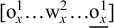 ; these segments are considered adjacent with regard to [+round]. Thus,
 is violated twice: by
 and by
 . Candidate (14c) violates
 once, because the pair
 in the chain agrees in backness but does not match in roundness. This candidate is exempt from
 , since only
 in the chain meets the condition [+round]. Instead, the winner (14a) uses segment deletion as a way to satisfy surface identity because Max-seg is ranked below Corr-XX and Ident-XX. Candidate (14d) violates
 three times with
 , [
$\textrm {w}_x^2$
 …
$\underline{{\unicode{x00251}}_x^1}$
 ] and [
$\underline{{\unicode{x00251}}_x^1}$
 …
$\underline{\textrm {w}_x^2}$
 ], since none of the pairs agrees in roundness. The constraint Corr-XX, which requires that any two segments stand in correspondence, rules out (14e). Finally, the faithful output fails to populate the floating mora, violating Headedness(μ). As a side note, a back low vowel is penalised in an open syllable
 as a basic phonotactic rule in Huozhou Chinese. Thus, candidates (14c) and (14e) end with a [−back] low vowel [a]. As was briefly mentioned, the empty mora could also be realised through epenthesis (e.g.,
 ), but the higher-ranked Dep-IO will rule out this possibility.
Another candidate, 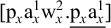 , also deserves mention. This candidate avoids violating
 because there are no adjacent [α back] pairs in the chain. However, it is ruled out since
 violates a general local assimilation requirement in this language. Specifically, segments in the rime domain of a Chinese syllable must agree in backness (e.g., [pɑw] rather than *[paw]). The requirement of local assimilation within the rime domain can be accounted for by a constraint known as Rime-Harmony (e.g., Duanmu Reference Duanmu2007: 60–64; Lin Reference Lin2015: 772). However, since local assimilation can also arise from SCorr (e.g., Inkelas & Shih Reference Inkelas and Shih2014), I will use ABC for a consistent analysis. The parameters of
 can be further adjusted to evaluate local segments only. Following the notation of Shih & Inkelas (Reference Shih and Inkelas2019: 140), I propose a variant of the limiter constraint,
 , and a specific instance
 , in (15), followed by an abridged tableau in (16).


The string in candidate (16b) is ruled out by , since they are immediately adjacent moraic segments (i.e., those in the rime domain) within the same syllable but do not agree in [back], although it satisfies all the Ident-XX constraints in (14).
In comparison, partial reduplication occurs in j-/ŋ-ending nouns, and base modification is blocked by the same grammar, as demonstrated in (17).

The ranking of these constraints remains unchanged from (14). Since there are no round segments,  is vacuously satisfied. Additionally, since all the corresponding moraic segments are [−back],
 is also vacuously satisfied. Candidate (17d) is ruled out by Corr-XX. Regarding candidates (17a) and (17c), although both fulfill the top-tier constraints, the candidate in (17a) is favoured over (17c) by Max-seg. Additionally, candidate (17b) incurs one more violation of Integrity-IO than (17a); the faithful output (17e) violates Headedness(μ) since the empty mora is not realised. As previously demonstrated, the primary factor that drives deletion is the Ident-XX constraints, which do not come into play when the corresponding segments do not meet the conditions. Furthermore, other losing candidates with vowel raising (not shown in the tableau), such as
 , will be harmonically bounded by (17a) because they violate relevant Ident-IO(F) constraints.
The same analysis also applies when the input contains a nasal coda, as in (18).

In (18a)–(18d), all the corresponding moraic [α\,back] segments are [−round], satisfying  , while the lack of moraic [+round] segments vacuously satisfies
 . Therefore, the nasal coda remains intact. When the rime part is [uŋ], however, additional treatment is needed to ensure the correct output, which will be discussed shortly in §3.4.
In sum, the analysis above shows the joint effect of Corr-XX and  in enforcing reduplicative identity. That is, the base and the reduplicant are identical in terms of segmental features. In particular, the key motivation for deletion in this context arises from grouping [w] and other moraic segments within the same correspondence chain, defined by a specific feature, such as [
$\textrm {o}_x^1$
 …
$\textrm {w}_x^2$
 …
$\underline{\textrm {o}_x^1}$
 ]. In order to satisfy the
 constraints, a solution is to delete a member from the correspondence structure by ranking Max-seg low. Furthermore, this process is blocked for nouns ending in [j]/[ŋ] that lack the [+round] or [+back] features. To summarise the analysis, the Hasse diagram of the current ranking is given in (19). The constraints in (8) that drive mora realisation are not included.

3.3. Stepwise raising in w-ending nouns
A more comprehensive analysis should include the featural changes – that is, why the output is  rather than
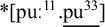 . This section provides a detailed exploration of the featural changes in the w-ending cases, as summarised in (20). The low vowel in (20a) and (20b) is raised to [o], while the mid vowel in (20c) and (20d) is raised to [u] or [y].

To address this issue, I adopt the autosegmental theory of featural faithfulness, as in Yang (Reference Yang2024), where features are viewed as autosegmental elements and stand in input–output correspondence. I propose that the raising of the nuclear vowel is mainly attributable to the preservation of [+high] and [+round] of [w]. Featural correspondence and preservation are governed by Max(F), which was first introduced by McCarthy & Prince (Reference McCarthy and Prince1995) and further discussed by Lombardi (Reference Lombardi and Lombardi2001), Causley (Reference Causley1997), Zhang (Reference Zhang2000) and Walker (Reference Walker2001), among others. The relevant constraints are defined as follows:


Furthermore, to block direct raising from low to high, a local constraint conjunction (Itô & Mester Reference Itô and Mester1998) is used, as commonly applied in analyses of stepwise raising (e.g., Kirchner Reference Kirchner1996; Walker Reference Walker2005, Reference Walker2011). Local conjunction allows for forming complex constraints from simple ones; the composite constraint is defined in (23).

If a segment in the output violates both Ident-IO(high) and Ident-IO(low), it will also violate the conjoined constraint Id(high) & Id(low). This constraint penalises the input–output mapping that involves a simultaneous change of two features, such as from [+low, −high] to [−low, +high].
The pattern of stepwise raising can now be accounted for. The effect of Max(F) and Id(high) & Id(low) is illustrated in (24). The constraint Corr-XX is omitted in the tableaux for the rest of this section.

In (24), the winning candidate (24a) raises the low vowel to [o], which violates Max(+high) but satisfies Max(+round). Since only Id-IO(low) is violated, the winner manages to avoid violating the conjoined constraint. Candidate (24b) does not retain [+round] in the output, resulting in a fatal violation of Max(+round), and the comparison between (24a) and (24b) establishes the ranking Max(+round) ≫ Id-IO(round), Id-IO(low). When a low vowel becomes high, as in (24c) and (24d), both Id-IO(high) and Id-IO(low) are violated, which triggers the violation of Id(high) & Id(low). Candidates (24e) and (24f) violate relevant Ident-XX constraints for similar reasons to (14b) and (14c), indicating that the ABC constraints are ranked higher than Max(+high). Additionally, the candidates that involve non-identical corresponding vowels, such as  and
 , can be ruled out by relevant Ident-IO and Ident-XX constraints. Finally, recall that a back low vowel is penalised in an open syllable
![( asterisk a ] sub sigma )](https://static.cambridge.org/binary/version/id/urn:cambridge.org:id:binary:20260804160220094-0420:S0952675726100414:S0952675726100414_inline1031.png?pub-status=live) , so *[
$\textrm {p}_x{\unicode{x00251}}_x^1\textrm {w}_x^2$
 .
$\underline{\textrm {p}_x{\unicode{x00251}}_x^1}$
 ] is ruled out.
The analysis reveals that low vowel raising is actually an epiphenomenon of Max(+round). Although Max(+high) is expected to promote vowel raising, the higher-ranked Id(high) & Id(low) blocks a two-step raising that involves a simultaneous change of [high] and [low]. Moreover, the requirement of Max(+round) drives the low vowel to [o] rather than [ɒ], since Huozhou prohibits a low back rounded vowel [ɒ] in general, a restriction that also applies in Standard Chinese (Duanmu Reference Duanmu2007: 66; cf. Zhang Reference Zhang2023b).
When an onglide is present in the input, the moraic condition excludes it from evaluation. The abridged tableau in (25) shows the effect of Id-XX [μ, +rd](hi). In this article, the onglide is treated as part of the onset and evaluated by Ident-Onset, although its status in a Chinese syllable remains controversial (see Zhang Reference Zhang and Aronoff2023a for an overview).

In (25), the low vowel is raised to mid to satisfy Max(+round), ruling out (25c), which is similar to the analysis in (24). Candidate (25b) preserves the [+round] feature of the input [w] on the onglide, but violates Ident-Onset; (25d) fatally violates Id-XX
[μ, +rd](hi) because it contains the sequence [
$\textrm {o}_x^2$
 …
$\textrm {w}_x^3$
 …
$\underline{\textrm {o}_x^2}$
 ].
Although (24d) *[puw.pu] does not affect the current analysis, a similar candidate becomes relevant when the input contains a mid vowel, as in  ‘bean.dim’. In this case, the attested output is
 rather than
 . The latter can be ruled out by an OCP constraint, *V[+high]G, defined in (26), which represents a general phonotactic restriction in Chinese syllables.Footnote
17
A tableau is shown in (27).


The ranking remains identical to the one in (24), except for the addition of *V[+high]G. The input mid vowel is raised to satisfy Max(+high) when [w] is deleted to satisfy  . Candidates (27b) and (27c) are ruled out by Max(+high) and Max(+round). Candidate (27d) fatally violates *V[+high]G, indicating that *V[+high]G ≫ Max-seg. The other two candidates, (27e) and (27f), are ruled out by
 because of the mismatch of height in the corresponding [+round] segments.
Finally, for the pattern [jow] → [yː], I follow Duanmu’s (Reference Duanmu2007: 59–63) point of view that both [jy] and [ɥy] are viewed as equivalent to [y] in Standard Chinese because they do not form phonemic contrasts. Then, the analysis is quite straightforward if the output is treated as  (equivalent to
 ).Footnote
18
The local assimilation constraint
 is used to account for this case, which follows the schema in (15a). Additionally, a value-specific Ident-IO(−back) is included for the directionality issue (after McCarthy & Prince Reference McCarthy and Prince1995, Reference McCarthy and Prince1999; Pater Reference Pater1999).Footnote
19


This case can still be viewed as deletion with feature preservation, similar to (27). Candidates (29a)–(29c) satisfy Max(+high) and Max(+round).Footnote 20 Candidate (29c) fails to satisfy Id-X::X[−cons](back), since the GV combinations do not agree in [back]. Further, backness agreement proceeds from left to right, which is ensured by Id-IO(−back), ruling out (29b). The constraint Id-X::X[−cons](back) will not cause unexpected assimilation in other syllables because of additional restrictions on sound inventory and phonotactics. For instance, [jo] will not be assimilated into *[jø] because of a general restriction against *[ø] in the language (e.g., Duanmu Reference Duanmu2007: 52–54).
3.4. Vowel alternations in j-/ŋ-ending nouns
Vowel raising is not observed in ŋ-/j-ending nouns except when the nuclear vowel is mid, as recapitulated in (30). The ABC approach can also account for these patterns well.

In cases where the nuclear vowel is low, as in (30a) and (30b), no raising will be triggered by Max(F). This fact aligns with the grammar that has been established so far, as shown in (31).

The Ident-XX constraints are omitted in (31); both of them are vacuously satisfied, since [j] and the nuclear vowel do not meet the conditions of the constraints. Additionally, Max(+high) and Max(+round) (also not shown) have no effect, since input [j] is still preserved in the output and has no [+round] feature. Thus, the input low vowel remains unchanged in the output. The same analysis applies to ŋ-ending nouns if [ŋ] is also viewed as [+high] (e.g., Hall Reference Hall and Lacy2007: 332).
The co-occurrence of the high back rounded vowel [u] and the nasal [ŋ] requires careful treatment, since the attested output  violates
 , while
 does not. To address this issue, I propose that the nasal coda and the input high rounded vowel are protected by Max(+nasal) and value-specific Ident-IO(+high), respectively.


Although the candidate in (33a) violates  twice because of the sequence
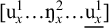 , it preserves the nasal coda, unlike (33c), thereby satisfying Max(+nas). Candidate (33b) fatally violates Ident-IO(+hi), though it incurs fewer violations of
 . Thus, the original high vowel cannot be lowered in order to satisfy the Ident-XX constraints, while vowel raising is permitted. As a side note, another potential way to preserve the nasal feature is through vowel nasalisation, but this option is excluded by a ban on nasalised vowels in this language. In addition, since labialised [ŋw] is regarded as unacceptable in Modern Chinese (Lin Reference Lin1993: 665), a candidate such as
 is also ruled out.
However, unrounding the vowels would satisfy  , resulting in
 or
 . These candidates can readily be ruled out as well. On the one hand, the high back unrounded vowel [ɯ] is marked in general across languages; on the other hand, although [ɯ] exists in Huozhou Chinese, its distribution is quite limited. Feng & Zhao (Reference Feng and Zhao2014) documents this sound only in a few diminutive forms with an onset [k], including [kɯ53] (‘dog.dim’) and
 (‘root.dim’). In the present study, however, [ɯ] is only found in [kɯ53] (‘dog.dim’, as noted in fn. 13), while the diminutive form for ‘root’ is
 . This may suggest that the diminutive forms are undergoing change, probably because of the lower F2 and greater perceptual salience of [u] compared to [ɯ].
The ŋ-ending nouns with a mid vowel pose a challenge to the existing analysis, but it is also possible to provide an ABC account. One possibility of vowel raising is that the presence of [ŋ] in the base influences the mid vowel in the reduplicant as a long-distance effect, causing it to be [+high]. This could result from the constraint  in (34).

Regarding backness, to avoid  , I propose that backing may also result from the presence of [ŋ], which influences the reduplicant in a rightward, unidirectional way. Although the directionality of assimilation in ABC remains problematic (see, e.g., Bennett Reference Bennett2013: 98–104), a potential solution is to encode the requirement of directionality in a constraint. The constraint in (35) requires that two corresponding segments agree in [+back] and that assimilation proceed rightward, following a similar formulation in Rose & Walker (Reference Rose and Walker2004: 508).


Although candidates (36a) and (36b) both violate Id-XX
[μ, α bk](rd), the latter incurs more violations of Id-XX
[μ, −lo](hi), since both  and
 are chain-adjacent with respect to [−low] but differ in [high]. Candidate (36c) violates
 twice; candidate (36d) fatally violates Id-X
LXR
[μ, −lo](+bk), because the vowel in the reduplicant does not match with [ŋ] regarding [+back] in the pair
 . The conditions encoded in this constraint ensure that
 in (18) is not affected because the vowels do not meet the condition [−low]. Further, the constraint
 does not affect the evaluation of
 in (31), because candidates such as
 and
 violate Id-IO(high) & Id-IO(low) and are harmonically bounded by the attested output
 . Further, the candidates involving [ɯ] are not considered for the reason explained above.
In the case of [wej], I again adopt Duanmu’s (Reference Duanmu2007: 59) position that [u] is equivalent to [wu] in Standard Chinese. In this case, mid vowel raising in the affix can be attributed to reasons similar to those in (35), and to local assimilation. In (37), the constraint ranking remains consistent in the established grammar; note that the prenuclear glide [w] is non-moraic.

Candidate (37b) does not show mid vowel raising in the reduplicant, similar to (36b). Additionally, local assimilation plays a role in ruling out (37c), since the pairs [
$\textrm {w}_x^1$
 …
$\textrm {e}_x^2$
 ] and [
$\underline{\textrm {w}_x^1}$
 …
$\underline{\textrm {e}_x^2}$
 ] incur violations of Id-X::X[−cons](bk). Candidate (37f) fails to comply with Id-X::X[μ](bk), or Rime-Harmony (recall §3.2), where the sequence [
$\textrm {o}_x^2\textrm {j}_x^3$
 ] in the rime domain does not agree in backness.
Finally, for [ej], the only syllable that has diminutive reduplication is [pej]. Further, the only possible (and productive) onsets are a series of labials, [p, pʰ, m, f], but these onsets do not co-occur with either [ə] or [e] on the surface: *[pəː, pʰəː, məː, fəː]; *[peː, pʰeː, meː, feː]. Thus, the nuclear vowel in the reduplicant needs to be optimised in order to be compatible with the labial onset. It is reasonable to assume that the labial feature makes the mid vowel surface as [uː].
In sum, the mid vowel raising in [əŋ] could potentially be motivated by Ident-XX [μ, −low](high), while that in [wej] also involves local assimilation. Although it is not uncommon for velar consonants to cause local backing and raising (see Padgett Reference Padgett, Oostendorp, Ewen, Hume and Rice2011 for an overview), the possibility of non-local consonant–vowel interactions like those in (36) needs further consideration. Nevertheless, the current analysis shows that it is possible to treat mid vowel raising in reduplication as long-distance agreement with an ABC analysis as well.
3.5. Summary and discussion
To summarise, the Hasse diagram of the constraint interactions established in §3.2, §3.3 and §3.4 is given in (38).

Although the detailed analyses of featural changes introduce complications, the central claim of this article is clearly reflected in the ranking {Corr-XX, Ident-XX [γG](F), Id-IO(F) & Id-IO(F)} ≫ Max-seg, where segment deletion serves as a strategy to achieve surface identity. This ranking schema is consistent with the one in (3): {Corr-CC, Ident-CC, Ident-IO} ≫ Max-seg. In both cases, segment deletion is employed to satisfy Corr and Ident-XX, albeit in Huozhou, it is the conjoined constraint Id-IO(high) & Id-IO(low) that dominates Max-seg. In addition, deletion is blocked in j-/ŋ-ending nouns since the contexts do not meet the conditions of the Ident-XX [γG](F) constraints.
The reduplicated forms of w-ending nouns give the appearance of the so-called ‘templatic backcopying’ in the literature (e.g., Downing Reference Downing2000; Caballero Reference Caballero2006; Gouskova Reference Gouskova2007; cf. McCarthy & Prince Reference McCarthy and Prince1999; Inkelas & Zoll Reference Inkelas and Zoll2005), but the current analysis shows that they can arise through the well-established mechanisms of ABC, which has been independently motivated by other phenomena, including long-distance and local assimilation/dissimilation. Thus, Huozhou diminutive reduplication serves as an example that supports this special prediction of ABC and highlights the utility of ABC in handling reduplicative identity. Instead of using BR correspondence, which is a specialised machinery that is limited to the domain of reduplication, this analysis shows that SCorr, which has been used in various phenomena including long-distance assimilation/dissimilation, can also effectively handle reduplicative identity. Given that SCorr has been well supported as a component of phonological grammar, there is no reason to exclude it from the domain of reduplication. In other words, SCorr should not be ‘switched off’ during reduplication. The following sections will address two remaining issues.
3.5.1. ABC in a derived environment
In the analysis above, the effect of Corr-XX and Ident-XX should only be activated within the context of diminutive formation, which can be understood as a morphologically conditioned phonological process. As previously mentioned, in the framework of MR, reduplication–phonology interaction is usually explained by level ordering in Stratal OT (e.g., Saba Kirchner Reference Saba Kirchner2010; Bermúdez-Otero Reference Bermúdez-Otero2012), rather than relying on other theoretical mechanisms such as morpheme-specific constraints (e.g., Pater Reference Pater and Parker2010).
In the framework of Stratal OT, there are typically three strata (or levels): stem, word and phrase.Footnote 21 Each stratum has its own specific constraint ranking (Bermúdez-Otero Reference Bermúdez-Otero2012, Reference Bermúdez-Otero, Hannahs and Bosch2018). Although these three levels can account for most morphology–phonology interactions and are considered to be universal, it is also possible for additional language-specific strata to exist, as evidenced by the studies such as Jaker (Reference Jaker2011), Jones (Reference Jones2014) and Jaker & Kiparsky (Reference Jaker and Kiparsky2020), among others. Overall, in line with the principles of MR, I propose that the diminutive construction establishes its own stratum, and the grammar presented in this section is associated with this particular phonological stratum. Some reasons to support this proposal are as follows.
The literature on the phonological strata of Chinese in the context of Stratal OT is limited. Nevertheless, in Lexical Phonology (Kiparsky Reference Kiparsky, Hulst and Smith1982; Mohanan Reference Mohanan1986), the precursor of Stratal OT, Packard (Reference Packard and Packard1998) proposed five strata for Standard Chinese (see also Packard Reference Packard1990; cf. Sproat & Shih Reference Sproat, Shih, Booij and Marle1993). In the case of Huozhou diminutive reduplication, it exhibits special phonological effects that are not observed elsewhere in this language. The unique phonological effects observed in diminutive formation suggest the possibility of forming its own stratum, which can be associated with the grammar proposed in this section. For the other strata, Corr-XX or Max-seg will be ranked differently to avoid deletion through SCorr. Additionally, the effect of SCorr is active at this specific level when the diminutive marker is affixed, but it does not apply at other levels when the diminutive is not present. A similar treatment of multiple-level strata can be found in Jaker & Kiparsky (Reference Jaker and Kiparsky2020). Thus, when the input is /pɑw/, which lacks the diminutive morpheme, it is not subject to the high-ranking constraint Corr-XX in the stratum for the diminutive affix and therefore surfaces without segment deletion.
3.5.2. Issues of rime change
Finally, I will provide a sketch of the rime change patterns and demonstrate how they are not affected by the ABC constraints.
As described in §2.3, there are two ways to form a diminutive in Huozhou Chinese – rime change and reduplication. The rime change patterns can also be interpreted as segment deletion with feature preservation. At this stage, I follow Yang’s (Reference Yang2024) proposal that these two diminutive forms are in free variation, and the grammar should be able to generate both.Footnote 22 Following the research of Trommer & Zimmermann (Reference Trommer and Zimmermann2014), Zimmermann (Reference Zimmermann2017) and Köhnlein (Reference Köhnlein2018), the affixation of empty prosodic templates, particularly mora affixation, is able to predict subtraction. Therefore, considering the proposal of an affixal mora in the above analysis, there can be two ways to repair the empty mora in the input: subtraction and reduplication.
Thus, as shown in (39a), the affixal mora (highlighted in bold) can be realised by docking on the vowel, resulting in the deletion of the offglide in order to maintain a bimoraic syllable; meanwhile, vowel raising (and rounding) satisfies Max(F). Alternatively, the affixal mora (highlighted in bold) can be realised through reduplication, as in (39b) and (39c).

The realisation of the affixal mora is driven by Headedness(μ) and MaxFlt, as defined in (8), along with *σμμμ, a constraint that prohibits trimoraic syllables. For now, the choice between reduplication and rime change is determined by the ranking of faithfulness constraints, specifically Max-IO-μ, Max-IO-seg and Integrity-IO. Given the ranking Integrity-IO ≫ {Max-IO-μ, Max-IO-seg}, the grammar selects rime change as the output, as in (40), where Corr-XX and Ident-XX are omitted. The constraints that drive floating mora realisation, Headedness(μ), MaxFlt and *σμμμ, are not included in the following tableaux.

If rime change is selected as the output, then vowel raising is simply driven by Max(F) and Id(high) & Id(low). In this case, the ABC constraints do not exert any effects because the corresponding segments do not fulfill the conditions of the Ident-XX
[γG](F) constraints, as illustrated in (40a), (40c) and (40d). The faithful candidate 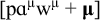 is not included here; it can simply be ruled out by Headedness(μ). A candidate that deletes the floating mora,
 , is penalised by MaxFlt.
With the ranking {Max-IO-μ, Max-IO-seg} ≫ Integrity-IO, however, the grammar selects reduplication as the output, as in (41), which integrates (14) and (24).

In summary, the rime change patterns can also be treated as segment deletion with feature preservation, similar to the reduplicative patterns analysed in §3.3 and §3.4. However, the ABC constraints will not take effect if the grammar selects rime change instead of reduplication.
4. Alternative analyses
Any potential alternative analysis needs to address the asymmetrical behaviour between w-ending and j-/ŋ-ending nouns in segment deletion and featural changes. In this section, four alternative analyses are considered. §4.1 explores the consequences if the featural changes in reduplication are treated as segment fusion. §4.2 discusses a BRCT analysis. §4.3 focusses on the derivational alternatives. §4.4 briefly discusses MDT (Inkelas & Zoll Reference Inkelas and Zoll2005).
4.1. Deletion or fusion?
At first impression, the Huozhou data seem to be more readily analysed as segment fusion, and Lin (Reference Lin1993) has proposed ‘segmental merger rules’ to account for similar patterns of rime change in other Chinese dialects. The current analysis, however, interprets Huozhou reduplication (and rime change) as deletion with feature preservation (recall §2.3). Specifically, segment deletion in reduplication is motivated by the ABC constraints, while feature preservation is primarily driven by Max(F).
In fact, if the fusional view is taken, with SCorr being included, the current analysis will still hold. However, a major difference arises in the ranking of constraints, with Max-seg dominating Uniformity-IO.Footnote
23
In that case, the output will be [
$\textrm {p}_x\textrm {o}\unicode{x02D0}_x^{1,2}$
 .
$\underline{\textrm {p}_x\textrm {o}_x^1}$
 ] rather than [
$\textrm {p}_x\textrm {o}\unicode{x02D0}_x^1$
 .
$\underline{\textrm {p}_x\textrm {o}_x^1}$
 ], as in (42).

When the motivation of fusion is attributed to the ABC constraints, a favourable outcome is the avoidance of unexpected fusions such as *[
$\textrm {s}_x\textrm {e}_x^{1,2}$
 .
$\underline{\textrm {s}_x\textrm {e}_x^1}$
 ], as demonstrated in (43). Candidates (43a)–(43c) do not meet the conditions in the Ident-XX constraints, and the candidate with the unexpected segment fusion, (43b), is harmonically bounded by the winner.

Alternatively, if the fusional analysis without ABC is pursued, several issues would arise. First, it becomes unclear what motivates segment fusion. One possibility could be NoCoda (e.g., Lamontagne & Rice Reference Lamontagne and Rice1995), but it would be necessary to modify NoCoda or Uniformity-IO to prevent the potential fusion of [aj] and [ɑŋ]. This point is similar to the discussion in §4.2, as will be elaborated later. If we instead choose not to modify NoCoda or Uniformity-IO, additional constraints would be required to ban forms such as  . Second, in order to comprehensively account for the segmental details, as has been done in §§3.3 and 3.4, a full set of constraints that refer to features would still be necessary, including Ident-IO(F), Id-IO(high) & Id-IO(low) and value-specific Ident-IO(±F). Thus, the fusional analysis will not be much simpler than the current one. Third, certain mechanisms would still be needed to ensure reduplicative identity, if a parallel analysis is pursued. Though reduplicative identity can be achieved through BR correspondence, some issues associated with this strategy will be discussed in §4.2.
In sum, the data can potentially be accounted for as either deletion or fusion, but what matters is the role of ABC. If we want to explain the reduplicative identity observed in Huozhou data, as well as the asymmetry between different types of nouns, ABC and SCorr are argued to be the driving forces in this analysis, regardless of the analytical view.
4.2. The BRCT alternative
In BRCT (McCarthy & Prince Reference McCarthy and Prince1995, Reference McCarthy and Prince1999), reduplicative identity is enforced by BR identity via BR correspondence. To produce  by deleting [w] while preserving [j] and [ŋ] in the base, we can simply posit an indexed markedness constraint
![Asterisk W ] sub sigma super D I M](https://static.cambridge.org/binary/version/id/urn:cambridge.org:id:binary:20260804160220094-0420:S0952675726100414:S0952675726100414_inline1068.png?pub-status=live) , which specifically prohibits syllable-final [w] in diminutive forms. When
![Equation showing asterisk W ] with subscript sigma and superscript D I M.](https://static.cambridge.org/binary/version/id/urn:cambridge.org:id:binary:20260804160220094-0420:S0952675726100414:S0952675726100414_inline1069.png?pub-status=live) interacts with Max-seg and NoCoda, it becomes possible to restrict segment deletion to w-ending nouns only, as in (44)–(46). Additionally, vowel raising in reduplication can be accounted for by the same set of constraints, including Max(+high), Max(+round), Ident-BR and Ident-IO, among others.


In (44), the deletion of [w] in reduplication in the winning candidate (44a) is due to the ranking *w]σ dim ≫ Max-seg. Syllable-final [j] (and [ŋ]) is preserved through the ranking Max-seg ≫ NoCoda, as in (45). Moreover, the morpheme-indexed constraint limits the effect of [w] deletion to diminutive formation only, so there is no such deletion in (46).
However, an issue arises when handling mid vowel raising in ŋ-/j-ending nouns, as in  in (47), where the intended winner is (47a), but (47b) is selected as optimal because it does better on Ident-BR.

In a grammar without ABC, alternative mechanisms such as feature spreading are needed to derive (47a), if we assume the vowel raising in the reduplicant results from [ŋ] or [j], as illustrated in §3.4.
As pointed out by a reviewer, markedness requirements could also play a role in the raising from [ə] to [u], since a high back rounded vowel is more natural and unmarked. This is a viable alternative, but the utility of ABC has also been demonstrated in accounting for local assimilation in (16), (29) and (37), as well as in other studies (e.g., Inkelas & Shih Reference Inkelas and Shih2014). Thus, as an independently motivated mechanism, if ABC effectively accounts for both reduplicative identity in Huozhou Chinese and other vowel-raising processes, BR correspondence may be obviated. In this way, ABC serves as a more versatile mechanism than BR correspondence.
4.3. Derivational analyses
A rule-based analysis may well account for the identity effect in the reduplication of w-ending nouns. To start with, if the fusional view is considered, the rules and their ordering are illustrated in (48).

To derive the correct output for each type of noun, there should be two fusion rules, one for /Vu/ and another for /əX/ (where X = /j/ or /ŋ/). When the fusion rules are properly ordered with copying and deletion, the attested outputs can be produced. Note that the /əX/ fusion rule should only target the second syllable in reduplicated forms.
The analysis seems simple and successful, but the fusion rules have been argued to be stipulative. For instance, Aoki (Reference Aoki1974: 224) argues that the fusion rules are ‘superfluous’, and that they can be broken down into more basic processes. In addition, the rule simply stipulates that /əX/ merges, but does not explain why /ai/ and /aŋ/ do not. Casali (Reference Casali1996: 33) has similar concerns about the explanatory power of rules when analysing vowel elision.
If the deletion view is taken instead, it would involve two deletion rules, one targeting [w] and the other targeting [j]/[ŋ]. However, this approach also introduces complexity in rule ordering and raises the question of why [w] behaves differently from [j] and [ŋ]. In contrast, the proposed ABC constraints can explain this asymmetry. This is because the [+back] and [+round] features of [w] could potentially trigger an identity effect, as reflected in the constraints  and
 . One way to satisfy these constraints is to delete a segment if Max-seg is ranked lower.
Finally, another alternative in the previous literature (e.g., Tian Reference Tian1992) is to view Huozhou diminutive reduplication as an ordered application of rime change and reduplication. If this alternative is pursued, we have to assume rime change and reduplication are two morphological operations at different levels. The most obvious problem is that there cannot be a unified ordering between rime change and reduplication. To generate the attested output in (49), rime change is applied before reduplication, but this ordered application results in a wrong output in (50). Thus, to produce the correct outputs, we need to assume different orderings for w-ending nouns and j-/ŋ-ending nouns. Apart from this issue, if both reduplication and rime change (subtraction) are treated as the result of mora affixation, as discussed in §3.5.2, then the ordered application of rime change and reduplication would require two underlying moras, which increases the complexity of representation.


Summing up, derivational analyses have the potential to handle reduplicative identity, but there are various problems as well. In a rule-based framework, issues such as stipulative fusion rules and the complexity of rules and rule ordering would arise. Further, the stratal analysis in (49) and (50) raises challenges regarding the uniformity of stratal ordering in a language. Instead, the current analysis using ABC gives the correct output using a single grammar, since j-/ŋ-ending nouns are exempt from the Ident-XX constraints.
4.4. Morphological Doubling Theory
MDT (Inkelas & Zoll Reference Inkelas and Zoll2005) treats morphological reduplication as the copying of morphosyntactic feature bundles, as illustrated in (51) (after Inkelas & Zoll Reference Inkelas and Zoll2005: 19).

The copying of morphosyntactic feature bundles results in two identical daughters. Each daughter node, as well as the mother node, can undergo phonological deviation from the underlying representation, which is attributed to three cophonologies.
Given the asymmetrical patterns in Huozhou diminutive reduplication, this proposal requires that Cophonology X triggers deletion on [w] only; in comparison, Cophonology Y, which trims the reduplicant to an open syllable, needs to be applied in every condition. The asymmetrical behaviour between [w] and [j]/[ŋ] in Cophonology X can be handled in various ways. One solution is to postulate *w]σ dim as in §4.2, but another is to make use of ABC. In Cophonology X, the ranking Ident-XX [γG](F) ≫ Max-seg predicts [poː]. See (52) and (53), where Corr-XX is omitted.


In Cophonology X, the grammar established in earlier sections can predict the correct output in the left daughter node. The constraints that are responsible for feature changes, such as Max(F) and Ident-IO(hi) & Ident-IO(low), are not shown, but the effect of these constraints is the same as in (24).
In Cophonology Y, NoCoda dominates Max-seg, while both stepwise raising and mid vowel raising can still be attributed to feature preservation, driven by Max(+round) and Max(+high). Again, if ABC is already part of the grammar and if it is required in Cophonology X anyway, we can appeal to a simplicity argument against the MDT alternative, since the grammar established in §3 sufficiently accounts for the observed patterns without the need for cophonologies.
5. Conclusion
As one of its goals, this article introduces new data on Huozhou diminutive reduplication that show a special case of reduplicative identity. The base in the reduplicated forms of w-ending nouns exhibits deletion in order to match the shape of the reduplicant. Further, this article shows that ABC and SCorr can be extended to account for the observed pattern. In this analysis, the motivation of base deletion is that [w] and other vocalic segments are included within the same correspondence chain defined by a certain feature, such as  . A way to satisfy higher-ranked Ident-XX constraints is to delete a segment in the base. In addition, deletion is automatically blocked for j-/ŋ-ending nouns that lack [+round] or [+back] feature.
As demonstrated in this article, segment deletion is another potential prediction of ABC. In the analyses of long-distance segment assimilation (e.g., Rose & Walker Reference Rose and Walker2004), the ranking schema that drives assimilation is Corr-XX, Ident-XX(F) ≫ Ident-IO(F). However, the case of Huozhou reveals another way to satisfy Corr-XX and Ident-XX(F) by deleting a segment, which is achieved by ranking Max-seg lower than relevant Ident-IO(F) constraints – specifically Ident-IO(high) & Ident-IO(low) in this case. Therefore, this case study of Huozhou offers additional evidence to support the idea of ‘deletion by correspondence’, which aligns with the ranking schema in Inkelas & Shih’s (Reference Inkelas and Shih2014) analysis of Lithuanian.
Nevertheless, this article does not make a strong claim that all instances of reduplication–phonology interaction can be accounted for by the existing mechanisms of ABC, but it demonstrates that, at least, the case of Huozhou can be accounted for by the existing mechanisms of ABC. The extension of SCorr to the domain of reduplication, together with its ability to analyse long-distance assimilation or dissimilation of segments and tones, as well as some local assimilation patterns, reinforces the effectiveness and versatility of this theoretical mechanism.
Acknowledgements
I am grateful to Rachel Walker and Stephanie Shih for their continuous support throughout this project, as well as to my other dissertation committee members, Khalil Iskarous and Toben Mintz. I am thankful to the anonymous reviewers and the editorial team of Phonology for their very insightful and helpful comments. Portions of this work were presented at various stages at USC Phonlunch, AMP 2019, and the 10th International Conference of Formal Linguistics, and I thank the audiences there for their valuable feedback, particularly Jisheng Zhang and Xiaopei Wang. Finally, I am especially indebted to the speakers of Huozhou for their generous assistance with data collection. All remaining errors are my own.
Competing interests
The author declares no competing interests.
 .
 , if more constraints, such as
 could also be interpreted as satisfying

 Open access

