1 Introduction
The study presented here concerns a body of information gathered as part of an online professional qualification course. In France, online Professional MAs in Language Teaching and Learning have attracted many teachers of French as a foreign language, most of them already working in this capacity in different countries around the world. They can enrol in online programmes that offer university-level professional qualifications. There are some particular characteristics shared by these groups of students: many already work in the field and are returning students; some have difficulty reconciling this dual identity as both teacher and student. Secondly, as this is distance learning, they may feel isolated when working from home but with other students they do not know personally; this is a situation they are not accustomed to, one that requires new forms of autonomy in their work and in their learning.
This article concerns one such programme, launched in November 2006 as a partnership between the Centre National d'Enseignement à Distance (French National Centre for Distance Education) and the University of Grenoble 3. A module in this course – entitled “A discourse approach to intercultural issues,” the aim of which is to help teachers structure the way they include culture and civilisation in a language class (providing both methodology and content) – provided the opportunity to collect a body of information in which we could observe and analyse different aspects of the identity and the autonomy of these online learners.
A month after the beginning of the course, the first graded assignment was to consider the way students were learning and the differences of distance learning. They were asked to discuss how they developed their autonomy using this learning tool and the possible connections between it and their isolation, or on the other hand between it and support they received from other students. Out of a cohort of 70 distance learning students, 27 of them chose to do this assignment; the analysis of their responses is presented here.
Our working hypothesis, which we hoped to support with the students’ written assignments, was that this self-analysis would allow us to identify and even characterize the influence of peers on the construction of individual autonomy for online learners. While it may appear counterintuitive, this idea seemed to be an interesting point that should be explored further, in particular the relationship between cooperation or collaboration via the Internet and the learners’ construction of identity and autonomy in their work. We wanted particularly to look at the role of others in the creation of one's own autonomy, and we did this using a specific analysis protocol for the students’ written reflections.
In presenting this work, the theoretical framework will allow us to examine the relationship between autonomy and identity and specifically how that relationship works in adult education and distance learning, to insist on the importance of the role that peers play in the construction of this autonomy, with a distinction being made between learning autonomously and learner autonomy. In the methodology section we discuss the context within which the study was done, the subjects’ profiles and the data gathered, after which the quantitative and qualitative results are given and then discussed. The students’ answers reveal the different factors that contribute to the development of their autonomy. The reflective writing assignment and the identification of the role of others in learning allow us to posit new practical and pedagogical implications as well as ideas for future research on the subject.
2 Theoretical framework
In addition to work done on language learning and teaching, which has already been the subject of multiple studies (Benson, Reference Benson2001; Blin, Reference Blin2004; Allford & Pachler, Reference Allford and Pachler2007; Benson, Reference Benson2007; Ciekanski, Reference Ciekanski2007; Pemberton et al., Reference Pemberton, Toogood and Barfield2009; O'Rourke and Carson, Reference O'Rourke and Carson2010), there is now general consensus on a certain number of points concerning adult learner autonomy. Both in research published in English (Candy, Reference Candy1991; Benson, Reference Benson2001, Reference Benson2007) and in French (Tremblay, Reference Tremblay2003; Eneau, Reference Eneau2005; Candas, Reference Candas2009), the authors of these studies agree that the role of the environment, and in particular the social environment, is key to developing this autonomy.
This consensus is most notable in the French research which follows in the footsteps of the pioneering work of Holec done at CRAPEL (Centre de Recherches et d'Applications Pédagogiques en Langues, Centre for Language Pedagogy Research and Application) over the last 30 years (Candas, Reference Candas2009). All this work confirms that autonomy for adult learners learning foreign languages or continuing their education in general is constructed through a process of exchange and sharing that depends largely on the resources and the environment. This means that, contrary to popular belief, a learner's autonomy does not grow out of isolation (to be autonomous is not to be self-sufficient); rather it goes hand in hand with the development of “meta-skills”, as Tremblay (Reference Tremblay2003) termed them, that require in particular:
– the capacity to “know oneself as a learner” (be able to identify how you learn best, your strengths and weaknesses);
– the “reflective” capacity of learning through action (be able to learn by doing, to act with full understanding of the situation);
– the capacity to “adapt” to the situation and the context (know how to take advantage of opportunities to learn, know how to turn a problem into something which you can learn from);
– the capacity to “learn from others” (know how to identify useful resources, develop skills in relating and communicating with others) (Tremblay, Reference Tremblay2003).
Where language acquisition is concerned, these meta-skills used by autonomous adult learners are types of metacognitive, reflective and social strategies (Oxford, Reference Oxford1990; Benson, Reference Benson2001; Candas, Reference Candas2009). But, more generally, they have been pointed out in work dealing with autonomy in adult learners and self-directed education on both sides of the Atlantic (Tremblay, Reference Tremblay2003; Eneau, Reference Eneau2005; Candas, Reference Candas2009). In fact, as four decades of research on self-education and self-directed learning in Europe and North America have shown, the social dimensions (knowing how to learn from others) and reflective dimensions (knowing how to learn through and from one's actions) are skills that characterize the autonomous adult learner even more than they characterize autonomous learning (Tremblay, Reference Tremblay2003; Tremblay & Eneau, Reference Tremblay and Eneau2006; Eneau, Reference Eneau2008). This means that in some training programmes that lead individuals to direct their own learning, we observe a veritable transformation of the learner's identity.
At this point and throughout the different sources mentioned by the authors (Benson, Reference Benson2001), it is important to distinguish between two levels of autonomy that are often confused (Candy, Reference Candy1991):
(1) autonomy in learning (for example, mastering procedures, managing or taking responsibility for all or some of the learning process, determining goals and evaluating what has been learned, and also the ability to find useful resources);
(2) autonomy of the learner (supposes distancing and critical reflection, understanding of levels of difficulty, reference frameworks, etc. and the ability to make informed judgements on the degree of dependence or interdependence of the individual in these different situations).
While the perfect level of autonomy in a learner (2) can be seen as the principal end result of the “autonomous learning” process (1), it is important to note that the former is not always the result of the latter; a certain number of environmental conditions (the institution, the programme, etc.) are necessary in order for this relationship to become firmly established (Eneau, Reference Eneau2005). Moreover, much like the process of constructing one's identity, the “ideal” level of autonomy in a learner can never be completely achieved because the process of autonomisation is always somewhere in between. It is a balancing act between the person and the environment; the person and their environment act like “reciprocal determiners” in the autonomisation process, which is governed by the individual's meta-learning skills (Tremblay, Reference Tremblay2003; Eneau, Reference Eneau2008).
Beyond this theoretical work on adult education, autonomy, self-education and self-directed learning, research has shown that this balancing act particularly characterises distance-learning programmes that include a fair amount of self-education (Eneau, Reference Eneau2005; Jézégou, Reference Jézégou2008; Develotte, Reference Develotte2009). These types of programmes actually cause learners (who may well not know each other before the programme) to work together in alternative configurations that challenge the traditional “learning methods” by, for example, using both real-time and delayed feedback, alternating between periods of individual and group learning, and using specific forms of communication via new media. However, it seems that it may be necessary to accompany this alteration of work habits in distance learning programmes with individual or group reflection so that the learners become aware of these changes, realizing and verbalizing them. With this point in mind, it seems therefore that the reflective dimension of the autonomisation process is particularly important (Barbot & Camatarri, Reference Barbot and Camatarri1999; Eneau & Poyet, Reference Eneau and Poyet2009; Guichon, Reference Guichon2009).
Lastly, some of the work done on distance learning seems to point to the fact that whether or not autonomisation occurs through formal, reflective awareness-raising, it encourages the people working in a group online to develop a “group identity” and a form of “collective autonomy” (Raby, Reference Raby2009). Other research concerning various subjects, from moving from cooperation to collaboration (Henri & Lundgren-Cayrol, Reference Henri and Lundgren-Cayrol2001; Simonian et al., Reference Simonian, Ravestein and Audran2006), to the relational skills developed online or the coordination that allows groups working together via the Internet to trust each other and to achieve results (Wenger, Reference Wenger1998; Loilier & Tellier, Reference Loilier and Tellier2004; Simeone et al., Reference Simeone, Eneau and Rinck2007; Simeone et al., Reference Simeone, Eneau and Simonian2009), highlights the impact of the group seen as a “learning community” and its influence on whether or not work or learning groups reach their individual and collective goals. Finally, in an “integrative” vision of the Internet as a learning tool, the various possibilities provided by distance learning allow learners to take control of their own learning process (and therefore of the development of their autonomy), even in their interaction with their peers and in collaborative learning exercises (Benson, Reference Benson2001).
It seems then that a distance learning programme that facilitates self-directed learning and the autonomy of the learners includes, but is not limited to:
– a reflective dimension that encourages learning about oneself (how one learns, noting one's strengths and weaknesses, etc.);
– a collaborative or reciprocal dimension to learning, which allows learners to learn from and with other learners by creating groups that are themselves autonomous and have their own identity.
Starting from this theoretical framework, the question that served as the basis of our research concerns this dual aspect of distance learning: In online learning, how do one's peers influence the construction of learners’ individual autonomy?
3 Methodology
To answer that question, we analysed the reflective writing assignments of adult students enrolled in a Master's programme for Teaching French as a Foreign Language, a partnership between the Centre National d'Enseignement à Distance (French National Centre for Distance Education) and the University of Grenoble 3. The class was made up of 70 distance learners; 85% of them were returning students, already teachers of French as a foreign language, the remaining 15% were initial students; they were spread across 33 different countries. The optional activity that provided the information for the study discussed in this paper concerned 27 students, of whom 22 were teachers of French living abroad, 7 men and 20 women (74% women). These students participated in an optional activityFootnote 1 consisting of online discussions to help them introduce themselves to the group and get to know each other.
The discussions took place on a Dokeos platform, with the principal tools being a forum (allowing progressive, reflective analysis through various activities over the course of the entire year) and all types of communication tools available on the Internet (MSN, Skype, etc.). The more traditional university work, i.e., student-teacher communication, was all distance learning and asynchronous communication. Printed materials were sent to students at the beginning of the year for each course. Forum discussions, which included a teacher, only related to learning activities intended to apply what had been learned in the course.
After the first month, students were asked to send a “self-observation” assessment to the teacher; the assignment was for a paper of roughly 2,400 words about one of the points of the methodology of the course (called “reflective analysis”), and they were asked to “make observations about their own habits, behaviour and opinions concerning online learning” (compared to the teaching culture for classes which they had experienced until now where students and teachers are physically present); one part of the assignment asked them to try to describe their “perception of the autonomy needed for this type of learning, and, for example, what other students had to contribute”. While this question does introduce a certain methodological bias, it seemed to us important to have students examine their own opinion of the subject through the self-reflection necessary in this assignment.
We then analysed the contents of these papers thematically to distinguish, firstly, the indicators and determining factors of autonomy, noting the ways students talked about it and how they defined it, and secondly, the role of other online students, the importance or lack of importance of others (in learning in general and more specifically in the construction of this autonomy). After two people separately categorized the data for analysis, seeking inter-rater agreement (Chi, Reference Chi1997; Kerlinger & Lee, Reference Kerlinger and Lee2000), what we noted from the learners’ papers concerning the autonomy acquired and the role of others in learning can be organized according to the following categories and sub-categories:
1. Contribution to learning
1.1. Personal organisation in learning
1.2. Socio-cognitive support/opposition
1.3. Complex conception of learning
2. Social-emotional contribution
2.1. Stimulation by/emulation of others
2.2. Exposing oneself to others’ judgement
2.3. Necessity of cooperating
2.4. Virtual sociability
2.5. Isolation from others because of the computer
3. Contribution to constructing autonomy
3.1. The role of others in autonomy
3.2. Acquiring a strategy for autonomy
3.3. Group autonomy
3.4. Reflection on autonomy
These categories, drawn from the data itself, help specify what role other people play in learning and in the construction of learner autonomy, whether directly (subcategory 3.1) or indirectly, voluntarily or involuntarily, out of choice or necessity, etc. These questions will be examined in more detail in the analysis.
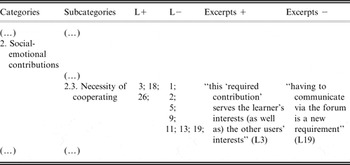
An example is given below to illustrate how the categorisation was carried out using the “social-emotional contribution” category (2). For the subcategory “Necessity of cooperating” (2.3), we noted that three of the learners’ papers (anonymously identified as L3, L18 and L26) cite positive opinions of examples of this necessity of cooperating online (+), while seven learners (L1, L2, L5, L9, L11, L13, L19) have more negative comments (−). As researchers, we did not expect this distinction between positive and negative opinions, given by the learners, sometimes about the same aspect of their learning experience. Moreover in some cases, learners note positive and negative comments about a single aspect (this could appear, in this case, in the two columns L+ and L−). As an example, excerpts from the papers are listed in the appropriate columns (Excerpts + and Excerpts −) to illustrate the positive and negative connotations of this necessity of cooperating (Table 1).
An example of the categorized information (excerpts from the self-analysis papers, learners No. L3 and No. L19)

A word about bias and the limits of this research: we would like to note first that the students’ comments were written in response to an institutional request (an assignment given by the trainer) and were therefore not made spontaneously; spontaneous remarks could have been found on the online discussion forums. External evaluation by the trainer of a document that supposedly addressed the question of “self-observation of the online learning process” does not give entirely unbiased results. Similarly, the fact that the instructions mention their “perception of autonomy” and the “possible contribution of other students” could lead to these dimensions of the learning process being over-represented in the learners’ papers. As we will see, however, the results of the research seem to downplay this bias.
In addition, we should note that while the different facets of learning, cooperation and autonomy development were observed in the activities and on the Dokeos platform, it is quite possible that they also could have been observed outside of the institutional confines, for example, in personal email exchanges. However, we were not able to analyse these private spaces that remain, by definition, inaccessible to us.
Lastly, the way this information was categorized pinpointed ideas such as the “necessity of cooperating” or “exposing oneself to others’ judgement” which for the most part have intrinsically negative connotations, while other points, such as “stimulation by/emulation of others” have more positive connotations. This organisation of data based on judgements reflects the content of the papers analysed, and as the results show, particularly in terms of quantitative analysis, these biases in the end have very little influence on the data produced in terms of the themes addressed or the positive or negative aspects.
4 Results
4.1 Quantitative data
Twenty-seven learners wrote self-analysis papers that described and/or analysed their online learning experience; the papers met the criteria for the assignment, which was for about 2,400 words. Following the categorisation introduced above, (three categories and twelve sub-categories), we selected 127 quotations concerning the ways others had or had not helped the learner construct their autonomy. However, we noted that the ideas of “autonomy” and “working together” were not over-represented as these 127 excerpts constitute only 4500 words out of an overall total of 64,800 words (27 papers with an average of 2,400 words); the students were told that they would be evaluated on the quality of their analysis rather than on their opinions (whether their learning experience was a positive or a negative one). In other words, the themes of autonomy and identity and the themes of group, collective work, or more generally the role of others in this type of learning represent less than ten percent of the total body of work produced in the 27 documents analysed. While we could have imagined that an assignment focusing on these two themes would represent a substantial bias in our work, the analysis shows that their quantitative importance was relative.
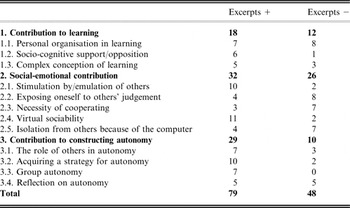
Another expected bias in our research results from the fact that this activity was done as part of an evaluation. We were expecting, therefore, a fairly positive slant from the learners in their self-analysis; it would be quite understandable that the learners, for the benefit of the person evaluating them, would stress their rich experience, the variety of the things they learned and the skills developed to overcome difficulties. As can be seen in Table 2, the students’ remarks were more balanced than we expected. While the various categories and sub-categories contain a range of positives and negatives (with both positive and negative views on a single point from the same person, in 14 of the 127 excerpts), the reflective analyses overall tend towards the positive, with 79 positive points compared to 48 negative ones, roughly two-thirds. However, while some learners mention the fact that what the exercise asks for is not easy or “natural” (learners L1 and L10, for example), most of them show a certain maturity with regard to the assignment, and they honestly analyse both the positive and negative aspects of their learning process, using this analysis principally for personal evaluation rather than as the basis for another's evaluation of them. Thus, for different aspects, the categories and subcategories include both positive and negative opinions, which are sometimes nearly balanced and sometimes have a clear tendency one way or the other. Their opinions, broken down into positive and negative, can be organized as shown in Table 2.
Number of positive and negative excerpts divided into categories and sub-categories, after inter-rater agreement

Although these categories were constructed from the data itself, we can see in Table 2 the different factors that are included in the link between the role of peers and learner autonomy. For example, as for the social and group dimensions of learning (which reflect the influence of others on the construction of autonomy), sub-categories such as “Socio-cognitive support/conflict”, “Stimulation by/emulation of others”, “Exposing oneself to others’ judgement”, “Necessity of cooperating”, “Virtual sociability”, “The role of others in autonomy”, and “Group autonomy” include 23 negative aspects and 47 positive aspects, that is, roughly twice as many positive as negative.
In other words, the papers list the positive connotations of constructing autonomy (two-thirds positive compared to one third negative), and they detail positive aspects of the role of the other in this autonomisation – almost twice as many positive connotations; the learners principally point out the positive aspects of their distance learning experience as well as the importance of the relationship with others and the influence of others in the process. These quantitative data thereby confirm the overall impression given by an initial, brief read-through of all the documents, which on the whole, give mostly positive accounts of the experience.
4.2 Qualitative data
A closer look at the categorisation reveals the range of positive and negative arguments found in the learners’ papers. The contribution of others to the online learning experience is classified into three sections: (a) in terms of procedural and cognitive learning (personal organisation, socio-cognitive support, etc.); (b) in terms of social and emotional support (stimulation from others, exposure to other people's judgements, feeling of isolation, etc.); (c) in terms of autonomisation, both on the individual and group levels (acquiring an autonomous learning strategy, reflective analysis in learning, feeling of belonging to a group that is itself autonomous, etc.). There are several examples to illustrate these inter-related categories.
4.2.1 (a) The role of others in learning
The contributions to learning come into play first with the personal organisation that is necessary for online learning (regularly reading remarks and responses on the forum, organising one's work at home, finding a routine to coordinate work, etc.). However, while seven learners list this personal organisation as a positive point, it is included in the restrictions and difficulties noted by eight other learners (online learning implies new restrictions in terms of time management, work rhythm, etc.).
This type of learning does take time (“it's progressive”, L11, “little by little” L9), but moreover it is seen by some as being much more demanding work, in terms of personal organisation, than traditional attendance learning (working online is “time-consuming”, L9, it's “a mountain of work”, L14). However, the other learners play an important role in as much as they offer direct or indirect support in learning the procedures and new ways of working: six learners said that having others read what you have written to make sure you understood it (e.g., L20: “I recently responded to a message by L2 (who wanted an explanation of Chomsky's idea of competence vs. performance) because I wanted to give him some kind of answer and at the same time I wanted to test my own understanding by inviting other students to expand on my answer”Footnote 2), getting help on technical questions or questions about the content, etc., helped them learn, while only one learner (L16) identified it as a possible problem (distance and time delay make the process more complex and upset people's previously held notions).
In fact, one of the most notable effects remarked upon is the fact that online learning seems to encourage a complex conception of learning precisely because of the distance and the specific time requirements, as well as new ways of working with other learners. For a majority of those who noted this point (five out of eight), their conception of learning is more nuanced and more complex; online learning itself becomes “another way” to learn that calls new representations into play, with new modes of communication, intergenerational and intercultural aspects. On the other hand, other learners (three people) see it as a way of learning that creates instability and makes it difficult to situate oneself (“who is reading what I write? what opinion do the others have of me?” L11), and this can cause the process to be uncomfortable and unsatisfying.
4.2.2 (b) The role of others on an affective and emotional level
For the majority of learners however, other people's contributions to the process were generally considered a positive element of online learning, mostly in terms of social or emotional aspects. Other people are a source of stimulation or serve as models. For those reasons, ten learners note the pleasure, interest and curiosity with which they approached the online discussions. “The platform is more than a learning tool, it becomes a psychological support for everyone thanks to the ties it creates” (L6). Again, even if it was difficult in the beginning, meeting and getting to know other people by learning about their differences and their similarities motivates learners and provides role models for learning. “Humour” (L8) and “positive attitude” (L6) or kindness from others have an influence on this distance meeting certainly, but the process itself is what makes this type of learning “exciting” and which can even, as one learner put it, “speed up the autonomisation process for the learner who is isolated by distance” (L3). Occasionally (for two people), this interaction with others can become an inhibiting factor in as much as accepting one's own shortcomings and agreeing to learn from others are not easy to do for people who are used to working alone or who have low self-esteem.
In the same vein, exposing oneself to others’ judgements is more of a problem than a positive point (for six and five learners, respectively). While distance and being in one's own personal space or in the “protective bubble” (L9) of the forum means people will share and subject themselves to others’ judgements more easily than when they are physically faced with others’ judgements, the “protective screen” in distance learning can be intimidating (L3), inhibiting or even “fake” for other learners. “The fact that everything was “public” made it hard for me; I felt held back because I was afraid of asking the wrong question, of being misunderstood and especially of being judged” (L9). It makes it difficult to identify with other people, to find your place in relation to them, to compare experiences or to “reveal oneself” (L24). Fear of asking the wrong question, perhaps an “inferiority complex” (L9) or the fear of being too casual and having your intentions misunderstood can distort communication via the technological means of distance learning, making it necessary to be more prudent in these exchanges than in person.
Moreover, the necessity of cooperating as part of group distance learning is not easy. While it is seen as serving everyone's interests (sharing, exchanging, and reciprocal stimulation make it easier for everyone to learn), only three learners stressed the positive aspects (a source of personal motivation, not wanting to let the others down) while seven others noted more negative aspects. “I have a hard time overcoming the discouragement and anxiety I feel at being judged by others” (L10). Being expected to participate in the forum or the let-down of rejection (accepting when others don't “take the outstretched hand”, L11) are also part of a learning process that can indeed be frustrating.
The importance that people attribute to the newly-formed group is for most of them a source of satisfaction, and this is in part because many of the learners (ten people) feel that they have overcome the difficulties involved to successfully participate in a new form of “virtual sociability” (L2) and create a “virtual community” (L15). “I was surprised by the fact that real sociability was created online. With time, people's identities become clearer, they become more real and you look forward to meeting with them online” (L2). The learners who felt this express the pleasure of being able to count on a new form of group solidarity (L4, L5, L13, L19) and mutual assistance between “experienced people” and “beginners” (L5, L13); they feel “proud” (L6) that in spite of the difficulties stemming from interacting with people of different origins, experiences and even different languages, they succeeded in constructing a group (a community of knowledge, a learners’ community) made up of diverse members from various countries who have different professional and personal experiences. Only two people note negative aspects about the diversity of the group and its languages.
This new form of “long-distance sociability” is one of the best remedies for the isolation and stress that distance learning and technological means of communication can cause, four learners note. However, the feeling of community and sociability do not make up for all the difficulties that all the learners feel, far from it: seven learners say that despite the time they have spent getting used to it, distance learning is still a source of technological stress (hoping that in time “computer” will no longer be equated with “horrid”, L5), communicational stress (feeling “paralysed” by the fear of being misunderstood, L4), organisational stress (constantly feeling “overwhelmed” by the mass of information to be incorporated, L9), or even psycho-emotional stress (the difficulty of overcoming the omnipresent “anxiety” and “discouragement”, L10). “A strange feeling creating virtual sociableness: I have the map and I know where I'm headed, but I have a hard time following the markers and actually communicating remotely” (L12).
4.2.3 (c) The role of others in developing autonomy
Overall, despite the difficulties it presents and also because of its specific organisation, distance learning represents a new path to developing autonomy for many of the learners who participated in this assignment, and they specifically point to the wealth of positives, both for others and in their own learning process.
Distance learning does indeed encourage learners to work alone as well as in a group, clearly highlighting the role that others play in constructing one's own autonomy: seven learners distinguish learning autonomously from merely working alone. For them, being autonomous means being “active” (L26) and “asserting oneself” (L8) surrounded by a “group” rather than “alone” (L2), becoming “involved” in other people's learning (L8), “taking on responsibility” (L11) and becoming more “confident” in group work (L8, L9). “You learn how to position yourself inrelation to others as well as how to affirm some of your own opinions” (L8). However, this means “taking a risk” or a “gamble”, and that is never easy to do (L9, L10, L14). Above all else, it requires time to learn to trust people and agree to share group responsibility. However, the sharing and pooling of resources also demonstrates how switching roles (the “reversal of constructive positions”, L8), learning from other people (by questioning your own positions), learning to be autonomous (while remaining relatively dependant on others), etc., all make it possible to learn about oneself and how one learns.
The reflective dimension of autonomy can be seen in some learners’ opinions (seven of them) of how one develops a veritable “strategy for autonomy”, which is closely linked to the time dimension of the development of this autonomy. “With a little time, you can pick out the “leading” students and those who have the most pertinent things to say” (L25). Within this aspect of time, the development of individual autonomy and a new identity as an “online learner” goes hand in hand with the construction of a group identity, which is probably related to the discovery of this new form of “virtual sociability” mentioned above. On the other hand, as two learners mention, this method of distance learning, which requires individual autonomy at the same time as it creates group autonomy, imposes rules for cooperation that may not suit some people (those who prefer working alone, in particular), because it requires one to start from each person's individuality and then strengthens awareness of one's own habits and behaviour and, ultimately, one's own limits. “Adaptability” is then often required (L3, L4, L8, L11). However, the students (as mentioned in seven papers) then learn to learn together, to better fulfil their dual role as student and teacher, to “share their voice with others” and encourage “shared values”; the end result is a “positive feeling about oneself” (L3, L8).
In this way, individual autonomy (which allows learners to find their place in the group) and group autonomy (of the learning community) seem to develop together. While one has to “come to terms with others’ autonomy to construct one's own” (L3) one of the paradoxical results of this new group autonomy is that the group learns together and because it is more autonomous, it may even come to resent the “intrusion of the instructor” (L2). Being more autonomous as an individual would seem to be the result of constructing autonomy in cooperation with others, and awareness of this comes about by developing a meta-learning skill which leads to true reflective analysis of this new-found autonomy. In some way, autonomy serves to systematically reaffirm the different elements previously mentioned concerning the first category, contribution to learning: five out of ten students noted the effects of this realisation about their own learning strategies – the way they learn, their need for a regular schedule, what they require for learning, how they adapt to situations, etc. – in much the same way that their representations of learning became “more complex” as their awareness of “the importance of others” in their own autonomisation process increased (L2, L5, L6, L8, L9). “You learn to all discuss things together in an environment of shared values, and the result is a positive self-image” (L8). At the opposite end of the spectrum, however, five students remarked that this realisation is a delicate and demanding exercise, both because of how difficult it is “to learn to work rigorously” (L4) and to “find the right balance, the correct distance inrelation to other people” (L6).
5 Discussion and future prospects
Despite a certain number of limitations, in particular ones that have been pointed out relating to the methodology and the interference of categorisation of learners’ opinions from a graded reflective assignment, this study led us to several conclusions and as many directions for future research.
In short, the results of this study show most importantly that becoming autonomous through online learning means learning by oneself, certainly, yet it also means becoming aware of the role of others in learning and constructing autonomy. Learning through one's own actions, online, probably requires more time, organisation and strict dedication than learning in a classroom, and the process is one that shakes up preconceived ideas and habits.
Developing one's autonomy requires that learners understand the level of autonomy required for online learning (which imposes specific work methods) and therefore that they understand their own strategies, strengths and weaknesses, in addition to being aware of their own level of dependence on others (learning to position oneself in relation to others). Following that, they must “approach others’ autonomy in order to construct their own” as noted by learner L3. In short, they must learn to work with others according to each person's skills and particular experiences, to help and support without anyone being in a position of authority over others, and begin a process of sharing and cooperation, that is, learning to learn together. Finally, it becomes possible to create an effective group, with a place for each person, that adapts to the varying situations (learning to work autonomously), and at the same time forging a group identity that leaves rooms for the individual (learning in an autonomous group).
Thus, the role played by the group seems all the more important in online learning because it allows learners to develop individual autonomy as they find their place in relation to others. Furthermore, it allows them to develop an acute sense of the autonomy within the group of online students in this “online sociability”.
This exploratory study confirms, beyond the work done specifically on autonomy and language learning (Little, Reference Little1991; Benson, Reference Benson2001) a certain amount of work concerning both adult autonomy and self-directed learning, highlighting both the importance of the role of others and the reflective work, or meta-learning, in the process of autonomisation (Tremblay, Reference Tremblay2003; Martin, Reference Martin2004; Eneau, Reference Eneau2005; Develotte, Reference Develotte2009).
Firstly, the role of the other in the construction of an online learner's identity in this programme seems similar to the role of the other in the construction of individual identity, that is to say the subject's inclusion in a structured relationship of interactions. The parallel construction of an online community of learners and the individual identities of learners is mentioned in one learner's comments, who noted that the “training was constructed not only with, but inrelation to and depending on the others. We work autonomously, but we also work in a community” (L23). Thus it is that a learner's individual autonomy can develop as a result of the meeting between learners in the online social group which, as we saw, gives rise to positive and negative reactions.
Whilst we had not necessarily planned on a categorisation dividing the comments into positive and negative aspects of this online learning experience and the problems or advantages that other learners could represent for the construction of one's autonomy, during the analysis of the 27 papers that we had to analyse, it was the methodology of the classification itself that led us to understand the importance of these points. Despite its limitations, this method shows that the positive effects of others (their opinions, what they had to share, their support, etc.) make up for the problems encountered when working on one's own in a distance learning programme with an “autonomous” learning process that nonetheless cannot be summed up as learning “alone”.
In addition, the work assigned to the learners here actively sought to bring about the meta-cognitive reflection that could help them develop strategies for becoming autonomous. If we look at the students’ comments, we find illustrations of how the process works: “each person has to choose the level of sociability that they want to develop with their classmates during the year-long programme” (L18). Here we can see the importance of time in the construction of a relationship, as well as the importance of the other members of the group (peers and trainer, possibly) and the importance of meta-cognitive reflection (realisation that one's level of sociability with others is a choice, which is a part of autonomy), in this case motivated partly by the self-analysis exercise assigned.
However, in contrast with other teaching situations (either in the presence of a teacher or distance learning), the online programme studied here was based on a guided teaching that “required” certain behaviour from learners: checking in regularly, obligatory participation in collaborative assignments, etc. These requirements seemed to create a particular learning culture manifested in an equal relationship between teachers and learners and greater solidarity between learners, and this is mentioned numerous times in the students’ comments. Of course, each person must come to this culture of online learning individually (Develotte, Reference Develotte2009), but also, all of the learners as a group develop a feeling of belonging to a learning community (Moisan, Reference Moisan2007). Certainly, these results are not entirely due to the fact that this was online learning, however, this learning situation most likely does reinforce them. Additional studies would be necessary to verify the effect of the group in other methods of collective education, in professional groups, practical situations and distance and on-site learning.
In a more general sense, the progressive construction of this new “culture of learning” seems to depend on a critical time aspect, and we should stress the frequency with which the students mention the effect of time. If we look at the “virtual sociability” category, for example, the importance of time becomes obvious in expressions such as “as time passes” (L2), and “the feeling of belonging to a “new social group” is constructed little by little” (L11). The fact that this new sociability among learners was noted after only four to six weeks of the programme leads us to believe that the learners’ perceptions change quickly, from the very first online group work assigned, and that by the end of the programme they may very well be more clearly defined. Further research should allow us to verify this idea.
The specific make-up of the group of learners examined could also have an effect on the results presented here; in this case, the group is made up of 85% teachers who are shifting from their professional identity of teachers to another identity, that of “online students”. Also, they are spread across the world and come from and work in different cultures and educational systems. The group is also 74% women, and this composition could have an influence on the quantitative as well as the qualitative results presented (see Mebane et al., Reference Mebane, Sorace, Solimeno and Tomai2007). Above and beyond the collaborative work assigned within the programme, this online context allows people to have a broader vision of different cultural situations, and relating to others under these conditions requires more open-mindedness than what is required in the context of standard training programmes that target the population in France or in another specific society. This is in fact one of the underlying ideas in the opinion expressed by one learner: “there is a greater feeling of solidarity because we are distance learners and the result is that we try to understand each other no matter what our own point of view may be” (L19).
In this way, autonomy may be brought about indirectly rather than directly by this type of teaching through the type of behaviour that it encourages; the flexibility that a change in learning habits requires is probably reinforced in the flexibility required to relate to others when it is important that one understand them. Moreover, we should remember that this course is about multiculturalism, and this variable concerning the content of the course should be taken into consideration and counterbalanced in future research.
Thus, this exploratory study of the dimension of autonomy that is based on others in online learning raises a certain number of new, practical and theoretical questions such as: How can we measure the importance of the other for each person in collaborative work specifically with regards to developing individual autonomy in learning? How do we take into account the aspect of time in the progressive construction of individual and collective autonomy in these types of online learning programmes? Does culture play a role in the willingness to work both autonomously and in a group in this type of programme? Does gender influence the development of autonomy for learners online?
As far as research goes, this study demonstrates the importance of continued exploration of the social dimensions of autonomy in order to continue studying the ways in which group and individual learning allows or prohibits the construction of individual autonomy beyond the simple procedural or cognitive procedures. It also points to the need to identify the influence of certain variables concerning individuals (gender, age, profession, previous experience, etc.) and those concerning the online learning programme (progressive collaboration, consideration of diversity, the type of sharing, etc.) on the construction of individual and collective autonomy. In terms of methodology, a questionnaire addressing the relational aspects of the learner to the peer group would probably make it possible to obtain more data on those points. A tool such as this would allow us to find correlations, if they exist, between the variables of time, social and reflective aspects that seem to have an influence on the process of autonomisation for online learners.