INTRODUCTION
Motor neurone disease (MND) is a neurodegenerative condition with a median survival of three years from symptom onset (Kiernan et al., Reference Kiernan, Vucic and Cheah2011). There is no known cure, and although the course of the disease and pattern of symptom progression can vary, patients typically develop increasing difficulties with movement, talking, swallowing, and breathing, continuing to the point of significant physical disability and dependency toward the end of life. The absence of hope for recovery and relentless progression present major challenges for both patients and their caregivers. Caregivers provide assistance in a range of daily tasks and personal care, up to 15 hours a day (Chio et al., Reference Chio, Gauthier and Vignola2006). Over time, they are required to manage multiple devices (wheelchairs, hoists, assistive communication tools, gastrostomy feeding, breathing devices). Some become socially isolated and income-deprived. Neurobehavioral changes are known to add to the burden of care in some 50% of such patients (Lillo et al., Reference Lillo, Mioshi and Hodges2012).
Given the disease burden, it is not surprising that research has established that family caregivers of people with MND experience significant caregiver burden, depression, distress, and anxiety, as well as poor quality of life. A recent systematic review of the MND caregiver literature identified the need for more intervention studies in this population, noting that descriptive studies have dominated the literature (Aoun et al., Reference Aoun, Bentley and Funk2013). Interventions to improve outcomes in caregivers of other types—such as in dementia, cancer, or palliative care—have been trialed and often showed a benefit (Parker et al., Reference Parker, Mills and Abbey2008; Waldron et al., Reference Waldron, Janke and Bechtel2013; Hudson & Aranda, Reference Hudson and Aranda2014), yet MND caregivers have rarely been the focus of intervention research.
Caregivers demonstrate a wide range of responses to the caregiving role, with some finding it more difficult than others. Understanding the factors that influence the caregiver experience is important for intervention development. This knowledge should guide the selection of any psychoeducational support or skill-enhancement components used in psychosocial intervention programs for caregivers. Furthermore, identifying subgroups of caregivers that may be at higher risk for poor outcomes is essential to ensuring that interventions target those who are in greatest need of assistance.
The aims of this paper were (1) to provide an overview and synthesis of the variables that can influence MND caregiver functioning and (2) to identify factors relevant to intervention development and testing.
METHODS
A narrative review approach was employed to identify and provide an overview of variables that might influence outcomes for informal or family caregivers of people diagnosed with MND or amyotrophic lateral sclerosis (ALS). This approach was chosen due to the variable quality of the studies and limited literature available on the topic.
Search Strategy
An electronic database literature search ((Ovid. Medline, PsychINFO, and PubMed) was undertaken using the search terms carer(s), OR caregiver(s), OR family carer(s), OR family caregiver(s), AND MND, OR ALS, OR neurodegenerative disease. The use of broad terms ensured that a comprehensive search was undertaken.
To be eligible for inclusion in our review, studies needed to be published between 2000 and March of 2016; written in the English language; address caregivers' psychosocial functioning; consider concepts such as quality of life, psychological functioning, and burden; and identify factors that could influence those outcomes. The search included empirical studies (qualitative and quantitative) and literature reviews. Studies were not rated for methodological quality due to the paucity of relevant literature. This approach is consistent with previous literature reviews on caregivers of people with MND (Mockford et al., Reference Mockford, Jenkinson and Fitzpatrick2006; Aoun et al., Reference Aoun, Connors and Priddis2012).
RESULTS
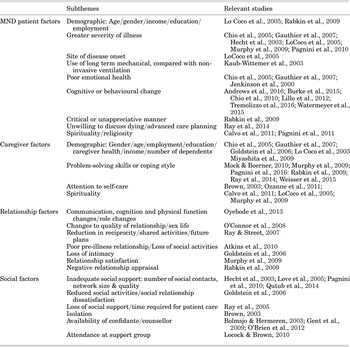
All retrieved publications were considered by the first author (CG) in consultation with the other authors, and 37 articles were included in this review. Studies were excluded when the caregiver psychosocial outcome data were not clearly reported. Of the studies included, 11 were qualitative and 26 quantitative. Papers were read in detail to identify the factors that influenced caregiver outcomes. Factors were broadly subcategorized into (1) patient factors, (2) caregiver factors, (3) relationship factors, and (4) social factors. Within each of these four factor categories, particular subthemes were examined for their potential impact on caregiver outcomes. The factors, subthemes, and relevant studies are summarized in Table 1.
Factors, subthemes, and relevant studies

MND = motor neurone disease.
Patient Factors
A number of studies investigated whether certain aspects of a person with MND could influence the psychosocial functioning of their caregiver, including demographic factors, severity of patient illness, or the emotional health, cognition, personality, or spirituality of the patient.
Patient demographic factors appear to bear no relationship to caregiver psychosocial outcomes. Rabkin et al. (Reference Rabkin, Albert and Rowland2009) identified no significant associations between caregiver depressive symptoms and any patient demographic factors (e.g., age, gender, education, or income). Similarly, Lo Coco et al. (Reference Lo Coco, Lo Coco and Cicero2005) found no correlation between caregiver quality of life and patient sociodemographic characteristics.
However, the severity of symptoms experienced by a patient may be relevant to caregiver burden and depression. This relationship was found in a cross-sectional study of 37 caregivers and patients (Pagnini et al., Reference Pagnini, Rossi and Lunetta2010), another cross-sectional study of 60 caregivers and patients (Chio et al., Reference Chio, Gauthier and Calvo2005), and a longitudinal study of 31 caregivers and patients (Gauthier et al., Reference Gauthier, Vignola and Calvo2007). Similarly, Hecht et al. (Reference Hecht, Graesel and Tigges2003) found a correlation between severity of patient clinical impairment and both caregiver burden and number of hours of caregiving per day, suggesting that it is not only subjective burden, but time spent caregiving as well, that increases with patient severity. By contrast, other studies of MND patient/caregiver dyads have found patient illness severity to be unrelated to caregiver ratings of quality of life (Lo Coco et al., Reference Lo Coco, Lo Coco and Cicero2005; Murphy et al., Reference Murphy, Felgoise and Walsh2009). The site of disease onset in the patient was also found to be unrelated to caregiver quality of life (Lo Coco et al., Reference Lo Coco, Lo Coco and Cicero2005). There may be particular components of care that impose a greater burden on caregivers: in a study of MND patients using long-term mechanical ventilation (LTMV) compared with noninvasive ventilation, qualitative data indicated a greater caregiver burden for LTMV caregivers (Kaub-Wittemer et al., Reference Kaub-Wittemer, von Steinbuchel and Wasner2003).
Cross-sectional studies have found concordance between measures of the emotional health of MND patients and their caregivers. For instance, a large study of more than 400 MND patients and caregivers found a correlation between the mental well-being scores of patients (as measured by the 36-item Short Form Health Survey [SF–36]) and that of caregivers (Jenkinson et al., Reference Jenkinson, Fitzpatrick and Swash2000). Chio et al. (Reference Chio, Gauthier and Calvo2005) also found a relationship between patient perception of being a burden and caregiver burden. However, in a longitudinal study, Gauthier et al. (Reference Gauthier, Vignola and Calvo2007) found a divergence between patient and caregiver emotional health scores. Over a period of nine months, patient psychological well-being, based on depression and quality-of-life measures, remained relatively stable throughout the course of their illness, despite worsening of patient clinical status, while that of caregivers deteriorated.
Around 50% of people with MND also experience some degree of cognitive or behavioral change associated with concurrent frontotemporal pathology. This presents with such features as apathy, disinhibition, and executive dysfunction (Witgert et al., Reference Witgert, Salamone and Strutt2010). A relationship between the presence of frontotemporal neurobehavioral factors and higher caregiver burden and distress has also been established (Chio et al., Reference Chio, Vignola and Mastro2010; Lillo et al., Reference Lillo, Mioshi and Hodges2012; Burke et al., Reference Burke, Elamin and Galvin2015). Another study found that this factor had a higher impact on caregiver burden than any other patient variable, including level of patient physical function (Lillo et al., Reference Lillo, Mioshi and Hodges2012).
The relative impact of MND patient behavioral versus cognitive changes on caregivers has been explored in a number of recent studies. Increased behavioral symptoms compared with MND patients' objective level of cognitive impairment (based on measures of executive function and social cognition) have been found to predict poorer caregiver outcomes on measures of burden, anxiety, and marital satisfaction (Watermeyer et al., Reference Watermeyer, Brown and Sidle2015). Similar differential findings were reported in another study of the impact on caregiver levels of burden and mood (Tremolizzo et al., Reference Tremolizzo, Pellegrini and Susani2016). Recent research by Andrews et al. (Reference Andrews, Pavlis and Staios2016) identified the specific aspects of ALS behavioral change that are most highly related to caregiver burden, which included difficulties with domains on the Cambridge Behavioural Inventory (revised) of everyday skills (tasks of daily living); motivation (i.e., increased apathy); orientation; and memory—all of which would require increased caregiver supervision or support.
Hecht et al. (Reference Hecht, Graesel and Tigges2003) found that caregivers of MND patients with problematic behaviors were disproportionately represented in MND support groups, even though these groups did not provide specific strategies with respect to neurobehavioral concerns, suggesting that these caregivers may be most in need of additional support. Other research may also indirectly point to the influence of neurobehavioral factors. For instance, in a longitudinal study of 71 caregivers and patient pairs, Rabkin et al. (Reference Rabkin, Albert and Rowland2009) found that caregivers reported higher rates of depression when their patients with MND were seen as critical or unappreciative. A qualitative study by Ray et al. (Reference Ray, Brown and Street2014) found increased caregiver burden in those whose spouses with MND were unwilling to discuss dying or refused to participate in developing advanced care plans.
Caregiver quality of life is reportedly better when patients identify spirituality or religiosity as being significant for them (Calvo et al., Reference Calvo, Moglia and Ilardi2011; Pagnini et al., Reference Pagnini, Lunetta and Rossi2011).
Despite some contradictions in the literature (such as the influence of patient symptom severity on caregiver experience), there is sufficient evidence to suggest that caregiver experience is linked with that of patients. Patients who have a more severe clinical profile and require more care, those who have neurobehavioral symptoms or poorer emotional health, who lack awareness of the impact of their care on others, or who are unwilling to discuss the terminal nature of their illness may be associated with worse psychosocial outcomes for their caregiver.
Caregiver Factors
The factors specific to caregivers that have been investigated in terms of their influence on psychosocial outcomes include demographic factors and problem-solving or coping styles.
Several studies have investigated whether specific caregiver demographic features are correlated with poorer outcomes. Working with a sample of 37 caregivers, Lo Coco et al. (Reference Lo Coco, Lo Coco and Cicero2005) reported that caregiver quality of life was not associated with such sociodemographic characteristics as gender, age, current employment, educational level, or relationship with the patient. Similarly, in a study of 60 caregivers, Chio and colleagues (Reference Chio, Gauthier and Calvo2005) found no relationship between caregiver burden and age, gender, or health status, and no relationship between burden and age or gender was found in another study of 31 caregivers (Gauthier et al., Reference Gauthier, Vignola and Calvo2007). A comparison of caregivers of MND patients and of those with other neurological diseases found that a low household income increased the prevalence of depression in MND caregivers (Miyashita et al., Reference Miyashita, Narita and Kawada2009). In contrast, Goldstein et al. (Reference Goldstein, Atkins and Landau2006) found that financial burden did not predict caregiver psychological functioning. However, they did find that caregiver functioning was negatively impacted by the number of other dependents for whom they cared (though only 9 patients in the sample of 50 reported having dependents). Overall, demographics appear to have a limited impact on caregiver functioning.
The magnitude of losses and lifestyle changes experienced by MND caregivers is enormous, challenging them to find personal resources for coping with loss and to make frequent adaptations to changing circumstances. Such caregiver factors as individual traits, coping styles, or problem-solving skills may influence whether a caregiver is at risk for worse outcomes. Problem-solving skills constitute one such factor that has been shown to predict quality of life and psychological morbidity (Murphy et al., Reference Murphy, Felgoise and Walsh2009). “Social problem solving” refers to a tendency to view problems as opportunities rather than threats, to use a rational behavioral response style (as opposed to being impulsive, careless, or avoidant), and to adopt problem-solving skills. Specifically, social problem solving accounted for more than 25% of the variance in caregiver psychological morbidity as measured by the Brief Symptom Inventory and for 16% of the variance on a caregiver quality-of-life scale (Murphy et al., Reference Murphy, Felgoise and Walsh2009). Similarly, Rabkin et al. (Reference Rabkin, Albert and Rowland2009) found that an avoidant coping style is associated with MND caregiver depression. Qualitative research by Ray et al. (Reference Ray, Brown and Street2014) found that some couples were reluctant to discuss planning for the end of life, connecting this behavior with a “loss of hope.” As such, increased caregiver suffering was occasionally associated with a lack of knowledge of and preparation for the dying trajectory. In contrast, caregivers who practically or emotionally prepared for the death appeared to have better outcomes, even experiencing positive affirmations associated with their loss.
A capacity for positive reappraisal, accommodative coping, or “finding benefit” in difficult circumstances has also been found to be associated with fewer depressive symptoms in patients with MND and their caregivers (Mock & Boerner, Reference Mock and Boerner2010). Some caregivers have identified benefits associated with caregiving, including personal growth and strength. In Brown's (Reference Brown2003) qualitative research, caregivers spoke of developing new ways of “being” and creating meaning in their life situations, as well as acknowledging the importance of keeping a focus on their own life needs. Similar positive themes were evident in the results of Ozanne et al.'s (Reference Ozanne, Graneheim and Persson2011) qualitative research, along with acceptance, living in the moment, and addressing achievable goals resulting in reduced distress, while lack of self-care resulted in increased caregiver burden. Positive aspects of caregiving were also identified in Weisser et al.'s (Reference Weisser, Bristowe and Jackson2015) reanalysis of qualitative interviews, including strengthening emotional relationships, increasing self-trust and advocacy, focusing on simple pleasures, living in the moment, and learning to see things from a different point of view.
Spirituality has also been found to be relevant to caregiver quality of life (Calvo et al., Reference Calvo, Moglia and Ilardi2011). In studying 75 caregivers, Murphy et al. (Reference Murphy, Felgoise and Walsh2009) found that spirituality was associated with better caregiver quality of life but was not a predictor of measures of psychological morbidity. Lo Coco et al. (Reference Lo Coco, Lo Coco and Cicero2005) asked 37 MND caregivers to rate the importance of five factors in determining their quality of life. These were, in order of importance, health (physical and psychological), family, social activities, finances, and spirituality. More recently, Pagnini and colleagues (Reference Pagnini, Phillips and Bosma2016) studied mindfulness in a group of 114 ALS caregivers via an online questionnaire and found it to be positively correlated with quality of life and negatively correlated with burden, depression, and anxiety scores.
Among the characteristics of MND caregivers that could affect their psychosocial outcome, adaptive problem-solving and coping skills and spiritual beliefs appear to be positively influential, while other factors may have a negative impact (e.g., financial limitations and number of dependents).
Relationship Factors
Motor neurone disease is likely to have an impact on the quality and intimacy of a couple's relationship, which will certainly affect a caregiver's psychosocial experience. The relationship between MND and relationship satisfaction has been investigated in a number of quantitative and qualitative studies. In one cross-sectional quantitative study, O'Connor et al. (Reference O'Connor, McCabe and Firth2008) found that both patients and caregivers reported a loss of satisfaction with their sex lives and a decreased quality of their relationships. This loss of satisfaction was not found to correspond to symptom severity or illness duration. The specific changes in relationship dynamics were explored in a qualitative research study by Oyebode et al. (Reference Oyebode, Smith and Morrison2013), who described the constraints on expression of intimacy due to loss of patient physical function, a need to simplify communication due to patient cognitive changes, caregiver “parentification,” and loss of intimate romantic qualities with the focus on personal care. Another qualitative study associated caregiver strain with the loss of relationship reciprocity, as well as the loss of the shared activities and future plans that once sustained their relationship (Ray & Street, Reference Ray and Street2007).
Changes in marital intimacy over the course of an illness were the focus of a 12-month longitudinal study conducted by Atkins et al. (Reference Atkins, Brown and Leigh2010). Patients and caregivers had similar perceptions of their marital intimacy at a number of timepoints during the trajectory of their illness. However, caregivers (but not patients) retrospectively rated pre-illness intimacy as significantly better than that during the course of the illness. The best predictors of caregiver intimacy ratings at each study timepoint were pre-illness intimacy, patient psychosocial functional impairment (e.g., involvement in social interactions, recreation, and pastimes) early in the illness, and their own feelings of burden later on. They recommended early relationship counseling about illness impact, as well as exploring how couples might maintain rather than reduce involvement in interpersonal activities.
In a related study conducted by the same research team, Goldstein et al. (Reference Goldstein, Atkins and Landau2006) found no correlation between marital intimacy scores and general caregiver psychological distress (combined scores on the anxiety, depression, and burden scales), which increased over time. Similarly, Murphy et al. (Reference Murphy, Felgoise and Walsh2009) found that their measure of relationship satisfaction (a subscale of the Dyadic Adjustment Scale) did not significantly predict ALS caregiver quality of life or psychological distress. By contrast, Rabkin et al. (Reference Rabkin, Albert and Rowland2009) reported an association between increased negative relationship appraisal and caregiver depressive symptoms and burden. Examples of negative appraisal were patient criticisms, disinterest in their own well-being, and lack of affection for and appreciation of the caregiver.
While changes in the marital relationship are evident, there are conflicting findings with respect to the extent to which changes in the relationship are associated with adverse caregiver psychosocial outcomes.
Social Factors
The experience of caregiving in MND is affected when there are limitations in terms of social support: inadequate social support can both increase caregiver burden (Hecht et al., Reference Hecht, Graesel and Tigges2003; Pagnini et al., Reference Pagnini, Rossi and Lunetta2010) and reduce caregiver well-being (Love et al., Reference Love, Harris and Lowe2005). Social support encompasses such factors as the number of social contacts and the size and quality of social networks. Caregivers who indicated that they had received adequate support from family and friends had lower scores on a caregiver burden scale (Qutub et al., Reference Qutub, Lacomis and Albert2014). A longitudinal study of general caregiver psychological distress (combined scores on anxiety, depression, and burden scales) by Goldstein et al. (Reference Goldstein, Atkins and Landau2006) found that the best predictors were various psychosocial factors over the course of the illness, from early reduction in social activities, through to later perceptions of dissatisfaction with social relationships. Ray et al. (Reference Ray, Street and Love2005) found that the main predictor of loss of social support and increased caregiver burden was the length of time they had been actively involved in care.
Qualitative research has identified the increasing social isolation of caregivers as a factor that intensifies emotional distress and suffering, with professionals more focused on providing moral support for the patient, not the caregiver (Brown, Reference Brown2003). There is a need for caregivers to have someone in whom to confide their experiences (Bolmsjo & Hermeren, Reference Bolmsjo and Hermeren2003), with some expressing a preference for confidential counseling and others placing value in support groups (Gent et al., Reference Gent, McGarry and Pinnington2009; O'Brien et al. Reference O'Brien, Whitehead and Jack2012). Locock and Brown (Reference Locock and Brown2010) identified both the challenges and opportunities afforded by support group membership, such as the shock and sadness associated with seeing others with more highly progressed illness, or the hope derived from seeing others coping well with an illness.
Overall, our research suggests that caring for someone with MND can limit access to social support, which is associated with negative psychosocial outcomes for caregivers.
DISCUSSION
This narrative review has identified the patient, caregiver, relationship, and social support factors relevant to the emotional health of those who provide care to people with MND. Our key findings are that caregivers may have poorer psychological outcomes when they care for patients with a more severe clinical profile, who require more care, have poorer emotional health, have additional neurobehavioral concerns, or have a lack of awareness about the impact of their care. Caregiver self-care is likely to be negatively affected. Caregivers may also have poorer outcomes if they have financial limitations or dependents. Good problem-solving skills and coping skills and strong spiritual beliefs may be protective in dealing with overwhelming loss. In regard to relationship factors, the evidence is mixed as to how this will impact caregivers, but the research suggests that changes in the relationship with a patient have an adverse effect on the caregiver. Finally, social support is likely to be protective, but the amount of social support, timing, and sources has not been well-explored.
The scope of application of these findings in MND caregiver intervention studies has been extremely limited. Caregivers were indirectly involved in a study of “dignity therapy” for MND patients (Bentley et al., Reference Bentley, O'Connor and Breen2014a ; Reference Bentley, O'Connor and Kane2014b ), and the impact on emotional experience was assessed for both patients and caregivers. While the intervention was found to be beneficial for patients (Bentley et al., Reference Bentley, O'Connor and Breen2014a ), it had no significant impact on caregiver ratings of burden, anxiety, depression, and hopefulness, and there was mixed feedback about its helpfulness for caregivers (Bentley et al., Reference Bentley, O'Connor and Kane2014b ). In another study that included both patients and caregivers (Marconi et al., Reference Marconi, Gragnano and Lunetta2015), an eight-session meditation skills training group was found, upon later interviews, to have resulted in positive outcomes with respect to relaxation and acceptance. Other recent qualitative research has identified therapist skills, theoretical models, and interventions as valuable tools for working with MND patients (Rabbitte et al., Reference Rabbitte, Bates and Keane2015), and similar research is strongly indicated for MND caregivers. The efficacy of some existing community-based interventions for MND caregivers (e.g., information sessions, websites, kits, home-based visits from MND Association workers, and group programs) has strong anecdotal support, but these programs are not always formally assessed or published. However, in a recent randomized controlled trial of cognitive behavioral therapy (CBT), a psychosocial intervention, van Groenestijn et al., Reference van Groenestijn, Schroder and Visser-Meily2015 targeted MND patients and caregivers. This intervention included modules on adjustment/coping strategies and mobilizing social support. Although the authors reported good outcomes for caregivers in the CBT group (n = 10) as compared with usual care (n = 5) over a 10-month period (better mental quality of life on the SF–36 Mental Component Summary and no increase in burden on the Caregiver Strain Index), these results were limited in terms of generalizability. The study was designed to address psychosocial factors relevant for both patients and caregivers, not those specific to caregivers, the sample size was small, and only 4 of the total of 10 couples completed the minimum of 5 CBT sessions. Of 153 potential couples, 67% did not meet the eligibility requirements and 22% declined. The researchers recommended offering caregiver sessions independent of patients and proposed methods of intervention delivery that are less burdensome for caregivers (e.g., an online CBT program).
LIMITATIONS OF THE STUDY
Some limitations of our narrative review should be mentioned. A standardized critical appraisal of each paper was not possible due to the scarcity of such literature and the variances in the methodology and quality of the reviewed papers. Only research published in English was included in our study. The reviewed articles were selected from the broader MND caregiver literature to highlight issues of relevance for caregiver psychosocial outcomes, particularly those that might be amenable to change as a result of psychosocial interventions.
CONCLUSIONS
Our literature review has implications for psychosocial intervention development and engagement of MND caregivers in receiving support. Given that MND poses unique challenges for caregivers, it is important that any intervention pay specific attention to the identified factors. It is recommended that those caregivers who are likely to be at higher risk—for example, those who have limitations with respect to problem-solving and coping skills, and those who care for patients with poor emotional health, a severe clinical profile, or neurobehavioral concerns—should be engaged as soon as possible. Particular emphasis should be given to those valued skills, strategies, and approaches to caregiving that have been associated with positive outcomes. Interventions could focus on teaching problem-solving or coping skills, maintaining self-care, understanding and managing patients' neurobehavioral changes, developing and encouraging strong support networks, maintaining relationship quality (including intimacy), and identifying and valuing beliefs that give meaning to their lives in the face of profound loss. The results of our review have identified all of these concepts as relevant. It is also recommended that interventions target caregivers broadly rather than focusing on specific demographic groups. Interventions delivered earlier on in the illness trajectory would be preferable, as this is a time when caregivers may be more available, and before the advent of more adverse psychosocial outcomes. Even interventions delivered early on in the course of an illness need to address the fact that caregivers are time-poor and should consider such innovative approaches as videoconferencing. With the need to move toward more intervention studies, our review provides a framework for the formulation of future caregiver psychosocial intervention research.
ACKNOWLEDGMENTS
This work was supported by a grant from the Bethlehem Griffiths Research Foundation.