Introduction
The expansion of the internet and its increased availability in centres of education has resulted in a rise in the number of medical educational facilities who are incorporating the internet into existing teaching practices (Evans et al. Reference Evans, Gibbons, Shah and Griffin2004). Electronic learning (or e-learning) refers to using electronic applications and processes to learn (Manochehr, Reference Manochehr2006). Resources for e-learning include video lectures and interactive tutorials. Rather than the conventional classroom setting, e-learning involves the acquisition of knowledge and skills using electronic technologies such as computer- and internet-based coursework, in addition to local and wide area networks (Rashid, Reference Rashid2006). Students who have had the experience of e-learning (which have included video lectures and interactive tutorials) often consider it an effective learning tool (King, Reference Chew and Smirniotopoulos1989; Chew & Smirniotopoulos, Reference Chew and Smirniotopoulos1995).
E-learning with video lectures and interactive tutorials may be used to entirely replace face-to-face teaching in a physical classroom, partially replace face-to-face teaching or solely supplement existing face-to-face teaching (Arbaugh & Duray, Reference Arbaugh and Duray2002). However, not everyone agrees with the wholesale adoption of computer-delivered education. After one medical school in Australia abandoned lectures in favour of online learning, pleas were made to reinstate the lectures in order to enable exposure to passionate role models (Ferrari, Reference Ferrari2006). It has been noted that students often prefer access to both e-learning (with material such as video lectures and interactive tutorials) and human teaching (Day & Payne, Reference Day and Payne1987; King, Reference Chew and Smirniotopoulos1989; Froman et al. Reference Edgerton1993; Chew & Smirniotopoulos, Reference Clark1995; Bissell et al. Reference Dixon2003; Maag, Reference Evans and Edwards2004; Seabra et al. Reference Evans, Gibbons, Shah and Griffin2004).
The use of computers in psychiatry is a rapidly expanding area. Interactive materials using videos and other electronic materials have been suggested as effective learning tools for teaching clinical skills in psychiatry (Maguire et al. Reference Felder1986; Vassilas & Ho, Reference Ferrari2000). Furthermore, an online interactive e-learning simulator called Virtual Interviews for Students Interacting Online (Fitzmaurice et al. Reference Fitzmaurice, Armstrong, Carrol, Dagger and Gill2007) has been described that allows students to choose an interview path for a particular psychiatric disorder. Students are able to view video clips of a role player portraying a patient with a psychiatric disorder who responds to the questions chosen by the student, therefore assisting the students to explore the history and mental state of the patient (Fitzmaurice et al. Reference Fitzmaurice, Armstrong, Carrol, Dagger and Gill2007). Hare et al. (Reference Froman, Hence and Neafsey2007) reported the development of a virtual soap opera for e-learning of issues arising from alcohol misuse. Yellowlees & Cook (Reference Galanter, Keller, Dermatisa and Biderman2006) suggested that an internet-based virtual reality system for personal computers could be used to create simulations of hallucinations in order to enhance students’ understanding of psychiatric illnesses.
There has been a lack of research that has assessed students’ perceptions of the use of technology in medical education, especially in psychiatry, and how this area could be further developed. We therefore explored the use of technology in medical education and investigated the role of e-learning in psychiatry undergraduate education. We tested the hypotheses that: (1) students prefer live psychiatry tutorials to e-learning lectures or textbooks and (2) significant relationships exist between learning styles and students’ preference for learning modalities.
Methodology
During The Royal College of Surgeons in Ireland (RCSI) School of Medicine psychiatry rotation in 2009/2010, students attended hospital tutorials, which were delivered by their designated tutor or lecturer. Further learning opportunities were provided via the RCSI virtual learning environment (Moodle). RCSI e-learning consisted of video lectures, interactive tutorials, a discussion forum for students to pose questions to tutors, an online calendar, which highlighted important dates within the psychiatry course and an instant messaging facility for the administrator or tutors to convey important information to students. The videos and interactive tutorials were recorded before the psychiatry rotation, in the absence of students, and were then uploaded to Moodle. The video lectures comprised the various topics within the psychiatry curriculum, which were further expanded upon during live hospital tutorials. Lecture notes in PDF format of the various lecture topics were posted on the e-learning site.
The interactive tutorials comprised short video clips of a psychiatrist interviewing a patient, after which students answered a variety of questions (e.g. on relevant psychopathology, mental state examination, differential diagnoses, investigations and management options) by choosing the correct answers from a list using the click of their mouse or by typing the answers. By means of clicking their mouse, students were required to rank features such as diagnoses, investigations and management options in order of relevance with reference to the presentation of the patient they had seen on the short video clip. After submitting their answers, text was provided on the screen in order to show the students the correct answers and to explain why the elements should be ranked in the order in which it was considered to be the most appropriate. Furthermore, students were able to move their mouse curser over a still picture of a patient on their screen in order to view some noticeable features of the mental state examination that were flagged as the mouse curser moved throughout the whole picture. A typed summary was provided at the end of each interactive tutorial to highlight the main points that the student should have learned from that particular e-learning tutorial.
At the end of the academic year 2009/2010, when all of the 231 RCSI senior medical students in their penultimate year of study had completed their psychiatry attachment, the students were invited to complete a questionnaire, which was posted online on Moodle. The first part of the questionnaire collected information on the demographic characteristics of the students and their future career preference. This was followed by investigating students’ previous computer experience by asking them to specify the age at which they first used a computer and on their recollection of their computer experience at the start of medical school. Students’ current use of technology was evaluated by asking them to rate their skills at using Microsoft Office Products (e.g. Word, Excel and PowerPoint), statistical software (e.g. SPSS), and at downloading videos, as well as audios and podcasts. Students were also asked to rate the frequency of their computer use for medical education. The next section of the questionnaire asked the students to rate the frequency at which they used their computer for various e-learning activities and their preference regarding information sources for psychiatry education.
Students were also asked in the questionnaire, how many psychiatry video lectures out of 30 they had viewed on Moodle, how many of the lecture notes, which accompanied each video, they had downloaded and the number of interactive e-learning tutorials that they had completed out of a possible 18. Students were asked to give their opinion by rating potential positive and negative attributes of e-learning lectures and interactive tutorials. Students also rated the resources they found most beneficial for their overall learning in psychiatry. The final section of the questionnaire was a self-reported preference regarding learning styles in order to explore whether students with different learning styles preferred different teaching methods. The responses from the questionnaire were collected anonymously. The means of all groups were compared together by means of χ 2. SPSS version 18 was used to analyse the data from the completed questionnaires.
Results
Demographics and future career preference
A total of 186 students (52% female and 48% male) responded to the questionnaire, yielding a response rate of 80%. The age range of the students was between 21 to 37 years, with a mean of 25±2.51 years. Significantly more males than females stated a preference for a future career in a medical specialty (χ 2 4.356, p 0.037) or surgery (χ 2 6.024, p 0.014). In contrast, significantly more females than males stated a preference for a future career in paediatrics (χ 2 8.919, p 0.003) or psychiatry (χ 2 4.974, p 0.026).
Previous computer experience
The mean age at which students stated that they first used a computer was 9±2.94 years, with an age range between 2 and 17 years. Males reported their initial contact with a computer was at a later age than females. Significantly, more males stated that they first used a computer at 12 years of age or older (χ 2 5.983, p 0.014). The mean age at which students first used a computer was 9±2.68 years and 10±3.16 years, respectively, for females and males. At the start of medical school, significantly more males than females stated they had self-taught or informal computer experience (χ 2 3.676, p 0.05). Significantly more females than males stated they had undertaken a course in using a particular computer programme (χ 2 7.603, p 0.006) but more males had undertaken a course on computer use.
Current use of technology
Most students rated their current skills in using Microsoft Word and PowerPoint as proficient, without the need for additional learning (75% and 74%, respectively). These findings were greater than the results provided for proficiency in downloading videos (63%), downloading audio (59%), using Microsoft Excel (44%) and for using statistical software such as SPSS (13%).
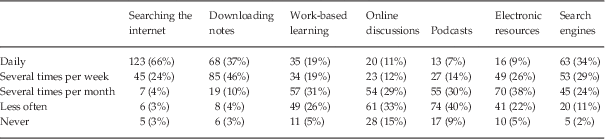
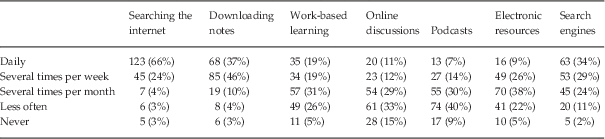
Regarding their frequency of computer use for medical education, students reported daily use of the internet for searching for relevant web pages, which was followed in frequency of use by the downloading of notes, audio or videos. Students also reported using online databases/search engines, computer web-based programmes (CD-ROMs and simulated patients) and assessing electronic resources through the RCSI library. The least commonly used modes of computer use were online discussion forums and podcasts. The frequency which students stated that they used their computer for medical education is shown in Table 1.
Frequency of computer use for medical education
E-learning in psychiatry undergraduate medical education
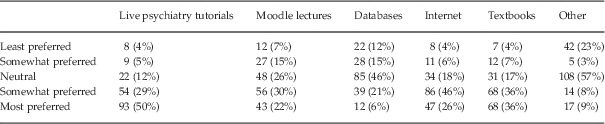
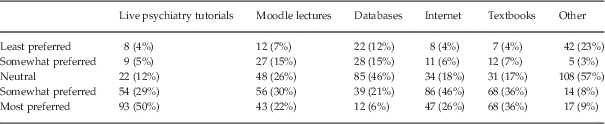
Significantly more students stated a preference for live psychiatry tutorials over e-learning lectures on Moodle (χ 2 25.513, p<0.001) or textbooks (χ 2 4.196, p 0.041). Significantly more students stated a preference for internet sources for psychiatry education over e-learning lectures on Moodle (χ 2 4.650, p 0.031). The internet was a preferred source for psychiatry education in comparison with databases (χ 2 21.513, p<0.001). The preference of students regarding information sources for psychiatry education is shown in Table 2.
Preference of students regarding information sources for psychiatry education
Out of a possible 30 psychiatry e-learning video lectures each with accompanying downloadable lecture notes, less than half of the video lectures were viewed by respondents (range 0–30). A mean of 22±10.64 lecture notes were downloaded (range 0–30). Students considered flexible learning (χ 2 109.352, p<0.001), having the option of viewing material again (χ 2 83.142, p<0.001) and the ability to learn at one’s own pace with e-learning lectures (χ 2 63.029, p<0.001), to be more valuable than having faster and easier information retrieval. Students considered the lack of the human aspect of teaching to be a more important factor as to why they disliked the e-learning lectures than the lack of fellow student contact (χ 2 132.203, p<0.001) or distraction by the videos (χ 2 47.066, p<0.001).
Out of a possible 18 psychiatry e-learning interactive tutorials one-third were viewed by respondents (range 0–18). Students considered the interactive nature of e-learning tutorials to be more beneficial than video links to tutorials (χ 2 107.694, p<0.001), website links to tutorials (χ 2 88.999, p<0.001) or the ease of ability to navigate through subheadings in tutorials (χ 2 120.48, p<0.001).
E-learning tutorials were considered to be more beneficial than e-learning audio lectures (χ 2 15.212, p 0.004) or e-learning video lectures (χ 2 13.041, p 0.011) but less beneficial than online lecture notes (χ 2 11.688, p 0.02). Audio lectures were considered to be less beneficial than video lectures (χ 2 156.87, p <0.001) or online lecture notes (χ 2 21.085, p <0.001). Video lectures were considered to be less beneficial than online lecture notes (χ 2 17.762, p 0.001). Students considered live psychiatry tutorials to be more beneficial than online lecture notes (χ 2 41.496, p <0.001).
E-learning and learning styles
Students responded that they learned better by both hearing and seeing or reading the material than by hearing the material (χ 2 28.491, p <0.001), doing what is taught (χ 2 48.67, p <0.001), working with others in groups (χ 2 32.319, p <0.001), observing what is happening around them (χ 2 49.81, p <0.001) or by studying theories and concepts (χ 2 14.744, p 0.005). Students stated that they learned better by doing what is taught than by working with others in groups (χ 2 34.282, p <0.001) or by observing what is happening around them (χ 2 109.534, p <0.001). Learning was considered to be better when working with others in groups than by working with problems alone (χ 2 12.803, p 0.012) but worse than when students were observing what is happening around them (χ 2 21.559, p<0.001). Observing what is happening was considered preferable to studying theories and concepts (χ 2 61.5, p <0.001). Working with others in groups was considered preferable to hearing material (χ 2 19.44, p 0.001).
Students who stated they learned best by doing what is taught reported that live psychiatry tutorials were their preference regarding information sources for psychiatry education (χ 2 4.055, p 0.044). Students who stated they learned best by working on problems alone reported that databases were their preference regarding information sources for psychiatry education (χ 2 5.034, p 0.025). Students who stated they learned best by hearing the material described that audio lectures were a beneficial resource (χ 2 3.829, p 0.05). The responses of students regarding their personal learning styles are shown in Table 3.
The responses of students regarding their personal learning styles

Discussion
Previous computer experience
The purpose of this study was to explore medical students’ perceptions of the usefulness of e-learning in medical education, particularly in psychiatry. The response rate (80%) was greater than the 60–70% response rate recommended by Salant and Dillman (Reference Galanter and Dermatisa1994). The results of the current study are consistent with those of Link and Marz (Reference Galitz2006) who described that half of all students used a computer for the first time by the age of 11 years. Significantly, more males than females in the current study reported previous computer experience at the start of medical school. The greater degrees of experience people have with technology, the higher their level of satisfaction in learning to use new technology (Volery & Lord, Reference Geri2000; Simmers & Anandarajan, Reference Geri and Gegen2001). Schanze (Reference Guri-Rosenblit2004) concluded that reluctance to embrace e-learning could be explained by students’ perceived difficulties in integrating technology into their way of learning.
Current skills and use of technology
Regarding their frequency of computer use for medical education, students in the current study reported daily use of the internet for searching for relevant web pages, which was followed in frequency of use by downloading notes, audio or videos. Other important resources cited were online databases/search engines, web-based programmes and the RCSI library electronic resources. These results emphasise the importance that medical students place on computers and the frequency, which students use computers for medical education. The findings in the current study suggest that e-learning should not be ignored by educational providers.
E-learning in psychiatry undergraduate medical education
Significantly, more students stated a preference for live psychiatry tutorials over e-learning lectures or textbooks. Previous research indicates that due to the essential human need to socialise, students prefer traditional in-class studying, even when they are offered a rich e-learning environment that includes video lectures, exercises and personal online tutoring (Guri-Rosenblit, Reference Hare, Evans, McIntosh and Thomson2005). Similar results were reported by Fitzmaurice et al. (Reference Fitzmaurice, Armstrong, Carrol, Dagger and Gill2007) when medical students were asked to rate various resources, which they found helpful in terms of learning interview skills in psychiatry. The students’ preference for face-to-face classes may also be explained from an attention economy perspective (Davenport & Beck, Reference Hasebrook, Herrmann and Rudolph2000, Reference Hong2001; Geri & Gegen, Reference Huntley and Conrad2007). When students are attending class meetings, they focus for example, for 3 hours on studying. When studying at home, however, their attention may be distracted by e-mails, phone calls or family members who require their attention (Geri, Reference Jiang and Ting2011).
E-learning enables learners to review material within a relatively short time. Teaching can be provided in a uniform standardised educational environment instead of in a busy and unpredictable clinic in order to provide a standardised educational experience (Galanter & Dermatisa, Reference Keane, Norman and Vickers1997; Galanter et al. Reference King1998). When students actively engage with the material to be learned, the learning will be deeper and more permanent than if they are merely passive recipients of information (Turchin & Lechmann, Reference Kolb2000). Furthermore, e-learning has been shown to enable learners to enhance their knowledge, skills and attitudes at a faster rate than with traditional learning practices (Ruiz et al. Reference Kulik, Bangert and Williams2006). E-learners have demonstrated increased retention rates and enhanced utilisation of content (Ruiz et al. Reference Kulik, Bangert and Williams2006). The use of e-learning may increase the performance of students in examinations (Kulik et al. Reference Kulik, Kulik and Cohen1980, Reference Link and Marz1983) and enhance their overall processing of information (Najjar, Reference Maag1996).
In our study, students considered flexible learning, having the option of viewing material again and the ability to learn at one’s own pace with e-learning lectures, to be more valuable than having faster and easier information retrieval. E-learning serves to consolidate learning by increasing access to innovative educational materials. Students in our study, however, considered the lack of the human aspect of teaching to be a more important reason as to why they disliked the e-learning lectures than the lack of fellow student contact or distraction by the videos. A traditional bricks and mortar environment provides the chance for a relationship to develop between students and tutors, facilitating the exchange of ideas (Hasebrook et al. Reference Maguire, Fairburn and Fletcher2003).
Students in our study considered the interactive nature of e-learning tutorials to be significantly more beneficial than video links to tutorials, website links to tutorials or the ease of ability to navigate through subheadings in tutorials. Many researchers agree that interactive instructional design is an essential factor for learning satisfaction and success (Schwartz, Reference Manochehr1995; Jiang & Ting, Reference Jiang and Ting1998; Hong, Reference Najjar2002). The design of an e-learning programme is vital if students are to achieve maximum benefit (Najjar, Reference Maag1996; Evans & Edwards, Reference Nielsen1999). Individual differences in design and general layout have been shown to impact on eventual learning outcomes (Clark, Reference Postman1985; Keane et al. Reference Rashid1991). Adopting a more straightforward and user-friendly design by omitting unnecessary components should be encouraged (Nielsen, Reference Ruiz, Mintzer and Rosanne2000).
E-learning and learning styles
The results of this study are consistent with previous research in which it has been reported that people have different learning styles (Kolb, Reference Salant and Dillman1985; Felder, Reference Schanze1988). Understanding students’ learning styles has been identified as an important element for e-learning development, delivery and instruction, which can lead to improved student performance (Shih & Gamon, Reference Schwartz2002). In order for e-learning to be fully effective, ICT designers should take account of a wide range of individual learning styles and behaviours (Galitz, Reference Seabra, Srougi, Baptista, Nesrallah, Ortiz and Sigulem2002).
Students who stated they learned best by doing what is taught reported that live psychiatry tutorials were their preference regarding information sources for psychiatry education. Students who stated they learned best by working on problems alone reported that databases were their preference regarding information sources for psychiatry education. Students who stated they learned best by hearing the material described that audio lectures were a beneficial resource. In contrast to e-learning, traditional lectures often focus on one of a variety of learning styles of the participants. E-learning has gradually been emerging as a more interactive resource, often effectively utilising multimedia formats to relay information in order to meet the individual preferences of the learners (Huntley & Conrad, Reference Shih and Gamon1994; Bell & Mangione, Reference Simmers and Anandarajan2000; Marshall et al. Reference Turchin and Lechmann2001). However, the role of technology in providing easy access to information should not be underestimated and in this context part of the role of resource creators should be to ensure good quality content is available to learners.
Some studies have looked at how educational departments can teach students to identify their personal learning styles, difficulties in their learning and the application of problem solving skills to achieve solutions. Dixon (Reference Vassilas and Ho1999) reported benefit if learners are self-aware of their own learning styles and can apply this information to their learning. Unless teachers ensure that the learning needs of all types of learners are met, e-learning will be ineffective and incomplete in the same way as classroom learning opportunities will be lost. Students’ motivation and learning improves when teaching is adapted according to students’ learning styles.
The relationship between e-learning and psychiatry undergraduate education is presently in a state of flux. It will take time to fully assess the impact of the changes that have been introduced in psychiatry teaching. Postman (Reference Volery and Lord1993) stated that whenever new technologies are being introduced, one has to consider what is lost in transition. In medical education and psychiatry teaching, the role of computers and technology are considered to be central and effective components, however, in the real world, real cost effectiveness can only be determined after a few years. The role of computers can be more effectively used to complement existing teaching approach rather than serve as a replacement tool (Edgerton, Reference Yellowlees and Cook2007).
Strengths and limitations of the study
A notable strength of the study was the large sample size comprising a similar proportion of male and female students. A limitation of the study may be that only students from one medical school were included in this study and these results possibly may not be applicable to students attending other medical schools.
Conclusion
Medical students tend to find the general concept of e-learning to be useful in medical education. The results of this study however, showed that in psychiatry, the preferred method of learning was onsite teaching. Students also indicated a preference for onsite teaching in addition to having access to e-learning resources. Previous research has reported that students often prefer access to both e-learning and human teaching (Day & Payne, Reference Day and Payne1987; King, Reference Chew and Smirniotopoulos1989; Froman et al. Reference Edgerton1993; Chew & Smirniotopoulos, Reference Clark1995; Bissell et al. Reference Dixon2003; Maag, Reference Evans and Edwards2004; Seabra et al. Reference Evans, Gibbons, Shah and Griffin2004). In psychiatry, it is unlikely that education would be effective if e-learning was solely used to deliver the entire medical curriculum. If this were the case, medical students would not benefit from the personal expertise of specialists. Furthermore, in implementing a sole e-learning model, medical students may lose the chance to be inspired by a particularly inspirational psychiatrist who could potentially influence them to pursue a future career in psychiatry. Good teaching will also ensure that students who pursue future career specialties other than psychiatry will have a basic core knowledge of psychiatry and an improved understanding of mental illness and its impact on the individual.
Acknowledgements
We would like to acknowledge the assistance provided by the 2009/2010 Senior RCSI medical students with completing the questionnaire for this study. This research would not have been possible without the help of these students.
Conflicts of Interest
None.