Introduction
Public ambitions in Sweden have been very high with regard to providing long-term care (LTC) services for the increasing number of frail older persons. In the 1960s and 1970s, Sweden became one of the first countries in the world to develop an extensive public system of care for frail older persons. The system follows the general Nordic model, aiming to provide low-cost comprehensive health care and social services for older people and as far as possible enable them to live independently with a high quality of life (Lagergren Reference Lagergren2002). The municipalities are responsible for providing LTC services in the form of home care for those who live in ordinary housing and in special forms of housing for those who need extensive care. This form of public care and services will be referred to as LTC throughout the rest of this paper. The county councils are responsible for medical treatment and health care until the medical treatment is considered completed, at which point the responsibility for the LTC services is transferred to the municipalities. Home health services and rehabilitation are provided by municipalities in some parts of Sweden and by county councils in others.
After a very rapid expansion in the 1970s and 1980s, economic recession in the 1990s forced a reduction in the provision of LTC. Between 1980 and 1998, the number of older persons receiving LTC in the community fell by 40 per cent. There was also a reduction in the number of beds available in special housing for older persons in relation to demographic developments. As a result, there ensued an intensive debate about whether this reduction had resulted in frail older persons in Sweden no longer receiving LTC in keeping with their needs. Frail older persons in Sweden, as in other countries, also receive informal care from next of kin – e.g. wife/husband, children – and sometimes from friends and neighbours. It has been argued that the reduction in LTC has resulted in the burden being shifted to these informal care-givers, creating a very difficult situation for the informal care-givers.
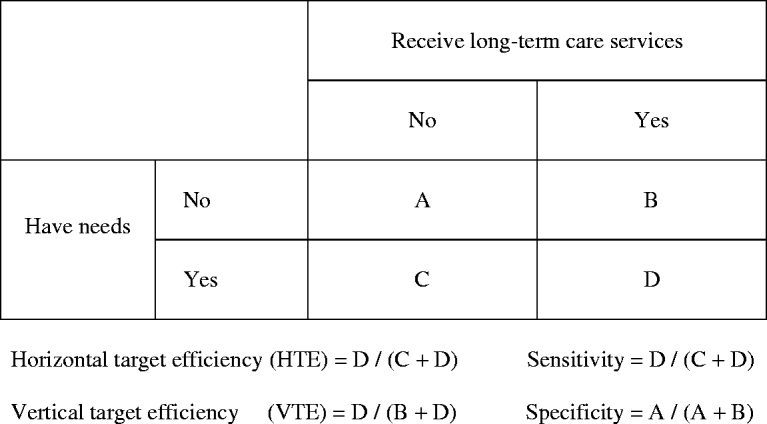
Clearly it is important that the system of LTC is in tune with the needs of the older population. A distinction can be made between horizontal target efficiency – the extent to which those deemed to need a service receive it – and vertical target efficiency – the corresponding extent to which those receiving services actually need it (Ferlie, Challis and Davies Reference Ferlie, Challis and Davies1989). Figure 1 shows how the concepts are defined and related to each other. Horizontal target efficiency measures the extent of unmet needs. The concept is equivalent to sensitivity – the proportion testing positive among the true positives. On the other hand, specificity – the proportion testing negative among the true negatives – is a different concept from vertical target efficiency (Altman and Bland Reference Altman and Bland1994).
Target efficiency definitions.

The concept of target efficiency, which is a more narrow efficiency concept than the usual one comparing output value and cost, was introduced in the 1980s by Davies and Challis from the UK Personal Social Services Research Unit, University of Kent at Canterbury (PSSRU) (Davies and Challis Reference Davies and Challis1986). The need for systematic monitoring of horizontal and vertical target efficiency was pointed out by Johansson (Reference Johansson1997) in a description of consequences of the Swedish Ädel reform. There is an extensive literature on unmet needs (cf. below), which is synonymous with horizontal target efficiency, but to the best of our knowledge, no previous researchers have attempted to measure both forms of target efficiency. In this paper, the definitions of the concepts of horizontal and vertical target efficiency of Glendinning et al. (Reference Glendinning, Davies, Pickard and Comas-Herrera2004) will be used. The target efficiency that will be analysed pertains only to whether or not the older person receives public LTC. Conditions relating to the receipt of informal care will be described in a coming article from the SNAC project.
The target efficiency clearly depends on the assessment system. Ideally the system should assure that both target efficiencies are 100 per cent – that all those in need receive services and no one else. In practice, of course, this is not possible. Also, the two target efficiency measures are in some conflict with each other. Assuming no change in the assessment system, if one extends services to ensure that all in need receive services, one is bound to end up with a growing proportion of persons that receive services without needing them. The target efficiency also depends on what is regarded as a need. Restrict the definition, and vertical target efficiency will decrease: fewer people with services will fulfil the needs criterion. The effect of a restricted definition on horizontal efficiency depends on the proportion of those who receive services but no longer fulfil the stricter needs criterion. If, which is probable, this proportion is less than the proportion of persons receiving services who are still regarded as having a need, horizontal target efficiency will increase. Vertical efficiency can be measured by looking only at those receiving services. For measuring the horizontal target efficiency of the public services in an area, one needs population surveys that provide data on health and disability for the total older population in the area – both users and non-users of public LTC services. However, the concept of horizontal target efficiency is not used very often. It is more common to address the equivalent question of unmet needs.
There are many studies on unmet LTC needs in United States of America (cf. Komisar, Feder and Kasper Reference Komisar, Feder and Kasper2005; Tennstedt, McKinlay and Kasten Reference Tennstedt, McKinlay and Kasten1994; Williams, Lyons and Rowland Reference Williams, Lyons and Rowland1997). These mostly refer to the US systems of Medicare/Medicaid and include access to all sorts of services, formal as well as informal, and privately as well as publicly paid. For these reasons, the results of these studies are not comparable with the results of the present study. In the current context, the articles by Savla et al. (Reference Savla, Davey, Sundström, Zarit and Malmberg2008) and Davey et al. (Reference Davey, Johansson, Malmberg and Sundström2006) that describe unmet needs in Sweden may be more relevant. Savla et al. conclude that the decreases in home help services in Sweden have not resulted in increased rates of unmet need. The article by Davey et al. focuses on local variations in coverage. Their needs definition, however, differs from the one used here. In their study, only those living alone who were also dependent in activities of daily living were defined as in need. The question of whether municipal home help addresses the needs of the population is also treated in Meinow, Kåreholt and Lagergren (Reference Meinow, Kåreholt and Lagergren2005). This study concluded that need indicators such as activities of daily living dependency and cognitive impairment were the strongest predictor of home help; most other factors contributed only marginally. Meinow, Kåreholt and Lagergren also questioned whether the needs of co-habiting persons were met in an adequate way.
There are a host of other studies that look into factors that predict the use of LTC. Among these can be mentioned Geerlings et al. (Reference Geerlings, Pot, Twisk and Deeg2005) and Larsson, Thorslund and Kåreholt (Reference Larsson, Thorslund and Kåreholt2006). Other relevant studies are those of Thorslund, Norström and Wernberg (Reference Thorslund, Norström and Wernberg1991) and Larsson and Thorslund (Reference Larsson and Thorslund2002). In the Geerlings study, a division is made between predisposing, enabling and need-predictive factors. The researchers found that factors related to need such as disability and chronic disease were important predictors of most transitions in care, but predisposing factors like age and education, and enabling factors such as partner status and income, also played a role. The most important predictor of use of home help seems to be dependency in activities of daily living – instrumental (IADL) and personal (ADL).
The impact of dementia and depression on use of LTC has been studied by Larsson using data from the Kungsholmen study, the precursor of the SNAC study (cf. below) (Larsson, Thorslund and Forsell Reference Larsson, Thorslund and Forsell2004). Other studies using different data have also confirmed the observation that persons with dementia are more likely to receive home help than persons without dementia (Livingston, Manela and Katona Reference Livingston, Manela and Katona1997; Stoddart et al. Reference Stoddart, Whitley, Harvey and Sharp2002). Others factors identified as associated with the use of home help are difficulties in moving around outdoors (Sakari-Rantala, Heikkinen and Ruoppila Reference Sakari-Rantala, Heikkinen and Ruoppila1995) and self-reported overall health (Stoddart et al. Reference Stoddart, Whitley, Harvey and Sharp2002).
Findings concerning the impact of gender on use of LTC are mixed. If one controls for the fact that women tend to outlive their spouses and consequently lack support from a partner in old age, gender does not seem to affect the use of formal home help (Larsson and Thorslund Reference Larsson and Thorslund2002). Generally speaking, access to informal care and having children has repeatedly been shown to reduce the likelihood of receiving formal support among community-dwelling persons in Sweden and elsewhere (Stoller and Cutler Reference Stoller and Cutler1993; Szebehely Reference Szebehely and Lewis1998). Differences between age groups, gender and types of household with regard to target efficiency reflect the priorities that have been made in allotting LTC to older persons. According to Swedish law, no age or gender discrimination is allowed. However, it has been shown that the reductions in LTC for frail older persons in Sweden during the 1990s affected co-habiting elderly persons more than the non-cohabiting elderly persons (Lagergren Reference Lagergren2005). For this reason, it was of special interest to analyse the extent of differences between types of household, and in the following analyses, the population has been divided into two groups, single living and co-habiting. In this context, co-habiting usually means living with a spouse or partner, as very few older persons in Sweden live with their grown-up children.
The aim of this study was to calculate the target efficiency of the public LTC system on the basis of age, gender and type of household in the studied areas. The research question to be addressed is the extent to which older people in the studied areas who need LTC – as defined by dependency in activities of daily living, personal or instrumental (ADL/IADL) – receive it and the extent to which older persons receiving LTC need it. Analyses of the quality of these services or whether they fulfil all the needs of the older persons are beyond the scope of this study. Additionally, the existence of alternative, non-public services is not taken into account.
Material and methods
Sample
The data used in these analyses were collected in the baseline survey of the SNAC longitudinal population study during the years 2001–04. The study has been described elsewhere (Lagergren et al. Reference Lagergren, Fratiglioni, Hallberg, Berglund, Elmståhl, Hagberg, Holst, Rennemark, Sjölund, Thorslund, Wiberg, Winblad and Wimo2004). It consists of two parts, one on the population and the other on the care system. However, in this case only population data have been used. The study involves four administrative areas: five municipalities in the region Skane in southern Sweden; Karlskrona municipality in Blekinge (also in southern Sweden); the Kungsholmen district in Stockholm, the capital of Sweden; and the municipality of Nordanstig in northern Sweden. For this paper, the data from all four sites have been pooled together. Focus is placed on describing the association between age, gender and type of household and the two kinds of target efficiency. In a coming article the focus will instead be on differences between areas; target efficiency in urban, mixed and rural areas will be compared.
The dataset contains a total of 6,192 observations regarding persons 65 years old and above. Of these persons, 1,773 were from the region Skåne, 1,211 from Blekinge, 2,615 from Kungsholmen and 593 from Nordanstig. Participants were randomly selected from the Population Registry and invited by letter to a health examination at a research outpatient facility. Response rates were high in Kungsholmen and Nordanstig (76 and 77%, respectively) and somewhat lower in Blekinge and Skane (62 and 60%, respectively). Persons living in institutions were included. To avoid selection bias, home visits were offered to participants unable to attend the research clinic. Information was also retrieved from care-givers or staff if the participants themselves were unable to give information. An analysis of the non-response in Kungsholmen showed no differences in mortality between participants and non-participants in the three years after attendance. Thus it can be concluded that disability rates were approximately the same for participants and non-participants. Ethical permission for the study was obtained from the ethical committees of the Karolinska Institute (KI dnr 00-446) and University of Lund (LU dnr 650-00 and LU 744-00).
The dataset includes information on age, gender and type of household (living alone or co-habiting) based upon a self-reported questionnaire. Participants also reported whether they received public LTC, and if not, why not. A user was defined as a person who had received any kind of public LTC (lasting or planned to last two months or more) during the past month. This LTC included home help (excluding meals on wheels only), home health care or day care, or living in publicly funded special housing for frail older persons. Furthermore, the participants were asked whether they received care or services from relatives, neighbours, friends or voluntary organisations, or had privately paid for such services in the last month.
Measures
The need for LTC can be measured in many different ways. One common way is to note dependency in ADL (Katz et al. Reference Katz, Ford, Moskowitz, Jackson and Jaffe1963). This is relevant in this context because the LTC services are to a great extent intended to provide support for these daily activities. The original activities commonly used for assessing ADL-dependency are bathing, dressing, toileting, transferring, continence and feeding. To this can also be added IADL – household chores like meal preparation and cleaning.
The ADLs used in this study comprise bath and shower, dressing and undressing, toileting, transferring and feeding. The definitions used were standard (Katz et al. Reference Katz, Ford, Moskowitz, Jackson and Jaffe1963). The three-step scale (independent, partly dependent and dependent) was reduced to two steps by merging the categories ‘partly dependent’ and ‘dependent’. Furthermore, the following IADL activities were registered: laundry, cleaning, public transport, purchase of food and preparation of food. Cognitive and mobility disability were registered using a scale from ‘0’ to ‘3’, in which ‘0’ denotes no disability; ‘1’, slight disability; ‘2’, severe disability; and ‘3’, very severe disability. The cognitive disability scale steps were determined by the Mini Mental State Examination (MMSE) score (Folstein, Folstein and McHugh Reference Folstein, Folstein and McHugh1975) with 0 = 23 ⩽MMSE; 1 = 17 ⩽MMSE ⩽ 22; 2 = 6 ⩽MMSE ⩽16; 3 = 0 ⩽MMSE ⩽5. The steps of the mobility disability scale were defined in relation to the ability to walk outdoors, indoors or not at all. A value of ‘0’ meant no mobility disability; ‘1’, the ability to walk outside only with aids and being able to negotiate small stairs only; ‘2’, the ability to walk indoors only or the need to use a self-operated wheelchair; ‘3’, dependence on the support of another person for walking, the need to use a non-self-operated wheelchair, or being confined to bed.
Depressed mood was assessed using an item from the Comprehensive Psychopathological Rating Scale (CPRS). This rating instrument consists of 65 scaled items covering a range of psychiatric symptoms. The rating is based upon answers given in interviews. In this case we used the item ‘Depressive mood’ with ‘yes’ corresponding to feelings of constant or maximal depressed mood (Montgomery and Asberg Reference Montgomery and Asberg1979). Urinary incontinence was also self-reported. The person was defined as incontinent if he or she had daily problems with urinary or faecal continence.
The various measures were all self-reported in an interview, but in a few cases (when there was an obvious deviation from a realistic assessment) an adjustment was made by the interviewer. Two levels were used to define a need for LTC: at least one dependency in instrumental ADL or at least one in personal ADL.
Statistical analysis
Binary logistic regression analysis was performed using the Statistical Application System (SAS; Proc Logistic) with use or non-use of public LTC as the dependent variable. Three models were analysed: Model 1: ADL, IADL: Dependent in at least one category = 1, otherwise = 0. Model 2: Model 1 + Age groups 75–84, 85+ (65–74 years default category); Co-habiting: Living together with other person = 1, otherwise = 0. Model 2 + Mobility disability: Severe = 2, very severe = 3, mobility disability = 1, otherwise = 0; Cognitive impairment: MMSE ⩽ 16 = 1; otherwise = 0; Incontinence: Daily urinary and/or faecal incontinence = 1, otherwise = 0; Depressed mood: Constant feeling of depressed mood = 1, otherwise = 0; Informal help: Received informal care or services the last month = 1, otherwise = 0. Gender was not included because a previous analysis had shown no connection between gender and use of public LTC services (p = 0.7412). Because of missing data on one or more of the variables only 5,414 (88.2%) of the observations could be used in the regression analysis. Due to the relatively minor amount of missing data and since there was no reason to suspect selection bias no missing value analysis was performed.
Results
Sample characteristics
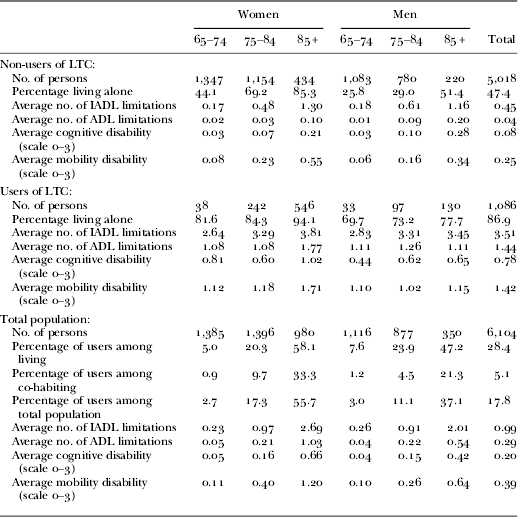
Table 1 shows non-users and users of LTC divided by gender and age group. The proportion of persons living alone is shown for each group. The average number of instrumental and personal ADL-dependencies and the average mobility and cognitive disability score is shown for non-users and users of public care and services as well as for the total population. The proportion of single-living and co-habiting persons that are users of public LTC in the total population is shown by gender and age group. The number of observations used in the prevalence calculations varied between 5,860 and 6,104 because of a differing amount of missing data for the variables.
Sample characteristics
Notes: LTC: long-term care. IADL: instrumental activity of daily living. ADL: personal activity of daily living.
As shown in Table 1, the proportion of persons living alone increased with age and was higher among women than men, reflecting differences in mortality and age differences between partners. Among the recipients of LTC, living alone was much more prevalent. The users of LTC were on average much older than the non-users – 86.6 years compared to 78.0 years. Table 1 also shows that the proportion of users of LTC was much lower among co-habiting persons than persons living alone in all age groups and both genders. Only co-habiting persons aged 85 and over received LTC to a great extent. At this point, however, is not clear whether this result reflects lesser dependency needs or greater access to alternative help, i.e. informal care from spouse, children or others.
Table 1 also shows that there are substantial differences between users and non-users of LTC in terms of disability. Among the users there were no large differences between age groups and genders. ADL-dependency was less common than IADL-dependency. The pattern of disability was very different for the non-users. In this group, the average number of ADL-dependencies was very low and the same was true of IADL except in the oldest age groups. The levels of the other measures were also much lower for non-users than for users of LTC but increased with age.
Regression analysis
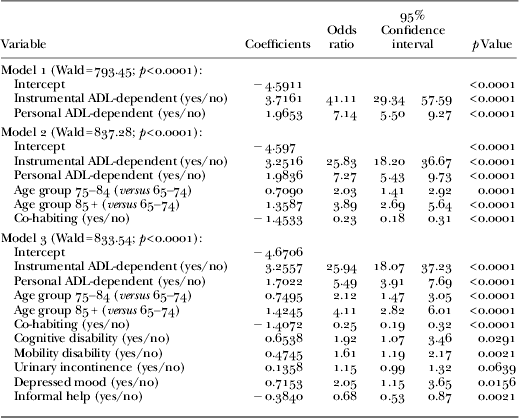
Table 2 shows the result of a logistic regression analysis (binary logit) with user/non-user of LTC as the dependent variable. The first model, in which only ADL- and IADL-dependency were used as dependent variables shows very high and strongly significant odds ratios for using LTC, if the person is ADL-dependent compared to if not. The same goes for IADL-dependency and this variable gives the highest odds ratio. It should be noted that very few persons in the sample (0.4%) were ADL-dependent without being IADL-dependent.
Logistic regression analysis showing odds ratio of being a user of public long-term care and services
Note: ADL: personal activity of daily living.
In model 2, age group and co-habiting were added. All the additional variables were significant. Being very old – 85 years and above – resulted in a higher odds of being a user of LTC than being 65–74 years old and co-habiting a lower odds than living alone. In a linear regression analysis with the same variables, the explained variance, R 2, increased from 0.38 to 0.42 by adding the age and co-habiting variables.
Adding the variables cognitive disability, mobility disability, urinary incontinence, depressed mood and informal help had a very limited effect, although all variables except urinary incontinence were significant. The odds ratios for the previously included variables remained almost unaltered. Linear regression with the same independent variables resulted only in a minor increase of explained variance, R 2, from 0.42 to 0.43. Overall fit of the model (likelihood ratio; Wald) was highly significant in all three models (p < 0.0001).
The relative importance of the variables can also be shown by a stepwise selection linear regression analysis. In the selection process, IADL-dependency came out first, ADL-dependency second and old age (85+) third. Cognitive disability came out only in sixth place. The various variables used to describe dependency or disability were strongly correlated. A regression analysis involving interactions showed no separate effect. The calculated probability of using LTC for a co-habiting person 65–74 years old with informal care and without any of risk factors included in the final model was 0.01. For a person 85 years or older, living alone, without informal care and with all the above risk factors, the probability was 0.975, which illustrates the span and relevance of the included factors in the analysis.
Horizontal and vertical target efficiency
Using the data, it is possible to calculate both the horizontal target efficiency (since we have access to population data) and the vertical target efficiency (since we have data on the users of care). This calculation was done using two different measures of need: dependency in at least one personal ADL and dependency in at least one instrumental ADL. The target efficiency was calculated by gender and type of household.
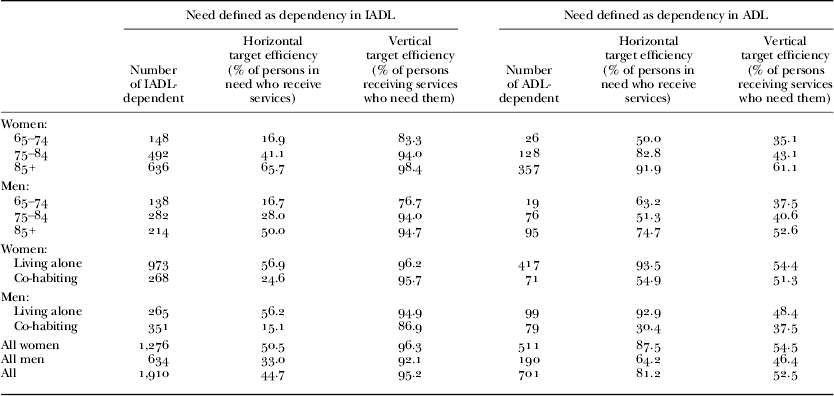
As expected, the extent to which persons in need receive services – the horizontal target efficiency – increased with a more restrictive definition of need. On the other hand, restricting the definition of need decreased the extent to which persons receiving services actually need them – the vertical target efficiency. Table 3 shows that there were rather large differences between age groups, genders and types of household. Public LTC to women over 85 years had the highest target efficiency (both horizontal and vertical) regardless of whether target efficiency was measured in relation to IADL- or ADL-dependency. Care services to the younger-old had generally lower target efficiency than services to the older-old. When need was defined as IADL-dependency, LTC services to men 65–74 years had the lowest target efficiency – horizontal as well as vertical. Defining need as ADL-dependency resulted in women 65–74 years having the lowest target efficiencies. But gender differences were small.
Horizontal and vertical target efficiency with regard to dependency in personal (ADL) or instrumental (IADL) activities of daily living by age group, gender and type of household
Table 3 also shows that horizontal target efficiency differed very much depending on type of household regardless of measure of need. Many co-habiting persons in need of LTC according to either of the two criteria did not receive it. Gender differences in this respect were fairly small. On the other hand, vertical target efficiency did not differ very much between the two household groups. It was somewhat higher for persons living alone than for co-habiting persons, but the differences were not dramatic. Those who received LTC fulfilled the need criteria to the same extent whether they were co-habiting or not.
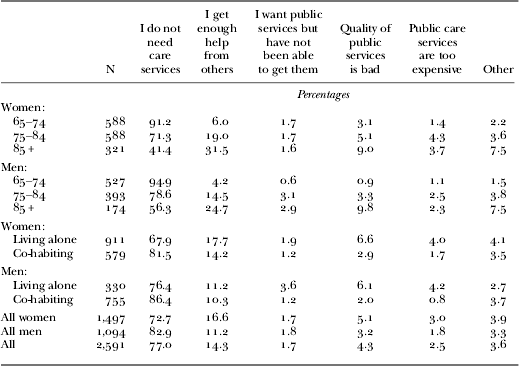
It may be of interest to know the reasons why the persons in the study were non-users of public LTC. Was it because services were denied, or were there other reasons? Table 4 shows the reasons persons with IADL- and/or ADL-dependency stated for not receiving public LTC by age, gender and type of household. A total of 2,591 ADL or IADL dependent persons answered this question, providing 2,681 answers (it was possible to give multiple responses).
Reasons for not receiving public long-term care and services for persons with dependency in personal or instrumental activities of daily living by age group and gender
The result indicates that the proportion of persons who perceived they had an unfulfilled need for public LTC was very small. Regardless of co-habitation status, feeling that there was no need for public LTC was by far the most dominant self-reported reason in all age groups for not receiving. However, this answer was less common among the oldest old than the younger and among those living alone than among the co-habiting. Very few reported that they had been denied public services or been dissuaded from applying. Moreover, very few regarded the public LTC as too expensive, which reflects the low level of co-payment in Sweden (around 4%). More frequent reasons given for not being a recipient of public care services were misgivings regarding the quality of care. Table 4 shows that this reason was especially common among the oldest-old and those living alone.
Discussion
The increasing pressures on the system of public LTC due to demographic developments make it paramount to ensure that scarce resources are used in an efficient way, reaching those in need, and ideally only those in need. The concepts of horizontal and vertical target efficiency are very suitable for expressing the extent to which these goals are achieved. In spite of the suitability of these concepts, there seems to have been few attempts to implement them in practice. One reason is that it requires considerable effort and costs to conduct the surveys that are needed for calculating the measures. What ideally should be used on a routine basis as a key indicator is only calculated using special studies and then very seldom. In Sweden, few municipalities measure disability and dependency among the recipients of care, which would enable them to calculate vertical target efficiency. And it is only possible to measure horizontal target efficiency of public LTC in a geographic area using data from an area-based population study like the SNAC study.
The results showed that more than 80 per cent of those dependent in at least one ADL were users of public LTC in the studied areas. For persons living alone this horizontal target efficiency was more than 90 per cent, but it was considerably less for co-habiting persons – especially men. Defining need as dependency in at least one IADL reduced horizontal target efficiency to around 45 per cent.
Vertical target efficiency was around 50 per cent when ADL-dependency was used as a criteria for need, varying between 35 and 61 per cent on the basis of age group, gender and type of household. Expanding the need definition to IADL-dependency increased vertical target efficiency to 83–98 per cent depending on age, gender and type of household, 95 per cent being the average over all sub-groups.
Dependency in at least one IADL was the most important predictor of using public LTC. Dependency in at least one ADL was also an important predictor, but less so. The reason why IADL-dependency was more important than personal ADL-dependency when predicting use of LTC is probably that many users of public LTC only have IADL problems. Advanced age was also connected to higher odds of being an LTC user than being younger. Living together with another person, on the other hand, was associated with a lower probability of LTC use than living alone. Adding other variables that describe functional limitations, such as cognitive or mobility disability and incontinence, made very limited contributions to odds ratios of using LTC. The reason for this is no doubt that the effect of these variables was already taken into account by the ADL/IADL variables. In other words, severe cognitive disability results in IADL- and ADL-dependency but has only a limited effect on the provision of LTC in itself.
From a societal point of view, support to care-givers seems important since having an informal care-giver resulted in almost half the risk of being a user of public LTC.
Another question is whether the LTC provided is adequate and of good quality. This cannot be answered by an assessment of target efficiency as it is defined here but requires a different approach, which falls outside the scope of this paper. Few older persons in the studied geographical areas reported having been denied services or refraining from applying because of poor quality or high costs.
A crucial component of the analysis is the way in which ‘needs’ are defined. As remarked above and shown in Table 3, target efficiency is strongly dependent on the needs definition. Needs can be defined from a subjective point of view (those persons are in need of LTC who perceive that they have that need), or they can be defined using some kind of professional assessment. In practice there is no golden standard definition of needs. Broadly speaking, the definition of needs depends on available resources. In this study, needs were defined in relation to dependency in activities of daily living. This choice was made because LTC services are to a great extent geared directly at providing support with daily living problems. The strong predictive effect of IADL- and ADL-dependency shows the importance put on these aspects of need when allotting public LTC in Sweden. Of course there may be other reasons for needing assistance (e.g. need for psychological support), but the influence of these factors (e.g. depression), is not supported by the data. It should also be noted that we did not analyse whether the kinds of services the older persons received were related to the specific dependencies they reported. The provided services may be mismatched with the person's actual needs. In order to address this question, a deeper measure of target efficiency than the one used here is required.
Another question is whether the results shown here are reliable and can be regarded as representative of the Swedish present situation. In answering the first question, response rate and selection bias are crucial. If only those who receive the services they need participate in the survey, then the results are of little value. As reported above, response rates were fairly high for a study of this kind, especially in Kungsholmen and Nordanstig. However, a 25 per cent non-response rate could hide a lot of unmet needs. To analyse whether there was selection bias by disability, we compared mortality in participants and non-participants.
The mortality analysis in Kungsholmen revealed no differences between non-participants and participants except for mortality rates within six months after the persons were invited to the examination. Almost all these persons, however, received public LTC. Thus, it seems that in Kungsholmen, at least, there was no selection bias. Judging from mortality, the non-participants should not have been more disabled and in need for LTC than the participants, with the exception of those non-participants dying within six months after invitation. The measures taken by providing home visits for those disabled persons, which otherwise would have refrained from participating in the study, thus seem to have been effective.
The second question concerns how representative the results are for all of Sweden. The data were collected from eight different municipalities in Sweden in different parts of the country chosen to be broadly representative of the country when looked at together. In 2005, the proportion of persons 65 years or older was 17.6 per cent in the SNAC areas and 17.3 per cent in Sweden. The proportion of old persons receiving public LTC was 16.4 per cent in the SNAC areas and 15.9 per cent in Sweden. A total of 5.7 per cent lived in special accommodation in the SNAC areas; the figure for Sweden as a whole was 6.1 per cent. With regard to other indicators, there was also broad agreement between average of the SNAC municipalities and the averages in all of Sweden; the proportion of women was 58.9 per cent in the SNAC areas and 56.7 per cent in Sweden; the proportion of low income 21.5 per cent in the SNAC areas and 20.0 per cent in Sweden; and the proportion of older persons who were married was 47.3 per cent in the SNAC areas and 50.8 per cent in Sweden.
It is known from other studies (Trydegård Reference Trydegård2000) that there are differences between municipalities with regard to the provision of LTC for older persons. However, in Sweden there is a national tax-equalisation scheme aimed at ensuring that all municipalities have equal monetary resources for providing LTC in relation to needs. Thus, even if there are municipalities that diverge, it does not seem probable that the majority of the municipalities present a very different picture from the one shown above. A comparison with the nationwide SWEOLD study shows almost identical horizontal target efficiency for the 75+ group when needs are defined as at least one ADL-dependency (SWEOLD 85 per cent; SNAC 83 per cent) (own calculation; for a description of SWEOLD, see www.sweold.se). Generally speaking, the results strongly suggest that there is no large gap in Sweden between the number of older persons needing LTC to cope with their activities of daily living and those actually receiving such care. That is, horizontal target efficiency should be regarded as satisfactory. In spite of the reductions in the 1990s, public LTC is still provided to those who need it, and few persons feel that they do not receive the services they need.
Vertical target efficiency is a somewhat different matter. The more generous the system, the larger the proportion of persons who receive services they do not really need. The size of the proportion depends on how one defines need, but also on the assessment system. In a more strict assessment system with well-defined criteria for providing assistance, fewer persons without need should receive services, all other things being equal. In Sweden, few municipalities use an assessment system that includes formal criteria for receiving services according to defined measurements and limits. None of the eight SNAC municipalities used such a system when the survey was made. In spite of this, vertical target efficiency was quite high if need was defined as IADL-dependency, although it was much lower when need was defined as dependency in personal ADL. As many users of LTC only need help for IADLs this is what would be expected. A comparison with the SWEOLD study showed a larger difference with regard to vertical target efficiency: 75 per cent in SWEOLD and 54 per cent in SNAC. It should be kept in mind that the SWEOLD study is comparatively small (around 500 participants 77 years and older).
In this study, we observed that target efficiency was lower for younger-old persons than older-old persons and that there were some gender differences. A higher proportion of the younger-older persons co-habited. In Sweden, there is no formal ground for denying someone LTC on the ground that the person is married or has grown-up children providing care. In practice, however, there are great differences between those who live alone and those who co-habit with regard to the use of formal services. It must also be kept in mind that co-habiting persons may refrain from seeking care services that they feel they do not need or want. As shown in Table 4, few persons felt they did not get the services they needed.
The reason for this study was to examine the truth in the assertion that there were many old persons in Sweden that did not receive LTC in spite of needing it. The results showed firmly that this allegation is unfounded. Very few persons in the municipalities studied reported being denied LTC or abstaining from requesting LTC. The results were similar in the different municipalities studied, and, in spite of the differences between municipalities in Sweden, there is no reason to believe that the situation elsewhere in the country is very different.
It also seems that targeting was adequate. There were clear differences in disability between those who received services and those who did not. This is important from a policy point of view. Thus the problems with LTC in Sweden – and they are numerous – do not include coverage among those in need, but rather include different aspects of the quality of the services provided, such as inadequate staffing, poor staff continuity, and lack of staff training and supervision. There are also questions concerning the availability of special accommodation and how far to pursue the ageing-in-place policy currently applied in Swedish municipalities.
Measuring target efficiency is thus only a first, but important, step when it comes to making the most efficient use of scarce resources for the public LTC of older people. There is a clear risk that resources will not increase in relation to needs in the coming decades. Measuring key indicators such as target efficiency, along with actively monitoring quality, will show whether resources are lagging behind and thus create an impetus for granting more adequate provisions. Simplified methods for achieving this goal should be developed and put into routine use by local authorities. Only in this way can the rights of older frail persons to adequate, high-quality care be protected in Sweden and the same is true of other countries.
Acknowledgements
The Swedish National Study on Ageing and Care (www.snac.org) is financially supported by the Ministry of Health and Social Affairs, Sweden and the participating county councils, municipalities and university departments. We are grateful to the participants, the participating counties and municipalities.