Kawasaki disease, a systemic vasculitis affecting the coronary arteries, is the most prevalent acquired heart disease in children in developing countries and results in coronary artery lesions in 25% of patients who do not receive treatment.Reference Kawasaki, Kosaki, Okawa, Shigematsu and Yanagawa1,Reference McCrindle, Rowley and Newburger2 The goal of acute treatment for Kawasaki disease is to control inflammation early and prevent the development of coronary aneurysms. High-dose (2 g/kg) intravenous immunoglobulins and aspirin are the standard treatment for Kawasaki disease.
Ten to twenty percent of patients with Kawasaki disease do not respond to 2 g/kg intravenous immunoglobulin treatment, and additional therapies (including intravenous immunoglobulin or steroids, immunosuppressive drugs, or infliximab) are used. The scores of Kobayashi,Reference Kobayashi, Inoue and Takeuchi3 Egami,Reference Egami, Muta and Ishii4 or SanoReference Sano, Kurotovi and Matsuzaki5 have been proposed as a prediction of resistance to standard therapy. These scores contribute to the decrease of coronary lesions by early additional therapies in patients with resistance to intravenous immunoglobulin alone.Reference Kobayashi, Saji and Otani6–Reference Ogata, Ogihara and Honda9
In contrast, Kawasaki disease is not severe in all patients, and Kawasaki disease has wide range of severity. Previously, the initial therapy for Kawasaki disease at our institution included 1 g/kg intravenous immunoglobulin treatment. Second 1 g/kg was added if the initial dose was not effective. Based on the observed clinical outcomes of the patients at our institution, we reported a new score (Less high-risk score) that can be used to identify patients in whom 1 g/kg intravenous immunoglobulin treatment will be effective.Reference Ichihashi, Shiraishi and Momoi10
In this study, we investigate the clinical outcomes of the Kawasaki disease patients with different treatments based on the risk scores of intravenous immunoglobulin therapy to clarify the usefulness of the stratified therapy.
Materials and methods
Patients
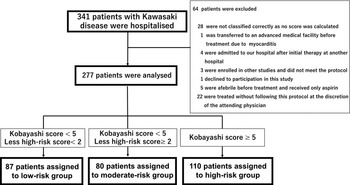
We retrospectively evaluated the clinical records of 341 patients with acute Kawasaki disease treated in the Department of Pediatrics at Jichi Medical University Saitama Medical Center from July 2009 to December 2020. Two hundred and seventy-seven treated according to our standard protocol were included in this study (Fig 1). Kawasaki disease was diagnosed according to the Revision of Diagnostic Guidelines for Kawasaki disease (6th revised edition).Reference Kobayashi, Ayusawa and Suzuki11 The patients were divided into three groups (high-risk, moderate-risk, and low-risk) based on Less high-risk score and Kobayashi score. The high-risk group included patients with Kobayashi score ≥ 5, the moderate-risk group included patients with Kobayashi score < 5 and Less high-risk score ≥ 2 points, and the low-risk group included patients with Kobayashi score < 5 and Less high-risk score < 2.
Enrollment of patients.

This study was approved by the Ethics Reviews Committee of Jichi Medical University Saitama Medical Center (approval number S19-078), and patients were permitted to opt out of the study based on a notice on our clinical department’s website. This study was conducted according to the Declaration of Helsinki.
Scoring systems
Kobayashi score was determined as follows: two points each for serum sodium concentration ≤ 133 mmol/L, ≤ 4 days of illness at the time of diagnosis, aspartate aminotransferase concentration of ≥ 100 U/L, and a percentage of neutrophils ≥ 80%; and one point each for a platelet count ≤ 30 × 104/μl, C-reactive protein concentration ≥ 10 mg/dl, and age ≤ 12 months.Reference Kobayashi, Inoue and Takeuchi3
Our Less high-risk score was determined as follows: two points for the percentage of neutrophils ≥ 70%; and one point each for serum sodium concentration ≤ 133 mmol/L, aspartate aminotransferase concentration ≥ 110 U/L, and C-reactive protein concentration ≥ 10 mg/dl.Reference Ichihashi, Shiraishi and Momoi10
Treatment
All patients received aspirin (30 mg/kg/day) for 48 hours or more after fever reduction followed by a lower dose of aspirin (5 mg/kg/day). Patients in the high-risk group were administered 2 g/kg intravenous immunoglobulin and prednisolone as previously reported.Reference Hamada, Suzuki and Onouchi7 Patients in the moderate-risk group were administered 2 g/kg intravenous immunoglobulin treatment. Patients in the low-risk group were administered 1 g/kg intravenous immunoglobulin treatment.
Patients who did not respond to the initial therapy within 24 hours after the end of intravenous immunoglobulin treatment or those who had recurrent fever were considered non-responders. These patients received additional therapy. Non-responders in the low-risk group were administered an additional 1 g/kg intravenous immunoglobulin treatment. Those in the moderate-risk group were administered an additional 2 g/kg intravenous immunoglobulin and 2 mg/kg prednisolone, and those in the high-risk group were administered an additional 2 g/kg intravenous immunoglobulin and intravenous methylprednisolone pulse therapy, cyclosporine, or infliximab.
Patient evaluations
The laboratory data, echocardiography data, and medical course before and after treatment were compared between the groups. The patients’ age, sex, and days of illness were recorded. The first day of the illness was defined as the day of the onset of fever. Prior to treatment, the white blood cell, neutrophil, and platelet count were recorded, as were the levels of aspartate aminotransferase, sodium, C-reactive protein, and N-terminal pro-b-type natriuretic peptide (if available). If patients underwent more than one round of laboratory tests prior to the treatment, the highest values for the percentage of neutrophils, aspartate aminotransferase, and C-reactive protein, and the lowest values for platelet count and sodium were used for the scoring.
The diameters of the proximal right coronary artery, left main coronary artery, and proximal left anterior descending artery were determined before and after treatment using echocardiography. The Z scoresReference Kobayashi, Fuse and Sakamoto12 of the proximal right coronary artery, left main coronary artery, and proximal left anterior descending artery were determined. The coronary artery diameter immediately prior to transfer was used in patients who were transferred to an advanced medical facility within 4 weeks after the onset of treatment. The acute treatment, clinical course, and long-term prognosis were evaluated in patients with coronary dilation.
Outcomes
The primary outcome was the response to initial therapy, defined as patients who were afebrile within 24 hours after the end of intravenous immunoglobulin treatment who did not have a recurrent fever. The secondary outcomes were coronary artery lesions (a Z score ≥ 2.5) within 4 weeks after the start of treatment and the Z scores of the right and left coronary arteries 4 weeks after treatment.
Statistical analysis
The patients’ backgrounds, laboratory data before treatments, response rate to initial therapy, and mean values of coronary artery diameters and Z scores before therapy and 4 weeks after the onset of illness were compared between the three groups. In addition, the Z scores of the coronary artery diameters before therapy were compared to those 4 weeks after the initiation of therapy within each group.
The positive predictive value of the Less high-risk score was defined as the response rate of the low-risk group. The positive predictive value of Kobayashi score in this study was defined as the response rate of the moderate-risk group. The positive predictive values of the Less high-risk score and Kobayashi score were compared to determine their usefulness.
Categorical variables were compared using Fisher’s exact test, and one-way analysis of variance was used to compare continuous variables. A paired t-test was used to compare changes over time in continuous variables. All statistical analyses were performed using EZR 1.33 software (Jichi Medical University Saitama Medical Center, Saitama, Japan).Reference Kanda13 Statistical significance was set at p < 0.05.
Results
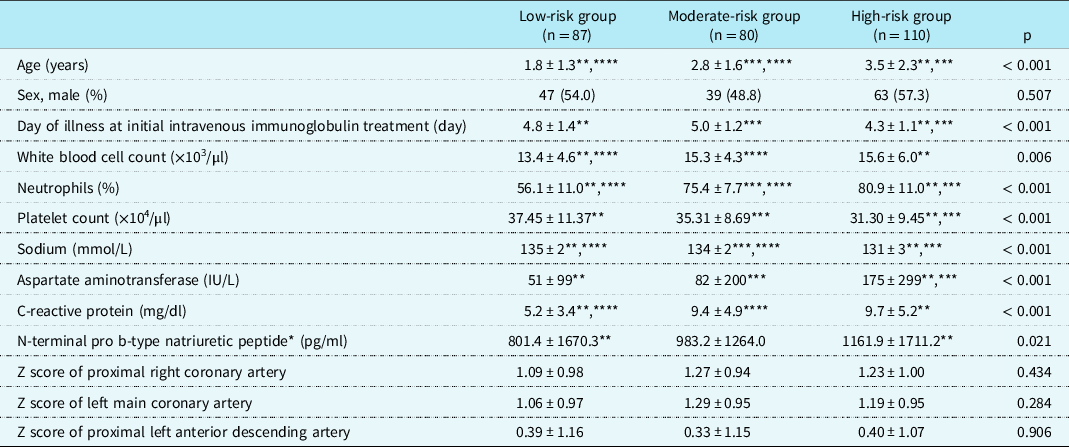
The study included 277 children (149 males and 128 females). The treatment was initiated an average of 4.6 days after the onset of fever. The low-risk group included 87 patients, the moderate-risk group 80, and the high-risk group 110 (Fig 1). Patient background information and baseline laboratory values are shown in Table 1.
Baseline characteristics

Continuous data are presented as mean ± standard deviation.
Categorical variables are presented as number (percentage).
* Low-risk group (n = 29), moderate-risk group (n = 26), and high-risk group (n = 31).
** p < 0.05 when the low-risk and high-risk groups are compared.
*** p < 0.05 when the moderate-risk and high-risk groups are compared.
**** p < 0.05 when the low-risk and moderate-risk groups are compared.
Response to initial treatment
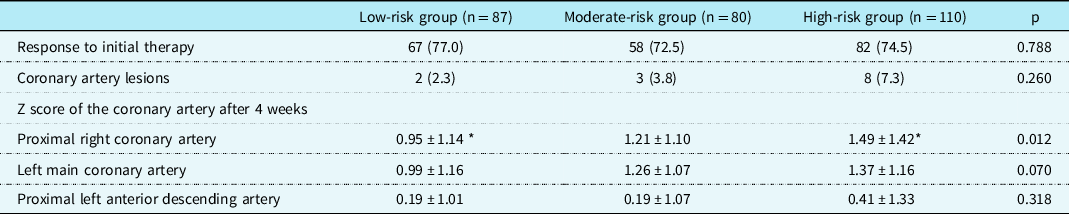
A total of 207 patients (74.7%) were responsive to the initial treatment, including 67 (77.0%) in the low-risk group, 58 (72.5%) in the moderate-risk group, and 82 (74.5%) in the high-risk group. There was no significant difference in the treatment response rate between the groups (p = 0.788) (Table 2). The positive predictive value of Less high-risk score was 77.0% and that of Kobayashi score was 72.5% (p = 0.593).
Clinical outcomes

Continuous data are presented as mean ± standard deviation.
Categorical variables are presented as number (percentage).
* p < 0.05 when the low-risk and high-risk groups are compared.
Coronary artery lesions
Thirteen (4.7%) patients had coronary artery lesions, including 2 (2.3%) in the low-risk group, 3 (3.8%) in the moderate-risk group, and 8 (7.3%) in the high-risk group. The rate of coronary artery lesions was not significantly different between the three groups (p = 0.260) (Table 2).
Two patients with coronary artery lesions in the low-risk group were not responsive to initial treatment, but the coronary artery lesions resolved spontaneously.
Of three patients with coronary artery lesions in the moderate-risk group, one patient was responsive to initial treatment and the other two patients were not responsive to initial treatment. The coronary artery lesions resolved spontaneously in two patients and one patient was transferred to an advanced medical facility with a suspected intramural thrombosis in addition to coronary artery dilation.
Of the eight patients with coronary artery lesions in the high-risk group, one patient was responsive to initial treatment and the coronary artery lesion resolved. The remaining seven patients were not responsive to initial treatment. The coronary artery lesions resolved spontaneously in three of these patients, two patients were transferred to an advanced medical facility, and one patient was referred to an advanced medical facility after discharge. One patient did not develop worsening of coronary artery lesions and was followed up regularly at another hospital after discharge.
Z scores of the coronary arteries
The Z scores of the proximal right coronary artery diameters 4 weeks after the initiation of therapy were significantly higher in the high-risk group than the low-risk group (the proximal right coronary artery Z score: p = 0.012) (Table 2).
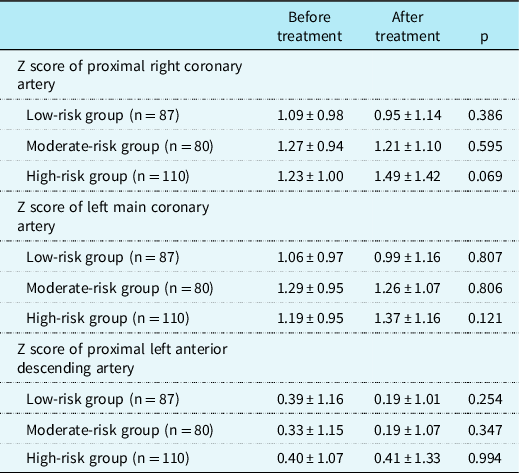
There were no significant differences between the Z score before therapy and those after 4 weeks of therapy in any group (Table 3).
Z scores before and after treatment

Variables are shown as mean ± standard deviation
Discussion
In this study, low-risk patients treated with 1 g/kg intravenous immunoglobulin treatment based on Less high-risk score and Kobayashi scoreReference Kobayashi, Inoue and Takeuchi3 did not have a decreased response rate or an increased coronary artery lesion rate compared to patients with a moderate- or high-risk who were treated with 2 g/kg intravenous immunoglobulin treatment with or without prednisolone. These results indicate that initial treatment with 1 g/kg of intravenous immunoglobulin treatment is sufficient for patients identified as low-risk by Less high-risk score.
Currently, the commonly used dose of intravenous immunoglobulin is 2 g/kg. The latest Kawasaki disease guideline recommends 2 g/kg of intravenous immunoglobulin as a treatment for Kawasaki disease.14 Some studies reported a lower risk of developing coronary artery lesions in patients treated with a single dose of 2 g/kg intravenous immunoglobulin treatment compared to those treated with 400 mg/day for 4 or 5 days.Reference Klasesen, Rowe and Gafnl15,Reference Sano, Sugimura and Akagi16 In a study comparing the initial 2 g/kg intravenous immunoglobulin treatment and the initial 1 g/kg intravenous immunoglobulin treatment (additional 1 g/kg for non-responsive cases), there was no significant difference in the incidence of coronary artery lesions,Reference Sakata, Hamaoka and Ozawa17 but 58% of patients in the initial 1 g/kg intravenous immunoglobulin treatment group were unresponsive and required additional treatment. Based on previous reports,Reference Klasesen, Rowe and Gafnl15,Reference Sano, Sugimura and Akagi16,Reference Barron, Murphy and Silverman18 it is suspected that treatment with 1 g/kg intravenous immunoglobulin treatment is inferior to treatment with 2 g/kg intravenous immunoglobulin treatment. According to a recent national survey in Japan, 95.7% of patients with Kawasaki disease receive a single dose of 2 g/kg intravenous immunoglobulins.19
However, in this study, we identified patients with a low risk of non-responsiveness and successfully treated them with 1 g/kg intravenous immunoglobulin treatment. The initial therapy was successful in 77% of patients in the low-risk group and non-responders also had a good long-term prognosis with additional treatment. Therefore, we believe that treatment with 1 g/kg intravenous immunoglobulin is sufficient for the initial treatment of patients identified as low-risk using the Less high-risk score. Furthermore, we promptly administered an additional 1 g/kg of intravenous immunoglobulin to any patient who was unresponsive to 1 g/kg of intravenous immunoglobulin by the ninth day of illness. Therefore, our stratified therapy does not significantly deviate from the latest Kawasaki disease guidelines.
The predictive value of the Less high-risk score was not significantly different than that of Kobayashi score. Using these two scores, we can divide Kawasaki disease patients almost equally into three groups according to the response to intravenous immunoglobulin therapy and can make stratified therapies.
Several studies have focused on the medical costs of Kawasaki disease. One study reported that adequate early treatments reduced the incidence of coronary artery lesions, which may lead to a reduction in medical expenses.Reference Klasesen, Rowe and Gafnl15 Stratifying treatments based on our new scoring system allow for adequate early treatment for patients with a high risk of not responding while minimising the excessive use of intravenous immunoglobulin in patients with a low risk of not responding, which can further reduce medical expenses.
Shortages of immunoglobulin have become more frequent in the past few years, spurred by demand for the medicine. Our stratified therapy will be one of the countermeasures for it.
In addition, the adverse reactions caused by immunoglobulins include not only anaphylaxis and viral infections but also a rapid increase in the volume of circulating blood and high blood pressure.14,Reference Bonilla20 However, reducing the dose of immunoglobulin may lead to a reduction in those risk of adverse reaction.
Limitations
Our study has several limitations. First, all the echocardiographic examinations were not performed by the same technician. However, echocardiography was performed more than once during the study period, and the Z scores were considered consistent. Second, some patients were transferred to an advanced medical facility early after the initiation of treatment, prohibiting the evaluation of coronary artery lesions 4 weeks after treatment. However, these patients were not included in the low-risk group, and the missing data did not affect the evaluation of the usefulness of the new scoring system. Third, this was a single-centre retrospective study and may be subject to bias. Multi-centre randomised controlled trials should be conducted in the future.
Conclusions
The therapeutic response rate and the long-term prognosis of patients identified as low-risk using the Less high-risk score to 1 g/kg intravenous immunoglobulin treatment were satisfactory. Stratified therapies for patients with Kawasaki disease based on the scoring system may be useful.
Acknowledgements
We thank all of the paediatricians and nurses at Jichi Medical University Saitama Medical Center.
Financial support
This research received no specific grant from any funding agency, commercial, or not-for-profit sectors.
Conflict of interest
None.
Ethical standards
This study complies with the Declaration of Helsinki (1975, as revised in 2008) and was approved by the Institutional Committees of Jichi Medical University Saitama Medical Center.