INTRODUCTION
A fascination with the history of science tends to be a preoccupation of those who themselves are being overtaken by time. However, ruminations on past progress may have some value in a research world whose collective memory tends to be hazy beyond the preceding 10 years. We hope this brief look at the progress of one particular aspect of malaria biology, the merozoite, will be useful, considering that this diminutive but potent entity has been a strong focus of international research for more than 40 years due to its potential for vaccination. It is worth remembering that while in the early days of this period malaria research happened in only a few laboratories and progressed slowly, much of what we know about merozoite structure and behaviour was established by 1990, before the great expansion in molecular biology had really taken off. A comprehensive history of these advances is clearly beyond the brief of this contribution, and we will focus mainly on those areas which have been our own research interests over this period. In doing so, we are keenly conscious of the magnitude of such a survey, and we ask the reader for forbearance where we have omitted or perhaps misrepresented important contributions to this field.
Malaria research, like most biomedical investigation, is driven mainly by a mix of clinical necessity, curiosity and opportunity. Clinical necessity is always with us, and, although in the 1960s the research scene was very different from the present one, a similar sense of urgency prevailed as efforts to eradicate or at least ameliorate the disease were making little progress. Then, as now, growing resistance of parasites to anti-malarial drugs and of mosquitoes to insecticides, plus politico-economic turmoil in many countries had dented hopes of malaria eradication. However, since some other previously intractable global diseases, notably poliomyelitis and smallpox, were succumbing to new vaccination programmes, it seemed possible then that malaria might yield quite quickly in the same way.
A great deal of previous vaccination work had involved simian and avian parasites (systematically summarized by Garnham (Reference Garnham1966) in his important monograph) and it had become clear that particular attention was merited by both sporozoites and merozoites. Being extracellular and therefore exposed to direct humoral attack, they were apparently good targets. UV-irradiated sporozoites had successfully protected birds (Russell and Mohan, Reference Russell and Mohan1942) but the line of argument for merozoites was more circuitous. Following the demonstrations in monkeys (Coggeshall, and Kumm, Reference Coggeshall and Kumm1937), and in humans (Cohen et al. Reference Cohen, McGregor and Carrington1961), that immunity to malaria could be transferred passively with immune serum or immunoglobulin from immune to non-immune subjects, a short term in vitro Plasmodium knowlesi culture system was developed. This showed that protection in monkeys correlated with the inhibition of invasion, and so strongly implicated merozoites as the blood stage most susceptible to antibody neutralization (Cohen and Butcher, Reference Cohen and Butcher1971). Incubations of newly rupturing schizonts with immune rhesus serum in this system showed that merozoites were sometimes agglutinated by their apices, an early harbinger of the importance of apical secretions in invasion (Butcher and Cohen, Reference Butcher and Cohen1970). Cytotoxic cells were not involved, and were similarly unnecessary for inhibition when the assay was extended to P. falciparum (Mitchell et al. Reference Mitchell, Butcher, Voller and Cohen1976). Thus, in the early 1970's, several parallel vaccination programmes were underway including one at New York University, based on sporozoites (summarized by Nussenzweig et al. Reference Nussenzweig, Vanderberg, Spitalny, Rivera, Orton and Most1972), and another, based on merozoites, at Guy's Hospital Medical School, London (e.g. Cohen et al. Reference Cohen, Butcher, Mitchell, Deans and Langhorne1977). In retrospect no-one suspected that the journey to an effective vaccine (still uncertain even now) would be so long and tortuous, or that Plasmodium would prove so antigenically complex as we now know it to be. The early naïve expectation of quick success has been tempered by reality, but the vaccine programme has at least given a deeper understanding of the merozoite, which is ultimately important to the rational design of anti-malarial strategies.
DEVELOPING CONCEPTS IN MEROZOITE BIOLOGY
Merozoites and the growth of technology
Over the last 40 years a succession of new techniques has revolutionized the study of merozoites, as of cell biology in general. From the 1960s onwards, electron microscopy introduced a new world of parasite cellular organization, while novel methods of immunological and electrophoretic identification and much later, molecular characterization by mass spectroscopy and X-ray diffraction, allowed detailed analysis of many merozoite molecules and their interactions. Overlapping these advances, from the mid-1980s the exploitation of nucleotide chemistry led to the growth of molecular genetics with its companion disciplines and techniques. The complete genome sequencing of now several species of Plasmodium following P. falciparum in 2002 is beginning to impact on the merozoite, with its predicted transcriptome and proteome now accessible to exploration (Pain and Hertz-Fowler, Reference Pain and Hertz-Fowler2009). Stable transfection, first achieved in the mid-1990s (van Dijk et al. Reference van Dijk, Waters and Janse1995), has enabled the systematic study of merozoite protein synthesis, function, trafficking and much more (Wu et al. Reference Wu, Kirkman and Wellems1996), and there is a sense in which progress is now limited chiefly by funding and availability of trained personnel rather than technique. It occurs to the observer of this remarkable new culture that the challenge may now be to see the biological wood for the very numerous molecular trees. Bioinformatic databases such as the PlasmoDB (Aurrecoechea et al. Reference Aurrecoechea, Brestelli, Brunk, Dommer, Fischer, Gajria, Gao, Gingle, Grant, Harb, Heiges, Innamorato, Iodice, Kissinger, Kraemer, Li, Miller, Nayak, Pennington, Pinney, Roos, Ross, Stoeckert, Treatman and Wang2009) are clearly essential for exploring and using the extensive data, but it will be a challenge to understand the broad biological themes they reflect.
Although these advances have depended on developments in technology, it is salutary that underpinning much research into malaria is the rather simple (though long sought-after) method of long-term P. falciparum laboratory culture devised in the mid-1970s (Trager and Jensen, Reference Trager and Jensen1976; Haynes et al. Reference Haynes, Diggs, Hines and Desjardins1976) assisted by many practical advances in parasite culture and manipulation since that time. Some aspects of merozoite biology including the process of invasion are not easily accessible in P. falciparum, and both in vivo and short-term in vitro studies in other species remain important.
Microscopy and merozoites
Merozoites are the smallest of the parasite stages, and their target, the red blood cell (RBC), is one of the smallest vertebrate cells. Before electron microscopy (EM), merozoites and their interactions with RBCs were visualized microscopically as only a small oval blob with a nucleus at one end. Although electron microscopes were available commercially in the early 1950s exploration of Plasmodium awaited the development of methods adequate for biological specimen preparation and sectioning, rudimentary until the mid-1960s. Nevertheless, the early explorations of blood stages by Rudzinska and Trager in New York (Rudzinska and Trager, Reference Rudzinska and Trager1959), and mosquito stages by Garnham, Bird, Baker, Bray and colleagues in London (Garnham et al. Reference Garnham, Bird and Baker1960) revolutionized our understanding of the parasite and opened up a world of unexpected structure. EM improvements, especially the use of glutaraldehyde for primary fixation, later enabled better imaging, and from 1966 a golden period of ultrastructural research began, establishing the major features of the Plasmodium life cycle and merozoite invasion. New research groups joined the field, notably at the Walter Reed Army Institute for Research (WRAIR) in the USA, from which a string of ultrastructural papers on malaria issued, describing amongst other things, merozoites of the bird malaria parasite Plasmodium fallax (Hepler et al. Reference Hepler, Huff and Sprinz1966; Aikawa, Reference Aikawa1967) and the major events of RBC invasion in rodents (Ladda et al. Reference Ladda, Aikawa and Sprinz1969). A member of that centre, Masamichi Aikawa, moved to Case Western Reserve, Cleveland, Ohio where he came to dominate the field of malaria EM for the next 30 years by the quantity and quality of his publications. Other centres around the world also soon began to provide EM information. In the USA, Miller's laboratory at the National Institutes of Health, Bethesda, explored the ultrastructure of the simian parasite P. knowlesi, mostly in collaboration with Aikawa (e.g. Aikawa et al. Reference Aikawa, Miller, Johnson and Rabbege1978; Miller et al. Reference Miller, Aikawa, Johnson and Shiroishi1979), and also published a classic light microscopic description of merozoite invasion (Dvorak et al. Reference Dvorak, Miller, Whitehouse and Shiroishi1975). Merozoite research began in Cohen's laboratory at Guy's Hospital Medical School in London, first with a light microscope study of species-specificity in RBC invasion (Butcher et al. Reference Butcher, Mitchell and Cohen1973). This led to EM studies of invasion by P. knowlesi (e.g. Bannister et al. Reference Bannister, Butcher, Dennis and Mitchell1975), and to collaborative EM freeze-fracture studies of invasion with McLaren and others at the National Medical Research Institute, Mill Hill, London (McLaren et al. Reference McLaren, Bannister, Trigg and Butcher1979). This theme was pursued later in Mitchell's laboratory on the Guy's site (see e.g. Mitchell et al. Reference Mitchell, Thomas, Margos, Dluzewski and Bannister2004). Meanwhile, at Rockefeller University in New York, Susan Langreth in Trager's department continued its tradition of EM excellence, describing P. falciparum merozoites and other stages in culture (Langreth et al. Reference Langreth, Jensen, Reese and Trager1978). However, by the mid-1980s the focus of merozoite research had shifted decidedly away from ultrastructure to the pursuit of molecular biology.
Interestingly, light microscopy now became important again as new methods of monoclonal and polyclonal antibody production combined with visual labelling by immuno-fluorescent antibody (IFA) staining came into general use. This enabled rapid screening of antibodies and an approximate immuno-localization of known proteins within the merozoite (Thomas et al. Reference Thomas, Deans, Mitchell, Alderson and Cohen1984; David et al. Reference David, Hudson, Hadley, Klotz and Miller1985), which has since become standard for protein characterization. The commercial availability of confocal microscopes from the 1980s, improvements in antibody technology, computerized image analysis and the advent of new fluors and genetically engineered fluorescence labelling have now made light microscopy an essential tool for Plasmodium research. Current developments in optics are pushing spatial resolution of microscopy well beyond the Abbé limit and can be expected to serve well in the analysis of merozoite structure and behaviour.
From the mid-1980s, immuno-electronmicroscopy (IEM) localization of merozoite proteins also became important, helped by the use of gold particle-conjugated antibody labels and formulation of new embedding resins and cryo-sectioning methods (Oka et al. Reference Oka, Aikawa and Freeman1984; Heidrich et al. Reference Heidrich, Matzner, Miettinen-Baumann and Strych1986; Aikawa et al. Reference Aikawa, David, Fine, Hudson, Klotz and Miller1986). At present IEM remains the only method with sufficient resolution for accurate organellar localization, although possessing many problems and pitfalls for the unwary. For morphology, recent developments in electron tomography hold out good prospects for 3-dimensional analysis of cryo-fixed material, as shown strikingly for sporozoite reconstruction (Cyrklaff et al. Reference Cyrklaff, Kudryashev, Leis, Leonard, Baumeister, Ménard, Meissner and Frischknecht2007).
Merozoite structure
By 1971 the major ultrastructural features of merozoites had been described for several Plasmodium species, summarized by Aikawa (Reference Aikawa1971). It was established that merozoites typically possess a cluster of specialized secretory structures (rhoptries and micronemes) and cytoskeletal elements (polar rings) at their anterior end, and are bounded by a triple membranous layer (pellicle) consisting of the plasma membrane and two underlying membranes (inner membrane complex) to which a set of longitudinal microtubules is attached. Also discovered were a single mitochondrion and a structure initially named a spherical body, now known as the apicomplast, although this organelle only came into its own as an important apicomplexan feature much later. Rhoptries were the first invasive organelles of Plasmodium to be described by EM, in sporozoites by Garnham and colleagues who named them ‘paired organelles’ (Garnham et al. Reference Garnham, Bird and Baker1960), terminology also initially adopted for these structures in P. fallax merozoites by the WRAIR laboratory (Hepler et al. Reference Hepler, Huff and Sprinz1966), although in sporozoites of Plasmodium berghei we now know there are 4 rhoptries per parasite (Schrével et al. Reference Schrével, Asfaux-Foucher, Hopkins, Robert, Bourgouin, Prensier and Bannister2007). The distinctive nature of micronemes, which in merozoites were at first lumped together with all secretory vesicles other than rhoptries as ‘dense bodies’ (Hepler et al. Reference Hepler, Huff and Sprinz1966), was recognized a few years later. The name rhoptry was suggested by Sénaud as a general term for those structures in the related genera Sarcocystis and Toxoplasma (Sénaud. Reference Sénaud1967), referring to the rhoptry's club (Greek: rhoptos) – like shape. The term microneme was introduced by Jacobs for these structures in Toxoplasma gondii (Jacobs, Reference Jacobs1967) to indicate their smaller size and elongate form (neme=Greek for a thread). Promoted in an influential review by Scholtyseck and Mehlhorn (Scholtyseck and Mehlhorn, Reference Scholtyseck and Mehlhorn1970) and embraced by biologists with a love of classical names, these terms rapidly came into universal use.
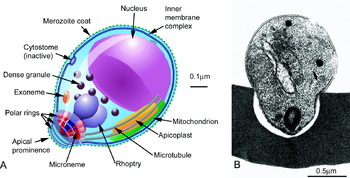
Dense granules, as currently defined, were recognized as a separate type of secretory organelle in Plasmodium merozoites some years later in 1975 (Bannister et al. Reference Bannister, Butcher, Dennis and Mitchell1975) by their rounded shape and timing of secretion late in invasion. An attempt to define them as ‘microspheres’ (Bannister et al. Reference Bannister, Butcher, Dennis and Mitchell1975) did not catch on, and so they have retained their unexciting name. However, some merozoite organelles customarily designated as dense granules have turned out to be distinctive in structure, contents and behaviour, being important in the exit of merozoites from schizonts rather than invasion. The precise routes of secretion by this organelle are not yet established, but gratifyingly they have been given a classical name, the exoneme (Yeoh et al. Reference Yeoh, O'Donnell, Koussis, Dluzewski, Ansell, Osborne, Hackett, Withers-Martinez, Mitchell, Bannister, Bryans, Kettleborough and Blackman2007). Their discovery suggests that we may have further suprises when merozoites are more fully analysed, although we may not always hope for classical terminology. A diagram depicting merozoite structure based on research over the last 40 years is shown in Fig. 1A.
(A) Summary of current views of the cellular organization of a Plasmodium falciparum merozoite, based on data from the last 40 years' research. (B) An electron micrograph showing a P. knowlesi merozoite imaged in the act of invasion into a red blood cell (reproduced from Bannister et al. Reference Bannister, Mitchell, Butcher and Dennis1986a).

Molecular composition of merozoites
Attempts to define the proteins of merozoites were initially driven by the hunt for immunogens suitable for vaccine use. Early studies used immuno-precipitation of metabolically radio-isotope labelled proteins with immune sera or inhibitory monoclonal antibodies (Deans, Reference Deans1984; Holder and Freeman, Reference Holder and Freeman1984). Similarly, labelling of intact merozoites with lactoperoxidase allowed the identification of surface components in P. falciparum, and, as methods of protein analysis improved, numerous merozoite components were identified by more advanced techniques and localized by IFA, IEM and, to a minor extent subcellular fractionation, to different organelles. An early discovery in Cohen's laboratory using these approaches was Pk66, later the Apical Membrane Antigen, AMA-1 (Deans et al. Reference Deans, Alderson, Thomas, Mitchell, Lennox and Cohen1982), a current vaccine trial component (see below).
The expansion of molecular biology in its many guises has of course now transformed the scene, with major players world wide and powerful new techniques of analysis.
MEROZOITE INVASION OF RED BLOOD CELLS
The pioneering study of RBC invasion by rodent malaria merozoites carried out by Ladda et al. (Reference Ladda, Aikawa and Sprinz1969) at WRAIR established the major events of this process, showing that after initial adhesion the parasite made apical contact, then moved into a deep pit formed in the RBC surface which eventually sealed over the merozoite to enclose it in a cavity lined by membrane (parasitophorous vacuole membrane, PVM). Two other aspects became clear – that rhoptries are depleted during this process, suggesting a vital role in bringing about RBC invasion, and the merozoite coat is removed. Subsequent work with the simian parasite P. knowlesi added further details, including the formation of an apical close junction with the RBC, which moves back over the merozoite as it invades (Aikawa et al. Reference Aikawa, Miller, Johnson and Rabbege1978), the discharge of dense granules into the PV towards the end of invasion (Bannister et al. Reference Bannister, Butcher, Dennis and Mitchell1975), and the structural transformation of the RBC membrane into the PVM (McLaren et al. Reference McLaren, Bannister, Trigg and Butcher1979; Aikawa et al. Reference Aikawa, Miller, Rabbege and Epstein1981). Video-imaging (Dvorak et al. Reference Dvorak, Miller, Whitehouse and Shiroishi1975) also demonstrated the rapidity of invasion, completed in about 1 min, and the strange convulsions undergone by the RBC surface during the process, still not understood. The molecular mechanisms underlying these events are still largely uncertain. An electron micrograph of an invading P. knowlesi merozoite is shown in Fig. 1B.
Formation of the parasitophorous vacuole and its membrane
Although it was recognized early on that rhoptries must be involved in the formation of the PVM, exactly how they might do this remains a mystery. IEM and other morphological evidence suggested that they insert new membrane into the RBC surface to cause its inward expansion (see Bannister et al. Reference Bannister, Mitchell, Butcher and Dennis1986a; Bannister and Dluzewski, Reference Bannister and Dluzewski1990; Dluzewski et al. Reference Dluzewski, Mitchell, Fryer, Griffiths, Wilson and Gratzer1992, Reference Dluzewski, Zicha, Dunn and Gratzer1995) but imaging of fluorescently labelled RBC membrane lipid during invasion appeared to contradict this view (Ward et al. Reference Ward, Miller and Dvorak1993). Currently, there are signs of a compromise solution, with evidence that some types of RBC lipid enter the PVM while others are excluded (Murphy et al. Reference Murphy, Fernandez-Pol, Chung, Prasanna Murthy, Milne, Salomao, Brown, Lomasney, Mohandas and Haldar2007), perhaps allowing room for the insertion of substantial amounts of parasite-derived membrane components. Although we know that some rhoptry proteins are transferred to the RBC during invasion (Ling et al. Reference Ling, Florens, Dluzewski, Kaneko, Grainger, Yim Lim, Tsuboi, Hopkins, Johnson, Torii, Bannister, Yates, Holder and Mattei2004), rhoptries in the allied apicomplexan T. gondii are less rich in lipids than are whole tachyzoites (Besteiro et al. Reference Besteiro, Bertrand-Michel, Lebrun, Vial and Dubremetz2008), the equivalents of the Plasmodium merozoite, so the mystery remains.
Host cell selection and capture by merozoites
How merozoites selectively capture RBCs has been a persistent problem over the years, still not yet quite resolved. All species of Plasmodium are known to have restricted ranges of host species and some are also restricted within species to either reticulocytes or mature RBCs. Despite this, work in the 1950's by McGhee with P. lophurae, whose natural host (on the surprising basis of a single isolation!) may be the Fire-backed Pheasant, succeeded in adapting this avian species to mice (McGhee, Reference McGhee1951). This lack of specificity may follow from the occurrence in avian malarias of secondary exo-erythrocytic development, since their merozoites freely invade endothelial and other cells. However, an early in vitro study with P. knowlesi merozoites co-cultured with RBCs of different mammalian species showed a strong positive correlation between merozoite adhesion and species susceptibility to infection (Butcher et al. Reference Butcher, Mitchell and Cohen1973), pointing to initial contact being critical for selection. From the 1970s onward, the availability of human RBC genetic variants resistant to malaria has provided natural tools to explore the mechanisms of selectivity. The first study centred on the resistance of many of West African descent to P. vivax infection due to the absence of the Duffy (Fy) blood group (Miller et al. Reference Miller, Mason, Dvorak, McGinniss and Rothman1975), a correlation also found for the closely related P. knowlesi. Miller's laboratory went on to show that P. knowlesi merozoites adhere to Duffy-negative RBCs but fail to form an apical junction (Miller et al. Reference Miller, Aikawa, Johnson and Shiroishi1979). The subsequent discovery of both the merozoite receptor, the micronemal Duffy-binding protein, DBP (Adams et al. Reference Adams, Hudson, Torii, Ward, Wellems, Aikawa and Miller1990) and its RBC ligand (Duffy antigen receptor for chemokines, DARC) gave hopes that a similar specific interaction might be found in P. falciparum.
A wide range of experiments over two or more decades have shown the situation in that species to be more complicated. From the mid-1980s when the first P. falciparum RBC-binding protein EBA-175 was reported (Camus and Hadley, Reference Camus and Hadley1985), an impressive number of putative merozoite adhesins have been characterized in this and other species of Plasmodium, several belonging to large polymorphic gene families (see Galinski et al. Reference Galinski, Dluzewski, Barnwell and Sherwin2005; Cowman and Crabb, Reference Cowman and Crabb2006). On the host side, it is clear that major RBC ligands for P. falciparum invasion include the sialylated transmembrane glycophorins A, B and C, but invasion can also occur in the absence of sialic acid, and no RBC ligand has been found individually indispensable for this species (Pasvol, Reference Pasvol2003), consistent with the early observation of redundancy of invasion receptor-ligand interactions (Mitchell et al. Reference Mitchell, Hadley, McGinniss, Klotz and Miller1986). Even the place of the Duffy antigen is open to question: trypsin or neuraminidase treatment of Fy-negative cells renders them susceptible to P. knowlesi invasion, without reversing their Duffy negativity (Mason et al. Reference Mason, Miller, Shiroshi, Dvorak and McGinniss1977) and in both Brazil and East Africa, cases of P. vivax have been reported in Fy-negative patients (reviewed by Pasvol, Reference Pasvol2007). It is also evident that the invading merozoite requires more than simply the red cell's membrane and glycocalyx in order for invasion to proceed: white ghosts are largely refractory to invasion, and a minimal content of red cell cytosol is required unless there is supplementation of the ghost contents with ATP (Dluzewski et al. Reference Dluzewski, Rangachari, Wilson and Gratzer1983). There is also a need for cytosolic Mg2+ ; in both cases the maintenance of phospholipid asymmetry in the membrane may be implicated (Field et al. Reference Field, Rangachari, Dluzewski, Wilson and Gratzer1992).
A further set of problems arises when one attempts to resolve at which stage of invasion an important merozoite molecule may function: for instance there is evidence for AMA-1 participating in either the reorientation step, or moving junction formation (Mitchell et al. Reference Mitchell, Thomas, Margos, Dluzewski and Bannister2004; Treeck et al. Reference Treeck, Zacherl, Herrmann, Cabrera, Kono, Struck, Engelberg, Haase, Frischknecht, Miura, Spielmann and Gilberger2009). Apart from the Duffy binding protein (see above), and perhaps the rhoptry adhesin, reticulocyte binding protein homologue 5 (PfRh5) which forms part of the apical/moving junction (Baum et al. Reference Baum, Chen, Healer, Lopaticki, Boyle, Triglia, Ehlgen, Ralph, Beeson and Cowman2009) in P. falciparum, it is not known where in the invasion process such interactions take place or to what extent different receptors and ligands interact sequentially.
As well as the secreted adhesins, EM strongly suggests that fixed, intrinsic merozoite surface coat components are also involved in RBC adhesion. In the 1970s it was suggested that the merozoite coat was an accretion from the host's blood plasma, but detailed EM analysis later showed it to be a genuine structural component of the parasite (Bannister et al. Reference Bannister, Mitchell, Butcher, Dennis and Cohen1986b). Since the first description of the major component, Merozoite surface protein (MSP)-1 (Freeman and Holder, Reference Freeman and Holder1983; Heidrich et al. Reference Heidrich, Strych and Mrema1983) at least 10 such proteins have been recently characterized, several of them linked to the merozoite membrane by GPI anchors (Gilson et al. Reference Gilson, Nebl, Vukcevic, Moritz, Sargeant, Speed, Schofield and Crabb2006). Proof that any of these are RBC receptors has been elusive, although recently some minor coat proteins (Pf 12, Pf 38) with at least theoretical adhesive properties have been found (see Cowman and Crabb, Reference Cowman and Crabb2006). How these proteins interact with secreted adhesins during the phases of invasion has not been explored as yet.
We are therefore left with the conclusion that there are multiple merozoite receptors, most of them secreted, for multiple RBC surface ligands, enabling the parasite to switch to alternative invasion pathways to exploit different RBC polymorphisms, and also likely to deflect the host's immune responses (see e.g. Pasvol, Reference Pasvol2003; Cowman and Crabb, Reference Cowman and Crabb2006). This situation doubtless reflects the intense interplay of defence strategies by parasite and host during the evolutionary past.
Merozoite proteases in invasion
This area of research has been complicated by the finding that protease inhibitors not only block invasion but also the exit of merozoites from mature schizonts, and it has been difficult to dissect the two processes. However, as long ago as 1983 Hadley and colleagues showed that invasion by isolated viable P. knowlesi merozoites could be prevented by protease inhibition (Hadley et al. Reference Hadley, Aikawa and Miller1983). This topic has only quite recently been clarified, showing that at least 2 sets of parasite proteases are necessary for invasion, both of them acting on the merozoite surface to cleave various merozoite surface components (Dowse et al. Reference Dowse, Koussis, Blackman and Soldati-Favre2008). Thus a micronemal protein Subtililisin-like protease (SUB)-2 is responsible for cleaving MSP-1 (Harris et al. Reference Harris, Yeoh, Dluzewski, O'Donnell, Withers-Martinez, Hackett, Bannister, Mitchell and Blackman2005), while one or more Rhomboids (e.g. Rh4) cleave various adhesins and other surface components (Baker et al. Reference Baker, Wijetilaka and Urban2006), both presumably necessary to allow the parasite to detach itself from the RBC membrane as it invades. In view of the major changes to the RBC membrane skeleton that must occur during invasion, it is to be expected that other proteases acting directly on the RBC during merozoite entry will be discovered. The observed blockade by protease inhibitors of schizont rupture to release merozoites has now been shown to act on a cascade of proteolytic events triggered by the release of Subtilisin-like protease (SUB)-1 from merozoite exonemes to cause the breakdown of the PVM and RBC membrane (Yeoh et al. Reference Yeoh, O'Donnell, Koussis, Dluzewski, Ansell, Osborne, Hackett, Withers-Martinez, Mitchell, Bannister, Bryans, Kettleborough and Blackman2007).
Merozoite motility
The early demonstration that cytochalasins halt invasion of P. knowlesi merozoites (Miller et al. Reference Miller, Aikawa, Johnson and Shiroishi1979) indicated that an actin-myosin motor powers this movement, as also later shown for other types of apicomplexan gliding locomotion. Actin was demonstrated in merozoites much later chemically (Field et al. Reference Field, Pinder, Clough, Dluzewski, Wilson and Gratzer1993) and by fluorescence microscopy (Webb et al. Reference Webb, Fowler, O'Shaughnessy, Pinder, Dluzewski, Gratzer, Bannister and Mitchell1996). This was followed by the discovery of a new form of myosin (type XIV) first in T. gondii (Heintzelman and Schwartzman, Reference Heintzelman and Schwartzman1997) and soon afterwards in P. falciparum, localized by IEM to the merozoite pellicle (Pinder et al. Reference Pinder, Fowler, Dluzewski, Bannister, Lavin, Mitchell, Wilson and Gratzer1998). Since then, several associated molecules have been described in Plasmodium merozoites and sporozoites, and in other apicomplexans, suggesting a generalized model for gliding locomotion in which myosin coupled to the inner membrane complex (IMC) moves on actin filaments attached through the plasma membrane to external ligands (e.g. the RBC membrane) (see Baum et al. Reference Baum, Richard, Healer, Rug, Krnajski, Gilberger, Green, Holder and Cowman2006 for recent review). Several uncertainties still exist over details of this model, but good progress is now being made.
Another set of cytoskeletal components, longitudinal microtubules, is associated with the inner surface of the merozoite pellicle, first described in detail for P. fallax in 1968, but rather neglected since. A possible role in invasion was suggested by the inhibitory effects of anti-microtubule drugs in P. falciparum invasion assays (Bejon et al. Reference Bejon, Bannister, Fowler, Fookes, Webb, Wright and Mitchell1997), but the EM evidence that microtubules act as tracks for microneme targeting to the merozoite apex (Bannister et al. Reference Bannister, Hopkins, Dluzewski, Margos, Williams, Blackman, Kocken, Thomas and Mitchell2003) provides an alternative explanation. Nevertheless, anti-microtubule agents do present another possible route for anti-malarial drug development either for this reason or their action on mitotic spindle microtubules during schizogony.
The merozoite and vaccine development
As mentioned at the beginning, immunogens derived from merozoites are important candidates in vaccine development, and clinical trials are at present being conducted on several, including MSP-1, MSP-3 and AMA-1, although there are many other possible targets to explore (Matuschewski and Mueller, Reference Matuschewski and Mueller2007). AMA-1 was first trialled as a P. knowlesi vaccine in macaques, using affinity-chromatography isolated protein, prepared using an invasion-blocking monoclonal antibody, in Cohen's laboratory at Guy's (Deans et al. Reference Deans, Knight, Jean, Waters, Cohen and Mitchell1988). Some 20 years later, it has been in Phase 1 clinical trials in Mali (Thera et al. Reference Thera, Doumbo, Coulibaly, Diallo, Kone, Guindo, Traore, Dicko, Sagara, Sissoko, Baby, Sissoko, Diarra, Niangaly, Dolo, Daou, Diawara, Heppner, Stewart, Angov, Bergmann-Leitner, Lanar, Dutta, Soisson, Diggs, Leach, Owusu, Dubois, Cohen, Nixon, Gregson, Takala, Lyke and Plowe2008). Athough the route between these points has been extraordinarily difficult (Remarque et al. Reference Remarque, Faber, Kocken and Thomas2008) the merozoite may yet prove the key to malaria immunization.
CONCLUSION
From this brief and very incomplete survey of merozoite research over the last 4 decades, it is clear that we still have much to learn about this small but highly complex parasite stage. The present upsurge of powerful new techniques and a new generation of able, strongly-motivated professionals give us hope that many of the old persistent puzzles will soon be settled, though a crop of new ones will doubtless emerge to take their place. The greatest challenge, of course, is to make use of this information for the control of malaria, something which after 40 years' experience of malaria research is to be sincerely hoped. This will need the cooperation of researchers from several disciplines, and the awareness of the parasite as an integrated biological entity rather than just an assembly of pieces. As we look down the microscope, or consider a sequence, we should remember Sun Tzu: ‘If you know yourself but not your enemy, for every victory gained you will also suffer a defeat.’