Japan's health insurance system is a universal care system, and public health insurance is available to all Japanese in principle. While the system is primarily funded by social insurance, public funding is used to maintain the universal care. For example, depending on patient age, income, and other factors, when an insured person classified as “working age” visits a hospital, the person typically has a co-pay of 30 percent of the total payment amount, while the remaining 70 percent is covered by public health insurance.
In fiscal year (FY) 2013, the national healthcare costs of Japan exceeded JPY 40,000B (approximately EUR 309.1B or USD 361.5B), with recent yearly increases of roughly JPY 800B to JPY 1,000B (approximately EUR 6.2 to 7.7B or USD 7.2 to 9.0B). These increases are thought to be due to the growing elderly population, the review of co-payment amounts by patients, and advancements in health care, among other factors. Of these, advancements in health care are considered to play a particularly large role due to the addition of new drugs, medical devices, and medical technologies to the insurance list (1).
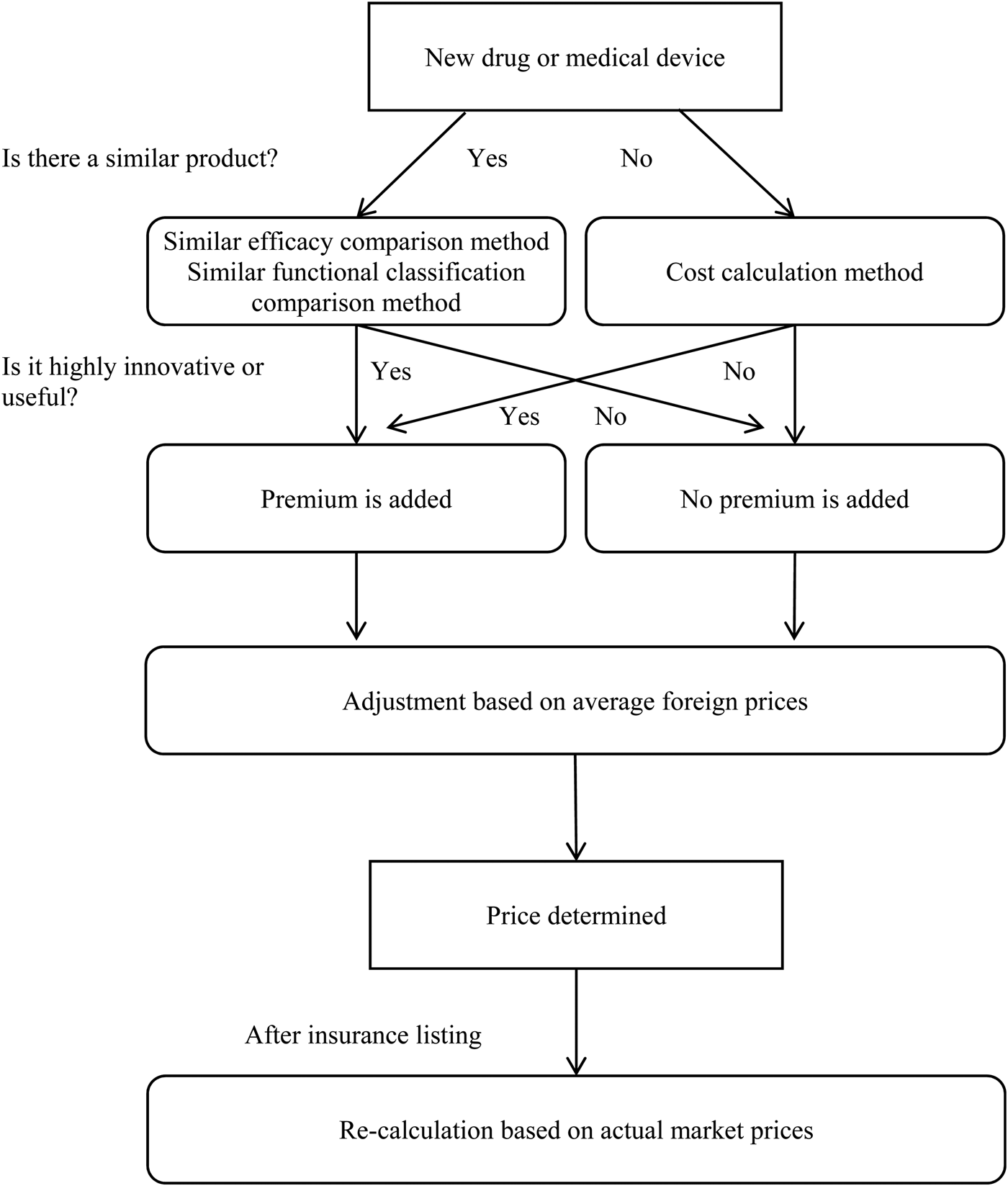
For new drugs and medical devices to be placed on the insurance list, the Central Social Insurance Medical Council (“Chuikyo”) determines the availability and range of reimbursement, as well as reimbursement prices, etc. Reimbursement prices are calculated using a formula specified by the Chuikyo. This calculation formula is based on a similar efficacy comparison method (similar functional classification comparison method), which refers to prices of drugs and medical devices with similar indications and efficacy. If there are no similar drugs or medical devices, then prices are calculated using the cost calculation method. For items considered highly innovative in terms of efficacy or safety, premiums are added to their prices. After a drug or medical device is added to the insurance list, the prices are revised once every 2 years in reference to average foreign prices and actual market prices (Figures 1 and S1) (2;3) (as of March 2018).
Overview of the price determination system for drugs and medical devices in Japan.

In recent years, an increasing number of costly and highly innovative drugs and medical devices have been added to the insurance list, offering considerable benefits to people and patients in terms of improved quality of life (QOL) and extended years of survival. This has also led to the inflation of healthcare costs, which has created concern about the impact on health insurance financing. Some countries with public health insurance systems similar to that in Japan reportedly assess the cost-effectiveness of drugs and medical devices and incorporate the evaluation results into the availability of insurance reimbursement and reimbursement price determination (4).
In Japan, health care with established efficacy and safety has been included in the scope of insurance benefits in principle. Cost-effectiveness has not been emphasized as a determining factor for insurance listing or price setting for drugs and medical devices. However, the Chuikyo has started discussing various methods that could be used for economic assessment, as well as the potential application of these to the health insurance system, in light of concerns about recent advancements in health care and their impact on health insurance financing. In 2012, a Special Committee on Cost-effectiveness Evaluation was established under the Chuikyo, which has been discussing how to introduce cost-effectiveness evaluation into the health insurance system, in addition to an implementation structure for evaluation, evaluation methods, and methods for using the evaluation results.
Methods
The basic idea underlying the application of cost-effectiveness evaluation in Japan's health insurance system is that the scope of evaluation should only include (i) therapies for which a certain degree of safety and efficacy have been established, and (ii) those with a potentially larger impact on healthcare financing relative to other existing alternative therapies. In addition, this system would exclude therapies for rare diseases from its scope, thereby avoiding the inclusion of all drugs and medical devices into the scope of evaluation. The basic idea also assumes that the principle would be maintained to ensure a comprehensive assessment of drugs and medical devices from various perspectives including safety and efficacy, while pursuing a more reasonable assessment that would use the results of cost-effectiveness evaluation. Cost-effectiveness evaluation should only comprise a part of the assessment of drugs and medical devices and be applied with certain flexibility, rather than determining and assessing the availability of insurance listing or reimbursement prices solely based on results of the evaluation (5).
Regarding the adoption of cost-effectiveness evaluation, the Chuikyo has also discussed specific methods and cases involving cost-effectiveness analysis, as well as initiatives in foreign countries. In 2015, a closed examination was held concerning methods used to evaluate cost-effectiveness, targeting specific drugs and medical devices. During this process, manufacturers were requested to submit data and analyses concerning the properties of applicable drugs and medical devices, settings for analysis, efficacy data, detailed analysis methods, and analysis results and interpretation, among other items. Submitted data were re-analyzed and overall assessed, and the results of this process were used to create a system to evaluate cost-effectiveness (6;7).
According to the “Basic Policy on Economic and Fiscal Management and Reform 2015,” a Cabinet decision at the Council on Economic and Fiscal Policy held in June 2015, “The government will continue to review specific contents when it comes to the full-scale implementation of cost-effectiveness evaluations, and will come to a conclusion in FY 2018” (8). In response to this, in the end of 2015, the Chuikyo summarized selection criteria and an analysis framework toward the trial adoption of cost-effectiveness evaluation to establish a relevant system, referring to past discussions (9). The decision was made to both adopt cost-effectiveness evaluation on a trial basis in April 2016, and establish a cost-effectiveness evaluation expert organization to perform the actual overall assessment (“appraisal”) of cost-effectiveness for individual items.
In this trial adoption, target items were selected, their cost-effectiveness was analyzed, and an appraisal was performed based on the “Notification Concerning the Handling of Cost-Effectiveness Evaluation for Drugs and Medical Devices,” issued by the Ministry of Health, Labour and Welfare on February 10, 2016 (10) (Figure S2). The specific evaluation process is described below.
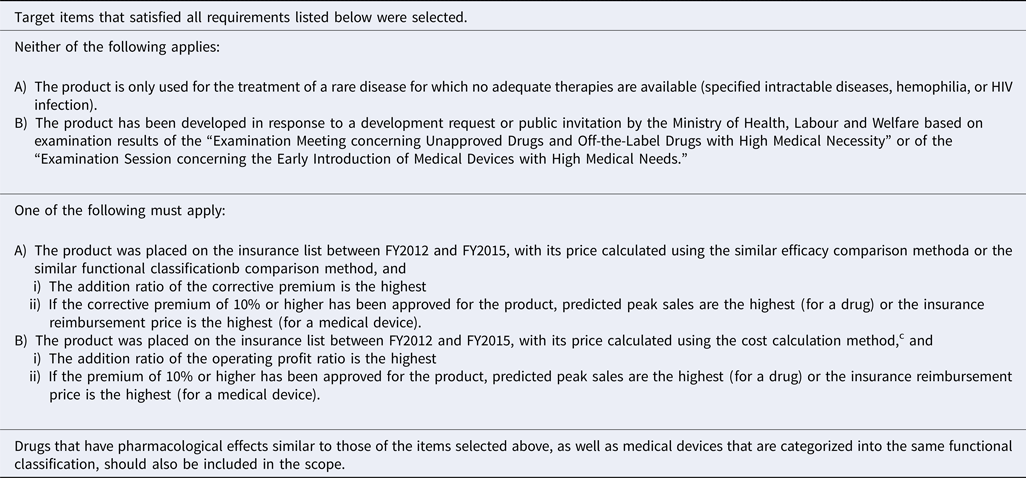
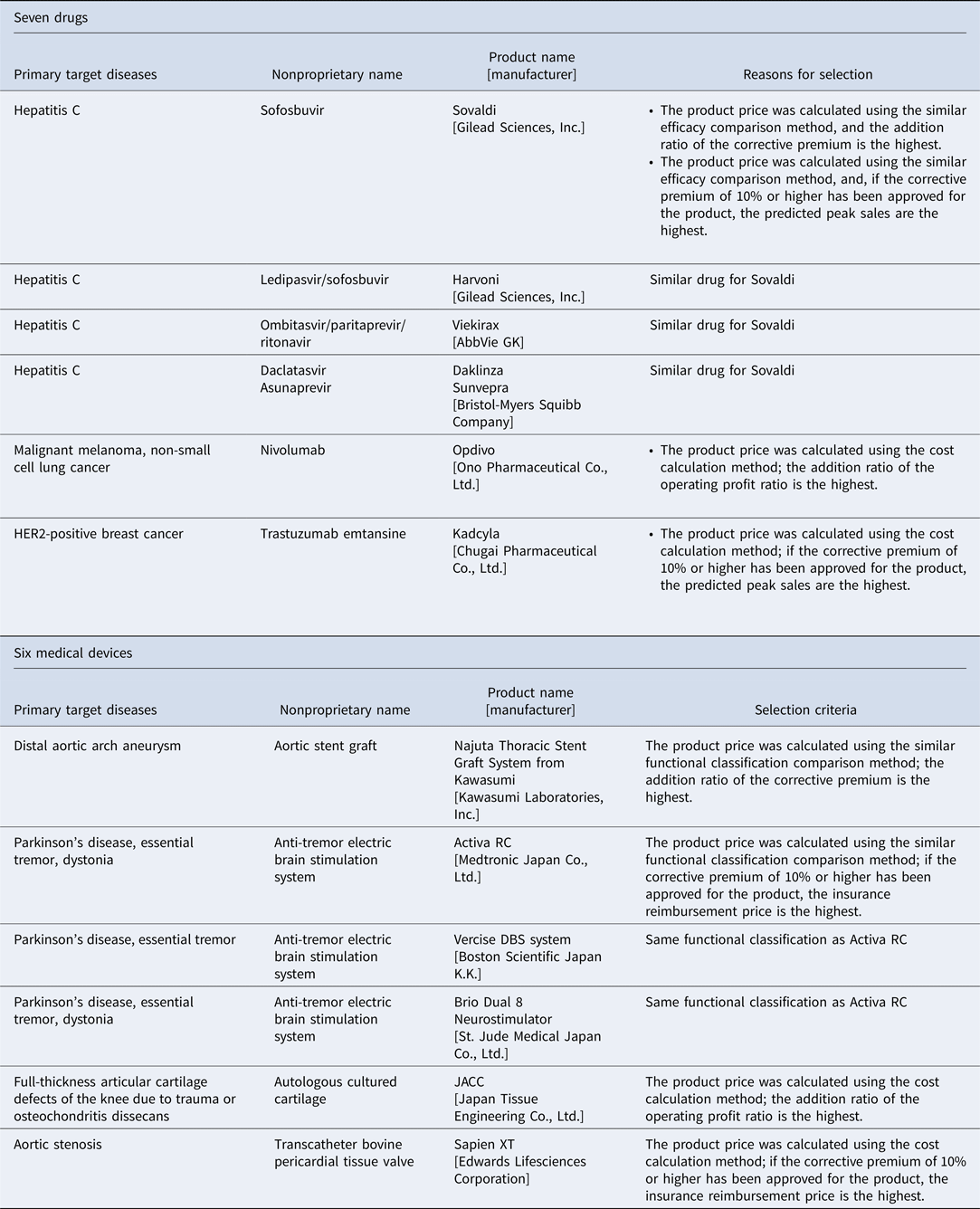
Regarding the selection of target items, seven drugs and six medical devices that had already been added to the insurance list were included in the scope of the cost-effectiveness evaluation, in accordance with the criteria specified by the Chuikyo (11) (Tables 1 and 2). To efficiently promote the flow of evaluation, a preliminary consultation service was provided to manufacturers of the target items concerning analysis methods, etc., before beginning the cost-effectiveness analysis.
Selection Criteria for Target Items in the Trial Adoption of Cost-Effectiveness Evaluation

aThe similar efficacy comparison method refers to a calculation method wherein the price of a new drug is determined based on a comparator with similar pharmacological effects pertaining to its key indication and efficacy, if the new drug is minimally innovative.
bFunctional classification refers to a division that includes a group of special treatment materials considered to have similarity in terms of structure, purpose of use, and/or medical indication and efficacy. The similar functional classification comparison method refers to a method wherein the standard material price for a new functional classification that includes a new listed item is determined based on the standard material price for a similar functional classification.
cThe cost calculation method refers to a method wherein the standard price is calculated by adding sales, general and administrative expenses, operating profit, distribution expenses, and consumption tax equivalents to the cost incurred on the manufacturing or import of a new listed item. The operating profit ratio should be adjusted in accordance with the innovativeness of the new listed item (addition to or subtraction from the operating profit ratio), referring to industry trends.
Overview of Target Items in the Trial Adoption of Cost-Effectiveness Evaluation

The cost-effectiveness analysis was performed by manufacturers of the target items, in accordance with the “Analysis Guidelines for Cost-Effectiveness Evaluation by the Central Social Insurance Medical Council” (“Analysis Guidelines”) (12). This analysis estimated the respective costs and effectiveness of medical technologies/items subject to evaluation and of control medical technologies/items, and incremental cost-effectiveness ratios (ICERs) were calculated. In principle, “costs” noted above only included public healthcare costs, while the estimation included costs on adverse events and future associated complications. Public long-term care expenses and lost productivity resulting from the target diseases were excluded from the costs. Public healthcare costs included not only coverage by insurers, but also co-payments by patients. Quality-adjusted life-years (QALY) were primarily used to indicate “effectiveness.” Other indicators were applied in accordance with characteristics of the diseases and of the drugs and medical devices. For QOL values as the basis of QALY calculation, EQ-5D and other methods were applied to incorporate values held by the general public (12).
Analyses and data submitted by manufacturers underwent a neutral review by a public expert organization. During this process, details of analyses submitted by manufacturers were verified, and evidence reviews and other analyses were conducted when necessary. Reviews were mainly undertaken by external experts (review group) entrusted by the National Institute of Public Health (10). In many countries, such neutral evaluation is considered important, and is usually led by a national or public institution (4).
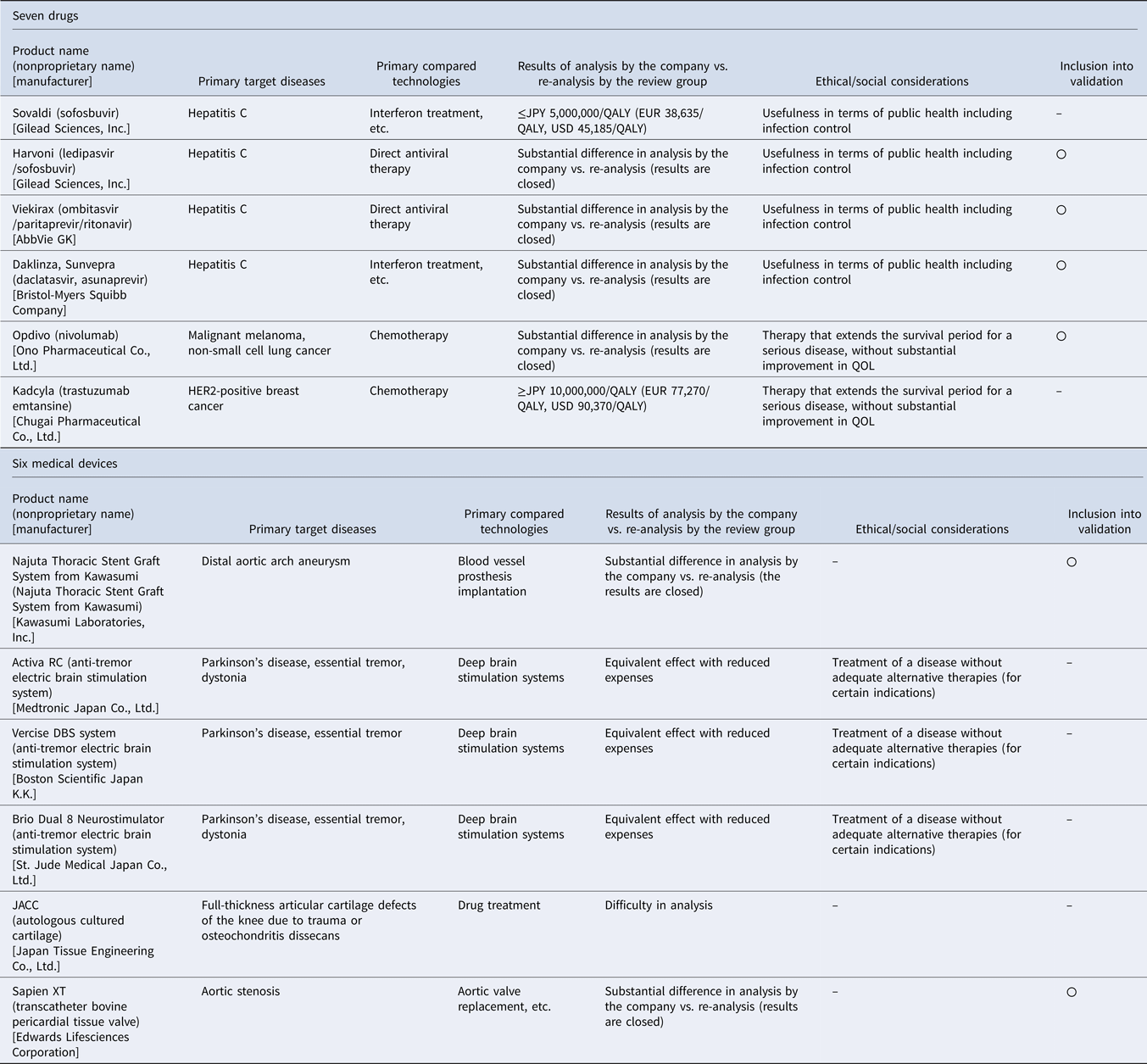
The results of analyses by manufacturers and the review group were reported to the cost-effectiveness evaluation expert organization, which in turn conducted an appraisal consisting of verification from a scientific perspective as well as from ethical and social influence perspectives. Discussions at the cost-effectiveness evaluation expert organization were confidential to ensure confidentiality. An overview of the results of the cost-effectiveness evaluation for target items discussed by the cost-effectiveness evaluation expert organization was published (13) (Table 3) and used for price adjustments.
Overview of Evaluation Results of 13 Target Items in the Trial Adoption of Cost-Effectiveness Evaluation

When appraisal results were used for price adjustments, if more than one ICER was calculated depending on the target population, etcetera. for the same target item, a weighted mean of the ICERs (price adjustment coefficient) was used based on the share of user patients. This is because only one price is applied to a given item in Japan, regardless of applicable diseases. For items that are examined from ethical and social influence perspectives, 5 percent was deducted from the ICER of the relevant population before calculation of the weighted mean of ICERs (14). Price adjustment coefficients that were calculated as above were incorporated into prices based on the calculation formula specified by the Chuikyo (Figure S3) (15;16). If an item has been proven, through clinical studies or other means, to have an equivalent or higher efficacy than that of conventional therapies while reducing expenses, and if the item exceeds the range of common improvement relative to conventional therapies, then an amount no larger than 10 percent of the price before calculation using the price adjustment coefficient is added as a premium to the final price (15;16).
Results
The trial adoption of cost-effectiveness evaluation took approximately 2 years and involved the inclusion of selection of drugs and medical devices into the scope of evaluation, the preliminary consultation service, analysis implementation, and appraisal completion. Through its appraisal of analysis results for target items, the cost-effectiveness evaluation expert organization determined that both the analysis by manufacturers and re-analysis by the review group were conducted in accordance with the Analysis Guidelines (17).
While the analysis and re-analysis were overall fairly consistent and led to a consensus for some items, substantial differences were identified for other items (13). For items with contradicting results, the analysis and re-analysis both demonstrated scientific validity, and it was difficult to judge clearly and immediately which results were more valid (17). In these cases, price adjustments for target items were conducted either in a range where the analysis results of manufacturers matched those of the review group, or using analysis results which were less influential through price adjustment; these were incorporated into the price revisions of April 2018 (17). Specifically, the price of the Najuta Thoracic Stent Graft System from Kawasumi (aortic stent graft) was increased, while prices of Opdivo (nivolumab) and Kadcyla (trastuzumab emtansine) were decreased (18). Based on the evaluation results, price adjustments were not applicable to the other target items.
Items for which cost-effectiveness analysis results by manufacturers differed substantially from those of the review group were Harvoni (ledipasvir/sofosbuvir), Viekirax (ombitasvir/paritaprevir/ritonavir), Daklinza (daclatasvir), Sunvepra (asunaprevir), Opdivo, Sapien XT (transcatheter bovine pericardial tissue valve), and Najuta Thoracic Stent Graft System from Kawasumi (13) (Table 3). Further verification will be needed to obtain more valid analysis procedures for these items. Final evaluation results will be summarized by the end of 2018 to perform final price adjustments (19).
Discussion
The “Basic Policy on Economic and Fiscal Management and Reform 2015,” a Cabinet decision at the Council on Economic and Fiscal Policy held in June 2015, states that “The government will continue to review specific contents when it comes to the full-scale implementation of cost-effectiveness evaluations, and will come to a conclusion in FY 2018” (8). In response to this, the Chuikyo examined the requirements for establishing a cost-effectiveness evaluation system in healthcare insurance.
The first requirement was selection criteria, for which the focus was whether drugs and medical devices to be assessed should be selected from new drugs and medical devices to be listed (new listed items) or from existing items on the insurance list (existing listed items). In many foreign countries, cost-effectiveness evaluations are performed on newly listed items. In Japan, however, drugs are placed on the insurance list within 60 days from their authorization in principle. Some time constraints exist in conducting a cost-effectiveness analysis, assessing the analysis results, and incorporating the evaluation results within this timeframe. Thus, a decision was made first to introduce cost-effectiveness evaluation on a trial basis for existing items on the list, and then perform price adjustments for those items (20). However, if the cost-effectiveness evaluation is performed on drugs and medical devices that had been listed for many years, products that are no longer commonly used in clinical settings could potentially be included in the scope of evaluation. Based on this, the scope only included items that were listed within the preceding 4 years (from FY 2012 to FY 2015) (20).
Furthermore, because efforts to consider introducing the cost-effectiveness evaluation system began in response to concerns about the impact on health insurance financing, the trial adoption targeted drugs and medical devices that were highly innovative and highly influential on financing. Therefore, targets were selected based on the highest corrective premiums and premiums on operating profit ratios (assessment of innovation), as well as sales at peak (financially influential) (20) (Table 1). In addition, for new listed items, the trial adoption required the submission of analysis results in accordance with the Analysis Guidelines and with the application for listing. However, evaluation results were not used for price adjustments (20).
The second requirement pertained to methods for using evaluation results. In many countries, results of cost-effectiveness evaluations are used to determine whether or not public health insurance systems should be applied to drugs, etc. In Japan, however, health care with established efficacy and safety has been included into the scope of insurance benefits in principle. Therefore, results of the cost-effectiveness evaluation were selected for use in price adjustments, but not to determine the availability of insurance reimbursements (20;21).
The third requirement was the establishment of standard values for incorporating evaluation results into price adjustments. To establish standard values for the trial adoption, the following rules were specified, referring to the system in the United Kingdom, where the living standards are relatively similar to those in Japan. Specifically, the acceptability of a target technology should be determined on a case-by-case basis up to the ceiling of GBP 30,000/QALY (JPY 4,360,000/QALY). It was also noted that WHO and other organizations used standard values based on fixed magnifications, and that, according to the co-payment willingness survey conducted by Shiroiwa and others in 2010, the 50 percentile value of tolerable co-payment was JPY 4,850,000/QALY (EUR 37,476/QALY, USD 43,829/QALY) (4;22;23).
1. Price adjustment will not be conducted if the price adjustment coefficient is ≤ JPY 5,000,000/QALY (EUR 38,635/QALY, USD 45,185/QALY).
2. Price adjustment will be conducted, depending on evaluation results, if the price adjustment coefficient is ≥ JPY 5,000,000/QALY (EUR 38,635/QALY, USD 45,185/QALY), and up to JPY 10,000,000/QALY (EUR 77,270/QALY, USD 90,370/QALY).
3. Price adjustment will be conducted at the upper limit of the price adjustment range, if the price adjustment coefficient is ≥ JPY 10,000,000/QALY (EUR 77,270/QALY, USD 90,370/QALY).
As described above, cost-effectiveness evaluation was adopted on an experimental basis, after repeated discussions regarding its requirements. Specifically, these included selection criteria for items to be included within the scope of evaluation, analysis methods, evaluation methods, and methods for incorporating evaluation results. New technical requirements were identified while the processes of selection, analysis, appraisal, and price adjustment were carried out for drugs and medical devices targeted in the trial adoption (17). In this trial adoption, preliminary consultation services were provided concerning the analysis framework in accordance with the Analysis Guidelines, before the start of the analysis by manufacturers. Despite the certain agreement formed as above, differences in recognition between the two parties and in opinions concerning more adequate data were left unresolved before conducting the analysis, resulting in contradictory analysis results (17). Further verification will be needed to determine more valid analysis procedures for items for which analysis results differ between the two parties. Subsequent examinations will be conducted by experts in health economics and other disciplines, and their input will be used in discussions by the Chuikyo (17;19).
Solutions to the technical requirements described above must be examined and processed, and the specifics of establishing a cost-effectiveness evaluation system must be discussed. Based on our experience with this trial adoption, examination will be started toward the establishment of a system, concerning the selection criteria for items to be included within the scope of cost-effectiveness evaluation, analysis methods, evaluation methods, and methods for incorporating evaluation results. The examination process will begin by targeting requirements that are ready to be discussed, and conclusions will be drawn by the end of FY 2018 (17;19).
In conclusion, the present report provides an overview of the purpose, methods, results, and other matters pertaining to the trial adoption of a cost-effectiveness evaluation system in Japan that began in FY 2016. Further progress toward the establishment of this system will be made in accordance with this experience.
Supplementary material
The supplementary material for this article can be found at https://doi.org/10.1017/S0266462319000060.
Conflicts of interest
The authors declare that there are no conflicts of interest.