

In spite of the popularity of cognitive behavior therapy (CBT) and much evidence supporting its overall efficacy (e.g., Blanchard, 2003; Cohen, Mannarino, & Murray, Reference Cohen, Mannarino and Murray2011; see also, Foa et al., 2008), there are few culturally sensitive CBT treatments available for Muslim cultural groups. There are currently around 1.6 billion Muslims in the world (a number expected to rise to 2.2 billion by the year 2030), with about 3.5 million Muslims living in the United States and 2.5 million in the United Kingdom (Pew Research Center, 2013). Additionally, given social and political unrest in the Middle East, Western countries (e.g., Europe, North America, and Australia) are likely to see an influx of Muslim refugees and immigrants in future years, many of whom suffer from mental disorders, including anxiety (e.g., post-traumatic stress disorder [PTSD]) and depressive disorders. There are also an increasing number of Muslims in the West currently finding themselves in need of therapeutic and social work services due to the negative impact of Islamophobic victimization, which likewise speaks to the pressing need for culturally sensitive treatments for this population.
Multiplex therapy as adapted for Muslim groups seeks to fill this gap by providing an accessible CBT treatment manual tailored primarily (but not exclusively) for Muslims living in the Western world (i.e., North America, Europe, as well as Australia), including immigrants and refugees, and other subgroups such as African Americans and second, third, and fourth generation American and European Muslims. The treatment manual is unique in that it takes into account the religious, spiritual, social, and cultural dimensions of individuals with a Muslim religious and/or cultural background. That is, the therapy frames treatment elements – that include mindfulness, loving-kindness meditation, attentional shifting, emotion regulation, yoga-like stretching, psychoeducation, anger management, and addressing catastrophic cognitions, pathological worry, and sleep-related problems (including sleep paralysis and nightmares) – in the context of well-known Islamic terms and concepts. Such cultural framing promotes treatment adherence and creates positive expectancy about treatment (Hinton & Jalal, Reference Hinton and Jalalin press), a major predictor of positive outcome in psychological research (e.g., Price, Finniss, & Benedetti, Reference Price, Finniss and Benedetti2008). Indeed, culturally sensitive treatments have increased beneficial effects compared to non-adapted ones through the framing of treatment in terms of the patient’s own understanding of disorder (Benish, Quintana, & Wampold, Reference Benish, Quintana and Wampold2011).
Multiplex CBT has been shown to be effective for multiple cultural groups including Southeast Asian groups and South African tribes (Cambodian, Vietnamese, Sepedi) (Hinton, Pham et al., 2004; Hinton, Chhean et al., 2005; Hinton, Hofmann, Pollack et al., 2009; Hinton, Hofmann, Rivera et al., 2011; Jalal et al., Reference Jalal, Kruger and Hintonin review) as well as multiple Muslim populations (Afghan, Egyptian, Syrian, and Turkish) (Acarturk, Abuhamdeh et al., 2019 Acarturk, Alyanak et al., in press; Jalal, Samir, & Hinton, Reference Jalal, Samir and Hinton2017; Shaw et al., Reference Shaw, Ward, Pillai and Hintonin press). Those studies have demonstrated the efficacy of culturally adapted (CA) Multiplex CBT as compared to waitlist and applied muscle relaxation with large effect sizes similar to those resulting from traditional CBT. These studies have shown the efficacy of CA Multiplex CBT in both individual and group formats.Footnote 1
Multiplex CBT takes into account issues like prominent somatic symptoms, low education, multiple comorbidities, ongoing life difficulties (e.g., financial stresses), and stigma about mental health, all of which are common challenges in Muslim populations and minority groups living in the West (Amer & Jalal, Reference Amer, Jalal, Ahmed and Amer2011; Jalal, Samir, & Hinton, Reference Jalal, Samir and Hinton2017). Overall, Multiplex Therapy aims to be consistent with core Islamic beliefs, which may encourage this large population to seek treatment for their mental health problems. This is important, as there is often a distrust of mental health treatment among Muslims; psychotherapy and counselling, especially among first-generation immigrants, are seen as a secular science incongruent with basic Islamic values (Amir & Jalal, 2011). As such, this treatment manual is an important tool for therapists working in culturally diverse mental health settings.
Multiplex CBT as adapted for Muslim populations is also clinically relevant for non-Muslims. Indeed, its cultural framing could be considered as comparative examples that are used to better illustrate general therapeutic principles, as done with meditation and other Buddhist practices and principles, which are taught regardless of the religion of the individual in question. That is, showing how the treatment was adapted for Muslim populations illustrates general issues of adaptations as well as universal therapeutic principles, and the adaptation for a group of those universal principles.
Overview of Multiplex CBT
There are many obstacles when adapting standard CBT interventions (Foa & Rothbaum, Reference Foa and Rothbaum1998; Resick & Schnicke, Reference Resick and Schnicke1996) to minority or cultural/religious groups. Such groups, including refugees and immigrants, may have low education, experience stigma about mental health and, crucially, have often undergone extensive traumas. As a result, standard treatment CBT techniques such as prolonged exposure for trauma may not be ideal for such groups, particularly those currently living in situations of stress and adversity (Hinton & Good, Reference Hinton and Good2016; Hinton, Rivera et al., Reference Hinton, Rivera, Hofmann, Barlow and Otto2012), like those living in refugee centers and impoverished urban areas. Moreover, standard CBT does not make somatic symptoms a key therapeutic target and does not take into consideration that catastrophic cognitions about symptoms such as somatic symptoms, and comorbid conditions like worry, may vary across ethnic and cultural/religious groups (Hinton & Good Reference Hinton and Good2016; Hinton, Rivera et al. Reference Hinton, Rivera, Hofmann, Barlow and Otto2012).
Multiplex CBT addresses many such challenges arising from working among refugee and minority populations (Hinton & Good, Reference Hinton and Good2016; Hinton, Rivera et al., Reference Hinton, Rivera, Hofmann, Barlow and Otto2012). The key elements and overall session structure of Multiplex Therapy are shown in Table 1. For example, Multiplex CBT focuses on somatic symptoms and sensorial experiencing, as well as attentional processes, and stresses the importance of identifying and addressing key catastrophic cognitions that emerge from ethnopsychology and ethnospirituality such as catastrophic cognitions about “worry” and worry-induced symptoms; another focus is arousal and symptoms of arousal such as anger, which is a major treatment issue in cultural groups in stressful contexts (Hinton, Rasmussen et al., Reference Hinton, Rasmussen, Nou, Pollack and Good2009).
Multiplex CBT is presented in an accessible way so that it can be administered both by highly trained clinicians (psychiatrists and clinical psychologists) and also by lesser-educated therapists. This is to ensure broader public health impact. The therapy is designed in a way that makes it accessible to patients with minimal or no schooling/education, which may be the case in refugee and immigrant populations and other lower-socio-economic status (SES) groups. To have wider public health impact (as dropout rates are typically high in minority groups such as among immigrants and refugees and other lower-SES communities), the treatment is relatively short, consisting of ten sessions (approximately one hour/session) that can be delivered once, twice, or three times a week, and can be administered to both individuals and groups of patients.
Multiplex CBT relies on a unique approach to exposure, with an emphasis on the emotion regulation of dysphoric states induced by asking about recent distressful memory recall and events. The patient is asked to describe such recall or other distressful events and then instructed to engage in emotion regulation techniques (i.e., what we call the Bad Memory Protocol [Emotion Regulation Toolbox], see Table 1) following the elicitation of distressing memories, including mindfulness, loving kindness, and applied muscle stretching with a visualization. It also includes interoceptive exposure to somatic sensations, many of which are thought to encode distressing events; the somatic distress cue is paired to a positive association (e.g., dizziness paired to positive memories of experiencing dizziness). Multiplex CBT uses yoga-like stretching and meditation techniques to promote emotional and psychological flexibility. It emphasizes the treatment of somatic sensations, targets comorbid anxiety conditions and anxiety-type psychopathological processes such as worry and panic attacks, and aims to reduce anger.
Finally, Multiplex Therapy is transdiagnostic in its approach, targeting anxiety and mood disorders, making it broad in its scope and applicable to a large segment of mental health patients. Such a transdiagnostic treatment also offers benefits such as ease of implementation (due to a decreased need for multiple manuals/treatments) and the possibility of providing group treatments to patients diagnosed with heterogeneous emotional disorders. The transdiagnostic therapeutic approach is increasingly being adopted as the preferred method of treatment, and as such is highly relevant to this cultural group.
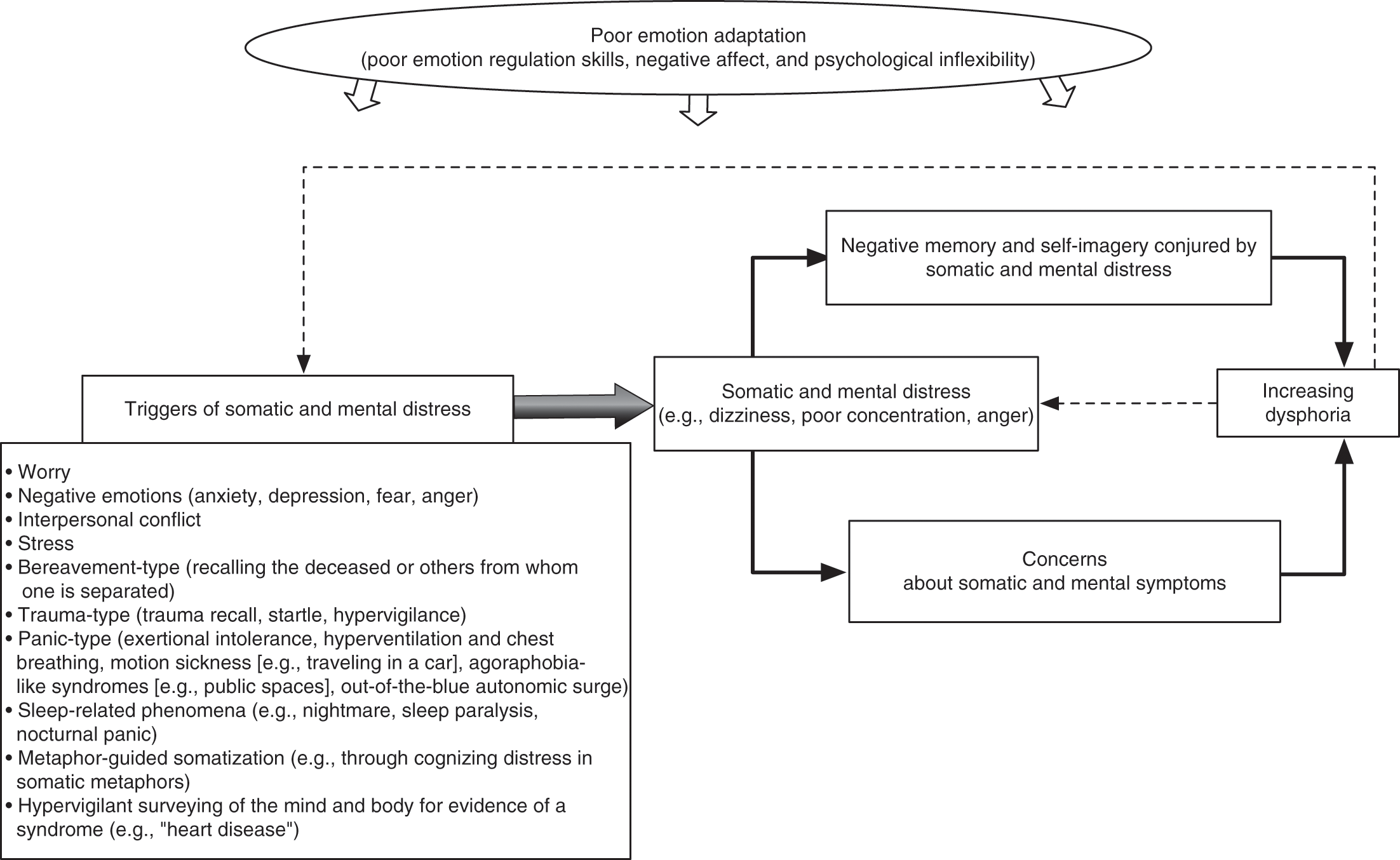
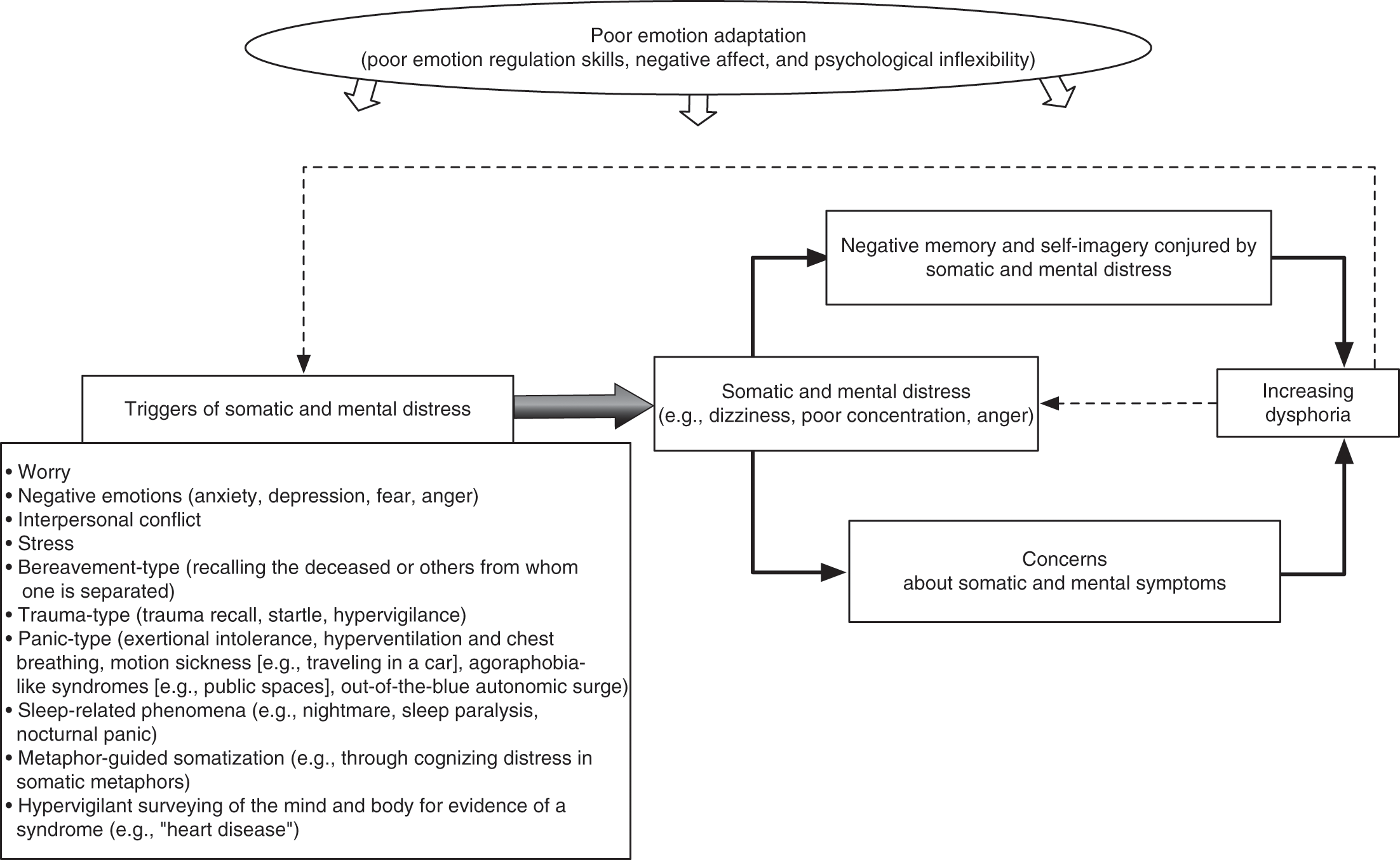
We refer to the treatment as multiplex CBT because it targets multiple processes in our model of how anxious-depressive distress is generated, which is shown in Figure 1. As can be seen, the model emphasizes the role of somatic and mental symptoms, cultural understanding of symptoms, and emotion regulation processes. Our treatment targets processes in this model, as shall be discussed in more detail.
The Multiplex Model of the Generation of Anxious-Depressive Distress
Cultural Framing for a Muslim Population
Culturally adapted Multiplex CBT takes into account the fact that Muslims living in the West have immigrated or may be the descendants of immigrants from a multiplicity of countries (e.g., Iraq, Syria, Turkey, Lebanon, Afghanistan, India, Pakistan, Bangladesh, and Somalia) and thus may represent, in some cases, diverse cultures. In America, there is, for instance, a strong presence of culturally distinct Muslim subgroups such as African American (approx. 20 percent of the US Muslim population) and, to a lesser extent, Caribbean Muslims. Similarly, there is a large group of Western Muslims who have converted into the faith. Although these groups may have unique cultural traditions, they all have in common basic Islamic beliefs as derived from the Quranic scripture and prophetic tradition (i.e., the “hadith literature”). This Islamic foundation should appeal across ethnicity, racial group, gender, SES, and age.
This approach of emphasizing basic Islamic teachings should appeal to persons from the various denominations of Islam. This includes major branches like Sunni (roughly 90 percent of all Muslims) and Shia (roughly 10 percent of all Muslims [often originating from Iran, Iraq, and Bahrain]). Whereas groups such as Sufi and Salafi (the latter prevalent in a Saudi Arabian context) are characterized by unique traditions in their own right, their teachings and practices broadly fall under the umbrella of Sunni Islam. It is worth pointing out that the hadith tradition, unlike Quranic scripture, may vary for Sunni and Shia Muslims. While Multiplex CBT refers to hadith literature derived from Sunni tradition (as noted, the largest Islamic denomination), the vast majority of Islamic references used in Multiplex CBT are quite basic and generally accepted and thus should appeal to all Muslims regardless of denomination.
Multiplex Therapy as adapted for Muslims aims to target heterogeneous Muslim populations by appealing to their underlying Islamic cultural heritage and belief systems. As an integral part of their culture, these group members would likely be familiar with basic Islamic concepts such as salah (ritualistic prayer that includes bodily motions), dua (supplication, that is, asking God for various worldly favors or spiritual elevation and forgiveness), fitraFootnote 2 (one’s natural or primordial state), sadaqah (charity), tazkiyahFootnote 3 (inner purification), wudhu and ghusl (ritualistic washing), dhikr (religious chanting as narrated in authentic hadith literature), husnu dhun bilah (having positive thoughts about Allah), shukr (gratefulness), sunnahFootnote 4 (prophetic customs and etiquettes), haya (chastity), istighfar (asking for forgiveness), qadr (predestination), and asma-ul-husna (Allah’s 99 names as mentioned in the Quran). Members of such populations should readily identify with and accept well-known Quranic verses such as “Allah doesn’t burden a soul beyond its capacity” (Quran 2:286) and “in the remembrance of God the hearts find rest” (Quran 13:28); prophetic sayings (e.g., “smiling in the face of your brother is charity”Footnote 5) and narrations that emphasize the importance of cheerfulness and optimism; and stories of the prophets, for example, those of Yusuf (Joseph), Yacub (Jacob), and Ayub (Job), who remained optimistic, grateful and patient in spite of facing much adversity. Such cultural and religious terms, concepts, and parables are incorporated into the therapy thereby making it potentially more culturally consonant, acceptable, and relatable. In short, culturally adapted Multiplex CBT for Muslim populations emphasizes basic Islamic terms and concepts, thus making it accessible and relevant to Muslims of various ethnic and cultural backgrounds.
Nonetheless, regardless of the general appeal of Multiplex CBT’s cultural adaptation, clinicians working with Muslim patients should always be flexible vis-à-vis religious adaptation. These must be personalized to the individual client’s needs and background. Ideally, such a personalized approach would entail an initial assessment (e.g., in the form of an open dialog during the intake) about the patient’s level of religiosity and cultural background (e.g., whether the patient is an African-American convert from Detroit versus a recent refugee from war-torn Syria) (see also, e.g., Amer & Jalal, Reference Amer, Jalal, Ahmed and Amer2011). By so doing, the therapist is able to better determine how much to emphasize and how to frame religious/cultural adaptation. For patients who are not religious, the religious rephrasing may be used as an example to make the concepts more understandable.
Key Treatment Dimensions of Multiplex CBT and the Adaptation for Muslim Populations
Here we discuss key treatment dimensions of Multiplex CBT and their adaptation for Muslim populations.
Normalizing Treatment and Promoting Adherence and Positive Expectancy
One way to normalize the treatment and create positive associations and expectancy is to provide certain descriptions of the entire treatment and its specific elements, grounding these elements in terms of culturally salient practices and metaphors. For example, in Multiplex CBT, treatment is compared to the making of a special cultural dish that involves multiple culinary steps in order to promote positive expectancy and to teach patience about the timeframe of improvement. As Muslims living in the West often have migrated from a multiplicity of countries with unique cultures and cuisines, one can refer to a special dish from the patient’s culture, for example, by directly asking the patient about such cultural foods. This metaphor naturalizes treatment and teaches the patient that the treatment process takes multiple steps and requires patience, as does cooking. Thus, such metaphors that emphasize the need to complete all parts of the treatment, like those in which all elements of the treatment are analogized to the myriad steps needed to prepare a dish, may help increase credibility, positive expectancy, and tolerability, and address structural barriers.
As another way to increase overall adherence to the treatment, the therapist may similarly highlight the numerous verses from the Quran and sayings of prophet Muhammad stressing the importance of being patient in order to achieve one’s goals (examples will be provided in the sessions that follow). In addition, as noted previously, Multiplex CBT frames CBT techniques in terms of Islamic healing traditions, thereby normalizing the process of treatment and increasing acceptance and positive expectancy. Examples include doing dhikr (i.e., engaging in the remembrance of Allah) to change attentional focus to a positive attentional object by engaging in the consecutive articulating of different names of God, which embodies attentional shift and a kind of descriptive flexibility, a viewing of an “object” from different perspectives.
Cultural Education about Anxious-Depressive Distress: The Inner Child
Educating patients about the anxiety-depressive state and psychopathological distress is another key part of Multiplex CBT. To this end, we use the metaphor of the “inner child” (an analogy for the brain’s limbic system). This is a way of analogizing a distress state and its resolution to a common daily-life event; that is, using a disturbance-and-resolution analogy, a grounding image of emotion regulation. It helps to attain distance from the negative state and mobilize self-soothing capacities. It is also an opportunity to teach emotion regulation techniques. The inner child metaphor is introduced in the following way, using the example of negative memory or an upsetting event. We explain that an inner child keeps thinking about the distressing event(s), is continually frightened by it, and that this inner child, when reminded of the past, causes one to have strong emotions, such as feeling angry or sad, or somatic symptoms such as a fast-beating heart and so on. We then suggest that this inner child needs to be soothed.
For a Muslim population, the therapist can suggest soothing the child by using dhikr (which literally means “remembrance” in the Arabic language and in this context refers to the remembrance of Allah’s names and attributes). Dhikr entails chanting religious phrases, for example, evoking and contemplating the meaning of different names for God. According to the Islamic faith, God has many names (an infinite number). Some of these were revealed to the prophet Muhammad, such as ar-Rahman (the Most Gracious), ar-Raheem (the Most Merciful), al-Wadood (the Ever-Most Loving), al-Mumin (the Granter of Security), al-Muhaymin (the Protector), al-Salam (the Ultimate Provider of Peace), al-Muqit (the Nourisher), and al-Gafur (the Forgiving). In this regard, one may mention to the patient that the Quran (Islam’s holy book) encourages Muslims to call upon God using these different names (see verse 17:110–111), and that he or she may evoke these names of God to soothe the inner child (see Table 2 for selected names for God). Also, one can mention how this child is safe and protected in the presence of God. A special dhikr that a patient may say to soothe the inner child is repeating each of three distinct praises of God – subhanAllah (glory be to God; thirty-three times), alhamdulilah (praise be to God; thirty-three times), Allahuakbar (God is the greatest; thirty-four times) – all the while using his or her fingers to count (called tasbeeh). Also, the clinician can mention to the patient the following verse in the Quran, in which God says, “in the remembrance of God the hearts find rest” (Quran: 13:28), a reassurance that the dhikr may bring inner peace and comfort to the “inner child.”
Note: While the names of Allah may be evoked at any given time, they can also be evoked depending on one’s circumstance. A person in need of protection may evoke the name al-Wali (the Protecting Friend), the person who craves inner peace the name as-Salam (the Provider of Peace), and the person worrying about financial difficulties the name ar-Razaaq (the Bestower).
It is important to note that this inner child analogy should be used cautiously when working with male Muslim patients. In our pilot work in Egypt using this metaphor, we found that a subset of Muslim Arab males found it somewhat problematic. This is probably because the idea of rocking an inner child may go against conventional Arab ideals stressing male masculinity. Many Muslims living in Western countries originate from Middle Eastern or Asian societies with similar ideals of masculinity (the same may be the case for African-American Muslims and second and third generation European Muslims including converts, originating from inner city and urban areas). As an alternative to the inner child metaphor, the clinician could refer simply to the “inner part of oneself,” which we have found to be more appropriate in an Arab/Muslim Egyptian context.
Teaching Mindfulness and Attentional Control
Mindfulness meditation techniques are an integral part of many types of CBT (i.e., the so-called third wave of behavior therapies: Hayes, Strosahl, & Wilson, Reference Hayes, Strosahl and Wilson1999; Linehan, Reference Linehan1993; Segal, Williams, & Teasdale, Reference Segal, Williams and Teasdale2002). Such techniques include being mindful of sensorial experiencing and acceptance of negative internal sensations and thoughts as opposed to trying to change them through an observational mindset (Brown, Gaudiano, & Miller, Reference Brown, Gaudiano and Miller2011; Herbert, Forman, & England, Reference Herbert, Forman, England, O’Donohue and Fisher2009). More generally, mindfulness involves being aware of the current attentional focus and learning to distance from that attentional focus in order to select a certain attentional focus (e.g., taking the mind away from worry to attend to the breath). We consider mindfulness and attentional control to be closely related. We will consider mindfulness in a broad sense as the taking of a certain attentional object with a certain emotional and/or cognitive frame so that it includes, for example, attending to the breath, attending to ambient nature, and loving kindness. (The mindful taking on of a certain attentional object with a certain frame that may be emotional, cognitive, and bodily; a certain emotion-cognitive-body set.)
Multiplex CBT teaches the importance of attentional focus. For instance, how the attentional object determines mood, and the fleeting nature of mood. It teaches techniques to help patients attend to the sensorial experience of the current environmental surrounding and to the body itself, and to notice the mood change that happens when shifting the mind from rumination to attending to the surrounding visual scape – leaves moving in the wind, for instance. It uses religious-based strategies derived from Islamic tradition to promote attentional-shifting, and to teach the patient to move the mind away from worries to a positive attentional object. For example, as ways to shift attention and to teach how the attentional object shapes mood, we recommend dhikr, such as the practice of remembering and evoking the names of God (usually while moving just the tongue without producing any vocal tract sound) and contemplating their deeper meanings. See Table 2 and the following sessions for various ways to do dhikr that include tasbeeh; reciting the Quran (Islam’s holy book); engaging in dua (supplication, e.g., while evoking God’s names and attributes); and engaging in salah (a ritualistic form of prayer where the individual prostrates, bows, and stands).
We integrate into treatment the practice of salah, which entails attentional focus and performing bodily stretching. As such, it is a way to embody flexibility (analogous to yoga). It is simultaneously a method to shift emotional focus to a positive object, to promote a low-impact physical activity (a type of “behavioral activation”), and to break vicious cycles of inactivity and inertia (e.g., sedentary habits that are exacerbated by psychopathology). As salah is to be performed throughout the day (five times per day) within specified time periods (morning, noon, afternoon, evening, and night), it is ideal for breaking sedentary habits. During salah, while uttering praises of God, the person bows down in a 90-degree angle and then stretches out on the ground with his or her face pointing downwards. Worshippers are encouraged to remain in these positions for as long as possible. They are indeed regarded as among the highest acts of worship (referred to in Arabic as sajdah and rukuh). The idea is to do salah with utmost attentional focus and emotional centeredness – that is, to enter into a meditative state, called kushoo in Arabic, with complete focus on God (e.g., on His infinite mercy and glory). This is a form of concentration meditation. Prophet Muhammad, the role model for Muslims, would himself regularly spend hours at night in this meditative state; this included long periods of stretching out with his face pressed on the ground or his body in a bowing position, while chanting God’s praises, or standing straight while reciting the Quran (see “Sahih Al-Bukhari,” book 19, hadith 2, the foremost authoritative work after the Quran). In this example, there is an element of embodied flexibility, somatic mode of attention (i.e., on bodily stretches), and focused attention on God, combined with the overall satisfaction of pleasing the deity resulting in further positive affect. Multiplex CBT includes bodily stretching paired to flexibility metaphors (Hinton, Rivera et al., Reference Hinton, Rivera, Hofmann, Barlow and Otto2012). It is thus ideal to mention salah in the context of stretching exercises.
All religious acts (e.g., those mentioned) performed by Muslims require what is called kushoo, namely, absolute attentional focus and “God awareness.” Such focused attention is emphasized in Multiplex CBT to amplify mindfulness. During treatment, it is clarified to patients that attending to positive objects, such as to God during prayer, dictates mood and emotion. As such, fully focusing on God’s infinite mercy and glory during salah, dua, and dhikr, is therapeutically beneficial.
Multiplex CBT teaches a specific meditation technique called “loving kindness” aiming to improve positive affect and attentional focus (see Hinton, Ojserkis et al., Reference Hinton, Ojserkis, Jalal, Peou and Hofmann2013; Hinton, Pich, Hofmann, & Otto, Reference Hinton, Pich, Hofmann and Otto2013). For a Muslim population, patients are told to direct love to God first (a type of ultimate love) and thereafter to his prophets; next to other human beings, starting with the ummah (the global Muslim community) and then to all mankind; and lastly to himself or herself. This particular hierarchy of directing loving kindness is more in line with core Islamic values, with God deserving a form of ultimate love. Prophets are next in line as they belong to the spiritual realm and deserve a type of spiritual and transcendent love and admiration. Next, selfless love is directed to others, including family members, which is crucial according to Islam; a type of a non-ego-based love. Such love should ideally first be directed towards parents, starting with the mother and then the father (and then remaining family members). This is in line with the Quranic ethos of parental love, which is highly prized. That is, in several verses the Quran stresses the importance of supplicating for one’s parents and showing them mercy, especially the mother; for instance, “and lower to them [i.e., your parents] the wing of humility out of mercy and say, ‘My Lord, have mercy upon them as they brought me up [when I was] small,’” (17:24), and “We [i.e., God] have enjoined upon man [to take good care] of his parents. His mother carried him, [increasing her] in weakness upon weakness, and his weaning is in two years. Be grateful to Me [i.e., God] and to your parents” (31:14). We tell patients to direct love towards the ummah (the global Muslim community) and then all mankind. Again, this order of showing love and kindness is consistent with the Prophet’s teachings that Muslims globally belong to a special brotherhood/sisterhood. This type of emphasis on collectivistic/social empathic bonding is echoed in his statements such as, “none of you has faith until he loves for his brother or neighbor what he loves for himself,”Footnote 6 and advice to his followers to make dua (e.g., supplicate) for one another, as so doing would make the angels in the sky make dua for the supplicating person in return.Footnote 7 Such collectivistic empathy is not restricted to the ummah (Muslim community) but indeed is for all mankind, as the Prophet noted, “Allah will not be merciful to those who are not merciful to mankind.”Footnote 8 Indeed, given prophet Muhammad’s emphasis on supplicating for others, such loving-kindness meditation may conclude by recommending that the patient supplicate for himself and others if he so wishes (e.g., asking for forgiveness, i.e., repenting, in Arabic referred to as making tauba).
In Islamic tradition, water and cooling imagery is highly valued, which is incorporated into the loving-kindness visualization. The Quran narrates the story of the prophet Job (Ayub, in Arabic) who fell ill and was eventually instructed by God to strike the ground with his foot. This, in turn, caused cool, healing waters to gush forth from the earth for him to drink and bathe in. Job thus became cured of his sickness (Quran 38:41–43). Likewise, the prophet Abraham was thrown into a fire, but miraculously survived as sudden coldness from God covered his body, “oh fire be you coolness and safety for Abraham” (Quran 21:69). During piloting of Multiplex CBT, we found such cooling imagery to work well with Muslim populations, and these specific prophetic examples may be mentioned when referring to this imagery.
Multiplex CBT utilizes facial-expression mindfulness. This may entail exhibiting a slight smile in social situations. We have found this to improve mood overall and strengthen the person’s interpersonal and social bonds. To encourage frequent smiling habits, we stress that smiling was recommended by the prophet Muhammad, who is the role model for all Muslims to emulate as per the Quran, “surely there was a good example for you in the Messenger of Allah (i.e., prophet Muhammad [33:21]). Prophet Muhammad was seen smiling often,Footnote 9 and notably said that “smiling in the face of your brother is charity.”Footnote 10
Another cultural way to teach mindfulness and present-moment sensorial awareness is via the Islamic concept of “mindful eating.” The prophet Muhammad said that “when one of you eats some food, let him say Bismillah (i.e., in the name of God),”Footnote 11 and also taught his followers to praise Allah upon finishing eating; for instance, “Allah is pleased with His servant [or slave] when he eats something and praises Him for it, or drinks something and praises Him for it.”Footnote 12 This is a way to teach attentional focus, mindfulness, and gratitude as applied to a seemingly trivial (reoccurring) everyday life-event, namely eating. Furthermore, the Prophet emphasized the importance of not overeating; for example, he said, “a man does not fill any vessel worse than his stomach.”Footnote 13 This is another approach to addressing mindless habitual eating, by being acutely aware of one’s food intake. To further encourage patients to adopt mindful eating habits, the therapist may remind the patient of the overall benefits of not overeating (e.g., increased energy and health benefits like weight loss and reduced bodily inflammation implicated in psychopathology [Su, Reference Su2012].) Similarly, the concept of fasting (associated with numerous health benefits like neuronal autophagy [e.g., Alirezaei et al., Reference Alirezaei, Kemball, Flynn, Wood, Whitton and Kiosses2010]) may be recommended to patients as a way to promote mindful eating and gratitude upon breaking the fast. Many Muslims, with the exception of the frail, sick, and elderly, fast (i.e., abstain from food and water consumption) from sunrise to sunset for an entire month each year (i.e., the month of ramadhan, which is one of the five pillars of Islam). However, voluntary fasting may be done year-round, and the Prophet himself often used to fast Mondays and Thursdays.Footnote 14 Such acts of fasting may foster a sense of appreciation and gratitude for food and enhance mindful eating once the fast is broken; having been deprived of food for many hours, the person may become more perceptive of the rich flavors and smells of food, its texture, and so on. We attempt to augment such sensorial experiencing by asking the patient to eat such fast-breaking meals while concentrating on the flavors, smells, appearance, touch, and even sound of chewing and swallowing. This is a way to counteract mindless habitual eating and transform the act of eating into an enhanced present-moment sensorial experience.
Multiplex CBT aims to further promote present-moment sensorial awareness of the environment. To teach this to Muslim patients, we suggest that patients contemplate the beauty of God’s creation, like watching the clouds, the greenery of trees, and the leaves moving gently with the wind (which is yet another way to teach flexibility, promoting emotion regulation). As a way to anchor such present-moment sensorial awareness in the Islamic cultural frame, the therapist can highlight Quranic verses on the topic of appreciating the beauty of nature (God’s creation): “this is the creation of God. So show Me what those other than Him have created” (31:11), “[such is] the artistry of God [i.e., referring to the creation], who perfected all things” (27:88), and “[God] perfected everything which He created” (32:7).
Finally, one cultural healing practice encouraged by Multiplex CBT involves attentional focus (concentration meditation) and positive bodily self-awareness, a practice called ruqyah. It entails recitation of Quranic verses to promote bodily healing (Hinton & Jalal, Reference Hinton and Jalal2014). For example, during ruqyah, the person may recite Quranic verses and then gently blow on various parts of his or her own body, or over a bucket of water used for drinking or bathing, or even over an olive oil container (it is not uncommon to massage such olive oil on the body prior to sleep [the olive is regarded as a blessed food in Islamic culture as too in the biblical tradition]). These cultural practices promote attentional focus and emotion centeredness and bodily relaxation, including release of muscle tension (see too Amer & Jalal, Reference Amer, Jalal, Ahmed and Amer2011). They function as body-focused emotion regulation techniques.
Addressing Sleep-Related Issues
Multiplex CBT targets sleep and sleep-related phenomena such as nightmares, sleep paralysis, and nocturnal panic. It does so through various means, including yoga-like stretching before sleeping to decrease tension and arousal (as well as promoting psychological flexibility) and shifting nightmare content upon awakening from sleep. Culturally specific techniques may be recommended in addition to standard CBT interventions for disturbed sleep. Islamic tradition has a number of such practices that Multiplex CBT encourages (see Table 3).
| Before sleeping | Upon awakening from sleep |
|---|---|
| 1. Perform wudhu (ritualistic washing) | 1. Perform salah-tul-subh (the morning prayer) |
| 2. Pray witr (night prayer) | 2. Recite dua (supplications) recommended by the prophet Muhammad |
| 3. Recite Quranic verses (112; 113; 114) and/or chapter 2 verse 255 (i.e., Ayah Al-Kursi) and/or chapter 67 (Al-Mulk) | |
| 4. Chant tasbeeh (praises of God) | |
| 5. Recite dua (supplications) recommended by the prophet Muhammad |
Note. Wudhu refers to the ritualistic washing of the body including the hands, face, and feet. Witr is a special salah that in the Islamic religion is specifically only performed before going to sleep at night. The Quranic verses 112, 113, and 114 are thought to bring about God’s protection from devils that might harm the sleeper. Tasbeeh is a form of dhikr (religious chanting) in which the person chants praises to God; tasbeeh may include saying, subhanAllah (glory be to God; thirty-three times), alhamdulilah (praise be to God; thirty-three times), and Allahuakbar (God is the greatest; thirty-four times), using the fingers to count. In respect to dua, the prophet Muhammad recommended many dua (supplications) before sleeping; see Hisnul Muslim by Sa’id bin Ali Ibn Wahf Al-Qahtaani. For instance, one could say, “In your Name, Oh God, I die and live” (bismika allahumma amootu wa ahya). Salah-tul-subh is a ritualistic prayer (or salah) that in the Islamic religion is performed early in the morning upon awakening from sleep. The prophet Muhammad recommended many dua (supplications) upon awakening from sleep; for instance, one could say, “All praise is to God who gave us life after death [death here refers to sleep that is considered a minor form of death in Islam] and to Him is the resurrection” (alhamdulillahil-ladhee ahyana ba’da maa amaatana wa ilayhin-nushoor) (see Hisnul Muslim).
In many non-Western cultures, nightmares are regarded as the visitation of a deceased person or other dangerous being (Hinton, Hinton et al., Reference Hinton, Hofmann, Pollack and Otto2009). In Islamic culture, nightmares are thought to be inspired by evil spirits (shayateen), whereas good dreams or visions (mubashiraat in Arabic) are inspired by God through His angels. Patients are reminded that Islam teaches that one should ignore nightmares, and avoid talking about them to others, as these in essence are meaningless (have no substance and only cause unnecessary fear and worry). The patient, after a terrifying nightmare, could ask God for refuge and inner peace, and even do salah as the prophet Muhammad advised his followers, to reduce any associated distress.
Addressing Worry
Uncontrollable worry is a central part of the distress pathology among refugees, ethnic populations, and treatment seekers in general (Hinton, Rivera et al., Reference Hinton, Rivera, Hofmann, Barlow and Otto2012). Common worry themes include financial stressors, health issues, housing issues, and residing in dangerous localities with sociopolitical instability. Multiplex CBT elicits worry topics that are of great concern. This process facilitates an empathic bond between patient and therapist (the patient feels understood) that improves the therapeutic alliance overall. Ideally, worry topics can be addressed. Also, Multiplex CBT reframes worry-type distress in adaptive imagery and metaphors that help to regulate distress, and it promotes present-moment mindfulness, the use of culturally relevant emotion regulation techniques, and the experiencing of certain emotions (e.g., gratitude) as adaptive mindsets to address worry. There is a shift from a maladaptive to an adaptive mindset (on gratitude as an adaptive emotional state, see Wood, Froh, & Geraghty, Reference Wood, Froh and Geraghty2010).
Multiplex CBT as applied to Muslim populations refers to traditional Islamic practices when teaching ways to alleviate worry and improve emotional regulation and decrease other types of negative affect. This includes encouraging the patient to engage in any supplication (dua) recommended by prophet Muhammad to reduce worry and anxiety states. For example, the patient may recite the following supplication when in a distressed state, “Oh the Living, oh the Eternal, I seek help in Your grace” (ya hayyu, ya qayyumu, bi-rahmatika astaghithu)Footnote 15. The patient may also consider doing salah (ritualistic prayer) or reciting dhikr (chanting different praises of Allah).
One cognitive reframing technique we use to foster optimism is reminding the patient of the idea of qadr (i.e., divine predestination, one of the six major pillars of Islamic beliefs, arkan al iman; not to be confused with the five pillars of Islam: arkan al Islam). It may be said to the patient that according to qadr, worrying will not change what God has predetermined, and will therefore not alter current circumstances. The patient is encouraged to instead engage in dua (supplication, as discussed previously) to counter negative affective states; as the prophet Muhammad famously said according to one narration, “nothing can change Divine Decree except dua [supplication].”Footnote 16 Thus, dua provides a psychologically positive tool to channel frustration and worry. Likewise, the patient is encouraged to have positive expectations for the future and think positively about God (husnu dhun bilah), being grateful for the present (shukr), irrespective of one’s condition. According to Islamic tradition, optimism about God (i.e., which indirectly affirms God’s infinitely merciful nature) and displaying gratefulness for the present (shukr), are ways to increase one’s blessings (the hadith regarding husnu dhun bilah is found in the Sahih Al-Bukhari collection, and on shukr vis-à-vis increasing blessing, see Quran 14:7).
One can additionally refer to Quranic stories that evoke this theme. For example, prophet Jacob (in Arabic Yacub), prophet Joseph (in Arabic Yusuf), and prophet Job (in Arabic Ayub) are depicted in the Quran as going through major trials and tribulations. But, because of their high level of gratefulness in spite of circumstances (shukr) and their positive expectations of God (husnu dhun bilah), they were eventually rewarded by God.
Another key Quranic principle to help cope with worry and distress is the concept of tawakkul – that is, putting one’s trust fully in Allah (i.e., trusting in Allah’s overarching plan). This is a fundamental Islamic theme, heavily evoked in the Quran (i.e., numerous verses); for example, “Allah loves those who put their trust in him” (3:159), and “put your trust in the All-Mighty, the Most Merciful (i.e., Allah)” (see Hamdan, Reference Hamdan2008; see too Amer & Jalal, Reference Amer, Jalal, Ahmed and Amer2011). The tawakkul mindset entails a full reliance on God regardless of circumstance, a firm conviction that God is the one who is in control of all things in the universe, and trust that God’s help and assistance will eventually be granted to those who have tawakkul (those who rely on God). This Quranic concept is meant to eradicate worry and anxiety, and teach resilience in the face of adversity, because the person submits his affairs to God, trusting that all will be well in the end (of note, submitting to the will of God aligns with the very definition of the word Islam, highlighting the central role of tawakkul in the Islamic faith).
Tawakkul is closely related to the notion of ibtilah (trial or tribulation). The Quran mentions, “We will surely test you with something of fear and hunger and a loss of wealth and lives and fruits, but give good tidings to the patient” (2:155). This is the idea that each person will be tested by God in various ways (i.e., will inevitably go through trial and tribulation); but that trusting in God, asking God for forgiveness (i.e., repenting, in Arabic making tauba) and having patience, is the way to pass such tests, leading to a state of inner peace. As noted, during therapy, one could mention the examples of the Islamic prophets (e.g., Abraham, Moses, Jesus, and Muhammad) who were tested by God but eventually were aided out of their troubles because of their tawakkul mindset. A potent way to engender such tawakkul in the face of life’s adversities is to remind the patient that whenever a person goes through any hardship (e.g., poverty, loss of a loved one, sickness) sins are erased accordingly. Indeed, such adversities are a means whereby the person will be forgiven by God and become spiritually elevated (i.e., akin to the prophets). In this vein, prophet Muhammad taught, “There is no calamity that befalls a Muslim but Allah expiates (sin) thereby, even a thorn that pricks him.”Footnote 17 In another narration, the Prophet said (in the context of illness but with a general meaning), “No Muslim is afflicted with any harm but that Allah will remove his sins as the leaves of a tree fall down.”Footnote 18 This principle (emotional reshifting strategy) is a way to pair negative life events (and the negative emotions they elicit such as distress and worry) with a positive occurrence (God’s forgiveness and spiritual elevation).
Teaching Anger Management
Anger is also a major treatment focus of Multiplex CBT (Hinton, Rasmussen et al., Reference Hinton, Rasmussen, Nou, Pollack and Good2009; Hinton, Rivera et al., Reference Hinton, Rivera, Hofmann, Barlow and Otto2012). There are a number of ways to frame anger management to make it culturally targeted for a Muslim population. For example, the clinician may tell the patient that Islam stresses that anger should be avoided. Prophet Muhammad emphasized that true strength is not physical strength (i.e., muscular) but successfully controlling one’s anger; he advised his followers, “do not become angry.”Footnote 19 Similarly, the Prophet advised his followers that, “when one of you becomes angry while standing, he should sit down. If the anger leaves him, well and good; otherwise he should lie down”Footnote 20 (see also, Amer & Jalal, Reference Amer, Jalal, Ahmed and Amer2011). This is a form of anger management technique that minimizes the likelihood that the person will engage in undesirable behavior during anger outbursts that will later be regretted. Other techniques include doing wudhu (ritualistic washing of the face and limbs) and physically leaving the location where one became angry (Haque, Reference Haque2004; Amer & Jalal, Reference Amer, Jalal, Ahmed and Amer2011).
Culturally Indicated Transitional Rituals
Multiplex CBT encourages patients to make use of transitional rites at the end of therapy as a way to increase positive self-imagery and expectancy about treatment. We specifically recommend the purification ritual known as wudhu. This is ritualistic washing of the face, arms, and feet. The act of wudhu is mandatory preparation for salah (ritualistic prayer), and is recommended before any act of worship such as making dua (supplication) and before sleeping; and also, when feeling angry, to cool down (see previous section on anger management). Islam teaches that during wudhu, any body part that comes in contact with water is cleansed of sin. For instance, by rinsing the mouth, it is cleansed from any sins, such as profanities uttered during the course of the day. We also recommend the related act called ghusl, which is the ritualistic washing of the entire body. Ghusl is a greater and more extensive form of spiritual and physical purification. It is performed after sexual intercourse (i.e., prior to salah), after menstrual periods for women, and ideally before going to the mosque on Fridays or religious festivities, and also after religious conversion. Both wudhu and ghusl are forms of attentional training: Muslims are encouraged to be mindful of God during wudhu and ghusl and they are in a somatic mood of attention (viz., with bodily cleansing, such as water running down the limbs and cleansing off sins). Wudhu and ghusl are ways for the person to transition into a symbolic state of spiritual purity, which is also free from physical impurity. As such, Multiplex CBT encourages patients to make use of wudhu and ghusl to promote a sense of closure and a feeling of transformation, including a change in self-image, and to foster positive expectancy about the completed treatment (Hinton et al., Reference Hinton, Rivera, Hofmann, Barlow and Otto2012).