





Introduction
Exposure to early life stress (ELS) has been associated with an increased risk of developing internalizing problems, such as depression and anxiety, by age 18 years (Elmore & Crouch, Reference Elmore and Crouch2020; LeMoult et al., Reference LeMoult, Humphreys, Tracy, Hoffmeister, Ip and Gotlib2020). ELS refers to exposure to adverse experiences—such as abuse, neglect, or household dysfunction—during childhood or adolescence, which can disrupt brain development, stress regulation, and immune functioning, increasing the risk for later mental and physical health problems. According to the Developmental Origins of Health and Disease paradigm (Barker et al., Reference Barker, Osmond, Winter, Margetts and Simmonds1989), vulnerability to mental disorders, including depression and anxiety, may be rooted in environmental exposures during particularly sensitive developmental windows in the prenatal period. Consistent with this perspective, previous research highlights the significant impact of prenatal maternal stress on offspring mental health (Glover, O’Donnell, O’Connor, & Fisher, Reference Glover, O’Donnell, O’Connor and Fisher2018; O’Donnell, Glover, Barker, & O’Connor, Reference O’Donnell, Glover, Barker and O’Connor2014). High levels of prenatal maternal stress may predispose adolescents to internalizing problems, through the dysregulation of the hypothalamic–pituitary–adrenal (HPA) axis which can show lasting effects on fetal brain development (Fitzgerald, Hor, & Drake, Reference Fitzgerald, Hor and Drake2020; Kim, Bale, & Epperson, Reference Kim, Bale and Epperson2015), affecting adolescents’ brain structure (Davis et al., Reference Davis, Hankin, Glynn, Head, Kim and Sandman2020; Lautarescu, Craig, & Glover, Reference Lautarescu, Craig and Glover2020) and function (Mueller et al., Reference Mueller, Maheu, Dozier, Peloso, Mandell, Leibenluft, Pine and Ernst2010; Wade, Fox, Zeanah, & Nelson, Reference Wade, Fox, Zeanah and Nelson2019).
However, not all adolescents exposed to prenatal stress develop internalizing symptoms, which reflect the presence of protective factors, such as a genetic predisposition that buffers the impact of stress. The aim of the current study was to investigate whether prenatal maternal stress is associated with depression and anxiety symptoms during adolescence, and to examine whether this association is moderated by genetic predisposition related to executive functioning (EF) and prefrontal cortical structure and function.
EF encompasses top-down cognitive control and goal-directed behaviors (Diamond, Reference Diamond2013). EF undergoes substantial development during childhood and early adolescence, before stabilizing in late adolescence (Huizinga, Dolan, & van der Molen, Reference Huizinga, Dolan and van der Molen2006; Tervo-Clemmens et al., Reference Tervo-Clemmens, Calabro, Parr, Fedor, Foran and Luna2023). Reduced EF has been associated with stress exposure both before birth and during childhood and adolescence (Miguel, Meaney, & Silveira, Reference Miguel, Meaney and Silveira2023) and has also been implicated in adolescent depression (Wagner et al., Reference Wagner, Müller, Helmreich, Huss and Tadić2015) and anxiety (Fontaine et al., Reference Fontaine, Blake, Koen, Stein, Hammar and Groenewold2026).
Better EF has been suggested as a potential protective factor for internalizing disorders such as depression (LeMoult & Gotlib, Reference LeMoult and Gotlib2019). For example, EF may mitigate the negative impact of stress by facilitating adaptive coping or inhibiting maladaptive coping mechanisms (Quinn & Shields, Reference Quinn and Shields2023). Focusing on depression, one study found that better EF protected against the effect of current parental depression on adolescent depressive symptoms (Davidovich et al., Reference Davidovich, Collishaw, Thapar, Harold, Thapar and Rice2016). The study focused on a high-risk sample of adolescents with parents who had recurrent major depressive disorder. To assess EF, adolescents completed an Affective Go/No-Go task, which measured inhibitory control and set-shifting in the context of emotional information, and a Verbal Fluency task, which assessed mental flexibility through their ability to generate words under time constraints. Results showed that, in the context of a current parental depressive episode, adolescents with stronger inhibitory control and mental flexibility reported significantly fewer depressive symptoms, suggesting that EF may serve as a cognitive resilience factor by supporting emotion regulation and adaptive coping.
Although general cognitive ability (Peyrot et al., Reference Peyrot, Lee, Milaneschi, Abdellaoui, Byrne, Esko, De Geus, Hemani, Hottenga, Kloiber, Levinson, Lucae, Lewis, Hamilton, Weissman, Breen, Blackwood, Cichon and Penninx2015) and educational attainment (Navrady et al., Reference Navrady, Ritchie, Chan, Kerr, Adams, Hawkins, Porteous, Deary, Gale, Batty and McIntosh2017) are both associated with emotional problems, models of stress and psychopathology emphasize EF as a proximal mechanism through which early or chronic stress contributes to emotional dysregulation (Shields, Moons, & Slavich, Reference Shields, Moons and Slavich2017). Compared to broader constructs such as general cognitive ability or educational attainment, which reflect cumulative outcomes shaped by multiple contextual factors, EF captures the more specific neurocognitive mechanisms involved in adaptive stress regulation and emotional resilience (LeMoult & Gotlib, Reference LeMoult and Gotlib2019). In this perspective, EF provides a conceptual framework for understanding how stress-related vulnerability and resilience emerge through individual differences in regulatory capacity.
Although EF comprises a suite of cognitive processes that support goal-oriented behavior (the executive functions;), the unity and diversity model of EF (Friedman & Miyake, Reference Friedman and Miyake2017) posits that performance on different EF measures (i.e., inhibition, shifting, updating) correlate due to a common underlying factor (i.e., common EF). For example, twin studies have shown that EF is highly heritable in young adults, possibly explaining the high correlation between EF measures (Friedman et al., Reference Friedman, Miyake, Young, DeFries, Corley and Hewitt2008; Miguel et al., Reference Miguel, Meaney and Silveira2023). While EF relies on distributed brain networks (Zink, Lenartowicz, & Markett, Reference Zink, Lenartowicz and Markett2021) the prefrontal cortex serves as a central hub (Friedman & Robbins, Reference Friedman and Robbins2022). A meta-analysis of adults found that performance on EF measures is positively associated with prefrontal cortical volume and thickness (Yuan & Raz, Reference Yuan and Raz2014). However, the opposite pattern has been found in childhood and young adults (Krogsrud et al., Reference Krogsrud, Mowinckel, Sederevicius, Vidal-Piñeiro, Amlien, Wang, Sørensen, Walhovd and Fjell2021; Weise, Bachmann, Schroeter, & Saur, Reference Weise, Bachmann, Schroeter and Saur2019).
While neuroimaging studies link EF to brain structure (Yuan & Raz, Reference Yuan and Raz2014) and functioning (Saylik, Williams, Murphy, & Szameitat, Reference Saylik, Williams, Murphy and Szameitat2022), genetic approaches offer a complementary perspective by identifying inherited factors that may underlie individual differences in these cognitive traits. Using genome-wide association studies (GWAS), researchers can identify which genetic variants (single nucleotide polymorphisms; SNPs) are associated with traits or behavioral outcomes. For each identified SNP, the effect size reflects how strongly that genetic variant is associated with the trait. A polygenic score (PGS) aggregates the effects of these SNPs to estimate an individual’s overall genetic predisposition. The selection of SNPs to be incorporated in the PGS computation is guided by the statistical associations with the trait of interest and multiplied by the effect size. Thus, the PGS reflects the cumulative effect of many genetic variants across the genome by summing the many small impacts of various SNPs (Uffelmann et al., Reference Uffelmann, Huang, Munung, de Vries, Okada, Martin, Martin, Lappalainen and Posthuma2021).
Using the GWAS approach, a recent large-scale study in individuals of European descent (n = 427,037) identified 129 genetic loci associated with common EF in adults (Hatoum et al., Reference Hatoum, Morrison, Mitchell, Lam, Benca-Bachman, Reineberg, Palmer, Evans, Keller and Friedman2023). The common EF PGS predicted common EF in the main sample (β = 0.17) and in independent subsamples (β = 0.10–0.15). The identified SNPs have been linked with GABAergic pathways, which have been implicated in cognitive functioning in depression (Prévot & Sibille, Reference Prévot and Sibille2021) and anxiety (Strom et al., Reference Strom, Verhulst, Bacanu, Cheesman, Purves, Gedik, Mitchell, Kwong, Faucon, Singh, Medland, Colodro-Conde, Krebs, Hoffmann, Herms, Gehlen, Ripke, Awasthi, Palviainen and Hettema2026), and in stress-regulation and the prefrontal cortex (Fogaça & Duman, Reference Fogaça and Duman2019; Ghosal, Hare, & Duman, Reference Ghosal, Hare and Duman2017). Likewise, brain structure is also heritable (Kremen et al., Reference Kremen, Fennema-Notestine, Eyler, Panizzon, Chen, Franz, Lyons, Thompson and Dale2013), and one can calculate a PGS for prefrontal cortical structure and function (Makowski et al., Reference Makowski, Wang, Srinivasan, Qi, Qiu, van der Meer, Frei, Zou, Visscher, Yang and Chen2023).
Although the predictive power of GWAS studies is so far limited for most traits, it has been argued that this will improve when combined with non-genetic risk factors such as stress (Murray et al., Reference Murray, Lin, Austin, McGrath, Hickie and Wray2021). In general, PGS-based gene-by-environment interaction studies of internalizing problems and stress have shown inconsistent findings, possibly due to limited sample sizes (Miguel et al., Reference Miguel, Meaney and Silveira2023), but larger sample sizes are expected to increase the predictive power of PGS (Murray et al., Reference Murray, Lin, Austin, McGrath, Hickie and Wray2021). This has been demonstrated in a recent well-powered study on depression showing that stress amplified the polygenic risk for depression (Wang et al., Reference Wang, Hartman and Snieder2023). To date, no studies have examined gene-by-environment interactions involving PGS for common EF and the prefrontal cortex as potential protective factors for internalizing problems such as depression and anxiety symptoms.
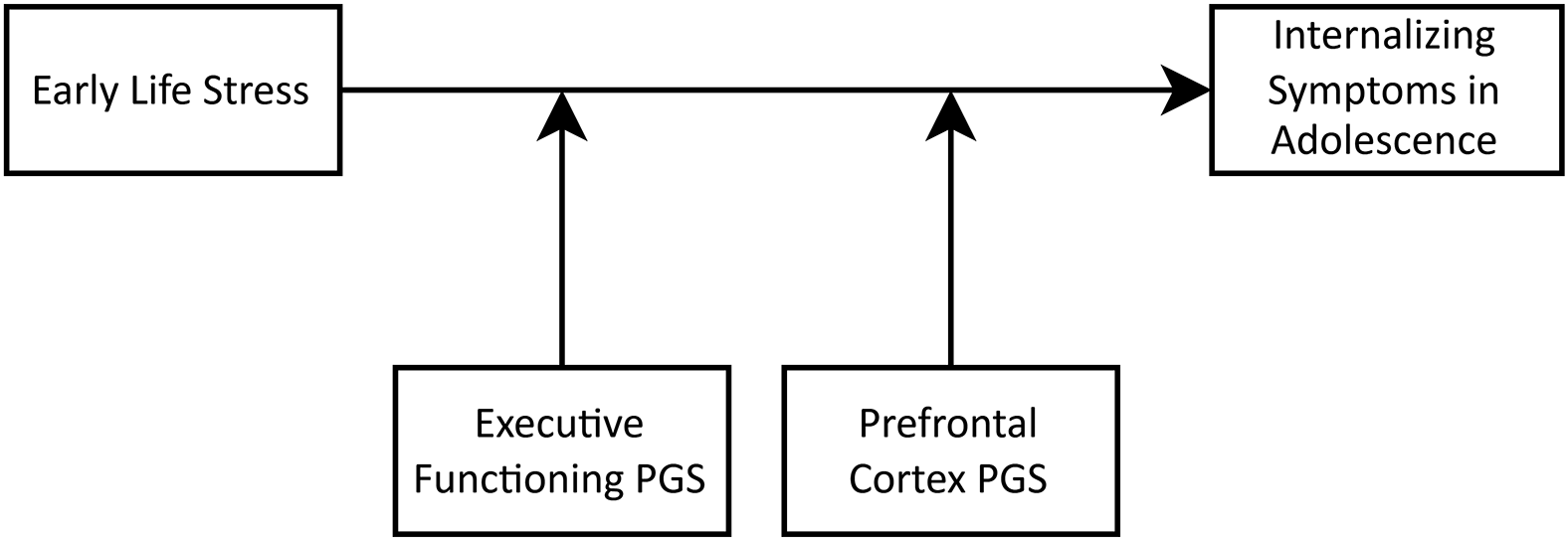
In this preregistered study, analyzing data from a large cohort of adolescents (N = 3 111), we investigated whether maternal prenatal stress predicts internalizing symptoms, and whether PGS for EF and prefrontal cortex structure (derived from adult samples) moderate this association. We hypothesized that 1) prenatal maternal stress would be positively associated with adolescent internalizing symptoms, and that 2) the association would be moderated (reduced) by higher common EF PGS and prefrontal cortex PGS (Figure 1).
Study design. Note: PGS, polygenic risk score.

Methods and materials
This study’s research questions, hypotheses, and statistical analyses were preregistered (https://osf.io/kfhq8), and all deviations from the preregistration are detailed below.
Participants
This study used data from the Norwegian Mother, Father and Child Cohort Study (MoBa; Magnus et al., Reference Magnus, Birke, Vejrup, Haugan, Alsaker, Daltveit, Handal, Haugen, Høiseth, Knudsen, Paltiel, Schreuder, Tambs, Vold and Stoltenberg2016), a population-based nationwide pregnancy cohort study conducted by the Norwegian Institute of Public Health. Participants were recruited from across Norway between 1999 and 2008, and 41% of invited women consented to participate (Schreuder & Alsaker, Reference Schreuder and Alsaker2014). Maternal questionnaire response rates at 15 weeks gestation and 30 weeks gestation were 95.1% and 91.4%, respectively. This study is based on version 12 of the quality-assured data files released for research in 2020. In the current study, we used data from maternal questionnaires collected at 17th and 30th weeks of gestation, as well as adolescent self-reports on mental health at ages 14 and 16, to examine the association between prenatal stress exposure and later internalizing symptoms. Protocols (which include consent forms and questionnaires) can be found here: https://www.fhi.no/en/publ/2012/protocols-for-moba/. MoBa is regulated by the Norwegian Health Registry Act. All participants have provided their informed consent prior to participation. The study was approved by the Regional Committees for Medical and Health Research Ethics (2009/1899–7; 2013/2061) and The Norwegian Data Protection Authority.
Measures
Predictor variable: Early life stress
ELS was operationalized as a global cumulative risk index, designed to capture broad psychosocial stress exposure across pregnancy, emphasizing the overall burden of multiple risk factors. Drawing from previous research in the Generation R and ALSPAC cohorts (Clayborne et al., Reference Clayborne, Nilsen, Torvik, Gustavson, Bekkhus, Gilman, Khandaker, Fell and Colman2023; Defina et al., Reference Defina, Woofenden, Baltramonaityte, Pariante, Lekadir, Jaddoe, Serdarevic, Tiemeier, Walton, Felix and Cecil2024), we developed a cumulative prenatal stress index reflecting ELS. Detailed information on specific items and timepoints of assessment can be found here: https://github.com/SereDef/cumulative-ELS-score. MoBa’s ELS index has been described in more detail in previous works (Clayborne et al., Reference Clayborne, Nilsen, Torvik, Gustavson, Bekkhus, Gilman, Khandaker, Fell and Colman2023; Creasey et al., Reference Creasey, Schuurmans, Tsotsi, Defina, Baltramonaityte, Felix, Neumann, Page, Tollenaar, Bekkhus, Walton and Cecil2025; Murgatroyd et al., Reference Murgatroyd, Salontaji, Smajlagic, Page, Sanders, Jugessur, Lyle, Tsotsi, Haftorn, Felix, Walton, Tiemeier, Cecil and Bekkhus2024). It encompasses four key domains of stress: 1) significant life events, such as the death of a parent or complications during pregnancy; 2) contextual challenges, e.g. financial strains; 3) personal factors, like mental health issues of the parents; 4) interpersonal difficulties, such as family disputes or losing a friend. These measures thus account for socioeconomic adversity and family stressors. For each domain, relevant items were classified as either “risk” (1) or “no risk” (0), and their average was calculated to determine four individual domain scores. These scores were then added together to form the overall prenatal stress index. A complete list of items for each of the four domains is provided in the Supplementary Materials.
Outcome variable
Adolescents reported on internalizing symptoms using the Symptom Check List 10-item version (SCL-10; Strand, Dalgard, Tambs, & Rognerud, Reference Strand, Dalgard, Tambs and Rognerud2003) when they were 14 and 16 years old. We examined the full SCL-10, as it captures a broad spectrum of emotional problems and offers greater sensitivity than individual subscales focusing on depression and anxiety. Depression items were as follows: Feeling hopeless about the future; Feeling blue; Worrying too much about things; Feeling everything is an effort; Feelings of worthlessness. Anxiety items were as follows: Feeling fearful; Nervousness or shakiness inside; Feeling tense or keyed up; Suddenly scared for no reason; Anxiety or panic attack. Response categories were “not bothered” (1), “a little bothered” (2), “quite bothered” (3), “very bothered” (4). The items were summed to obtain an overall score. The outcome variable was calculated by taking the mean at age 14 and age 16, thus capturing adolescents’ overall level of internalizing symptoms across this developmental period and reducing the influence of short-term fluctuations at a single time point.
Control variables
The following variables were included as control variables: maternal genetic risk for depression (as indexed by PGS for depression; Howard et al., Reference Howard, Adams, Clarke, Hafferty, Gibson, Shirali, Coleman, Hagenaars, Ward, Wigmore, Alloza, Shen, Barbu, Xu, Whalley, Marioni, Porteous, Davies and Deary2019), subtle population structure (computed by genetic principal components (PCs); the top ten were used; PC1–10), child sex at birth (as registered in the Medical Birth Registry), and maternal marital status.
Moderator variables
PGS for common EF, calculated based on Hatoum et al. (Reference Hatoum, Morrison, Mitchell, Lam, Benca-Bachman, Reineberg, Palmer, Evans, Keller and Friedman2023), and PGS for brain endophenotypes for executive function, calculated based on Makowski et al. (Reference Makowski, Wang, Srinivasan, Qi, Qiu, van der Meer, Frei, Zou, Visscher, Yang and Chen2023), were examined as moderator variables. Thus, both PGS were derived from adult samples but applied here to an adolescent cohort.
As all phenotypes analyzed in the present study are highly polygenic, we opted for an approach that would capture the most phenotypic variance, a whole-genome polygenic approach, using the PRS-CS model (Ge et al., Reference Ge, Chen, Ni, Feng and Smoller2019). We followed the recommendations from the model developers (i.e., computing PGS for high-quality genome-wide SNPs that have been analyzed by the HapMap projects). Posterior effect sizes were derived by PRS-CS using the linkage disequilibrium structure from the 1000 Genomes Project. These effects were used as the weights of allele copies in computing PGS using PLINK (Chang et al., Reference Chang, Chow, Tellier, Vattikuti, Purcell and Lee2015).
PGS for prefrontal cortex was calculated based on cortical thickness (quantifying the morphology of cortical grey matter) and activity (task-related activation). We opted to use GWAS data without global adjustment, given the strong correlation between the prefrontal cortex and global measures (Makowski et al., Reference Makowski, van der Meer, Dong, Wang, Wu, Zou, Liu, Rosenthal, Hagler, Fan, Kremen, Andreassen, Jernigan, Dale, Zhang, Visscher, Yang and Chen2022). Based on previous longitudinal and cross-sectional studies showing that both the thickness and activity of PFC are correlated with adolescent depression symptoms (Bos et al., Reference Bos, Peters, Van De Kamp, Crone and Tamnes2018; Gold et al., Reference Gold, Steuber, White, Pacheco, Sachs, Pagliaccio, Berman, Leibenluft and Pine2017; Schmaal et al., Reference Schmaal, Yücel, Ellis, Vijayakumar, Simmons, Allen and Whittle2017; Strawn et al., Reference Strawn, John Wegman, Dominick, Swartz, Wehry, Patino, Strakowski, Adler, Eliassen and DelBello2014; Tamnes et al., Reference Tamnes, Herting, Goddings, Meuwese, Blakemore, Dahl, Güroğlu, Raznahan, Sowell, Crone and Mills2017), we calculated six prefrontal cortex PGSs: dorsolateral prefrontal activity, dorsolateral prefrontal thickness, dorsomedial frontal activity, orbitofrontal activity, medial prefrontal thickness, and ventral frontal thickness. See Supplementary Table S5 in Supplementary Materials for associations between each of these measures and symptoms. These variables were highly correlated. To address the multicollinearity and reduce the multiple-testing burden, we applied principal component analysis (PCA) to extract orthogonal components that capture independent sources of genetic variation. This approach allowed us to generate individual-level scores that summarize the shared variance across the six prefrontal cortex PGSs. PCA was performed on the centered and scaled data, and we extracted individual loadings. The first PC accounted for approximately 68% of the total variance, with subsequent components explaining considerably smaller proportions (14%, 7%, 6%, and 5%, respectively), indicating a dominant common dimension.
To correct for population structure, genetic PCs were computed in PLINK. This was performed to reduce the set of genome-wide SNPs that have a minor allele > .05 and passed the Hardy-Weinburg test with p-value >1e-6, and are relatively independent from each other by the pruning command (−indep-pairwise 100 50 0.1). The top ten computed PCs were included as covariates to correct for population structure.
Statistical analyses
All statistical analyses were performed using the R software (v4.4.1; R Core Team, 2024). Hypotheses were tested using linear mixed modelling using the R-package lme4 (Bates, Mächler, Bolker, & Walker, Reference Bates, Mächler, Bolker and Walker2015). To test our first hypothesis, we examined whether maternal prenatal stress was associated with internalizing symptoms in adolescence. Control variables were as follows: sex, marital status, mother’s depression PGS, and PC1–PC10 to account for population stratification. Family identification number was included as a random intercept to account for relatedness within the MoBa cohort. To test our second hypothesis, we added the interaction terms between prenatal stress and EF PGS, and prenatal stress and prefrontal cortex PGS, respectively, in two separate models. As early and mid-adolescence may represent distinct phases in emotional and neurobiological maturation, we conducted additional statistical analyses examining symptoms at ages 14 and 16 separately.
Results
Maternal prenatal stress and adolescent internalizing symptoms
A total of 3111 children within 2990 families were included in the analyses (1881 girls and 1230 boys). See Table 1 for demographic statistics (see Supplementary Table S14 in the Supplementary Materials for more details).
Demographic statistics (N = 3111)

Table 1. Long description
The table consists of two columns: Variable and Value.
* Sex, n female (percent): 1881 (60 percent)
* SCL-10 at age 14, M (S D): 14.95 (5.87)
* SCL-10 at age 16, M (S D): 16.22 (5.87)
* ELS score, M (S D): 0.23 (0.09)
* Mother tongue, Norwegian, n (percent): 2843 (91 percent)
* Maternal education categories:
- Primary and secondary school (mandatory), n (percent): 22 (0 percent)
- High school education, n (percent): 88 (0 percent)
- Vocational education, n (percent): 274 (1 percent)
- College (1 to 2 years), n (percent): 353 (11 percent)
- University (3 to 4 years), n (percent): 1415 (45 percent)
- Postgraduate degree, n (percent): 860 (28 percent)
Note: ELS stands for early life stress and S-C-L-10 stands for Symptoms Check List (10 items).
Note: ELS, early life stress; SCL-10, symptoms check list (10 items).
Results (Table 2) showed that higher ELS was associated with more internalizing symptoms (b = 0.15, p < .001). Female sex was also associated with higher symptom levels (b = 0.72, p < .001). Maternal polygenic risk for depression showed a small but significant association with adolescent symptoms (b = 0.03, p = .046). Marital status was not associated with the outcome (p = .246). Sensitivity analyses at age 14 (n = 6679) and age 16 (n = 3317) separately yielded consistent patterns (see Supplementary Tables S6–S7 in the Supplementary Materials).
Linear mixed effects model predicting adolescent internalizing symptoms

Table 2. Long description
The table contains seven columns: Predictor, b, S E, d f, t, p, and 97.5 percent C I.
* Early life stress: b = 0.15, S E = 0.02, d f = 3077.77, t = 9.27, p < .001, C I [0.122, 0.187].
* Sex (Female): b = 0.72, S E = 0.03, d f = 3095.15, t = 21.33, p < .001, C I [0.655, 0.787].
* Maternal depression PGS: b = 0.03, S E = 0.02, d f = 3089.93, t = 2.00, p = .046, C I [0.001, 0.066].
* Marital status (not married): b = 0.17, S E = 0.15, d f = 3094.93, t = 1.16, p = .246, C I [-0.118, 0.460].
The model note specifies the formula as Symptoms ~ ELS + Sex + Maternal Depression PGS + Marital Status + PC 1 through PC 10 + (1|Family ID).
Note: Model specification: Symptoms ~ ELS + Sex + Maternal Depression PGS + Marital Status + PC1 + PC2 + PC3 + PC4 + PC5 + PC6 + PC7 + PC8 + PC9 + PC10 + (1|Family ID); * = p < .05; ** = p < 0.01; *** = p < 0.001; PGS, polygenic score; ELS, early life stress; PC, genetic principal component.
Prenatal domain-specific effects
Conducting domain-specific analyses of prenatal stress, we found that higher internalizing symptoms were associated with contextual risk (b = 0.09, 95% CI [0.05, 0.12], p < .001), life event stress (b = 0.08, 95% CI [0.05, 0.11], p < .001), interpersonal risk (b = 0.08, 95% CI [0.05, 0.11], p < .00) and personal risk (b = 0.13, 95% CI [0.10, 0.17], p < .001).
Postnatal environmental effects
Postnatal family and environmental influences are important contributors to adolescent symptoms and could act as confounders. Although many of these influences are captured prenatally within the cumulative ELS index, we performed analyses testing whether postnatal maternal depression scores (when the children were 6 months old), parenting style (Alabama parenting questionnaire: positive, negative and inconsistent disciplinary), and family conflict score affect the associations between ELS and adolescent symptoms. Maternal postnatal depression (n = 2690; 1614 girls) was significantly associated with symptoms (b = 0.06, 95% CI = 0.02–0.09, p < .01), but the effect of ELS on symptoms was still significant when controlling for this (b = 0.13, 95% CI = 0.09–0.17, p < .001). For the parenting style analysis (n = 2690; 1614 girls), none of the three styles were associated with symptoms (p > .05), nor affecting the effect of ELS on symptoms. Family conflict (n = 1641; 999 girls) was associated with symptoms (b = −0.07, 95%CI = −0.12 – −0.03, p < .01), but the relation between ELS and symptoms was still significant when controlling for this (b = 0.11, 95% CI = 0.07–0.16, p < .001).
Moderation by executive functioning and prefrontal cortex PGS
Executive functioning PGS
There was no effect of EF PGS on internalizing symptoms, and the interaction effect between EF PGS and ELS was non-significant (Table 3). Comparing high versus low polygenic risk groups showed no association with symptoms (Supplementary Table S12).
Linear mixed effects model predicting adolescent internalizing symptoms with executive functioning polygenic risk score

Table 3. Long description
The table contains seven columns: Predictor, b (coefficient), S E (standard error), d f (degrees of freedom), t (t-statistic), p (p-value), and 97.5 percent CI (confidence interval).
* Early life stress: b = 0.15, SE = 0.02, d f = 3094.00, t = 9.27, p < .001, CI [0.121, 0.186].
* Sex (female): b = 0.77, SE = 0.03, d f = 3094.00, t = 22.87, p < .001, CI [0.701, 0.833].
* Maternal depression PGS: b = 0.03, SE = 0.02, d f = 3094.00, t = 1.84, p = .066, CI [-0.002, 0.062].
* Marital status (not married): b = 0.18, SE = 0.15, d f = 3094.00, t = 1.24, p = .214, CI [-0.105, 0.469].
* E F P G S: b = 0.02, SE = 0.02, d f = 3094.00, t = 1.15, p = .253, CI [-0.013, 0.051].
* Early life stress x E F P G S: b = 0.02, SE = 0.02, d f = 3094.00, t = 0.99, p = .322, CI [-0.016, 0.049].
Note: P G S stands for polygenic score, E L S for early life stress, and E F for executive functioning. Significance levels are indicated by asterisks where p < .001.
Note: Model specification: Symptoms ~ ELS + Sex + Maternal Depression PGS + Marital Status + PC1 + PC2 + PC3 + PC4 + PC5 + PC6 + PC7 + PC8 + PC9 + PC10 + (1|Family ID); * = p < .05; ** = p < 0.01; *** = p < 0.001; PGS, polygenic score; ELS, early life stress; PC, genetic principal component; EF, executive functioning.
Sensitivity analyses focusing on age showed no statistically significant results at age 14 (Supplementary Table S8 in Supplementary Materials). At age 16 (Supplementary Table S9), EF PGS was not significantly associated with symptoms, but the interaction effect between ELS and EF PGS was statistically significant (b = 0.04, p = .044). Examining the potential three-way interaction of stress, EF PGS, and sex on symptoms at 16 years revealed no statistically significant result.
Prefrontal cortex PGS
There was no statistically significant effect of PFC PGS on internalizing symptoms, and the interaction between PFC PGS and ELS was non-significant (Table 4). Comparing high versus low polygenic risk groups showed no association with symptoms (Supplementary Table S13). Sensitivity analyses focusing on age showed no statistically significant results at age 14 and 16 (Supplementary Tables S10 and S11 in Supplementary Materials). Replacing the prefrontal cortex PGS component with the six individual prefrontal cortex PGS variables, no significant associations were observed (Supplementary Table S5).
Linear mixed effects model predicting adolescent internalizing symptoms with prefrontal cortex polygenic risk score

Table 4. Long description
The table contains 6 rows of predictors and 6 columns of statistical data (b, S E, d f, t, p, and 97.5 percent C I).
* Early life stress: b = 0.15, S E = 0.02, d f = 3076.00, t = 9.27, p < .001, C I [0.122, 0.188].
* Sex (female): b = 0.72, S E = 0.03, d f = 3093.00, t = 21.31, p < .001, C I [0.655, 0.787].
* Maternal depression P G S: b = 0.03, S E = 0.02, d f = 3087.00, t = 1.98, p = .048, C I [0.000, 0.065].
* Marital status (Not Married): b = 0.17, S E = 0.15, d f = 3093.00, t = 1.17, p = .244, C I [-0.117, 0.461].
* P F C P G S: b = -0.01, S E = 0.02, d f = 3067.00, t = -0.83, p = .405, C I [-0.046, 0.019].
* Early life stress x P F C P G S: b = 0.01, S E = 0.02, d f = 3090.00, t = 0.41, p = .683, C I [-0.025, 0.039].
Note: Model specification includes Symptoms tilde E L S plus Sex plus Maternal Depression P G S plus Marital Status plus P C 1 through P C 10 plus (1|Family I D).
Note: Model specification: Symptoms ~ ELS + Sex + Maternal Depression PGS + Marital Status + PC1 + PC2 + PC3 + PC4 + PC5 + PC6 + PC7 + PC8 + PC9 + PC10 + (1|Family ID); * = p < .05; ** = p < 0.01; *** = p < 0.001; PGS, polygenic score; ELS, early life stress; PC, genetic principal component; PFC, prefrontal cortex.
Discussion
This study examined whether prenatal maternal stress was associated with internalizing symptoms in adolescence, and whether this association was moderated by genetic predispositions related to EF and the prefrontal cortex.
We found that higher levels of stress experienced by mothers during pregnancy were associated with more internalizing symptoms in their children during adolescence. Girls reported higher symptom levels than boys, and children of mothers with a higher genetic risk for depression also showed slightly more symptoms, although this effect was weaker and not consistent. These associations were robust when controlling for potential confounders such as maternal genetic liability for depression and marital status, and appeared in sensitivity analyses at age 14 and 16 separately.
These findings align with a broader literature showing that adolescent girls report higher levels of depression and anxiety than boys (Fløtnes, Nilsen, & Augestad, Reference Fløtnes, Nilsen and Augestad2011; Weeks et al., Reference Weeks, Cairney, Wild, Ploubidis, Naicker and Colman2014), a pattern that typically emerges around the onset of puberty (Chen & Simons-Morton, Reference Chen and Simons-Morton2009). One possible explanation is that females may be more sensitive to the effects of ELS, potentially due to biological, hormonal, and psychosocial differences (Chen & Yu, Reference Chen and Yu2015). For example, earlier pubertal timing in girls has been associated with increased vulnerability to mood disorders (Lien et al., Reference Lien, Dalgard, Heyerdahl, Thoresen and Bjertness2006).
Although the observed effects were modest, they support the notion that early environmental risk factors can have lasting impacts on adolescent emotional health. These findings align with the view that prenatal environmental exposures may shape developmental trajectories, increasing vulnerability to psychopathology later in life (Davis et al., Reference Davis, Hankin, Glynn, Head, Kim and Sandman2020; Huizink & de Rooij, Reference Huizink and de Rooij2018). Prenatal stress, in particular, may influence fetal brain development—especially in regions critical for emotion regulation and stress responsiveness, such as the limbic system and prefrontal cortex (Wu et al., Reference Wu, Lu, Jacobs, Pradhan, Kapse, Zhao, Andescavage, Vézina, du Plessis and Limperopoulos2020).
A key pathway linking ELS to later depression and anxiety involves dysregulation of the HPA axis, the body’s central stress response system. Exposure to stress during sensitive developmental periods—such as in utero or early childhood—can lead to long-term alterations in HPA axis functioning (Lopez-Duran, Kovács, & George, Reference Lopez-Duran, Kovács and George2009). These changes may impair the individual’s ability to regulate stress, increase vulnerability to negative emotional states (Adam et al., Reference Adam, Doane, Zinbarg, Mineka, Craske and Griffith2010), and disrupt neural circuits involved in mood regulation and executive functioning (Wesarg et al., Reference Wesarg, Van Den Akker, Oei, Hoeve and Wiers2020), such as those in the prefrontal cortex (Belleau, Treadway, & Pizzagalli, Reference Belleau, Treadway and Pizzagalli2019).
Regarding the potential protective effect of genetic predisposition for EF and prefrontal cortex, our results showed that these were not clearly associated with adolescent internalizing symptoms. This suggests that a genetic propensity for higher EF derived from adult samples is not inherently protective or harmful with regard to adolescent emotional problems. However, we observed a weak gene–environment interaction at age 16 involving the EF PGS, suggesting that adolescents who were exposed to prenatal stress and also had a higher genetic propensity for better EF reported more internalizing symptoms in late adolescence. This finding was unexpected, given that EF is typically considered a protective factor in emotional development. Alternatively, this finding may simply reflect random variation, as very small effect sizes can lead to inconsistent or potentially spurious associations.
Most existing studies associate higher EF with reduced internalizing in adolescence (e.g., Wagner et al., Reference Wagner, Müller, Helmreich, Huss and Tadić2015), and we are not aware of prior reports suggesting that higher EF amplifies vulnerability. Our finding that higher EF was associated with more symptoms at age 16 may therefore represent a novel, context-dependent pattern in which cognitive control capacities interact with early stress exposure rather than a generalizable risk mechanism. According to developmental calibration models (Ellis & Del Giudice, Reference Ellis and Del Giudice2019), early stress can tune neurocognitive systems to function optimally in harsh or unpredictable contexts. If later environments do not reflect early conditions, adaptations linked to a genetic disposition for high EF in adulthood may become maladaptive in adolescence (Daskalakis et al., Reference Daskalakis, Bagot, Parker, Vinkers and de Kloet2013). Genetic traits associated with high EF in adulthood may act as environmental sensitivity factors in adolescence, making individuals more susceptible to early adverse influences. Early adversity can recalibrate neurodevelopmental pathways (Bale et al., Reference Bale, Baram, Brown, Goldstein, Insel, McCarthy, Nemeroff, Reyes, Simerly, Susser and Nestler2010), altering how EF is applied to emotional processing later in life. Genetic propensities supporting strong executive control might thus promote vigilance, overregulation, or heightened goal monitoring after early stress, which—when later environments are stable—could manifest as rigidity, self-critical rumination, worrying, or reduced emotional flexibility. The developmental potential for high EF could thereby be co-opted into processes that amplify negative affect, such as increased rumination (Kercher & Rapee, Reference Kercher and Rapee2009) or intensified awareness of goal–reality discrepancies under stress. The fact that this effect emerged only at age 16 suggests that it may become more pronounced by mid-adolescence, when EF approaches functional maturity (Tervo-Clemmens et al., Reference Tervo-Clemmens, Calabro, Parr, Fedor, Foran and Luna2023). Additionally, because the PGS were derived from adult samples, the underlying genetic influences may not yet confer full functional advantages in adolescence, creating a temporary mismatch between genotype and phenotype expression.
Limitations
Although the study design included longitudinal components, such as prenatal predictors and later adolescent outcomes, the outcomes at ages 14 and 16 years are snapshots in time. This limits the ability to model developmental trajectories. Trimester-specific or sensitive-window effects could not be examined because the available data did not include stress indicators for each trimester. Future studies with repeated, trimester-dense assessments are needed to evaluate timing-specific hypotheses more directly. The study used a genetic proxy (PGS) for EF but did not include actual EF performance measures (e.g., task-based assessment, behavioral or inventory assessment). This would have helped validate the proposed mechanism and interpret the gene–environment interaction more directly. PGSs typically explain only a small fraction of phenotypic variance, especially in complex traits like EF and depression and anxiety. This limited predictive power may result in underestimation of true associations. SNPs included in EF or depression/anxiety PGSs may influence multiple traits (pleiotropy), making it unclear whether the observed effects are specific to EF or reflect broader neurodevelopmental or cognitive vulnerabilities. PGS for EF and PFC were derived from two GWAS studies conducted in adults, but we applied them to an adolescent cohort. This may limit the predictive validity of the PGS in our sample, as the genetic architecture of such complex traits can vary across developmental stages. This age mismatch may reduce predictive accuracy and calibration, as genetic effects on executive functioning and prefrontal traits may differ developmentally. Consequently, associations could be attenuated or biased downward due to reduced relevance of adult-derived genetic architecture in adolescence.
Conclusions
Prenatal maternal stress predicted higher adolescent internalizing symptoms, supporting its role as an early risk factor. A weak interaction between prenatal stress and genetic predisposition for EF emerged at age 16, suggesting that adolescents with higher genetic predisposition for better EF may be at increased risk after early stress. These findings elucidate the impact of prenatal stress and the need for further research on gene–environment interactions in emotional development.
Supplementary material
The supplementary material for this article can be found at http://doi.org/10.1017/S0033291726105431.
Acknowledgments
We are grateful to all the participating families in Norway who have taken part in this ongoing cohort study. The Norwegian Mother, Father and Child Cohort study is supported by the Norwegian Ministry of Health and the Norwegian Research Council FUGE (grant number 151918/S10). This work was also supported by the Research Council of Norway grant number 288083 and 301004. We are also grateful to the Dam Foundation (FOR462234) and The Norwegian Women’s Health Organization (453233). For generating high-quality genomic data, we thank the Norwegian Institute of Public Health, the HARVEST collaboration, the NORMENT Centre at the University of Oslo, the Center for Diabetes Research at the University of Bergen, and deCODE Genetics.
Competing interests
The authors declare no conflicts of interest.
Open science statement
Data from the Norwegian Mother, Father and Child Cohort Study is managed by the Norwegian Institute of Public Health. Access requires approval from the Regional Committees for Medical and Health Research Ethics, compliance with GDPR, and data owner approval. Participant consent does not allow individual-level data storage in repositories or journals. Researchers seeking access for replication must apply via www.helsedata.no.




 Open access

