

Implications
The present study is the first that has focused explicitly on the role of copper in the denitrification process in agricultural soil, at concentrations that are not excessive but instead promote the reactions that convert NO3 − to NO2 −, NO, N2O, and ultimately to N2. The results from the present study have potential application in designing and optimizing procedures in which reduction of N2O and other reactions of denitrification pathway are manipulated in systems like wetlands, wastewater treatment, etc.
Introduction
Denitrification refers to the respiratory reduction of nitrate (NO3 −) and nitrite (NO2 −), to the gaseous products nitric oxide (NO), nitrous oxide (N2O), and nitrogen gas (N2), which are linked to electron transport phosphorylation activities. Several processes other than denitrification produce N2O, such as nitrification, nitrifier denitrification and dissimilatory NO3 − reduction to ammonium (NH4 +) (Bleakley and Tiedje, Reference Bleakley and Tiedje1982; Stevens et al., Reference Stevens, Laughlin and Malone1998; Pathak, Reference Pathak1999; Mathieu et al., Reference Mathieu, Leveque, Henault, Milloux, Bizouard and Andreux2006; Burgin and Hamilton, Reference Burgin and Hamilton2007; Baggs, Reference Baggs2008). However, denitrification is the only biological process that has the capacity to reduce N2O to N2. Each reduction step in the denitrification pathway involves a metalloenzyme that uses a redox active metal cofactor (Kroneck et al., Reference Kroneck, Antholine, Riester and Zumft1988; Scott et al., Reference Scott, Zumft, Coyle and Dooley1989; Carr and Ferguson, Reference Carr and Ferguson1990; Godden et al., Reference Godden, Turley, Teller, Adman, Liu, Payne and Legall1991; Glockner et al., Reference Glockner, Jungst and Zumft1993; Butler et al., Reference Butler, Fairhurst, Ferguson, Thomson, Berks, Richardson and Lowe2002; Richardson et al., Reference Richardson, Felgate, Watmough, Thomson and Baggs2009). The enzyme responsible for the reduction of N2O to N2 is nitrous oxide reductase (N2OR). Copper (Cu) is the cofactor in N2OR, with one enzyme containing 12 Cu atoms (Cambillau et al., Reference Cambillau, Brown, Djinovic-Carugo, Haltia, Cabrito, Saraste, Moura, Moura and Tegoni2000; Thomson et al., Reference Thomson, Rasmussen, Berks, Sanders-Loehr, Dooley and Zumft2000 and Reference Thomson, Rasmussen, Berks and Butt2002; Haltia et al., Reference Haltia, Brown, Tegoni, Cambillau, Saraste, Mattila and Djinovic-Carugo2003; Hasnain et al., Reference Hasnain, Paraskevopoulos, Antonyuk, Sawers and Eady2006). Another denitrification enzyme that uses Cu as a cofactor is NO2 − reductase, responsible for the reduction of NO2 − to NO (Liu et al., Reference Liu, Liu, Payne and Legall1986; Libby and Averill, Reference Libby and Averill1992). Much research has been conducted in aquatic and pure culture systems demonstrating the importance of Cu to the denitrification process, especially to N2OR activity (Iwasaki et al., Reference Iwasaki, Saigo and Matsubara1980; Iwasaki and Terai, Reference Iwasaki and Terai1982; CatalanSakairi et al., Reference CatalanSakairi, Wang and Matsumura1997; Cervantes et al., Reference Cervantes, Monroy and Gomez1998; Granger and Ward, Reference Granger and Ward2003). Considerably less research has been conducted on the effects of Cu on N2OR activity in soils and sediments.
Inadequate amounts or low availability of Cu will reduce the activity of N2OR in soils. Soil with high organic matter (OM) or clay content often have low Cu bioavailability (Lucas, Reference Lucas1948; Gilbert, Reference Gilbert1952; Elliott et al., Reference Elliott, Liberati and Huang1986; LHerroux et al., Reference LHerroux, LeRoux, Appriou and Martinez1997; Bolan et al., Reference Bolan, Adriano and Mahimairaja2004; Gerzabek et al., Reference Gerzabek, Lair, Haberhauer, Jakusch and Kirchmann2006; Lair et al., Reference Lair, Gerzabek and Haberhauer2007). Copper and molybdenum form strong coordinate linkages with organic ligands found in OM. Organic (ORG) Cu forms strong chelation complexes with organic molecules within the OM. The chelation complex contains two or more coordinate positions around the metal ion, forming a complex ring structure. The formation of more than one bond between the metal and the organic molecule usually imparts high stability (Stevenson, Reference Stevenson1994). The stability of the metal-chelate process is determined by a host of factors including the number of atoms forming the organic ligand, number of ring structures, concentration of metal ions and pH. Cu forms the strongest stability complex of the primary transition series metals. For these reasons, Cu can be a limiting essential nutrient, especially in soils of high OM.
Addressing the limiting factors affecting the complete reduction of inorganic N to N2 in soils and sediments is important to reducing N2O emissions. This is especially important in agricultural soils, the primary source of N2O emission globally (Oenema et al., Reference Oenema, Wrage, Velthof, van Groenigen, Dolfing and Kuikman2005). The aim of this study is to investigate the effects of Cu form and concentration on denitrification, in a low Cu, high OM contents peat soil, with a focus on N2OR activity.
Material and methods
Soil
Peat soil was collected from an agricultural field on Twitchell Island in California's Sacramento-San Joaquin River Delta. The soil is classified as a Rindge mucky silt loam (euic, thermic Typic Medisaprist). The peat soil was chosen for this study because of its high NO3 − and OM contents and low Cu concentration. These soil conditions are conducive to a large denitrification potential. In addition, the high OM content lowers available Cu through strong OM complexion reactions and high Cu chelating capacity. Soil OM content determined by loss on ignition was 38%; Total C and N contents determined by direct combustion/gas chromatograph analysis were 18% and 1.15%; dissolved organic carbon (DOC), NH4 +-N, NO3 −-N, (extracted by 0.5 M K2SO4 at an extractant to soil ratio 10 to 1) was 720 μg DOC/g, and 1.4 μg NH4 +-N and 305 μg NO3 −-N/g soil, respectively. Available Cu as measured by diethylenetriaminepentaacetic acid extraction (Lindsay and Norvell, Reference Lindsay and Norvell1978) was 9 μg/g soil and the pH (1 : 1 H2O) was 5.2. The soil was air-dried and sieved (<1 mm) to remove stones and plant residues, such as roots.
Soil incubation
Cu source
The ORG Cu source was the soluble fraction of a proprietary Cu-peptide used in animal feed additive formulations (Bioplex®, Alltech, Nicholasville, KY, USA). This product was chosen as a typical source of Cu that might reach the environment via application of animal manure. The INO Cu source was Cu sulfate (CuSO4).
Incubation
Twenty-seven soil samples (6.3 g/sample, air dry) were weighed into 60-ml glass serum vials. Nine treatments with different concentrations of either INO Cu or ORG Cu or no Cu (CON) were randomly assigned to the vials. The experiment was arranged in a completely randomized design with three replications per treatment.
Preliminary experiments were conducted to identify the approximate concentration of Cu at which denitrification would be affected. The concentrations of INO and ORG Cu chosen were 750, 550, 125, and 60 μg Cu/g soil (abbreviated as INO 750, INO 550, INO 125, INO 60, ORG 750, ORG 550, ORG 125, ORG 60). These treatments were applied to soils in 9 ml of deionized water. The ORG Cu treatments increased the DOC content of the soil by 90, 65, 10 and 5 μg/g soil in the 750, 550, 125 and 60 treatments, respectively. Each vial then received 1 ml of a solution of 99 atom% K15NO3 resulting in an overall 15N isotopic enrichment of the NO3 − pool of 10.0 atom% 15N. The vials were sealed with rubber septa and aluminum seals. In order to create an anaerobic environment in the vials, each vial was evacuated and flushed with helium (He) for 10 min. This process was repeated three times. The vials were shaken in an orbital shaker/incubator (Model C25, New Brunswick Scientific, NJ, USA) at 150 r.p.m. and 35°C to facilitate denitrification and diffusion of gaseous products. The incubation period lasted 24 h.
Sample collection
Every 8 h, 1 ml gas and 0.5 ml soil solution were removed from each vial. A gas tight syringe with a two-way stopcock was used for gas sampling. The syringe was flushed with He before sampling to avoid introducing air from the needle into the incubation vials. The gas samples were transferred to 12 ml evacuated gas tight vials (Labco, Lampeter, UK) until further analysis. The soil solution samples were immediately centrifuged to remove soil and the supernatants were stored at −20°C until further analysis. After sampling, vials were returned to the incubator to continue the incubation.
Gas analysis
Concentration of N2 and N2O and 15N isotope ratios of these gases were measured on a ThermoFinnigan GasBench + PreCon trace gas concentration system interfaced to a ThermoScientific Delta V Plus isotope-ratio mass spectrometer (IRMS; ThermoFinnigan, Bremen, Germany). Gas samples were purged from vials through a double-needle sampler into a He carrier stream (20 ml/min). Nitrogen gas was sampled by a rotary eight-port valve and passed to the IRMS through a molecular sieve 5A GC column (15m × 0.53 mm ID, 25°C, 3 ml/min). The remaining gas sample passed through a CO2 scrubber (Ascarite) and N2O was trapped and concentrated in two liquid nitrogen cryo-traps. N2O was carried by He to the IRMS via a Poroplot Q GC column (25m × 0.53 mm, 25°C, 1.8 ml/min).
Analysis of soil solution
Concentrations of NO3 − and NO2 − in the soil solution were determined spectrophotometrically (Verdouw et al., Reference Verdouw, Vanechteld and Dekkers1978; Doane and Horwath, Reference Doane and Horwath2003).
Calculations
Determination of NO3 − to N2O and N2
The amount of N2 present at each time point was calculated from the measured concentration, converted from molar ratio units to mass per volume units assuming ideal gas relations, and multiplied by the volume of the head space.
The amount of N2 and N2O derived from NO3 − was calculated as:
 $${\rmu {\rm{g}}\,{{{\rm{N}}}_{\rm{2}}}\,{\rm{ - }}\,{\rm{N/g}}\,{\rm{soil}}\:\times \:\:{\rm{(atom\% }}{{\,}^{{\rm{15}}}} {\rm{N}}\,{\rm{excess}}\,{\rm{of}}\,{{{\rm{N}}}_{\rm{2}}}{\rm{)/}} \cr {{(\rm atom\% }}{{\,}^{{\rm{15}}}} {\rm{N}}\,{\rm{excess}}\,{\rm{of}}\,{\rm{soil}}\,{\rm{NO}}_{{\rm{3}}}^{{\rm{\ - }}} {\rm{)}}$$
 $${\rmu {\rm{g}}\,{{{\rm{N}}}_{\rm{2}}}{\rm{O - N/g}}\,{\rm{soil}}\,\times \,{\rm{(atom\% }}{{\,}^{{\rm{15}}}} {\rm{N}}\,{\rm{excess}}\,{\rm{of }}\,{{{\rm{N}}}_{\rm{2}}}{\rm{O)/}}\cr{{(\rm atom\% }}{{\,}^{{\rm{15}}}} {\rm{N}}\,{\rm{excess}}\,{\rm{of}}\,{\rm{soil}}\,{\rm{NO}}_{{\rm{3}}}^{{\rm{ \ - }}} {\rm{)}}$$
The percent of soil NO3 − converted to N2 and N2O was calculated as:
 $$no{{\rm{100}}\,\times \,{\rm{amount}}\,{\rm{of}}\,{{{\rm{N}}}_{\rm{2}}}\, {\rm{derived}}\,{\rm{from}}\,{\rm{NO}}_{{\rm{3}}}^{{\rm{ \ - }}} \,{\rm{(}}\rmu {\rm{g}}\,{\rm{N/g}}\,{\rm{soil)}}\,{\rm{/}} \cr \rmu {\rm{g}}\,{\rm{NO}}_{{\rm{3}}}^{{\rm{ \ - }}} {\rm{ - }}\,{{{\rm{N}}}_{{\rm{initial}}}}{\rm{/g}}\,{\rm{soil}}$$
 $$no{{\rm{100}}\,\times \,{\rm{amount}}\,{\rm{of}}\,{{{\rm{N}}}_{\rm{2}}}{\rm{O}}\, {\rm{derived}}\,{\rm{from}}\,{\rm{NO}}_{{\rm{3}}}^{{\rm{ \ - }}} \,{\rm{(}}\rmu {\rm{g}}\,{\rm{N/g}}\,{\rm{soil)}}{\rm{/}}\, \cr \rmu {\rm{g}}\,{\rm{NO}}_{{\rm{3}}}^{{\rm{ \ - }}} {\rm{ - }}\,{{{\rm{N}}}_{{\rm{initial}}}}/{\rm{g}}\,{\rm{soil}}$$
The amount of N2O in solution was estimated using the Bunsen coefficient (Bleakley and Tiedje, 1982), which was added to the amount in the headspace to give total N2O.
Reaction rates
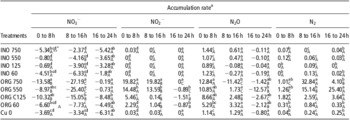
The rates of accumulation of NO3 −, NO2 −, N2O and N2 (Table 1) were calculated as the difference in the concentrations (in μg N/g soil) of a given species between the initial and final time points (expressed per hour) of the given interval divided by the duration of the interval.
Effects of different concentrations of inorganic and organic Cu and incubation times on NO3 −, NO2 −, N2O and N2 accumulation

NO3 − = nitrate; NO2 − = nitrite; N2O = nitrous oxide; N2 = nitrogen gas; INO = inorganic, ORG = organic values are in μg Cu/g soil.
For a given N species, means designated with the same letter (lower letter or capital letter) are not significantly different (P > 0.05). n = 3.
aμg/g soil/h. Positive numbers indicate accumulation; negative ones indicate consumption.
*Means of a given N species among different treatments within the same time period followed by the same lower case letter are not significantly different.
**Means of a given N species during different time periods within a treatment followed by the same capital letter are not significantly different.
Statistics
All data were analyzed using SAS v. 9.3 (SAS Institute nc., Cary, NC). Accumulation rate of NO3 −, NO2 −, N2O and N2, among different treatments and time periods and the percentage of NO3 − converted to N2O and N2 among different treatments and time periods were analyzed using an ANOVA within the Proc Mixed Model. Treatment, time and their interactions were fixed effects and replication the random effect. Means among treatments within each time period and among time periods within each treatment were compared using least significant differences. Differences were considered significant if P < 0.05.
Results
Effects of inorganic Cu on denitrification
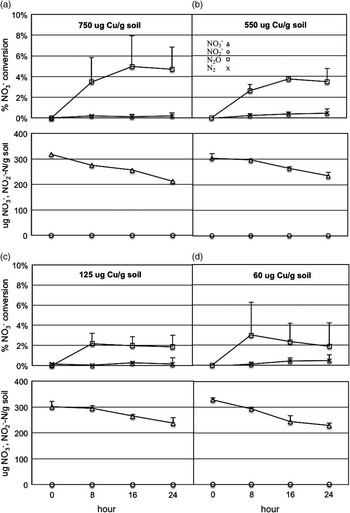
Inorganic Cu did not affect N transformation rates in the denitrification pathway (Table 1). The NO3 − consumption rate was not different for any INO Cu treatments within each time period of the incubation. Within each INO Cu treatment, the NO3 − consumption rate did not differ among time periods except for the 8 to 16 h period in the INO 550 treatment. No accumulation of NO2 − was observed in any of the INO Cu treatments. The N2O and N2 accumulation rates did not differ among INO Cu treatments within time periods, nor did they differ within INO Cu treatments over time periods. In the INO Cu treatments over time periods, the NO3 − recovery percentages as N2O and N2 were not different than the control (Figure 1).
Percent of initial NO3 − converted to N2O and N2, and measured concentrations of NO3 − and NO2 − in inorganic Cu treatments. Standard error of the mean shown as the line bars, n = 3.

Effect of ORG Cu on denitrification
NO3 − reduction
In the ORG Cu treatments, the rates of NO3 − reduction increased with increasing Cu concentrations. From 0 to 16 h, NO3 − was completely consumed in the ORG 750 and ORG 550 treatments, whereas approximately one-third and two-thirds of the NO3 − remained in the soil of ORG 125 and ORG 60 treatments, respectively. The rate of NO3 − disappearance was higher from 8 to 16 h (27.19 and 25.40μg/g soil/h) than that from 0 to 8 h (13.58 and 8.97 μg/g soil/h) at the two highest ORG Cu concentrations (ORG 750 and 550 treatments).
NO2 − accumulation and reduction
From 0 to 8 h, NO2 − accumulated among all ORG Cu treatments (19.82, 14.48, 5.46 and 2.29 μg/g soil/h for ORG 750, 550, 125 and 60 Cu treatments). From 8 to 16 h, NO2 − was quickly reduced in the ORG 750 and ORG 550 treatments (19.82 and 13.59 μg/g soil/h for ORG 750 and 550 Cu treatments) to the base concentration (the NO2 − concentration in the soil before incubation started), but in the ORG 125 and ORG 60 treatments the rates of NO2 − consumption was lower (0.14 ad 1.04 μg/g soil/h for ORG 125 and 60 Cu treatments) than the rates of accumulation during 0 to 8 h. From 16 to 24 h, NO2 − decreased in all the treatments.
N2O accumulation and reduction
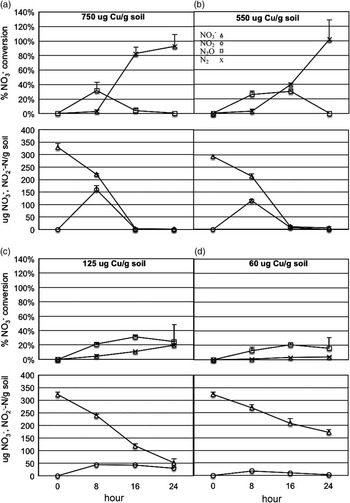
N2O and N2 were expressed as percentage conversion of NO3 − (Figure 2). In the ORG 750 treatment, N2O peaked at 8 h (31% conversion from NO3 −) and was reduced from 8 to 16 h with a concomitant increase of N2. In the ORG 550 treatment, N2O peaked at 16 h (30.6% conversion of NO3 −) and disappeared between 16 and 24 h. In the ORG 125 treatment the highest N2O concentration was recorded at 16 h (31% conversion of NO3 −), and the reduction of N2O to N2 was slower than at the two greater ORG Cu concentrations as there was only a 6.4% decrease of N2O from 16 to 24 h. In the ORG 60 treatment N2O was lower than in the higher Cu concentration treatments and peaked at 16 h (20.9% conversion of NO3 −). In the following 8 h, N2O was reduced by only 5.1%.
Percent of initial NO3 − converted to N2O and N2, and measured concentrations of NO3 − and NO2 − in organic Cu treatments. Standard error of the mean shown as the line bars, n = 3.

In the ORG 750 treatment, N2O decreased simultaneously with NO2 − from 8 to 16 h. However, in the ORG 550 treatment, N2O increased as NO2 − decreased, indicating that N2OR activity was lower in the ORG 550 than in the ORG 750 treatment. In ORG 125 and ORG 60 treatments, N2O increased as NO2 − decreased, which suggested lower N2OR activity in these treatments.
Discussion
Cu availability
In the present study ORG Cu was more effective in accelerating denitrification activity than INO Cu. This difference is likely due to greater bioavailability of ORG Cu in soil. Cu is easily bound to, and complexes with, soil OM, more than any other transition metal in soil. Adriano (Reference Adriano2001) compared the affinity of a series of metals to OM and reported that Cu is the metal most strongly complexed with OM. Kornegay et al. (Reference Kornegay, Hedges, Martens and Kramer1976) found Cu to be immobile in soil with high OM due to the complexation of Cu by OM. Several other researchers noted that Cu in organic soils is held tenaciously by the OM (Gilbert, Reference Gilbert1952; Jones, Reference Jones1967; Gigliotti et al., Reference Gigliotti, Businelli, Massaccesi and Said-Pullicino2009; He et al., Reference He, Guan, Zhang and Bai2011). Therefore, when the OM content is high, Cu bioavailability is likely low (Kornegay et al., Reference Kornegay, Hedges, Martens and Kramer1976; LHerroux et al., Reference LHerroux, LeRoux, Appriou and Martinez1997; Bolan et al., Reference Bolan, Adriano and Mahimairaja2004; Gerzabek et al., Reference Gerzabek, Lair, Haberhauer, Jakusch and Kirchmann2006; Lair et al., Reference Lair, Gerzabek and Haberhauer2007). ORG Cu in the present study was in the form of a copper-peptide complex. In this complex, Cu may form bidenate, terdenate, tetradenate and pentadenate with the peptide, which imparts high stability to the complex. As a result, ORG Cu may be more stable in soil solution (less reaction with OM) and accessible to denitrifiers than INO Cu, which is easily bound to ligands containing either oxygen or N, P, S as donor atoms in the soil.
Importance of Cu to N2OR
In the present study, N2O reduction rate was significantly increased in ORG 750 and ORG 550 treatments, demonstrating a threshold concentration for Cu on N2OR activity under the present study conditions and emphasizing the importance of Cu form and concentration on N2OR activity. In addition, in the present study N2OR activity reached its maximum from 8 to 16 h in ORG 750 treatment while in ORG 550 treatment, the enzyme activity was at its optimum from 16 to 24 h. This result indicates enzyme induction is dependent on Cu concentration.
The importance of adequate Cu to induce N2OR activity in denitrifiying bacteria has been demonstrated in previous studies. Iwasaki and Terai (1982) cultured denitrifying bacteria in Cu-depleted and replete media under anaerobic conditions and found that under Cu deficient conditions, N2O accumulated with only slight accumulation of N2, whereas in the presence of sufficient Cu (5.5 μM), N2O did not appear and N2 was the main gaseous product. Granger and Ward (2003) studied the effect of Cu on N2OR by culturing denitrifiers in artificial seawater medium under trace mineral deficient conditions and found that decreasing Cu concentrations (<11 nM) in the culture medium lead to the accumulation of N2O. The author also reported that N2OR activity was higher in Cu replete cultures than that in Cu depleted cultures. However, Labbe et al. (Reference Labbe, Parent and Villemur2003) conducted an experiment to examine the effect of different metals (Fe, Mo, Cu, Mo, Zn) on denitrifying bacteria activity in the artificial seawater denitrifying system and reported that when CuSO4 was added alone to the system it had no impact on the denitrification process. This finding is in contrast to the present results in which ORG Cu had a significant impact on the denitrification process and on N2OR activity. This might be explained by other metal deficiencies, which might have masked the effects of Cu on N2OR, that is, that the availability of other metals were deficient in their experimental system, for example, Mo for NO3 − reductase, Fe for NO2 − reductase, which masked the effects of Cu on N2OR. In the present experiment, these metals were likely present in adequate amounts while Cu was the deficient one and, therefore, Cu supplementation had a significant effect on denitrification and N2OR. Another possibility for the different results between these two studies could be due to the difference in the Cu form (CuSO4 v. Cu peptide) applied to the experimental systems.
Cu effects on NO3 −, NO2 − and N2OR reductases
In the denitrification pathway, Cu is a cofactor for both NO2 − reductase and N2OR and, therefore, affects their activity (Matsubara et al., Reference Matsubara, Frunzke and Zumft1982; Viebrock and Zumft, Reference Viebrock and Zumft1988; Kukimoto et al., Reference Kukimoto, Nishiyama, Murphy, Turley, Adman, Horinouchi and Beppu1994). The effects of Cu on NO3 −, NO2 − and N2OR were investigated by Ho et al. (Reference Ho, Jones and Hollocher1993) who isolated denitrifying enzymes from denitrifiers and supplemented the enzymes with diethyldithiocarbamate (DDC), a Cu chelating agent, for 5 min. The activity of NO2 − reductase activity was totally inhibited whereas NO3 − reductase and N2OR activity were affected to a lesser extent, indicating the importance of Cu to NO2 − reductase. Several other researchers have reported the inhibitory effect of DDC on NO2 − reductase and the importance of Cu to NO2 − reductase activity (Shapleigh and Payne, Reference Shapleigh and Payne1985; Coyne et al., Reference Coyne, Arunakumari, Averill and Tiedje1989). In the present study, the observation that ORG Cu accelerated NO2 − reduction compared with INO Cu and CON could be due to its impact on NO2 − reductase activity.
In the present study, ORG Cu increased NO3 − reductase activity compared with INO Cu and CON treatments. NO3 − reductase requires a molybdenum cofactor (Moco) (Kuper et al., Reference Kuper, Llamas, Hecht, Mendel and Schwarz2004). Biosynthesis of Moco has been reported to require Cu to protect the dithiolene moiety of Moco before the insertion of molybdenum (Morrison et al., Reference Morrison, Cobine and Hegg2007). In the present study, ORG Cu exerted a significant effect on increasing NO3 − reductase activity, which could be attributed to ORG Cu being more available. NO3 − reductase activity has been reported to be inhibited by NO2 − (Knowles, Reference Knowles1982; Glass and Silverstein, Reference Glass and Silverstein1998). The increase in NO3 − reductase activity in the ORG Cu 750 and 550 treatments during 8 to 16 h compared with 0 to 8 h period is more readily explained as inhibitory effect of NO2 − build-up in the soil from 0 to 8 h.
The Cu concentration needed to promote N2OR activity is likely much higher than the Cu concentration required by NO3 − and NO2 − reductase. The N2O accumulation rate did not differ in the ORG 750, 550 and 125 treatments from 0 to 8 h. However, N2O consumption in the ORG 750 treatment started during the 8 to 16 h period, whereas in the ORG 550 and 125 treatments, N2O decreased from 16 to 24 h. During this period, N2O consumption occurred at a lower rate in the ORG 125 and 60 treatments than in the ORG 750 and ORG 550 treatments. Cu availability may have influenced the kinetics of N2O accumulation because N2OR has a relatively high Cu requirement compared with that of the enzyme(s) leading to N2O production. NO2 − reductase, a trimer with a di-copper complex found in each monomer (Paul and Karlin, Reference Paul and Karlin1991), requires only six Cu atoms to maintain its function whereas 12 Cu atoms are required for N2OR to reach optimal function. The Cu requirement of NO2 − reductase and N2OR has been investigated by Cervantes et al. (1998), who observed both NO2 − and N2O accumulation in an anaerobic reactor at low Cu (Cu applied in this study was CuCl2) concentration (<28 μg Cu/l). However, at Cu concentration >28 μg Cu/l, NO2 − accumulation stopped while N2O accumulation continued (the highest Cu concentration applied in that study was 56 μg Cu/l). The author concluded that Cu was the limiting factor for NO2 − reductase activity but not for N2OR activity and that the accumulation of N2O was not due to the lack of Cu but the fact that N2OR is slower than the preceding enzymes in the denitrification process. In contrast to those findings, the present study showed that N2OR activity increased at higher Cu concentrations. A reason for the divergent results in these two studies could be that the Cu concentration (56 μg Cu/l) applied in Cervantes’ study was not high enough to activate N2OR or that the inorganic Cu (CuCl2) was not readily available to the denitrifiers in Cervantes’ anaerobic incubation system.
NO2 − accumulation in the present study may have occurred because the synthesis of NO2 − reductase requires more time than that of NO3 − reductase (Williams et al., Reference Williams, Rowe, Romero and Eagon1978). Betlach and Tiedje (Reference Betlach and Tiedje1981) explained that NO2 − accumulation in three pure cultures of denitrifiers was due to differences in their relative reduction rates. A substantial accumulation of N2O, followed by its rapid reduction took place in the present study, which suggests that N2OR synthesis was slower than that of the enzymes leading to N2O production. The lag of N2OR synthesis compared with other enzymes in denitrification has been reported by other workers (Betlach and Tiedje, Reference Betlach and Tiedje1981; Cervantes et al., Reference Cervantes, Monroy and Gomez1998). Firestone and Tiedje (Reference Firestone and Tiedje1979) also demonstrated that synthesis of enzymes in the denitrifying pathway is staggered and that NO3 − reductase required the least amount of time for synthesis.
It seems that, often, accumulation of N2O as a first response to anaerobic conditions is inevitable because the synthesis of denitrifying enzymes occurs at varying rates (Firestone and Tiedje, Reference Firestone and Tiedje1979). However, ORG Cu studied in the present study showed a potential to shorten the lag phase of N2OR synthesis and, therefore, accelerated N2O reduction to N2.
Significance
The present study is the first that has focused explicitly on the role of Cu in the denitrification process in soil, at concentrations that are not excessive but instead promote the reactions that convert NO3 − to NO2 −, NO, N2O, and ultimately to N2. Two different forms of Cu were compared for their effectiveness in enhancing the successive reduction steps in the denitrification pathway, with an emphasis on the final step, reduction of N2O. While peat soil has a higher OM content than other soil types, the data presented here provide reference values for the amount of Cu needed to affect various reactions in an environment with high Cu chelating potential. Our results, therefore, have potential application in designing and optimizing procedures in which reduction of N2O and other reactions of denitrification pathway are manipulated in systems like wetlands, wastewater treatment, etc.
Further information
The Dairy Solutions Symposium is a biennial event that covers a wide variety of themes and topics of relevance and importance to the dairy industry. The aim is to provide high level, up-to-date information and research to dairy professionals, technologists and scientists. In 2012, the theme addressed the biggest challenge facing all those involved in dairy production: Optimizing production efficiency while lowering environmental impact. For more information, please visit www.dairycowsolutions.com or contact dairycowsolutions@alltech.com.