

Introduction
Global biodiversity has been experiencing unprecedented declines in recent decades (Maxwell et al. Reference Maxwell, Fuller, Brooks and Watson2016; Pimm and Raven Reference Pimm and Raven2000). This trend is reflected in the rapid decline of many bird species’ populations worldwide over the last few decades (Li et al. Reference Li, Miao and Khanna2020; Rosenberg et al. Reference Rosenberg, Dokter, Blancher, Sauer, Smith and Smith2019), although the extent of population decline varies across species. For instance, specialist species are often displaced by generalists (Correll et al. Reference Correll, Strasser, Green and Panjabi2019). Similarly, open-habitat birds, such as grassland and steppe species, are facing greater threats and steeper declines than many other bird groups, as their habitats are rapidly being converted for human land use and agricultural intensification (Correll et al. Reference Correll, Strasser, Green and Panjabi2019; Gómez-Catasús et al. Reference Gómez-Catasús, Benítez-López, Díaz, González del Portillo, Pérez-Granados and Alonso2025; Hallmann et al. Reference Hallmann, Foppen, Van Turnhout, De Kroon and Jongejans2014; Stanton et al. Reference Stanton, Morrissey and Clark2018). Developing effective conservation actions to reverse these declines requires insight into basic demographic processes, including key fitness components such as survival rates, which are crucial for understanding population dynamics and their underlying drivers.
Demographic parameters of birds, and consequently bird populations, often vary according to extrinsic factors (Zhao et al. Reference Zhao, Mitchell, Cadman, Kusack, Evans and Bumelis2022), such as climatic conditions (Chiffard et al. Reference Chiffard, Delestrade, Yoccoz, Loison and Besnard2019; Hill et al. Reference Hill, Lloyd, McFarland and Rimmer2019; Pérez-Granados et al. Reference Pérez-Granados, Bota, Gómez-Catasús, Pla, Barrero and Sáez-Gómez2023), food availability (Davis et al. Reference Davis, Nager and Furness2005; Hill et al. Reference Hill, Lloyd, McFarland and Rimmer2019), predation pressure, and human activity (Li et al. Reference Li, Miao and Khanna2020). These parameters may also be influenced by density-dependent processes (Saether et al. Reference Saether, Engen, Lande, Both and Visser2002) and intrinsic factors, such as age (Clobert et al. Reference Clobert, Perrins, McCleery and Gosler1988), sex (Chiffard et al. Reference Chiffard, Delestrade, Yoccoz, Loison and Besnard2019; Post and Götmark Reference Post and Götmark2006), social status (Cïrule et al. Reference Cïrule, Krama, Krams, Elferts, Kaasik, Rantala and Krams2017; Schubert et al. Reference Schubert, Mennill, Ramsay, Otter, Ratcliffe and Kraus2008), and reproductive effort (McCleery et al. Reference McCleery, Clobert, Julliard and Perrins1996). However, our understanding of how both extrinsic and intrinsic factors shape birds’ survival remains incomplete for many threatened species, as their rare and patchy distributions make them difficult to monitor. Nonetheless, estimating and understanding variations in survival rates are crucial for the effective management of threatened species, particularly those with small population sizes and restricted ranges (Dierickx et al. Reference Dierickx, Robinson and Brooke2019).
Among the threatened species typical of open habitats, Dupont’s Lark Chersophilus duponti is of particular concern. This resident steppe bird has low breeding dispersal ability (Laiolo et al. Reference Laiolo, Vögeli, Serrano and Tella2007; Pérez-Granados et al. Reference Pérez-Granados, Sáez-Gomez and Lopez-Iborra2022) and is highly vulnerable to landscape transformation (Gómez-Catasús et al. Reference Gómez-Catasús, Pérez-Granados, Barrero, Bota, Giralt and López-Iborra2018; Reverter et al. Reference Reverter, Pérez-Granados, López-Iborra, García-Mellado, Aledo-Olivares and Alcántara2023). The European population of Dupont’s Lark, restricted to Spain, has experienced an annual decline of 2.3–3.9% over the past two decades (Gómez-Catasús et al. Reference Gómez-Catasús, Pérez-Granados, Barrero, Bota, Giralt and López-Iborra2018; Reverter et al Reference Reverter, Pérez-Granados, López-Iborra, García-Mellado, Aledo-Olivares and Alcántara2023) and is listed as “Vulnerable” by the International Union for Conservation of Nature (IUCN) (BirdLife International 2021) and “Endangered” in Spain (BOE Orden TED/339/2023). The species is predicted to go extinct within the next 20–30 years due to a centripetal contraction from peripheral to core areas (García-Antón and Traba Reference García-Antón and Traba2021). The species’ elusive and cryptic behaviour poses challenges for researchers and managers in obtaining ecological data, and even greater challenges in peripheral and fragmented populations due to their smaller and more isolated nature (García-Antón and Traba Reference García-Antón and Traba2021; Reverter et al. Reference Reverter, Pérez-Granados, López-Iborra, García-Mellado, Aledo-Olivares and Alcántara2023).
Previous research on the Dupont’s Lark metapopulation in the Ebro Valley (north-eastern Spain) estimated adult annual apparent survival probabilities between 0.24–0.35 (physical marking) and 0.50 (acoustic marking; Laiolo et al. Reference Laiolo, Vögeli, Serrano and Tella2008; Vögeli et al. Reference Vögeli, Laiolo, Serrano and Tella2008, Reference Vögeli, Laiolo, Serrano and Tella2011). However, these estimates were based on a restricted monitoring period (2.5 years) and were derived from one of the species’ strongholds in Europe, which may not be fully representative of other regions (Vögeli et al. Reference Vögeli, Serrano, Pacios and Tella2010). In fact, significant variation has been documented among populations in terms of breeding success, habitat selection, and vocal behaviour (e.g. Garza et al. Reference Garza, Suárez, Herranz, Traba, García de la Morena and Morales2005; Herranz et al. Reference Herranz, Manrique, Yanes and Suárez1994; Laiolo et al. Reference Laiolo, Vögeli, Serrano and Tella2008; Pérez-Granados et al. Reference Pérez-Granados, López-Iborra, Garza and Traba2017a; Seoane et al. Reference Seoane, Justribo, García, Retamar, Rabadan and Atienza2006), suggesting that survival rates might also differ among populations depending on site-specific characteristics. Additionally, previous studies in the Ebro Valley have focused exclusively on male survival (Laiolo et al. Reference Laiolo, Vögeli, Serrano and Tella2008; Vögeli et al. Reference Vögeli, Laiolo, Serrano and Tella2008), overlooking females. Expanding survival estimates to include females would therefore provide a more comprehensive understanding of the species’ overall demographics. Likewise, recent research has shown that climatic conditions, such as winter snowstorms, and food availability can significantly affect the species’ distribution and population abundance (e.g. Gómez-Catasús et al. Reference Gómez-Catasús, Reverter, Bustillo-de la Rosa, Barrero, Pérez-Granados and Zurdo2023; Pérez-Granados et al. Reference Pérez-Granados, Bota, Gómez-Catasús, Pla, Barrero and Sáez-Gómez2023). Even so, our understanding of how weather or food availability influences survival rates remains limited. Given these gaps in knowledge, estimating survival rates in new areas and identifying the factors that affect survival are crucial for assessing the long-term persistence of the species and guiding conservation strategies (Dierricks et al. Reference Dierickx, Robinson and Brooke2019; Siriwardena et al. Reference Siriwardena, Baillie and Wilson1998).
Motivated by these concerns, we conducted a nine-year study on an isolated and peripheral metapopulation of Dupont’s Lark located in the southern part of its European distribution, i.e. Valencia (Reverter et al. Reference Reverter, Pérez-Granados, López-Iborra, García-Mellado, Aledo-Olivares and Alcántara2023). Our objectives were to (1) estimate apparent survival and recapture probabilities of adult Dupont’s Larks, and (2) assess whether extrinsic factors (i.e. climate variability and vegetation productivity, used as a proxy for food availability) influenced the species’ survival. Overall, we hypothesised that the annual adult survival rates of the species might be lower during harsher periods, especially during the winters, with larger amounts of accumulated rainfall, cooler temperatures, and lower availability of resources. We expected that improved knowledge of adult survival rates could help to identify the conditions necessary for the long-term persistence of the studied metapopulation and provide insights into the causes of the species’ broader decline.
Methods
Study area
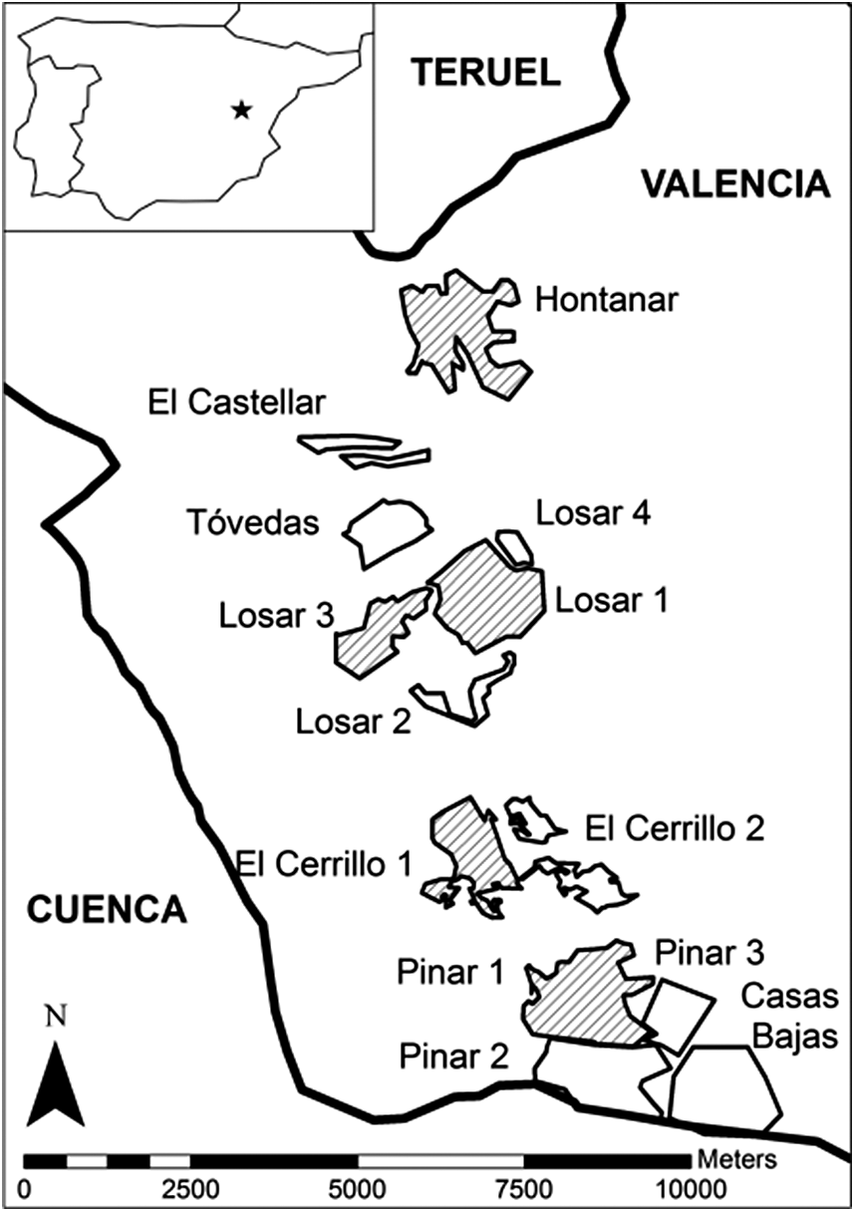
The study was conducted from mid-March to mid-June between 2011 and 2019 in Rincón de Ademuz, located in the southern part of the Iberian System (Valencia province, eastern Spain, 40º03’ N, 01º20’W; Figure 1). The monitored metapopulation encompassed the entire known distribution range of Dupont’s Lark within the Valencia province. The species was present in five patchily distributed sites, while eight other potentially suitable habitat sites were also surveyed annually (Pérez-Granados and López-Iborra Reference Pérez-Granados and López-Iborra2013). The maximum distance between patches was 2.1 km (Figure 1), a range within the known dispersal range of the species (up to 30 km; García-Antón et al. Reference García-Antón, Garza and Traba2015; Vögeli et al. Reference Vögeli, Serrano, Pacios and Tella2010). A detailed description of the Dupont’s Lark breeding dispersal distances and the landscape configuration can be found in Pérez-Granados et al. (Reference Pérez-Granados, Sáez-Gomez and Lopez-Iborra2022). The occupied sites averaged 155 ha in size (ranging from 60 ha to 200 ha), whereas the eight other potentially suitable habitat sites averaged 66 ha (range 15–160 ha; see Supplementary material S1). The metapopulation size varied between 45 and 56 territorial males throughout the study period (authors’ unpublished data). Additionally, within a 25-km buffer around the monitored area, two other known populations were present: one to the north, in Teruel (locality of Riodeva, unknown current population size), and another to the south, in Cuenca (locality of Moya, 36 males; Traba et al. Reference Traba, Barrero, Gómez-Catasús, Hervás and Reverterin press). Although these populations were not included in the current study, they likely form part of the same broader population unit and have been considered as such in prior research (Reverter et al. Reference Reverter, Pérez-Granados, López-Iborra, García-Mellado, Aledo-Olivares and Alcántara2023).
Location of monitored habitat patches for Dupont’s Lark in Rincón de Ademuz (Valencia province). Occupied patches are marked with black stripes while potential ones are empty. Habitat patches are identified by their name. The insert shows the location of the study area (star) in the Iberian Peninsula.

Rincón de Ademuz is located above 1,000 m a.s.l., featuring a mix of sloped terrain and flat areas used primarily for crops, particularly almond trees Prunus dulcis, alongside scrublands. The vegetation across all monitored sites was dominated by low shrubs, including scorpion broom Genista scorpius, rosemary Salvia rosmarinus, and thyme Thymus spp., with scattered trees like junipers Juniperus thurifera and black pines Pinus nigra. The mean annual temperature in the area is approximately 10ºC, with average annual precipitation around 550 mm. A more detailed explanation of the habitat structure and dominant vegetation in the study area can be found in Pérez-Granados et al. (Reference Pérez-Granados, Lopez-Iborra and Seoane2017b).
Physical marking, recapture, and resighting
During the study period, we conducted a Dupont’s Lark monitoring programme to estimate metapopulation size using the mapping method (Pérez-Granados and López-Iborra Reference Pérez-Granados and López-Iborra2017). Unoccupied sites were surveyed 3 times annually, while occupied sites were visited 8–9 times at regular intervals (typically once every 10 days) throughout the breeding season. Each lark territory estimated through the mapping method was surveyed for ringing purposes, and colour-ringed individuals were searched for at least three times per year. The survey effort was consistent across years.
During each visit we annotated the locations of singing males (territories hereafter) using a GPS (Garmin eTrex legend HCx). To capture and mark individuals, we set 3–5 small spring-traps in the territories that were detected during dawn surveys. Each day, traps were placed in 3–4 different territories. The spring-traps were baited with mealworms Tenebrio molitor, and playback equipment (MP3 and RadioShack amplifier) was used to attract the birds into the traps. Captures were typically restricted to the first four hours after dawn on mornings with favourable weather conditions (no rain, mist or strong winds) to minimise the risk of hypothermia and stress for the birds. Whenever possible, we also trapped and ringed adult birds at the nest (16 nests found) using passive traps (for females) or spring-traps around the nest (Pérez-Granados et al. Reference Pérez-Granados, López-Iborra, Garza and Traba2017a). To facilitate reading, hereinafter all marked and recaptured birds are considered as physically marked individuals, regardless of the trapping or resighting method used (Pérez-Granados et al. Reference Pérez-Granados, Sáez-Gomez and Lopez-Iborra2022; Vögeli et al. Reference Vögeli, Laiolo, Serrano and Tella2008).
Trapped birds were ringed with one metal ring and up to three colour rings to enable individual identification from a distance, measured immediately after capture and then released at the capture site. The maximum wing length, length of the eighth primary (F8 hereafter), and tail length were measured using a precision ruler to the nearest 0.5 mm, while tarsus length was measured with dial callipers (accuracy 0.01 mm; Vögeli et al. Reference Vögeli, Serrano, Tella, Méndez and Godoy2007). Each bird was weighed using a precision scale (0.1 g). All birds were aged as adults (i.e. born prior to the current breeding season), as first-year birds cannot be distinguished from older individuals after their complete post-breeding moult (Svensson Reference Svensson1992). Birds were sexed based on the presence of brood patches (females), cloacal protuberances (males) or wing length (males >97 mm; Suárez Reference Suárez2010; Vögeli et al. Reference Vögeli, Serrano, Tella, Méndez and Godoy2007).
Meteorological and satellite data
We extracted meteorological data from an official meteorological station of the Ministerio de Agricultura, Pesca y Alimentación (MAPA, Ministry of Agriculture, Fisheries and Food, of Spain (Sistema de Información Agroclimática para el Regadío). The station, located in Teruel city, was the closest to the study area – about 35 km from the nearest occupied site (Hontanar; Figure 1) and located at a similar altitude (935 m a.s.l.). For the entire study period, we gathered daily data on minimum air temperature (ºC), mean air temperature (ºC), and daily rainfall (mm). We collected meteorological data for two periods during which Dupont’s Lark survival might be compromised: (1) the post-breeding period, the period after the breeding season when Dupont’s Lark typically disperses (1 September–30 October; García-Antón et al. Reference García-Antón, Garza and Traba2015); (2) the winter, defined as the period between 1 November and 15 March. The first laying date in the study area was estimated to be 25 March (Pérez-Granados et al. Reference Pérez-Granados, López-Iborra, Garza and Traba2017a), so mid-March was considered the onset of the breeding season. To facilitate reading we will refer to the post-breeding period hereinafter as autumn. In the analyses, we did not include data on weather conditions or food availability during the breeding period and early summer (mid-March to August), as we did not expect annual survival of the species to be negatively affected during this time due to greater arthropod availability (Reverter et al. Reference Reverter, Traba, Barrero, Bustillo-de la Rosa, Gómez-Catasús and Zurdo2025) and generally mild weather conditions (e.g. higher mean air temperature and no snow).
For each period and year, we calculated the following meteorological variables: (1) the number of frost days, defined as total days with a minimum air temperature ≤0ºC (Müller et al. Reference Müller, Nuñez and Seluchi2000), (2) mean air temperature (ºC), calculated as the average daily air temperature during each period; (3) accumulated rainfall (mm), as the sum of daily rainfalls throughout the period. Additionally, we estimated vegetation productivity for each period and year using the minimum Normalised Difference Vegetation Index (NDVI; Rouse et al. Reference Rouse, Haas, Schell, Deering and Rossi1974), a common measure of photosynthetically active vegetation (reviewed in Pettorelli et al. Reference Pettorelli, Vik, Mysterud, Gaillard, Tucker and Stenseth2005). NDVI has been linked to arthropod abundance in various open-habitat ecosystems (Fernández-Tizón et al. Reference Fernández-Tizón, Emmenegger, Perner and Hahn2020; Sweet et al. Reference Sweet, Asmus, Rich, Wingfield, Gough and Boelman2015), including Iberian shrub-steppes inhabited by Dupont’s Lark (Traba et al. Reference Traba, Gómez‐Catasús, Barrero, Bustillo‐de la Rosa, Zurdo and Hervás2022). Therefore, we used NDVI as a surrogate for arthropod biomass, the primary prey of Dupont’s Lark (Zurdo et al. Reference Zurdo, Bustillo-de la Rosa, Barrero, Gómez-Catasús, Reverter and Pérez-Granados2024; see similar approach in Barrero et al. Reference Barrero, Gómez‐Catasús, Pérez‐Granados, Bustillo‐de la Rosa and Traba2024). We expected that larger plant productivity and warmer temperatures, both during winter and autumn, could be related to higher survival rates (Brittingham and Temple Reference Brittingham and Temple1988; Davis et al. Reference Davis, Nager and Furness2005; Oro and Furness Reference Oro and Furness2002).
NDVI values were derived from the MODIS Terra NDVI data product, which provides 16-day temporal resolution and a spatial resolution of 236 m. The satellite data were processed through a three-step approach: first, we constructed a mask to estimate NDVI only for the five sites occupied by Dupont’s Lark (Figure 1). Second, we excluded pixels influenced by human activities, such as crops or areas outside the species’ natural habitat, which may provide altered NDVI values. Lastly, we removed pixels whose boundaries did not fall within the site edges. In summary, we considered only those pixels (n = 18) whose boundaries were entirely within the occupied sites and with natural vegetation. NDVI values for each period and year were calculated using two (autumn) or five (winter) images spaced 16 days apart, captured on similar dates across the study years (e.g. autumn images from 29–30 September and 15–16 October; winter images from 16–17 November to 5–6 March). NDVI values were filtered using MODIS quality assurance information, retaining only pixels classified as “good” or “marginal” data (Dimov et al. Reference Dimov, Löw, Uhl, Kenjabaev, Dubovyk and Ibrakhimov2019; Löw et al Reference Löw, Prishchepov, Waldner, Dubovyk, Akramkhanov and Biradar2018). For each period and year, we estimated the minimum NDVI as the average of all pixel values for the month with the lowest NDVI, since survival of the species might be more likely constrained by periods of lowest vegetation productivity rather than for the mean NDVI over the whole period. A detailed table showing average seasonal weather conditions and NDVI values for each period and year is available in Table S2.
The three climatic variables and minimum NDVI values were scaled (mean = 0, standard deviation = 1) and summarised using independent Principal Component Analysis (PCA) for each period. The PCAs were conducted using the “prcomp” function of the MASS package (Ripley et al. Reference Ripley, Venables, Bates, Hornik, Gebhardt and Firth2013) in R 4.3.1 (R Core Team 2023), and the scores from the PCA axes were used as explanatory variables in subsequent analyses (see Table S3).
Survival analyses
During the study period (2011–2019), we marked 113 adult Dupont’s Larks (89 males and 24 females), of which 33 individuals were recaptured a total of 43 times. We used capture-mark-recapture data (CMR) to estimate adult local survival (ϕ) and recapture probabilities (P) by fitting the classical Cormack–Jolly–Seber (CJS) model, which accounts for detection probability (Lebreton et al. Reference Lebreton, Burnham, Clobert and Anderson1992). Before fitting the models, we performed a goodness-of-fit test (GOF) of the Jolly Movement model for unistate data using R2UCARE (Choquet et al. Reference Choquet, Reboulet, Lebreton, Gimenez and Pradel2005; Gimenez et al. Reference Gimenez, Lebreton, Choquet and Pradel2018). None of the GOF tests were significant, indicating no need to include sources of heterogeneity in recapture or survival, such as trap dependence or transience (Pradel et al. Reference Pradel2005).
We proceeded with a two-step model selection approach. First, we identified the best recapture structure by testing the effects of time (annually, as a factor) and sex (“male” and “female”, as a factor). We included the factor sex since the trapping method employed is inherently biased towards the capture of males (Pérez-Granados et al. Reference Pérez-Granados, Sáez-Gomez and Lopez-Iborra2022). Once the best recapture structure was identified, we tested the effects of time, climatic variables, and vegetation growth (NDVI) during the autumn and winter periods on annual survival variation. Sex was not considered as a factor at this stage because females were much less frequently trapped than males, and their low numbers did not allow for reliable sex-specific estimates. The effects of climatic variables and NDVI were tested by incorporating the scores from the PCAs of the autumn and winter periods as linear constraints on survival. For the first PCA axis of winter, a quadratic term was also included due to the interpretation of this axis (see Results section). We selected models based on the second-order Akaike’s information criterion corrected for over-dispersion and small sample sizes (AICc) (Burnham and Anderson Reference Burnham and Anderson2002). For each model, we calculated the Akaike weight (w j) as an index of relative plausibility (Burnham and Anderson Reference Burnham and Anderson2002). Model averaging was used to generate estimates, with each model contributing to the final estimate according to its w j (Burnham and Anderson Reference Burnham and Anderson2002). We considered models to be equivalent if the difference in AICc with the best model was ΔAICc <2 (Burnham and Anderson Reference Burnham and Anderson2002). All models were run in RMark (Laake Reference Laake2013).
Results
Analyses of climatic and vegetation variables
Autumn PCA extracted a first axis (51.9% of variance, henceforward referred to as “Autumn1”) mainly related positively to accumulated rainfall and the number of frost days, although frost days were rare during this period (mean of 1.6 frost days per autumn during the study) and negatively to mean temperature (Table S3). Thus, this axis represents a gradient of years with high accumulated autumn rainfall versus years with warmer autumns. The second axis (25.7% of the variance, henceforward referred to as “Autumn2”) represented a gradient in plant productivity (see Table S4), being negatively associated with minimum NDVI values (indicating higher vegetation productivity) and positively associated with the number of frost days. The first axis for Winter (Winter1), which represented 45.0% of the variance, was negatively associated with the number of frost days and positively correlated with the other three variables, particularly accumulated precipitation. Winter1 thus described a gradient between cooler winters (i.e. winters with more frost days) and winters with more rainfall or snow. The second winter axis (Winter2), which accounted for 35.6% of the variance, presented the largest, positive correlations with minimum NDVI and mean air temperature, and a moderate negative correlation with accumulated precipitation. This axis represents a gradient of winter mildness with positive values associated with greater vegetative activity and warmer temperatures. The first axis of autumn (Autumn1) and the second axis of Winter (Winter2) were highly correlated (Spearman correlation of 0.87), showing that the greater the rainfall in autumn, the greater the vegetation development in winter. Therefore, to reduce the collinearity we decided to remove Autumn1 from further analyses and keep Winter2, as it is during this season that the consequences of weather conditions may have a more direct impact on the survival of the species.
We expected Dupont’s Lark survival to be negatively correlated with Autumn2 values, with higher survival occurring in years with lower values, which correspond to periods of higher plant productivity and fewer frost days. Regarding Winter1, we hypothesised that Dupont’s Lark survival would be maximised in years near the middle of this gradient, particularly in winters with fewer frost days and moderate precipitation, which may often fall as snow during this season. According to that interpretation, we also included the quadratic effect for Winter1 (Winter12) in the model, since a non-linear relationship was expected. We expected that both an increasing number of frost days and higher winter rainfall may reduce the species’ survival. We expected a positive association between positive values of Winter2 and Dupont’s Lark survival owing to higher survival in warmer winters with increased vegetative activity. In agreement with these hypotheses the scores of the second axis of autumn PCA (Autumn2) and the scores of both PCA axes during winter were used as explanatory variables in subsequent analyses (see Table S3).
Survival modelling
Selection of the best recapture structure was inconclusive, both models with and without sex effect on recapture were within two AICc points (Table 1). Therefore, models with and without sex differences in recapture were retained to explore best survival structure in step II. The set of best competing models included a significant negative quadratic effect Winter1 (βWinter12 = -0.71, 95% CI = [-1.37, -0.04], M1; Table 1, Figure 2, and Table S4) and a negative, albeit non-significant, lineal effect of Winter2 (βWinter2 = -0.21, 95% CI = [-0.91,0.5], M2; Table 1). Model averaging of competing models estimated an annual survival probability that ranged during the study period between 0.34 (SE = 0.12, year 2017) and 0.80 (SE = 0.11, year 2012) (Figure 3, Table 1, and Table S5). Recapture probability was sex-dependent with males experiencing higher recapture (pmale = 0.31) than females (pfemale = 0.17) (Figure 3).
Top competing models for survival (Φ) and resight (p): Winter1, principal component I of winter, Winter2, principal component II of winter; Autumn2, principal component II of autumn; the superscript “2” indicates that the models include both linear and quadratic terms for a given variable; “+” = additive effect; “*” = interaction effect; NP = number of parameters; DEV = deviance; AICc = corrected Akaike’s information criterion; ΔAICc = AICc difference to the best model. Top competing models in bold

Adult annual apparent survival of Dupont’s Lark as a function of the first principal component (Winter 1) summarising interannual variation in winter climatic conditions. Black points represent annual survival estimates from the model assuming time as a factor on survival and sex effect on recapture (Model A in Step I – Recapture, Table 1), with vertical bars indicating their 95% confidence intervals. The blue curve depicts the predicted survival from the model including a quadratic effect of Winter1 on survival (Model M1 in Step II – Survival, Table 1 and Table S2), with the shaded grey area representing its 95% confidence interval.

Model averaging parameter estimates (top competing models M1, M2, and M9, Table 1) of Dupont’s Larks breeding in Rincón de Ademuz (Valencia province) from 2011 to 2019. We present survival (left) and recapture (right) probabilities. Survival probabilities for a definite year represent the probability of surviving from one year to the next one (i.e. survival probability for 2018 represents the probability of survival from the breeding season of 2018–2019). Points show mean estimates, and line segments show their standard errors. Estimates and standard errors are available in Table S4.

Discussion
This study provides new insights into the adult annual apparent survival of Dupont’s Lark and is the first to include females in these estimates. The results indicate substantial annual fluctuations in survival rates, ranging from 0.34 to 0.80, likely driven by climate variability. The overall adult annual apparent survival rate in this study is 0.56 (the average of the eight available estimates; see Table S5), slightly higher than previous estimates from the Ebro Valley metapopulation. A short study (two and a half years) in this area found contrasting survival estimates depending on the marking method used: 0.24–0.35 for physically marked (ringed) birds and 0.5 for acoustically marked birds (Vögeli et al. Reference Vögeli, Laiolo, Serrano and Tella2008). The results of such short studies are inevitably influenced by the specific conditions of the study years. In this case, the winter of 2004–2005 was classified as one of the coldest in Spain in the past 20 years, particularly in the Ebro Valley (EFE 2005; García-Herrera et al. Reference García-Herrera, Hernández, Barriopedro, Paredes, Trigo, Trigo and Mendes2007). Based on our results, annual survival rates below 0.5 in particularly harsh winters are expected and should not be generalised to longer periods. Our findings show that adult survival in this species fluctuates significantly over time and in response to climate variability, highlighting the need for longer monitoring periods and more detailed investigation of the effects of climatic factors and food availability.
The results of this study provide a novel contribution to the understanding of the Endangered Dupont’s Lark and represent one of the few studies describing adult annual apparent survival rates within the Alaudidae family. The survival estimates obtained for Dupont’s Lark are very similar to those reported for the closely related Eurasian Skylark Alauda arvensis, which range between 0.39 and 0.78 (Donald Reference Donald2004), but are substantially lower than those for the island-endemic Raso Lark Alauda razae, which range from 0.76 to 0.94 (Dierickx et al. Reference Dierickx, Robinson and Brooke2019). Overall, the survival rate of Dupont’s Lark in the study area is similar to, and falls within the upper half of, the range of average survival rates for 25 British passerine species (mean 0.49, range 0.27–0.69; Siriwardena et al. Reference Siriwardena, Baillie and Wilson1998) and 33 European passerine species (mean 0.49, range 0.35–0.79; Saether Reference Saether1989). However, despite the average adult annual apparent survival, between 2011 and 2018, we found a significant decline of the studied population (-77% between 2005 and 2022; Reverter et al. Reference Reverter, Pérez-Granados, López-Iborra, García-Mellado, Aledo-Olivares and Alcántara2023). Similar declining patterns have been observed in other passerines with high adult survival, where population declines were linked to low and variable breeding success (França and Marini Reference França and Marin2010). Similarly, Schapaugh (Reference Schapaugh2009) also demonstrated that the projected population growth of the Streaked Horned Lark Eremophila alpestris strigata only reached sustainable values when adult survival, breeding success, and juvenile survival were all improved simultaneously; otherwise, unrealistic increases in each vital rate would be necessary to achieve a stable growth rate. In our case, the breeding success of Dupont’s Lark in the study area appears relatively high compared with similar species and unlikely to compromise the long-term viability of the monitored populations (Pérez-Granados et al. Reference Pérez-Granados, López-Iborra, Garza and Traba2017a).
This suggests that low juvenile survival is the most plausible factor contributing to the species’ decline in our area. This assumption is supported by extremely low recapture rate of ringed nestlings (3.8%, 1 of 26), compared with 33 of the 113 adults recaptured (29.2%, 33 of 113), suggesting that juvenile survival is extremely low. Moreover, it is also possible that juveniles born in the study area may disperse to other populations. Indeed, this recaptured juvenile was found at a different site from its natal patch, 4,500 m away, in agreement with that assumption (Pérez-Granados et al. Reference Pérez-Granados, Sáez-Gomez and Lopez-Iborra2022). The early post-fledging period is recognised as a demographic bottleneck in many altricial bird species due to elevated mortality (Naef-Daenzer and Grüebler Reference Naef-Daenzer and Martin U.2016), and our study lacks data on this critical phase. Thus, while our findings provide insight into adult survival, broader demographic data including juveniles and immatures are needed to better understand the drivers of the species’ decline.
This study also provides the first assessment of the impact of climate variability and vegetation productivity on the survival of the Dupont’s Lark, a threatened resident species. Our results reveal that annual survival of the studied Dupont’s Lark population was not influenced by climatic variables or vegetation productivity during the post-breeding period. However, survival decreased during winters characterised by a greater number of frost days (temperatures below 0°C) and higher accumulated rainfall. Although previous research has suggested that autumn conditions can also affect passerine survival (Halupka et al. Reference Halupka, Wierucka, Sztwiertnia and Klimczuk2017), our findings align with numerous studies in Europe that have documented the negative effects of adverse winter weather on the survival of resident adult passerines (e.g. Newton Reference Newton1998; Perdeck et al. Reference Perdeck, Visser and Van Balen2000; Robinson et al. Reference Robinson, Baillie and Crick2007). Our results are consistent with a recent study on Dupont’s Lark, which reported a drastic 66.5% population decline across seven populations monitored the year before and after an extreme winter snowstorm (Pérez-Granados et al. Reference Pérez-Granados, Bota, Gómez-Catasús, Pla, Barrero and Sáez-Gómez2023). This event, which occurred in January 2021 (after the study period of this paper), covered central and eastern Spain with snow for over 10 days and was followed by a severe cold wave. The observed negative impact of harsh winter conditions on adult survival of the Dupont’s Lark in our study may be attributed to several factors. For example, exposure to rainfall or snow increases heat loss, which may pose significant thermal challenges for maintaining body temperature (Kennedy Reference Kennedy1970; Ramakrishnan et al. Reference Ramakrishnan, Sivasubramanian, Ramkumar and Ramasubramanian2013; Wilson et al. Reference Wilson, Cooper and Gessaman2004). Prolonged exposure to wet and cold conditions can also induce stress, potentially suppressing immune function and compromising overall health (Liu et al. Reference Liu, Hu, Kessler, Gong, Wang and Li2018; Rogers et al. Reference Rogers, Ramenofsky, Ketterson, Nolan and Wingfield1993). Furthermore, snow cover, even if temporary, can reduce habitat suitability and insect activity, limiting food availability for this insectivorous species. This scarcity may also force some birds to move to suboptimal habitats, increasing their mortality risk (see Pérez-Granados et al. Reference Pérez-Granados, Bota, Gómez-Catasús, Pla, Barrero and Sáez-Gómez2023). The impact of adverse winter conditions on survival may be particularly pronounced in populations residing at high altitudes, such as our study area, which is located above 1,000 m a.s.l. While our study utilised a nine-year data set, a longer temporal scale, considering also a higher temporal resolution (i.e. estimating seasonal survival rates), would enable a more comprehensive analysis of the relationship between climate variability and vegetation productivity and survival. Prior studies have suggested that bird mortality often results from prolonged periods of continuous, severe weather (e.g. Greenwood and Baillie Reference Greenwood and Baillie1991; Meininger et al. Reference Meininger, Blomert and Marteijn1991; Robinson et al. Reference Robinson, Baillie and Crick2007). Thus, future research – both at larger spatial scales and with higher-resolution environmental data – should consider incorporating additional climatic variables that better capture the duration and intensity of extreme weather events, which are expected to increase under on-going climate change, to refine our understanding of these impacts. The lack of a detected impact of resource availability on Dupont’s Lark survival may be explained by limitations in the proxy used (minimum NDVI per period) obtained from remote sensing. Previous research has shown much stronger correlations between arthropod abundance and vegetation indices derived from high-resolution drone imagery compared with satellite products (Traba et al. Reference Traba, Gómez‐Catasús, Barrero, Bustillo‐de la Rosa, Zurdo and Hervás2022). Therefore, the potential effect of food availability should be better assessed in future studies through direct arthropod sampling in the field (e.g. using pitfall traps) or by employing high-resolution, multispectral drone imagery. While both methods are more costly than satellite-based indices, they may detect more subtle effects of food availability that were not captured in our study.
By encompassing a longer timeframe, our study provides better understanding regarding the survival rate of Dupont’s Lark than that obtained in prior research (Laiolo et al. Reference Laiolo, Vögeli, Serrano and Tella2008; Vögeli et al. Reference Vögeli, Laiolo, Serrano and Tella2008) and shed light, for the first time, into the factors influencing it. We are aware that our results are based on small sample sizes and would like to encourage further research to estimate adult annual apparent survival for each sex, to better understand whether survival rates vary among sexes. Nonetheless, trapping Dupont’s Lark females is challenging, since the method used here – the most commonly applied to this species, a combination of spring-traps and playback – is inherently biased towards the capture of males (e.g. Pérez-Granados et al. Reference Pérez-Granados, Sáez-Gomez and Lopez-Iborra2022). Overall, our survival estimates align with previous studies on the species, although showing the existence of significant interannual variability according to weather conditions. Despite these fluctuations, the average adult annual apparent survival rates found do not appear to threaten the long-term viability of the species, as our survival estimates are slightly higher than those reported for several other European passerines or previous research on the species in its core area (Vögeli et al. Reference Vögeli, Laiolo, Serrano and Tella2008). However, environmental stochasticity, represented by very cold winters driving survival to low values, may have a strong negative effect on the viability of small populations. Currently, there remains a critical knowledge gap regarding the apparent survival rate of Dupont’s Larks from the period when nestlings leave the nest until their first breeding season – a phase likely marked by much higher mortality rates compared with adults. For instance, the juvenile survival probability from post-fledging to breeding for the Eurasian Skylark in the Netherlands was 0.235, whereas adult survival was 0.632 (Zomer Reference Zomer2021). Therefore, it would be desirable to focus further research on the survival of the species into this topic, which could significantly influence management efforts if aimed at improving survival rates and recruitment of juvenile birds.
Supplementary material
The supplementary material for this article can be found at http://doi.org/10.1017/S0959270925100233.
Acknowledgements
This study was supported by Levantina y Asociados de Minerales, S.A., as part of the project “Estudios de investigación aplicados a la conservación de las poblaciones de alondra ricotí (Chersophilus duponti) en el entorno del município de Vallanca”. We wish to thank the Servicio de Vida Silvestre of Conselleria D´infraestructures, Territori i Medi Ambient (Generalitat Valenciana) for ringing permits and supporting our work. We also thank Alberto Lucas for his collaboration with the project. Our methodology complies with current Spanish laws in the matter of avifauna capture and three of the authors were authorised for ringing activities.