Introduction
Both prehospital and emergency department (ED) health care providers encounter violent, combative, and agitated patients on a regular basis. Reference Scaggs, Glass, Hutchcraft and Weir1 This can pose safety risks to both the patient and the provider. To deter such risks, certain chemical restraints have been used in the past such as benzodiazepines, anticholinergics, and antipsychotics. Reference Zun2 Ketamine is a N-methyl-D-aspartate (NMDA) receptor blocker that produces a dissociative state without respiratory depression at higher doses, which can be administered via intramuscular (IM), intranasal (IN), intraosseous (IO), or intravenous (IV) routes. Reference Linder, Ross and Weant3
Recently, Emergency Medical Services (EMS) providers have been increasingly using ketamine as a chemical restraint due to its rapid onset of action, safety profile, and the ability for the patient to maintain respiratory drive. Reference Burnett, Peterson and Stellpflug4 Within the study’s geographic area, ketamine has become the most frequently used sedative agent. Local EMS protocols allow for ketamine administration in violent/combative patients and suspected excited delirium. Under standing orders, paramedics commonly administer ketamine at a standardized dose of 400mg IM or 200mg IV/IO, with the ability to repeat the dose once as needed.
However, few studies have examined the use of ketamine for agitation, including dose-dependent outcomes, and results have varied regarding rate of intubation and other adverse outcomes. Reference Burnett, Peterson and Stellpflug4-Reference Hollis, Keene, Ardlie, Caldicott and Stapleton10 The goal of this study was to evaluate the safety of prehospital ketamine administration, as determined by the rate of airway intervention after ketamine administration, including the need for intubation.
Methods
Study Design and Setting
This is a retrospective cohort study of patients transported by EMS to the EDs of two community hospitals. The combined annual volume of both EDs is over 81,000 visits per year. Multiple fire-based EMS agencies, operating under the same standing orders, transport patients to the two hospitals. The study was approved by the institutional review boards of Florida Atlantic University (Boca Raton, Florida USA; study #1100947) and Baptist Health South Florida (Miami, Florida USA; study #1308933).
Selection of Participants
Patients receiving ketamine by EMS and transported to one of the study hospitals from January 1, 2017 through April 30, 2019 were identified. Inclusion criteria were age 18 or greater and ketamine administration by EMS for agitation. Patients were excluded if they solely received ketamine as an induction agent for intubation, as post-intubation sedation, or for pain control.
Measurements
The hospitals’ health information management department ran a query that retrieved patients 18 years and older who had the keyword “ketamine” mentioned in either the ED physician or nursing documentation from January 1, 2017 through April 30, 2019. Chart review of the patients’ hospital electronic medical record (EMR) and prehospital EMS report was conducted by one of the physician study investigators, who was aware of the research question. Charts were first screened for ketamine administration reason prior to full-chart review. Only patients who were treated with ketamine for agitation were included. Any unclear reason for ketamine administration was adjudicated by a second study investigator.
Variables extracted from the charts included demographic data such as age and gender, as well as height and weight from the ED triage note. First documented EMS vital signs and first documented ED vital signs were recorded, as well as dose, route, and indication for ketamine administration. If the EMS report was not available, ketamine administration information was obtained from nurse and physician documentation of prehospital treatment. Patient history, including medical history and social history, were also recorded. Airway interventions (intubation, supraglottic airway placement, supplemental oxygen administration, oral/nasal airway placement, and airway suctioning) were noted if performed by either EMS or ED personnel, as well as indication(s) for performance of each intervention as documented in the narrative reports. Finally, any concomitant use of additional sedatives besides ketamine was identified if administered by EMS or in the ED.
Study data were systematically collected using the Research Electronic Data Capture (REDCap; Vanderbilt University; Nashville, Tennessee USA) data management system. Reference Harris, Taylor, Thielke, Payne, Gonzalez and Conde11 Variables were abstracted directly from the EMR to the web-based data collection instrument, which used real-time validation to ensure accuracy of data entry.
Outcomes
The primary outcome measure was need for airway intervention, with intubation being the main focus. Additional airway interventions included supplemental oxygen administration, need for airway suctioning, placement of an oral/nasal airway, and placement of a supraglottic airway. Secondary outcomes included patient disposition from the ED (admit, discharge, or transfer).
Analysis
Patients were stratified into two groups based on if they necessitated intubation after ketamine administration. Mean ketamine doses were compared between the groups by independent samples T-tests. Proportions of patients intubated by reasons for agitation, comorbidities, and exam findings were compared using chi-squared tests. Using data directly exported from REDCap, statistical analyses were conducted using SPSS (IBM Corporation; Armonk, New York USA).
Results
Characteristics of Study Subjects
During the 28 months of data review, 254 patients were identified with “ketamine” mentioned in their ED charts. One hundred sixty-eight had ketamine mentioned for reasons other than for administration by EMS for agitation. Of these, 53 received ketamine by EMS for other indications (47 for pain management, five for intubation induction, and one for post-intubation sedation); 74 received ketamine in the ED; and 41 had ketamine mentioned on their chart but not administered (23 allergy, nine home medication, five abuse history, and four other). The remaining 86 patients were enrolled in the study. Forty-seven (54.7%) were female and the average age was 42.9 years (SD = 18.9; range 18 to 98). Ketamine was administered primarily via IM (97.6%). Doses of ketamine ranged from 50mg to 600mg (mean 349; SD = 104). Weight-based doses of ketamine ranged from 0.74mg/kg to 8.80mg/kg (mean 4.88; SD = 1.65). Two patients were missing route of administration and one was missing the dose administered. These patients were only excluded from dosing analyses.
Main Results
Fourteen of 86 patients (16.3%) underwent endotracheal intubation while in the ED. One of these patients underwent bag-valve-mask ventilation and unsuccessful intubation attempt by EMS after ketamine administration. No other patients had invasive airway management by EMS after ketamine administration. Patients undergoing intubation had a variety of indications for this procedure, including decreased Glasgow Coma Scale (GCS; 43.0%), respiratory failure (43.0%), hypoxia (36.0%), hypercarbia (13.9%), vomiting (6.9%), airway protection (63.9%), hypersalivation (6.9%), and need for paralysis (13.9%).
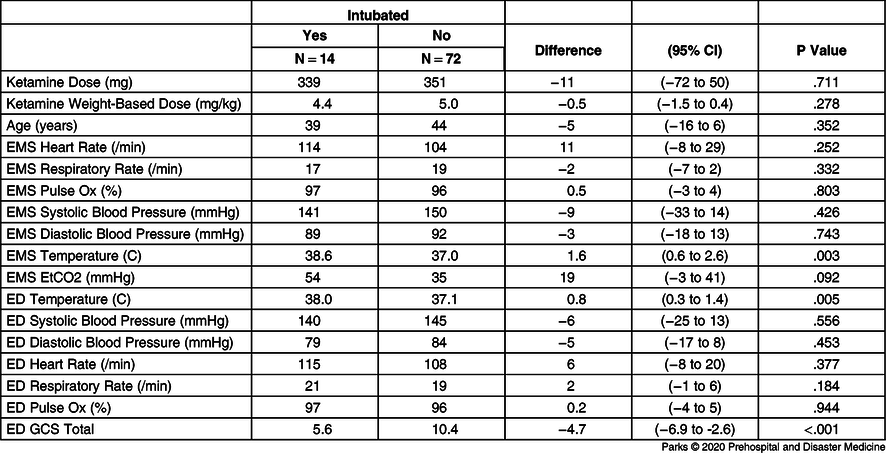
The mean ketamine dose of the intubation group was 339.3mg (95% CI, 293.7 to 384.8) and mean dose of the group that was not intubated was 350.7mg (95% CI, 324.9 to 376.5), which was not significantly different (-11.4mg difference; 95% CI, -72.4 to 49.6; P = .711). There was no significant difference in the weight-based dosing between groups, which was 4.44mg/kg (95% CI, 3.73 to 5.15) in the intubation group and 4.96mg/kg (95% CI, 4.56 to 5.37) in the non-intubated group (-0.53mg/kg difference; 95% CI, -1.49 to 0.43; P = .278).
The EMS temperature, ED temperature, and ED GCS were all significantly different between the group that was intubated and the group that was not: EMS temperature = 38.6°C versus 37.0°C (1.6°C difference; 95% CI, 0.6 to 2.6; P = .003); ED temperature = 38.0°C versus 37.1°C (0.8°C difference; 95% CI, 0.3 to 1.4; P = .005); and ED GCS = 5.6 versus 10.4 (-4.7 difference; 95% CI, -6.9 to -2.6; P <.001). No other vital signs from EMS or the ED demonstrated statistically significant differences between the two groups (Table 1).
Characteristics by Intubation

Abbreviations: ED, emergency department; EMS, Emergency Medical Services; EtCO2, end-tidal CO2; GCS, Glasgow Coma Score.
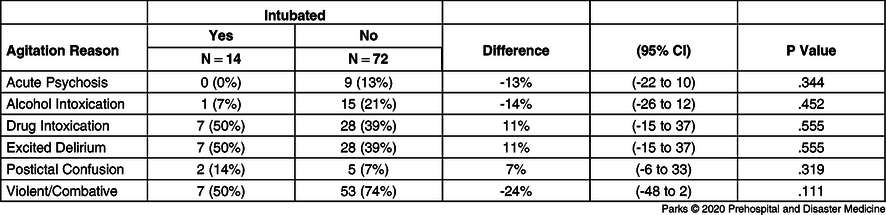
There was no difference between the group that was intubated versus the group that was not in regard to age, cause of agitation (acute psychosis, alcohol intoxication, drug intoxication, excited delirium, postictal confusion, or violence/combativeness), patient’s comorbidities (cardiovascular disease or pulmonary disease), or being treated with additional sedation in addition to ketamine (Table 2 and Table 3).
Reason for Agitation by Intubation, n (%)

Risk Factors by Intubation, n (%)

a Atrial fibrillation, congestive heart failure, coronary artery disease, hypertension, and valvular disease.
b Asthma, chronic obstructive pulmonary disease, and pulmonary hypertension.
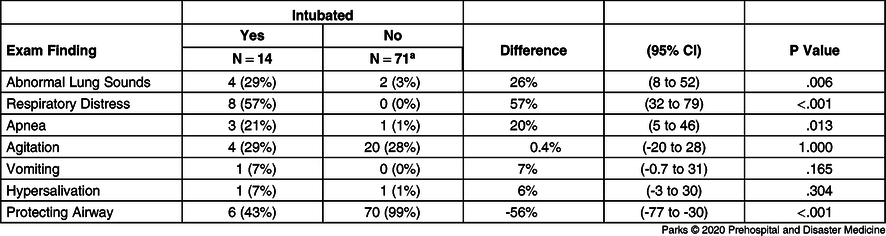
Certain clinical exam findings by the ED physician had significantly increased rate of intubation including abnormal lung sounds (29% versus 3%, 26% difference; 95% CI, 8 to 52; P = .006), respiratory distress (57% versus 0%, 57% difference; 95% CI, 32 to 79; P = <.001), apnea (21% versus 1%, 20% difference; 95% CI, 4 to 46; P = .013), and if the patient was protecting their airway (43% versus 99%, -56% difference; 95% CI, -77 to -30; P = <.001). Findings of agitation, vomiting, and hypersalivation while the patients were in the ED were not associated with an increase in intubation (Table 4).
Emergency Department Physical Exam Findings by Intubation, n (%)

a One patient had physical exam missing from emergency department physician note.
In addition to the 14 patients intubated, one patient had a nasopharyngeal airway placed and required oral suction. Another had an oropharyngeal airway placed that was removed shortly after naloxone was administered. Twenty-one of the patients that did not get intubated received supplemental oxygen in the ED (16.3% nasal cannula [NC], 8.1% nonrebreather [as well as NC], and 1.2% venti mask). Only six of these patients had one or more documented reasons for supplemental oxygen (three for decreased GCS, two for respiratory distress/failure, four for hypoxia, one for hypercapnia, and one for hypersalivation).
Of the 86 patients, 66 (76.7%) were medically admitted to the hospital, 16 (18.6%) were discharged, and four (4.7%) were transferred to a psychiatric facility.
Discussion
This study’s rate of intubation of 16% is considerably lower than most previous studies. Reference Cole, Moore and Nystrom5-Reference Mankowitz, Regenberg, Kaldan and Cole7 There is a wide range of intubation rate associated with prehospital ketamine for agitation. A retrospective study of 135 patients demonstrated an intubation rate of 63%, concluding that this high rate may be associated with provider variability in comfort level with post-ketamine patients. Reference Olives, Nystrom, Cole, Dodd and Ho6 A retrospective Australian study found that of 38 patients who received prehospital ketamine for agitation, 26% required intubation. Reference Hollis, Keene, Ardlie, Caldicott and Stapleton10 In a prospective study of 146 patients (64 of which received ketamine), 39% of the ketamine group received intubation. Reference Cole, Moore and Nystrom5 The authors also felt that there was significant variation in provider comfort with post-ketamine patients and they suggested that patients receiving ketamine should be scored in a different manner regarding GCS evaluation. Patients who are dissociated with ketamine often have a GCS of three due to the effects of the medication. However, unlike most other unresponsive patients who typically require intubation, patients who receive ketamine often have maintained airway reflexes, respiratory drive, and cardiovascular stability.
Contrary to the studies mentioned above, others have reported a much lower rate of intubation following ketamine administration. The lowest published rate of prehospital intubation was four percent in a retrospective review of 52 patients receiving ketamine for agitated delirium by EMS, but the study did not evaluate subsequent care in the ED, where most of the patients requiring intubation in this study was performed. Reference Scheppke, Braghiroli, Shalaby and Chait12 A prospective study of 49 patients who received rescue ketamine after failing droperidol for agitated delirium demonstrated no cases of intubation, with a 300mg median dose of ketamine and 50mg to 500mg range. Reference Isbister, Calver, Downes and Page13
Some studies have shown an association between higher doses of ketamine and intubation. Reference Burnett, Peterson and Stellpflug4 However, other studies fail to demonstrate such an association. Reference Cole, Moore and Nystrom5,Reference Olives, Nystrom, Cole, Dodd and Ho6 This study’s data fail to demonstrate association of dose, route, age, any vital signs (other than temperature), intoxication, comorbidities, or additional sedatives with risk of intubation. There was a significant difference in patients with a higher temperature and a lower GCS in the group that were intubated, perhaps representing a sicker cohort of patients.
Twenty-one patients that did not get intubated did receive supplemental oxygen in some form; however, at the study institution, it is common practice for nurses to place sedated patients on oxygen even in the absence of clinical necessity. Reason for oxygen administration was not consistently documented, and it is uncertain what percentage of these patients truly needed it.
Limitations
There were several limitations to this study. The retrospective nature of this study is prone to selection bias. Some charts were lacking EMS documentation. In these cases, the physician and nursing documentation were used to determine indication, dose, route, and circumstances of ketamine administration. This may have led to inaccuracies, insufficient data, or failure to identify patients who received this intervention. In addition, where GCS was not reported, this was estimated based on available documentation in the chart. There were multiple instances where supplemental oxygen was administered without a documented indication or a clear reason from chart review by both EMS and in the ED. It is unclear whether these patients required oxygen, or if it was simply administered as prophylaxis in a patient who had received sedation. In addition, neither hospital in the study has a psychiatric facility and thus EMS may have preferentially transported patients with acute psychosis/agitated delirium to a more distant hospital equipped with psychiatric services.
Conclusions
The observed rate of intubation in patients receiving prehospital ketamine for agitation was 16.3%. Patients with a higher temperature and a lower GCS were more likely to require intubation. Study data did not reveal an age or dose-dependent rate of intubation. Further research should be conducted to compare the airway intervention rate of agitated patients receiving ketamine versus other sedatives in a controlled fashion and other less-objective factors such as clinician experience and comfort.
Conflicts of interest
The authors report no conflict of interest.