I. INTRODUCTION
Al–Li alloys have been widely concerned recently for their lower densities, higher strengths, and stiffness to weight ratio compared to other conventional Al alloys. Reference Lavernia, Srivatsan and Mohamed1–Reference Dursun and Soutis3 As reported, each 1 wt% increment of Li addition (up to 4 wt%, all compositions are in wt% hereafter unless otherwise noted) into Al alloys can reduce density by 3% and simultaneously increase elastic modulus by about 6%. Reference Gupta, Nayan, Nagasireesha and Sharma4 Therefore, Al–Li alloys, such as AA2099, AA2195 etc., have received extensive attentions in aerospace, military, and commercial applications which strongly require weight critical and stiffness-critical structures. However, the existing aerospace applications of Al–Li alloys are mostly wrought alloys. There is still lack of data on cast Al–Li alloys. This situation is mainly because that the wrought Al–Li alloys have the superior mechanical properties to cast alloys.
Casting is not only a low-cost way to manufacture products with complex shapes, but also an effective method to mitigate the anisotropy of mechanical properties. Moreover, the weight reduction could be much more effective in cast condition, since the limitation of Li addition can be much higher than that in wrought alloys. Therefore, it is important to investigate the cast Al–Li alloys. Drits et al. Reference Drits, Kadaner, Turkina and Fedotov5 reported that casting Al alloys containing 2 wt% Cu and 1–2 wt% Li have reasonable high mechanical properties [ultimate tensile strength (UTS) = 350 MPa, elongation (EL) = 2–3%] in the full aged condition. Moreover, some other alloying elements (such as Mg, Zn, etc.) are usually added into Al–Li alloys to further improve the strength. It was reported that Mg addition lowered the solubility of Li in Al matrix, thereby increasing the tensile strength of Al–Li alloys by enhanced precipitation of fine Al3Li phases. Reference Kim, Seong, Jun, Shin, Kim and Jung6 Hirosawa et al. Reference Hirosawa, Sato and Kamio7 also found that a small amount of Mg addition (0.5%) to Al–1.35Li–5.5Cu–0.4Ag–0.15Zr alloy resulted in an enhanced age-hardening response. Recent research by Gable Reference Gable, Pana, Shiflet and Starke8 indicated that Zn addition to an Al–1Li–4Cu alloy facilitated the T1 (Al2CuLi) matrix nucleation, which is the primary strengthening phase in Al–Li alloys. Nevertheless, the addition of Mg and Zn to Al–Li–Cu alloy will give rise to an unavoidable decrease in EL. Thus, seeking an approach to improve the ductility of cast Al–Li alloys is crucial.
It is well accepted that Fe has harmful effect on the mechanical properties of casting Al alloys, especially the ductility. Mn is used extensively in casting Al–Cu alloys, since it can neutralize the detrimental effect of Fe in these alloys. Reference Couture9,Reference Karlík, Mánik and Lauschmann10 The major effect of Mn is to transform the needle shape compound Al7Cu2Fe into round Mn-bearing particles, which are less harmful to mechanical properties. Reference Tseng, Lee, Tsai and Cheng11 Owing to the low ductility of Al–Li alloys, they are more sensitive to Fe than other conventional Al alloys. Reference Meng and Zheng12,Reference Meng and Tian13 However, previous works rarely investigated the effect of Mn on the microstructure and mechanical properties of cast Al–Li–Cu based alloys. In this work, the cast Al–2Li–2Cu–0.8Mg–0.4Zn–0.2Zr–(0.5Mn) alloys were systematically studied to clarify the effects of Mn addition on the microstructural evolution and mechanical properties.
II. EXPERIMENTAL PROCEDURES
The materials used in this study were prepared with commercial pure Al, Li, Mg, Zn, and master alloys of Al–10% Zr, Al–50% Cu, and Al–10% Mn. The alloys were melted in graphite crucible in a resistance furnace under the protection of LiCl–LiF flux mixture. After the alloy was completely melted, 0.3% C2Cl6 was used for degassing at 740 °C. The melt was isothermally held at 720 °C for about 10 min and stirred well to ensure complete homogenization of alloying elements. The melt was then poured into a metallic mold pre-heated to 200 °C. The chemical compositions of the studied alloys, measured by inductively couple plasma-atomic emission spectroscopy, were listed in Table I. The as-cast alloys were solution treated at 520 °C for 24 h, immediately quenched into cold water (as-quenched), and then aged (T6) at 175 °C for 32 h near to the peak hardness.
Chemical composition (wt%) of the investigated alloys.

Bal. = Balance
Microstructures of specimens were observed by optical microscopy (OM, LEICA MEF4M, SDI Group Germany GmbH, Bielefeld, Germany) and scanning electron microscopy (SEM, JEOL-6460, JEOL Ltd., Tokyo, Japan). The samples for metallographic observation were prepared through a conventional mechanical polishing and followed by etching with Keller's reagent. Energy dispersive x-ray spectroscopic (EDS) and x-ray diffraction (XRD) were carried out to identify the phase constitutions. The ambient temperature tensile testing was conducted on Zwick/Roell Z100 testing machine (Zwick GmbH & Co., Ulm, Germany) equipped with a noncontact extensometer at a cross-head speed of 1 mm/min. The transmission electron microscopy (TEM) samples were prepared by twin-jet polishing technique in a 4 vol% perchloric acid and 96 vol% ethanol solution cooled down to approximately −30 °C by liquid nitrogen. TEM observation was carried out by JEM2100 microscopy (JEOL Ltd.) operating at 200 kV.
III. RESULTS
A. Microstructural characterization
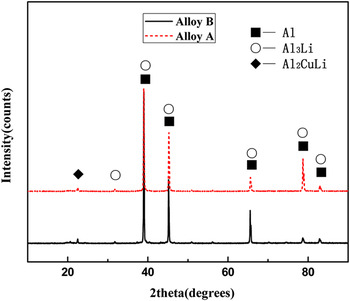
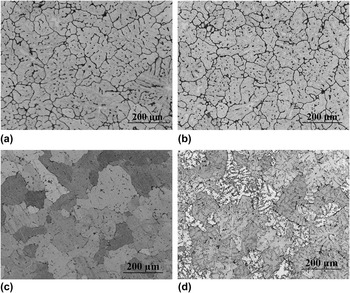
Figure 1 presents the XRD patterns of as-cast alloy A (Al–2Li–2Cu–0.8Mg–0.4Zn–0.2Zr) and B (A with 0.5Mn addition), respectively. From which it can be seen that both of them are mainly consisted of α-Al, Al3Li, and Al2CuLi phases. Although intermetallic phases including Al2CuMg, AlLi, Al2Cu, and Al6CuLi3 should be also co-existed in α-Al solid solution according to Belov et al. Reference Belov, Eskin and Aksenov14 However, no diffraction peaks of these phases are presented, and which is mainly due to their small quantity. Figures 2(a) and 2(b) show the as-cast microstructure of alloy A and B, respectively. Both alloys comprised typical dendritic α-Al and secondary phases. The average grain size of alloy A is about 234 μm, and it was reduced to 178 μm after 0.5% Mn addition. When the alloys were subjected to the solution treatment [Figs. 2(c) and 2(d)], the dendritic grain structures are basically eliminated, and the grain boundaries become level and smooth. After solution, the grain size of alloy A and B is coarsened approximately to 252 and 192 μm, respectively. Moreover, a certain amount of dispersoids were formed within grains of alloy B as can be clearly seen in Fig. 2(d).
XRD patterns of as-cast Al–2Li–2Cu–0.8Mg–0.4Zn–0.2Zr–(0.5Mn) alloys (A and B).

The as-cast microstructure of (a) alloy A, (b) alloy B; as-quenched microstructure of (c) alloy A, (d) alloy B.

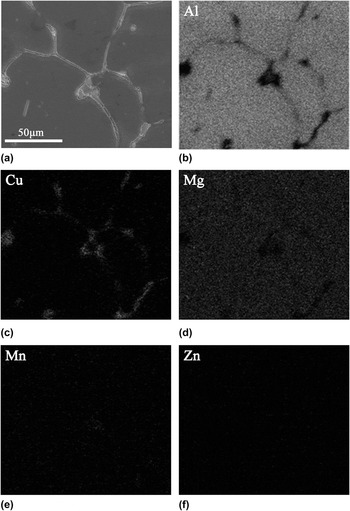
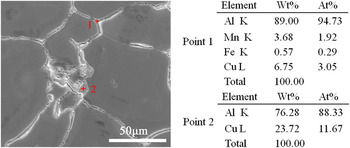
Figure 3(a) shows the SEM images for as-cast alloy B. Coarse secondary phases with continuous networks morphology can be seen along the grain boundaries. To clarify the distribution of alloy elements, the image mapping analyses were conducted by EDS. The results showed that the alloying element Cu is significantly enriched in grain boundaries [Fig. 3(c)], while Mg, Zn, and Mn distribute homogeneously in α-Al grains as shown in Figs. 3(d)–3(f). Figure 4 further displays the EDS point scans of Cu-rich phases at grain boundary, which also agrees well with the above EDS mapping results. Note here that the (Fe, Mn)-rich phase marked with “1” is formed during solidification of liquid alloy and hardly dissolves into Al matrix during solution treatment.
SEM image and elements map-scanning of as-cast alloy B: (a) SEM images, (b) Al, (c) Cu, (d) Mg, (e) Mn, and (f) Zn.

EDS results of point 1 and point 2 in as-cast alloy B.

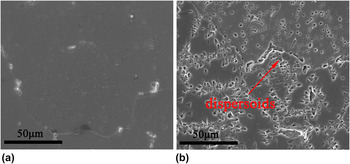
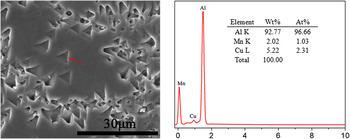
Figures 5(a) and 5(b) show the SEM microstructure for the as-quenched alloys A and B, respectively. After solution, the grain boundaries are no longer continuous and become thinner, indicating that most of the continuous nonequilibrium phases have dissolved into the matrix. Lots of dispersoids were formed during solution treatment in alloy B as shown in Fig. 5(b). The EDS results (Fig. 6) revealed that these dispersoids are Mn-containing particles, and we can conclude that they are Al20Mn3Cu2 phase according to literature. Reference Tseng, Lee, Tsai and Cheng11,Reference Zhang, Lin, Zhang and Li15
SEM microstructure for the as-quenched: (a) alloy A, (b) alloy B.

SEM image and EDS results of alloy B after solution treatment.

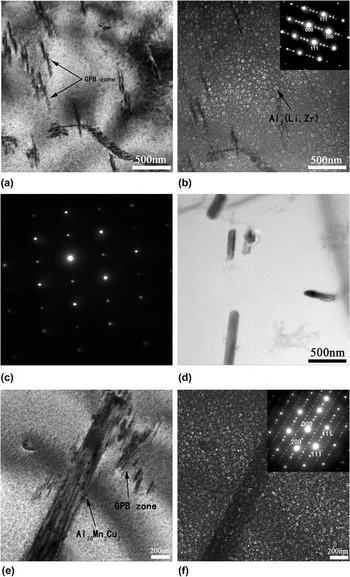
Figures 7(a) and 7(b) display the bright-field (BF) and dark-field (DF) TEM micrographs of alloy A aged at 175 °C for 32 h, respectively. It can be seen that some irregular-shaped phases precipitated in alloy A, and their corresponding selected area electron diffraction (SAED) pattern showed sharp streaking through {100}Al [Fig. 7(b)]. These results are consistent with the GPB (Guinier–Preston–Bagaratsky) zones. Reference Chen and Zheng16 Besides GPB zones, a high number density of fine spherical δ′ (Al3Li) and core/shell Al3(Li, Zr) particles are also observed in alloy A. The δ′ phase has an L12 superlattice crystal structure. The core/shell Al3(Li, Zr) particles are usually coherent with Al matrix even when coarsened to large diameters (>300 nm), and have typical dark β′ (Al3Zr) core enveloped by a bright δ′ shell, which was first reported by Gayle and Vander Sande. Reference Gayle and Vander Sande17 Characteristic L12 superlattice reflections from these particles were clearly visible in the SAED in an orientation near the [011] zone axis as shown in Fig. 7(c). Figures 7(d)–7(f) showed the transmission electron micrographs of alloy B aged at 175 °C for 32 h. In comparison with alloy A, the GPB zones with smaller size and less number densities are observed, but some plate-like phases are visible as shown in Figs. 7(d) and 7(e). Plenty of fine spherical δ′ and core/shell Al3(Li, Zr) particles are also formed in alloy B, and the SAED pattern corresponding to a [011] zone axis as shown in Fig. 7(f) revealed that the plate-like phases were Al20Mn3Cu2. Reference Shuncai, Li and Yan18 This is consistent with the above EDS results.
TEM images of samples aged at 175 °C for 32 h: (a) BF image, (b) DF image together with an inset SAED pattern and (c) superlattice reflections of Al3Li/Al3(Li, Zr) along [011]Al zone axis; (d) microstructure, (e) BF image, and (f) DF image together with an inset SAED pattern of alloy B.

B. Mechanical properties
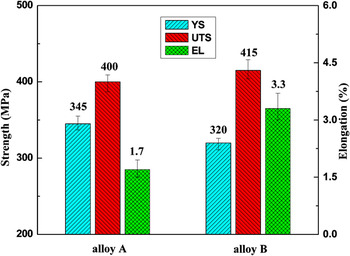
The mechanical properties of alloys A and B in T6 state are illustrated in Fig. 8. It shows that both alloy A and B have high tensile strength, i.e., the yield strength (YS) are above 320 MPa and the UTS are about 400 MPa. It can be concluded that Mn addition has little effect on strength, but has significant effect on the EL which was improved from 1.7% to 3.3%.
Mechanical properties of alloys under T6 treatment.

IV. DISCUSSION
A. Effect of Mn addition on grain size
In the as-cast condition, the grain size of the Mn-containing alloy is slightly smaller than that of Mn-free alloy. It was reported that Mn has no appreciable grain refining effect on cast Al. Reference Lihl and Sagoschen19 However, in the case of the studied alloy, the grain refinement of the Mn-containing alloy is mainly related to a grain multiplication mechanism by remelting of the dendrite arms caused by the constitutional undercooling effect of Mn addition. Reference Bowen and Bernstein20 On the other hand, Fe element can form intermetallic compounds in the high temperature when Mn was added. Reference Mondolfo21 These intermetallic compounds may act as heterogenous nucleation sites for α-Al during subsequent solidification.
In the as-cast condition of alloy B, no obvious Mn-containing phases are formed as justified by the XRD and optical microstructure results. However, during solution treatment, some Mn elements in α-Al were transformed into Al20Mn3Cu2 particles, since 0.5% Mn addition exceeds the solid solubility of Mn element (0.42%) in Al at 520 °C according to Al–Mn binary phase diagram. Mondolfo Reference Mondolfo21 pointed out that the precipitation of Al20Mn3Cu2 particles during the solid solution could effectively inhibit the grain growth in high-Mn content of Al–Cu system alloys. Thus, the grain growth in alloy B was restricted due to the formation of Al20Mn3Cu2 dispersoids near grain boundaries, resulting in a smaller grain size after solution treatment.
B. Effect of Mn addition on precipitation behavior
Additions of particular elements such as Mg, Li, Ag, and Mn can influence the aging behavior of Al alloys at room or elevated temperature through different effects on the nucleation and precipitation process. The difference can be interpreted in terms of two major factors, i.e., solute–solute interaction and solute–vacancy interaction. The Li content in the studied alloys is quite high, and the Li-vacancy binding energy (0.26 eV) is much higher than that of Mn/Zn/Cu–vacancy in Al alloys. Reference Wolverton22 Thus, Li could occupy most of the vacancies after quenching. As is known, the misfit between δ′ and Al matrix was in the range of 0.08–0.3% and the interface energy of δ′ and Al solid solution was 14 mJ/m2, so the nucleation activation energy of δ′ phase was quite low. Reference Williams and Edington23 Moreover, Gayle and Vander Sande Reference Gayle and Vander Sande17 observed that the Al3Zr (β′) particles can act as heterogeneous nucleation sites for δ′ precipitation in the Zr-containing Al–Li alloys. Flower and Gregson Reference Flower and Gregson24 stated that the reduction in both strain and surface energy terms associated with δ′ nucleation were responsible for the effectiveness of the β′ particles as nucleation sites. Precipitation of δ′ on the β′ particles results in coarsening, and the δ′-coated Al3Zr behaves as a population of larger δ′ particles. As a result, both alloy A and B are consisted of a high number density of δ′ and core/shell Al3(Li, Zr) particles.
With the nucleation and growth of δ′, the vacancies are released and the high Mg-vacancy binding energy (0.25 eV) contributes to the formation of Mg-vacancy pairs which would be arranged in clusters with vacancies and multiple solute atoms. The strong Mg–Cu interaction may encourage some Mg–vacancy clusters to seize Cu atoms to form Cu–Mg co-clusters incorporating vacancies. Reference Niessen, De Boer, Boom, De Chatel, Mattens and Miedema25 Due to that Mg atom is larger and Cu is smaller than Al, the formation of Mg–Cu-vacancy groups would compensate for the atomic size misfit and was suggested to thereby result in released vacancy which, in turn promote the mobility of the Mg–Cu co-clusters. Thus, the assistance of vacancies in the Mg-containing Al–Li alloys facilitated the formation of GPB zones which act as vacancy traps. The observed GPB zones in alloy A was in good agreement with the experiment conducted by Huang and Zheng. Reference Huang and Zheng26 While in alloy B, the formation of Al20Mn3Cu2 particles during solution treatment reduced the available Cu content in the matrix, which would be provided to precipitate GPB zones, leading to a decreased driving force for precipitation of Cu-rich phases. Moreover, it appears that the Mg-vacancy binding energy reduced with decreasing Cu: Mg ratios. Reference Ringer, Hono, Polmear and Sakurai27 As a result, the amounts of GPB zones are much less in alloy B when compared with alloy A.
It should be noted here that the precipitation behavior in this studied alloy is much different from wrought alloys with the similar Cu and Li content (AA2091, AA1441), i.e., no θ′ and T1 phases are observed. Plastic deformation and cold work prior to aging greatly increase the number density of subgrains and dislocations, which can act as heterogeneous nucleation sites for θ′ and T1. Reference Decreus, Deschamps, De Geuser, Donnadieu, Sigli and Weyland28 Cassada et al. Reference Cassada, Shiflet and Starke29 observed that the nucleation and growth of T1 plates occur by the dissociation of matrix dislocations into particles (1/6〈112〉) which form the growth interfaces of the plates and the plate edges, as proposed by Noble and Thompson. Reference Thompson and Noble30 The number of subgrains and dislocations in the experimental alloys is far below wrought alloys, and consequently no θ′ and T1 phase were observed in the aging condition.
C. Effect of Mn addition on the mechanical properties
Mn addition has effect on the grain size, phases and aging precipitations of cast Al–2Li–2Cu–0.8Mg–0.4Zn–0.2Zr alloy, and thus influences the mechanical properties. Firstly, Mn addition formed the incoherent, nonshearable Al20Mn3Cu2 dispersoids during solution treatment [Fig. 5(b)]. When dislocations bypass these dispersoids, local strain hardening response is produced through looping of dislocations around the particles, and this behavior leads to an increase in strength. Secondly, Mn has refined the alloy grain size, and thus the yield strength could be improved according to the grain boundaries hardening mechanism modeled by the Hall–Petch equation. However, in age-hardenable Al alloys, the effect of grain size hardening is not believed to be as significant as precipitates hardening because of low Petch slope. Thirdly, GPB zones are considered to be an effective strengthening factor in Al–Cu–Mg alloys. Reference Wang, Starink and Gao31,Reference Silcock32 But Mn addition consumes Cu element (to form Al20Mn3Cu2 dispersoids), and thereby, decreases GPB zones as a result of the reduced Cu content in the matrix after solution. From these three aspects, it is deduced that the decrease in YS is most possibly caused by the reduction of GPB zones.
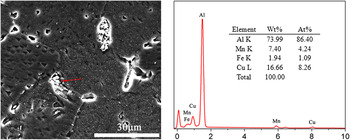
Fe is a usual impurity in commercial Al alloys and forms intermetallic compounds easily. Fe-containing compounds variously affect the mechanical behavior, depending on their compositions, morphologies, and distributions. In general, they are detrimental to strength and ductility of materials, especially when present as needle shape with sharp tips. It has been reported that the strength and ductility of Al–Cu alloys decreased linearly with increasing Fe content, Reference Zhang, Lin, Zhang and Li15,Reference Tseng, Lee, Wu and Lin33 since the needle-like Al7Cu2Fe phase acting as crack initiation sites. To alleviate this effect of Fe, the most common addition is Mn, since Al6Mn phases can dissolve some Fe element [Al6(FeMn)]. In this study, the Al6(CuFeMn) phase which is more round and less detrimental to mechanical properties compared with needle like Al7Cu2Fe, was observed in alloy B as shown in Fig. 9 due to that some of the Al in Al6(FeMn) was replaced by Cu.
SEM image and EDS results of intermetallic compound in as-quenched alloy B.

It is well known that the planar slip caused by shearing of Al3Li particles is an important reason for the low ductility of Al–Li alloys. The Al20Mn3Cu2 dispersoids, formed during solution treatment, are nonshearable particles. Dislocations are forced to bow around these dispersoids rather than cut them during deformation, and thereby can disperse the co-planar slip arising from Al3Li phase, leading to fine slip due to working hardening that occurs on the operating slip plane. Starke Reference Starke and Lin34 and Walsh et al. Reference Walsh, Jata and Starke35 found that 0.3% addition of Mn in an Al–Cu–Mg–Zr alloy produced sufficient submicrometer sized dispersoids to homogenize slip, resulting in improved ductility. In addition, the refinement of grain size after Mn addition reduces the slip length, and contributes to the ductility as well. Therefore, based on the above knowledge, we could draw a conclusion that the improvement of EL in alloy B is mainly resulted from the neutralization of Fe detrimental effect, the formation of Al20Mn3Cu2 particles, and the refinement of grain size cause by Mn addition.
V. CONCLUSIONS
The effect of 0.5% Mn addition on the microstructure and mechanical properties of cast Al–2Li–2Cu–0.8Mg–0.4Zn–0.2Zr alloy has been investigated. Following conclusions can be made:
-
(1) In comparison with Mn-free alloy, the grain size of Mn-containing alloy is refined both in the as-cast and solution treated state. The increased constitutional undercooling caused by Mn addition and Al20Mn3Cu2 dispersoids formed during solution treatment were mainly responsible for the finer grain size obtained in Mn-containing alloy.
-
(2) Large volume fraction of spherical δ′ and core/shell Al3(Li, Zr) particles are formed in both Mn-containing and Mn-free alloys. In the Mn-free alloy, a relatively higher number density of GPB zones are observed, while in the Mn-containing alloy, some Al20Mn3Cu2 dispersoids together with less GPB zones are visible. The reduction in GPB zones is ascribed to the consumption of Cu by the formation of Al20Mn3Cu2 particles.
-
(3) Mn addition has no obvious effect on tensile strength of Al–2Li–2Cu–0.8Mg–0.4Zn–0.2Zr (0.5Mn) alloy, but significantly improves the alloy EL from 1.7 to 3.3%. The improvement of ductility is mainly caused by the refinement of grain size, the formation of Al20Mn3Cu2 particles, and the neutralization of Fe detrimental effect after Mn addition.
ACKNOWLEDGMENTS
This project is supported in part by National Natural Science Foundation of China (No. 51404153) and Shanghai Yang-fan Program (No. 14YF1402000). The authors would like to thank the TEM labs of school of materials science and engineering at Shanghai Jiao Tong University for their assistance.