INTRODUCTION
In agricultural research and extension (AR&E) projects, successful collaboration depends on the roles, behaviours and attitudes of scientists, extension workers and other involved stakeholders. Within such projects, a common understanding of tasks and responsibilities and a clear distribution of roles is of high importance (Hall, Reference Hall2007).
Over the last century, mainstream AR&E was shaped by the paradigm of transfer of technology (ToT). The ToT model emphasises hierarchical roles between scientists, extension workers and farmers. The role of scientists is to set priorities for the research process and to lead experiments for innovation development. These are then transferred via agricultural extension to farmers (Röling, Reference Röling2006). Due to this linear top-down communication, farmers become mere recipients of technological innovations rather than active participants in their development and diffusion. Although failings of the ToT model have been intensively critiqued within the AR&E community and alternative approaches have been developed and implemented over the last decades (e.g. Pretty et al., Reference Pretty, Guijt, Thompson and Scoones1995; Röling, Reference Röling2006), ToT principles can still be found in current AR&E practices (e.g. Landini, Reference Landini2015). One extension method that is still widely used for technology transfer to farmers is on-farm demonstration. In the early stages, the technologies were developed and tested beforehand under controlled conditions on research stations. The function of the demonstration farm was to show farmers the benefits of the proposed innovations. Hence, the role of extension workers was to show the practical implementation of new technologies to farmers. The farmers’ role was to attend the demonstration activity and to implement the proposed innovation on their own farms.
More recent agricultural extension demonstration farm proposals and guidebooks reveal a change whereby the mere demonstration of technologies has been replaced by joint on-farm experimentation including farmers and extension workers. This represents a shift from a ‘teaching’ to a ‘learning’ approach. In the latter, importance is placed on farmers’ active participation in the process including situation and problem analysis, goal definition and planning of actions (see also Hoffmann et al., Reference Hoffmann, Gerster-Bentaya, Christinck and Lemma2009; Restrepo et al., Reference Restrepo, Lelea, Christinck, Hülsebusch and Kaufmann2014). These new demonstration farm approaches combine elements of top-down on-farm demonstration with participatory on-farm experimentation and participatory monitoring and evaluation (PM&E). Farmers are accorded the role of ‘monitor farmers’, such as in a collaborative AR&E project in New Zealand where farmers were actively involved in monitoring, evaluation and demonstration of farming practices which triggered joint action and learning (Dalley et al., Reference Dalley, Pinxterhuis, Hunter, Geddes, Tarbutton, Aenis, Knierim, Riecher, Ridder, Schobert and Fischer2014). This shift in focus is reflected in a growing body of research that emphasises farmers’ role as more equal collaboration partners and, further, as protagonists of the innovation process.
Since the 1950s, the AR&E agenda in Argentina has introduced demonstration farm approaches (Carbonell et al., Reference Carbonell, Marinissen and Lauric2012). Today, the National Institute for Agricultural Technology (INTA, a public institution for AR&E) implements demonstration farm approaches in different regions and production systems (e.g. Carbonell et al., Reference Carbonell, Marinissen and Lauric2012). In collaboration with farmers, universities, INTA extension workers and INTA scientists, demonstration farms are established in the farmers’ fields to showcase agricultural innovations while experimenting with their implementation. Demonstration farms are used for ToT within the Integral Technology Transfer System, a conceptual approach developed by INTA, where existing technologies from different research projects and development programmes are ‘harmonised’ within the region of intervention. On-farm demonstration is used to facilitate the often slow process of technological adaptation and diffusion in light of ‘real-world’ conditions. Experiments are carried out on demonstration farms (e.g. Carbonell et al., Reference Carbonell, Marinissen and Lauric2012) primarily by INTA staff, while farmers who own the fields often only participate passively.
Thirty years ago, Richards (Reference Richards1985) described a ‘people's science’ approach where scientists’ ToT role ‘is replaced by the notion of an agent who is a catalyst and facilitator to meet localised research needs and to mobilise local skills and initiatives’ (Richards, Reference Richards1985). This change of roles remains a major challenge for establishing participatory approaches in existing AR&E structures. Typically, scientists are still perceived as actors who are outside of the system that is studied (e.g. a smallholder production system), relying on the belief that they can fragmentarily define and understand the system in an objective manner, also called first-order R&D (Russell and Ison, Reference Russell, Ison, Ison and Russell2000), or a realist-positivist epistemology (Röling, Reference Röling2006). Russell and Ison (Reference Russell, Ison, Ison and Russell2000) call for second-order R&D in which scientists, as a first step, must change their position from one of objectivity to responsibility and from ‘outside’ to ‘inside’ such that they perceive themselves as actors who are part of the system under analysis (Russell and Ison, Reference Russell, Ison, Ison and Russell2000). This is the case of transdisciplinary research which makes use of multiple sources of knowledge beyond disciplines through the collaboration of multiple stakeholders, including scientists from different disciplines and practitioners, to solve ‘real-world problems’. Transdisciplinary research and extension are then understood as part of social processes that enable negotiability of values and norms in society and in science.
Accordingly, the classical role of extension workers as transmitters of technological innovations is replaced by the role of facilitator for innovation: managing dialogue and stimulating collective problem analysis with multiple stakeholders to overcome challenges or make use of opportunities in a flexible and adaptive process (Hoffmann et al., Reference Hoffmann, Gerster-Bentaya, Christinck and Lemma2009). In order to achieve this, extension workers need to acknowledge that they have decision-making power and influence on the process (Groot, Reference Groot2002). Groot (Reference Groot2002) encourages facilitators of agricultural innovation to question and to reflect upon their own relevance systems (values, beliefs, interests, theoretical and methodological assumptions), and to recognise that these highly shape the process, content and outcomes of an intervention.
Against this background, improved understanding of the roles and relations of stakeholders interacting in collaborative learning processes within AR&E projects can contribute towards project success. Instead of ‘treating collaboration as a black box’, research is needed on the mechanisms underlying collaboration processes (Dillenbourg, Reference Dillenbourg1999). For instance, McKee et al. (Reference Mckee, Guimaraes and Pinto-Correia2015) show that assessment of the scientist's role in multi-stakeholder projects can lead to relevant knowledge gains concerning critical success factors and required changes in roles. Often disregarded in scientific analysis, the role of farmers and the extent of their involvement need to be considered when developing and experimenting for agricultural innovation (Meijer et al., Reference Meijer, Catacutan, Ajayi, Sileshi and Nieuwenhuis2015). Meijer et al. (Reference Meijer, Catacutan, Ajayi, Sileshi and Nieuwenhuis2015) further highlight the need for research that focuses on intrinsic factors, such as knowledge, perceptions and attitudes of farmers and their relevance in the adoption process. Significant discrepancies can often be found between farmers’ perceptions of innovations and those of scientists and extension workers (e.g. Meijer et al., Reference Meijer, Catacutan, Ajayi, Sileshi and Nieuwenhuis2015). These differences in perception between stakeholder groups influence the collaboration and adoption process.
These gaps in knowledge are addressed by the present study. To this end, an exploratory case study was carried out in low-external-input pastoral systems of northern Patagonia, Argentina, where INTA (represented by scientists and extension workers) was implementing a demonstration farm approach for on-farm experimentation, monitoring, evaluation and diffusion of innovations, in collaboration with livestock keepers and their organisations. The study has three main aims: (i) to describe key elements of the demonstration farm approach implemented in selected cases, (ii) to assess how different stakeholder groups perceived positive impacts and constraints of an exemplary innovation tested on the demonstration farms (supplemental feeding of small ruminants) and (iii) to assess and reflect on how participating stakeholders perceived their roles and how this affected the collaboration process.
MATERIALS AND METHODS
Study location
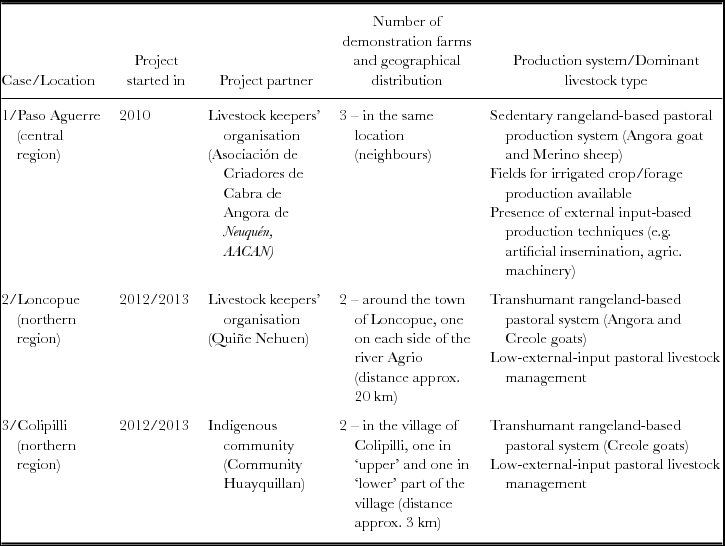
The Neuquén Province is situated in the north-western part of Patagonia, Argentina, with the Andean range in the west, constituting the international border with Chile. Except for the mountainous Andean zones, the climate is semi-arid to arid and different vegetation types within the families of Patagonian and Monte phytogeographies can be found. The Northern and Southern Andean zones are characterised by very high mountains, containing the main water resources for the whole province. Study locations selected for the present research (Table 1) are situated in the central and northern regions of the province, which are dominated by pastoral livestock production, predominantly based on transhumance. In Northern Patagonia, livestock production systems are rangeland-based and low-external-input systems, most frequently organised by smallholder livestock keepers (Easdale et al., Reference Easdale, Aguiar, Román and Villagra2009). The Neuquén Province has the country's largest stock of goats, mainly Creole and Angora breeds, constituting the predominant species in the transhumant pastoral system (SENASA, 2010). Many Merino sheep are also kept, as well as a small amount of cattle (SENASA, 2010). In the study region, the transhumant pastoral system is a socio-productive adaptation to particular ecological conditions, especially to the high spatial heterogeneity of the environment and the highly variable climate (Bendini and Tsakoumagkos, Reference Bendini and Tsakoumagkos1994). However, permanent or sedentary grazing is also practiced in some areas. In the entire province, approximately 2500 smallholder livestock keepers (constituting more than 90% of the rural population) still practise transhumance, mostly on communally owned rangelands (Bendini and Tsakoumagkos, Reference Bendini and Tsakoumagkos1994). The main marketable products are Mohair fibre (Angora goat), wool (Merino sheep) and to some extent in the northern regions, Cashmere fibre (Creole goat). Meat production (goat kids, Spanish chivitos) is important for both the market and household consumption (Bendini and Tsakoumagkos, Reference Bendini and Tsakoumagkos1994).
Overview of assessed cases.

The assessed demonstration farm projects
In the late nineties, INTA Bariloche started to integrate a demonstration farm approach into their research and development (R&D) agenda and the first farms of livestock keepers became demonstration farms in the Rio Negro Province, followed by demonstration farms in the Neuquén Province. The principle idea was to find ways to foster collaboration between the different INTA research sections (at the experimental station) and the INTA extension agencies, and thereby strengthen the link between research outcomes and their practical implementation. Through collaboration with practitioners and their organisations in monitoring, adaptating and diffusing technologies developed by INTA, the integration of a ‘real world system perspective’ aimed to improve the production systems of pastoral livestock keepers. When the demonstration farm approach is implemented, it requires three years of commitment of the demonstration farmer to collaborate in monitoring and evaluation of herd and rangeland development for the assessment of innovation impacts. For example, one innovation implemented consists of supplemental feeding of small ruminants. It was developed because nutritional deficiencies in pregnant adult females during pre-birth periods in winter and early spring were identified as the main bottlenecks negatively impacting pastoral livestock production systems in Patagonia (Giraudo, Reference Giraudo2011). Monitoring results and information on the innovations were shared with livestock keepers’ organisations and other regional institutions through field days and trainings. Table 1 gives an overview of the demonstration farm projects assessed in the present study.
Data collection
Qualitative data was collected during a four month period between September and December 2014. An exploratory approach was chosen. Semi-structured interviews were carried out with demonstration farmers, extension workers and scientists. Main topics were as follows:
• project participants’ understanding of stakeholder roles;
• motivation for participation and expected benefits;
• achieved benefits and fulfilled expectations;
• attendance in different activities;
• perceptions of successful and positive aspects of the project;
• learning outcomes from the project and interactions with other participants;
• ideas for improving the approach;
• efforts (costs) to participate in the project.
In addition, the interview setting provided a space for interview partners to bring forward relevant aspects that had not previously been thought of by the interviewing scientist. Narrative interviews were carried out with some demonstration farmers, extension workers and scientists, in order to reconstruct project activities (e.g. herd monitoring, supplemental feeding) from the participants’ perceptions. Whereas semi-structured interviews are based on a ‘question–answer’ interview mode, in a narrative interview only one broad initial question is asked which prompts the respondent to tell a story, without interruptions by the interviewer. Thereafter, all further questions refer to statements already made and only ask for more information (can you tell me more about it) (Jovchelovitch and Bauer, Reference Jovchelovitch and Bauer2000). Supportive visual tools, such as drawing time lines and actor maps and participant observation during project activities were employed, following the objective to gain a better understanding of the project environment, activities and human interactions. These also served to be able to compare statements and perceptions given during the interviews with actions and behaviour of people in the real collaboration situation. The whole process of data collection was accompanied by intensive memo writing, providing indispensable information for structuring and interpreting the collected qualitative data.
Selection of cases and interview partners
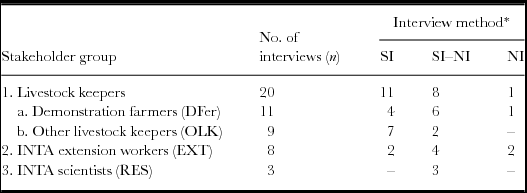
Out of the total of five cases of ongoing demonstration farm projects in the Neuquén Province, three cases described in Table 1 were selected for this study. The selection was based on predefined criteria, such as (i) project duration, (ii) settings of participating stakeholder groups and networks, and (iii) characteristics of participating livestock keepers’ organisation. In the three selected cases, the whole population of demonstration farmers (1a) and involved INTA extension workers (2) were interviewed (Table 2). Other livestock keepers (1b), who were members of the collaborating livestock keepers’ organisation or indigenous community, and who had participated in at least one demonstration farm activity, were also interviewed.
Stakeholder groups and number of interviews.
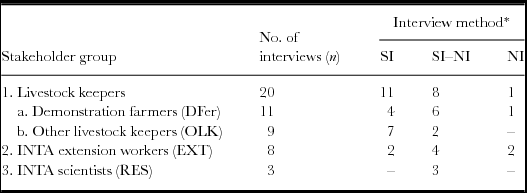
*SI = Semi-structured interview; SI–NI = Semi-structured interview with initial narrative question; NI = Narrative interview.
The interviews were conducted in Spanish and generally lasted between 45 and 60 minutes. They were audio recorded after obtaining the permission from the respondents.
Data analysis
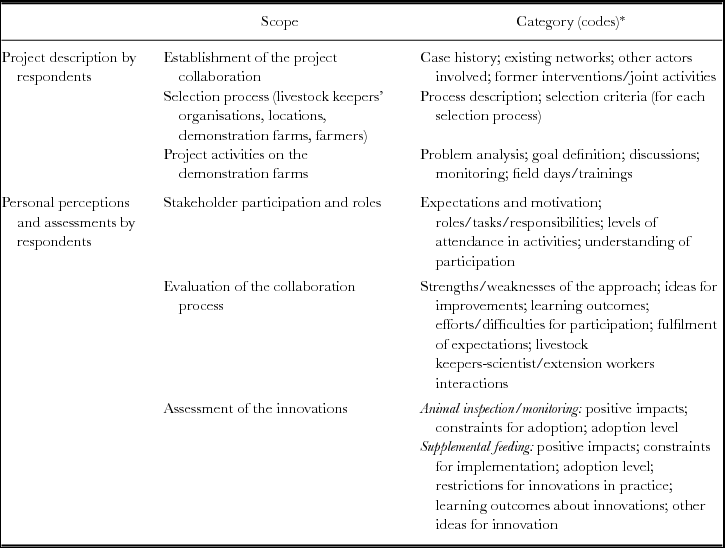
All recorded material was transcribed in Spanish and introduced into a qualitative data analysis programme (ATLAS.ti®) for qualitative content analysis. Transcription of the first interviews was done by the author in the field, to review them concerning interview style, to get a first overview of content, and to further adapt subsequent interviews. The remaining interviews were then transcribed by a professional transcriptionist (whose mother tongue was Spanish). Basic transcription mode was used to completely transcribe the literal content. Content analysis was guided by methodological principles developed by Mayring and Fenzl (2014), where the analytical-interpretative process is guided by the development of concepts and categories (codes) that are applied to the text in order to sort the material with regard to content (coding), to increase information density by reducing text volume and elucidating patterns. In ATLAS.ti®, the original Spanish material was analysed with a coding system in English. An overview of the code system used to analyse the data is shown in Table 3.
Overview of the code system.
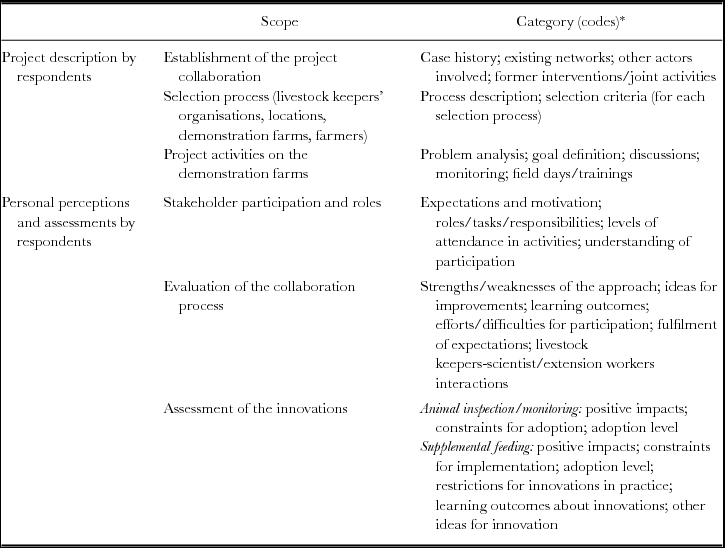
*The codes shown here were selected from the entire list of codes developed for the study, according to their relevance for results presented in this paper.
For interviewees’ statements that are quoted in the results section, the following quote reference system is used, e.g. ‘C1/16/DFer’ indicates the case number (C##)/unique interview ID (##)/stakeholder group (DFer = demonstration farmer; OLK = other livestock keeper; EXT = INTA extension worker; RES = INTA scientist). Recurrence of statements shown in figures and tables is indicated by the number of quote references.
RESULTS
Key elements of the demonstration farm approach implemented in selected cases
Review of the project-related literature as well as analysis of the interviews carried out with scientists and extension workers revealed that for INTA, the general aim of the project was to improve the link between research, extension and livestock keepers by implementing and testing innovations on selected demonstration farms, and triggering diffusion of tested innovations among other livestock keepers. According to project documents (e.g. Villagra, Reference Villagra2014), the main purposes of herd monitoring conducted on the demonstration farms were to:
• collect baseline data of herd status for analysis and evaluation of the production system;
• give recommendations for changes of management practices and strategies;
• measure impacts of strategic supplemental feeding and replacement strategies;
• demonstrate effects of management changes to livestock keepers and use the data for scientific analysis;
• train livestock keepers in the use of animal inspection and observation techniques and recording herd development by using different parameters for improved decision making in herd and rangeland management (supplemental feeding, replacement, breeding, stocking rates, etc.).
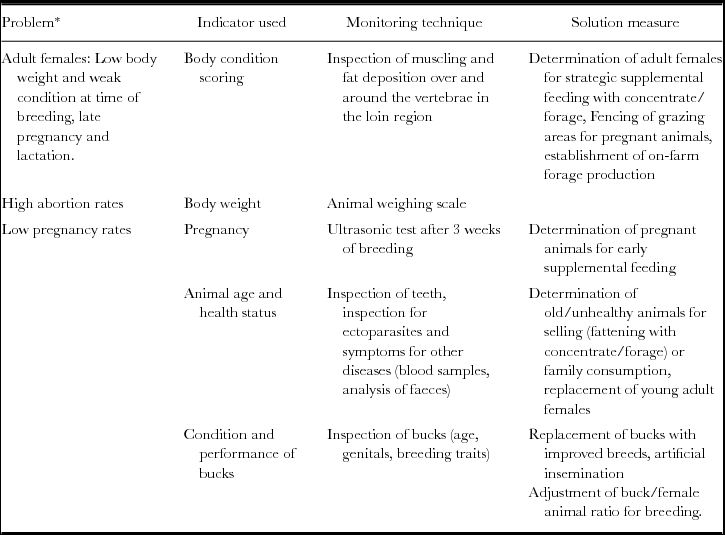
Based on results of previous demonstration farm projects, INTA scientists had identified major problems in the pastoral livestock system for which they proposed innovations as possible solution measures. In order to monitor the effect of the implementation of the innovations on the demonstration farms, they decided which indicators and monitoring techniques should be used (Table 4).
Herd monitoring approach, identified problems and proposed solutions*.
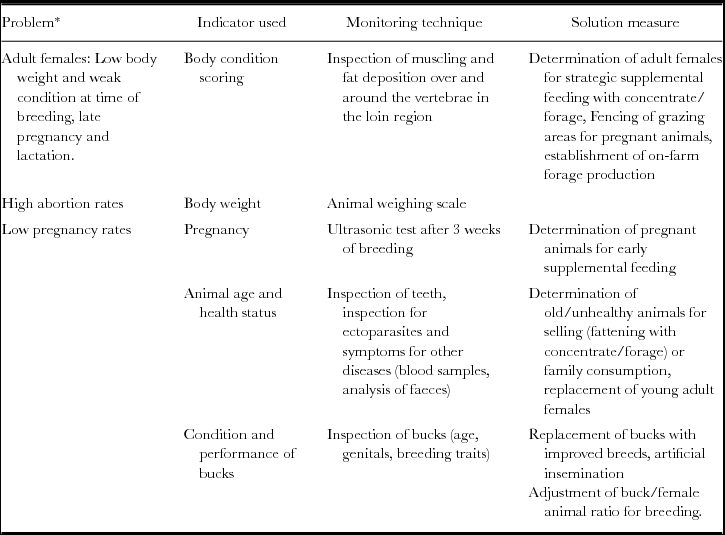
*Based on (Giraudo, Reference Giraudo2011; Villagra, Reference Villagra2014).
Monitoring of herd status and development was done on all demonstration farms of the assessed cases. It was led by INTA personnel and conducted with the participation of the demonstration farmers and members of their organisation or other peers. Based on data collected from monitoring activities, INTA gave detailed instructions to the demonstration farmers on the implementation of supplemental feeding strategies, and provided fodder (roughage and concentrate) to demonstration farmers free of charge the first year. In the subsequent years, costs were shared between INTA and demonstration farmers (using a credit system). Furthermore, results of the monitoring of supplemental feeding strategies were shared within the livestock keepers’ organisations and with peers during field days and trainings on the demonstration farms.
Stakeholder perceptions of supplemental feeding
The strategic supplemental feeding of pregnant goats conducted at the demonstration farms addressed the problem of low reproductive performance (Table 4) and was intended to increase herd resilience in case of natural disasters (droughts, volcano ash fall, etc.), and to increase productivity and product quality (fibre/wool) (Villagra, Reference Villagra2014). It followed the nutritional method described by Giraudo (Reference Giraudo2011).
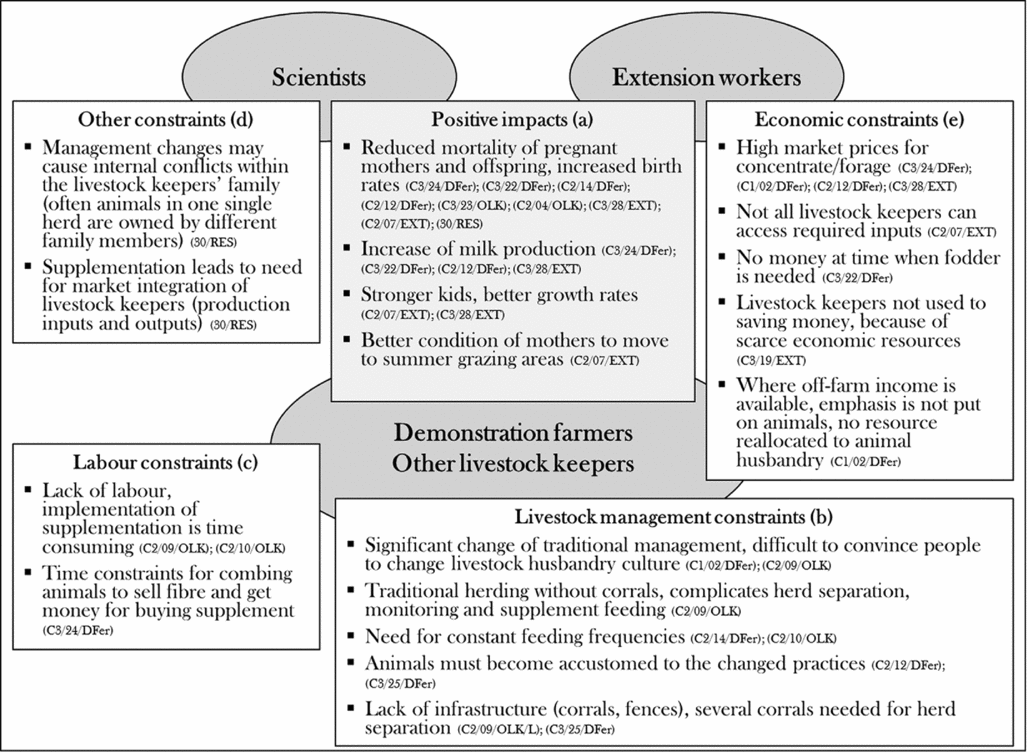
Figure 1 shows positive impacts of strategic supplemental feeding as well as constraints for implementation, as perceived by the different stakeholder groups. Overlapping of the boxes with stakeholder groups illustrates which stakeholder groups perceived which type of constraints. In the analysis, it turned out that positive impacts on the animal level (a) were observed by all stakeholder groups. Interestingly, demonstration farmers referred to their daily observation of animals when explaining positive impacts (e.g. they do not die, they have more milk, kids are better off, etc.) and not to the monitoring data collected during project activities.
Strategic supplemental feeding – perceived positive impacts and constraints for implementation.

Concerning constraints for implementation, the analysis revealed that livestock keepers emphasised livestock management issues (b), such as the necessity of corrals, change in herding patterns, conflicts with other activities, etc., as well as labour constraints (c) and economic constraints (e).
Yes, they have taught us how [to do supplemental feeding], but we have not managed to put an emphasis on this - there is a piece missing from our side. It is difficult, it is complicated, to put animals in a shelter, it is an important management change. . . It is like, changing the working culture on the farms, this is a hard piece of work (C1/16/DFer).
Changing working culture refers to the generally practiced open grazing, where animals graze the whole day on the rangelands, and return for the night to an open place near the homestead, or remain in a second settlement to benefit from grazing areas that are far from the homestead. Regular enclosure and separation of animals for supplemental feeding therefore requires a substantial change of management and additional labour input. These burdens regarding livestock management were not reflected by extension workers and scientists (as illustrated in Figure 1). Discrepancies between perceptions of different stakeholder groups become clear by the following statement of one demonstration farmer:
We, as livestock keepers working in the field, I mean, not everything worked out well, but we were doing it [keeping livestock]. And the technicians from their viewpoint - not all of them, but most of them - they have their technical view point. I mean, they did not come to the field (C1/02/DFer).
In addition, economic constraints were revealed to be of critical importance for livestock keepers. These were also recognised by the extension workers (Figure 1). On the one hand, the positive effects of supplemental feeding for the animals were recognised, but on the other hand, subsidised fodder provided by INTA seemed a major incentive for implementation:
It was nice, it helped me a lot. There, I saw for the first time that it was good, that one has to do it. I can confirm that it was a good way for the animals. That there were no invoices [for the fodder], nothing, and that is why I accepted (C3/24/DFer).
The following critical requirements for the implementation of the supplemental feeding strategy were mentioned in interviews and could also (partly) be observed by the first author during activities on the demonstration farms:
• means to obtain or produce fodder (as an external input or produced on-farm);
• knowledge of calculation for fodder ration, fodder types and period of supplemental feeding;
• knowledge of parameters for selecting animals to be supplemented;
• infrastructure for separating animals for supplemental feeding (corrals/shelters, feeding troughs);
• labour force to gather and separate animals and provide fodder;
• measures and knowledge to monitor effects of supplemental feeding and calculation of costs and benefits
• reliable forecast concerning extreme climate conditions and other environmental disasters to assure availability of economic means to purchase fodder.
Stakeholder perceptions of roles
In the field of social psychology, the term role relates to a set of expected behaviours by a social group or individuals towards a social position (Peuckert, Reference Peuckert1992). During the interviews, it was clarified by the interviewer (the first author) that the question about the respondent's role perception also related to tasks and responsibilities in the project. In the analysis of these perceptions of roles, discernment was made between self-perception and perception of other stakeholder groups. In order to examine the level of shared understanding of roles by the different stakeholder groups, results were sorted according to the level of congruency between self-perception and perception from others.
Role of demonstration farmers
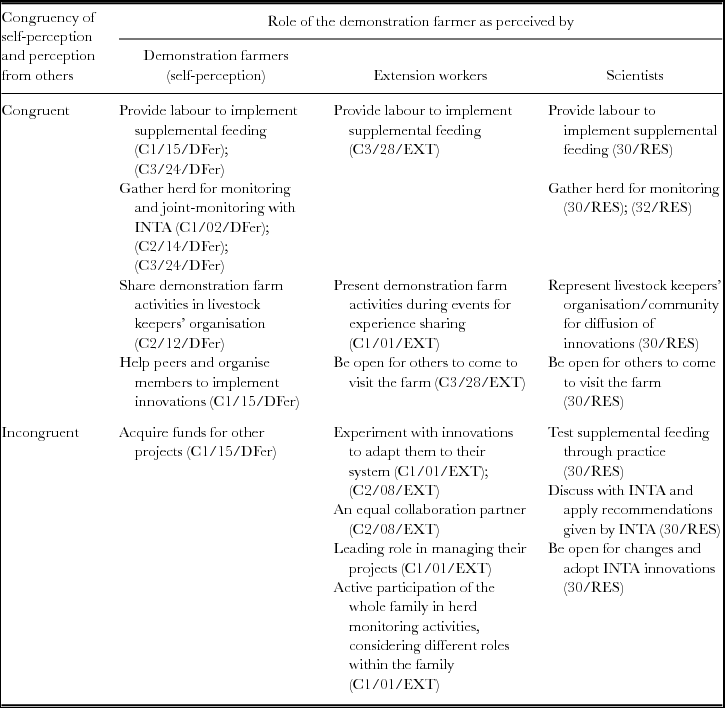
The demonstration farmers in all cases studied saw their principle role in herding the animals in the corral for monitoring activities, assisting INTA personnel with the monitoring tasks and implementing supplemental feeding according to the advice given by INTA (Table 5). These tasks and responsibilities of demonstration farmers were also mentioned by the INTA personnel interviewed. Demonstration farmers highlighted their responsibility to provide labour for the implementation of supplemental feeding, and to act as multipliers in the process of sharing experiences with peers and implementing tested practices on other farms. However, the latter was mentioned only in one case.
Role of the demonstration farmer as perceived by the different stakeholder groups.
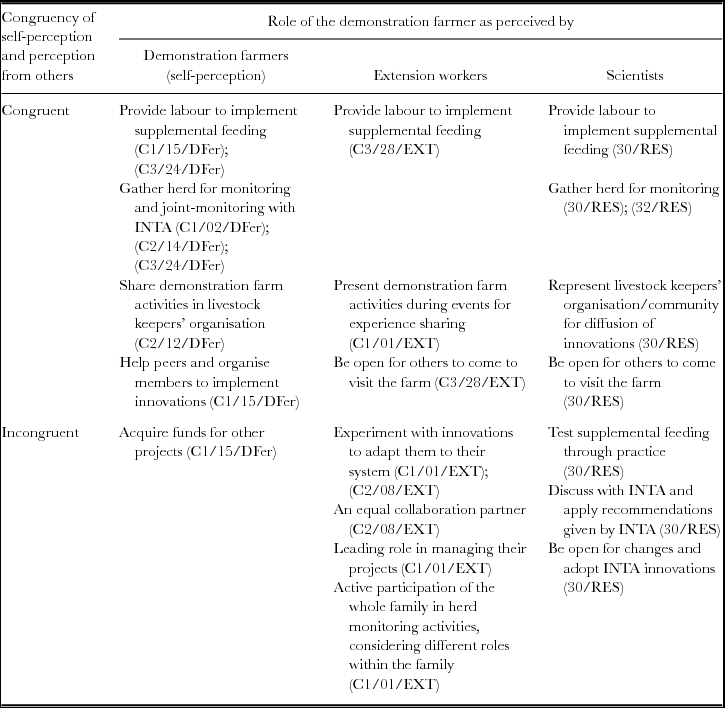
The extension workers’ perceptions of the demonstration farmers’ role was partly congruent with the demonstration farmers own perception but also revealed important incongruences in the understanding of roles. Extension workers explained the importance of demonstration farmers taking a leading role in managing the demonstration farm project, to actively experiment and adapt innovations proposed by INTA, and to assure participation of the whole livestock keepers’ family in monitoring activities, considering internal roles within families. Furthermore, active and equal participation in the process of knowledge creation with all stakeholder groups was stated to be critical by extension workers.
Participant observation during monitoring activities revealed passive participation of livestock keepers (demonstration farmers and other participants) in monitoring activities on the demonstration farms in two cases. They merely helped with gathering the animals around the weighing balance, but did not take part in animal inspection, note taking, calculating results or active discussions with INTA extension workers and scientists. This matches with the scientists’ perceptions of the demonstration farmers’ role, namely to cooperate in the process by gathering their herd for INTA, providing his/her animals for monitoring, and testing changes proposed by INTA:
He [the demonstration farmer] was committed to endure three years, sometimes we will come a minimum of four times a year, and he will have to gather his animals for us, and we will discuss in the field. . ., from the outcome of this discussion, go ahead in the process. And apart from this, he will have to open his doors for others to come. How willing is he to do this change? This is his role (30/RES).
Role of extension workers
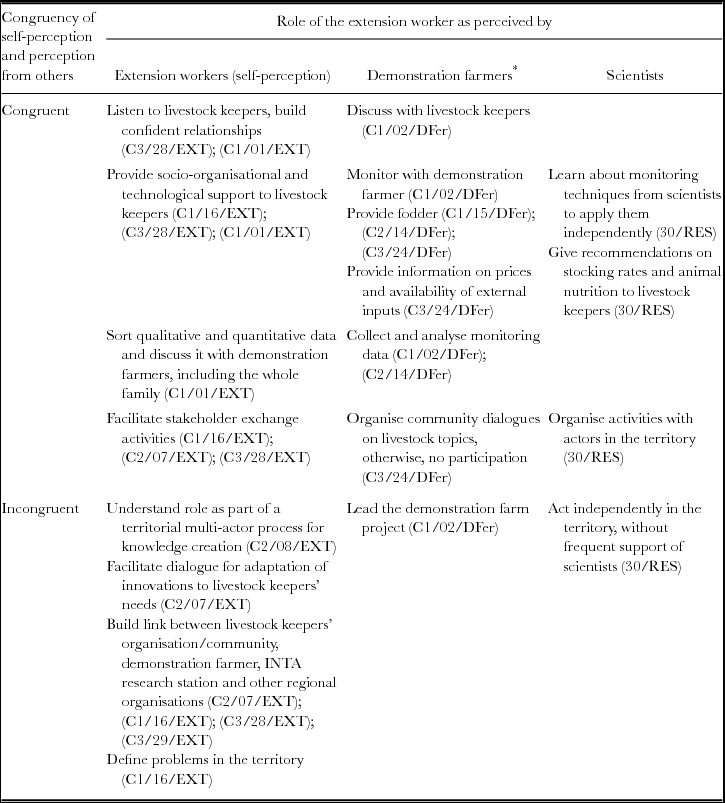
Regarding the extension workers’ role (Table 6), congruent perceptions by all stakeholder groups concerned the classical extension tasks, such as provision of advice and organisational support.
Role of the extension worker as perceived by different stakeholder groups.
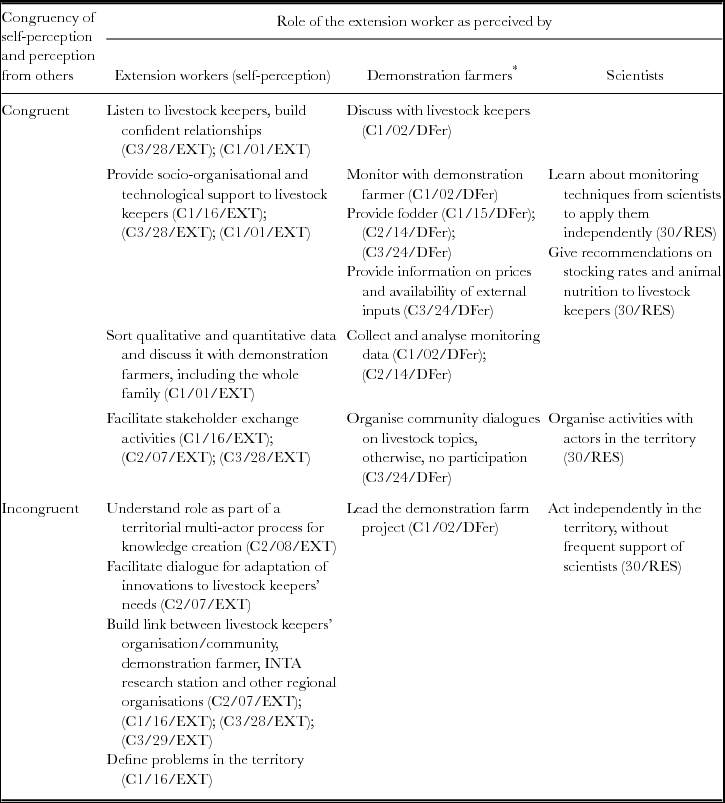
*Demonstration farmers talked about INTA personnel roles without differentiation between extension workers and scientists; mostly they referred to the extension workers, because they had frequent contact and a stronger personal link, therefore the demonstration farmers’ perceptions of the scientists’ role was also to some extent reflected here.
Additionally, most extension workers included fostering participation, collaborative knowledge construction with scientists and livestock keepers, as well as inclusion of social dimensions of innovation and assessment of impacts into their understanding of their role:
One strength, something that the demonstration farms generated, was the transdisciplinarity. It is not to bring together different disciplines, but to be able to discuss about a problem from different viewpoints. And see what everyone can contribute from his viewpoint. Maybe, our institution lacks human resources from other disciplines, but often it is a matter of attitude (C1/01/EXT).
In contrast, the scientists put extension workers into a more classical extension role: to learn from the scientists and to put the scientists’ technical knowledge into practice by using their methods and advice:
They [extension workers] simply have to understand the logic behind it, which is basically to adjust stocking rates and manage the nutrition of adult females (30/RES).
From the demonstration farmers’ point of view, the principle role of the extension worker was to provide (subsidised) fodder, and, to some extent, to bridge the gap between demonstration farmers and input markets in terms of logistical support, including comparison of suppliers and prices. Notable in many of the interviews with demonstration farmers was that they gave this role for extension workers priority in the demonstration farm projects. They saw the extension worker as the person who was responsible for monitoring activities, who analysed the data and who gave recommendations for supplemental feeding strategies. The perception of the classical teacher-scholar relation became clear in the following quotation of a demonstration farmer:
They [scientists and extension workers] explain and one learns from them because they are the engineers. The veterinarian from Bariloche, he explained to us, he told us how to do it with the bucks, look at the goats, what they should look like (C2/14/DFer).
However, other demonstration farmers stress the value of their own knowledge shown by the contrasting statement given by another demonstration farmer:
There are people [livestock keepers] who know a lot, only they lack knowledge about some specific issues. All this is corrected with the technicians who help you and you manage to do good work (C1/02/DFer).
Role of scientists
Scientists saw their role in the demonstration farm projects as creating technological and production oriented knowledge through on-farm-research. They recognised their responsibility to transfer this knowledge to extension workers and to provide funds for supplemental fodder and other external inputs to the livestock keepers (30/RES; 31/RES; 32/RES).
One scientist described his position as someone from outside the territory, but was linked to the territory through the extension role. Extension workers underlined the necessity of changing scientists’ understanding of roles. They argued that scientists need to understand themselves as equal to the other actors (livestock keepers, extension workers), who are part of the territory and who contribute to the process of multi-sourced knowledge creation:
In the first instance, knowledge generation is [currently] the exchange between extension agencies and the INTA experimental station. . . But I think that we must overcome that. . . the scientists in this place [experimental station], are far away from the territory. They look from outside. . . The frame of participation I aim for is like the example of a guy [scientist] who is in the territory doing research, and there are livestock keepers and livestock keepers' organisations within a social and cultural network that sustains practices. I think that it is an utopia (C2/08/EXT).
Extension workers further pointed out the importance of shifting from a strict focus on technological dimensions of innovation towards socio-organisational dimensions. Talking about the scientists’ role when interacting with livestock keepers, one extension worker said:
And then the participation of some scientists from the experimental station, trainings - sometimes I feel that it is very narrow, very technical. Well, they can focus on that. I would use more of, recognition about how to link oneself or how to listen to the other (C3/28/EXT).
This extension worker emphasised overcoming the scientists’ technological focus by stressing the importance of building relationships with farmers.
DISCUSSION
The aim of the demonstration farm approach was to test and demonstrate technological innovations developed by formal research in practice. The innovations were predefined by the intervening institution, in this case, INTA, and the same set of innovations was to be implemented on all demonstration farms in different regions. The process was strongly led by scientists as characteristic of the ToT model used in the demonstration farm approach. This means that the problems, goals, activities and outcomes were controlled by the initiating institution. The livestock keepers’ role in this approach is aligned with the concept of functional participation (Pretty et al., Reference Pretty, Guijt, Thompson and Scoones1995), where practitioners’ participation is used to meet predetermined objectives. Hence, major decisions have been taken in advance by the initiating institution.
This study revealed differences between different stakeholders’ perceptions of the utility and feasibility of an innovation, assessed with the example of strategic supplemental feeding, proposed as an innovative management option for low-external-input pastoral systems. These supplemental feeding strategies were designed as a response to a pervasive problem throughout all cases in the study area: nutritional deficiencies of adult females that affected productivity. Major structural restrictions (e.g. high temporal and spatial variable availability of fodder) were similar across cases and locations and might have encouraged scientists to homogenise solutions for the whole region. Thus, although some biophysical and ecological contextual conditions were considered, the complex association between ecological, economic and social factors that affect livestock keepers’ decision-making was not adequately reflected upon. In particular, these aspects were not considered in relation to the livestock management. This became clear from the stakeholder perceptions regarding constraints for implementing supplemental feeding. Understanding the reasoning behind livestock keepers’ actions would have revealed the constraints influencing routine management and that also affect the possibility of livestock keepers to take up new management practices (Kaufmann, Reference Kaufmann2011). Research on farmers’ decision-making shows the relevance of assessing attitudes and objectives (e.g. Austin et al., Reference Austin, Deary, Edwards-Jones and Arey2005), or assessing how farmers’ values influence the adoption of certain management strategies. This is supported by the statement of a demonstration farmer, ‘actually, from the technical point of view, [the proposed innovation] should be perfect, but we know that it is not’ (C1/02/DFer). This utterance ‘we know that it is not’, points to the livestock keepers’ knowledge that needs to be unfolded when aiming to create a shared understanding of integrated scientific and practical knowledge. Practitioners’ knowledge is often process-oriented and tacit (Polanyi, Reference Polanyi1966). The necessity of using methods in multi-stakeholder collaborations to support making tacit knowledge explicit was addressed by Polanyi (Reference Polanyi1966: 4) when he said: ‘we can know more than we can tell’. Livestock keepers have a close relation with their animals and sophisticated observation skills (Bendini and Tsakoumagkos, Reference Bendini and Tsakoumagkos1994; Kaufmann, Reference Kaufmann2011). Bendini and Tsakoumagkos (Reference Bendini and Tsakoumagkos1994) point to the fact that (transhumant) livestock keepers in the study region have a strong cultural relationship with their environment and animals. They further explain the fundamental importance of carefully observing and understanding these relationships and recognising the accumulated experiences of livestock keepers in restricted social-ecological livestock systems. Hence, time for dialogue, trust building and increasing awareness of the value of livestock keepers’ knowledge is crucial when seeking sustainable solutions to trigger real world changes. Possible reasons why this was not achieved in the assessed cases were reported by extension workers and livestock keepers when they highlighted time constraints of INTA personnel for interaction with the livestock keepers on the demonstration farms. Extension workers further pointed to missing institutional human resources and lack of training in the field of social sciences to methodologically address the issue of knowledge integration (Frank, Reference Frank2015).
When teaching is to be replaced by the aim of creating learning opportunities, then monitoring and evaluation approaches can be used as learning tools (e.g. Dalley et al., Reference Dalley, Pinxterhuis, Hunter, Geddes, Tarbutton, Aenis, Knierim, Riecher, Ridder, Schobert and Fischer2014). When possibilities for observing and monitoring are improved, livestock keepers can gain a more differentiated understanding of relationships between observed restrictions and options concerning available resources (Kaufmann, Reference Kaufmann2011). Thus, these improvements in monitoring and observation can lead to a change in their information processing and knowledge gain. The results from this study indicate a rather low relevance of the employed monitoring approach for the livestock keepers. In order to monitor the effect of supplemental feeding, they relied on their own observations, rather than on the monitoring results. This may be due to the fact that the monitoring design, techniques and parameters were predetermined by INTA and not developed within a PM&E approach. This means that the herd monitoring rather failed to assist livestock keepers as a learning tool.
The study provides in-depth insights into the understanding of roles, stakeholder relations and challenges related to achieving project goals. Congruence in the understanding of roles between different stakeholders was found to be consistent with the hierarchical character of the project implementation. All stakeholders perceived that the scientists’ role was to lead the project, to do on-farm research and to define the overall project goals; the extension workers’ role was to do the monitoring activities, provide consultancy and logistical support; and the responsibility of the livestock keepers was to gather the animals for INTA, to collaborate in the project and to expand their experience with other livestock keepers. These perceptions imply a clear distribution of tasks and responsibilities. However, this rigid division of tasks is more characteristic of cooperation, where partners cooperate to achieve their individual goals (Dillenbourg, Reference Dillenbourg1999), than of collaboration, where a multi-stakeholder shared action is undertaken on a jointly defined issue leading to an understanding that individual collaboration partners cannot develop on their own. The importance of joint role definition and distribution of roles for effective collaborative multi-stakeholder learning and project success was highlighted by Restrepo et al. (Reference Restrepo, Lelea, Christinck, Hülsebusch and Kaufmann2014).
Recognising and balancing power differences in multi stakeholder projects are critical points for innovation system functioning (cf. Hall, Reference Hall2007). As shown in this study, there are incongruences between the extension workers’ own perception of their role versus the perception of their role from others. Namely, the participating scientists emphasise the classical role of extension. Extension workers recognise this classical role, while they also saw themselves as facilitators. The way they perceived this shift in role links to how Groot (Reference Groot2002) describes extension workers as facilitators of complex innovation and development processes. Power differences and the overall lack of joint role definition can be regarded as one underlying reason why the extension workers’ advanced understanding of collaborative action, knowledge integration and participation did not lead to reorganisation/change of the collaboration approach. Furthermore, the lack of methodological training of extension workers to successfully play the facilitator's role might be another reason. These results are in line with findings from a recent study from Argentina (Landini, Reference Landini2015) on extension workers’ understanding of their role. The study concludes that there is a heterogeneous understanding of roles within the extension community in Argentina. Landini's results showed that dialogue and participatory action with farmers were not considered to be part of the extension workers’ curricula, and that in many cases the ToT principles were still persistent in their mind-set.
The scientists’ perception of their role within the project, pointed to the advantages of doing experiments in real world systems, building on system thinking and listening to real world demands. This goes along with the paradigm shift from on-station research, where scientists control experimental conditions but results lack applicability to real farming systems, towards on-farm research. Scientists remained in the role of ‘outside observers’, assuming that they can assess the systems and develop solutions/give recommendations from this standpoint, and to control the overall collaboration process (cf. first order AR&D described by Russell and Ison (Reference Russell, Ison, Ison and Russell2000)). In this sense, scientists seemed to transfer the control principles of on-station research to the on-farm situation. INTA extension workers pointed to the need to change this role; such that scientists ‘enter the system’ and take into consideration other levels of complexity of the (innovation) system, such as social, cultural and organisational issues (cf. second order AR&D). The need for changing attitudes and understanding of AR&E institutions about roles is regarded as crucial, when aiming to create partnerships that enable sustainable change in practice (Russell and Ison, Reference Russell, Ison, Ison and Russell2000). However, Harwood's (Reference Harwood2013) historical analysis of AR&E reveals that development experts’ indifference towards learning from past failures and successes of development projects constrain the possibilities for changing approaches. A possible reason might be rooted in hierarchical structures within AR&E institutions that limit the individual freedom of scientists and extension workers to redefine their roles and scope of action. Schmitz (Reference Schmitz2005) found that individual's or working groups’ options for change are often broader than perceived, and can therefore only be exploited according to the individual's subjective abilities to make use of this freedom. The present study has shown that this freedom was far from fully exploited.
In order to enable actors to recognise their scope of action and to obtain a shared understanding of their roles in the collaboration, context-specific training curricula for transdisciplinary projects must be developed, disseminated and implemented in the research and extension institutions involved.
Furnishing demonstration farm approaches with more collaborative learning principles, methods and tools (Restrepo et al., Reference Restrepo, Lelea, Christinck, Hülsebusch and Kaufmann2014), will lead to changes in actors’ understanding of their roles to exploit the potential of transdisciplinary collaboration in tailoring innovations that suit the livestock keepers’ and farmers’ contexts.
Acknowledgements
We gratefully acknowledge financial support for this study through the Agriculture and Environment Foundation, Germany, and the INTA project (PRET 1281103), Argentina. We are very thankful to all the livestock keepers and the involved INTA personnel for taking time and for sharing their perspectives. Our thanks are extended to Dr. Margareta Lelea for valuable comments and editing support, and to the two anonymous reviewers for their constructive comments.