Implications
Aquaculture production systems all face the same problems, that is, maximizing production or feed efficiency while minimizing water input, and wastes that must be removed (feces) or transformed into non-toxic compounds (e.g. from ammonia to nitrates). Recirculating water systems, which operate a combination of mechanical and biological filters, recycle water but necessitate periodical waste removal. In an integrated rearing system, wastes are recycled and contribute to enhancing production. Our integrated recirculating system uses no filter but a simple artificial ecosystem (phytoplankton, zooplankton and fish) and enables fish (tilapia) production while recycling almost all organic wastes, without water exchange.
Introduction
Among Integrated Multi-Trophic Aquaculture (IMTA), closed systems combining intensive and extensive rearing have been tested in Taiwan and Singapore (Liao and Chen, Reference Liao and Chen1983; Chin et al., Reference Chin, Ong and Foo1993), and notably in Israel (Mires et al., Reference Mires, Amit, Avnimelech, Diab and Cochaba1990; Diab et al., Reference Diab, Kochba, Mires and Avnimelech1992; van Rijn, Reference van Rijn1996). The identification of autochthonous detritivorous fish species adapted to such technology (mutualism between these fishes and phytoplankton) is a key to its implementation (Gilles et al., Reference Gilles, Lacroix, Corbin, Bâ, Ibañez Luna, Nandjui, Ouattara, Ouédraogo and Lazzaro2008). Fish recycle nutrients by consuming live and dead micro-algae and provide the remaining live algae with the inorganic carbon needed for their growth. In the meanwhile, algae purify the water and generate the oxygen required by the fish (Hargreaves, Reference Hargreaves2001and Reference Hargreaves2006; Neori et al., Reference Neori, Chopin, Troell, Buschmann, Kraemer, Halling, Shpigel and Yarish2004).
Generally, fish grazing is unable to control phytoplankton growth (Turker et al., Reference Turker, Eversole and Brune2003) resulting from the input of nutrients from fish feed, even when the reared species are phytoplanktivorous. Furthermore, it has often been reported that fish such as tilapia, by recycling nutrients through excretion, eventually promote the production of phytoplankton in ponds and lakes (McQueen et al., Reference McQueen, Post and Mills1986; Drenner et al., Reference Drenner, Hambright, Vinyard, Gophen and Pollingher1987; Lazzaro, Reference Lazzaro1987; Northcote, Reference Northcote1988; Elser et al., Reference Elser, Marzolf and Goldman1990). Without algal biomass control, an excessive algal bloom may occur, followed by a collapse of the algal population, an increase in ammonia concentration and an oxygen depletion (Rimon and Shilo, Reference Rimon and Shilo1982).
Two main types of Photosynthetic Suspended-Growth (PSG) systems (Hargreaves, Reference Hargreaves2006) have been developed, both relying on a periodic or continuous removal of phytoplankton. In the Dekel Aquaculture system (Mires et al., Reference Mires, Amit, Avnimelech, Diab and Cochaba1990; Mires and Amit, Reference Mires and Amit1992), the rearing water is discarded at the end of the production cycle, and must be fully renewed for the next cycle, which might be an issue wherever water resources are limited. In the Partitioned Aquaculture System (PAS), phytoplankton must be continuously collected in the sewage treatment channel by a rolling filter and removed from the system (Drapcho and Brune, Reference Drapcho and Brune2000; Brune et al., Reference Brune, Reed, Schwartz and Collier2001and Reference Brune, Schwartz, Eversole, Collier and Schewedler2003).
We developed a prototype of an alternative system, which does not require periodic or continuous removal of phytoplankton, installed at the IRD (Institut de Recherche pour le Développement) centre in Mbour, on the Atlantic shore of Senegal. It mimics a brackish water natural ecosystem where phytoplankton is largely grazed by zooplankton. It comprises tanks for intensive fish culture, linked with sewage ponds, two for phytoplankton (almost exclusively Chlorella sp., naturally seeded), and one for zooplankton (rotifer, Brachionus plicatilis, naturally seeded) as an additional volume to the one occupied by the fish–algae ecosystem. Rotifers contribute to regulate the growth of phytoplankton and are distributed as additional food to the fry and juveniles of tilapia. Water is slowly fully recycled, with only freshwater being periodically added to compensate for evaporation. Only sediment has to be removed from the zooplankton pond. This system is partly similar to those developed by Shnel et al. (Reference Shnel, Barak, Ezer, Dafni and van Rijn2002) for tilapia and Burford et al. (Reference Burford, Thompson, McIntosh, Bauman and Pearson2003) for shrimp.
Our artificial ecosystem has originally been developed for rearing the euryhaline tilapia, Sarotherodon melanotheron heudelotii (Trewavas, Reference Trewavas1983; Falk et al., Reference Falk, Teugels and Abban2000), which is endemic to the coastal regions of Senegal and Guinea. The fry and fingerlings are zooplanktivorous, whereas juveniles are omnivores, and adults are essentially detritivorous (Pauly, Reference Pauly1976). This robust fish can adapt to integrated aquaculture because it mainly consumes sediment (i.e. dead algae, uneaten food and its own feces) when fed restricted food rations, therefore contributing to clean up its own farming environment.
Recently, we provided information on how Chlorella biomass, in the presence of S. m. heudelotii, varied with fish biomass and feeding level, depending on its nutrient uptake (Gilles et al., Reference Gilles, Lacroix, Corbin, Bâ, Ibañez Luna, Nandjui, Ouattara, Ouédraogo and Lazzaro2008). In this paper, we focus on the system productivity during a routine operation period over several months. We also describe the system resilience, that is, how it responds to a sudden drop in phytoplankton concentration following an invasion of the main circuit by rotifers from the zooplankton pond.
Material and methods
Description of the prototype
The prototype was developed at IRD Centre in Mbour, Senegal (14° 23′ 30.89′′ N, 16° 57′ 26.80′′ W), from June 2003 to August 2009. It operated as a recycling system including an intensive fish rearing unit and a depuration unit.
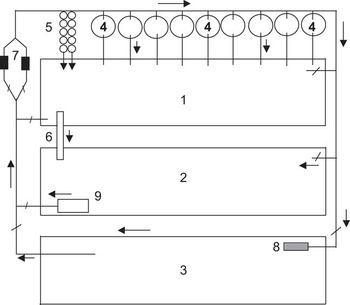
The intensive farming unit comprised ten cylindrical 30 l tanks (useful volume), stocked with fry (one progeny per tank, i.e. on average 300 to 500 fry; Figure 1 [5]) and nine cylindrical 1300 l (useful volume, black polyethylene) growth tanks (Figure 1 [4]). The overall volume of these tanks was 12 m3. Aeration columns, for exchange of oxygen and carbon dioxide, were placed on the water feeding line.
Schematic view of the prototype: (1) sewage pond 1, (2) sewage pond 2, (3) sewage pond 3 as zooplankton producer, (4) intensive rearing tanks, (5) fry tanks, (6) connection between ponds 1 and 2, (7) alternative operating pumps and (8 and 9) fish filters.

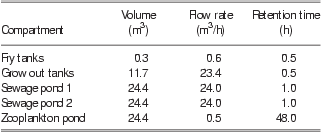
The wastewater treatment included three lined ponds (13-m long × 4-m wide × 0.50-m deep each; Figure 1 [1, 2, 3]), covered with translucent greenhouses in order to maintain water temperature above 25°C during the cold season (December to March). Their total useful volume was 78 m3, that is, about 6.5 times the volume of the intensive rearing section (Figure 1 [4]). Ponds 1 and 2, interconnected with a pipe (∅ 140 mm), received wastewater from the intensive rearing tanks and were stocked with S. m. heudelotii. The intensive farming tanks plus sewage ponds 1 and 2 (Figure 1) constituted the main rearing circuit. Pond 3, dedicated to zooplankton rearing, was filled with algae-rich water from the main circuit and sown with rotifers (Table 1). When phytoplankton was depleted by zooplankton, water of pond 3 was periodically drained into the main circuit using a set of valves and the main recirculation pump (Figure 1 [7]). In contrast to ponds 1 and 2, pond 3 was devoid of fish and continuously mixed by air bubbling (using a 12 m3/h blower) in order to reduce sedimentation. During the cleaning procedure, sediment was either returned to the circuit or thrown out of the system, when Chlorella density was over 35 106 cells/ml in the main circuit, while keeping some rotifer stock in order to reinitiate the food chain for subsequent farming cycles.
Characteristics of the various compartments of the system
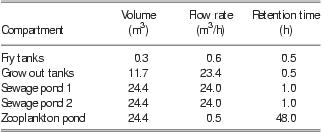
Tilapias S. m. heudelotii were obtained from neo-males (XX females treated with a masculinizing hormone, 17 α methyltestosterone), and their male : female sex ratio was about 1 : 9 (i.e. the mean phenotypic sex ratio in the progenies of neo-males in this subspecies). This enabled to slow down the proliferation of fry, which is systematic with balanced sex ratios. Two circulating pumps (24 m3/h, Figure 1 [7]) used alternatively enabled an overall renewal rate of 200%/h in the intensive farming volumes, and 46%/h in the sewage volume (ponds 1 and 2).
Within the whole system, water salinity was 15, a suitable level for the phyto- (Chlorella sp.) and zooplankton species (B. plicatilis) that naturally colonized this artificial environment. A well, located 50 m from oceanside, supplied brackish water (15) used for filling the circuit. Evaporation was compensated for (on average 1.5% of overall volume per day; i.e., about 1 m3/day) with fresh tap water from the public water system.
Study periods
Fish productivity was calculated from early January to end of April 2009, after about 2 years of operation so as to refine the production parameters. Rotifer invasion and the description of the system resilience occurred in March 2007. Nitrogen absorption within the system was calculated during a 7-day period in February 2007.
Monitoring of physico-chemical parameters
Water temperature and dissolved oxygen (DO) concentration (mg O2/l) were measured in all rearing tanks and ponds twice a day, at 0700 h (before sunrise) and 1500 h, using a CyberScan DO 300/310 dissolved oxygen meter (Eutech Instruments, Singapore). Salinity was measured every day at 1500 h using an ATAGO S-10e refractometer (Tokyo, Japan).
Parameters monitored after pond samplings were: pH measured using a Hanna HI 9025 pH meter (Hanna Instruments Inc., RI, USA), dissolved nitrogen (N-NH4+ + N-NH3 and N-NO2− + N-NO3−) and phosphorus (PO43−) in ponds 2 and 3 assessed by colorimetric methods after vacuum filtration using Whatman GF/F membrane filters (0.7 μm pore size, ∅ 47 mm; Florham Park, NJ, USA) and preservation with chloroform. Concentrations of total ammonia nitrogen (TAN = N-NH4+ + N-NH3; Koroleff, Reference Koroleff1969) and (ortho)phosphate (PO43−; Murphy and Riley, Reference Murphy and Riley1962) were measured in the ponds with a Helios UV-visible spectrophotometer (Thermo Electron Corp., Winsford, Cheshire, UK). Concentrations of nitric nitrogen (N-NO3−; Grasshoff, Reference Grasshoff1976) and nitrous nitrogen (N-NO2−; Bendschneider and Robinson, Reference Bendschneider and Robinson1952) were measured using a TECNICON II auto-analyzer (Bran and Luebbe Analyzing Technologies Inc., Elmsford, NY, USA). Water alkalinity was measured using a Varian model Spectra AA220 flame absorption spectrophotometer (Victoria, Australia).
Biological parameters
Fish were collected and weighed individually using a 0.5 g precision scale balance. Chlorella density was determined by colorimetry using a Hanna C203 photometer (Hanna Instruments Inc., RI, USA), with the ammonia medium range program at 420 nm wavelength and a tungsten lamp source. Before this study, a calibration curve was established by comparing the optical density (OD) measured with the photometer and the actual algal density (AD), which was assessed from counts using a Burker cell and an Olympus CX41 microscope (×20 magnification; Olympus, Shinjuku, Tokyo, Japan). Each sample count was achieved by computing the mean density of 12 optical fields, of which the highest and lowest algal densities were removed. The observed relationship between OD and AD was:
 $${{\rm{AD}}\;{\rm{(cells/ml)}}\,{\rm{ = }}\,{\rm{(6}}{\rm{.62}}\times {\rm{1}}{{{\rm{0}}}^{\rm{6}}} \;{\rm{OD)}}\,{\rm{ + }}\,{\rm{127}}{\rm{.90, }}\ {{r}^{\rm{2}}} \,{\rm{ = }}\,{\rm{0}}{\rm{.9995,\,df}}\,{\rm{ = }}\,{\rm{3}}$$
Rotifer densities (ind./ml) in ponds 2 and 3 were determined from counts under an Olympus SZX9/12 stereomicroscope (Olympus, Japan) (after adding 5% formaldehyde). As for algae, 12 counts were performed on 50 μL samples, of which the highest and lowest values were removed. Specific compositions of phytoplankton in ponds 2 and 3 were determined using an Olympus CX41 microscope (×100 magnification, ×0.65 eyepiece).
Fish feeding and growth
Total nitrogen concentrations of fish feed were determined using a CHN Thermo Finnigan Flash Series EA1112 analyzer (Milan, Italy). Fish feed used during the nitrogen absorption study contained 4.5% nitrogen, 28.1% as protein and 38.7% carbon. Floating feed used during the fish productivity study had a 32% protein content, and was specifically formulated for tilapia. Floating feed allowed to control the effective food intake by fish, and thus to adjust subsequent food distribution.
In this article, we focus on fish production rather than growth. Nevertheless, to facilitate comparisons between studies, the Specific Growth Rate (SGR, % ww/day) has been calculated as
 $${\rm{SGR}}\,{\rm{ = }\,{\rm{(ln}}\,{\rm{w}}{{{\rm{w}}}_{\rm{2}}}\,{\rm{ - }}\,{\rm{ln}}\,{\rm{w}}{{{\rm{w}}}_{\rm{1}}}{\rm{)}}\times {{{\rm{(}}{{t}_{\rm{2}}}\,{\rm{ - }}\,{{t}_{\rm{1}}}{\rm{)}}}^{{\rm{ - 1}}}} \times 1{\rm{00}}$$
where ww2 and ww1 are the mean individual wet weights (g) of fish at times t 2 and t 1 (days), respectively, corresponding here to the end and the start of the operation period.
Nitrogen balance during the productivity period
To assess the nitrogen balance in the system, the following equations were used:
 $${{\rm{N}}\;{\rm{(period}}\;{\rm{end)}}\,{\rm{ = }}\,{\rm{N}}\;{\rm{(period}}\;{\rm{start)}}\,{\rm{ + }}\,{\rm{N}}\;{\rm{(inputs)}}\,{\rm{ - }}\,{\rm{N}}\;{\rm{(outputs)}}$$
where, in the overall circuit:
 $${ {\rm{N}}\;{\rm{(period}}\;{\rm{start)}} \,{\rm{ = }}&\,{\rm{N}}\;{\rm{(initial}}\;{\rm{algae)}}\,\cr &{\rm{ + }}\,{\rm{N}}\;{\rm{(initial}}\;{\rm{dissolved}}\;{\rm{in}}\;{\rm{water)}} \cr &{\rm{ + }}\,{\rm{N}}\;{\rm{(initial}}\;{\rm{rotifers)}}\,{\rm{ + }}\,{\rm{N}}\;{\rm{(initial}}\;{\rm{fish)}} \cr &{\rm{N}}\;{\rm{(inputs)}}\,{\rm{ = }}\,{\rm{N}}\;{\rm{(feed)}} $$
 $${ {\rm{N}}\;{\rm{(period}}\;{\rm{end)}}\, {\rm{ = }}&\,{\rm{N}}\;{\rm{(final}}\;{\rm{algae)}}\,\cr &{\rm{ + }}\,{\rm{N}}\;{\rm{(final}}\;{\rm{dissolved}}\;{\rm{in}}\;{\rm{water)}} \cr &\,{\rm{ + }}\,{\rm{ N}}\;{\rm{(final}}\;{\rm{rotifers)}}\,{\rm{ + }}\,{\rm{N}}\;{\rm{(final}}\;{\rm{fish)}} \cr &{\rm{N}}\;{\rm{(outputs)}}\,{\rm{ = }}\,{\rm{N}}\;{\rm{(rejected}}\;{\rm{sediment)}} $$
Results
During the early working period of the prototype, we had no specific idea of the best planktonic species, and of the optimal salinity, in relation to temperature and dissolved oxygen. Tests with Dunaliella and copepods as grazers were unsuccessful. Thereafter, salinity was stabilized at 15 g/l in the system, leading to spontaneous propagation of algae Chlorella sp. (formerly Nannochloris, 4 to 5 μm diameter) and rotifer B. plicatilis. Rotifers were probably introduced through feces of wild fishes that had been caught and farmed. Chlorella blooms occur when fish biomass is high, in relation with CO2 concentration (Turker et al., Reference Turker, Eversole and Brune2003).
The main objective achieved was the total recycling of water, with only compensation for evaporation. Recycling of sediment from the zooplankton pond was partial, and mud was eventually returned to the main circuit, according to the concentration in algae. When fish biomass reached about 1 kg/m2 in the sewage volumes, no sediment was found in ponds 1 and 2.
Physico-chemical parameters
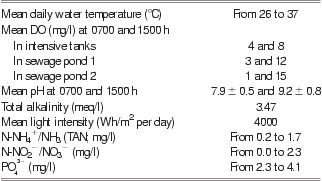
The minimal average temperatures were observed in January and the maximum in October. Daily variations of DO in the intensive tanks were low because of the mechanical action of the aeration columns. Greater variations of DO occurred in pond 2 because photosynthetic oxygen was not expelled by mechanical action. Water salinity buffered the variations of pH, especially high values due to the uptake of inorganic carbon by photosynthesis. As the evaporated water from the circuit was replaced by alkaline tap water (about 1.5%/day), a heavy precipitate of calcium carbonate was observed in all tanks, and alkalinity remained constant. During the rare cloudy (or sand winds) days, oxygen in sewage ponds dropped by about 5 mg/l at 1500 h because light intensity fell approximately to 500 W h/m2 per day. Routine variations of values of TAN, N-NO2−/NO3− and PO43− are indicated in Table 2.
Physico-chemical parameters
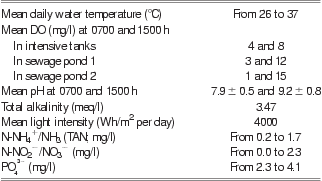
DO = dissolved oxygen; TAN = total ammonia nitrogen.
Fish productivity
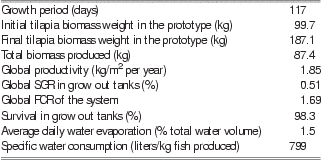
Results of fish production were obtained at the end of the test, when the prototype system was run with a correct balance of algae, rotifers and fish biomasses. This period occurred between two drainages of sewage ponds, allowing control of total fish biomass in ponds 1 and 2, as well as in the intensive rearing tanks (Table 3). The feed distributed during this period was 149 kg, equivalent to 8.6 g/m2 per day at the beginning and 13 g/m2 per day at the end, for the whole prototype (including the zooplankton pond). Global density of fish was 1.2 kg/m2 or 3.1 kg/m3, as 8.1 kg/m3 in the intensive rearing tanks and 1.1 kg/m2 in the sewage part (ponds 1 and 2). Fish productivity in the sewage part was 1.1 kg/m2 per year in pond 1 and 0.6 kg/m2 per year in pond 2.
Performances parameters of the system (2008)
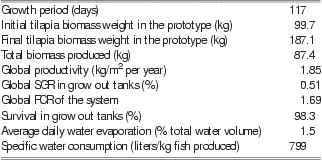
SGR = specific growth rate; FCR = food conversion ratio.
Nitrogen balance during the productivity period
The ratio between the N quantity included in feed and fish (i.e. by reference to the gain of biomass) was 4.8.
During the entire test period the algal density remained stable, between 30 and 45 106 cells/ml. Similarly, TAN and N-NO2−/NO3− concentrations were stable during the whole period (minima in Table 2). In the main circuit, the rotifers were completely consumed by fish during the 117-day period. Henceforth, it can be assumed that N was not lost from plankton and dissolved elements. This interpretation is largely supported by the observation that the combined N amount included in sediment, 6284 g (outputs), and the increase of N in fish biomass, 1315 g, almost perfectly matched with the N amount included in feed, 7596 g (inputs).
Cycles of the zooplankton pond occurred three times per week. Over the 117 days of the test period, sediments from this pond were either returned to the circuit (15 times) or removed from the system (30 times). Rejected sediment (total dry weight of 127 323 g) had 47.6% water content, thereby meaning that a total of 61 l had been removed, which represents a negligible water loss (i.e. on average 0.5 l/day).
Rotifer invasion and the ecosystem resilience
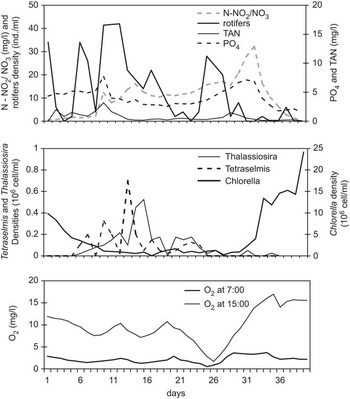
At one moment during the test, when algal density had considerably declined to 16 × 106 cells/ml and when a large amount of fish (fry and fingerlings, which actively consume rotifers) had been removed from sewage ponds 1 and 2, draining of pond 3 induced an invasion of rotifers into the circuit (from 4 to 41 ind./ml), which could not be regulated by fish predation. This resulted in a near-complete disappearance of Chlorella sp from the circuit, and blooms of centric diatoms Thalassiosira sp. and Tetraselmis sp. (Prasinophycae; Figure 2b). Twenty-nine days later, after newly hatched fry in the circuit had largely consumed rotifers, these opportunistic algae disappeared. Concomitantly, Chlorella progressively started propagating again in the circuit. During the period of rotifer invasion, tilapias in the rearing tanks were not fed so as to avoid eutrophication. At the beginning, rotifer invasion was accompanied by a progressive increase in TAN (from 1.7 to 3.1 mg/l), N-NO2−/NO3− (from 2.3 to 12.2 mg/l) and PO43− concentrations (from 5.2 to 7.7 mg/l; Figure 2a). Nine days later, TAN and PO43− concentrations began to decrease and returned to their original levels until the end of the period. In contrast, N-NO2−/NO3− concentrations continued to increase and peaked at 32.2 mg/l on day 33, before declining progressively down to 0.12 mg/l on day 37. The high capacity of Chlorella to absorb nitrates, which had been demonstrated in a previous experiment (Gilles et al., Reference Gilles, Lacroix, Corbin, Bâ, Ibañez Luna, Nandjui, Ouattara, Ouédraogo and Lazzaro2008), was confirmed here with this rotifer invasion. In pond 2, which was not mechanically aerated, DO concentration at 1500 h decreased on average from 12 mg O2/l on day 1 to 9 mg O2/l on day 21, when the opportunistic algae were abundant in the circuit (Figure 2c). By day 26, when almost all algae had disappeared, the DO concentration (at 1500 h) drastically dropped down to 1.68 mg O2/l. Eight days later, during the new Chlorella bloom, DO rose up to 16 mg O2/l, and then remained stable. No fish died during the rotifer invasion, even when DO dropped drastically. Such resilience of this artificial ecosystem was not exceptional, as it had been observed on several other occasions before and after this observation.
Temporal evolutions in the main circuit of: (a) rotifer density, N-NO2−/NO3−, total ammonia nitrogen (TAN) and PO43− concentrations, (b) algal densities as Chlorella, Tetraselmis and Thalassiosira and (c) dissolved oxygen in pond 2 at 0700 and 1500 h, during the rotifer invasion.

Uptake of total nitrogen
During the nitrogen absorption study, the biomass of S. m. heudelotii was 8.1 kg/m3 in the intensive part and 0.6 kg/m2 in the sewage part, for an overall fish biomass of 1.4 kg/m2 in the circuit, except the zooplankton pond. Initial TAN concentration was 0.12 mg/l, and concentration of N-NO2−/NO3− was null, because of an almost total absorption of nitrates by Chlorella (Gilles et al., Reference Gilles, Lacroix, Corbin, Bâ, Ibañez Luna, Nandjui, Ouattara, Ouédraogo and Lazzaro2008). Fish were fed with a 4.99% N feed, at a daily rate of 1.6% BW, equivalent to 15.2 g/m2 per day. Considering that all feed was consumed, and 53% of absorbed N was excreted (Beveridge et al., Reference Beveridge, Phillips and Clarke1991), the expected final N concentration was 13.7 mg/l, taking into account the initial N concentration dissolved in the water. The final N concentration was 0.22 mg/l. Nitrogen absorption was thus 1.9 mg/l per day with a mean Chlorella concentration of 35 × 106 cells/ml. The PO43− concentration showed little variation, from 2.5 mg/l to 4.4 mg/l, because of phosphorus excretion by rotifers.
Discussion
Control of algal biomass
The inclusion of a rotifer pond (pond 3) and the way it was operated (i.e. draining at regular intervals) proved that it is a good tool for controlling algal blooms in the circuit, although rotifers brought in extra TAN and phosphates. The periodic drainage of pond 3, after algae had been depleted, resulted in dilution events of phytoplankton concentration in the rest of the circuit. Pond 3 water, rich in rotifers, led to an additional reduction in algal concentration in the main circuit immediately after draining. Consequently, such control of algal biomass was at least as effective as the periodic or continuous removal of algae in the Dekel Aquaculture System (Mires and Amit, Reference Mires and Amit1992) or in the PAS (Drapcho and Brune, Reference Drapcho and Brune2000). The efficient control of algal biomass in the present study was also facilitated by the fact that B. plicatilis did not suffer from the concurrence or predation by other zooplanktonic species.
Fish productivity
The euryhaline tilapia S. m. heudelotii is not domesticated and no dedicated selection program has been undertaken until now. It is likely that its growth performances can be improved. In the system, each intensive rearing tank received one batch constituted with a single progeny, and we observed substantial between-tank (and thus between-progeny) variations in growth, although the very same amounts of food were distributed. The use of fry obtained from neo-males did not completely prevent reproduction, and this certainly affected fish growth. In the present study, the SGR was 0.51% ww/day, whereas in another test made with all mono-sex male groups using fish obtained through hormonal treatment, the SGR was 1.96% ww/day.
During the production trials in the present study, the daily feeding rate was 13 g/m2 for an instantaneous biomass of 1.8 kg/m2. Yet maximum productivity of this system still remains to be determined.
A test with Nile tilapia Oreochromis niloticus was also implemented in the prototype (S. Gilles, unpublished data) and showed that O. niloticus is able to adapt to this planktonic artificial ecosystem running in brackish water, at least regarding the intensive rearing unit. This is of particular interest as O. niloticus grows faster than S. m. heudelotii and is currently found in most tropical countries around the world, as a result of introductions. Nevertheless, an associated detritivorous species is needed for the sewage ponds, as O. niloticus is not efficient in recycling sediments.
It could probably be possible to achieve a more efficient recycling of the sediment in pond 3, and thus to avoid N loss, by increasing the rotifer number seeded at the start of each cycle, thereby increasing grazing and limiting the amount of dead algae sinking to the bottom of the pond. To this respect, the subdivision of pond 3 into two separate volumes would allow reciprocal seeding, as well as an increase of productivity and global conversion efficiency in the system.
The rotifer invasion and the ecosystem resilience
Algae belonging to the genera Thalassiosira and Tetraselmis are reputedly not grazed by rotifers (Lavens and Sorgeloos, Reference Lavens and Sorgeloos1996). Hence, these algae proliferated in the main circuit, whereas Chlorella almost disappeared, and rotifers remained abundant for a while. The later disappearance of these algae along with the return of Chlorella is more difficult to explain. Drapcho and Brune (Reference Drapcho and Brune2000) pointed out that the addition of inorganic carbon to PAS resulted in a predominance of green algae, to the detriment of cyanobacteria. King (Reference King1970) also reported that green algae benefited from high dissolved CO2 concentrations. Dissolved CO2 tends to increase concomitantly with increasing fish biomass and feeding rate. Indeed, fish metabolism and thus CO2 production are proportional to food intake. Witt et al. (Reference Witt, Koske, Kuhlmann, Lenz and Nellen1981) showed that optimum salinity for Nannochloris sp. (now renamed within the Chlorella genus) growth ranged from 10 to 20. The conjunction of these two factors (i.e. inorganic carbon load and salinity) is then likely to account for the predominance of green algae in this prototype.
After the 6th day of rotifer invasion, TAN elimination from the circuit could have resulted from nitrifying bacteria, which developed particularly in the circuit pipes (Dvir et al., Reference Dvir, van Rijn and Neori1999), as well as from opportunistic algae. We must emphasize, however, that these algae do not regulate nitrites or nitrates, the levels of which only began to decrease after Chlorella returned. This significant control of N-NO2−/NO3− by Chlorella was illustrated in a previous experiment conducted ex situ but with biological material (algae, fish) from the prototype (Gilles et al., Reference Gilles, Lacroix, Corbin, Bâ, Ibañez Luna, Nandjui, Ouattara, Ouédraogo and Lazzaro2008).
Uptake of nitrogen
During this experimental period with a feeding rate of 15.2 g/m2 per day, the N assimilation in the prototype was 1.90 mg/l per day, which fits with the range given by Hargreaves (Reference Hargreaves2006) in his review of PSG systems in aquaculture. Yet the depuration capacity of the prototype can be higher, as demonstrated during previous experiments with the prototype, when the uptake of N from fish excretion was as high as 4.4 mg N-NH4/l per day (for feed with a 8.32% nitrogen content; Gilles et al., Reference Gilles, Lacroix, Corbin, Bâ, Ibañez Luna, Nandjui, Ouattara, Ouédraogo and Lazzaro2008). The prototype was evaluated in Senegal (14°N) where solar radiation is effective for photosynthesis all year around and cloudy days are rare. In contrast, other systems studied at higher latitudes experienced instantaneous TAN peaks of up to 17 mg/l during protracted cloudy periods. This was observed for a marine recycling system using macro-algae in southern France (44°N; Blancheton, Reference Blancheton2000; Pagand et al., Reference Pagand, Blancheton, Lemoalle and Casellas2000; Deviller et al., Reference Deviller, Aliaume, Franco Nava, Casellas and Blancheton2004; Metaxa et al., Reference Metaxa, Deviller, Pagand, Aliaume, Casellas and Blancheton2006) or for PAS in South Carolina (35°N; Brune et al., Reference Brune, Schwartz, Eversole, Collier and Schewedler2003).
Conclusion
This study, by focusing on resilience and purification capacities of a prototype of recycling aquaculture system, provided further evidence of its relevance in comparison to conventional systems in clear water with mechanical and biological filters, especially wherever water resources are limited. It is possible to implement a stable outdoor artificial planktonic ecosystem, in tropical conditions, thanks to constant or at least sufficiently stable light and temperature conditions all year long, and to a brackish water environment. By contrast, it would probably be very difficult to have such a system stabilized outdoor in temperate climatic conditions. With their fast growth potential, Chlorella and rotifers seem to be the ideal candidates for planktonic artificial ecosystems in brackish water, especially with their spontaneous development.
In view of the increasing constraints on water supplies, planktonic recirculating aquaculture systems (PRAS) may certainly have a bright future. In particular, efforts should be deployed to develop similar approaches in marine and fresh waters, while using local resources. To this respect, new research efforts are currently undertaken by the authors to develop a similar system adapted to the Amazonian waters and fish fauna. The second step in the effective development of PRAS will be their transfer from the research sector to the industry, which is not always familiar with the way of operating these new systems. The recent transfer to a private tilapia farm in Senegal of the prototype originally developed in Mbour indicates that this is feasible, at least after proper information exchange and staff training.
Acknowledgments
This study was supported by Languedoc-Roussillon Incubation (LRI) and the ‘Direction de la Valorisation au Sud’ (DVS) of IRD. The authors wish to thank Olivier Schlumberger (Ministère de l'Agriculture et de la Pêche, Paris, France), Jean-François Agnèse (IRD, UMR ISEM, Montpellier, France) for fruitful discussions on the biological concepts underlying the rearing system, François Doumenge for his encouragement and support, and two anonymous referees for constructive comments on a first draft of the article.