Today knowledge is seen by many to be critically important in our lives and work, yet organized knowledge production in laboratories is a relatively recent phenomenon that is costly, often takes detours or fails altogether. The promises of knowledge, money and data, however, are its motors. This paper attempts to build an integrative historical perspective on laboratories starting from knowledge and its promises.
Taking a broad view of the historical literature makes clear that several types of laboratory have existed side by side. Yet the literature is fragmented. Typically, one type of laboratory is central to a particular strand of the literature.Footnote 1 Crucially, academic and research and development (R & D) laboratories have attracted much more attention than other laboratories in business and government or laboratories run as stand-alone businesses.Footnote 2 Only very few studies have pursued a comparative perspective, but these studies typically focus on a only few countries and only a few types.Footnote 3 Because of the fragmentation, it seems that one type of laboratory has replaced, or has dominated, other types, and that one particular type embodies a superior mode of knowledge production. Particularly the history of R & D laboratories has been written from the perspective that such labs are inevitable for (big) business.Footnote 4
In the historical literature different types of laboratory are also poorly conceptualized. Laboratories often appear as single-purpose entities; for instance, the routine activities of the first R & D labs in the German dyestuffs industry are seen as indications that these facilities were less important for new products than has previously been suggested in the literature.Footnote 5 Moreover, the university laboratory often appears as the basic type from which other labs are derived. In this perspective, research is equated with university science, but the context of business or government changes it. A strong current in the literature views R & D labs as halfway between the university laboratory and the world of business, as academic research with another goal.Footnote 6 This approach has led to studies focusing on the question how to integrate ‘scientific research’ in an ‘industrial laboratory’.Footnote 7 Government-supported laboratories have also been approached as deviations from the university lab.Footnote 8 This has led to a negative judgement on government officials who were supposedly reluctant to invest in ‘science’ and worked against a proper ‘scientific’ operation of laboratories.Footnote 9
In this way, distinctions between ‘science’ and ‘technology’, or ‘fundamental research’ and ‘applied research’, play an important role in the conceptualization of laboratories in the historical literature. Many alternatives have been proposed for these concepts, but, in general, fundamental research is supposed to be conducted without concern for how the results can be put to practical use, while applied research is supposed to be focused on practical results, and on the needs of its sponsor.Footnote 10 However, fundamental and applied research are not mutually exclusive concepts; fundamental research can be very useful and applied research can lead to fundamental insights.Footnote 11 Moreover, laboratories and their personnel use these concepts as rhetorical devices to justify one type of knowledge production over another, to enrol policy-makers, and to seek professional status. In this way, they can combine fundamental and applied research into a linear model of innovation in which technology originates from science, and fundamental research becomes useful via applied research.Footnote 12
A simple distinction between, and a sequence of, ‘fundamental research’ and ‘applied research’ captures little of the differences between laboratories; laboratories in business and government are not simply deviations from the university laboratory, but have distinct profiles. This becomes particularly clear from economic and sociological studies that try to build typologies from samples taken from specific countries. The university laboratory then becomes one type in a range of types.Footnote 13 This literature emphasizes that the work carried out inside laboratories is crucial for its profile. Moreover, laboratories are not single-purpose entities, but engage in different sorts of activity in different contexts in parallel, and build and maintain networks with stakeholders in policy, industry and other sectors of society.Footnote 14 Consequently, some laboratories combine public and private regimes of ownership. Some laboratories are public (in the sense that they are owned and funded by the state, and are influenced by, or even a part of, the machinery of public administration) and some are private (in the sense that they are owned and funded by a company, or that they are stand-alone businesses). However, some laboratories are difficult to classify as either public or private, but are mixed.Footnote 15 For example, laboratories run by universities but working for companies mix public and private regimes of ownership.Footnote 16
This paper takes a first step towards building an integrated and historical perspective on laboratories. To do so, a better conceptualization of laboratories is necessary. Building on the typological literature, the next section proposes three dimensions to analyse laboratories: the type of knowledge production, its orientation and its ownership. These three dimensions build a profile of a specific laboratory, but can also be used to construct a set of laboratory types. In addition to the archetypal laboratory types – the university and the R & D labs – six additional types are identified in this paper. In this way, the integrative perspective redresses the balance in the literature. In addition, testing – gathering data – plays a key role in understanding the six additional types. Although a related literature on instrumentation is flourishing, testing has often been overlooked.
The main part of this paper is historical, and focuses on the evolution of the identified laboratory types. Secondary literature, Organization for Economic Cooperation and Development (OECD) reports, and commemorative volumes are the main sources for this account. A better conceptualization of the laboratory shows that different types have existed side by side, and that none has dominated the others. Moreover, this paper underlines that the two world wars of the twentieth century had a profound effect on the development of laboratories. The wars created urgent problems that needed to be solved, and crucially changed the perception of the role of knowledge in society. In turn, this shows that models of innovation, building causal links between knowledge production and its impact, have profoundly shaped the positions and roles of different laboratories. This has been particularly so in the period after 1965.
This paper strives to be integrative, but it cannot be complete. It identifies common types of laboratory and describes the historical evolution of these types. In this way, individual variations and trajectories are excluded. The typology, however, should not be read as a classificatory scheme for individual laboratories; the typology proposes patterns: specific configurations of the type of knowledge production, orientation and ownership that change over time, but remain identifiable relative to each other. Further, the internal, anthropological and sociological functioning of laboratories, and how laboratories fit into larger systems of knowledge production and use, has attracted much scholarly attention.Footnote 17 Our unit of analysis, however, is the laboratory, and our aim the construction of laboratory types; the conceptualization of knowledge production fits that unit of analysis and that aim. Finally, the sources used for this paper pull it towards Western countries. In this way, the paper reproduces the institutional emphasis in those countries on organized knowledge production in laboratories. The paper, however, organizes an important part of the history of knowledge; it should not be read as an argument that laboratories are an essential means for producing knowledge.
Using three dimensions to identify eight laboratory types
In general, a laboratory may be thought of as a set-up where thought and tools are used to produce knowledge. This set-up is recognizable as an organizational unit or sub-unit: it has a management structure, and is capable of initiating strategic decisions. The starting point for conceptualizing laboratories is their key activity: knowledge production. First of all, it is important to distinguish the types of knowledge production from their orientation. The types refer to the basic characteristics of the work inside the laboratory, and are connected to knowledge; the crucial question here is what the work looks like, and what it produces. The key question to determine orientation is who profits, or who should profit, from the laboratory's work; this is connected to the content of knowledge production, but also to its justification. Ownership, finally, refers to the organizational structure and networks of the laboratory; the crucial question here is who owns the lab.
Three types of knowledge production are proposed here – research, development and testing – and each type is linked to different products and capabilities (Table 1). Knowledge as a product refers to tangible or intangible results, such as theories, papers and patents. Knowledge as a capability refers to the ability to produce knowledge, and particularly the ability to produce the products related to a particular type of knowledge production.Footnote 18
Three types of knowledge production, and their associated products and capabilities

Research concerns why-questions; it aims to understand the phenomena under investigation. Its main products are ideas, broadly understood to include theories, models, tools and papers and other texts. As a capability, research builds an ability to do research, and to do research more effectively. This is a crucial organizational capability that reinforces the laboratory and builds path dependencies.Footnote 19
Development concerns how-questions; its aim is to get a particular technology to work, and its main knowledge products are designs (for products and/or processes). The main knowledge capability of development is the creation of economic value. Development is not necessarily, or sequentially, linked to research, but can inspire a why-question when a problem is persistent, for instance. In development, why a technology works matters less than the simple observation that it does work. Empirical, cut-and-try methods, assembled by experience, are important tools. Moreover, development often starts from a dominant design: a basic understanding of the configuration and operational specification of a technology which provides important guideposts to researchers.
Finally, testing is a crucial type of knowledge production for classifying laboratories. Testing concerns answering questions of ‘what’ and ‘how many’. Its main product is data, typically quantitative and tabulated. Testing is also important to build specifications, classifications and standards. This may be important as such, or may provide input for development and research. During development, testing helps define problems and specifications, and helps build certainty about performance.Footnote 20 During research, testing provides the data necessary to build or check theories and models. Research may also encompass the creation of testing methods, particularly instrumentation, which may open a different set of why-questions. Testing itself may also lead to the creation of methods to gather that data. Research and testing overlap in the creation of testing methods.
The main capability of testing is control. Counting and quantifying, and the methods used to do that, enhance the capability to control what is counted and quantified.Footnote 21 Companies test to control production. Testing monitors production costs and product quality, for instance, and enables companies to take action if necessary. Governments test to control society, and specific laws often underpin this activity.
Besides the type of knowledge production, its orientation and ownership are important dimensions of the profile of a laboratory. The orientation of knowledge production refers to the question who profits from the work, or who is supposed to profit from it. Creating value from knowledge occurs in a context of application: a site – a company, a trade organization, a government department – where knowledge from the lab is integrated and complemented with other knowledge. A company, for instance, needs to transform the knowledge from the lab into a product, requiring knowledge from marketing, finance, production and other functions.Footnote 22 The context of application matters for the orientation of knowledge production; orientation may be generic and aimed at several contexts of application, or it may be specific and aimed at one particular context of application.
In relation to the ownership of a laboratory, three broad categories may be distinguished – public, private and mixed – on the basis of organizational structure and the networks of the lab.Footnote 23 Broadly speaking, a public laboratory will typically be organized differently to a private one, and the way it is organized influences its work.Footnote 24 The composition of networks also indicates ownership; whether relations are built with internal and/or external actors, and the diversity of actors and the position of the lab in networks, shape knowledge production.
Orientation and ownership are often linked. A private laboratory will typically focus on specific knowledge production intended to boost one particular company or organization. Private laboratories typically have more specific, or more narrow, goals than do public and mixed laboratories. Private laboratories often focus on testing and development – knowledge production that is of immediate profit to the owner of the lab. Mixed-ownership laboratories often focus on generic knowledge production. Their work is intended to be of value for a group, or even society in general; a group of owners will focus on subjects of interest to them all. Frequently these labs focus on testing and research as these types of knowledge production are easier to translate into collective benefits than is development, which is often tied to a particular technology in a particular context. Generic development, however, is not a contradiction in terms; it may be undertaken to prove that a concept will work, without designing a market-ready product.
These links between dimensions may not be strong and are not automatic. Orientation is often controversial, and generic and specific knowledge production can be mixed or the balance can shift over time. Several types of knowledge production may be combined as well, in particular ways, which may also change over time. In other words, the three basic dimensions of laboratories – the type of knowledge production, orientation and ownership – combine into a profile: a blueprint of what a laboratory is and does.
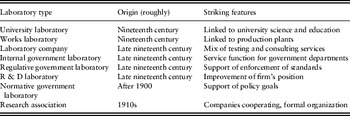
At a macro level, the three dimensions proposed here can be used to identify and characterize common types of laboratory (Table 2). Even though the profiles of these types have changed, they have remained identifiable relative to each other. In this way, building a typology helps in understanding differences and similarities in the history of laboratories, enabling a broad view of this history and an integration of different strands of literature. This paper builds a historical typology, recognizing change and continuity in the evolution of laboratory types.
Types of laboratory identified in the literature

Note: Well-known labels for these labs are used as much as possible.
The remainder of this paper focuses on the evolution of eight laboratory types. We start with the two archetypal laboratories, the university lab and the R & D lab, respectively aimed at generating new knowledge and at creating economic value. Subsequently, we focus on four types that contrast with the archetypal types in their emphasis on testing. The final two types that make up the typology emerged during the First World War. Here the historical account moves to the foreground, emphasizing that both world wars of the twentieth century and the period around 1965 profoundly changed the profile of the eight common types of laboratory.
The archetypal labs: the university lab and the R & D lab
In the nineteenth century, academics invented the laboratory as a site where knowledge is produced. In that century, science became a profession, practised at universities. Universities took on a mission to produce, besides trained graduates, knowledge as such, and laboratories provided the facilities to do so. The production of knowledge was tied to teaching; students learned in the lab and the knowledge produced was used to design and improve curricula. Academics generally assumed that the knowledge they produced furthered societal wellbeing. In the late nineteenth century, this idea was tied to industrial development when the chemical and electrical industries started to grow, and attracted attention as the epitomes of modern industry. Academic scientists justified their production of knowledge by arguing that the results were important to industrial development, basically arguing for a linear model of innovation that boosted the status of academic research, and was useful in obtaining public funds.Footnote 25
As a type, university laboratories do generic research; they produce knowledge geared towards understanding phenomena. Testing is a second important activity: university labs gather data to develop and check theories and models.Footnote 26 Ideas are the main product of university labs, broadly understood to include theories, advice and all sorts of texts. Testing in university labs often leads to the development of testing methods, including instrumentation. The main capability produced by these labs is the capability to do research. Students and PhDs are the embodied form of this capability. University labs also perform an agenda-setting function in their exploration of knowledge frontiers, pulling governments, societal groups and companies along.Footnote 27
Together with university labs, R & D labs are often the most visible laboratory types. The pioneers of R & D labs were German and American firms in the chemical and electrical industries. Specific commercial and/or technological threats played a major role in the establishment of R & D laboratories up to the First World War. In the German dyestuffs industry, the enactment of a patent law in 1877 played a key role.Footnote 28 As a type, R & D laboratories are private and specific, and focus mostly on development. An R & D lab is intended to create economic value, to boost the company that sponsors it in general, and to improve the company's commercial and technological positions in particular. Nevertheless, R & D labs are versatile. They often have substantial testing facilities to support development and research, and sometimes branch out into generic research as well.
Works, private and internal government laboratories: testing in industry and government
R & D laboratories were not the first laboratories in industry. Some chemical firms operated works laboratories to control the quality of raw materials, intermediates and end products as early as the second half of the eighteenth century, but the numbers increased in the nineteenth century. For instance, Brunner, Mond was established in the United Kingdom 1873 to exploit the ammonia–soda process developed by Ernest Solvay. The company equipped a small works laboratory to control production in 1877. The laboratory was near the plant so feedback loops were short. Reflecting the high volume of this work, the laboratory employed twenty-five people by 1892. By that time, chemical testing methods had replaced skilled labour as the main assessors of quality in the alkali industry. Analytical chemistry developed rapidly and provided the tools, standardized procedures and instruments to gather data, and to compete with sensory observation. The works lab also started to spread to other industries in the late nineteenth century.Footnote 29
The works laboratory type focuses on specific testing; it provides data in one context of application. The lab is typically part of the organization it supports; close feedback loops between control and the object of control are advantageous for these labs. However, the dividing line is often thin between the works laboratory type and the R & D laboratory type. Gathering data related to products and production can lead to ideas and designs for improvement, and can help solve problems. Brunner, Mond's works laboratory also provided the input to improve the plant; it worked on the causes of ammonia loss, a crucial issue for manufacturing efficiency. Moreover, R & D labs typically did not replace, but came next to, works laboratories. Works laboratories often branched out into development, and in turn this could trigger the establishment of an R & D lab. DSM and Unilever, for instance, two of the biggest Dutch multinationals, took this gradual route.Footnote 30
Laboratory companies also focus on specific testing, but work for several contexts of application. This type of laboratory comprises stand-alone firms focused on supporting other companies, governments and hospitals. Laboratory companies emerged in the late nineteenth century, initially when most of their clients lacked in-house testing facilities. For instance, the coal and ores trades in the ports of Rotterdam and Amsterdam provided a large market for laboratory companies in the Netherlands. Some laboratory companies diversified into (limited) development work.Footnote 31 They still exist today, and some are also quite large. Eurofins, for instance, was established in 1987 with one testing method as a spin-off from the University of Nantes (France), but quickly grew in size and scope. Currently, the Belgian-based lab company is listed and employs seven thousand employees in twenty-seven countries.Footnote 32 Generally, lab companies today find a large market in testing and certification of all sorts of products, processes and services.
Outside industry, specific testing is also used to support the parent organization's core activities. Hospitals test to diagnose patients; police departments test to build cases against suspects. Such laboratories have grown in size and number after the year 1900. Governments were an important client of laboratory companies but around the year 1900 started to establish their own facilities. For instance, the Dutch department of Public Works (Rijkswaterstaat, a civil engineering body) opened a laboratory in 1927 to test the composition of road surfaces, with the double goal of controlling road construction, and to find better compositions.Footnote 33 Such internal government laboratories, as a type, use specific testing to support public functions. Governments also use testing to control society, often underpinned by specific laws; these regulative government laboratories perform generic testing. Food safety is a well-known example. The Dutch Warenwet of 1919, for instance, obligated local governments to create testing laboratories to test foodstuffs for safety.Footnote 34 Regulative laboratories, and the testing they do, also cover other, strongly contested, subjects as well, such as intelligence tests.Footnote 35
The First World War and its effects: the rise of normative government laboratories and research associations
Around the year 1900 several types of laboratory had been established, although not to the same degree in all countries. The German system of knowledge production, encompassing a diverse set of laboratories and close links between laboratories, industry and government, inspired awe in other countries. Particularly in chemistry and in the chemical industry, German leadership was attributed to its cutting-edge knowledge production. After the outbreak of the First World War, catching up became urgent. The feeling of being threatened was as effective as the threat itself. The First World War changed the perception of the university laboratory, provided a strong impetus to the R & D lab and boosted the development of normative government laboratories and research associations.
In the United Kingdom, Germany and the United States in particular, but in other countries as well, university laboratories were called into the war effort. University laboratories worked on concrete, short-term problems, forging links between universities, government and industry. Even if the practical results were sometimes poor, the First World War decisively positioned the university lab as a motor of progress, and anchored the linear model of innovation as a way of thinking about and structuring the relations between different types of laboratory, innovation and economic growth.Footnote 36
The First World War also firmly rooted the R & D lab in industry. In the 1910s, companies increasingly established R & D labs. The threats and opportunities of wartime conditions provided an important impetus to do so. However, the reasons for establishing an R & D laboratory started to shift from a specific threat to more diffuse factors; companies that established an R & D laboratory in this phase did so to keep up: they often had no detailed ideas of what this laboratory should produce, but they expected that it would greatly improve their powers to compete. The success of the pioneering firms and their labs had gradually put the R & D laboratory on the map as a model of creating economic value, and other firms now started to follow this model.Footnote 37
Between universities, industries and governments, the First World War triggered a similar development. By 1910 the academic and R & D laboratories were firmly established models of organizing knowledge production, and concern arose over those companies that did not produce knowledge in-house. Academic scientists and governments alike thought that these companies would struggle to survive in a climate of accelerating technological change and intensifying competition. The outbreak of the First World War added urgency to the matter and, in short, prompted the establishment of the Department of Scientific and Industrial Research (DSIR) in the United Kingdom, and the Kaiser-Wilhelm Institute in Germany; in the Netherlands it started a process that led to the establishment of TNO in 1930.Footnote 38
All these laboratories were intended to boost industry through knowledge production, but they represent two different types. Normative government laboratories produce knowledge for a group in society with public means; they are in a strict sense not necessary to enforce a law like regulative laboratories, or to enable the internal functioning of a government department like internal laboratories, but they work to foster policy goals. Research associations are private organizations, but are often subsidized by governments. They bring together a (sometimes substantial) number of companies and produce knowledge for them. Research associations are often open-ended, both in the sense of membership (any company that subscribes to the aims of the association can become a member) and in the sense of their work (typically committees of researchers and company representatives draft programmes).Footnote 39 The distinction between normative government laboratories and research associations is gradual, but should be made according to the role of government.
The involvement of government with normative laboratories goes back to a basic concern over the welfare of society. The oldest ones operated in the fields of agriculture and health, while the armed forces were also a central concern. Besides internal laboratories, operated to test supplies and equipment, some military labs produced knowledge on a wider front. In 1906 a Chemical Research Department was established in the United Kingdom to work on the design of shells and fuses. The laboratory also investigated TNT, a novel high explosive at that time, which proved critical during the First World War.Footnote 40 In the Netherlands, rumours of ‘deadly rays’ prompted the establishment of a committee of experts, which in turn established a small Physical Laboratory in 1926. The laboratory focused on generic testing, and investigated the workings of aircraft detection instrumentation, for instance.Footnote 41
On the border between the regulative and normative government laboratory types were organizations like the Physikalisch-Technische Reichsanstalt (established in Germany in 1887), the Bureau of Standards (established in 1901 in the United States), and the National Physical Laboratory (NPL, established in the United Kingdom in 1902).Footnote 42 These laboratories focused on developing standards and, as such, engaged in generic testing and the development of testing methods. This work, however, was viewed not only as regulative, but as broadly supportive of the functioning of markets and industry. For instance, the Bureau of Standards tested close to 24,000 samples of cement in 1911. This work prompted the development of improved testing methods, which in turn led to an investigation of the relation between the properties of the raw materials of cement and the finished product; a small-scale cement plant was built to do this work. In 1912 a specification for cement was drafted for the government, which was later adopted by industry as well. Although the Bureau of Standards had no formal policing power, it commanded the authority to develop, and enforce, standards.Footnote 43
In the Netherlands the first normative government laboratory working specifically for an industrial sector was established in 1910; the State Rubber Service (Rijksrubberdienst) was organizationally part of the Ministry of Agriculture, Trade and Industry, but was housed in the laboratory of its founding father: Gerrit van Iterson Jr, a professor at Delft Polytechnic (now Delft University of Technology). Van Iterson was an important propagator of testing. He believed that the replacement of sensory observation of the composition and quality of raw materials, intermediates and end products by standardized scientific methods would boost the development of industry and society. The Rubber Service promptly focused on testing. For the Dutch Army, for instance, the lab tested rubber parts of gas masks and helped draft a standard for these products. The Rubber Service also developed a method to measure the ageing of rubber products, a crucial property.Footnote 44 Eventually this lab, and similar ones, merged into TNO, and TNO inherited its focus on generic testing from these labs.Footnote 45
The best-known example of the research association type are the British research associations, working under the umbrella of the DSIR. During and shortly after the First World War, the DSIR channelled substantial government funds to laboratories that, in turn, bundled the resources and funds of a group of companies, typically by sector. The share of industrial funds, however, rapidly increased after 1925.Footnote 46 The work of the associations focused on testing, complemented by the development of testing procedures. For instance, the British Portland Cement Research Association was established in 1918 and worked on the composition of cement. Such generic work was easily made beneficial to a group of companies as it focused on common problems. Specific work was done on a limited scale, and included tests for companies and troubleshooting.Footnote 47
In other cases, research associations were more clearly mixed, tending to private. In the Netherlands, for instance, the shipping industry organized a research association in 1929 (currently Marin); the association built a tank and started investigating the propulsion and shape of ships.Footnote 48 The category of research associations also includes the (small) laboratories operated by some trade associations and stretches out into organizations which aim to propagate a specific technology or focus on a specific topic. The Dutch Sound Foundation (Geluidstichting), established in 1934, fought against sound pollution, but also had a consulting service, which tested the noise level of horns and bells, as well as the sound insulation properties of materials.Footnote 49
The profile of normative government laboratories and research associations in this period underlines that the R & D laboratory was not the only model producing relevant knowledge for firms. The generic orientation of normative government laboratories and research associations followed from their ownership structure: focusing on common problems faced by all members made the knowledge produced by the laboratory relevant to all members, and enabled them to work together as the work of the laboratory shied away from the specific competitive advantage of each firm; better standards for cement or the ageing of rubber products benefited all firms in the industry, not one in particular. The example of the NPL, the Reichsanstalt and others drew normative government laboratories and research associations towards testing. The involvement of academics, who tested in their own labs and attached great importance to it, also played a role.
The Second World War and its aftermath
Like the First World War, the Second changed the development trajectory of laboratories. Universities were called into the war effort again, and with marked and spectacular success, particularly in the United States. The atom bomb, synthetic rubber, radar and other technologies were developed in a concerted effort by universities, the military and companies. The visible success of these programmes enshrined the linear model of innovation: knowledge production was crucial for innovation, and innovation was crucial for the development of industry and society. This ideology boosted the development of all laboratory types after 1945, even though innovation processes followed non-linear paths.
Universities grew by an unprecedented scale after the Second World War. Part of this growth was related to growing numbers of students. The war also initiated a trajectory of large-scale, multidisciplinary and ultimately expensive knowledge production that meant a stronger involvement of government.Footnote 50
The interplay between universities and government resulted in organizational innovations like the national laboratories and NASA in the United States, and ESA and CERN in Europe.Footnote 51 Closest to the universities were laboratories like CERN which extended university knowledge production in a cooperative way to enable generic research and testing with large-scale equipment. NASA and the ESA pursued generic research and testing with specific development and public ownership: governments funded large programmes of knowledge production in space exploration related to astronomy and to manned spaceflight, both of which also entailed the development of technology (telescopes, rockets, space vehicles and so on).Footnote 52
Such programmes and the associated organizational innovations also existed in atomic energy and, particularly in the United States, in military technology.Footnote 53 Funding from the armed forces had a profound impact upon university laboratories. Some conducted generic research for the military while others were deeply involved in the development of weapons systems and were, to a very large extent, dependent on military funding.Footnote 54 For example, the Jet Propulsion Laboratory, which grew out of a small group at the California Institute of Technology but which came to rely on the military, conducted generic research into rocket fuels, but was also critical in the development of tactical nuclear missiles in the 1940s and 1950s.Footnote 55 At MIT, the Instruments Laboratory designed gun and bomb sights, and trained military personnel during and after the Second World War. This work had a strong generic research component, not only in the training activities of the lab but also through the development of a notation system for location and movement, and the writing of a textbook on instrumentation. Design of instrumentation also fits the profile of a university laboratory.Footnote 56
In industry, R & D laboratories also grew fast, and sometimes employed thousands of people. After 1945 business managers gave R & D laboratories more room to set their own agendas in a belief that knowledge production inevitably, but unpredictably, leads to innovation. Moreover, companies invested heavily in what was called ‘fundamental research’: generic research aimed at understanding phenomena and typically focused on fields underlying several product lines such as solid-state physics, polymers and catalysis. Generic research could be useful in specific development projects to solve problems (for instance, to find an optimum catalyst) and played a crucial part in diversifications across industry subsectors (for instance, from fertilizers to plastics in the chemical industry). In the case of the Dutch company DSM, generic research played a major role in the transformation of the company from coal mining to chemicals in the 1950s and 1960s.Footnote 57
Normative government laboratories flourished after the Second World War. The Fraunhofer Gesellschaft, established in 1949, developed into West Germany's normative government laboratory. The armed forces greatly contributed to Fraunhofer's position by naming it the principal contractor for knowledge production in 1957. The military primarily funded generic research, not weapons development, but no less than half of Fraunhofer's work was related to defence.Footnote 58 Similarly, the military played an important part in the expansion of TNO in the Netherlands. Shortly after the war, the Dutch government transferred the Physical Laboratory, and similar facilities of the armed forces, to TNO. From the late 1930s, these laboratories grew to substantial facilities employing about five hundred people by the early 1960s (about 14 per cent of TNO's total workforce). Besides the evaluation of equipment, TNO's defence laboratories worked extensively on radio and radar, developing, for instance, a marine radar system capable of detecting and identifying small objects like helicopters from ships.Footnote 59
Finally, dedicated military normative laboratories greatly expanded. The Royal Aircraft Establishment (RAE) in the United Kingdom, with roots going back to 1908, expanded to no less than 8,500 people in 1962, unmatched by any private R & D laboratory in Europe. The RAE conducted much generic research, covering the full spectrum of aircraft-related fields such as aeronautics, instrumentation and materials. Generic development led to a conceptual design of a jet-powered, supersonic fighter. Both industry and the military profited from this work: industry got knowledge, and the military were able to articulate specifications and standards for unknown and unproven technologies. The RAE also housed large-scale testing facilities like a wind tunnel, and was able to build custom testing set-ups if needed.Footnote 60
There were also numerous research associations in Britain and in other countries after the Second World War. Some operated on a member-only basis while others took the lead in knowledge production, and actively diffused results to members and non-members alike. Some research associations, particularly the British ones, did not do contract research, believing that this would dilute the collective goals of the associations. Typically, these labs were run by committees consisting of industrialists, academics and government officials. Governments often remained at distance from the operation of the laboratories even in cases when they funded these labs to a substantial degree. Knowledge production was generally seen as crucial, and governments viewed research associations and normative government laboratories as appropriate alternatives for companies lacking the funds and resources to establish their own R & D laboratories.Footnote 61 In the Netherlands, TNO pushed the establishment of research associations to bundle the resources of a group of companies to get its knowledge production funded, and the results into industry.Footnote 62
Knowledge production at normative government laboratories and research associations remained of a generic orientation. Testing remained important as well, but research and development grew in importance. For instance, TNO investigated hazardous compounds in paints for the paint research association (established in 1956).Footnote 63 In the 1950s, the British Hosiery Research Association developed a yarn speed meter that took measurements while the knitting machines were in full operation. The missions of the British research associations remained focused on generic knowledge production as well, particularly investigating materials and improvements in production processes.Footnote 64
After 1965: changing profiles
The ideology of the linear model peaked around 1965. As the postwar economic boom slowed down, companies and governments faced tighter budgets. At the same time, managers and policy-makers took a second look at the perceived link between knowledge production, innovation and society to find that the linear model is a simplification of innovation processes. The key question for governments and companies became what the impact of knowledge production was; and the key point, that this impact could be improved. In the 1970s, the linear model was put in reverse; the idea was that users of knowledge could direct knowledge production to relevant subjects (‘market pull’) better than knowledge producers could (‘technology push’). In the 1980s and 1990s, a dynamic linear model became fashionable. This model basically argues that knowledge producers and users need to be in close contact to produce innovation (and so are dynamic) but, particularly in the public sphere, still assume a direct relationship between knowledge production and innovation (and so are still linear).Footnote 65
For companies, the key issue was how to align R & D laboratories with other company functions like marketing, production, finance and management. Some R & D laboratories had drifted away from the company. When market growth stagnated after 1965, many companies cut their R & D budgets and reorganized their laboratories to improve the alignment between R & D and the company. Business managers got a much stronger say in the direction of knowledge production. Initially this pushed R & D labs towards fulfilling short-term needs and troubleshooting, but this narrow focus broadened out in 1980s.Footnote 66 At the electronics multinational Philips, for example, research into Wankel engines and other subjects outside the business scope of the company was killed. The development of the audio compact disc, a very important innovation for the company, was also triggered and closely managed by the Audio Division instead of by the R & D organization.Footnote 67
Companies have also sought close links with university laboratories after 1965. Such links were not new, but they have multiplied and gained more weight in the strategies of companies. Companies cut back generic research to a minimum, believing that this type does not create economic value, that it should be better left to universities, and that R & D labs were no longer able to master all necessary knowledge alone. This has led Royal Dutch/Shell, for instance, to abolish its corporate R & D completely. It has also led to substantial contracts between companies and universities. Moreover, companies have generally cast a wider geographical net for the sourcing of knowledge and the location of R & D labs. Although internationalization is also not new, it has increased after 1965 and has become an integral part of R & D strategies and structures. General Electric, for instance, one of the pioneers of R & D labs at the turn of the twentieth century, today operates facilities in New York (in the United States), Bangalore (India, opened in 2000), Shanghai (China, opened in 2000), and Munich (Germany, opened in 2004). The laboratories are organized across these locations around ten subjects, such as biosciences and imaging technologies.Footnote 68
Academic and normative government laboratories did not have a direct organizational link to a context of application as R & D labs had; government science and innovation policies functioned as the tool to increase market pull on these laboratories. As the postwar economic boom slowed, and governments faced tighter budgets, science policies were tied strongly to achieving particular goals instead of fostering knowledge production in general. Funding frameworks defined questions and issues, and increasingly tied knowledge production to policy objectives instead of specific organizational set-ups. After 1980 these frameworks emphasized high-tech sectors such as biotechnology and advanced electronics, shifting attention away from traditional sectors such as textiles. Finally, in Europe the availability of supranational funds for knowledge production has internationalized laboratories at least to some extent, and has also amplified the trends in national policies.Footnote 69
At normative laboratories these developments have, in general, resulted in pressure on generic research and testing, and in incentives to do more development and produce more innovations. Orientation has become more specific, and ownership more profoundly mixed.Footnote 70 However, these laboratories continue to work on typical subjects like materials and energy, and continue to make use of generic diffusion mechanisms such as committees, symposia and publications. Fraunhofer works on alternative power sources, for instance, but targets small electronic devices like mobile phones. Work in the field of polymers is targeted at the automotive sector, with the aim of saving weight and increasing fuel economy, and at electronics, with research into conductive polymers.Footnote 71
Moreover, these general developments played out differently in different countries. The German government pushed Fraunhofer towards specific knowledge production under contract, but in the process gave the lab the clear profile it had lacked before 1970.Footnote 72 The British research associations, on the other hand, were hit hard by the introduction of a ‘customer–contractor’ model which dictated that their activities be induced by demand, and governed by contract. One reason why this shift in policy cut so deep was that the research associations performed little specific knowledge production. British research associations that worked for sectors such as textiles and the shoe industry also looked irrelevant as their ‘customers’ went into steep decline.Footnote 73 TNO in the Netherlands, finally, went through reorganization after reorganization; its organizational structure evolved from a large number of sectoral institutes into five broad clusters, emphasizing high-tech industries such as defence and semiconductors. Government funding has fallen from roughly 65 per cent in 1965 to 35 per cent in 2005. In 1965, moreover, public funds were unconditional, while in 2007 all of these funds have been tied to conditions formulated in programmes pulled by different government departments.Footnote 74
Mixed-to-private research associations changed face after 1965. Their preferred role as alternative labs for R & D have-nots moved into the background, but less durable research associations have emerged. Trade organizations play a key role in the organization of networks of companies and laboratories aimed at a particular technology, and at taking advantage of European funding opportunities. In contrast to the 1950s and 1960s, these research associations are not open, but are organized to run a specific project and are disbanded when the project is finished.Footnote 75 In the sixth framework programme, running from 2002 to 2006, almost half a billion Euros was available for ‘collective research’. The projects included Hipermoulding, which focused on developing software to improve injection moulding of plastics parts, and Leadout, which focused on helping small companies comply with regulations banning the use of lead in solder and other electrical components. There is a much stronger emphasis on development in such projects, but orientation has remained generic; not one but several companies are supposed to profit from the work. TNO and Fraunhofer have also found employment in projects of these kinds.Footnote 76
Ownership of university laboratories has changed after 1965. Governments have shifted their funding from unconditional to conditional; funds have become increasingly tied to projects and programmes, and research councils and other mechanisms distribute these funds through competitive schemes. Moreover, industry funding of university laboratories has increased after 1965 and particularly after 1980, mixing ownership. Universities have developed specific policies to ‘transfer’ the results of their work to society, and consequently emphasize patenting as an appropriate product.Footnote 77 Research and testing still account for a large part of the work in university labs, but specific research and testing have increased. At least some university laboratories have embraced generic development; such work develops proofs of concept but not market-ready products. At the Eindhoven University of Technology, for instance, a new concept for a heat exchanger was recently developed that reduced emissions of fine particles from wood combustion. The project also included generic research and testing, focusing on understanding the process of heat exchange through the construction and validation of models.Footnote 78
These developments have been read as indicators of the rise of a new kind of university laboratory, organized around projects, pursuing interdisciplinary knowledge production and fundamentally rooted in society.Footnote 79 This, in turn, has triggered debate around whether such developments are different from earlier periods.Footnote 80 The development of university laboratories, however, has been uneven. Conditional government funding is substantial, but unconditional funding, tied to teaching, still accounts for the largest share of many university budgets.Footnote 81 Working for industry has become a preferred argument justifying academic research, but the level of industry funding of universities is not spectacular at the macro level, and seems to vary at the micro level. Only in 1989 did American companies start to spend more than 1 per cent of their total R & D budget on university labs; in the Netherlands, this level was passed five years later.Footnote 82 Moreover, only a small group of American universities is responsible for the bulk of academic patents.Footnote 83 This suggests change, but at a gradual pace and differentiated across universities.
Understanding laboratories
The recent changes at universities underline that laboratories have changed profoundly over time, but also that they have adapted. Knowledge and money continue to provide strong incentives for producing knowledge. The respective archetypal incarnations of these ideals – the university laboratory and the R & D laboratory – remain strong models of how to produce knowledge. Inclusion of testing, however, is a crucial step towards an integrated perspective on laboratories. Knowledge, money and data intertwine to shape laboratory profiles.
This paper has focused on laboratories, not on innovation. It is important to underline that laboratories are only one input in innovation processes, and that other sites, and particularly the shop floor, were, and remain, critical sources of knowledge and innovation as well.Footnote 84 Laboratories also produce knowledge that might be useful in other contexts. University laboratories, for instance, also have a training function, and provide society with skilled people and educated citizens. However, models of innovation strongly shape laboratory profiles. These models postulate links between knowledge production and innovation, and as such provide the means to organize and justify knowledge production. The linear model did so by providing causal relationships between innovation and knowledge production of any type and of any orientation. Belief in such causal relationships broke down after 1965. In turn, this meant that all laboratories had to confront difficult questions about their relevance.
The experience of R & D labs in the 1970s and 1980s has shown that close links and mutual commitment between laboratory and context of application are necessary for knowledge production to be transformed into innovations. Some companies have mastered this challenge better than others, but the history of normative government laboratories and research associations testifies to the difficulty of organizing close contacts between users and producers of knowledge when the context of application is plural. In this perspective, normative government laboratories, research associations and university laboratories can only help companies to innovate. The response of these three types of laboratory, and of policy-makers, has been to try to produce more knowledge under contract, to produce knowledge only when there is a demand for it. This shift towards specific knowledge production has proven controversial, particularly in the case of university laboratories, but it has also proven difficult to achieve given the traditionally heavy emphasis on generic knowledge production and the logic of this orientation. The result has been a stalemate; the linear model has broken down, but an alternative has yet to emerge.
The framework of this paper offers one possible option: generic development. Such projects focus on developing a concept, and proving that this concept can work, but do not develop manufacturing processes and markets. Generic development facilitates cooperation between companies as it does not directly translate into competitive advantage, but could also make it easier for companies to use this knowledge in innovation processes as it avoids both very broad issues like standardization and safety that translate into innovation with great difficulty, and very abstract products such as theories and models that require substantial capabilities to acquire and use. For university laboratories, research associations and normative government laboratories, generic development offers an opportunity to help companies, but places responsibility for the success or failure of innovation firmly with companies.
Understanding the profile of laboratories, conceptually and historically, is essential. Measuring the effectiveness of normative government laboratories, research associations, and university laboratories in terms of innovations does not fit their ownership structure, and the type of knowledge production they have traditionally pursued. There are different types of laboratory with different profiles and different returns, and these types have existed, and exist, side by side. One-size-fits-all models of innovation cannot capture this diversity, and point some laboratories to goals they cannot achieve. It is time for laboratories and policy-makers to say goodbye to such models.