Introduction
Organizational resilience encapsulates restorative (Sutcliffe & Vogus, Reference Sutcliffe and Vogus2003), adaptive (Holling, Reference Holling2001; Sutcliffe & Vogus, Reference Sutcliffe and Vogus2003; Chang-Richards, Wilkinson, Seville, & Brunsdon, Reference Chang-Richards, Wilkinson, Seville and Brunsdon2013; Lee, Vargo, & Seville, Reference Lee, Vargo and Seville2013; Nilakant, Walker, van Heugten, Baird, & de Vries, Reference Nilakant, Walker, van Heugten, Baird and de Vries2013), and transformative (Hamel & Valikangas, Reference Hamel and Valikangas2003; Lengnick-Hall & Beck, Reference Lengnick-Hall and Beck2009; Seville, Stevenson, Brown, Giovinazzi, & Vargo, Reference Seville, Stevenson, Brown, Giovinazzi and Vargo2014; Seville, Reference Seville2018) responses of an organization in the face of adversity. While restorative responses lead to survival, adaptive and transformative responses serve to maintain the sustainability of a resilient organization (Yilmaz Borekci, Rofcanin, & Gurbuz, Reference Yilmaz Borekci, Rofcanin and Gurbuz2015). As Burnard and Bhamra (Reference Burnard and Bhamra2011) underline, in the face of disruptive conditions, organizational resilience operates as a linchpin against the possibility of breakdowns within and between organizations. Since these breakdowns may occur in the operations of a company and in its relations with the various stakeholders (Seville et al., Reference Seville, Stevenson, Brown, Giovinazzi and Vargo2014), organizational resilience is closely related to both operational and relational resilience components (Yilmaz Borekci, Iseri Say, Kabasakal, & Rofcanin, Reference Yilmaz Borekci, Iseri Say, Kabasakal and Rofcanin2014).
Operational resilience is defined as the survival and sustainability of an organization’s operations including task completion, work performance, and product delivery, in case of operational disruptions within and between organizations (Yilmaz Borekci et al., Reference Yilmaz Borekci, Iseri Say, Kabasakal and Rofcanin2014). Adverse conditions may also influence the way organizations relate to other organizations (interorganizational relations) and the way organizational members relate with other organizational members (intraorganizational relations) (Seville et al., Reference Seville, Stevenson, Brown, Giovinazzi and Vargo2014). Those relational influences may continue even after the disturbance is over (Kahn, Barton, & Fellows, Reference Kahn, Barton and Fellows2013). Parallel to the concept of operational resilience, relational resilience is defined as the survival and sustainability of an organization’s relationships within and between organizations against adversities. Since resilience is developed via the interactions and relationships between organizations (Powley, Reference Powley2009; Burnard & Bhamra, Reference Burnard and Bhamra2011) and between organizational members, each party in these relationships is expected to contribute to the survival and sustainability of the overall system (Bhamra, Dani, & Burnard, Reference Bhamra, Dani and Burnard2011; Yilmaz Borekci, Rofcanin, & Gurbuz, Reference Yilmaz Borekci, Rofcanin and Gurbuz2015).
Kahn, Barton, and Fellows state, ‘if crises are understood to be operationally resolved yet the relational systems that underlie organizations remain disturbed, the crises may not actually be resolved, with implications for ongoing dysfunctional patterns of behavior, organizational vulnerabilities, and longer-term performance problems’ (Reference Kahn, Barton and Fellows2013: 377). Despite the key role of relational resilience, most research has, to date, exclusively focused on operational resilience (Allen, Reference Allen2011). An exception is Ponomarov (Reference Ponomarov2009) who delineated the concept of relational resilience. Ponomarov (Reference Ponomarov2009) studied the concept at an interorganizational level but mainly concentrated on the survival dimension of relational resilience without paying attention to the dimension of sustainability. Kahn, Barton, and Fellows (Reference Kahn, Barton and Fellows2013) analyzed the concept in terms of the relational dynamics within organizations. We should also note the studies that underline the importance of networks and relations for organizational resilience (Seville et al., Reference Seville, Stevenson, Brown, Giovinazzi and Vargo2014; Brown, Seville, & Vargo, Reference Brown, Seville and Vargo2017; Chang-Richards, Wilkinson, Seville, & Brunsdon, Reference Chang-Richards, Wilkinson, Seville and Brunsdon2017; Seville, Reference Seville2018).
Building on the emerging research on organizational resilience, the main aim of this study is to investigate the various dimensions of organizational resilience, namely relational and operational resilience. This study makes two contributions to research on organizational resilience. First, this study presents a complete and coherent picture of organizational resilience, paying attention to its complementary relational and operational resilience dimensions. Although organizational resilience research has mainly focused on operational resilience and given limited attention to relational resilience (Ponomarov, Reference Ponomarov2009; Kahn, Barton, & Fellows, Reference Kahn, Barton and Fellows2013; Seville et al., Reference Seville, Stevenson, Brown, Giovinazzi and Vargo2014), this study conceptualizes organizational resilience composed of relational and operational resilience dimensions with a holistic and balanced approach. In a related vein, this research attempts to analyze impacts of relational and operational resilience on organizational resilience with regards to the dimensions of survival and sustainability. Adopting this approach brings clarity to the literature and offers a more complete picture. Second, to the best of our knowledge, this study is one of the first attempts that focus not only on the survival dimension of relational resilience but also integrates its sustainability dimension (Ponomarov, Reference Ponomarov2009; Chang-Richards, Wilkinson, Seville, & Brunsdon, Reference Chang-Richards, Wilkinson, Seville and Brunsdon2014; Seville et al., Reference Seville, Stevenson, Brown, Giovinazzi and Vargo2014; Kuntz, Naswall, & Malinen, Reference Kuntz, Naswall and Malinen2016). This understanding enables congruence with the recent conceptualization of organizational and operational resilience in survival and sustainability aspects (Powley, Reference Powley2009). We develop our theorization in the following sections.
Conceptual Background
Deconstructing organizational resilience: Operational and relational resilience
Resilient organizations survive and sustain in their networks because resilience enables the focal organization to develop organizational capabilities and processual resources against adversities (Hald, Cordón, & Vollmann, Reference Hald, Cordón and Vollmann2009; Yilmaz Borekci et al., Reference Yilmaz Borekci, Iseri Say, Kabasakal and Rofcanin2014). Organizational survival involves coping with crisis conditions and regaining precrisis performance targets (Lengnick-Hall, Beck, & Lengnick-Hall, Reference Lengnick-Hall, Beck and Lengnick-Hall2011; Yilmaz Borekci et al., Reference Yilmaz Borekci, Iseri Say, Kabasakal and Rofcanin2014). Dynamics and processes that (a) retain organizational resources and competencies, and (b) maintain experience repertoires and efficacies serve organizational survival (Sutcliffe & Vogus, Reference Sutcliffe and Vogus2003). On the other hand, organizational sustainability involves responding to adversities by adapting, changing, reinventing and thriving (Seville et al., Reference Seville, Stevenson, Brown, Giovinazzi and Vargo2014; Yilmaz Borekci et al., Reference Yilmaz Borekci, Iseri Say, Kabasakal and Rofcanin2014). Dynamics and processes that (a) create organizational resources and competencies, and (b) combine/recombine experiences and increase efficacies serve organizational sustainability (Sutcliffe & Vogus, Reference Sutcliffe and Vogus2003).
One perspective on organizational resilience refers to a system’s capacity to rebound from and reinvent against unexpected, stressful and adverse situations that influence system’s operations (Beck, Brüderl, & Woywode, Reference Beck, Brüderl and Woywode2008; Armenakis & Harris, Reference Armenakis and Harris2009). This perspective underlines an organization’s operational resilience by restoring and reinventing operations and processes. Another perspective on resilience refers to a system’s ability to maintain and develop relationships and to learn flexibility and readiness from these networks of relationships in order to restore and reinvent itself (Waterman, Waterman, & Collard, Reference Waterman, Waterman and Collard1994; Ponomarov, Reference Ponomarov2009; Kahn, Barton, & Fellows, Reference Kahn, Barton and Fellows2013; Brown, Seville, & Vargo, Reference Brown, Seville and Vargo2017; Chang-Richards et al., Reference Chang-Richards, Wilkinson, Seville and Brunsdon2017; Seville, Reference Seville2018). This perspective underscores an organization’s relational resilience. In this research, organizational resilience is conceptualized as being composed of aspects of operational and relational resilience and in so doing, the dynamic relationships among these constructs are explored.
Operational resilience
Increasingly complex, uncertain, and unpredictable business environments make it difficult to determine and predict how the environment will affect the operations of an organization. Operational resilience is the capability to rebound from and reinvent against unexpected, stressful and adverse situations (Beck, Brüderl, & Woywode, Reference Beck, Brüderl and Woywode2008; Armenakis & Harris, Reference Armenakis and Harris2009). According to Ponomarovoperational resilience is related to ‘dealing with continuity of processes and operations’ (Reference Ponomarov2009: 325).
Crises may interrupt the operations of an organization such as production, inventory, quality, project management and many other interdependent activities (Yilmaz Borekci, Rofcanin, & Gurbuz, Reference Yilmaz Borekci, Rofcanin and Gurbuz2015). In order to maintain operations, production targets should be met in terms of quantity, quality and time; project milestones should be achieved, processes should deliver the outputs required from the inputs, and products should be introduced, delivered and withdrawn according to the market needs (Armenakis & Harris, Reference Armenakis and Harris2009).
Yet, in some other cases of adversities, operations of an organization such as production management, inventory management, quality management, project management, process management and product management can no longer serve the current organizational needs (Beck, Brüderl, & Woywode, Reference Beck, Brüderl and Woywode2008). In such cases, operational resilience means adaptation and transformation of intraorganizational and interorganizational operations as required. To ensure sustainability of operations, new production methods could be introduced to serve the identified needs better; processes and quality could be improved or redesigned to streamline the transformation of inputs to outputs and new products could be developed and innovations could be introduced (Fletcher, Miller, & Hilbert, Reference Fletcher, Miller and Hilbert2006).
Relational resilience
Good quality relationships within and between organizations are crucial because these internal and external relationships influence how work is conducted. Borrowing from Kahn (Reference Kahn1998), it can be stated that, through their sets of relationships, business partners (interorganizational) and organizational members (organizational) can ‘join together not simply to fix problems but to strengthen how they think, work, and learn about themselves, their work, and their environment.’ Crises may harm organizational partners and members and the connections between them (Kahn et al., Reference Kahn, Barton and Fellows2013; Seville et al., Reference Seville, Stevenson, Brown, Giovinazzi and Vargo2014). On the other hand, adverse conditions may bring new opportunities for parties to relate to each other in novel ways (Dutton, Worline, Frost, & Lilius, Reference Dutton, Worline, Frost and Lilius2006).
High-quality relationships are characterized by mutual trust, commitment and exchange of resources between parties (Blau, Reference Blau1964; Cropanzano & Mitchell, Reference Cropanzano and Mitchell2005). Parties involved in these exchange relationships modify their exchange patterns according to their perceptions of benefits and opportunities received. In such relational exchanges, parties acquire and retain the resources that they value and need (Gouldner, Reference Gouldner1960). Those resources are likely to involve different combinations of tangible and intangible elements and those involved are inclined to preserve these resources in cases of any unexpected conditions (Hobfoll, Johnson, Ennis, & Jackson, Reference Hobfoll, Johnson, Ennis and Jackson2003). Exchanges influenced by relational patterns can enable a company to absorb and overcome risks, hence increase organizational resilience.
Ponomarov (Reference Ponomarov2009) concentrates on mutually beneficial and trust-driven behaviors (reciprocal actions that reflect a willingness to accept vulnerability in the face of uncertainty) as the relational antecedents to buyer–supplier resilience and indicates that mutual trusting behaviors could be viewed as the relational source of buyer–supplier resilience. Acceptance of vulnerability in their mutual actions secures their relationship in the face of adversities. Long-term relationship orientation shows mutual desire to maintain their relationships in the future (Ganesan, Reference Ganesan1994). Ponomarov (Reference Ponomarov2009) proposes that long-term orientation positively moderates the influence of trust on relational resilience. If business partners are willing to maintain a long-term relationship, then they may be less inclined to act opportunistically. As a result, their relationships are more likely to survive.
Organizations in networks of relationships tend to learn from each other through relational learning (Kohtamäki & Bourlakis, Reference Kohtamäki and Bourlakis2012). They may face turbulence together. They may advise each other on how to overcome some setbacks. They may share their previous experiences. Characteristics of relational resilience include diversification, making new connections, bringing in new parties into their networked relationships, and forming new cooperation or coopetition groups (Yilmaz Borekci, Rofcanin, & Gurbuz, Reference Yilmaz Borekci, Rofcanin and Gurbuz2015). As a result of these new relational forms, new resource and capability sets may be developed (Lengnick-Hall, Beck, & Lengnick-Hall, Reference Lengnick-Hall, Beck and Lengnick-Hall2011; Gatignon & Capron, Reference Gatignon and Capron2013; Chang-Richards et al., Reference Chang-Richards, Wilkinson, Seville and Brunsdon2017). Learning from relationships, for example, via adaptive (exploitative) or generative (explorative) learning, influences the sustainability of organizational relationships. Exploitative learning may involve cost reduction, productivity and quality improvement whereas explorative learning may involve new product or market opportunities or innovations via interactions between business partners (Kohtamäki & Bourlakis, Reference Kohtamäki and Bourlakis2012).
Research questions and conceptual framework
Drawing on the emerging research on organizational resilience, the goal of this current research is to understand how relational and operational resilience dimensions contribute to and constitute organizational resilience. Previous research in this field revealed that scholars mainly focused on operational resilience and only a few of these studies, as outlined above, have analyzed relational resilience by focusing on aspects of its survival. Thus, this research aims to fill this gap by focusing on both relational and operational dimensions of resilience in both survival and sustainability aspects.
In this respect, the research questions that drive this study are:
What are the underlying survival and sustainability dynamics of relational resilience? How does relational resilience influence organizational resilience?
What are the underlying survival and sustainability dynamics of operational resilience? How does operational resilience influence organizational resilience?
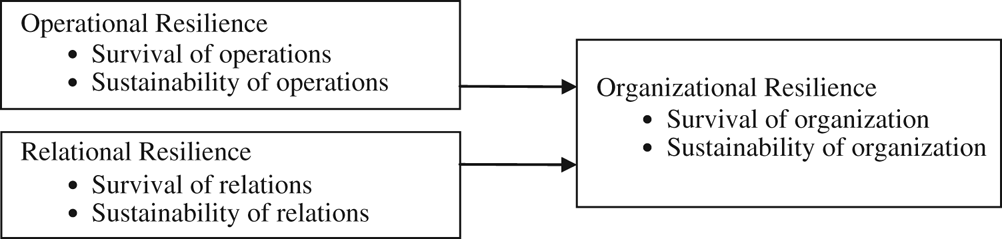
Our research framework is depicted in Figure 1.
Relational and operational resilience leading to organizational resilience.

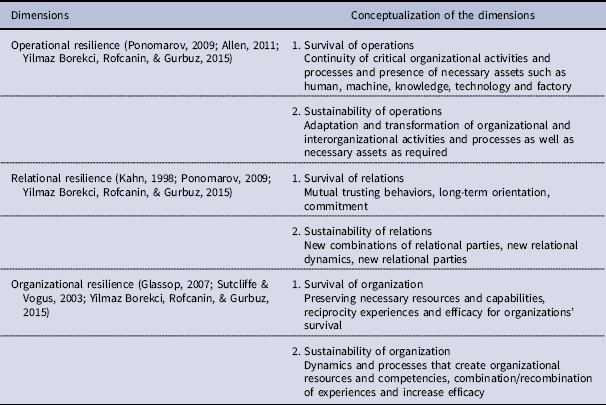
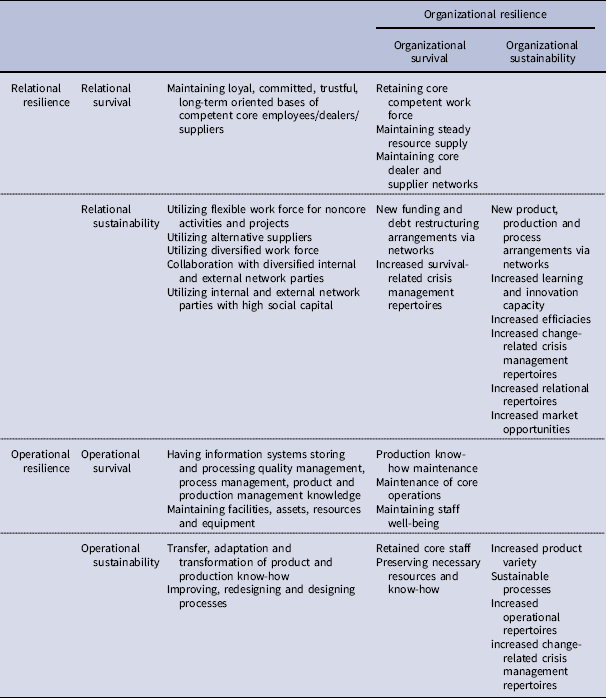
The proposed research framework includes relational, operational and organizational resilience variables. In this regard, organizational resilience is schemed as being influenced by relational and operational resilience. The constructed framework will serve two purposes. On one hand, it represents both relational and operational dynamics of organizational resilience; on the other hand, it is used as a tool to guide this research in the sense that each dimension of the framework was operationalized to collect, organize and analyze the study data as presented in Table 1.
Analytical dimensions

Methodology
To explore the relational and operational resilience dynamics and their influence on organizational resilience with regards to the components of survival and sustainability, this research is based on a case study approach (Eisenhardt, Reference Eisenhardt1989). Yin (Reference Yin2009) emphasizes that multiple-design case studies should be adopted in order to achieve replication, strengthen the emerging constructs and reveal the pattern of relationships among the investigated constructs. Therefore, we adopted a multiple-design case approach and built on interviews, observations and analysis of interintra organizational documents across several organizations operating in Istanbul, Turkey.
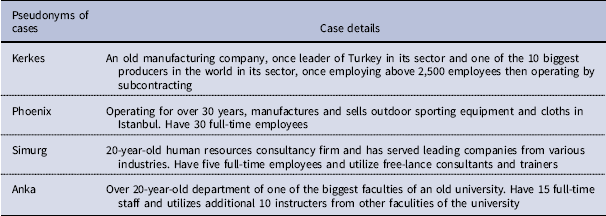
In a case study approach, it is important to identify cases that demonstrate insights about the research constructs and the relationships among these constructs (Eisenhardt, Reference Eisenhardt1989; Eisenhardt & Graebner, Reference Eisenhardt and Graebner2007). Thus, in this research we concentrated on two manufacturing and two service organizations. We use pseudonyms to avoid revealing the identities of the organizations. The organizations, their employees and managers have revealed important insights about the dynamics of relational and operational resilience. The organizations were selected because they experienced a series of crises, such as funding and debt problems, global competition and losing high-profile customers/staff, and handled such issues in their own way and managed to remain in business. In Table 2, pseudonyms for the case study organizations, their size in terms of number of employees and their main area of operations are presented.
Case site information

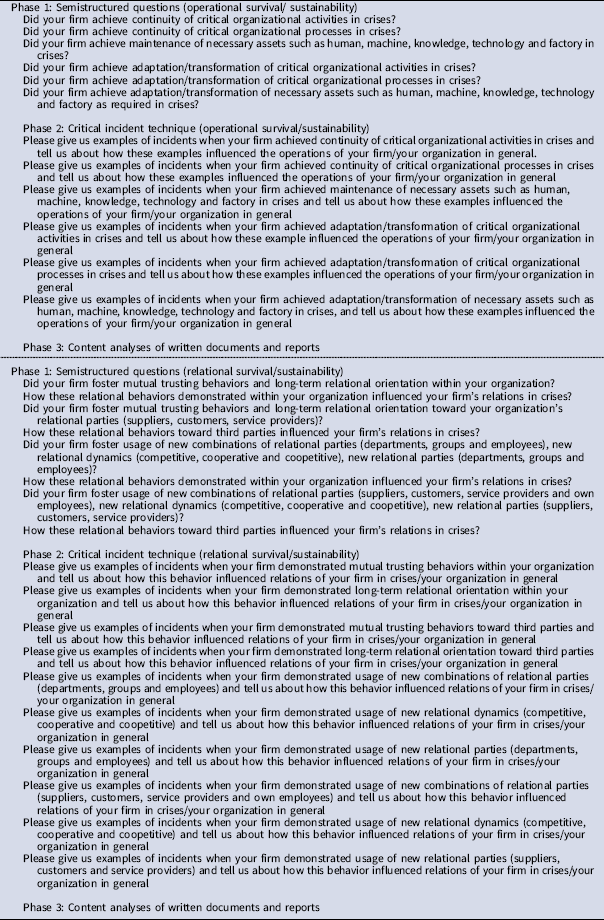
Within each organization, a semistructured interview process was followed as suggested by Choi and Hong (Reference Choi and Hong2002) and open-ended questions were used in the interviews. In order to ensure internal reliability, we supported the findings with documents from the firms and their networks. The procedure followed during the case study is presented in Table 3. The data were collected and coded until the point of information saturation (Ridder, Hoon, & McCandless, Reference Ridder, Hoon and McCandless2009).
Procedure followed during multidesign case study

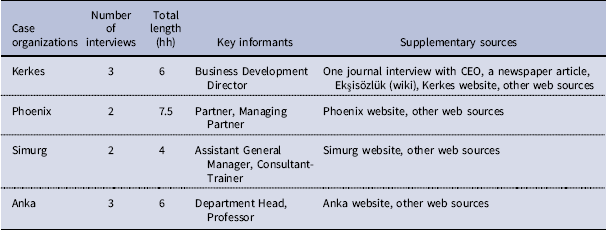
Interviews were conducted with the relevant individuals either face-to-face or via telephone or email. Both of the interviewers were engineers with management graduate degrees. This enabled capture of both operational and relational aspects of the phenomena under study. In addition, since the interviewers have experience of resilience related studies they were very appropriate for the purpose of this study. The pseudonyms of the participant companies are Kerkes, Simurg, Anka and Phoenix. The business development director of Kerkes was interviewed for three 2-hr sessions. Moreover, interviews with the CEO of Kerkes in one leading national journal and a national newspaper were also utilized. We interviewed one of the partners of Phoenix in two 3-hr sessions and conducted a 1.5-hr cross-checking interview with the managing partner. One of the former assistant general managers of Simurg was contacted via e-mail and telephone, and answered our case questions. A former consultant-trainer of Simurg also provided answers to the case questions. Interviews with the head of department of Anka and one of the professors of the institute were our case sources. Interviews at Anka were conducted in three 2-hr sessions. The profiles of the case organizations and their executives were important in analyzing the dynamics underlying relational behaviors and resilience. Those interviewed were experienced individuals who had been with their organizations to witness the adverse dynamics and their organizations’ responses. The statistics related to the number of interviews, total length of interviews and the key informants for each case are given in Table 4. In addition, the provision of consultancy services for the case firms by one of the authors enabled triangulation for the interpretation of the interviews.
Case site interviews

All interviews were recorded and the data were linked to the research questions in accordance with the analytical framework. Ordered categories were utilized in matrix format to structure and analyze data (Miles & Huberman, Reference Miles and Huberman1994). The central goal of this approach was to compare cases and determine shared patterns and convergent points. After multiple reading and double-checking, we first classified data for each case under survival and sustainability, then under operational and relational categories as defined in our analytical framework. The categorization of data was then assessed and criticized by five academics with related knowledge of this study topic.
In the following sections, case findings (both within and across organizations) and survey results are reported.
The case organizations: Relational, operational and organizational resilience
Kerkes
Kerkes is a manufacturing company operating in Istanbul and has been one of the pioneers in its sector. The 1970s were the golden age for Kerkes. Yet, family conflicts that started in the 1980s have always been a handicap for the company. In the 1990s, one part of the family held all the shares. Then Kerkes was listed on the Stock Exchange. The 2001 economic crisis caused major disruptions for the firm such as an 85% decrease in sales and a 75% decrease in revenue and increase in debts. Agreements with banks and hard work enabled the firm survive for 2 years, and the firm began to grow quickly and achieved considerable revenues in the mid-2000s. Kerkes then initiated its process of globalization. During this period, by producing in several central European countries, Kerkes sold its products to almost one hundred countries. The company became one of the 10 biggest producers in the world in its sector. In 2006, financial crises in global markets influenced Kerkes. In addition, family conflicts also increased with members suing each other. This led to the appointment of trustees. The firm’s global operations were gathered under an umbrella firm. Under financial burden, Kerkes halted its production in 2008 and faced chaos. Firm’s dealers, suppliers, employees, banks and all other payees demanded payment.
After a period of difficulty in that year, Kerkes convinced some of its dealers and restarted production. With the funding provided by its dealers, Kerkes was able to produce the first products branded with its own name in the following year. For years, Kerkes had produced under license from a globally recognized European manufacturer and due to its recent crisis, had lost its position as licensee. Although increased production rates raised positive expectations, continuing litigations and conflicts led to Kerkes being declared bankrupt.
Phoenix
In operation for over 30 years, Phoenix manufactures and sells outdoor sporting equipment and clothes in Istanbul. To begin with, the company only imported these to sell in the local market. Due to increased import costs and financial crises, the company began manufacturing its own branded products in the beginning of 2000. The fabrics used in the production of the sports clothes are still imported from the Far East. Although until recently they operated their own retail stores, they currently utilize a retail network. In addition to local sales, they export to countries all over the world. One of the owners of Phoenix started his career as a worker in the same sector. The other owner entered the textile business in her early childhood. They built a manufacturing company by transforming their importing firm. Their core management team is made up of family members. Their core operating personnel have worked for Phoenix for more than 10 years. Their sector is a niche one and there are international competitors. In addition, Phoenix complains about the seasonality of some of their products and looks for ways to overcome this issue.
Simurg
Simurg is a human resources consultancy firm that has served leading companies from various industries for the last 20 years. Simurg provides human resource management consultancy, recruitment and training services. Before the economic crisis in 2008, Simurg experienced its golden age. At that time, they were providing training services to the leading banks. Their training services were diversified and ranged from technical to managerial.
Simurg’s employees are mainly operation oriented and the company recruits freelance consultants and university professors for training and consultancy projects. Due to an increase in customer accounts and projects, Simurg began construction of its training center just before 2008. A huge amount of investment was made. The 2008 economic crisis created significant debt and lost accounts for Simurg. They were near bankruptcy and sold all their assets. The owner tried to maintain Simurg’s business via a home-office. They again utilized freelance trainers and consultants. By regaining some of its previous power, Simurg moved to a business center in 2011. This time, Simurg recruited an experienced head of operations. They tried to improve their accounts receivables. Simurg tried to improve its own processes in terms of cycle times and costs. In 2013, Simurg experienced a downsizing and decided to operate in management consultancy and human resources consultancy lines separately.
Anka
Anka is a department of one of the largest faculties of an old university. Anka has provided undergraduate degree programs since the early 1990s. Its master and doctorate degree programs are 15 years old. Graduates of Anka are well respected in business circles and work in manufacturing and service industries. Due to an increase in the number and quality of competitors, Anka faces a potential decline in the quality and entrance exam rankings of its students in addition to potential academic staff turnover.
Anka serves in an interdisciplinary area thus is able to establish diverse and rich relationships. The academic personnel of Anka consist mainly of academicians who have different backgrounds and perform interdisciplinary academic studies. In 2014, Anka initiated several programs with its relational partners and made several operational arrangements, such as starting to deliver some of its courses in English.
Analysis and the findings
An analysis of the both intraorganizational and interorganizational relationships and operations of the case firms clearly reveals a set of insights that must be handled properly. The study findings depict relational and operational dimensions of organizational resilience in survival and sustainability aspects.
Summary of the findings
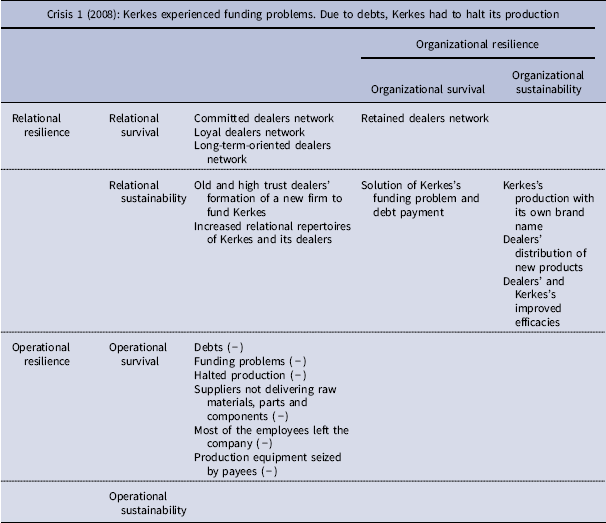
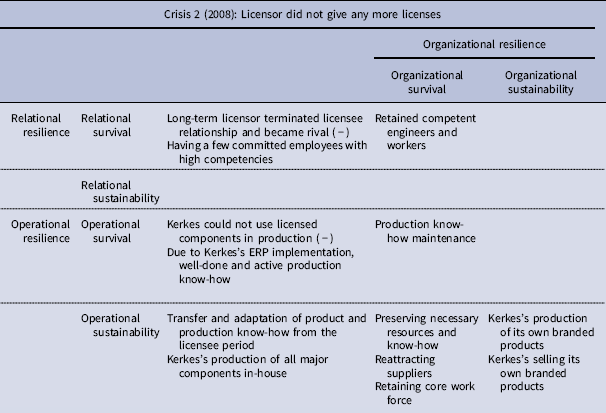
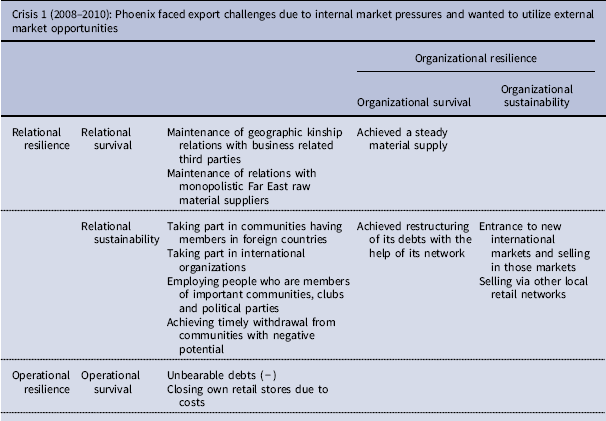
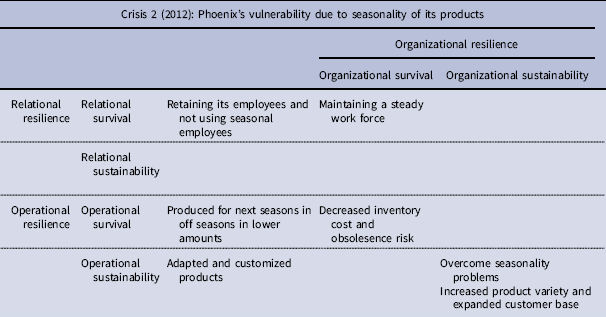
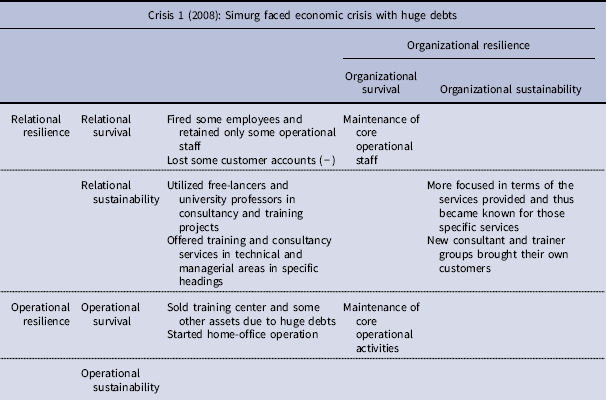
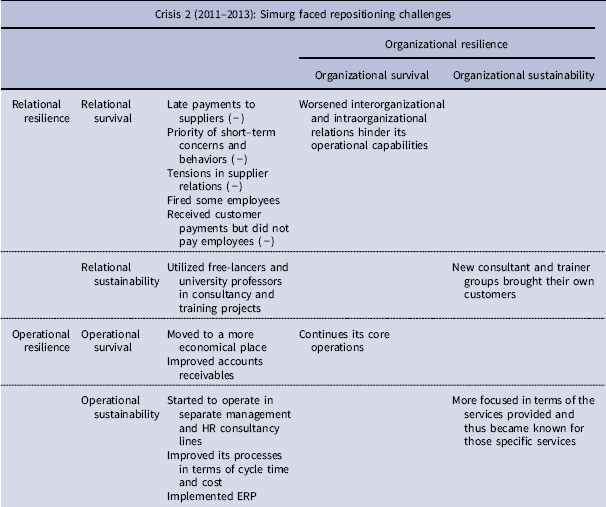
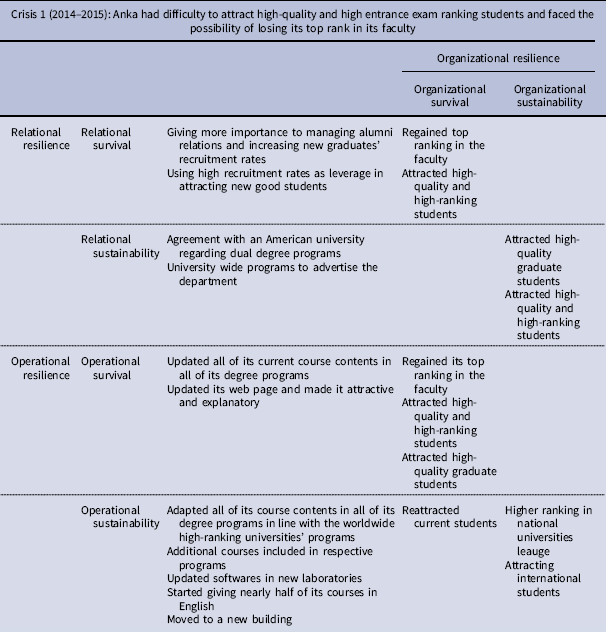
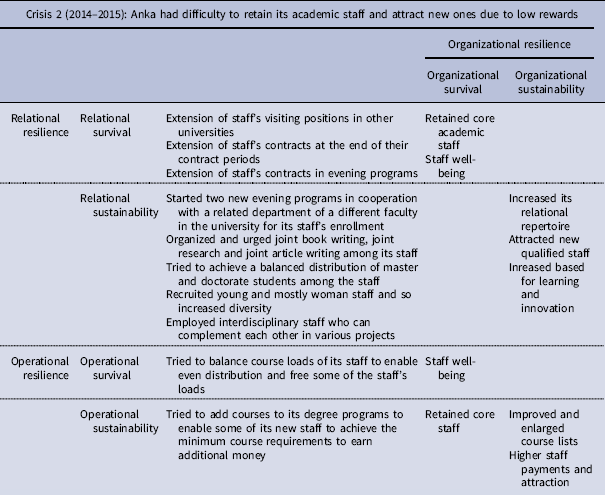
The operational, relational, and organizational resilience dynamics of the case companies in specified crises are summarized in Tables 5–12. By comparing the crises experiences of the case companies in accordance with our analytical framework, a summative picture was obtained as presented in Table 13.
Summary of the Kerkes findings-1

Summary of the Kerkes findings-2

ERP = enterprise resource planning.
Summary of the Phoenix findings-1

Summary of the Phoenix findings-2

Summary of the Simurg findings-1

Summary of the Simurg findings-2

ERP = enterprise resource planning.
Summary of the Anka findings-1

Summary of the Anka findings-2

Summary of the case findings

Resilience of Kerkes
One of the entries about Kerkes in a local web dictionary Ekşisözlük says, ‘A firm that never dies despite all the troubles it faces.’ When the production halted, some dealers and customers commented on several Internet platforms that they would not change even the corpse of Kerkes and its products for its competitors and their products. This loyalty and trust enabled Kerkes to survive in very tough situations. In some other web sources Kerkes’ dealers shared comments like ‘My father was their dealer. I will continue to be their dealer whatever happens.’ The existence of dealers who have been with the company for 50 years may reflect the firm’s relational persistence. The CEO of Kerkes stated in an interview that the formation of a funding firm by ten former dealers that trust Kerkes led to their organization’s survival and sustainability. In other words, sustainability of the relationships enabled organizational survival. The business development director of Kerkes stated that:
When we achieved our own branded products, we were born out of our ashes.
Resilience of Phoenix
In their search for export opportunities, Phoenix began to participate in international fairs via their international contacts. One of the partners of Phoenix expressed the following quote:
When my husband went to the USA, he was met by one of the X community members. They organized all his meetings with potential customers and assisted him since he didn’t speak any English.
Phoenix achieved timely withdrawal from that community (some members were involved in activities that are no longer permitted by the government) by being aware of that community’s problematic situation via their contacts in political parties. It can be deduced that Phoenix has flexible relationships. It has a core employee, supplier, customer and business partner base. In addition to this, Phoenix utilizes flexible relational parties according to the zeitgeist. Thus, Phoenix achieves relational survival via its core groups while it achieves sustainability through flexible relational arrangements.
Phoenix’s relationships with a religious community enabled them to produce shoes as part of their religious clothing. This kind of production enabled Phoenix to overcome seasonality. Their relationships with various municipalities enabled them to manufacture outdoor work clothes by utilizing the distinguishing properties of Phoenix’s textiles. The nature of the fabrics (waterproof etc.) they used in their outdoor sports clothes enabled Phoenix to utilize these fabrics in the production of specialist clothes such as those used by delivery persons and firefighters. Their tailoring and pattern building skills enabled Phoenix to customize their products.
Most of Phoenix’s staff have been employed by the company since it began production. Phoenix tried to make timely payments and built a trusting relationship with them. Phoenix’s partners’ style could be described as paternalistic. They provided meals for their employees during Ramadan, attended their weddings and similar ceremonies. Even in the presence of a lower-cost Syrian work force, Phoenix preferred to work with their existing employees.
Resilience of Simurg
Simurg operated on a very small and operational core and provided its responsive flexibility by utilizing freelancers and academics on a project-by-project basis. Head of operations stated that she felt guilty not paying staff salaries and consultancy fees even though Simurg began receiving payments from customers after 2011. Payments received were sometimes used for personal payments by the firm’s partners instead of paying staff. During this period, intraorganizational and interorganizational trust levels were very low.
One of freelance consultants and trainers said that:
Each time we met with the partner of Simurg, she expressed how her staff was ill performing and how weak they were. She also complained about some free-lancer consultants and trainers with whom we worked as colleagues in various projects. Thus, we were expecting same kind of talk about us, too.
Simurg’s managing partner ordered an assessment of Simurg from the free-lancing consultants, trainers and academicians utilized in Simurg’s projects. The advice based on the assessment was very well received and attempts were made to apply the advice regarding operational activities.
Resilience of Anka
Anka responded to criticisms by its academic staff regarding the quality of its students by making the department more attractive (via high graduate recruitment rates, English programs, and other relational and operational actions) for potential high-ranking students. A professor at Anka expressed:
Two years ago, in a department meeting, almost all of the academic personnel complained about junior students’ unsatisfactory levels. One of the professors compared previous students’ performances with that year’s students by reminding us some of those names. We all remembered those previous students with good feelings.
Another professor noted:
We don’t want to work with graduate students who are here to escape from military services or who are unwillingly here since they didn’t find a satisfactory job. We want dedicated students who have scientific ambitions. Thus, I believe Anka’s relationship building with international universities and other interdisciplinary departments is fruitful in this respect to attract better graduate students.
Anka’s core academic staff delivered all the major courses. In addition, the interdisciplinary nature of its academic staff enabled them to design and deliver most of their interdisciplinary courses. Thus, Anka integrated the faculty members of other departments, faculties, and universities for a very limited number of courses. As a result, Anka has been able to develop a strong and flexible core group of academic staff.
Discussion
The case analyses revealed interesting insights regarding the existence of relational and operational resilience dimensions of organizational resilience with both survival and sustainability aspects. This research has extended organizational resilience research by conceptualizing its relational and operational dimensions as complementary and emphasizing both survival and sustainability aspects.
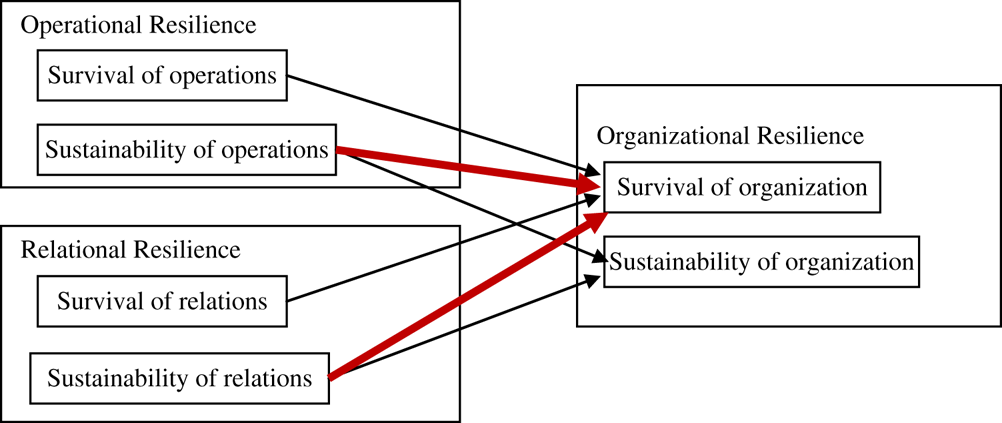
Relational survival is maintenance of organizational and interorganizational relations against crises. Preserving and maintaining organizational and interorganizational relationships results in retaining internal and external resources and capabilities necessary for an organization’s survival. The loyal dealer network of Kerkes enabled maintenance capabilities and resources. The cases of Phoenix and Simurg showed that a core group of relational parties both within and from the partners provides a kernel that is easy to retain and maintain. In addition, relational survival leads to expansion of the parties’ repertoire of reciprocity experiences against crises. Another consequence of relational survival is an increase in the relational parties’ efficacy in dealing with crises. Thus, we can argue that relational survival leads to organizational survival.
Bringing in new parties (new freelancers as in the case of Simurg), creating new forms of organizational and interorganizational relations (as dealer funding organization of Kerkes), and changing forms of relationships (freelancers become personnel or vice-versa in the case of Simurg) result in the creation of necessary internal and external resources and capabilities, varied sets of experiences for improvisation, and increased efficacy of the parties for organizational sustainability. Thus, we can state that relational sustainability leads to organizational sustainability. In addition, relational sustainability influences organizational survival mechanisms such as network based funding and debt restructuring arrangements.
In cases of crises, precrises operational experiences can be utilized with known courses of action. For example, Kerkes and Simurg’s implementation of enterprise resource planning provided the companies with process management platforms that enabled knowledge and control of the processes. In those cases, regaining previous performance levels refreshed the efficacy of the companies. Thus, we can argue that operational survival leads to organizational survival.
Trying to improve/change operations and related performance levels lead to the creation of new resource and capability sets for organizational sustainability. For example, Kerkes’s transfer of knowledge from the licensee period and beginning to produce all the major components in-house enhanced operational sustainability. Likewise, Phoenix adapted and customized its products and therefore overcame seasonality issues. These actions cause an increase in a firm’s repertoire of experiences and efficacy. Thus, we can state that operational sustainability leads to organizational sustainability. Additionally, operational sustainability increases beliefs in organizational survival potential. Thus, operational sustainability leads to organizational survival by retaining core staff, reattracting suppliers and banks.
Our revised framework is depicted in Figure 2. The model indicates that relational and operational resilience influence organizational resilience in survival and sustainability dimensions.
Relational and operational resilience leading to organizational resilience (revised).

The revised model, to our knowledge, is among the first attempts to extend previous research on organizational resilience by focusing on its relational resilience dimension and integrating this with its operational resilience dimension. Understanding the relational resilience construct and complementing it with the operational resilience construct enables us to have a complete and balanced picture of organizational resilience (Thompson & Ravlin, Reference Thompson and Ravlin2010). We developed and refined a conceptual model in this regard and argued that relational resilience and operational resilience in survival and sustainability dimensions influences organizational resilience in survival and sustainability dimensions.
Although previous research has examined organizational and operational resilience in depth, there is scant study, to our knowledge, related to relational resilience (Ponomarov, Reference Ponomarov2009; Kahn, Barton, & Fellows, Reference Kahn, Barton and Fellows2013; Seville et al., Reference Seville, Stevenson, Brown, Giovinazzi and Vargo2014; Brown, Seville, & Vargo, Reference Brown, Seville and Vargo2017; Chang-Richards et al., Reference Chang-Richards, Wilkinson, Seville and Brunsdon2017; Seville, Reference Seville2018). Thus, this study prepared an infrastructure for further conceptual and empirical development studies on relational resilience. A significant theoretical contribution of this study is the conceptualization of organizational resilience as comprised of complementary operational and relational resilience dimensions.
In this study, survival and sustainability dimensions of relational resilience were formed by matching relational constructs in the related literature such as relationship management (Blau, Reference Blau1964) and relationship quality and relationship learning (Kohtamäki & Bourlakis, Reference Kohtamäki and Bourlakis2012). Analysis of organizational, relational and operational resilience constructs in the same survival and sustainability dimensions brings analytical integrity.
Limits and further research directions
The main aim of this research was to understand the relational and operational resilience dimensions of the organizational resilience construct. We explored our research questions by adopting a multiple case study approach. It will be interesting for future research to adopt a quantitative approach and replicate the findings across different industries. Therefore, validation of this model will offer critical insights with respect to causal patterns.
This study adopted a multiple-case design perspective that increased the validity of insights. However, it should be noted that the study is conducted in a Turkish business environment, which, therefore, reduces its power of generalizability. Case studies can be carried out in different national business environments to further strengthen the external validity.
In the framework development process, the effects of wider contextual elements such as culture and structure of the organizations were not included. It is highly plausible to see that the study constructs will change depending on the impact of culture and the context within which organizations operate. Hence, further studies need to test and control for these contextual elements in order to reach cross-cultural generalizability.
As this study adopted a qualitative approach, no attention was paid to possible interactions between relational resilience and operational resilience dimensions. In further studies, whether the survival of relationships influences the survival of operations and whether the sustainability of relationships influences the sustainability of operations could offer an interesting line of research.