




No CrossRef data available.
Democracy in Europe: The Impact of European Integration
Published online by Cambridge University Press: 23 November 2005
Abstract
Europeanization has brought radical change to the governance practices of all European Union (EU) member states, and these practices have clashed with traditional ideas about democracy. The degree to which EU member states have been affected is largely a matter of institutional fit. The EU, as a compound supranational polity in which governing activity is highly diffused through multiple authorities, has been more disruptive to simple national polities such as Britain and France, in which governing has traditionally been channeled through a single authority, than to compound national polities such as Germany and Italy, in which it has traditionally also been diffused through multiple authorities.
The main problem for EU member states, however, is that national leaders have generally failed to develop new ideas and discourses to reflect Europeanized realities. But here too institutional differences matter. Simple polities are better positioned to address changes because their concentration of authority ensures them a more elaborate communicative discourse with the general public, in which they are able to speak with one voice, than are compound national polities, let alone the EU, given the number of potentially authoritative voices with differing messages.Vivien A. Schmidt is Jean Monnet Professor of European Integration at Boston University (vschmidt@bu.edu). Her recent books include Policy Change and Discourse in Europe, coedited with C. Radaelli (2005), and The Futures of European Capitalism (2002). Her forthcoming book Democracy in Europe: The EU and National Polities (2006) explores the impact of the European integration on national democracies. This article is a revision of a paper prepared for presentation to the American Political Science Association National Meetings in Chicago, September 1–5, 2004.
Information
- Type
- Research Article
- Information
- Copyright
- © 2005 American Political Science Association
Democracy has become a problem for Europe. The problem is not just at the supranational level of the European Union (EU), where all the talk of the democratic deficit has been focused, but even more importantly at the national level. This is because Europeanization, defined here as the top-down impact of the EU on its member states, has brought major change not just to national policies and economies, but also to national polities, that is, to the traditional workings of national democracies.1
There is a debate about how to define Europeanization (Olsen 2002; Radaelli 2003). Some scholars define it as I do, as a top-down process of EU impact on its member states (for example, Ladrech 1994; Radaelli 2003; Börzel and Risse 2000; Schmidt 2002a). Others focus only on the bottom-up process of what I call European integration, as the projection of member-state preferences onto the EU (Caporaso and Jupille 1999). Yet others include both top-down and bottom-up processes (Cowles, Caporaso, and Risse 2001). I find the distinction useful for analytic purposes, although the two are part of the same overall dynamic, with feedback effects going in both directions.
Europeanization has disrupted the institutional patterns of all of its member states, shifting the focus of governmental power and authority upward to the EU, moving the locus of interest access and influence from national capitals to Brussels, and subordinating the expression of partisan votes and voice to a more consensus-oriented, interest-based politics. But it has affected member states characterized by more simple polities, in which governing activity has traditionally been channeled through a single authority, more than those with more compound polities, in which activity has traditionally been more diffused through multiple authorities. Such differential impact is the result of the institutional fit (or lack thereof) between the EU's highly compound institutional arrangements and those of its member states.2
The problems for democracy following from member-state adaptation, however, stem less from the changes in governance practices per se than from the lack of change in ideas and discourse about democracy. The main problem is that national leaders generally continue to project traditional visions of national democracy rather than to speak to the changes in the traditional workings of their democracies. That they choose not to engage their publics in deliberation about the effects of Europeanization on the polity attests to the difficulties of doing so when the short-term political costs are high and the benefits low. But their failure to do so leaves them open to the censure of their publics for policies for which they are not fully responsible, over which they often have little control, and to which they may not even be politically committed. And this is the source of a national democratic deficit, which is more serious regarding questions of political legitimacy than the democratic deficit at the EU level.
But again, member states' institutional differences matter. Europeanization represents a greater challenge to simple polities' ideas about democracy, where legitimacy is focused on a single authority, than to those of compound polities, where it is inherently more diffused. National leaders in simple polities have a greater capacity to speak to those challenges, since in a system where a restricted government elite tends to coordinate policy construction and communicate its initiatives to the public for deliberation, leaders are better able to project a clear message in a single voice. By contrast, in compound polities, which involve a much wider range of actors in the coordinative discourse, a clear communicative discourse cannot easily emerge, given the number of potentially authoritative yet differing voices. In the compound EU, these problems are multiplied, since it has an even greater range of national and EU-level actors involved in coordinative discourse and little communicative voice of its own.3
Schmidt 2002a, chap. 5; Schmidt 2004.

In this paper, I first examine the EU's institutions in comparative perspective (mainly with the United States) and their impact, generally and then differentially, on its member states. I then similarly consider the EU's organizing principles of democracy and their challenge to those of EU member states. Finally, I analyze the EU's patterns of discourse and their differential effects on national patterns. Throughout, two matched pairs of cases are used in illustration: Britain and France as simple polities, Germany and Italy as compound polities. While these two pairs represent “most different” cases for the purposes of comparison, within each of the pairs, once we control for the overarching institutional similarities, we also find “most different” cases; Britain and France, on the one hand, and Germany and Italy, on the other, differ significantly in history, culture, institutional capacity, and politics as well as in their responses to Europe. To elucidate the theory, I use a mix of “new institutionalist” methods, with soft rational choice assumptions about the interest-based logic of simple and compound polities, historical institutionalist attention to how the actual relationships shape interests in such polities, sociological institutionalist awareness of how cultural rules and norms frame both interests and institutions, and my own discursive institutionalist approach, which adds the dimension of ideas and discourse to illuminate the dynamics of change in interests, institutions, and culture.4
Governance in the EU
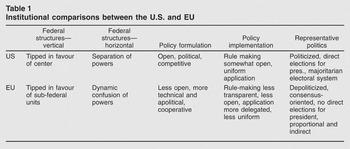
With its dispersion of activity through multiple authorities at different levels, in different centers, with different forms of governing, the EU's governance system is more highly compound than those of even the most compound of nation-states, such as the United States. Nevertheless, it greatly resembles the United States in its quasi-federal institutional structures, its semi-pluralist policy formulation processes, and its regulatory implementation processes; it differs from the United States in its consensus-oriented, largely indirect system of political representation (see table 1). The greatest difference occurs with regard to the impact on “subfederal” units. This is because, unlike the American states, EU member states prior to European integration have been highly developed nation-states in their own right, with democracies that evolved differently in terms of structures, policy-making processes, and representation systems.
Institutional comparisons between the U.S. and EU

The EU has greatly affected its member states' governing by federalizing national institutional structures, pluralizing national policy-making processes, and depoliticizing national representative politics. But the EU has also differentially affected polities depending upon where countries can be situated along a continuum from simple to compound in their governance (see fig. 1).5
Although this distinction between simple and compound polities owes much to Lijphart's (1984) dichotomy of majoritarian and consensus democracies, it differs in its focus on three dimensions—structures, processes, and politics—instead of Lijphart's two, federal-unitary and executive-parties. His first dimension of federal-unitary fits my “structures” category perfectly but his second dimension of executive-parties collapses into one my two categories of “politics” (containing majoritarian and proportional representation systems) and “processes.” Within the latter, he also collapses into two, pluralist and corporatist, my three categories of pluralist, corporatist, and statist.

Countries on a continuum from simple to compound polities
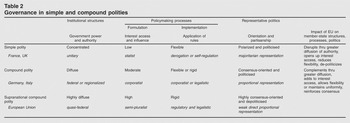
At one end of the spectrum are Germany, Spain, Belgium, and Italy—compound polities. Like the EU, they diffuse power and authority through federal or regionalized institutional structures and permit a moderate level of interest access and influence through corporatist policy making, in which certain privileged interests—mainly business and labor—help formulate and implement policy. They also promote compromise-oriented politics through proportional systems of representation, and strive for consensus despite partisan patterns of voting and exercising voice.
At the other end are countries such as Britain, France, or Greece. These are relatively simple polities with a concentration of power and authority in unitary institutional structures, and minimal interest access and influence through statist policy-making processes in which the executive has a monopoly on policy formulation but accommodates interests in implementation. They also share more conflictual politics in majoritarian representation systems with polarized patterns of voting and exercising voice (see table 2). Between the two extremes are a range of countries that do not fit neatly into any one place on the continuum, as one or another institutional element may be more simple—that is, a unitary structure or majoritarian politics—even though the polity as a whole basically functions in a compound manner—for example, because of corporatist policy-making and consensus-oriented politics—as in the Netherlands and Sweden.6
Certain policy sectors may function in more simple or compound manner, despite a country's overall pattern. In security and defense policy and monetary policy, for example, most countries operate as more “simple” polities.
Governance in simple and compound polities

The EU serves to move all member-states' governing practices toward the compound end of the continuum. However, the EU has had a comparatively greater impact on simple polities than on compound ones because of a lack of institutional fit (see table 2). For simple polities the Europeanization of national governing practices has diffused their traditional concentration of power in the executive through the EU's quasi-federal levels and centers of governance. It has opened up their traditionally limited interest access in policy formulation through semi-pluralist EU level processes. It has diminished their flexibility in policy implementation through EU demands for regulatory uniformity. And it has subordinated their polarized, majoritarian politics to the EU's consensus-oriented, interest-based politics. For more compound polities, by contrast, Europeanization has mainly added to their traditional diffusion of power, further opened up interest access while allowing corporatist implementation to stand, and reinforced consensus-oriented (albeit partisan) politics.
Institutional structures
Although the EU bears a surface resemblance to the United States,7
There is actually a closer resemblance to German federalism than American (Scharpf 1988; Sbragia 1993).
The development of the EU's quasi-institutional structures has significantly affected all members' structures by altering the traditional power and authority of national governments. National executives have become EU-level decision makers in exchange for giving up autonomy in national policy making. National legislatures have become transposers of EU directives and regulators of society as they have lost traditional legislative powers of initiative and approval. National judiciaries have become interpreters of EU law, and subnational units, implementers of EU regulations, at the same time that both have become more independent of the national executive.11
On legislatures, see Duina and Oliver 2004 and Norton 1996a. On the courts, see Stone Sweet 2000; Burley and Mattli 1993; Weiler 1994. On subnational authorities, see Hooghe 1996 and Keating and Jones 1995.
But the EU's institutional structures have disrupted countries with simple institutional structures more than they have those with already compound institutional structures. Although the executives in all states have lost power and autonomy in the shift of decision making upward to the EU, in unitary states this has been comparatively more significant not only because executives have traditionally been highly autonomous, but also because national judiciaries and regions have become more independent of the executive as a result of their EU-related roles (as well as because of internal dynamics related to judiciary activism and devolutionary reforms).12
The loss of executive autonomy has been less significant for more federal states like Germany, given that the executive has always had to share power and authority with other national and subnational units of government. For regionalized Italy, the executive has actually gained.13Paradoxically, although the diminution in national parliaments' legislative powers has been potentially of greater significance in federal states, it too has in the end affected unitary states more profoundly. This is because in federal systems in which the executive's greater legislative role in the EU stood to alter the balance in the national division of powers to the detriment of the legislature, parliaments were able to negotiate a new balance of powers with the central executive. In Germany, for example, the opposition-controlled second chamber of the legislature was instrumental in forcing the issue.14
Belgium and Austria subsequently followed suit. In unitary states, by contrast, the legislature had no such capacity, given the weakness of the second chamber and control of the first by the executive as representative of the majority party. As a result, for example, the French Parliament's limited powers have become more limited, despite reforms attendant upon the Maastricht Treaty.15 The British Parliament has by comparison retained its traditionally greater powers of oversight, although it too has lost powers of initiative and approval.16 In Italy, a highly regionalized but technically unitary state, by contrast, the reduction in the parliament's powers of initiative and approval were balanced by greater effectiveness, as the transposition of EU directives made the log-rolling of the past impossible.The greater independence of the judiciary from the national executive has also been more important for unitary than federal states, even though national courts' loss of autonomy to the European court has been more problematic for federal states. In France, for example, where the courts have traditionally been subordinated to the executive, the courts' increasing independence—the result of internal dynamics more than of their empowerment as an enforcement arm of the EU17
—has been particularly unsettling to the executive, which is concerned by corruption investigations and is more resistant to applying EU law than either Germany or Britain. In Britain, where the courts have always been relatively independent and the precedent-setting approach of British common law matches EU practice, the executive found it easier to accept the increased independence of the judiciary, if not the proliferation of EU-inspired laws, while the courts bristled at giving up their prerogatives and have referred fewer questions to the ECJ than have France or Germany.18 In Germany, where the courts are even more independent than they are in Britain and the importance of law as a regulatory instrument parallels EU practice, the problem has been neither with the even greater independence of the courts nor with the proliferation of EU laws, but rather with constitutional issues related to the precedence of EU law over German.19 In Italy, where the courts were traditionally subordinate to the political power, they asserted their independence not just through the EU,20 but through a variety of corruption investigations, which ended the careers of major political and business officials—along with the entire postwar party system.Finally, the closer links with the EU through regional policies, committees, and funds has been more significant for the regions of unitary states, which gained greater independence from national executives than they had in the past, than for the regions of federal and regionalized states. These always had more independence and stood to lose more as a result of the EU, but for the most part they managed to make up for their losses through other gains. Any increase in supranational access and funding clearly enhanced independence for the regions of unitary France, which gained some measure of autonomy from the executive only in the decentralizing reforms of the 1980s;21
for the more autonomous regions of formally unitary Italy, which have long had an uneasy truce with the central government; and for the newly emancipated regions of Britain, beneficiaries of the devolution that started in the late 1990s for Scotland, Wales, and Northern Ireland with elected legislatures, but which has yet to begin for the recently created English regions.22 By contrast, in federal Germany, the regions, after an initial loss in power as a result of the executive deciding at the EU level on policies that had long been their domain, were compensated for the loss with a seat at the table in the EU on issues that affect them. In regionalized Spain, the regions' rebalancing of power was also negotiated, albeit following greater delay due to the regions' initial resistance to any accommodation with the center.23Policy making
The policy-making processes that infuse these quasi-federal institutional structures also resemble those of the United States—but again with significant differences. The EU's predominant pattern of policy making, often called the Community Method, involves a range of governmental and nongovernmental actors in joint decision making akin to the pluralist process of the United States, in which interests are involved in policy formulation, but excluded from policy implementation, which is mainly regulatory, with an arms' length, uniform application of the rules. In the EU, however, policy formulation is less open in terms of interest access because of EU civil servants' gate-keeping role in deciding which interests to allow into the official consultative fora and committees. Their role is more technical than political, given the apolitical status of EU civil servants who privilege technical and scientific bases for decisions. And it is more cooperative than competitive in style, given the EU's consensual culture.24
In addition, EU regulatory implementation is less transparent in making rules, given the expert-dominated “comitology” system; more delegated, given the role of member states in transposing and enforcing the rules; and less uniform in application, given national differences in patterns of enforcement.Here again, EU practices have affected member states. National interests have gained access and influence in an EU policy process that involves a vaster array of actors in a more complex set of interactions with more points of entry than that of any member state.25
Moreover, national administrations have been pressed into more regulatory and legalistic modes of enforcement—where the rules are applied without exception by independent regulators and judges—from approaches that often relied instead on administrative discretion, joint regulation, or self-regulation.26Adaptation to the EU's policy making processes has also been particularly difficult for simple member-state polities, where statist policy formulation traditionally gives little influence to organized interests, but flexible policy implementation allows for their accommodation, either by making exceptions to the rules as often as not (for example, France) or limiting the number of rules to allow self-governing arrangements (for example, Britain). In policy formulation, the learning curve for interest groups hoping to exert influence at the EU level was perhaps steepest in France, where lobbyists were accustomed to advancing their positions over lunch and relying on political arbitration late in the process, rather than approaching policy makers early with solid technical information—the best way to exert influence in the EU. Now, however, French interests have greater input at the EU level on decisions from which they had been normally excluded at the national level.27
British interests had much less to learn, having honed their lobbying skills in relations with Parliament and their negotiation skills with the bureaucracy. But they also gained in influence.28In policy implementation, both countries have had difficulties with the EU requirements to apply the rules without exception. In France, where EU requirements go against traditional patterns of administrative discretion, organized interests without access to EU policy formulation find themselves denied past accommodation. They therefore see no other alternative than to confront national authorities, as in the cases of truck drivers upset about EU-mandated liberalization and public service workers worried about privatization and deregulation.29
In Britain, where the EU's codification of the rules go against traditional preferences for self-regulation and informal agreements, the problem has been in the increasing numbers of laws that deny organized interests the voluntary rules and self-governing arrangements of the past, leaving them to complain of the increasing rigidity of the public sphere.30Adaptation to EU policy processes has been easier for member states with more compound polities, where corporatist processes have traditionally allowed influence in policy formulation and implementation to certain privileged interests, mainly business and labor. The EU's openness to interests has simply added even more interests into policy formulation, while implementation has not been at issue, since the EU generally allows corporatist implementation to stand. Germany's interests have readily adapted to the EU's pluralist process, having been schooled in the same kind of cooperative negotiating style and committee work prevalent in the EU, something that has guaranteed their dominion of standard-setting committees.31
Egan 2001, 144–45.
Politics
The EU is most different from the United States in its system of representative politics. In place of a directly elected presidential system with a strong, directly elected legislature and vigorous political parties in a competitive, majoritarian electoral system, it has the indirect representation afforded by national executives through the Council and the much weaker direct representation of the European Parliament. Unlike the United States, where politics and partisan competition is ever present, in the EU, partisan differences and political contestation have been submerged by the general quest for interest-based consensus.
Again, EU practices have affected member states. National electoral politics have been complicated by voting in European elections, which can become referenda on national elected officials, especially when they occur in the middle of a government's term in office.34
National partisan politics has little outlet in the EU. Most significantly, national partisan politics has been subordinated, first, to the national interest politics of the Council, as ministers speak more often in the name of the nation than as the representative of the governmental majority; second, to the public interest politics of the European Parliament, as members of the European Parliament speak for the general good, rather than as representatives of electoral majorities; and third, to the organized interest politics of the Commission, as citizens exercise voice more effectively when lobbying in Brussels than voting or protesting in national capitals.As with the Europeanization of institutions and policy making, so with representative politics. Compound polities—where compromise-oriented politics is the norm, given proportional electoral systems with multiple parties and/or two powerful legislative chambers in which control may be divided between government majority and opposition—are a closer match with the EU's quasi-consensual politics than countries with simpler polities—and more conflictual politics.35
In Germany and, to a lesser extent, Italy, the complex negotiations and search for consensus of the EU are not so different from their own politics, since compromise in negotiated settings is a sine qua non of their proportional representation systems, however partisan the politics.36Italy lately has been more complicated, since under Berlusconi we see increased polarization and less compromise.
Bréchon 2002, 103.
Europeanization vs. European integration and policy implementation
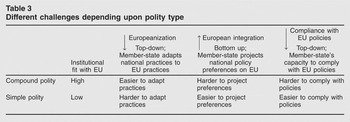
One caveat, however. Misfit is mainly a problem for simple polities, while fit is an advantage for compound polities when we consider Europeanization as the top-down impact of the EU's governance on its member states. By contrast, in the case of European integration, as the bottom-up process of projecting national preferences onto the EU, misfit may be an advantage for simple polities and a problem for compound ones. There can be little question that countries like Britain and France, where the executive has hierarchical control of other branches and levels of government, are more effective at the EU level because they can speak with one voice than those where ministries and regions have greater measures of independence.38
Other factors are of course also at work, such as relative size and economic weight (with bigger countries having greater sway than smaller), strategic position (for example, when a country has the presidency of the European Council), or good ideas and innovative practices (for example, Germany with regard to European Monetary Union, with all that it entailed in terms of monetary stability and independent central banks).
Although institutional “fit” is the primary factor with regard to the impact of EU institutions on national ones, it is only one of a number with regard to the impact of EU policies on national ones. See Schmidt 2001; Schmidt 2002a; Scharpf 2000b; Hértier 2000.
Different challenges depending upon polity type

Democracy in the EU
That national governance has changed in response to Europeanization is not the main problem for EU democracies. Rather, the problem is that their ideas about democracy generally have not changed, leaving questions about the legitimacy of the new practices and confusion over political control and accountability—and more so in simple polities where the clash is greater between the new practices and traditional ideas about democracy. To see this clearly, it is necessary first to consider how democracy in the EU has affected national democracies more generally.
The general impact of EU democracy on national democracy
More ink has been spilt in recent years over the issue of the democratic deficit in the EU than just about any other problem. Democratic theorists have pointed to the lack of input democracy through political participation and the impossibility of such given the lack of a collective identity or a common political space.40
Scharpf 2000b; Weiler 1995; Grimm 1995, Habermas 1996; Greven 2000.
Most see the main answer to this problem as the development of EU-level institutions that are more participatory and representative than they are currently—thus the focus on a new Constitutional Treaty intended to strengthen the democratic status of the EU. But this is not so easy.
The central problem has to do with the fragmented nature of democracy in the EU. In national polities, democracy tends to be based on four legitimizing mechanisms: government by the people, through political participation (or input democracy); of the people, through citizen representation; for the people through effective government (or output democracy); and what I call (adding a preposition to the traditional formulation) government with the people, through interest consultation (legitimized in the United States as pluralism). In the EU, only two of these four mechanisms are prominent, effective governance for the people and interest consultation with the people; government by and of the people is left largely to the national level.42
There is no consensus to shift government by and of the people to the EU level through EU-wide parliamentary elections—nor would this necessarily help democratize the EU, given the lack of a collective identity and will. Democratic reforms of the EU still focus mainly on improving governance for the people, through greater accountability and transparency, and with the people, through more interest-based access and a greater opening to “civil society”—meaning more public interest groups, along with business, labor, and agricultural interests. This does little to decrease the fragmentation of EU democracy as a whole.
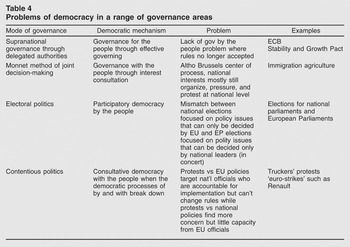
The deficiencies of fragmented EU-level democracy put tremendous pressure on national politics. The resulting problems cover a wide range of governance areas (see table 4). In areas of supranational governance in which the Commission, the European Central Bank (ECB), or the European Court of Justice (ECJ) have delegated authority, the lack of government by the people makes this kind of governance for the people generally problematic. This is especially so in cases where rules formerly agreed are no longer accepted, given that they are very difficult to reverse.43
In monetary policy, for example, while the ECB's role in monetary policy, together with the restrictive terms of the Stability and Growth Pact, limit national governments' ability to take effective demand-side action in economic downturn, national constituencies still hold national authorities responsible for the state of the economy. At the same time that the Commission took Chancellor Gerhard Schröder to task for risking breaching the 3 percent deficit criterion, the German public blamed him for high unemployment and the declining state of the economy. It is no surprise, then, that Germany (and France, for similar reasons) bucked the Stability and Growth Pact when their economies were in a state of downturn, and then sought to amend the rules of the Pact. Where such defiance does not work, as in the UK's response to the EU Commission's decisions on the measures regarding mad cow disease or of France's unwillingness to agree to agricultural concessions in the Uruguay Round, national leaders have sought to convince the public of a good faith effort to fight the policy at the EU level while moderating its impact nationally—mainly by buying off the most affected interests. The French government offered subsidies to farmers after the Uruguay Round; the British gained EU recompense for farmers in the mad cow crisis.44Problems of democracy in a range of governance areas

Equally problematic are the effects of Europeanization on input democracy by the people when national governments, elected on a platform at the national level, have to implement EU policies to which they may not be politically committed. This has been the case for successive French governments' implementation of EU deregulation in electricity, which they had all resisted because of its potential impact on the public utilities that were seen as a public service obligation of the Republican state.45
The problems of participatory democracy by the people also suffers because of a mismatch between national elections, which focus on policy issues that increasingly can only be fully addressed at the EU level, such as immigration, food safety, or economic growth, and European parliamentary elections, which tend to focus on more general polity issues that can only be resolved by nationally based actors, such as how to reform EU institutions.46Finally, contentious politics, consultative democracy with the people when regular consultation breaks down, have also generated problems for national democracies.47
Protests against EU policies target national officials who are accountable for policy implementation, but who can do little to accommodate protesters' concerns. Yet protests focused on local issues may find more response from EU officials than from national ones. On the one hand, truckers' blockades of highways in France and Italy to protest EU-mandated deregulation have had little effect on EU policy, although they have forced national governments to buy off truckers through expensive concessions on fuel taxes and the like. On the other hand, the “euro-strikes” against the closing of French car manufacturer Renault's Belgian plant in Vilvoorde garnered the attention of EU officials, who pledged to strengthen plant-closing legislation, and sanctions by those officials, because the manufacturer had not given prior notice on the plant-closing.48 Yet they led to no French government action against Renault, despite the fact that the new Socialist government had promised in its election campaign to sanction the still partially government-owned firm.49Schmidt 2002a, 284.
The problem for national leaders is that EU-level decision making largely involves policy without politics, whereas national level decision making involves politics without policy, that is, national control over policy making. Because national citizens lack a system in which one can “throw the scoundrels out” at the EU level, national politics takes the heat for EU decisions. Until citizens begin to see Brussels as an equally important place to voice concerns, apply pressure, and protest, national politics will continue to suffer from the bottleneck caused by national governments being the main focus of national discontent. But while a fuller democracy with the people at the EU level would alleviate problems at the national level, it cannot solve all of them. This is because the EU alters the traditional workings of national institutions and challenges traditional ideas about national democracy.
The differential impact of the EU on national democracies
The EU not only poses problems for all member states' democracies, but it has differential effects on member states depending on whether they are simple or compound. The effects are best elucidated in terms of the challenges to the organizing principles of national democracies constituted by the EU-related changes in institutions, policy processes, and representative politics.
To begin with, the EU's federalizing diffusion of power through its multiple authorities reinforces the underlying assumptions in compound polities that democracy by the people is best served by dispersing government power such that citizens' rights are protected from government excess through vertical and horizontal checks and balances. In Germany, this sits well with a centuries-old history of regional power and a postwar constitution written to prevent any possible return to the excesses of centralized power. By contrast, the EU challenges the traditional assumptions in simpler polities that democracy is better served by the concentration of governmental power vertically and horizontally such that the government has the sole responsibility as well as the capacity to respond to citizens' wants and needs. For France, the EU challenges the country's Jacobin philosophical foundations that concentrate authority in the “one and indivisible” Republican state. For Britain it undermines the authority of the executive as the embodiment of parliamentary sovereignty. In Italy the EU reinforces the assumptions underlying the increasingly regionalized practices that disperse power, even as it challenges what is still in principle a unitary state.
Similarly, the EU's pluralizing of member-state policy formulation through increasing interest influence bolsters the views in compound polities that effective governing for the people demands the greatest openness to multiple inputs from intermediate interests through multiple centers of power via consultation with the people. For Germany and Italy, the EU only reinforces legitimacy, since it adds a wider range of interests to those traditionally involved in corporatist or clientelistic processes. By contrast, EU-related institutional changes clash with the assumptions of simple polities that the executive governs most effectively for all the people while ensuring against governmental excess by being closed to interest consultation with the people. For France, open interest consultation offends ideas prevalent since the Revolution that see it as illegitimate; in Britain, it clashes with ideas of executive autonomy.
In implementation, moreover, the EU's regulatory model clashes with simple polities' commitment to flexibility. For France, the EU's insistence on applying the rules without exceptions reduces the executive's ability to govern effectively for the people in implementation by accommodating minority interests harmed by majority decisions in policy formulation. For Britain, the problem is rather with the statutes that, by abrogating organized interests' self-regulatory arrangements, increase the scope and rigidity of the public sphere and thereby encroach on the private sphere. By contrast, the EU again tends to reinforce legitimacy in compound polities by promoting governing effectiveness for the people through regulatory and legalistic processes (which also predominate in Germany), by allowing corporatist processes to continue (in both Germany and Italy), or by substituting regulatory enforcement for a discredited clientelism (in Italy).
Finally, the EU depoliticization of representative politics by way of interest-based, consensus-oriented politics sustains the assumption in compound polities that political compromise among the plethora of authorities representative of the people, elected by the people, and open to interest intermediation with the people, is the best way to express the will of all the people. In Germany, it matches a consensus-oriented political culture that expects compromise among federal and regional governments; government and opposition (when in control of the upper house); and government, business, and labor (on labor-related policies). In Italy, it fits with a conflict-ridden political culture that accepts the need for compromise among myriad parties in coalition governments, with regional governments (on regional issues), and with the social partners (on labor-related policies). By contrast, the EU's depoliticzation of representative politics clashes with the expectation in simple polities that political leadership by a single executive, representative of and elected by the people, requires fulfillment of all political commitments made to the electorate. For France and Britain, it undermines conflict-based political cultures which expect the government to impose its electoral program without compromise—although in France unpopular programs are immediately sanctioned through protest in the streets, whereas in Britain's “elected dictatorship” the main sanctions come from elections.
In short, even though EU legitimacy may be increasing with the development of EU institutions, national legitimacy suffers from the effects of EU governance on national democracies more so for simple polities, where legitimacy is focused on a single authority than for compound polities, where it rides on the system as a whole. Thus although national publics generally hold their own politicians accountable, the public of simple polities hold their politicians more accountable because they see them as more fully responsible for and more politically committed to all decisions, whether or not EU-related, than the public of more compound polities, who know that their politicians are never fully in control of any decisions, even those they are committed to politically. Questions of democratic legitimacy therefore come up more frequently in simple polities, since they can arise in response to any unpopular policy, than in compound polities, where democratic legitimacy is at issue when the people lose trust in the system as a whole.
Other problems for national democracy
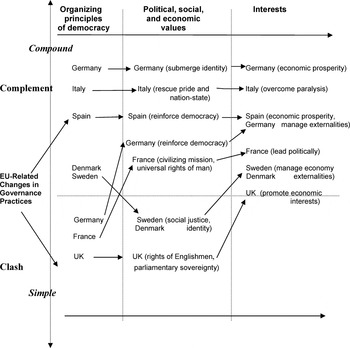
There are limits to the significance of institutional fit with regard to ideas about democracy. The organizing principles of democracy are not the only ideas that affect responses to Europeanization; so do other historically and culturally grounded values and interests—political, social, and economic (see fig. 2).

National responses to EU-related changes in governance practices
In simple polities, for example, consideration of political, social, and economic values can elucidate how countries mediate the clash between the EU and their democratic organizing principles—for example, why the French, with their ideas about a civilizing cultural mission and the universal rights of man, have embraced Europeanization despite its potential impact on the powers of the Republican state, whereas the British have kept Europe more at arms' length because it threatens ideas about the rights of Englishmen and parliamentary sovereignty. In compound polities, social and political values show how the fit with democratic organizing principles was enhanced, with Germany's embracing Europe as a way to submerge national identity in a larger whole; Italy's, a way to rescue the nation-state; and Spain's (like Greece's, despite its “simpler” polity), a way to reinforce democracy.
National values can also help explain responses to the EU policy issues. Sweden and Denmark, for example, resisted becoming part of the European Monetary Union because they were concerned about its impact on social justice in the social democratic welfare state, while Germany embraced the EMU because it fit with notions of economic order and the stability, despite the public's qualms about giving up the Deutschmark and problems related to its exchange rate value. In addition, although the French and the Germans have both on the whole been pro-European, when EU policies threaten Germany's economic order—through decisions against the lending practices of the regional banks—or the French state's social service mission—through liberalization of public utilities—the responses are as negative as the British or the Swedes on the euro. What is more, the French no vote in the referendum on the Constitutional Treaty made clear that policy issues related to the euro's impact on the welfare state or liberalization on the services publics go to the heart of the left's social justice concerns, while the impact of enlargement and immigration on national identity was the major concern on the right. The same concerns explain the Dutch no vote, although the euro's alleged inflationary impact was also an issue.
Interests also matter, of course. One cannot understand the push for European integration without recognizing the economic, political, and social interests that enabled countries to overcome ideational obstacles to change—the French desire to lead politically in Europe; the German interest in economic growth and social stability; the British willingness to follow economic interest despite political reticence; the Italian hope to overcome the hazards of state paralysis; or the need for small states such as Denmark, Sweden, and Austria to be part of a larger political entity in order better to manage economic externalities.
Experiences of European integration or policy implementation may also affect perceptions of the EU. Thus, for example, success in projecting national preferences onto the EU can offset concerns about the impact of the EU on national democratic practices and ideas. In France, leadership in the EU has long served to obscure the state's real loss of power. By contrast, success in policy implementation may only increase concerns about the impact of the EU, as in Britain, whose stellar compliance record has only meant that it has felt the effects of Europeanization more, thereby adding to the clash with national ideas. Finally, Britain's experience of better economic performance outside the eurozone than France's, Germany's, or Italy's within it, also helps explain its continued reluctance to join the European Monetary Union.
The Real Democratic Deficit
That democracy in the EU regional state is fragmented and does not match the democracy of any nation-state, by emphasizing democracy for and with the people over and above democracy by and of the people, is not the problem for democracy in the EU. Moreover, even the fact that EU-level democracy has challenged national ideas about democracy is not the problem, or that those challenges are greater for simple than compound polities. The problem for democracy is that national leaders and publics have failed to come to terms with the changes to the traditional workings of their democracies.
While national governance has changed dramatically in the process of Europeanization, leaders have not only not generated new ideas to legitimize the new practices, but they have also persisted in speaking about Europeanization as if the old ideas about democracy still applied, as if little has changed, though everything has. Although EU policy issues are often at the forefront of national discourse, as politicians blame the EU for unpopular policies or take credit for popular ones, issues related to the changes in governance practices take a back seat except at certain defining moments—times of treaty referenda or accession agreements. Even though this is understandable—politicians, after all, are not likely to use their scarce political resources to speak about changes that are complicated and difficult to sell, and there are no electoral incentives to do so—it adds to the problems of the democratic deficit. These problems have been dramatized most recently by the fiasco of the ratification of the Constitutional Treaty.
In France, for example, national leaders ignore the impact of the EU on the national polity, focusing instead on France's impact on the EU. Thus they still speak as if the state were unitary, despite the federalizing trends related not only to the EU but also to internal reforms, as in the case of Corsica. France continues to insist that it remains a leader in Europe, despite the faltering of the Franco-German partnership and the fact that it has followed much more than led in the 1990s, and sometimes reluctantly, as in the liberalization of the public services industries50
or in its change in immigration policy.51 The failures of this kind of discourse came home to roost with the referendum on the Constitutional Treaty in 2005. Mainstream leaders in the yes campaign, who spoke mainly about EU-level institutional reforms and the need for continued French leadership in Europe, were drowned out by voices for the no vote, which focused on the national-level impact of EU policies related to liberalization, enlargement, and immigration—when they were not more simply voting against the government leadership and decisions taken without consultation.In Britain, by contrast, leaders have often highlighted the EU's negative impact on national practices. Prime Minister Margaret Thatcher engaged in polemical diatribes against ambitious integration plans that challenged national sovereignty and excess regulations that reduced the private sphere while rigidifying the public sphere. John Major did the same through a quieter, but equally negative, discourse. Tony Blair, by contrast, has largely remained silent, in particular over possible entry into the eurozone, which has been portrayed as a strictly economic problem—leaving Fleet Street to continue the negative polity discourse. The result is that the public has been made maximally aware of the drawbacks to Europeanization and told few of the benefits, such that any government that moves toward greater integration risks being seen as undermining British democracy. The referendum on the Constitutional Treaty tentatively scheduled for the end of 2006 would have been very hard to win, even if Blair couched it as a question of Britain being in or out of Europe—pitting current economic interests against old political values. As it turns out, the no votes in France and the Netherlands let Blair off the hook.
Neither Germany nor Italy has had problems as serious as those of France and Britain with regard to the changes in governance, given their better fit with the EU as compound democracies. Thus the discourse of national leaders about the EU's national impact has been mostly positive. For Italy, the problems with governance practices may come when it is forced to implement the EU rules. For Germany, problems are more likely when EU policies are seen to challenge its social market economy (of which decision by the Competition Commission against the regional state-owned savings and loan banks was a foretaste), because it is seen as fundamental to citizens' economic and social rights. Moreover, because both countries had parliamentary votes ratifying the Constitutional Treaty, there were no public debates of the kind that occurred in France and the Netherlands.
The referenda saying no to Europe were a wake-up call to national leaders that the democratic deficit they were trying to remedy at the EU level through the Constitutional Treaty was felt more intensely at the national level. The referenda were in fact all about politics—the lack of government by the people at the EU level and national electorates' desire to make their views heard on the EU as a whole as well as on particular policies over which they have had very little say. Ironically the no vote in the referenda stopped the EU-level institutional reforms that might have introduced more politics into the EU policy process and thereby made it possible for voters' policy concerns to be addressed.
Moreover, the political fallout from the Constitutional Treaty referendum has increasingly split mainstream political parties down the middle—into pro and anti-Europeans—leaving an opening on both sides of the political spectrum for extremes to exploit. Increasing polarization has gone hand in hand with citizens' loss of trust in both national governments and EU institutions,52
Reynié and Cautrès 2001, 243–44; Bréchon 2002, 103.
The democratic deficit, in short, is a problem at the national level. And it will remain a problem as long as national leaders and citizens in the member states do not reevaluate what they mean by national democracy today, even before they decide how to democratize the EU for tomorrow. The EU is no longer an elite project supported by a permissive consensus. But it is not yet a peoples' project grounded in a democratic consensus.
How can leaders build democratic consensus? To answer this, we need to consider the patterns of discourse in European democracy at both EU and national levels, which also differ in simple and compound polities.
Patterns and Problems of Discourse in Europe
The new EU governance has generated new patterns of discourse which have differentially affected simple and compound polities. Discourse, after all, is not just about what you say, but also about who talks to whom while constructing new policies and communicating them to the public.54
One question that always comes up in analyzing discourse is that people always talk, so when does it matter and when does it not? This depends upon how good or persuasive the ideas are—such that people change their minds in response to “arguing” rather than just remaining in a “bargaining” mode (Risse 1998) and reconceptualize interests rather than just reify them. The causal influence of discourse can be demonstrated through studies that engage in process-tracing of ideas to show how they led actors to different policy choices (Berman 1998; Blyth 2002); studies that show how speakers “entrap” their publics through “rhetorical action” (Schimmelfennig 2001); or studies that take matched pairs of cases where everything is controlled for but the discourse (Schmidt 2002b; see discussion in Schmidt 2002a).
See Schmidt 2002a, chaps. 5 and 6.
In the domain of coordinative discourse, the main interlocutors are policy actors—experts, organized interests, civil servants, elected officials, and public figures—who coordinate agreement often using ideas conveyed by policy entrepreneurs and/or developed in discursive communities—whether policy networks based on the exchange of ideas, epistemic communities united by shared ideas, advocacy coalitions sharing ideas and access to policy making, or strong publics that critically deliberate about policies.56
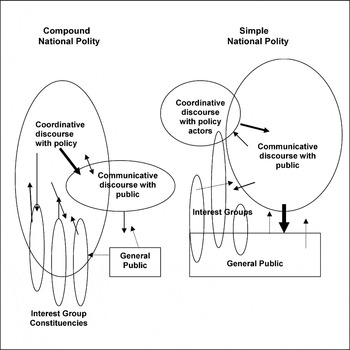
In the domain of the communicative discourse, the key interlocutors are political actors—politicians, spin doctors, campaign managers, government spokespersons, party activists—who communicate the ideas developed through coordinative discourse to the public—including the general public of citizens, the informed publics of organized private persons, and policy forums of community leaders, activists, experts, organized interests, the media—for deliberation and, ideally, modification.57Most important for our study, polities differ in their emphasis on the coordinative or communicative discourse, largely as a result of institutional context (see fig. 3). In compound polities, the dispersion of power, widespread interest consultation, and consensus-oriented politics ensure that the coordinative discourse is elaborate and the communicative discourse thin. Here, the large number of policy actors making decisions must deliberate extensively as well as come to terms with their own constituencies; while leaders are expected to communicate with the general public only in vague terms, since detailed discussion risks unraveling compromises reached in private. By contrast, in simple polities, the concentration of power, the restricted nature of interest consultation, and the polarization of politics ensures that the coordinative discourse is thin and the communicative discourse elaborate. In the absence of widespread policy coordination and in the face of certain opposition from other parties and minority interests, political actors have greater need to legitimate new ideas directly with the general public.58
Schmidt 2002a, chap. 5. Institutional context also makes for a difference in where to test for the causal influence of discourse. In simple polities, where the communicative discourse is most elaborate, causal influence is most likely to be evidenced in public responses, whether acceptance through quiescence and positive election results or rejection through protest or positive or negative election results, opinion polls, and surveys. In compound polities, where the coordinative discourse is most elaborate, causal influence is more likely to be evident in whether policy actors reach agreement or not, with empirical investigation focused on interviews with and reports of the policy actors themselves.

Discourse interactions in simple and compound national polities
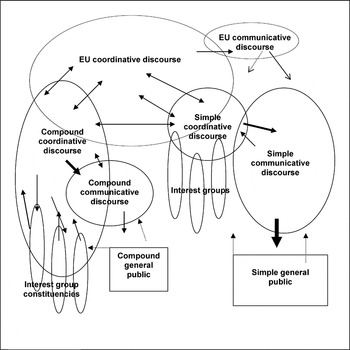
In the EU, the discursive pattern of compound polities is even more pronounced. The EU's coordinative discourse involves a wide range of policy actors at both national and EU levels. Policies are generated, for example, by the ideas of the “epistemic communities” of central bankers, economists, and financial reporters tied to EMU; by the discursive policy networks of EU, national, and regional actors; or by advocacy coalitions.59
Moreover, policies are debated in the supranational deliberative democracy or directly-deliberative polyarchy of the EU-anointed national experts, government representatives, and interests meeting in “comitology” committees; they are critiqued through the strong publics constituted by the Parliament; and they are decided in the arenas of the Council and Commission.60By contrast, the EU's communicative discourse has very few actors capable of speaking for the EU as a whole and no single public to address. This is not only for want of a common European language, media, political parties, and public opinion—let alone a European citizenry or directly elected president. It is also because the institutional design of the EU provides for no strong central voice; the Commission president is the most visible (and audible) spokesperson, but authority relies heavily on the force of his or her personality. (Constitutional reforms might have helped remedy this situation, with proposals for a new foreign minister and nonrotating president of the Council in addition to the Commission.)
All in all, while the EU benefits from the most elaborate of coordinative discourses, it suffers from the thinnest of communicative discourses, with policy ideas conveyed mostly indirectly by national political actors in national contexts.61
As such, it has had a differential impact on countries with simple and compound discursive patterns (see fig. 4).
Discourse interactions in the EU
In simple polities, national political leaders can speak clearly and in one voice to the changes in national practices and Europeanization's challenges to traditional ideas about democracy. But rather than addressing these issues, political leaders' communicative discourses have increasingly focused on purely national issues, whether public services in Blair's second term or the 35-hour work week in Lionel Jospin's prime ministership, leaving the impact of Europeanization open to exploitation by political extremists. A consequence of this has been the “no” vote in the French referendum.
Compound polities confront a different set of problems since political leaders are schooled in communicating only in vague terms on the agreements reached among the actors involved in the coordinative discourse of policy construction. Here, it is good that Europeanization has been less of a challenge to compound polities' organizing principles of democracy, since the general poverty of the communicative discourse makes for a cacophony of voices where there is no consensus. This was clearly the problem in the Dutch referendum, which was made worse by national leaders' inability to articulate any clear message in the communicative discourse—this having been the first time they had ever had a referendum on any issue, let alone on the EU.
Europeanization, in short, is problematic to its member states not so much because of the changes in national practices as because of the lack of new ideas and discourse to address those changes. For simple polities like Britain and France, the challenge is to change ideas about the polity. The strong communicative discourse exists to make that a possibility, if only leaders were willing to try. For Germany and Italy, it is good that the polity issues are not as serious, since they would have a much harder time projecting a successful communicative discourse. As it is, policy issues that challenge deep-seated values do need to be addressed—and this is where potential problems lie.
References
Berman, Sheri.
1998.
The social democratic moment: Ideas and politics in the making of
interwar Europe.
Cambridge:
Harvard University Press.
Blyth, Mark.
2002.
Great transformations: Economic ideas and institutional change in
the twentieth century.
New York:
Cambridge University Press.
Börzel, Tanja, and
Thomas Risse.
2000.
When Europe hits home: Europeanization and domestic change.
European Integration Online Papers (EIOP)
4 (15):
1–24.Google Scholar
Börzel, Tanja, and
Thomas Risse.
2002.
States and regions in the European Union: Institutional adaptation
in Germany and Spain.
Cambridge:
Cambridge University Press.
Bréchon, Pierre.
2002.
Des valeurs politiques entre pérénnité et
changement.
Futuribles
277:
92–128.Google Scholar
Burley, Anne-Marie, and
Walter Mattli.
1993.
Europe before the court: A political theory of legal
integration.
International Organization
47 (1):
41–76.Google Scholar
Bush, Evelyn, and
Pete Simi.
2001.
European farmers and their protests. In
Contentious Europeans: Protest and politics in an emerging
polity, ed.
Douglas Imig and
Sidney Tarrow,
97-124.
Lanham, Maryland:
Rowman and Littlefield.
Caporaso, James, and
Joseph Jupille.
1999.
Institutionalism and the EU: Beyond IR and comparatives
politics.
Annual Review of Political Science
2:
429–444.Google Scholar
Conant, Lisa.
2001.
Contested legal boundaries and institutional adaptations: The
Europeanization of the law in France, Germany, and the United
Kingdom. In
Transforming Europe: Europeanization and domestic change, ed.
Maria Green Cowles,
James Caporaso, and
Thomas Risse,
97–115.
Ithaca, NY:
Cornell University Press.
Conant, Lisa.
2002.
Justice contained: Law and politics in the European Union.
Ithaca:
Cornell University Press.
Cowles, Maria Green.
2001.
The transatlantic business dialogue. In
Transforming Europe, ed.
Maria Green Cowles,
James Caporaso, and
Thomas Risse,
159–79.
Ithaca:
Cornell University Press.
Cowles, Maria Green,
James Caporaso, and
Thomas Risse, eds.
2001.
Transforming Europe: Europeanization and domestic change.
Ithaca, NY:
Cornell University Press.
Duina, Francesco, and
Michael J. Oliver.
2004.
National parliaments in the European Union: Are there any benefits
to integration?
Paper presented at the American Political Science Association
National Meetings, Chicago, September 1–5.
Egan, Michelle.
2001.
Constructing a European market: Trade barriers, regulatory
strategies and corporate responses.
Oxford:
Oxford University Press.
Eising, Rainer, and
Nicolas Jabko.
2001.
Moving targets: Institutional embeddedness and domestic politics in
the liberalization of EU electricity markets.
Comparative Political Studies
34 (7):
742–67.Google Scholar
Eriksen, Erik O., and
John Erik Fossum.
2002.
Democracy through strong publics in the European Union?
Journal of Common Market Studies
40 (3):
401–24.Google Scholar
Fabbrini, Sergio, ed.
2003.
L'Europeizzazione dell'Italia: L'impatto
dell'Unione Europea sulle istituzioni e le politiche italiane.
Rome:
Laterza.
Falkner, Gerda.
1998.
EU social policy in the 1990s: Towards a corporatist policy
community.
London:
Routledge.
Gabel, Matthew.
2001.
European integration, voters, and national politics. In
Europeanised politics, ed.
Klaus Goetz and
Simon Hix,
52–73.
London:
Frank Cass.
Geddes, Andrew, and
Virginie Guiraudon.
2004.
Britain, France, and EU anti-discrimination policy: The emergence of
a EU paradigm.
West European Politics
27 (2):
334–53.Google Scholar
Gerstenberg, O., and
C. Sable.
2000.
Directly-deliberative polyarchy: An institutional ideal for
Europe?
www2.law.columbia.edu/sabel/papers/gerst-sabel1029.doc
Greenwood, Justin.
2003.
Interest representation in the European Union.
Basingstoke:
Palgrave/Macmillan.
Greven, Michael T.
2000.
Can the European Union finally become a democracy? In
Democracy beyond the state? The European dilemma and the emerging
global order, ed.
Michael T. Greven and
Louis W. Pauly,
35–62.
Lanham:
Rowman and Littlefield.
Grimm, Dieter.
1995.
Does Europe need a constitution?
European Law Journal
1 (3):
282–302.Google Scholar
Haas, Peter M.
1992.
Introduction: Epistemic communities and international policy
coordination.
International Organization
46 (1):
1–35.Google Scholar
Habermas, Jürgen.
1989.
The structural transformation of the public sphere.
Tr. T. Burger and F. Lawrence. Cambridge:
MIT Press.
Habermas, Jürgen.
1996.
Between facts and norms: Contributions to a discourse theory.
London:
Polity Press.
Hértier, Adrienne.
2000.
Differential Europe: National administrative responses to community
policy. In
Europeanization and domestic change, eds.
Maria Green Cowles,
James Caporaso, and
Thomas Tisse.
Ithaca:
Cornell University Press.
Hooghe, Liesbeth, ed.
1996.
Cohesion policy, the European Community and subnational
government.
Oxford:
Oxford University Press.
Hooghe, Liesbet, and
Gary Marks.
2001.
Multi-level governance and European integration.
Lanham, Maryland:
Rowman and Littlefield.
Imig, Douglas, and
Simon Tarrow, eds.
2001a.
Contentious Europeans.
Lanham, MD:
Rowman and Littlefield.
Imig, Douglas, and
Simon Tarrow
2001b.
Political contention in a Europeanising polity. In
Europeanised politics, ed.
Klaus Goetz and
Simon Hix,
73–93.
London:
Frank Cass.
Jeffery, Charlie.
1999.
Recasting German federalism.
London:
Pinter.
Jobert, Bruno.
2001.
Europe and the reshaping of national forums: The French case.
Paper prepared for presentation at the conference Ideas,
Discourse and European Integration, European Union Center, Harvard
University, May 11–12.
Joerges, Christian.
1999.
Good governance through comitology? In
EU committees: Social regulation, law, and politics, ed.
Christian Joerges and
Ellen Vos,
311–38.
Oxford:
Hart Publishing.
Keating, Michael, and
Brian Jones.
1995.
The European Union and the regions.
Oxford:
Oxford University Press.
Klingemann, Hans-Dieter.
1999.
Mapping political support in the 1990s. In
Critical citizens, ed.
P. Norris.
Oxford:
Oxford University Press.
Kohler-Koch, Beate.
2002.
European networks and ideas: Changing national policies?
European Integration Online Papers
6 (6).Google Scholar
Kohler-Koch, Beate, and
Rainer Eising, eds.
1999.
The transformation of governance in the European Union.
London:
Routledge.
Ladrech, Robert.
1994.
The Europeanization of domestic politics: The case of France.
Journal of Common Market Studies
32 (1):
69–88.Google Scholar
Lijphart, Arend.
1984.
Democracies: Patterns of majoritarian and consensus government in
twenty-one countries.
New Haven:
Yale University Press.
Loughlin, John,
Eliseo Aja,
Udo Bullmann,
Frank Hendriks, and
Anders Lidstrom.
2001.
Subnational democracy in the European Union: Challenges and
opportunities.
Oxford:
Oxford University Press.
Mair, Peter.
2001.
The limited impact of Europe on national party systems. In
Europeanised politics, ed.
Klaus Goetz and
Simon Hix,
27–51.
London:
Frank Cass.
Majone, Giandomenico.
1998.
Europe's democratic deficit.
European Law Journal
4 (1):
5–28.Google Scholar
Majone, Giandomenico, ed.
1996.
Regulating Europe.
London and New York:
Routledge.
Marks, Gary,
Liesbeth Hooghe, and
Kermit Blank.
1996.
European integration since the 1980s: State-centric versus
multi-level governance.
Journal of Common Market Studies
34 (3):
341–78.Google Scholar
Moravcsik, A.
2002.
Reassessing legitimacy in the European Union.
Journal of Common Market Studies
40 (4):
603–24.Google Scholar
Nicolaides, Kalypso.
2001.
Conclusion: The federal vision beyond the nation-state. In
The federal vision, ed.
Kalypso Nicolaides and
Robert Howse,
439–82.
Oxford:
Oxford University Press.
Norton, Philip.
1996a.
The United Kingdom: Political conflict, parliamentary
scrutiny. In
National parliaments and the European Union, ed.
Philip Norton.
London:
Frank Cass.
Norton, Philip, ed.
1996b.
National parliaments and the European Union.
London:
Frank Cass.
Olsen, Johan.
2002.
The many faces of Europeanization.
ARENA Working Papers WP 02/2.
http://www.arena.uio.no/publications/wp02_2.htm.
Pharr, Susan J., and
Robert D. Putnam, eds.
2000.
Disaffected democracies.
Princeton:
Princeton University Press.
Radaelli, Claudio M.
2003.
The Europeanisation of public policy. In
The politics of Europeanisation, ed.
Kevin Featherstone and
Claudio M. Radaelli,
27–56.
Oxford:
Oxford University Press.
Radaelli, Claudio M., and
Vivien A. Schmidt.
2004.
Mapping the scope of discourse, learning, and Europeanisation in
policy change.
West European Politics
27 (2):
183–210.Google Scholar
Rein, M., and
D.A. Schön.
1994.
Frame reflection: Toward the resolution of intractable policy
controversies.
New York:
BasicBooks.
Reynié, Dominique, and
Bruno Cautrès.
2001.
L'opinion européenne.
Paris:
Presses de Sciences Po.
Risse, Thomas.
1998.
“Let's argue!” Communicative action in world
politics.
International Organization
54 (1):
1–39.Google Scholar
Rizzuto, Franco.
1996.
The French parliament and the EU: Loosening the constitutional
straitjacket. In
National parliaments and the European Union, ed.
Philip Norton.
London: Frank Cass.
Saalfeld, Thomas.
1996.
The German houses of parliament and European legislation.
In
National parliaments and the European Union, ed.
Philip Norton.
London:
Frank Cass.
Sabatier, Paul A.
1998.
The advocacy coalition framework: Revisions and relevance for
Europe.
Journal of European Public Policy
5 (1):
98–130.Google Scholar
Sbragia, Alberta.
1993.
The European community: A balancing act.
Publius
23 (3):
23–38.Google Scholar
Scharpf, Fritz W.
1988.
The joint decision trap: Lessons from German federalism and European
integration.
Public Administration
66 (3):
239–78.Google Scholar
Scharpf, Fritz W.
2000a.
Economic changes, vulnerabilities, and institutional
capabilities. In
Welfare and work in the open economy. Vol. 1, From vulnerability to
competitiveness, ed.
Fritz Scharpf,
Vivien A. Schmidt
21-124.
Oxford:
Oxford University Press.
Scharpf, Fritz W.
2000b.
Governing in Europe.
Oxford:
Oxford University Press.
Scharpf, Fritz W.
2002a.
Concepualizing democratic accountability beyond the state: The
European Union.
Unpublished manuscript. (June).
Schimmelfennig, Frank.
2001.
The community trap: Liberal norms, rhetorical action, and the
eastern enlargement of the European Union.
International Organization
55 (1):
47–80.Google Scholar
Schmidt, Vivien A.
1990.
Democratizing France: The political and administrative history of
decentralization.
Cambridge:
Cambridge University Press.
Schmidt, Vivien A.
1996.
From state to market? The transformation of French business and
government.
New York and London:
Cambridge University Press.
Schmidt, Vivien A.
1999a.
European “federalism” and its encroachments on national
institutions.
Publius
29 (1):
19–44.Google Scholar
Schmidt, Vivien A.
1999b.
National patterns of governance under siege: The impact of European
integration. In
The transformation of governance in the European Union, ed.
Beate Kohler-Koch and
Rainer Eising,
155-172.
London:
Routledge.
Schmidt, Vivien A.
2001.
Federalism and state governance in the EU and the US: An
institutional perspective. In
The federal vision: Legitimacy and levels of goverance in the U.S.
and the European Union, ed.
K. Nicholaides and
R. Howse.
Oxford:
Oxford University Press.
Schmidt, Vivien A.
2002a.
The futures of European capitalism.
Oxford:
Oxford University Press.
Schmidt, Vivien A.
2002b.
Does discourse matter in the politics of welfare state
adjustment?
Comparative Political Studies
35 (2):
168–93.Google Scholar
Schmidt, Vivien A.
2004.
The European Union: Democratic legitimacy in a regional
state?
Journal of Common Market Studies
42 (4):
975–98.Google Scholar
Schmidt, Vivien A., and
Claudio Radaelli.
2004.
Conceptual and methodological issues in policy change in Europe.
Introduction to Symposium issue of
West European Politics
27 (4):
1–28.Google Scholar
Stone, Alec.
1992.
The birth of judicial politics: The constitutional council in
comparative perspective.
New York:
Oxford University Press.
Stone Sweet, Alec.
2000.
Governing with judges: Constitutional politics in Europe.
Oxford:
Oxford University Press.
Van der Eijk, Cees, and
Mark N. Franklin.
1996.
Choosing Europe? The European electorate and national polities in
the face of union.
Ann Arbor, MI:
University of Michigan Press.
Verdun, Amy.
2000.
European responses to globalization and financial market
integration: Perceptions of European Monetary Union in Britain, France,
and Germany.
Basingstoke:
Macmillan.
Weiler, J. H. H.
1994.
A quiet revolution: The European Court of Justice and its
interlocutors.
Comparative Political Studies
26 (4):
510–34.Google Scholar
Weiler, J. H. H.
1995.
The state “über alles”: Demos, telos and the German
Maastricht decision.
Jean Monnet Working Paper Series 6/95.
Cambridge:
Harvard Law School.
Weiler, J. H. H.
1999.
The constitution of Europe: “Do the new clothes have an
emperor?” and other essays on European integration.
Cambridge:
Cambridge University Press.
Institutional comparisons between the U.S. and EU

Countries on a continuum from simple to compound polities
Governance in simple and compound polities
Different challenges depending upon polity type
Problems of democracy in a range of governance areas
National responses to EU-related changes in governance practices
Discourse interactions in simple and compound national polities
Discourse interactions in the EU
 You have
Access
- 40
- Cited by