INTRODUCTION
This contribution is a personal reflection on 40 years of radiocarbon dating and archaeology. I became a member of the 14C community in 1976. This was 5 years before the first “14C and Archaeology Symposium” held in Groningen in August 1981, organized by Wim Mook from the 14C laboratory of Groningen University and archaeologist Harm Tjalling Waterbolk. The aim of that meeting was to bring together archaeologists and physicists in order to, and I quote, “discuss the mutual problems in radiocarbon dating of prehistoric remains” (Waterbolk Reference Waterbolk1983). It is significant here that Mook and Waterbolk limit the subject of research to “prehistoric remains.” Indeed, at that time it was still uncommon to use 14C dating for historical periods, although exceptions existed already. The organization of this symposium was considered necessary because, as the above-cited authors stated, “the scope of these (regular 14C conferences) has become so wide, that no longer sufficient attention can be paid to prehistoric dating.” This was very true. Although there has always been an intricate link between archaeology and 14C dating, illustrated by the fact that the first graph published by Arnold and Libby in 1949 already contained archaeological samples from Egypt (Arnold and Libby Reference Arnold and Libby1949), the field of 14C dating had grown enormously since the 1950s and, as we all know, still continues to grow. When I joined the 14C community in 1976 the “second radiocarbon revolution” had just begun. While the first revolution was the invention of the method, the second was the start of the calibration of the 14C dates. Soon after, the third 14C revolution would start, that of accelerator mass spectrometry (AMS), although the word “evolution” is better suited here. Indeed, for different reasons it took quite a while for AMS to become the dating instrument of choice.
Not only did the 14C technique change a lot, the philosophy behind the method evolved enormously as well. While in the old days the main task of 14C dating was to date an artifact, nowadays the method is increasingly used to define cultural periods, settlement phases, etc. How this will evolve in the near future is difficult to predict. Much will depend on how the relationship between 14C dating and archaeology will develop. But before I discuss this, let’s first have a look at the technical evolution that took place.
ABOUT COUNTERS AND OTHER TECHNICAL STUFF
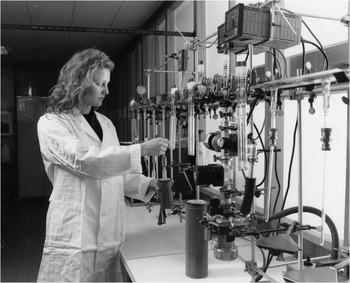
Let me start with counters and other types of machinery. Looking back, the technical evolution in 14C dating is overwhelming. I started in a so-called service laboratory at the Antwerp State University (Figure 1) and 18 months later at the Royal Institute for Cultural Heritage in Brussels (Figure 2) without any computers or automated apparatuses. β-decay was measured in proportional gas counters (GC) or liquid scintillation counters (LSC). We used a slide rule and a book with logarithmic tables to calculate our results. If we were lucky we could use an electric calculator. This kind of situation is hardly imaginable today. A modern 14C lab is dominated by computers that operate the air conditioning, the graphitization line, the AMS machine, and manage the database, the invoices, the security system and even the door lock. When I started in 14C, the change from “homemade counters,” most of them proportional gas counters, to commercially available machines like the Packard liquid scintillation counter was taking place. This was an important step forwards because now also research groups that were not part of a nuclear physics or isotope group could start a 14C laboratory.
Benzene preparation line. Antwerp State University (RUCA) 1976 (© Mark Van Strydonck)

Proportional gas counter at the Royal Institute for Cultural Heritage (KIK-IRPA) made by the Belgian company M.B.L.E. (Manufacture belge de Lampes et d’Électronique) – before 1978 (© KIKIRPA).

If one takes a look at the date lists in the 1976 volume of Radiocarbon (volume 18, 1976) and considers this as a random sample for that decade, it is clear that measurements, at least by our modern standards, were not very precise. Standard deviations for measurements in the late Neolithic–Early Bronze Age period could vary from >100 to about 45 14C yr. Today, these large standard deviations would be unacceptable. But as I will discuss later, in the beginning standard deviations were not the prime issue for the archaeologists.
Although the counters did not undergo spectacular changes since the invention of the proportional gas counter and the introduction of liquid scintillation, the electronics used to operate the machine evolved rapidly from the 1960s onwards. In 1983, the first personal computer arrived in the lab and was connected to our counters. It was an Apple IIe, a small computer with two disc drives (640kb each), one for the program and the other for data storage. Although the possibilities of this old machine were very limited, a whole new world opened up to us. It became not only possible to automate data management and calculations, but other devices could be linked to the counter so that corrections could be implemented much easier than before. The background signal of the large gas counters, for instance, was susceptible to changes in barometric pressure. As our laboratory mainly worked for the archaeological community, which by the time I started became interested in high-precision dates, we absolutely needed to apply these corrections. This quest for increased precision would continue for quite some time, but for the archaeologists another, enormous problem remained unsolved: sample size. For bone samples, it was not uncommon to use 300 g of bone to extract the amount of collagen required for just one measurement! For archaeologists this was often problematic, while art historians and museum curators by principle could not allow such large samples to be taken from their art works. One can easily imagine the devastating result of taking only 1 or 2 g of an ivory statue or an ax made of antler. So, when in the late 1970s to early 1980s the first AMS measurements were carried out, expectations ran high (Taylor Reference Taylor1991). For the first time, highly precious objects could be dated without significant damage. In our laboratory, this resulted in a growing demand for textile analysis. However, in the beginning, restraints against the new method remained. Not many facilities offered the expensive AMS dating and the results were a priori not better (or worse) than those produced by β-counting labs. Furthermore, most AMS facilities were used for measuring different cosmogenic nuclei, resulting in frustrated archaeologists who had to wait a long time before their samples could be measured. The evolution could however not be stopped. The field of AMS developed enormously and in the context of “14C & Archaeology,” the introduction of small exclusively 14C-dedicated machines was an enormous step forwards. The continuing effort to make smaller and cheaper AMS machines and the availability of automatic preparation lines will most probably change the concept of the 14C dating facility, as I will discuss later.
At the same time, in combination with the AMS technique, the evolution of modern chemistry had a huge impact on sample pretreatment. Terms like nano-filtration, ultra-filtration, compound-specific dating, and single-entity dating became part of the 14C jargon. On the other hand, it is remarkable that the chemistry to make benzene for the LS counters and the chemistry for making AMS graphite basically still are the same as 30 yr ago (Figure 3).
First preparation line for AMS targets at the Royal Institute for Cultural Heritage (KIK-IRPA) (1989, © KIK-IRPA)

The Radiocarbon 1976 date list also reveals that, at that time, a large number of laboratories did not yet use the δ13C correction but still calculated the supposed calendar age by subtracting 1950 from the 14C date. This, however, would change rapidly as well. When I started in the lab, a large MASCA curve hung against the wall. With that enormous poster, we manually calibrated our results. But by the time the second 14C & Archaeology meeting was held in Groningen, in 1987, different computerized calibration programs were already in use and a verification of the quality of the different programs became necessary. Furthermore, there was a discussion on how the calibrated dates should be reported: ad/bc versus AD/BC, bp versus BP, cal BC/AD, or cal BP. In those days, there was no general consensus about this and the editor of Antiquity was more than unhappy with this situation, as he made clear at the 14C & Archaeology symposium (Chippindale Reference Chippindale1990).
In a way, this necessity to calibrate gave rise to all kinds of new domains for research such as the study of the reservoir effects in marine and freshwater reservoirs and the impact of the diet on the 14C content of human bones, teeth, and soft tissue (mummies). That calibration became much more than a correction for the conventional date can be seen from the evolution of the calibration programs, as I will discuss further later on. When looking at this evolution, it is remarkable to note how a relatively old analytical method like 14C dating constantly adapts and rejuvenates itself with every new discovery.
The main issue in the context of this symposium, however, is not the technical evolution, but the relationship between 14C dating and archaeology. Is it a passionate relationship or rather a marriage of convenience? Allow me to start with an anecdote. When I was a young scientist with a degree in chemistry working in a 14C lab, an archaeologist came to me and said that the sample he had submitted for dating must be from the Hallstatt B1 (Ha B1) period. I absolutely did not understand what he was talking about and, being a novice in the business, I did not want to lose face. So I promptly replied that “the date of his sample within the two sigma range was between…,” and he did not have a clue what I was talking about! In fact, we were both speaking another language although all the words we used came from the same dictionary. This illustrates that the relationship between 14C dating and archaeology is not straightforward. So let’s have a look at this relationship from the perspective of both fields.
RADIOCARBON AND ARCHAEOLOGY
According to a list published in 2016 on the website of Radiocarbon (http://www.radiocarbon.org/), about 90% of the 14C laboratories are part of a university department, either in the field of isotope studies, geochronology, or physics. Only about 10% of all 14C laboratories can be situated in what I would like to call an archaeological or cultural environment. From those 10%, some are connected to a museum while others are linked to a university or research center. This has enormous implications on the functioning of these labs. Research is, besides teaching, the main reason of existence for universities. University departments will thus focus on the development of their research field. The success of a university department will be measured by the number of PhD students, the publication of high-quality papers, citation indexes, etc. Routine analyses for archaeologists do not give any credits to a 14C laboratory that is part of an isotope, geochronology, or nuclear physics department. In the 1990s, in Belgium, a laboratory was even closed altogether, after the retirement of the main operator of the lab because archaeology did not fit in the concept of a nuclear physics department. The construction of the laboratory and the counter in the 1960s was a scientifically interesting topic, but the production of dates for archaeologists was not. For most laboratories, routine dating for archaeologists is thus not their core business.
Still, in spite of the fact that universities are research oriented, by consulting their websites it becomes clear that most laboratories, but not all, want or need the extra money routine analyses provide. One must, however, realize that the concept of research and development is somehow in contradiction with the functioning of a service laboratory. The latter needs secure, reliable, well-developed, and tested procedures. Experimental procedures must be avoided in all cases. But the fact that most laboratories are service as well as research labs leads to conflict and chaos, as is very clear in the case of bone pretreatment. Almost every laboratory has carried out, at a certain moment of its existence, research on developing collagen extraction methods from bones. Most of them state that the method they have developed is based on the work of Longin from 1971 (Longin Reference Longin1971), but I am pretty sure that most of them have never read Longin’s original work. The result is that every laboratory has developed a method that is slightly or fundamentally different from the method developed in another laboratory. There is no standard procedure, or better, not even a set of standard procedures that one can use depending on the age or state of preservation of the bone. This situation is very uncommon in the world of both analytical chemistry and biochemistry. I already mentioned this at the workshop on the Isle of Arran in 2004, but nothing has changed since then. Perhaps the situation would have been different if a more formal International Association of Radiocarbon Laboratories would exist. Such an association was proposed in the 1980s, but most laboratories were reticent towards a formal association. During the business meeting held at the end of the Radiocarbon conference in Dubrovnik, it was formulated as follows: “A suggestion was discussed to unite radiocarbon laboratories into some kind of association. The majority of the participants did not feel the need for such an organization and showed restraints towards formal bodies” (Mook Reference Mook1989).
Due to the fact that citation indexes gain in importance, we also see that researchers want to promote new ideas like for instance single-entity dating, just to name one, at any cost and without restraints. Single-entity dating is a powerful tool, no question about that. From my personal experience, I recollect very well the situation at a Belgian site called Verrebroek (Van Strydonck et al. Reference Van Strydonck, Crombé and Maes2001) where surface hearths with charcoal and charred hazelnut shells had been found. It turned out that there was a gap of several centuries between the deposition of the hazelnuts and the charcoal and that the hazelnut samples themselves even came from different periods! On another occasion, I was asked to date a sample of six charred cereal grains from a gigantic Bronze Age tower in Menorca. It was the only deposit of grain within one particular section of this huge building (Anglada et al. Reference Anglada, Ferrer, Plantalamor, Ramis, Van Strydonck and De Mulder2014). Is single-entity dating necessary in this case? Does it really matter? If we do not believe the archaeologists’ opinion that these six grains come from one and the same deposition, we should not have dated them at all, because in that case each single grain could be in situ, residual, or intrusive. Nobody would know which one to date and which result to believe. From all of this, we can conclude that most 14C laboratories are stuck somewhere in the middle between research and service, which causes them some friction.
But one has to be honest and admit that it is archaeology that pushes 14C labs to perform better and constantly renew their methods. Most geochronological dating projects and tracer work do not require high precision and in many cases the dates are simply put into a model that carries out the calculations. Archaeology, however, is much more demanding. For example, imagine yourself standing in front of a lead sarcophagus. When the curator of the crypt opens the lead cover of the tomb, your mind starts to race. Where should I start? First of all, an anthropologist has to verify whether the sarcophagus contains one or more persons. Where should I take the sample? In most cases, the collagen in the femur is better preserved than that in the ribs. But the carbon residence time in the ribs is shorter than in the femur so it will give an age closer to death. Perhaps, if I know his age of death, I can try to correct for the residence time of the carbon in the bone? On the other hand, it might be better to date a tooth. The carbon there has been sealed off after it was formed. What about the person’s diet? Did he or she consume a lot of fish? If so, was it marine or river fish? Stable isotopes will help, but a shift in 13C can also be caused by the consumption of C4 instead of C3 plants and a high 15N value can be caused by urea recycling due to the fact that this person lived in a very arid environment. What method shall I use to extract the collagen? Since there is no internationally accepted procedure I’ll have to choose myself. I’ll first remove the surface to avoid pollution. Has the skeleton, during previous openings of the sarcophagus, been treated with consolidation products? If so, how can they be removed? Is the Longin method sufficient or should I add a sodium hydroxide treatment to remove humic acids? If the bones are rather degraded, a more complex pretreatment like ultrafiltration may be needed. I’d better do some tests before I start the extraction. With the help of some parameters like the carbon nitrogen ratio I will decide what to do. I must keep in mind that we are also processing some mammoth bones and that cross-contamination must be avoided. The AMS machine must really be perfectly tuned because the sarcophagus contains an inscription with a name, and, although we can never be certain that it really is the person in question that we are dating, we want to know whether the skeleton is not from a later interment. When finally the curator has opened the lead cover, he emphasizes that the skeleton is of great importance to the local community because it is supposed to be the remains of the founder of the local monastery. I should therefore avoid damaging the skeleton and must take a sample as small as possible. All these dilemmas, thoughts, and considerations just for one routine sample…Dating is a complex matter! I’m convinced that, from the point of view of 14C dating, the relationship with archaeology is passionate, but nevertheless complex like it has always been (Marlowe Reference Marlowe1980).
ARCHAEOLOGY AND RADIOCARBON
Now, what about the relationship from the point of view of archaeology? In his foreword to the proceedings of the first 14C and Archaeology conference in 1983, Waterbolk wrote: “These early experiences were decisive and in this country [The Netherlands] we never have had such strange doubts as were so common among archaeologists in other European countries. Up to only a few years ago it could happen that some German archaeologist would ask me whether I still believed in radiocarbon” (Waterbolk Reference Waterbolk1983).
Although it was not fair to denounce any group of archaeologists in particular, Waterbolk was absolutely right that a lot of archaeologists did not embrace 14C in the early years of the method. There were different reasons for this. As you all know, archaeologists all over the world had put forward chronologies for many cultures without the use of absolute dating techniques and thought it was a job well done. If we look back at what they achieved without absolute dating methods, it was indeed impressive. We know now that it was far from perfect, but to be honest, I still admire their achievements. So they found themselves in a very comfortable and secure situation and resented a new method, which they did not understand at all. The fact that most archaeologists had no clue what 14C dating was all about did not help the integration of this new technique in their research field. Even those who wanted to give it a try got lost when they had to interpret the results. Here is a short example to illustrate this: in 1958 the French Jesuit Pierre du Bourguet sacrificed almost four entire pieces of his Coptic textile collection to test the 14C dating method. He wanted to make this sacrifice because he thought the new technique was worthwhile testing. He nevertheless rejected the results because the dates did not agree with his personal belief (Van Strydonck and Bénazeth Reference Van Strydonck and Bénazeth2014). He was however less upset by the fact—and this is important—that the dates were given with a standard deviation of ±120 yr. This means that with 95% probability the dates could be anywhere within a timespan of almost 5 centuries!
For quite some time, it was common practice to put 14C dates in an annex to the archaeological paper and it was not uncommon that the chronology proposed in the paper was in contradiction with the chronology one could deduce from the 14C dates. Fortunately, a lot of this has changed, but surprisingly not all. Due to the subdivision between α and β sciences that starts already in secondary school, it is still possible in most countries to obtain a Master’s degree in archaeology without any knowledge about chemistry or physics. So there are still archaeologists that have no clue about natural sciences. For them, even today, it remains very difficult to understand what 14C is about, even without going into technical details or complex equations. I can illustrate this with a quote, of which I unfortunately cannot reveal the source. Last year—in 2015!—a commission member who had to evaluate archaeologists’ grant proposals wrote the following about 14C dating in his comment on a submission: “It is a blind method practiced by physicists that gives rather imprecise dates and, hence, is not useful.”
The resistance against 14C was even considerably stronger among archaeologists studying historical periods and art historians, compared to prehistorians. In his speech from 1981, even Waterbolk only talks about “prehistoric dating,” which shows that he also was reticent about the use of 14C for historical periods. Nevertheless, we can see that already in the proceedings of this first 14C & Archaeology symposium papers on Medieval Europe were published.
A lot has changed since then. We can now hardly imagine a paper dealing with chronology that does not contain or makes reference to 14C dates. The dates have become part of the study and have evolved, in many cases, from the dating of an artifact to a tool that helps to define cultural periods, settlement phases, or even construction phases of a single large construction like a fortress or palace. This can be demonstrated very well by looking at the evolution of the calibration programs. While in the beginning they were just used to calibrate a date, nowadays they permit the construction of chronological models of settlements by allowing the introduction of “phases,” “sequences,” “boundaries,” “terminus dates,” etc. So taking this evolution into account, it is legitimate to conclude that in spite of some rear-guard actions 14C dating is well accepted in the archaeological community.
In their relationship with 14C dating, there are two types of archaeologists. The monogamous ones who pick out a laboratory and stay with it for a very long time, and the promiscuous ones. This last group goes on the internet to find a dating partner. One can imagine that those archaeologists are very precautious with these casual contacts. Well, this is definitely not the case. In our lab, we often get emails from archaeologists who want us to do some analysis for them. In their demand for quotation, they only ask about the price and “how long” it will take. Nobody has ever asked me about the quality of our work, how we treat the samples, if we have a quality assessment program, etc. They just seem not to be interested. I’m often tempted to ask a ridiculously low price and then say that I use the “crystal ball” method. However, in a way I can understand these archaeologists. Most of them work in rescue archaeology, have a very low budget, and must perform their job while the bulldozer is in a hurry to clear the area. But on the other hand, it invites laboratories to go for easy money and low quality. Perhaps it would not be a bad idea for the 14C community to put together a questionnaire archaeologists can use in their negotiation with the laboratories. It should contain a set of parameters that are important for a good analysis. The archaeologists can make up their own ranking of these parameters and set their priorities. Some will find that high precision is very important, while others will ask for compound-specific analysis. Others need to go for the fastest and the cheapest, while still others will ask for assistance in the interpretation of the results. To call for help in the evaluation of the results is often an underrated issue. On several occasions, archaeologists came to me for help because they received results from another laboratory and did not understand the result or were unaware of the procedures that were used in the pretreatment of their samples. A questionnaire could help in avoiding this kind of situations, but would also help the laboratories to propose the best price-quality ratio for their analysis. These calls for help also reveal the fact that the relationship between the lab and the archaeologist should be more than just a client-supplier relationship, which unfortunately is often the case. Archaeologists and laboratories should be partners in research. This is not a new idea at all. During the third 14C and Archaeology symposium in Lyon, Waterbolk even called it “The Golden Alliance” (Waterbolk Reference Waterbolk1999). And that is really what it should be. At the same symposium the so-called groupe de travail formulated this in a more prosaic way:
Successful application of 14C dating requires detailed consideration of the many complex requirements which must be met to satisfy the assumptions underlying the method. While some of these requirements are the sole responsibility of the 14C laboratory, most are not, and they must be carefully evaluated by the archaeological user if reliable chronological information is to be obtained. In particular, the archaeologist must carefully specify the chronological questions of interest, and must then carefully identify, choose and evaluate samples which can be expected to provide reliable answers to those questions. This is not a task which can simply be delegated to the “scientific experts” at the measurement laboratory, but it is also the responsibility of the user. We hope that the approach outlined here will aid users by providing a framework for these complex evaluations (Van Strydonck et al. Reference Van Strydonck, Nelson, Crombé, Bronk Ramsey, Scott, van der Plicht and Hedges1999).
This was in 1999 and is still valid today.
THE FUTURE…
How the relationship between 14C dating and archaeology will evolve in the future is difficult to predict; my crystal ball does not give me this information. But there is something strange in the way 14C dating works. Let me explain this. In our institute in Brussels, we have archaeologists, art historians, restorers, chemists, and physicists all studying cultural heritage. All the analyses we need for our research are carried out in the institute, except those that we only do occasionally or the ones that must be done on very exclusive machines. In other words, a research group that wants to perform a certain type of analysis buys a machine and performs the analysis in-house. This is not the case with 14C: people call upon an external laboratory to perform the analysis for them. It holds true for small archaeological units as well as for the large and important ones. In general, this is a slow, inefficient, and difficult to control procedure. This situation was quite normal as long as 14C was an experimental method and when very large, complicated, and expensive machinery was required. But recently we have seen the introduction of smaller, cheaper, and easier to handle AMS machines; an evolution that has not come to an end yet. At the same time, fully automatic graphitization lines came on the market. This evolution may change the concept of the 14C lab in the future. An increasing number of large archaeological institutes will possibly be in the position that their archaeometry unit will be able to establish an own 14C laboratory. It is thus not impossible that the amount of laboratories belonging to an “archaeological” or “cultural” environment will increase at the expense of the old-style 14C laboratories.
… AND THE PAST
But, of course, all this is guesswork and I can only talk about the past. For me, this past was very exciting. During 40 years, I have been privileged to play with all kinds of expensive toys like GC, LSC, and AMS machines, found myself hanging on a rope attached around a stalactite to descend into a cave to sample a prehistoric hearth, or climbing a shaky staircase to take a mortar sample from the wall of a Romanesque church. It was really an all-round job, from the lab to the cave, from the cave to the campanile, or even from the almost sterile museum environment where precious textiles were kept, to the swampy coastal plains to look for salt-winning sites. It was fun. Finally, I want to say that I enjoyed working with archaeologists, anthropologists, anthracologists, physicists, chemists, or whatever you call all those people with a passion for archaeology.