Natural forests are composed of a heterogeneous mixture of plant architectures that change temporally and spatially. In addition, variation in ridges, tree falls, natural clearing, logs and animal or man-made paths results in a topographic complexity which is likely to have a profound effect on the movements of animals within the forest.
Bat activity for all species pooled is generally lower in thick, cluttered vegetation compared with more open forest (Brown et al. Reference BROWN, NELSON and CHERRY1997, Estrada & Coates-Estrada Reference ESTRADA and COATES-ESTRADA2001, Humes et al. Reference HUMES, HAYES and COLLOPY1999, Law & Chidel Reference LAW and CHIDEL2001, Kalko et al. Reference KALKO, HANDLEY, HANDLEY, Cody and Smallwood1996). Medellín et al. (Reference MEDELLÍN, EQUIHUA and AMIN2000) showed that index values of bat species richness, number of rare bat species and bat diversity (Phyllostomidae in Nicaragua) were positively correlated with vegetation diversity. Flying bats must contend with physical clutter (i.e. vegetation; Brigham et al. Reference BRIGHAM, GRINDAL, FIRMAN and MORISSETTE1997, Fenton Reference FENTON1990, Schnitzler & Kalko Reference SCHNITZLER and KALKO2001) that reduces flight efficiency (Jones & Rayner Reference JONES and RAYNER1991). Moreover, bats that forage very close to, or within, vegetation have to deal with the interference of target echoes with clutter echoes (Mackey & Barclay Reference MACKEY and BARCLAY1989, Schnitzler & Kalko Reference SCHNITZLER and KALKO2001) and further reduction of foraging efficiency may be introduced.
One way for animals, including bats, to overcome these physical constraints is to use networks of trails while moving within the forest (Bernard & Fenton Reference BERNARD and FENTON2003, Crome & Richards Reference CROME and RICHARDS1988, Grindal & Brigham Reference GRINDAL and BRIGHAM1999, Law & Chidel Reference LAW and CHIDEL2002, Menzel et al. Reference MENZEL, CARTER, MENZEL, FORD and CHAPMAN2002). Bats use these networks for a variety of reasons, such as economising on energy (fast flight is possible and requires less manoeuvrability) and safety (easy to navigate, less chance of injury). A study conducted in Australia suggested that low bat activity off flight tracks was related to vegetation clutter and showed how bat activity decreased significantly with increasing clutter formed by the layer of regrowth of the rain-forest understorey (Law & Chidel Reference LAW and CHIDEL2002). These studies further suggest that vegetation cover affects the movements of bats and that these effects can be related to body size, wing morphology and echolocation behaviour.
In the present study, we ask how vegetation density affects path (trail) use by ground-level phyllostomid bats in a secondary forest at El Paraiso Valley, Honduras. We have manipulated these passages with mist nets to test the hypothesis that abundance and flight behaviour of bats within the paths are related to vegetation density. We tested the following predictions: (1) Flight behaviour of bats within the manipulated path will be affected by vegetation densities that surround the path. We categorised flight behaviour by bat catches in different sides of the experimental nets (internal parallel nets, external parallel nets and perpendicular nets). (2) We further predicted a relationship between path use and body size of bats. Larger bats are more likely to use the centre of a path than its edges, and therefore will be caught in cross-path nets (perpendicular nets). Conversely, small bats are more likely to be caught in the parallel nets as they try to avoid the perpendicular net.
The study took place during July and August 2005 in El Paraiso valley (UTM 16P38166 173399), Honduras. The valley is privately owned and since the fall of cocoa exports 25 y ago, abandoned plantations allowed natural re-colonisation, developing into dense secondary forest. Surrounded by cleared and cultivated plantations, and with 40° slopes (reaching 500–1000 m), it is now an isolated and densely forested massif with only a handful of penetrating paths.
Netting sites were selected according to vegetation density around them. We developed a set of subjective vegetation density classes with three categories to classify vegetation cover: 1 = Few trees – presence of obstacles such as leaves, and more than a single branch interrupted by small gaps; flight suffers some interference. 2 = Dense – leaves and branches, but not impenetrable; presumably, only a bat that is highly manoeuvrable and flies slowly, could get through. 3 = Very dense – thick undergrowth; practically impossible for bats to fly through.
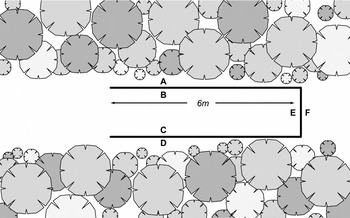
In order to catch bats that use the paths for movement within the forest, we used the following set up: We used two nets, each measuring 6 m, which were set parallel to the path edges, as near as possible to the vegetation. At only one end a perpendicular net was set closing the path, and thereby creating an open-ended rectangle. Net sides were marked with letters, A and D were external sides of the two parallel nets, and B and C were the internal sides of the same nets. E represented the internal perpendicular net, and F delineated the external side (Figure 1). At each site, net sampling was conducted twice, on different nights, with the rectangle opening in opposite directions to account for bat traffic in both directions. The behaviour of the bats was categorized by bat catches in different sides of the experimental nets. Nets were opened 30 min before absolute darkness (typically at about 18h00), and were kept open for 6 h. Replicate netting of the same site maintained a 14-day gap to avoid training bats to the presence of the nets. Captured bats were identified according to Reid (Reference REID1997), sexed, aged and assessed for reproductive status. We measured body mass (± 0.1 g) with Pesola scales, and length of forearm and tibia with a dial calliper (± 0.1 mm). Bats were ‘marked’ during DNA wing-punch biopsy and recaptures were easy to identify.
Schematic drawing of the experimental nets, placed along paths within the forest of El Paraiso valley, Honduras. Different sides of the nets are shown by different letters. Parallel nets are divided into two categories – external (A and D) and internal (B and C). Perpendicular nets are E (internal) and F (external).

Each experimental site was treated the same way, and work efforts were identical, thus we can consider a night's netting a standardized unit. We used Chi-square tests to determine the association between different factors affecting bat flight and assemblages. For example, we tested for association between catches and vegetation density class or bat size and vegetation density. Further ‘species specific’ statistics were calculated on the six most common species (N > 15). We also used the chi-square test to determine whether individual bats were captured at any of the vegetation density classes more frequently than random. P < 0.05 was accepted as a significant value.
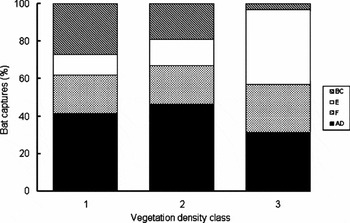
Overall, we captured 169 individuals of 18 species. The majority were Phyllostomidae – frugivores (78%), nectarivores 15% and blood-eaters (2%); only a few (4%) non-Phyllostomidae aerial insectivores were captured. Association-test results between proportions of bats captured at each of the three net sides (AD, BC, and EF) and vegetation density class, were significant (χ2 = 16.1, df = 4, P < 0.003). The difference is emphasized by the proportion of bats captured in the internal nets (BC). In the high vegetation density class (3), proportionately more bats were captured in the perpendicular nets (E and F); while the proportion of bats captured in the parallel nets (especially BC) reduced significantly (Figure 2).
Relative distribution of individual bats captured at different net sides in relation to vegetation density. Data are shown for all species of bats. A and D nets are external parallel nets while B and C are internal parallel nets. Net E is internal and perpendicular (bordered by B and C) while F is an external perpendicular net.

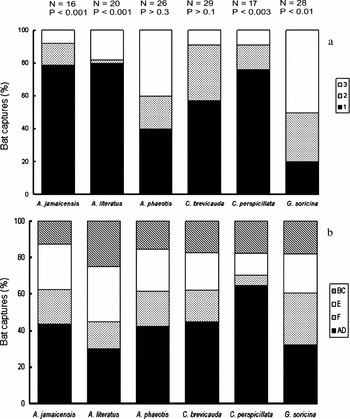
Species abundance showed strong association to vegetation cover (χ2 = 35.0, df = 10, P < 0.001). Individuals of three species Artibeus jamaicensis, A. literatus and Carollia perspicillata were captured significantly more often in areas of low vegetation cover than in denser vegetation (χ2 = 18.1, df = 2, P < 0.001, χ2 = 17.3, df = 2, P < 0.001, χ2 = 8.1, df = 2, P < 0.01, respectively, Figure 3a). In contrast, Glossophaga soricina, was captured significantly more often at sites with dense vegetation cover (χ2 = 14.3, df = 2, P < 0.001, Figure 3a).
Relative distribution of individual bats captured at different net sides in relation to vegetation density class (a), and in relation to different net sides (b). Data are shown for six species of bat. Numbers above each bar present the number of captured individuals and P presents probability levels. VD = Vegetation Density class that ranged from 1 to 3. None of the associations in (b) was significant. A = Artibeus, C = Carollia and G = Glossophaga. Abbreviations for Figure 3b are as in Figure 2.

The association between species abundance and net side was not significant (χ2 = 9.10, df = 15, P > 0.87, Figure 3b). Similarly, to test the association between size of bat species to net-side captures we divided the above six species into three groups: large species which included Artibeus jamaicensis and A. literatus (body mass > 40 g); medium-sized species which included both Carollia spp. (body mass of 20–40 g); and small species which included G. soricina and A. phaeotis (body mass < 20 g). The catches at the different net sides was not affected by the size of the bats (χ2 = 1.55, df = 6, P > 0.96).
Our results show that the use of a cleared space by bats, provided by a path, is affected by vegetation density around it. While in lower vegetation density class sites (1 and 2) bat catches are similar, a marked change is evident in the cluttered sites (vegetation density class 3) where bats tend to be caught in the perpendicular nets. The majority of this shift seems to follow a marked reduction in bat catches in the internal parallel nets.
However, being caught in the internal parallel nets could also indicate a lower level of agility (more agile bat species would successfully escape the boxed up area). To examine that option, we looked at the distribution of species amongst the different nets, i.e. if certain species are caught in different nets we could argue that their flying ability is different. Our results regarding the six species-specific catches in the different net sides were not significant, indicating that within the paths, bats use the available space similarly. Since the shift seems to be related to vegetation density rather than flight ability, we suggest that bats at higher vegetation density fly in a more ‘determinant’ manner through the centre of the path.
To explain the distribution of catches in the experimental nets two main effects need to be considered. The first is the general change in behaviour as vegetation density restricts escape manoeuvres. The second is vegetation density effect on net detection ability. Ordinarily (i.e. in areas of low vegetation density) approaching the perpendicular nets, bats can detect the nets and avoid the obstruction by flying around it through the forest. It is a quick and instinctive reaction to an otherwise natural occurrence – an obstacle on the path. Passing the obstacle, bats return to the path to continue their journey. This might explain the generally higher proportion of total catches on parallel nets in comparison to perpendicular nets. The higher capture rate in the external nets (A and D) could be because they include bats which are caught trying to join back onto the pathway including bats moving in both directions. In high vegetation densities, bats rely more on the centre of the path and are less likely to successfully avoid perpendicular nets or even attempt to. The increased catches on the parallel nets could be influenced by the difficulty of identifying the obstacle against a denser background. This would cause an increase in the catches within the internal parallel nets in denser vegetation density.
The important aspect we demonstrate in relation to the vegetation density and flight behaviour relationship is that the behaviour is uniform across species studied. Fleming et al. (Reference FLEMING, HEITHAUS and SAWYER1977) suggested that some frugivorous bat species forage while commuting, like Carollia sp. and Glossophaga sp., while other species like Artibeus sp. do not. If we consider foraging behaviour to be indicative of awareness (bats are less likely to be foraging in denser vegetation) – the expectation would be that foraging commuters would be less likely to be caught in perpendicular nets. We therefore suggest that space use in the path is not determined by physical attributes of the flight ability of the bats but show significant change with vegetation density.
The energetic cost of flying through vegetation is probably higher than using a path even if considering the potential predation risk against it. Therefore, bats using the forest paths to travel rather than forage, do so quickly and efficiently (requiring minimal energy and awareness; Britton et al. Reference BRITTON, JONES, RAYNER, BOONMAN and VERBOOM1997). We would like to offer a human analogy – commuting down a motorway. Following a description by Schnitzler et al. (Reference SCHNITZLER, MOSS and DENZINGER2003) we suggest that ‘commuting’ behaviour is analogous to their definition of ‘guidance behaviour’ which ‘only require raw sensory information (e.g. the distance between the bat and the background), but not the assessment of an internal spatial representation’. In our experiments, when unsuspecting of any change to their usual pattern, commuting bats are less able to escape the experimental area. The surrounding vegetation amplifies this effect. Flight agility or detection ability becomes useful when vegetation density is low enough to allow movement through the vegetation, be it for foraging or escaping an obstacle. Bats are more aware of their surroundings, perhaps similar to driving in an urban area and are less likely to be caught in cross-path nets. In contrast, in high vegetation density, which naturally restricts movement in the forest, bats fly in ‘commuting’ mode. Flying this way, through the centre of the path, results in high cross-net catches. The fact that the species tested showed the same pattern relates this phenomenon to behaviour rather than ability.
To summarize, being mobile animals with foraging trips that may extend far from their roosts, bats do what in human terms could be classified as commuting. In our experiments bats flying through paths (particularly in dense areas) show similar behavioural patterns common to all commuters – low awareness, focused directionality and reduced realization of their flight ability.
ACKNOWLEDGEMENTS
We would like to thank Operation Wallacea who hosted and funded the fieldwork. A great many thanks to Charley White, Sarah Mee, Alan Haynes and Ruari Allan who spent many sleepless nights braving rain and mosquitoes. We would like to thank Dr Pinshow for his comments. This is paper number 631 of the MDDE and 250 of the RSC.