In preparing my presidential address for publication, I debated between different options. On the one hand, I could do what I assume is most typically done—that is, take the oral presentation and re-present the material as a research-based journal article. On the other hand, I considered the extraordinary year of challenges, disruptions, traumas, fears, and insights that had preceded this presidential address. Nothing from that year could be considered normal, from a personal or professional point of view; therefore, another option would be to engage in a writing structure reflecting our departure from the normal. For the Association for Asian Studies (AAS), the year of abnormality began with the canceled 2020 Annual Conference in Boston as a result of the COVID-19 pandemic, continued with online teaching and meetings, and culminated in a virtual Annual Conference in 2021.
The past year spanned the political turmoil of Black Lives Matter instigated by the killing of George Floyd by police officer Derek Chauvin, an act of racial violence that roiled nearly every American academic institution, including the AAS. The Black Lives Matter movement, which has grown to global proportions, calls upon us all to critically examine structural racisms within our histories, practices, prejudices, and professions. With a great sense of relief and commitment to the work that lies ahead, the end of my presidential term coincided with the guilty verdict against Chauvin, which spawned further questioning of widespread race-inflected police violence in the United States.
The year witnessed a spate of other kinds of racialized violence as well, including that against Asians and Asian Americans, spurred in part by a pandemic that began in Asia and spread along inadvertent vectors of global transmission. The pandemic spread not only disease but also racialized blame, encouraged by a political administration that gave permission to publicly and overtly scapegoat Asians for the disease and its wildfire contagion. Amid verbal and physical attacks in the United States and elsewhere against people of Asian ancestry, I feel vulnerable in the racial climate of our times. As I write this, the processes of legislation are at work: on April 22, 2021, by an overwhelming vote of 94–1, the US Senate passed an anti–hate crimes bill aimed at addressing attacks upon Asian Americans amid the COVID-19 pandemic.
I present this preamble as a way of explaining why I have chosen to connect much of what I said in my presidential address with the past year's experiences and events. Rather than ignore the history of the moment, I have chosen to embed my thoughts as very much of the moment, emerging from the yearlong context in which I spoke. This is particularly important as the emotions and vulnerabilities of the past year continue. Even though the topic of my address—Global Asias—is a concept that I had been developing well before 2020, the events and interactions of the past year have shaped how I have thought about it and its implications for Asian studies. Therefore, I have decided to preface the words I spoke at the conference with the words I wrote in the form of presidential columns (italicized here). In the process, I have taken the opportunity to examine those columns—written in their own register and very much in reaction to our constantly evolving experiences—as an archive of our immediate history.
When I took up the presidency in March 2020, I had no intention of making regular pronouncements on the state of Asian studies. I had little confidence in my ability to assess such a broad domain. But each day, week, and month proved so extraordinary, so challenging, that I felt the need to reach out, given the platform of the presidential column, to express my version of our shared trauma. What I wrote was not meant to be grand, but rather small, intimate reflections, occasionally reaching beyond my bubble of experience to what might be commonly felt. And I continued to reach out by way of what eventually became nine columns, partly informational to membership, but also transformational to my way of thinking. Each of the columns represents a way of processing widespread trauma, from the personal to the institutional. The presidential columns became my way of thinking through the traumas of the year interwoven with work on a new initiative, Global Asias. The fact that these two dovetailed—that is, the processes of the year coincided with the themes and opportunities laid forth by Global Asias—marks the significance of what I discuss here. So I begin and end with presidential columns as reflections on the challenges of an extraordinary year.
Presidential Column 1: Asian Studies in a Time of Pandemic, April 3, 2020
Greetings from lush Manoa Valley in sunny Honolulu! It is a strange time to become AAS President with the cancellation of our Boston conference and the realization of just how important these meetings are in renewing our friendships and ties to each other. We all feel the loss deeply. . . .
But for now, I return to the present, and to my desk with a view, where everything looks as unchangingly beautiful as always, but nothing remains the same. We are living a nightmarish game-changer. Our days and minds are filled with numbers, projections, fears, Zoom meetings, and the strange newfound experience of time on our hands. . . . Our at-home activities take place in the name of an enforced pause button in our lives that are anything but paused. . . . As of the time of this writing, I personally do not know anyone suffering from COVID-19, much less died from it. My heart goes out to those more directly affected. But the threat looms large and captures us all.
That threat has taken on a particularly pernicious turn in the form of anti-Asian racism. Although the pandemic's epicenter has moved away from Asia to Europe and the United States, some segments of the population still cling on to the image of China qua Asia as holding the blame of its origins. Certain political leaders have inflamed this sentiment by repeatedly calling it the “Chinese virus.” Expectedly, this nomenclature has ugly consequences that call up long histories of yellow-peril racism in the United States and elsewhere. . . . That racism strikes fear in the hearts of Chinatowns, Japantowns, Little Saigons, Little Manilas, and other Asian American enclaves throughout the United States. . . .
This kind of violence reminds us of ways in which Asians—including those within the geopolitical scope of continental and island Asias, as well as the many diasporic Asians across oceans and continents—may be bound together, not always by choice, but by fiat, through racism. As long as powerful naming practices label a pandemic a “Chinese virus” and thus lay the blame more broadly by association upon something called “Asia,” then Asian Studies must take note and consider such targeted racism part of our kuleana—a Hawaiian word, meaning responsibility, concern, stewardship.
The Association for Asian Studies connects us through kuleana to Asia. That kuleana may be intellectual, emotional, and personal. Some of us are of Asian ancestry and may embrace kuleana on a familial level. Others may not be consanguineally linked to Asia, but share strong affinal bonds. All of us have committed our careers to scholarship on Asia. I ask that we as Asian Studies scholars extend our kuleana inclusively to the many parts of Asias and Asians globally that may suffer as targets of public fears and real human loss.
In the midst of dire forecasts, I extend my own concern for the safety, health, and lives of yourselves and those you know. . . . . I extend warm gratitude for the personal ties that have been created—in the name of Asian Studies, over virtual and in-person annual meetings (including AAS-in-Asia), in an overworked and highly committed office staff in Ann Arbor, in the regional huddles of friendship, and in the many bonds of collaboration centered upon our zeal for scholarship. My gratitude is heartfelt, undoubtedly heightened by a sense of shared, global crisis. We wash each others’ hands and feet as we maintain the social distance that draws us ever closer. Did saying “take care” ever mean so much?
Take care.Footnote 1
In this first column, you can hear and feel the sense of trauma not only from the newness of enforced lockdowns, but also from the anti-Asian racism that became part of fear-filled lives, especially for those of us who are of Asian descent. In no uncertain terms, the racism knew no bounds of nationality. Instead, Asians and Asian Americans alike became targets of attack. These lines, drawn upon racialized boundaries, gave immediate impetus to a shared experience of Asians and Asian Americans, whose reactions variously included racialized huddling for protection, indignant calls to fight back, and media expressions of protest (Yano Reference Yano and Chaturvedi2020). Unwittingly, these lines reinforced the call for an initiative that embraces the complexity of Global Asias, challenging Asian studies to more fully and structurally acknowledge the many diasporic ties that traverse oceans.
Presidential Column 3: On the Inevitable Politics of Our Lives and Institutions, July 21, 2020
It has been fifty years since the Journal of Asian Studies published William Theodore de Bary's by now iconic presidential address, “The Association for Asian Studies: Nonpolitical but Not Unconcerned” (Reference De Bary1970). De Bary spoke in the context of very different, but not unrelated, times, marked by debates over the Vietnam War, as well as the rise of social movements that included the Black Panthers, Women's Liberation, and Ethnic Studies. De Bary's address responded to fissures within the Association for Asian Studies, such as the formation of the Committee of Concerned Asian Scholars, whose members expressed their criticism of the Vietnam War, and particularly of the complicity of the field of Asian Studies with US international policy . . . 1970 represented highly public political times and divides—globally, nationally, and within institutions. . . .
My message to you today plants two seeds closely related to 1970.
Seed One: Politics of Everyday Lives
The first seed regards what I call the inevitable politics of our lives and institutions. Given the urgency of Black Lives Matter and the backdrop of global tensions surrounding the coronavirus pandemic, it seems an appropriate time to revisit AAS's long-standing self-identification as a “nonpolitical organization.” The current groundswell clamor demands that we listen and examine ourselves, our institutions, and our histories as part of the process of connecting the dots and acknowledging larger structures of inequity and discrimination. I suggest that we shift what de Bary defined as the tipping point of political/nonpolitical because our times demand it. What do acts of police brutality and systems of racism, and civil protests against these, demand of us? Nothing less than that the details of who we are come under close and critical scrutiny. . . .
What our times require is that the necessary work of critical scrutiny and enunciations be reconfigured into practice, into active citizenship. . . .
Part of what needs to be done lies in questioning the processes of our organization. We should rethink and restructure to assure greater transparency and more widespread involvement. We should more clearly define our stakes and thereby build a broader base of committed stakeholders. Any culture of elitism and gatekeeping must give way to mentorship and support. Emphatically, we gain strength by learning from one another at all levels of the profession. In the spirit of generative communication, we will hold town hall discussions at our Annual Conference and through council open houses, as well as encourage broader dialogue and conversation with the membership in general. Now that our interactive possibilities have expanded virtually, these should not necessarily be confined to in-person annual meetings, but held on a regular basis virtually.
Seed One takes politics as the engagement and responsibility of AAS, not only for ourselves but also for those with whom we work. . . . I invoke it [kuleana, responsibility] here again as the principle of fundamentally conjoining engagement and responsibility, and doing so with community at its helm. Kuleana presupposes a commitment, an understanding that we are really part of something we cannot easily dismiss. . . . Our communities are multiple: research communities, colleagues, institutional communities, families and social ties, places where we live. Engagement, responsibility, community: here lies kuleana politics at its core. The Black Lives Matter movement teaches us as committed scholars of Asia the importance of centering social justice, freedom from oppression, and that fragile, shifting negotiation called truth in our work. These times call upon us to recognize the inevitable politics of who we are and what we do. Ours is the fundamental commitment to the human spirit.
Seed Two: Global Asias
. . . . Inasmuch as AAS structured itself fifty years ago through area-focused councils, I propose that we recognize both the value and limitations of that structure. Increasingly, our Asiatic worlds include intersections, crossings, mobilities, migrations, and diasporic communities that preclude a strict areal focus. . . .
I would like to explore the possibility of. . . . Global Asias. . . . Although the core issues that animate Asian and Asian American Studies have been historically very different, I think it is important that we structurally acknowledge and learn from each other. Among the core issues of Asian American Studies—from which Asian Studies can gain—is that of race and racialization. . . . It is my hope that by creating an institutional space for these diasporic considerations in Global Asias, we acknowledge both the common issues, as well as new framings that can bring greater meanings to kuleana-based research.
The tumult of 2020 is at least as demanding of our response as that of 1970 was. We must face it with all our resources and reasoning, and make active, political concern our motivating guide. Fifty years after de Bary's pronouncement, we are still in turmoil, but that turmoil has meant that we are indeed political and, in fact, very concerned.Footnote 2
The political turmoil of 2020—from the government response to the pandemic to the Black Lives Matter movement—forced us to consider what that might mean for Asian studies. By referencing De Bary's presidential address of 1970 and the conflict from which it emerged, I suggest that the challenges of 2020 are no less pivotal. The demands placed upon us to respond, rethink, redo, and reconfigure seek new seeds of change. The first seed—inevitably politicized Asian studies—planted overt change. But so, too, does the second seed of Global Asias. Even if Asian studies has never turned its back completely on Asian diasporas, the more fulsome embrace of an expanded field and purview are part of a process that includes issues of race, social justice, and critical theory. I see both seeds as part of what we may commit to as components of engaged Asian studies, of which this organization holds primary responsibility.
Presidential Column 4: Convocation for a New School Year, August 24, 2020
I write this on the first day of classes at my university in our strange pandemic world of non-campuses and virtual classes. I mourn with the rest of you the losses incurred by the pandemic. . . .
However, if we take a step back, consider how we can take the pandemic as an opportunity to question the structures of that ivory tower. To what extent do those structures reinforce systemic violence and hierarchies? To what extent do they enable, as well as limit? How do we teach (and research) Asia to accommodate the flexibilities necessary to address our changing worlds?. . . .
First of all, as institutions move away from areally focused programs and faculty hires, and toward the integration of area-based research as case studies for disciplinary issues, we have to retool, reframe, and perhaps retrain students for this reality. . . . Even as we acknowledge this new reality, we need to continually make the case for the depth of our background knowledge (language, culture, history, etc.) in our specific areas, only gained through lengthy training, deep familiarity, and strong commitment. Furthermore, we need to not lose sight of what might be overlooked in a strictly disciplinary structure—that is, our strength in interdisciplinarity. This is what makes Asian Studies so valuable.
Secondly, we need to keep an eye on the importance of applied Asian Studies, including work in museums, organizations, businesses, private consultancies, and governmental agencies. . . . The kind of training that may be had through knowledge of Asia and its diasporas has vast implications for public life and policy. The challenge is to create these pathways, especially since our status quo training does little to prepare us for them. . . . I would like to move . . . toward . . . “engaged” Asian Studies.
Thirdly, we need to think through our research and teaching as Asian Studies scholars. The question is not so much, “What can we do to protect our fields?” . . . The onus of responsibility should be on us to make sure that the field of Asian Studies itself has flexibility and therefore resilience. We need tensile strength in order to move forward. We have to make sure that what we teach may be esoteric, but also exoteric—that we stay connected, engaged, and relevant to the world around us. That world is rapidly changing; so, too, should be our approaches and teachings. . . . Our challenge is to respond creatively, critically, and productively. Indeed, we have to constantly hit the “refresh” button to remind ourselves of the importance of always examining our endeavors. We cannot take “refresh” as an assumption, but as a call to action, a call to reform. . . .
Perhaps administrators will . . . notice a shift in Asian Studies as it broadens to include thematics that might be responsive to the times at hand. At that point, we may no longer need admonitions, such as “Asia Matters,” because Asia is already upon us. A reconfigured Asia will certainly matter in shaping a broad, inclusive view of the world. Asian Studies will thus go well beyond its nineteenth-century Orientalist cradle to embrace the many Asias that are part of our lives globally. Global Asias. It's a lot to consider.Footnote 3
This column represents a convocation for a new Asian studies—with broader boundaries, fresh and refreshed approaches, and frameworks built upon diasporic extensions and global movements. Call this a newly configured engaged Asian studies, built upon the strengths of deep training and inherent multidisciplinarity, but tackling bridging issues of race, power, empire, and shared global concerns such as the environment and democracies. This Asia matters precisely because its extensions have become not peripheral, but central. The diasporic extensions create textures that constantly challenge and disrupt our assumptions. This is not a bad thing, but key to futures of flexibility and resilience, as I discuss in the presidential address that follows.
As we switch registers of narrative, I ask that we integrate the archival sense of the past year into the more formally reflective address. In this, we trace threads of dislocation, turmoil, anxiety, loss, disorientation, and pathways of recovery in the presidential columns to a framework of performance and its possibilities in the address. We deliberately entangle the year's moments of reaction into more integrated optimism. We take the pinpoints of disruption and chaos and try to connect them through a framework of Global Asias that in its most comprehensive sense suggests means by which Asian studies may reconfigure itself into a broader, more engaged scope. That scope is not wholly new, but includes the transnational as a given, assumptions of movement through time and space, and the challenges and necessity of a more global purview when thinking through issues of diaspora, empire, climate change, human rights and democracy, academic freedoms, and pandemics. Adopting a broader purview means shouldering the mantle of global kuleana—engagement and responsibility—exactly because of our interconnectedness. The past year's chaos documented in part through the presidential postings ask us to think through just what Global Asias might mean in terms of the bridgings of who we are, what we do, and why. Each of the postings responded to a particular moment in time, to which I suggest a more broadly focused, integrative challenge of Global Asias and its concerns.
Riffing on the Occasion of the Presidential Address 2021: Chindon-ya and the Sounds of Global Asias
We have been living under the dark cloud of the pandemic for over a year now, and its viral load has not produced any “new normal.” But the flexibility and resilience with which a conference such as this has come together is a testament to the commitments that unite us.
My topic is Global Asias, an initiative that I began working on throughout my vice presidency and presidency. Global Asias refers to transnational, transhistorical, and transgeographic flows, whether of peoples, ideas, practices, goods, diseases, and environmental concerns of Asia and its related communities (both inside and outside Asia) across time and space. The concept relates directly to the work of my immediate predecessor, Prasenjit Duara (Reference Duara2020, 841), who discussed “the circulatory processes that have been weaving—or entangling—the globe together into the modern era” in his presidential address last year. It also relates closely to the ideas presented in the presidential address of Barbara Andaya (Reference Andaya2006, 685), who broached the subject of teaching and thinking through the broad scope of Asia by way of its oceanic history—what she calls a “transocean standpoint.”
However, whereas Duara and Andaya focused primarily on Asia itself, my intention in Global Asias is to quite deliberately extend those circulatory processes across the Pacific to diasporic Asian communities. In doing so, I embrace not only expanded geographic areas and groups of peoples, but also the embeddedness of their movements in infrastructural immigration and refugee dispersal, as well as the inflected fields of study that have developed in their analyses. Global Asias represents an epistemological shift that encompasses various contradictions, contentions, critique, creativity, and sometimes violence as part of the fluidity of movement and encounter. The mobility may encompass and range from privilege to poverty, from political asylum to proselytizing missions, from established pathways of the marketplace to bootleg distribution. Global Asias focuses on the circuits themselves, on the oceanic flows and dynamic encounters.
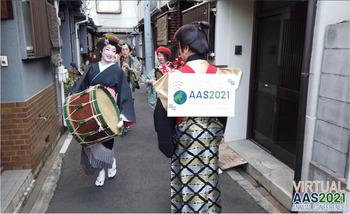
Before I expand further on the who, what, where, and how of Global Asias, I would like to turn our attention to the music ensemble from Osaka, Japan that opened this conference, chindon-ya (see figure 1), and specifically one of the pieces that I will discuss later.
Chindon-ya performance featuring Hayashi Kōjirō (chindon drums), Kawaguchi Masaaki (banjo), Kobayashi Shinnosuke (clarinet), Kamanaka Fumika (gorosu drum/dance), and Kariyasaki Ikuko (accordion), taken in the Karahori area of Osaka, broadcast as part of the opening ceremony of the Annual Conference of the Association for Asian Studies, March 21, 2001. Photo courtesy of Chindon Tsūshinsha.

Chindon-ya performed as part of the opening of the 2021 AAS Annual Conference conveys a certain amount of playful chaos, but the troupe does so in part through a well-known song, “Ue o muite arukō” (lyricist Ei Rokusuke, composer Nakamura Hachida), one of the only twentieth-century global hits from Japan, known abroad as “Sukiyaki” (with Anglicized pronunciation of four distinct syllables). Recorded in 1961 by Kyu Sakamoto (1941–85), the song hit the Billboard charts in the United States and others worldwide in 1963 and became one of the best-selling singles globally. As with any successful pop song, it was covered—that is, re-performed by other singers—over and over, including as part of the AAS chindon-ya performance. In fact, “Sukiyaki” became a global cover song, re-recorded numerous times by musicians outside Japan, sometimes with a wholly new set of non-Japanese lyrics.
One of the most notable of these covers is “Sukiyaki” by the group Taste of Honey, who released their version of the song in 1980 with new English lyrics, adding Japanese koto (zither) to impart a hint of Japan and dressing in kimono. In one performance televised on the iconic Black American music show Soul Train, the lead singer (Native American Janice Marie Johnson) added a quasi-Japanese fan dance and whispered “Sayonara” at the end.Footnote 4 The performance—with its lyrics, instrumentation, costuming, staging, and cultural quotation—uses “Sukiyaki” to cover Japan. Yet another notable cover was performed by the Mexican American superstar Selena Quintanilla-Pérez, who released a version of “Sukiyaki” in 1989, titled “Caminaré Mirando Arriba,”Footnote 5 with lyrics entirely in Spanish, translated from the English version recorded by Taste of Honey. What these and other performances display are the head-spinning ways in which the movement of a song from one country, language, and singers to another becomes part of its archival resonance over time and space. These are Global Asias’ processes, histories, interpretations, expressions, and capitalistic endeavors.
“Sukiyaki” attracted global fans with its simple, catchy tune, upbeat pop orchestration, and Sakamoto's clear voice, with the added bonus of his strong whistling. What most global listeners did not understand were the meanings of the Japanese lyrics, which expressed deep pain and suffering, a young man looking up to the sky while walking so that his tears would not fall. The lyrics are generic, so that even a Japanese listener might take this as the song of a romantically broken heart. In fact, lyricist Ei Rokusuke wrote the song in 1961 after returning home from a massive Japanese student protest against the AMPO Security Treaty between Japan and the United States. The tears that he wrote about were not from lost love, but lost innocence and political anguish (NPR 2013). When this song traveled globally, it was renamed “Sukiyaki,” a nonsense title that could resonate playfully with English-speaking audiences far more than its other English subtitle, “My First Lonely Night” (Bourdaghs Reference Bourdaghs2012, 102–3). The title “Sukiyaki” had no meaning other than as an indexical placeholder for Japanese exotica. In this way, “Sukiyaki” spun staged levity from the pathos of loss, giving added poignancy to its many rebounded global cover performances.
Watching twenty-one-year-old Sakamoto sing “Sukiyaki” in 1963 before a Sunday prime-time American audience on The Steve Allen Show, one views a particular performance of masculinity that is entirely disarming and unthreatening and not without some degree of self-awareness.Footnote 6 As Sakamoto later recalled, “I'm only going to be there [America] for a very short time, but I still want to introduce properly, in my own way, ‘Japan.’ . . . On The Steve Allen Show, . . . I want to show them me just as I am, a completely ordinary visitor” (quoted in Bourdaghs Reference Bourdaghs2012, 85). This was not the Japan of AMPO demonstrations, nor the Japan of a defeated country. Rather, this was Japan as a “completely ordinary visitor” to the United States, whose performance was broadcast on NBC at the prime-time family hour of 8:00 p.m. on Sunday evening. This was also a Japan gearing up at a feverish pace for the Tokyo Olympics in 1964, the first Olympics held in an Asian country, and the first to be broadcast by satellite globally. In short, the Tokyo Olympics of 1964 provides a Global Asias moment on a grand scale, which Sakamoto performs with all the televisual intimacy of a popular prime-time American broadcast. Within this broader context, Sakamoto presents a benign ordinariness—sweetly vulnerable Japanese masculinity of a clean-cut young man singing the catchy melody of lyrics unintelligible to most American audiences. He beams cheerfully even as he gestures his tears, cocks his head to one side, and whistles his refrain. Sakamoto on The Steve Allen Show is transnational cute in a naive Global Asias encounter. Non-Japanese-speaking American audiences could barely know that Sakamoto sang of such heart-wrenching pathos.
If the focus of our Global Asias framework is movement, then “Sukiyaki” represents one of the most notable examples of song that has traveled from one part of Asia to numerous parts of the world. Consider such a global hit. And then consider the numerous levels of mistranslations that made it possible, beginning with its preposterously renamed song title to doubly misunderstood lyrics. In such a global hit, the lyrics become nonsense syllables, a “fa-la-la” of style. “Sukiyaki” exists as a catchy pop bauble, woefully, perhaps even gleefully, misunderstood. On the one hand, it may be thought of as a violation of the lyricist's originally encoded meanings. But, on the other hand, it was undeniably a record-breaking hit, regardless of its string of recoded messages. By 1963 and beyond, the song became loosely everyone's—owned by no one, identified only as a kind of “Global Japanese.” It was an early version of “soft power,” well before Joseph Nye (Reference Nye2004) coined the term.
For the most part, people in Japan hailed Sakamoto as a hero for being a hometown sweetheart who crossed the globe. They celebrated the fact that one of their pop songs became a global hit, a rare phenomenon that has been a major goal of the Japanese recording industry ever since. “Sukiyaki”—unmoored from its origins—retained newly framed exotic associations with Japan. The song became a point of national pride, particularly through its global success that continues well beyond the 1960s. The song has garnered such popularity in Japan as a well-loved postwar “classic” that “everybody knows” that it has gained near-folk-song status. In fact, in Japan, it has been used variously in recent years as an iconic beloved cover song for political and emotional purposes, as in the following examples: (1) “Playing for Change” in 2010;Footnote 7 (2) Japan's “Sing Out,” sung as a medley with the Bob Marley and the Wailers’ 1965 reggae song “One Love” in 2011, a tribute to Japan's solidarity following the Triple Disaster of that year;Footnote 8 and (3) the Japanese Artist Project, performed in 2020 by Japanese artists quarantined in New York City, in which the song acts as an iconic bridge between individuals, nations, and crises.Footnote 9 Hearing these voices sing the Japanese lyrics and familiar tune becomes an emotional rendering of connectivity, particularly poignant amid the pandemic of 2020. Part of this quasi-folk-song stature in Japan and its diaspora with multiple repurposed performances derives from its global fame as “Sukiyaki.” In short, the song's achievement as a global hit made “Sukiyaki” (“Ue o Muite Arukou”) an anthem of emotion and support in Japan and, to an extent, elsewhere.
The “Sukiyaki” story continues with further recordings and recontextualized longevity, but let us return more explicitly to chindon-ya and Global Asias. Chindon-ya absorbs the musics of many cultures, filtered through Japan, performed with a combination of portable Japanese and Western instruments. As chindon-ya is music in and of movement, so, too, is Global Asias predicated upon mobilities that have taken people, ideas, and goods from and through Asia to other parts of the world. In these diasporic settings, they have established themselves often within Asian enclaves of Chinatowns, Koreatowns, Japantowns, and Filipinotowns. As chindon-ya performance rests on its adaptability to different and changing settings, so, too, these Asian diasporic communities have had to adapt to different sociopolitical conditions—sometimes smiling and whistling as Sakamoto did. Inasmuch as chindon-ya performance is not the music of solitude and contemplation, so, too, the lives of working-class immigrants of Global Asias may be visualized by their actions, bodies restless in their need to earn a living, carving out newly improvised lives in new settings. The acts of chindon-ya are explicitly commercial, providing sights and sounds to attract customers. So, too, are acts of Global Asias often driven by economic needs. In the course of new lives, Global Asias creates new pleasures, new forms of play, and new conflicts very much a part of the bridgings between past and present worlds.
Chindon-ya resounds with sonic and visual images of Japan's urban pasts, emerging on reconfigured stages in the twenty-first century (Abe Reference Abe2018). In both contexts, chindon-ya represents music in motion, music as encounter, music of indeterminacy. Music in motion: here is sound meant to energize, goading people to action, to spend their money, even to attend a conference such as this. The actions prompted by chindon-ya may be as small as a tapping foot, a clapping hand, or a bobbing head. Or they may be as large as following the musical troupe as it winds it way through urban neighborhoods. Music as encounter: here is sound meant to bring people together, socializing, interacting in lighthearted ways. Chindon-ya creates a party-like atmosphere that Japanese would describe as nigiyaka (lively, energetic). This is not music of reflection or tranquility so much as music of action, moving bodies, invitations to join the parade. Music of indeterminacy: here is sound as both the expected and unexpected. The expected rests in well-known songs such as “Sukiyaki” that are freely incorporated into the chindon-ya repertoire; but the unexpected surroundings place those songs in different contexts, with different instruments, and sometimes with surprising effects.
The result is chindon-ya as riff, a performative asobi (play) that taps into vast and deep creative fun in Japan. Here I mean fun not only in the superficial sense, but in the deeper sense of that which binds people together in pleasure from the poetic to the carnal and, in the case of the AAS conference, to the academic. Chindon-ya engages asobi both sonically with an odd assortment of instruments from clarinet to shamisen to accordion, and visually, with bright colors, playful designs, stage makeup, and fanciful costumes mixing historical periods and idioms. This is meant to be tongue-in-cheek, sensory overload that draws people together and pulls them in to spend their money or attend an academic panel. Chindon-ya is the music of commerce, advertising, and premodern sociality, recontextualized to raucously call us together—in 2021, online. As such, chindon-ya can become our prompt for critiquing cultural boundaries and maybe even suggesting a politics of the play.
Together, chindon-ya and “Sukiyaki” encapsulate much of what I would like to think through in this presidential address vis-à-vis Global Asias, from movement to adaptability to mistranslations to global hits to conflicts of misunderstanding, and what these may come to represent. Global Asias represents the power dynamics of transnational encounters both mundane and profound.
Global Asias as Personal Narrative
Let me place Global Asias within the context of my own background. I am not the first AAS president of Asian ancestry. (Notably, 2021 is the first year in the association's eighty-year history in which all four officers—Duara, myself, Hy Luong, and Kamran Ali—are of Asian ancestry.) But I am the first president of Asian ancestry whose platform agenda begins with identity politics and moves from there to a disciplinary call. What I am suggesting is that we find ways to create, sustain, and encourage bridgings, initially between Asian studies and Asian American studies and then beyond to Afro-Asian, Pacific Rim, Indian Ocean studies, and other fields. In this, I firmly believe that the bridgings extend far beyond their crossings, becoming more than the sum of their parts. In short, Global Asias can be generative.
My own personal research trajectory began firmly in Asian studies but extended to Asian American studies, enabled in part by my own family background as a third-generation Japanese American, as well as my position at the University of Hawai‘i. In fact, several other Asian American scholars followed this same pattern of training as scholars of Asia, eventually researching Asian American topics, often because of personal backgrounds in the subject. Because of my experiences and training in one field and then moving into another and sometimes tacking back and forth between them, I could see the ways in which both fields are very different, but productively related.
Let me bring in a case study from my own research past to demonstrate ways in which a trajectory toward Global Asias may lead to different frameworks, assumptions, and insights. When I was studying a Japanese popular song diva, Misora Hibari (1937–89), as an extension of my dissertation and first book (Yano Reference Yano2003), I researched as much as I could from the context in which she was raised and built a career—Japan. I studied the kinds of music she sang (a variety from boogie-woogie onward, but with an increasing specialization in enka, the old-fashioned melodramatic song dubbed expressive of the “heart and soul of Japanese”). I researched the personal history that brought her to the stage, the daughter of a humble fishmonger in Yokohama, and her relationship with an overbearing stage mother. That personal history included the rumor that her family was actually zainichi (residing-in-Japan) Korean, so that her voice might be repositioned ironically as a minority singing the heart and soul of Japanese. Most importantly, I researched the structural conditions of the entertainment stage as she sang her way from child star to young screen ingenue to veteran “Queen of Enka.” What this form of research centered on was a Japanese story (Yano Reference Yano, Miller and Copeland2018). However, if I included other diasporic details of her life, that story broadened and rebounded considerably.
Among Japanese Americans, Misora Hibari became a touchstone of diasporic identity, one filled with a certain poignancy, in part because she was an enormously talented child star from the “mother country,” and in part because she had survived a brutal war with a complicated history vis-à-vis Japanese Americans. At a time when some Japanese American families were being incarcerated on the basis of race, others were instructed to destroy material vestiges of Japanese culture such as kimono, as well as to deny immaterial remnants such as Japanese religion, language, and music. Being able to listen to the child star Misora Hibari sing her boogie-woogie songs only a few years after the end of World War II suggested that this form of linkage to Japan was publicly acceptable in the United States. That form was a prodigiously talented child star, singing jazz numbers alongside Japanese popular songs, with a winning smile and a big bow in her hair. Boogie-woogie and enka, served up in a small package, became symbolically and emotionally important for Japanese Americans as well as Japanese nationals in the 1950s and 1960s. She became known not only for her musical talent, but also for her work ethic and drive, which served as inspiration for Japanese and Japanese Americans alike.
Thinking through Misora Hibari, the child star who performed abroad at a time when such travel was not available to the average Japanese citizen, helped me extend my focus beyond Japan. Understanding Misora Hibari as a phenomenon meant contextualizing her fandom overseas within Japanese diasporic communities in Hawaii, Los Angeles, Chicago, Sao Paolo, and elsewhere—in short, placing her within a Global Asias framework of transnational circulation. That overseas support and enthusiasm subsequently became part of her star text—that is, the narrative of her celebrity—enhancing her reputation in Japan itself. Japanese diasporic engagements with this star became part of a rallying cry for communities on both sides of the Pacific, a mark of her and their achievement. One of her fans and singers in Hawaii, Lorraine Kaneshiro (1943–99), became known as “Hawaii's Misora Hibari,” appearing in performances covering the star's songs while miming her gestures.
This two-way identification—members of the diasporic community performing their version of the star, as well as the star in Japan gaining greater prestige for her overseas popularity—speaks to some of the productive ways in which a Global Asias framework may help us consider a phenomenon not only within a single setting in Asia, but as it multiplies through different iterations outside its home turf. Each place-based iteration becomes part of a rebounded aura, creating dialectical relations set within Global Asias. One may see this as a relationship between biography (one's moving journey; here, a star text) and geography (the place or places of that journey)—as former AAS President Anne Feldhaus (Reference Feldhaus2019, 745) argues from a very different historical and cultural context in her presidential address of 2019, highlighting “attachment to particular places in . . . highly mobile worlds.” Global Asias recognizes those attachments etched in high relief given the itinerancy of the journey. For Misora Hibari, the itinerancy lent prestige as a form of cosmopolitan ascendancy.
Let me add another layer to the Misora Hibari star text example. She was known to sing a broad range of pop music genres, not only from older Japanese forms, but also based on the latest hits from the United States and elsewhere. Her repertoire thus included signature Japanese tearjerkers such as “Kawa no Nagare no Yō ni” (As the River Flows, 1989), Edith Piaf's chanson classic 1947 “La Vie en Rose,” and Harry Belafonte's 1956 “Banana Boat Song.” In particular, watching Hibari sing the “Banana Boat Song,”Footnote 10 with its drum-roll introduction and quasi-calypso-dancing male chorus of backup singers, highlights Global Asias’ multiply embedded ironies. Here is a decked-out Japanese diva blithely singing a black work song from Jamaica that had been popularized in the United States and elsewhere by the iconic political activist and singer Harry Belafonte as part of the global Latin calypso moment. This “Sukiyaki” in reverse speaks to the queries and quandaries, the ironies and mistranslated pleasures of global circulation.
Misora Hibari's fame may be read as a star text that echoes beyond Japan multiply, including her popularity among Japanese Americans in North and South America, as well as within Japan in its zainichi Korean population with whom she retains a special affinity, as well as the gay male fan community, idolizing a diva in their midst. Thus, if we are to link the many nodes in which Misora Hibari figures, they would include issues of minority relations in Japan, race/ethnicity, sexual politics, and the political history of populations moving between Korea and Japan. Misora Hibari represents a chindon-ya-like spectacle, a woman moving between poles of fandom, between continents, histories, and populations, advertising her own brand as she goes. Misora Hibari's very in-betweenness allows and obscures the flexibility of the global encounter, both by design and happenstance. Her star text thus helps us critically examine these bridging processes.
Global Asias as Bridge
In thinking through the bridgings made possible by Global Asias, it is important to keep in mind its open-endedness. This is not a one-size-fits-all agenda. Asian studies and Asian American studies, to name only a few preestablished agendas, differ in topical concerns, training, and research fields. These differences are not necessarily reconciled by Global Asias. Rather, I ask that we consider the possibility of a framework that is multiply wrought, with differences that remain adjacent, rather than resolved. Thus, Asia is not limited to a spatial concept, or a set of political entities, and certainly not racialized embodiments, but encompasses a multivalent complex by which “Asia” or “Asias” gains meanings.
Global Asias includes the following: Asian diasporas in the Americas and elsewhere (Chinatowns in San Francisco, as well as Yokohama; South Asian communities in Silicon Valley; Southeast Asian fishing communities in Texas; Japanese diasporic communities in Sao Paolo, Brazil); Asian immigrant communities in different parts of Asia (e.g., Filipino communities in Japan; Japanese communities in Nepal; Nepalese communities in Hong Kong); intra-Asia connections in terms of goods and their consumption (K-pop in Indonesia; Japanese cute culture in Hong Kong). Global Asias includes a broad span, from the lives of Asian American international flight attendants, to plush toys originated in Asia but popular in many first-world markets, to Western-originated musical instruments that have made creative inroads in Asia and elsewhere (Yano Reference Yano2011, Reference Yano2013, Reference Yano2015). Why group these disparate elements together? Primarily because by doing so, we may better understand some of the interconnections by way of something called “Asia,” as well as the processes of mobility that give these meaning and force. These mobile “Asias” exist relationally, shifting definitions contextually, historically, and typically asymmetrically.
I am not denying the importance of studying Asian countries and cultures in situ, with their long histories and accomplishments. These foundational Asian studies research agendas are absolutely critical to our understanding of the complex processes that take part in and around Asia. Notably, mobility has long been part of those histories, especially since very few countries and cultures have lived in total isolation. However, increasingly mobility has come to define twentieth- and twenty-first-century lives and conditions of interaction. Placing mobility—that is movement itself as an economic necessity, a political act, an act of violence, an assertion of liberation, an expression of creativity, a product of the marketplace—center stage in research has necessitated approaching national borders as porous and unevenly so.
In her recent ethnography of Japanese Brazilians in Japan titled Jesus Loves Japan, anthropologist Suma Ikeuchi (Reference Ikeuchi2019, 5) talks about the kinds of movements that shape Global Asias: “Movement does not merely entail a physical change of locations but also amounts to a temporal, affective, and moral act. Mobility is thus fraught with aspirations, anxieties, and ambiguities.” It is these aspirations, anxieties, and ambiguities that headline Global Asias’ diasporic concerns. By emphasizing an open, fluid approach, Global Asias builds a framework for engagement with social and cultural theory (including critical race studies), as well as engagement with global political concerns (e.g., indigenous rights, settler colonialism, empire, crises of democracy, environmental issues), drawing on a wider range of perspectives that address what Asias might mean, do, or say. Global Asias opens up a “pointillist” approach to phenomena, conditions, and analyses. Here, I acknowledge and extend former AAS President Katherine Bowie's (Reference Bowie2018, 873) work on oral histories, and her call for the value of many voices: “the pointillist perspective of many truths afforded by multiple points of view . . . , provides a groundswell of contradictions, convergences, and collective mini-formations.” That “groundswell” may not be exclusive to the terrain of Global Asias, but setting sights upon moving targets makes Bowie's pointillist imperative even more critical.
Global Asias as Method
Asian American literary scholar Frances Tran (Reference Tran2016, 231) writes, “Undisciplining encourages a shift in perspective and affect, a disinvestment from the security of disciplinary formations and institutional paradigms of success.” Tran's work focuses on issues of futurity and the place of concepts of Asia within that production. In a related vein, I propose a kind of unsettling in Asian studies in the form of Global Asias as a new institutional formation. Global Asias does not turn us away from Asia, but recognizes shifting, complex Asias globally, especially in diasporic settings. What I propose is that Global Asias encourages us to question the more traditional Cold War–based regional, political, economic, cultural, and social spaces. In this process, Global Asias attempts to be generative in recognizing a separate but connected subject frame that takes Asia beyond its geopolitical boundaries—that is, unsettling Asian studies from its more traditional moorings.
Global Asias takes mobility as a given and asks that we look at the meanings, privileges, and conflicts given to movement itself. What do we gain by focusing on the spaces of betweenness created by the transgeographic? Based in and through mobilities that shape many people's lives, identities, affiliations, and consumption practices, that in-betweenness creates its own dynamic friction. Embedded within that in-betweenness are elements that do not fit established models, that refuse to be “disciplined,” and that therefore beg to be reframed as the uneasy purview of the “unsettled.” This is the dynamic lens of Global Asias, challenging us with its juxtapositions in motion, forcing us to pay attention to the dynamic, unsettling forces of human actions. Reframing includes some of the effects of new juxtapositions, including settler colonialisms by which immigrant groups adopt and assert dominant positions in new settings. In many cases, those dominant practices come at the expense of disadvantaged indigenous populations (e.g., Fujikane and Okamura Reference Fujikane and Okamura2008). In further extensions, settler immigrants (here, Asian Americans) may move from one overseas locale to another as exemplars familiar with the practices of colonialism, contributing to a compounded empire (Azuma Reference Azuma2019).
Anna Tsing's writing on matsutake—a prized mushroom gathered in the wild in places such as the forests of Oregon and crossing the Pacific for gourmet Japanese consumption—is useful here. What ties mushrooms and Global Asias together is what Tsing (Reference Tsing2015, 132) calls “unintentional design, that is, the overlapping, world-making activities of many agents.” In mushrooms, as sometimes in diasporic communities, what makes for enhanced propagation is not well-tended and plowed fields—the planning and plowing inherent vehicles of modernity—but “disturbance—a change in environmental conditions that causes a pronounced change in an ecosystem . . . Disturbance opens the terrain for transformative encounters, making new landscape assemblages possible” (Tsing Reference Tsing2015, 160). In short, disturbance by its very precarity, refigures possibilities, creates the conditions and instigations of Global Asias. It is the unsettling nature of the encounter—even taking into account infrastructures of history—that is significant here, keeping us mindful of the intertwined routes of precarity, serendipity, fragility, flexibility, invention, and resilience.
Global Asias as the purview of unsettling, of disturbance, may be thought of as part of the process of “things falling apart,” discussed by Laurel Kendall (Reference Kendall2017) in her AAS presidential address in reference to the decay of material religious objects in Korea. In Global Asias, the processes by which “things fall apart” include both the material and immaterial, framed within sociopolitical processes of the encounter, of global shifts, of juxtapositions of systems. In fact, “things falling apart”—whether intentionally or not—may be considered part of process of producing newer forms and recontextualized lives in new locales, in parallel with the role of disturbance in matsutake farming. The key issues to be addressed in Global Asias include examining what things fall apart, under what historical and infrastructural circumstances, and with what new hybrid results. These research processes form what Kendall (Reference Kendall2017, 880) calls “stalking the specter of decay” as part of the “process of becoming.”
Notably, Global Asias holds perhaps the greatest potential not so much as a content-driven label, but as a methodological approach. By taking the conditions of circulation as its central purview, Global Asias provides a “stalking” framework for the application of social and cultural theory that has historically not been central to Asian studies. This says as much about the history and development of Asian studies as a field, as it does about the institutions that have come to structure it. Newer and different approaches within the purview of Global Asias include critical race theory, empire, indigenous rights, and social justice. That broadened purview includes the environment and climate change as fundamental to social responsibility. It includes the global crisis of democracy and freedom as threats that concern us as scholars and individuals. In these ways, Global Asias—deliberately pluralized to include the many configurations unmoored from a particular geopolitical space—challenges us to think fluidly, contingently, intersectionally, critically, and most of all, with a deep sense of responsibility. Here is where unsettling opens up our concerns to the multiple interconnections of mobile histories, imaginative practices, even alternative epistemologies. Global Asias as method seeks the mobile vocabularies that have challenged existing bodies of knowledge, and produced appropriative pleasures and sometimes fear and violence. These pleasures and fears may be built in mistranslations, but that is part of the indeterminacy of the encounter. Here is the possibility for asobi—for joking relations that may be no joke, for guilty pleasures, if need be. In truth, “Sukiyaki” only exists through histories of encounters and channels of circulation. It only exists as a Global Asias phenomenon.
Conclusion
In conclusion, let us return to the musical opening of this conference and to the “chindon-ya riffs” that I have been thinking through. Global Asias fully embraces the generative possibilities of musics in motion, of chindon-ya, of what it might mean that the number one song in 1963 in the United States and elsewhere might be a cheerful-sounding Japanese ditty of personal (and political) tragedy called “Sukiyaki.” These features all form a caravan around Global Asias, encompassing not only the Asia-originated immigrant communities, goods, practices, belief systems, cuisines, and arts that have established lives outside of Asia but also diasporic communities, tensions, frictions, and dynamic elements within Asia. Chindon-ya performs to the echoing sounds of traveling itself, navigating vectors of power while making waves, both by design and by happenstance. It is that combination of design and happenstance built into waves of circulation that makes Global Asias an important improvisation for Asian studies. By making Global Asias structural within our organization, we acknowledge the importance of dynamism and the challenge of bridgings. We are not trying to combine fields, but to learn together laterally, making that juxtaposition legible. Global Asias helps us bridge new fields, concerns, theoretical apparatuses, and avenues of scholarship. Some of these bridgings call our attention to newer concerns. Thus, we consider the challenges of systemic inequities, to social justice, and to the critical lens that might be brought to bear by taking mobility as a key and questioning force.
In winding their way through the streets and back alleys of urban Japans past, chindon-ya ensembles create sonic waves that announce their very local presence. Here–at the virtual conference of AAS 2021, taken so clearly out of time and space–we lay witness to ways in which some of those waves might make a global splash. Whether we call it “Ue o Muite Arukō” or “Sukiyaki,” whether we sing to or of political protests or loves lost, whether we bring full historical knowledge to the sound of one's own cheerfully discordant, highly appropriated, mistranslations, the restless movements of Global Asias create their own thrum. Call this the restless vibration of motion and resultant unexpected juxtapositions.
We feel that thrum with great poignancy in the brilliant 2021 film Minari with its searing story of a Korean American family seeking their American dream in rural Arkansas. That thrum continues with even greater insistence in the controversy over Minari's categorization as a foreign, rather than American, film by certain US awards institutions, such as the Golden Globes. This controversy echoes the “forever-foreigner” status of Asian Americans, producing the violence of exclusion (Tuan Reference Tuan1999). As director Lee Isaac Chung says, “Maybe the positive side of all of this [controversy] is that we've made a film that challenges some of those existing categories, and adds to the idea that an American film might look and sound very differently from what we're used to” (quoted in Salam and Ito Reference Salam and Ito2021). Minari sounds the thrum of Global Asias—of living the forever-foreigner in-betweenness, challenging existing categories, and pushing the boundaries of “what we're used to.” That thrum may resound with different beats, meanings, and agendas, but there is winking recognition even in those contradictions. I suggest that we embrace the project of thrummings, laden with power, pleasures, and controversies. In unruly ways, the vibrations of Global Asias—crossings of different domains of study, fluid movements of diasporic indeterminacy, generative frameworks of concerns—thrum with such possibilities. This is the constant. restless improvisatory quality of Global Asias, a.k.a. chindon-ya riffs.
These are riffs to be continued, in conversations online and offline, in homes, classrooms, streets, and on screens. They continue as anti-Asian racism has required the protection of Congress in the passage of a bill introduced by Hawaii senator Mazie Hirono in April 2021. The riffs of Global Asias continue as part of immigration policy, military maneuvers, sex trafficking, environmental challenges such as climate change, threats to democracy and academic freedom, and pandemic health concerns. Most importantly, these riffs continue as they constitute people's lives, filling the spaces between as they labor, love, sing, weep, eat, and laugh Global Asias.
Finally, let us return to one last presidential column, taking Global Asias back to institutional considerations.
Presidential Column 8: Charting Shared Futures, February 22, 2021
Change is afoot, as is always and inevitably the case. But change need not be chaotic. The point of our thinking through . . . initiatives such as Global Asias . . . is to guide that change to best serve members and the broader Association.
Let me close by asking your help, providing feedback, adopting leadership as your own, and thus shouldering the future of the Association for Asian Studies. We await your voice as we welcome your actions.Footnote 11
That voice, those actions guide the way forward for the field of Asian studies and its organizational capacity. The conditions of the past year continue to challenge us with a pandemic that stubbornly refuses to go away as we witness resurgences, vaccine inequalities, and ultimately global interconnectedness. The past year brought into focus long-wrought structural inequities, racial violence, struggles for academic freedom, and plights of democracies. The year also highlighted the perils of isolation and the dynamic potential for technology to create new possibilities of interaction. By adopting a more fluid, dynamic approach to Asia over time and space, I suggest heeding the chaos of the year with its lessons of interconnection and bridging responsibilities. To this end, “them” and “us” are only “we.” The power of Global Asias lies in our shared attempt to bring critical frameworks to life, creating opportunities to reconfigure our futures around stewardship and compassion. Consider this our kuleana: to make Asian studies exoteric. If the pandemic has upended our lives (as it has), then let us act with care and deliberation to etch new grooves of normalcy shaped by the politics of engagement.
Acknowledgments
My first round of thanks goes to fellow AAS officers Anne Feldhaus, Prasenjit Duara, and Hy Luong. Call them an “executive committee” or not, but they provided invaluable support for what felt like always a president-in-training. I am indebted to Tina Chen, founding editor of The Verge, for her role as swami in this endeavor to bridge Asian and Asian American studies. Jennifer Ho, president of the Association for Asian American Studies, always lent moral and smart support from which I learned constantly. Helena Kolenda of the Luce Foundation was remarkable for her generosity, not only in terms of shepherding a three-year Global Asias grant, but also, and equally important, in her personal care and involvement. I am grateful to Merry White, an invaluable muse, for her clarity and insight. I also thank Ken Ito for his reading through a near-final version of this essay and providing valuable feedback. My thanks to the anonymous reviewers of the manuscript; they gave me food for thought and rethought.
This presidential address was enabled by Marié Abe, who contributed multiple ways, bringing Chindon-ya to AAS and writing eloquently on the genre. A Global Asias subcommittee of AAS helped me think through the ideas included in this piece: Krisna Uk, Hy Luong, Anne Gerritsen, Chiara Formichi, Ching Kwan Lee, Elora Shehabuddin, Hyaeweol Choi, and Lori Watt. The Verge team of Charlotte Eubanks, Kendra McDuffie, and Su Young Lee has been important in organizing a series of cyberchats on the issues, practices, and meanings of something called Global Asias; thank you to the many who participated in the virtual conversations. I am inspired and indebted.
There are many others in both Asian and Asian American studies who helped shape my thoughts in various ways—responding to drafts of ideas, prodding me to consider hidden realities, opening up new avenues of expression—to whom I am truly grateful. I think of this presidential address as a record of an extraordinary year and thank all—especially Secretariat staff and Board members—who contributed so profoundly to it.