





Introduction
As gender roles have evolved, so have gender gaps in politics. For much of the 20th century, women in developed democracies were more politically conservative than men (Shapiro and Mahajan Reference Shapiro and Mahajan1986; Studlar, McAllister and Hayes Reference Studlar, McAllister and Hayes1998). However, this pattern has reversed in recent decades, with women increasingly more ideologically left-wing and more likely to vote for left-wing parties (Inglehart and Norris Reference Inglehart and Norris2003; Box-Steffensmeier, de Boef and Lin Reference Box-Steffensmeier, de Boef and Lin2004; Iversen and Rosenbluth Reference Iversen and Rosenbluth2006; Barnes and Cassese Reference Barnes and Cassese2017; Shorrocks Reference Shorrocks2018; Gethin, Martínez-Toledano and Piketty Reference Gethin, Martínez-Toledano and Piketty2022; van Ditmars Reference van Ditmars2023; van Ditmars and Shorrocks Reference van Ditmars and Shorrocks2025). Gendered differences in redistribution attitudes have been a particular area of scholarly focus, as a core dimension of political conflict (eg Andersen Reference Andersen1999; Alvarez and McCaffery Reference Alvarez and McCaffery2003; Häusermann, Kurer and Schwander Reference Häusermann, Kurer and Schwander2015; Goossen Reference Goossen2020; Shorrocks and Grasso Reference Shorrocks and Grasso2020; Garritzmann and Schwander Reference Garritzmann and Schwander2021).
Political economists generally understand women’s backing for redistribution as self-interested, given the precarity women face in the labor market (Schwander and Häusermann Reference Schwander and Häusermann2013; Häusermann, Kurer and Schwander Reference Häusermann, Kurer and Schwander2015, Reference Häusermann, Kurer and Schwander2016; Goossen Reference Goossen2020; Shorrocks and Grasso Reference Shorrocks and Grasso2020). However, women’s self-interest is not only the product of individuals’ labor market risks; the economic interdependence of cohabitating partners makes the household a crucial site of preference formation (Becker Reference Becker1981; Iversen and Rosenbluth Reference Iversen and Rosenbluth2006, Reference Iversen and Rosenbluth2010; Häusermann, Kurer and Schwander Reference Häusermann, Kurer and Schwander2016; Abou-Chadi and Kurer Reference Abou-Chadi and Kurer2021). Feminist scholarship has shown that differences in relative income between male and female partners have profound effects on women’s bargaining power over decision-making and the division of household labor (Hobson Reference Hobson1990). This can create divergent interests between men and women over the welfare state provision of benefits and services that equalize incomes and socialize household labor (Iversen and Rosenbluth Reference Iversen and Rosenbluth2006, Reference Iversen and Rosenbluth2010; Esping-Andersen Reference Esping-Andersen2009).
Where previous literature generally conceives of conflict between men and women as aggregated groups, however, sociologists and economists have uncovered a major compositional change in gender inequality across the income distribution (eg Gregory Reference Gregory, Salverda, Nolan and Smeeding2011; Ponthieux and Meurs Reference Ponthieux, Meurs, Atkinson and Bourguignon2015; Harkness Reference Harkness and Shaver2018). The broader context of rising economic inequality observed since the 1980s (Piketty Reference Piketty2014; Atkinson Reference Atkinson2015; Lupu and Pontusson Reference Lupu, Pontusson, Lupu and Pontusson2023: 4–10) has had uneven effects on gender inequality across the income distribution. At the bottom and middle of the income distribution, rising female labor force participation and income stagnation of men in working-class occupations have created much greater gender equality in incomes, while at the top of the income distribution, runaway pay in male-dominated occupations and glass ceilings for women maintain stark gender disparities (Ponthieux and Meurs Reference Ponthieux, Meurs, Atkinson and Bourguignon2015: 1021; Fortin, Bell and Böhm Reference Fortin, Bell and Böhm2017; Atkinson, Casarico and Voitchovsky Reference Atkinson, Casarico and Voitchovsky2018; Quadlin, van Heuvelen and Ahearn Reference Quadlin, van Heuvelen and Ahearn2023). We build on extant work on gender pay gaps in society to demonstrate the sharp variation in gendered income inequality between and within households and trace its political consequences.
We first analyze Luxembourg Income Study (LIS) data from the 1960s to 2024 to examine women’s household income shares across the income distribution. The findings demonstrate clearly that women’s relative income is highest at the bottom of the income distribution and lowest at the top, across national contexts. At the bottom of the income distribution, men’s and women’s incomes are relatively equal within households, implying a convergence of material interests. At the top of the income distribution, gender inequality is much more severe. Since within-household gender inequality expands moving up the income distribution, we expect attitudinal differences to follow a parallel pattern.
Our next step uses data from the 2016 International Social Survey Programme (ISSP) to test whether gender gaps in welfare state support are conditional on households’ position in the income distribution. Our analysis finds that household income moderates the magnitude of the gender gap in welfare state support. There is little to no gender gap in welfare state support for the lowest-income households; gender gaps only emerge at the middle and widen at the top of the household income distribution.
Finally, we use the ISSP to measure within-household gender inequality and test whether it conditions gender gaps in welfare state support. In line with their greater need, we find that gender gaps in welfare state support in households in the lower half of the income distribution are narrow, statistically uncertain, and unrelated to within-household inequality. In more affluent households, however, attitudinal gender gaps are strongly conditioned by within-household inequality. In the top half of households, gaps in welfare state support are sharp when men’s income predominates, but weak to nonexistent in households where women’s relative income is higher. We conclude by considering implications for welfare state coalitions.
This study helps us understand for whom gendered conflicts over the welfare state are most polarizing. Existing literature on gender gaps in redistribution attitudes focuses mainly on how men and women, on average, experience varied risks in the labor market. On the other hand, feminist scholarship has emphasized the importance of the relative income of men and women within households for women’s self-interest, but has not fully explored the political implications of different inequality dynamics within low- vs. high-income households. We argue that patterns of gender inequality and their political consequences are shaped by the broader structure of income inequality. Analyzing both between-household and within-household inequality, we show that the gender gap in support for the welfare state is conditional, not universal, and that earnings inequalities within the household moderate attitudinal divides. Studying the gender gap in terms of broad differences thus masks important heterogeneity in the economic and political positions of these groups.
Gender inequality across the household income distribution
The existing literature on gender gaps in support for redistribution generally compares the attitudes of men and women as aggregated groups, and not without reason (Iversen and Rosenbluth Reference Iversen and Rosenbluth2006, Reference Iversen and Rosenbluth2010; Garritzmann and Schwander Reference Garritzmann and Schwander2021). Economic precarity and security are gendered. Cross-nationally, women and female-headed households have lower incomes and are at disproportionate risk of poverty (Gornick and Boeri Reference Gornick, Boeri, Brady and Burton2016). Women are disproportionately employed in lower-paying occupations than men, are more likely to work in precarious part-time jobs, suffer career interruptions and associated income losses due to care responsibilities, and face pay discrimination relative to men, even in the same jobs (Misra and Murray-Close Reference Misra and Murray-Close2014; Häusermann, Kurer and Schwander Reference Häusermann, Kurer and Schwander2015).
These disadvantages make the welfare state central for the position of women in society. It can not only directly compensate for gendered labor market risk but also offer work-family reconciliation policies that give women more autonomy in their career choices and minimize career disruptions that depress their earning potential (Iversen and Rosenbluth Reference Iversen and Rosenbluth2006, Reference Iversen and Rosenbluth2010; Iversen, Rosenbluth and Wren Reference Iversen, Rosenbluth, Wren and Wren2013). Political economists have argued that this economic precarity underlies women’s relative support for redistribution; from the perspective of self-interest, women support a generous welfare state because they are net beneficiaries of social programs and services (Schwander and Häusermann Reference Schwander and Häusermann2013; Häusermann, Kurer and Schwander Reference Häusermann, Kurer and Schwander2015; Shorrocks and Grasso Reference Shorrocks and Grasso2020; Garritzmann and Schwander Reference Garritzmann and Schwander2021).Footnote 1 In line with this theory, a wealth of evidence shows that women are more supportive of the welfare state than men, on average.
However, gendered self-interest is not only the product of individuals’ labor market positions in isolation. The economic interdependence of cohabitating partners makes the household a critical site for the formation of preferences (Becker Reference Becker1964, Reference Becker1981; Edlund Reference Edlund2003; Iversen and Rosenbluth Reference Iversen and Rosenbluth2006, Reference Iversen and Rosenbluth2010; Häusermann, Kurer and Schwander Reference Häusermann, Kurer and Schwander2016; Abou-Chadi and Kurer Reference Abou-Chadi and Kurer2021). But whose preferences matter? Feminist scholarship challenges the prevalent assumption that a household is ‘a unit of shared interests where incomes are pooled and distributed equally’ (Hobson Reference Hobson1990: 235). Instead, it focuses on the consequences of income inequality between men and women within households, with crucial implications for women’s social and economic well-being. Hobson (Reference Hobson1990) argues that women’s bargaining power over decisions in the context of her relationship is conditional upon her relative economic contribution to her household’s income.Footnote 2 She terms this ‘economic dependency’; when women are economically dependent upon their husbands, they lose bargaining power over ‘decisions involving the allocation of money, time and the division of market and domestic work’ (Hobson Reference Hobson1990: 237; see also Esping-Andersen Reference Esping-Andersen2009: 53).Footnote 3
However, this literature has scarcely focused on gendered differences in relative incomes between richer and poorer households, even as sociologists and economists have uncovered a compositional shift in the structure of within-household gender inequality. Figure 1 builds on this literature to lay out our theoretical argument, highlighting the contemporary inequality dynamics we expect to push within-household inequality up in higher-income households and down in lower-income households.
Conceptualizing societal and within-household inequality.

During the early years of the postwar boom, the single male breadwinner model made sharp intra-household gender inequalities pervasive, even among many working-class households (MacLean Reference MacLean, Agnew and Rosenweig2002; Esping-Andersen Reference Esping-Andersen2009: 12; Winant Reference Winant2021). Deindustrialization and the service-sector transition have since made the single-earner household a defunct model for most (Ibid; see also Häusermann, Kurer and Schwander Reference Häusermann, Kurer and Schwander2016). The mass entry of women into the labor market and the eroding economic position of male industrial workers have had the effect of ‘narrowing the pay gap for those at the bottom end of the income distribution’ (Harkness Reference Harkness and Shaver2018: 116; see also Mandel and Rotman Reference Mandel and Rotman2022: 148). At the bottom of the household income distribution, becoming a single-income or one-and-a-half-income household creates heavy financial strain. Both partners therefore often need to remain in the labor force. This should lead to more equal within-household income dynamics between partners in low-income households, especially as wage floors equalize pay at the bottom (Fortin and Frey Reference Fortin and Frey2024).
Gender inequality in high-income households is a different story. Today, women’s employment is lower (Esping-Andersen Reference Esping-Andersen2009: 68; Schwartz Reference Schwartz2010; England, Gornick and Fitzgibbons Shafer Reference England, Gornick and Fitzgibbons Shafer2012; Kuhn and Ravazzini Reference Kuhn and Ravazzini2017: 128; Albanesi and José Prados Reference Albanesi and José Prados2022))Footnote 4 and the gender pay gap is wider at the top of the income distribution, across advanced democracies (Blau and Kahn Reference Blau and Kahn1992, Reference Blau and Kahn1994, Reference Blau and Kahn1996, Reference Blau and Kahn2003, Reference Blau and Kahn2017; Fortin, Bell and Böhm Reference Fortin, Bell and Böhm2017; England, Levine and Mishel Reference England, Levine and Mishel2020; Mandel and Rotman Reference Mandel and Rotman2022; Quadlin, van Heuvelen and Ahearn Reference Quadlin, van Heuvelen and Ahearn2023). The benefits of rising income inequality have predominantly gone to those in male-dominated occupations in finance and management (Piketty Reference Piketty2014; Atkinson, Casarico and Voitchovsky Reference Atkinson, Casarico and Voitchovsky2018), where women still face glass ceilings and particularly sharp pay gaps (Mandel and Rotman Reference Mandel and Rotman2022).Footnote 5 This should generate greater within-household income disparities higher up on the income distribution.
We expect this to hold across welfare state types. In countries where the welfare state is not supportive of female labor force participation, the high cost of childcare and wider gendered pay differentials among the middle and upper classes lead many families to move toward the one-and-a-half income model – the brunt of this labor force detachment usually falling on women (Blau and Kahn Reference Blau and Kahn2017).Footnote 6 Even if both partners work full time, women’s relative contribution should be lower in these countries due to particularly sharp gender pay gaps at the top of the income distribution.
Even in countries with gender egalitarian welfare states, we still expect similar gendered income dynamics within high-income households. Household labor in these countries, including care work, remains unequally distributed within households, with women taking on the brunt of it even when they work full time (Hochschild and Machung Reference Hochschild and Machung2012; Nyman, Reinikainen and Eriksson Reference Nyman, Reinikainen and Eriksson2018; Mandel, Lazarus and Shaby Reference Mandel, Lazarus and Shaby2020; Mandel and Lazarus Reference Mandel and Lazarus2021). Gender egalitarian welfare states try to overcome these inequalities by socializing care work and offering generous parental leave policies. While they do succeed in increasing women’s labor force participation, they also ‘reinforce occupational segregation by pushing women into feminized types of employment’ (Laperrière and Orloff Reference Laperrière and Orloff2018: 232; see also Mandel and Semyonov Reference Mandel and Semyonov2006). An encompassing welfare state expands public sector employment, and the benefit generosity and increased flexibility in this sector are particularly attractive to women. Public sector expansion thus depresses women’s wages at the top of the income distribution by creating opportunities for high-skilled women to move from higher-paid, private sector jobs to public sector positions where the wage ceilings are lower (Mandel and Semyonov Reference Mandel and Semyonov2006; Mandel and Shalev Reference Mandel and Shalev2009; Mandel Reference Mandel2011, Reference Mandel2012; Korpi, Ferrarini and Englund Reference Korpi, Ferrarini and Englund2013).
We therefore expect that, across welfare state contexts, women whose male partners are lower on the income distribution will have higher levels of relative earnings (H1):
H1: For a given household, men’s position on the income distribution is negatively associated with women’s relative household income, regardless of country context.
Intra-household inequality and gender gaps in welfare state support
What are the implications of this household-level perspective for the gender gap in welfare state support? There is a long-standing debate in the literature about which partner’s labor market position matters within the household for preference formation.Footnote 7 Some have argued that, because men’s (generally higher) incomes are most important for the status of the household, women adopt preferences concordant with their partners’ economic positions (Sørensen Reference Sørensen1994; Kan and Heath Reference Kan and Heath2006; Häusermann, Kurer and Schwander Reference Häusermann, Kurer and Schwander2016; Abou-Chadi and Kurer Reference Abou-Chadi and Kurer2021). However, feminist welfare state literature argues that economic dependency generates intra-household conflict rather than convergence. When women are economically dependent on their partners, the state can equalize within-household bargaining power and offer women greater autonomy (Hobson Reference Hobson1990; Orloff Reference Orloff1993, Reference Orloff, Castles, Liebfried, Lewis, Obinger and Pierson2010; Gornick, Meyers and Ross Reference Gornick, Meyers and Ross1997; Huber and Stephens Reference Huber and Stephens2000; Huber, Stephens, Bradley et al. Reference Huber, Stephens, Bradley, Moller and Nielsen2009; Mandel and Shalev Reference Mandel and Shalev2009; Hook Reference Hook2015; Nelson and Stephens Reference Nelson, Stephens and Wren2013; Jozwiak Reference Jozwiak2023). Building on this, Iversen and Rosenbluth (Reference Iversen and Rosenbluth2006, Reference Iversen and Rosenbluth2010) link intra-household income dynamics to preferences (specifically preferences over public employment); as women-friendly welfare states provide women with exit options in the case of divorce or separation, strong welfare states can amplify the gender gap in attitudes.Footnote 8
We argue that whether there will be convergence or divergence of welfare state preferences depends on the economic position of households. Figure 2 below visualizes our theoretical expectations for both lower- and higher-income households, with women’s relative income within the household on the x-axis and welfare state support on the y-axis.
Expected welfare state support by women’s relative economic income.

Scholars of redistribution attitudes have consistently found that the pressing needs of those at the bottom of the income distribution make them more likely to support redistribution, regardless of other considerations (Dimick, Rueda and Stegmueller Reference Dimick, Rueda and Stegmueller2016, Reference Dimick, Rueda and Stegmueller2018; Rueda Reference Rueda2018; Rueda and Stegmueller Reference Rueda and Stegmueller2019; Armingeon and Weisstanner Reference Armingeon and Weisstanner2021; Cavaillé Reference Cavaillé2023). In low-income households, men’s and women’s self-interest are aligned; because both partners would benefit from an equalizing welfare state, we expect they will both have similarly high levels of welfare state support.
On the other hand, within-household income differentials generate more sharply different interests among men and women at the top of the distribution. As discussed above, we expect women in higher-income households to have the lowest within-household bargaining power. The welfare state is not only capable of equalizing incomes across society, but also of equalizing incomes within the household (Gornick, Meyers and Ross Reference Gornick, Meyers and Ross1997; Huber and Stephens Reference Huber and Stephens2000; Huber, Stephens, Bradley et al. Reference Huber, Stephens, Bradley, Moller and Nielsen2009; Nelson and Stephens Reference Nelson, Stephens and Wren2013; Hook Reference Hook2015; Jozwiak Reference Jozwiak2023). Welfare state provision makes it easier for higher-income women to reconcile career and family, and reduce income differences between them and their highly-paid male partners. Conversely, high-income men are at their most powerful both in the labor market and at home in the absence of a strong equalizing welfare state. From a self-interest perspective, therefore, their support for the welfare state should be low because they have aligned interests across both arenas. This should generate sharper differences between men and women in welfare state support in higher-income households.
We again expect this to be a general dynamic across welfare regimes. While existing welfare state provision in more gender egalitarian countries increases the labor force participation of higher-income women, its effects on within-household bargaining power are counteracted by generalized processes of gendered occupational segregation, glass ceilings, and rising inequality described above. These processes also affect social democratic welfare states (see Iversen and Rosenbluth Reference Iversen and Rosenbluth2010: 129). This leaves ample space for gender divides in welfare state support among high-income households across national contexts.
These expectations lead us to two concrete hypotheses. Between households, we expect that a couple’s position in the household income distribution will moderate the size of the gender gap in welfare state support, as pressing need at the bottom will equalize welfare state support (H2).
H2: The gender gap in welfare state support is conditional on position in the household income distribution. Gendered differences in welfare state support increase moving up the household income distribution.
At higher household income levels, relative affluence makes within-household inequality more consequential for welfare state preferences. Since the welfare state socializes household labor and redistributes resources, we expect that inequality within higher-income couples will be associated with greater differences in welfare state support (H3).
H3: Gender gaps in welfare state support will be less sensitive to women’s relative income in lower-income households. Within higher-income households, the gender gap in welfare state support is conditional on women’s relative income.
Data and methods
Women’s relative income power and the income distribution
To test H1 and integrate household dynamics into our scrutiny of the hypothesized self-interest mechanism for the gender gap, we use Luxembourg Income Study (LIS) data (www.lisdatacenter.org), which includes detailed income, labor market, and demographic data for nineteen countries, including waves ranging from the early 1960’s up through 2024.Footnote 9 Each country-year combination includes two datasets: a household-level and an individual-level dataset, and there are between 3,000 and 30,000 observations at the household-level per country-year. This allows us to look at within-household dynamics and create variables at the household level that reflect these individual-level dynamics. That is, individual-level income data are used to construct household-level relative income variables.
Here, our dependent variable is women’s relative income, operationalized as women’s income as a percentage of both spouses’ incomesFootnote
10
(Hobson Reference Hobson1990; Huber, Stephens, Bradley et al. Reference Huber, Stephens, Bradley, Moller and Nielsen2009). Mathematically, this is
 ${{woman's\;income} \over {both\;spouses'\;incomes}}*\left( {100} \right)$
. This is calculated at the household level, so that a man and a woman in the same household would have identical values for this variable. The income measure used is post-transfer but pre-tax. We use post-transfer income because, if child allowances or other social benefits are directed at the mother, she can leverage this income the same way she would her market income to increase her relative economic power. The detailed nature of the LIS data allows us to separate out benefits which are directed at individuals (and thus are included in personal income) and those which are not. This allows us to separate transfers directed to carers, who may use this income as bargaining leverage, from those included in breadwinners’ wage packets or to the family via the tax system. This income, however, is pre-tax, as countries inconsistently apply taxes to either the household or individual level, and household members may have a choice as to whether they want to file separately or jointly depending on country context. We include only households headed by married or cohabitating heterosexual couples.
The main independent variable is men’s income. We use men’s income rather than household income as an independent variable to avoid collinearity, since women’s income directly contributes to household income (ie if women’s income increases, household income also increases). ‘Men’s income’ and ‘women’s relative income’ do not suffer from this inherent collinearity – if men’s and women’s incomes were to increase in lock-step, moving up the men’s income distribution would not result in a change in women’s relative income. If both partners make $10,000 or both partners make $100,000, women’s relative income percentage would be 50, as her contribution to her family’s income would be 50 percent. Men’s income is expressed as a percentage of the mean of men’s income in the country-year to make it comparable across datasets; a man whose income is exactly equal to the mean of men’s income will therefore have a value of 100. We are interested in location on the men’s income distribution rather than the absolute value of men’s income, so this is appropriate. Finally, we include several controls based on previous findings in the literature. At the country-year level, we control for women’s employment (percentage of working-age women who are employed) and public sector size (percentage of workers working in the public sector). At the household level, we control for number of children (aged 17 or younger) and number of adults over the age of 65, to account for total number of dependents.
We test H1 using OLS regressions with Huber-White standard errors and account for time dependence using a third-order polynomial.Footnote 11 We include models both with and without the two potentially endogenous control variables (public sector size and women’s employment.)Footnote 12 We also include models both with and without country fixed effects for robustness purposes.
Analyzing gender gaps across the household income distribution and by women’s relative income
We then assess whether households’ position on the income distribution (H2), and within-household relative income (H3) condition the gender gap in welfare state support, using the 2016 International Social Survey Programme (ISSP) module on ‘Role of Government’ (ISSP Research Group 2018).Footnote 13 It contains a battery of measures tapping welfare state preferences and items capturing both personal and household income, which allow us to construct the measure of women’s relative income within households (see online Appendix A for descriptive data). We include households headed by married couples, with and without children. Our primary independent variable is women’s relative income, which, for women, we calculate as women’s personal income divided by household income; and for men, household income minus men’s individual income, all divided by household income.Footnote 14 Values above .5 indicate that the woman earns more than her husband; values below .5 indicate that the man earns more than his wife.
We have used the following survey questions to construct our attitudinal dependent variable: ‘On the whole, do you think it should or should not be the government’s responsibility to….[reduce income differences between rich and poor]/[provide a decent standard of living for the unemployed]/[provide a decent standard of living for the elderly]/[provide a job for everyone who wants one]/[provide decent housing for those who can’t afford it]/[provide healthcare for the sick]’. These items capture a broad set of preferences about the scope of the welfare state, including egalitarian redistribution, social consumption policies, and active labor market policy. Respondents could answer: ‘definitely should be’, ‘probably should be’, ‘probably should not be’, and ‘definitely should not be’. We used principal component factor analysis to produce a factor variable, welfare state, in which higher values indicate more support for an expansive welfare state (see online Appendix B.2 for details).Footnote 15
To test H2 on the moderating effects of household income on gender gaps, we regress welfare state against the interaction of gender and household income decile, controlling for possible confounders of education, number of children, union membership, religious attendance, and rural-urban location, with country fixed effects.Footnote 16 For H3, we theorized that the relationship between within-household inequality and gender gaps in welfare state support would differ among households at different points in the income distribution. Accordingly, we split the sample between below-median and above-median household incomes. We then regress welfare state against the continuous measure of women’s relative income, under the same controls and with country fixed effects.
Results
Women’s relative incomes within households and the income distribution
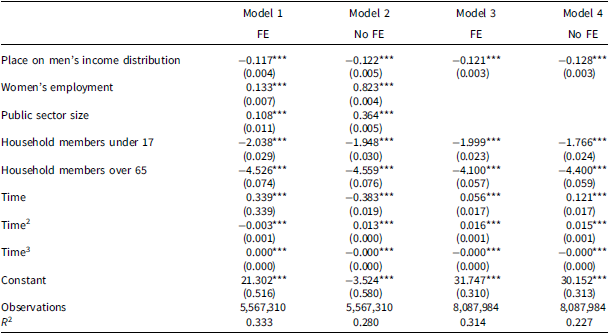
In keeping with literature describing changing trends in gender inequality, we begin by exploring women’s relative income across the income distribution.Footnote 17 Table 1 depicts four models testing H1, which stated that, for a given household, men’s position on the income distribution is negatively associated with women’s relative household income. All models show a negative relationship between men’s income and women’s relative household income. The effect is similar in magnitude in all four models. This suggests that this finding is robust to the inclusion and exclusion of country-level characteristics as controls, as well as to models both with and without country fixed effects.Footnote 18 The magnitude ranges from a 0.117 to a 0.128 percentage point decrease in women’s relative household income for each percentage point increase in men’s income (as a percentage of the mean of men’s income).
OLS regression predicting women’s relative income

Table 1. Long description
A table with four rows and eleven columns comparing four regression models predicting women’s relative income. The columns are labeled Model 1 FE, Model 2 No FE, Model 3 FE, and Model 4 No FE. The rows are labeled with different variables: Place on men’s income distribution, Women’s employment, Public sector size, Household members under 17, Household members over 65, Time, Time squared, Time cubed, Constant, Observations, and R squared. Each cell contains numerical values representing the coefficients, standard errors, and other statistics for each model. The table shows the impact of various factors on women’s relative income, with notable negative relationships for men’s income and household members under 17 and over 65, and positive relationships for women’s employment and public sector size.
Note: *p < 0.05; **p < 0.01; ***p < 0.001.
This means that moving from 10 percent to 100 percent of the mean of men’s income results in an average decrease in women’s relative income of between 10.53 and 11.52 percentage points. Similarly, moving from 100 percent to 200 percent of the mean of men’s income results in a further average decrease in women’s relative income of between 11.7 and 12.8 percentage points. Looking at the entire distribution, the 10th percentile woman contributes approximately 8.6 percentage points more to her household income than does the median woman; and the median woman contributes approximately 18.6 percentage points more to her household income than her counterpart at the 95th percentile. In sum, women with medium-income and, even more so, women with high-income partners enjoy substantially less within-household relative income than those with lower-income partners. We thus find support for H1.
The gender gap in welfare state attitudes across the household income distribution
We theorized that convergence or divergence of welfare state preferences among male and female partners depends on the economic position of households. In low-income households, we expect convergence as both partners would benefit from an equalizing welfare state. At the top of the distribution, within-household income differentials generate more sharply different interests among men and women, leading to divergent preferences. Figure 3 below shows the interaction between (country-level) household income decile and gender on Welfare State support (full regression results can be found in Appendix Table B3).
The gender gap in welfare state attitudes across the household income distribution.

In keeping with H2, we find that household income decile moderates the size of the gender gap in Welfare State support. In the bottom deciles of the household income distribution, women are estimated to have virtually identical or slightly higher Welfare State support than men, but these differences are not statistically significant. By contrast, moving up the household income distribution, we see that estimated differences in Welfare State support become statistically significant and grow in magnitude. In particular, in the top household income decile we see that women are predicted to be only moderately less supportive of the Welfare State than the country average. However, the contrast between women and men in the highest household income decile is clear – where men’s value of Welfare State support is about one fifth of a standard deviation lower than women’s, on average. This is consistent with H2.Footnote 19
H3 focuses on within-household income dynamics. We theorized that, due to varying levels of need and inequality, women’s relative income should not be associated with the magnitude of the gender gap for poorer households, but that gender gaps within affluent households should be conditioned by within-household inequality. Figure 4 below shows, for each, the predicted value of Welfare State support for men and women across the range of women’s relative income, under controls (see Appendix Table B4 for full regression results). To test our expectations, we split the sample between below-median (top panel) and above-median (bottom panel) income households.
The gender gap in welfare state support across the range of women’s relative income.

Consistent with H3, we find no relationship between women’s relative income and the gender gap in welfare state support for below-median income households. In keeping with need-based explanations, both men and women in these lower-income households are estimated to have similar positive values of Welfare State support across the entire range of women’s relative income. In above-median income households, by contrast, the gender gap is strongly conditioned by women’s relative income. Gender gaps in welfare state support are at their largest when men contribute all or most of household income, where we see a gap of about .4 standard deviations. However, in households with lower levels of gendered income inequality, the estimated magnitude of the gender gap shrinks; indeed, in households in which women make at least 60% of income, there is no statistically significant gender gap in welfare state support.Footnote 20
Gender inequality and attitudinal gaps across welfare state contexts
We next examine whether these results broadly hold across welfare state contexts, since both gendered income dynamics and attitudes may be responsive to the structure of the welfare state itself (Huber, Stephens, Bradley et al. Reference Huber, Stephens, Bradley, Moller and Nielsen2009; Gingrich and Ansell Reference Gingrich and Ansell2012). We first turn to our analyses of the LIS data on women’s relative incomes across the income distribution (see Appendix A). We estimate all models controlling for welfare regime type – Liberal, Continental, Social Democratic (and Southern European)Footnote 21 – to see whether results hold when social policy regimes are taken into account.
We find that welfare regime type has an independent effect on women’s relative income share; relative to Liberal countries, those with Continental and Southern European welfare states have on average lower levels of women’s relative income, and those with Social Democratic welfare states have higher levels. However, inclusion of this variable changes neither the significance level nor coefficient magnitude of our main results. In other words, while welfare state regime affects the baseline level of women’s relative income, it does not change the slope. This suggests that while welfare states are successful at reducing inequality between men and women in the home more broadly, they have not done so equally across the income distribution.
We then move to our analyses of ISSP data examining gender gaps in welfare state support (see Appendix D). We subset our analyses by welfare state regime type (Esping-Andersen Reference Esping-Andersen1990). Across all three welfare state types, we observe clear gender gaps in welfare state support for above-median income households, but not in below-median income households (consistent with H2). Furthermore, in keeping with our theory, in above-median income households, gender gaps are sensitive to women’s relative income within the household, in both Continental and Social Democratic welfare states. In Liberal regimes, however, the relationship between women’s relative income and gender gaps in welfare state support is weak and unclear, with evidence inconsistent with H3. In higher-income households, the size of gender gaps is relatively constant and not sensitive to women’s relative income. In lower-income households, gender gaps are not statistically significant, but women are more supportive of the welfare state where they contribute a higher percentage of income to their households.Footnote 22 Overall, gender gaps in welfare state support are conditional on women’s relative income within households, with the exception of countries with Liberal welfare regimes. Additionally, gender gaps in support for the welfare state are conditional on the household’s position on the income distribution across all welfare regime types.
Discussion and conclusion
On aggregate, women are more supportive than men of an equalizing welfare state. However, the gendered nature of economic disparities is not uniform across the household income distribution. Consequently, gender gaps in welfare state support are not constant across the household income distribution either. Our analysis of cross-national ISSP data suggests that there is little to no gender gap in welfare state support for low-income households, as men and women’s attitudes converge in a context of economic vulnerability. Rather, it is in households at the middle and especially the high end of the household income distribution where lower levels of women’s relative income render attitudinal divides over the welfare state particularly sharp.
Our findings diverge significantly from extant work on gendered household dynamics in preference formation. Some scholars have argued that, especially when women’s income is lower, their reliance on their partners will lead to convergence in within-household preferences. They contend that, when women have fewer outside options, they will aim to maximize household income by maximizing their male partner’s income (Becker Reference Becker1964, Reference Becker1981; see also Häusermann, Kurer and Schwander Reference Häusermann, Kurer and Schwander2016 for a similar argument focusing on labor market risk). We find the opposite – it is precisely when there are significant pay discrepancies between men and women that their preferences diverge most sharply. When women are reliant on their partners and have fewer outside options, their relative resources become their most important form of bargaining power within the home (Hobson Reference Hobson1990; Iversen and Rosenbluth Reference Iversen and Rosenbluth2010: 115).
There are several potential reasons for our divergent findings. First, previous empirical research on gender gaps in attitudes has typically focused not on relative income but on labor market attachment or vulnerability as a measure of women’s dependency. This is important in its own right, but misses dynamics related to the current context in which most women work, but gender wage gaps remain large and persistent even for full-time workers. Second, unlike previous studies, we identify the combination of both the household’s income position and women’s relative income as a predictor of gendered convergence or divergence in welfare state support.
We thus agree with Iversen and Rosenbluth (Reference Iversen and Rosenbluth2006, Reference Iversen and Rosenbluth2010) that there is significant within-household conflict between men and women on the basis of income differentials and inequality in labor market options. However, they argue – but do not test – that the resulting divergence in welfare state support is uniform across the income distribution (Iversen, Rosenbluth and Wren Reference Iversen, Rosenbluth, Wren and Wren2013: 312). Rather, they focus on country-level factors (ie skill regimes and size of the public sector) as determinants of the size of those aggregate differences (Iversen and Rosenbluth Reference Iversen and Rosenbluth2010: 118). Our findings contradict this argument in two ways. First, we show that the magnitude of the gender gap in welfare state support varies across the household income distribution – in fact, towards the bottom of the household income distribution there is little to no gender gap at all. Second, we find a strong and consistent relationship between households’ position in the income distribution and the size of the gender gap that holds across a range of heterogenous national contexts.
These findings have implications for welfare state politics. One of the core conclusions of the last decade of scholarship on the subject is that the potential coalition for redistribution has expanded as insecurity has spread well into the middle class, particularly among women (eg Schwander and Häusermann Reference Schwander and Häusermann2013; Gingrich and Häusermann Reference Gingrich and Häusermann2015; Häusermann, Kurer and Schwander Reference Häusermann, Kurer and Schwander2015; Schwander Reference Schwander2020). Male-dominated winner-take-all inequality makes women less equal both in the labor market and at home. Our findings build on this work by suggesting that middle- and upper-income women do not turn against the welfare state as sharply as their male counterparts because of their relative economic standing in the home. Support for a redistributive welfare state and attitudes towards gender inequality are thus to some extent broadly complementary under the current inequality regime, where the financial elite are mostly men, and high-paid occupations have glass ceilings. Since gender gaps in income and in support for the welfare state are higher at the top of the income distribution, increasing overall income inequality in the context of stalled progress towards gender equality can be expected to sharpen this divide.
This also has implications for the electoral consequences of welfare reform strategies, especially for Social Democratic parties. These parties have embraced social investment as a way to attract middle-class women by helping them reconcile work and family in a form of ‘supply-side solidarity’ (Baccaro and Locke Reference Baccaro and Locke1998; Thelen Reference Thelen2014: 15; see also Iversen and Rosenbluth Reference Iversen and Rosenbluth2006; Morgan Reference Morgan2013; Thelen Reference Thelen2014; Ansell and Gingrich Reference Ansell, Gingrich, Bermanedi, Häusermann, Kitschelt and Kriesi2015). Women indeed tend to support social investment policies like childcare and parental leave, which boost their career prospects and pay (Iversen and Rosenbluth Reference Iversen and Rosenbluth2006; Morel, Palier and Palme Reference Morel, Palier and Palme2012; Häusermann, Kurer and Schwander Reference Häusermann, Kurer and Schwander2015; Garritzmann and Schwander Reference Garritzmann and Schwander2021). Our analyses suggest that progressive redistribution, which taxes high (predominantly male) incomes to fund social safety nets, may also be attractive to some women from the perspective of within-household inequality. This may help to explain not only why women demonstrate greater general support for an encompassing welfare state but also why they appear unwilling to trade off social consumption policies for social investment (Garritzmann and Schwander Reference Garritzmann and Schwander2021: 261). Given gender divides within higher-income households, welfare reform strategies which increase progressive taxation to expand the overall welfare state budget may be less electorally dangerous than those which recalibrate spending away from social consumption to social investment.
Our analyses do have some limitations, which could be addressed in future research. Firstly, our reliance on cross-sectional data comes with several drawbacks. Data that include time-varying country-level factors, such as spending on family benefits, are necessary to assess the effects of changes in welfare state structure on gender gaps in welfare state support. Second, we are unable to make strong causal claims about the relationship between within-household income dynamics and gender gaps in support for the welfare state. It is possible that ideology may condition men’s and women’s preferences for forming couples with egalitarian or unequal distributions of income. If this is the case, then ideology may predict within-household income inequality rather than the reverse. While robustness tests presented in the Appendix do account for ideology as a control variable, follow-up work would benefit from probing the causal direction of this relationship. In particular, panel data would allow for directly testing whether changes in women’s relative income within households cause commensurate shifts in gender gaps in welfare state attitudes.
Additionally, future work could benefit from taking a broader perspective on household composition and intra-household differences in support for the welfare state. In keeping with existing literature (eg Häusermann, Kurer and Schwander Reference Häusermann, Kurer and Schwander2016; Abou-Chadi and Kurer Reference Abou-Chadi and Kurer2021), we focus on heterosexual couples due to our interest in male-female gender dynamics. There is growing recognition, though, that within-household income differentials may influence relationship and power dynamics among LGBTQ+ couples as well (eg Howard, Blumstein and Schwartz Reference Howard, Blumstein and Schwartz1986; Peplau and Cochran Reference Peplau, Cochran, McWhirter, Sanders and Machover Reinisch1990; Kalmijn, Loeve and Manting Reference Kalmijn, Loeve and Manting2007; Schneider, Schönberg and Ferié Reference Schneider, Schönberg and Ferié2017; Lazarus and Mandel Reference Lazarus and Mandel2023). Integrating these perspectives could shed light on the relative weight of gender norms and income disparities in shaping gaps in welfare state attitudes within households. Finally, further research should examine whether the attitudinal gaps found in our analyses also manifest in more sharply divergent voting behavior between men and women in high-income households relative to lower- and medium-income households.
Supplementary material
The supplementary material for this article can be found at https://doi.org/10.1017/S1475676526101765
Data availability statement
Luxembourg Income Study (LIS) Data that support the findings for H1 of this study and associated Appendices are available at https://www.lisdatacenter.org/data-access/ via the LISSY system. International Social Survey Programme (ISSP) data which support the findings for H2 and H3 can be found at https://www.gesis.org/en/issp/data-and-documentation/role-of-government/2016 and the European Social Survey (ESS) data for Appendix C is available at https://ess.sikt.no/en/datafile/ffc43f48-e15a-4a1c-8813-47eda377c355. Replication files for data management and analysis of LIS data, ISSP data, and ESS data, for both the manuscript and Appendices, are provided in this article’s online supplementary materials.
Acknowledgements
We are thankful to all those who have given comments on earlier drafts of this paper, including especially Pamela Conover, Eloisa Harris, Silja Häusermann, Julian Garritzmann, Matthias Enggist, John D Stephens, Evelyne Huber, and the anonymous reviewers. We are also thankful to the political science departments of the University of Zurich and Grinnell College, for invaluable feedback provided at their respective departmental seminars.
Competing interests
The author(s) declared no potential conflicts of interest with respect to the research, authorship, and/or publication of this article.
Funding statement
The research presented in this article has received partial financial support from VELUX FOUNDATIONS as part of the Velux Core Group ‘The Politics of Insecurity (POINS)’, Project No. 26613.




 Open access

