Introduction
Allergic rhinitis is a symptomatic disorder of the nose that is induced after allergen exposure and caused by immunoglobulin E (IgE) mediated inflammation of the membrane lining the nose. It is characterised by nasal congestion, rhinorrhoea, sneezing, itching of the nose and/or postnasal drainage.Reference Wallace, Dykewicz, Bernstein, Blessing-Moore, David and David1 Allergic rhinitis is the most common form of non-infectious rhinitis, affecting between 10 and 30 per cent of all adults, and as many as 40 per cent of children. The prevalence of allergic rhinitis continues to increase worldwide. Allergic rhinitis affects 500 million people around the world, with 100 million of the affected people living in the Indian subcontinent.Reference Bousquet, Khaltaev, Cruz, Denburg, Fokkens and Togias2
Treatment of allergic rhinitis involves allergen avoidance, pharmacotherapy, immunotherapy and patient education. Identifying the profile of allergens aids allergen avoidance, immunotherapy planning and patient education. There are very few studies on allergic rhinitis in India. Therefore, our aim was to study the profile of offending allergens in patients with allergic rhinitis in Bangalore. The skin prick test was used to identify allergen sensitivity in our study.
Materials and methods
This was a descriptive study conducted at our allergy clinic from January 2011 to December 2012. The skin prick test was used on 486 patients suffering from allergic rhinitis, who were diagnosed based on the Allergic Rhinitis and its Impact on Asthma (‘ARIA’) guidelines.Reference Bousquet, Khaltaev, Cruz, Denburg, Fokkens and Togias2 Pregnant and lactating women were excluded from the study.
A detailed history was taken from all patients. Patients were subjected to clinical examination and investigations, such as total leucocyte count, differential count and absolute eosinophil count. Informed consent was obtained, which was approved by the institutional ethics committee.
Skin prick test
The allergens were obtained from Creative Diagnostic Medicare Private (Navi Mumbai, India). The test was performed with 49 allergen extracts, which included 19 types of pollen, 10 kinds of fungi, 5 types of dust, 2 species of dust mites, 10 kinds of insects and 3 types of epithelia.
Patients stopped taking long-acting antihistamines for 2 weeks, and short-acting antihistamines and sympathomimetic drugs for 5 days prior to the test. The skin prick test was performed on the flexor aspect of the arm and forearm. In children, the skin prick test was performed on the back.
The interpretation of results was carried out in accordance with the Indian College of Allergy, Asthma and Applied Immunology guidelines.Reference Gaur, Singh, Singh, Vijayan and Agarwal3 Those results classified as grade 2+ and above were considered positive.
Results
The skin prick test was performed on 486 patients with allergic rhinitis; 231 patients (47.5 per cent) were males and 255 (52.5 per cent) were females. The majority of patients (63.58 per cent) were in the 21–40-year age group (as indicated by the 21–30 and 31–40 age group bars in Figure 1). A total of 175 patients (36.01 per cent) had a family history of allergic rhinitis or atopy. Of the 486 allergic rhinitis patients, 212 (43.6 per cent) had asthma, 144 (29.6 per cent) had chronic urticaria and 122 (25.1 per cent) had allergic conjunctivitis.
Age and sex distribution of study population (n=486).

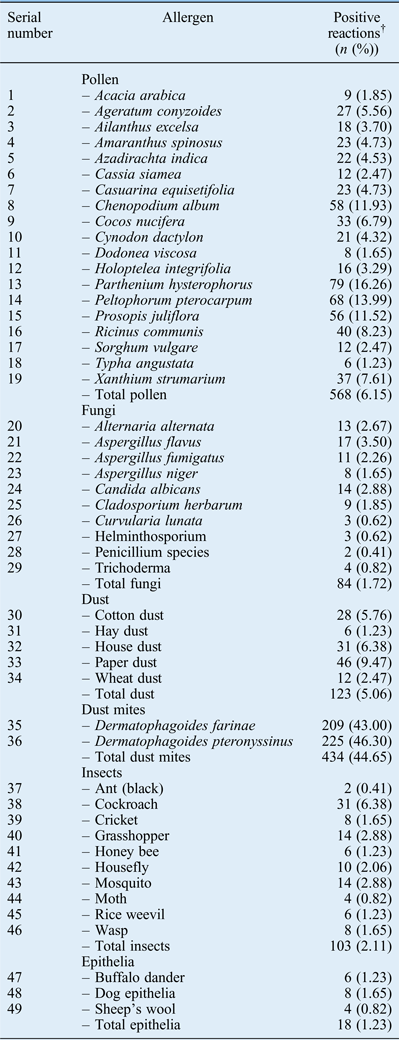
Of the 486 patients tested, 335 (68.93 per cent) were sensitive to one or more allergens (Table I). The most common offending allergen was the dust mite, with positive results in 44.65 per cent of cases. This was followed by pollen (6.15 per cent), dust (5.06 per cent), insects (2.11 per cent), fungi (1.72 per cent) and epithelia (1.23 per cent).
Skin prick test reactions to various allergens*
* Number of patients = 486. †Reaction of grade 2+ and above.
Among dust mites, the most common mite was Dermatophagoides pteronyssinus (46.30 per cent), followed by Dermatophagoides farinae (43.00 per cent).
The most common pollen allergen was Parthenium hysterophorus (16.26 per cent), followed by Peltophorum pterocarpum (13.99 per cent), Chenopodium album (11.93 per cent), Prosopis juliflora (11.52 per cent), Ricinus communis (8.23 per cent), Xanthium strumarium (7.61 per cent), Cocos nucifera (6.79 per cent), Ageratum conyzoides (5.56 per cent), Amaranthus spinosus (4.73 per cent) and Azadirachta indica (4.53 per cent).
The most common insect allergen was the cockroach (6.38 per cent), followed by the grasshopper (2.88 per cent), mosquito (2.88 per cent), housefly (2.06 per cent) and cricket (1.65 per cent).
The most common dust allergen was paper dust (9.47 per cent), followed by house dust (6.38 per cent), cotton dust (5.76 per cent) and wheat dust (2.47 per cent).
The common fungi detected were Aspergillus flavus (3.50 per cent), Candida albicans (2.88 per cent), Alternaria alternata (2.67 per cent), Aspergillus fumigatus (2.26 per cent), Cladosporium herbarum (1.85 per cent) and Aspergillus niger (1.65 per cent).
The common epithelial allergens were dog (1.65 per cent), buffalo (1.23 per cent) and sheep (0.82 per cent) epithelia.
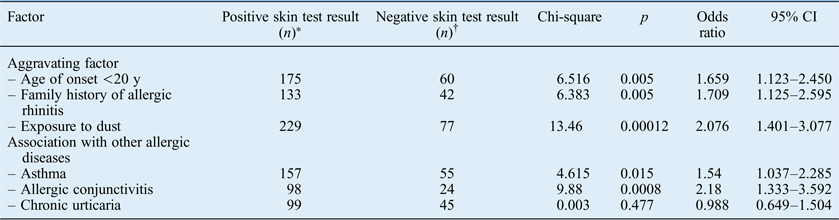
The data of patients with positive and negative skin prick test results were compared. This revealed stronger associations between skin prick test positive cases and bronchial asthma and allergic conjunctivitis compared with negative cases; these findings were statistically significant (p < 0.05). The probability of having a positive skin prick test result was higher when the age of disease onset was less than 20 years and in those with a family history of atopy (p < 0.05). Dust-induced aggravation of symptoms was greater in patients with positive skin prick test results as compared with those who had negative skin prick test results, and the difference was found to be statistically significant (p < 0.05) (Table II).
Comparison of allergic rhinitis patients with positive versus negative skin prick test results
*Total n = 335; †total n = 151. CI = confidence interval; y = years
Discussion
Allergic rhinitis is a global health problem that is also responsible for several co-morbid conditions. The diagnosis of an allergy to a specific allergen enables patients to avoid the allergen and makes them candidates for allergen-specific immunotherapy.Reference Gendo and Larson4
Allergen sensitivity can be diagnosed by a skin prick test, an intradermal test, specific IgE estimation and an allergen provocation test. Skin prick testing is currently considered the most valuable test in the diagnosis of IgE-mediated allergic disorders. Skin prick testing is more sensitive than specific IgE estimation and has the best positive predictive value in diagnosing respiratory atopic diseases.Reference Choi, Koh, Koh and Lee5 It is also simple, inexpensive and provides immediate educational information to both the patient and the doctor.Reference Tschopp, Sistek, Schindler, Leuenberger, Perrachoud and Wuthrich6
In the present study, the commonest allergen was the dust mite (44.65 per cent), followed by pollens (6.15 per cent), dust (5.06 per cent), insects (2.11 per cent), fungi (1.72 per cent) and epithelia (1.23 per cent). Table III compares the allergen sensitivity findings in this study with those of other studies.Reference Prasad, Verma, Dua, Kant, Kushwaha and Agarwal7–Reference Kumar, Sharan, Kumar, Bisht and Gaur9 The variation in the allergen-positive results across the different studies may be due to the use of different allergen extracts and/or grading criteria. Skin allergy testing performed in Indian adults by Shah and Pawankar indicated that the house dust mite (D farinae) was the most common allergen.Reference Shah and Pawankar10 In the present study, the commonest dust mite was D pteronyssinus (46.30 per cent).
Comparison of allergen sensitivity in various studies
The most commonly detected pollen allergens in the current study were P hysterophorus (16.26 per cent), P pterocarpum (13.99 per cent), C album (11.93 per cent), P juliflora (11.52 per cent), R communis (8.23 per cent), X strumarium (7.61 per cent), C nucifera (6.79 per cent), A conyzoides (5.56 per cent), A spinosus (4.73 per cent) and A indica (4.53 per cent). Studies carried out in Southern India found that casuarina, parthenium, spathodea, cheno-amaranth, cocos, eucalyptus, poaceae, peltophorum and cyperaceae were the dominant pollen allergens.11, Reference Singh and Kumar12 Subbarao et al. found allergenicity to P hysterophorus pollen extracts in 12 per cent of allergic rhinitis patients from Bangalore.Reference Subbarao, Prakash and Subbarao13 In a similar study by Prasad et al., conducted in Lucknow, the most common pollen was A spinosus (35.4 per cent), followed by Argemone mexicana (22.9 per cent), Adhatoda vasica (18.5 per cent), ailanthus (12.5 per cent) and cannabis (8.3 per cent).Reference Prasad, Verma, Dua, Kant, Kushwaha and Agarwal7 In a study by Agrawal et al., conducted in Allahabad, Uttar Pradesh, the most common pollen was Cynodon dactylon (56 per cent), followed by Gynandropsis gynandra (54 per cent), Brassica campestris (52 per cent), Putranjiva roxburghii (52 per cent), Sorghum vulgare (46 per cent), C album (32 per cent), X strumarium (28 per cent) and P hysterophorus (26 per cent).Reference Agrawal, Chandra, Jain and Agrawal8 The variation in pollen sensitivity shown in the above studies may be because of geographical variation.
• Allergic rhinitis is a growing problem worldwide
• The skin prick test is an efficient diagnostic tool
• Skin prick test positivity increased in allergic rhinitis patients with early onset of disease, family history of atopy and other co-morbid atopic conditions (e.g. asthma and allergic conjunctivitis)
• This study is one of the largest conducted on a South Indian urban population
• It aimed to identify the allergen profile in allergic rhinitis patients
• The results can enhance patient education, immunotherapy planning and allergen test selection, and enable allergen avoidance
In the present study, 1.72 per cent of patients tested positive to fungi. The most common fungus was A flavus (3.50 per cent), followed by C albicans (2.88 per cent), A alternata (2.67 per cent), A fumigatus (2.26 per cent), C herbarum (1.85 per cent) and A niger (1.65 per cent). The study conducted by Agrawal et al. showed marked skin positivity to A fumigatus (16 per cent), followed by C albicans (10 per cent) and A niger (10 per cent).Reference Agrawal, Chandra, Jain and Agrawal8 In a study by Prasad et al., the most common fungal antigen was A fumigatus, followed by A flavus, Alternaria tenuis and Fusarium solani. Reference Prasad, Verma, Dua, Kant, Kushwaha and Agarwal7 Aspergillus species were common allergens in both studies, consistent with our study findings.
In the present study, 2.11 per cent of patients were allergic to insects. The common insect allergens were cockroach (6.38 per cent), grasshopper (2.88 per cent), mosquito (2.88 per cent), housefly (2.06 per cent) and cricket (1.65 per cent). In a study by Prasad et al., the common insect allergens were female locust (33.3 per cent), male locust (25 per cent), grasshopper (20.8 per cent), cricket (16.7 per cent), female cockroach (16.7 per cent) and male cockroach (14.6 per cent).Reference Prasad, Verma, Dua, Kant, Kushwaha and Agarwal7 Gaur et al. found that allergies to moths, mosquitoes, locusts, cockroaches and grasshoppers were common in patients with nasobronchial allergy.Reference Gaur, Kapoor, Garg and Agarwal14 Similarly, Acharya found that moth, mosquito and ant allergens were commonly responsible for nasobronchial allergy.Reference Acharya15
Different geo-climatic conditions have resulted in variations in the prevalence of aeroallergen reactivities in different regions. Adaptation of specific microbiological flora and fauna in specific climatic conditions also adds to the variation of allergens. The percentage of allergen positivity varies from one study to another. This may be because different studies adopt different types of allergens. There is no uniformity in the selection of allergens used for testing. The strengths of allergen extracts used and the criteria for skin reactivity grading also vary from one study to another. There is a need for guidelines on the selection of allergens utilised for testing and for a standardised grading system, for use in allergic rhinitis and respiratory allergy cases.
Conclusion
The most common allergen for allergic rhinitis in our study was the dust mite. Allergens responsible for allergic rhinitis have geographical, seasonal and subject variation. A positive reaction with the skin prick test was found to correlate with early onset of allergic rhinitis (age of less than 20 years) and family history of atopy. In addition, there was an association with other atopic conditions, such as asthma and allergic conjunctivitis. The study findings could aid the selection of allergens for the skin prick test in this part of the world, avoiding unnecessary testing for other allergens.