1 Introduction
1.1 Soft ‘g’ in the literature
One of the most contentious issues in the phonology and phonetics of Turkish is probably the so-called soft ‘g’. Soft ‘g’, known in Turkish as yumuşak g and spelt <ğ> in Turkish orthography, is treated as a phoneme (Kornfilt Reference Kornfilt1997, Kabak Reference Kabak2007) or as an allophone of /ɡ/ (Underhill Reference Underhill1976, Konrot Reference Konrot1981). In IPA terms, it is either represented as a velar fricative /ɣ/ in the Turkish phoneme inventory (see Table 1 below and Zimmer & Orgun Reference Zimmer and Orgun1999) or it is not represented at all. For instance, Kopkallı-Yavuz (Reference Kopkallı-Yavuz, Yavaş and Topbaş2010: 27), when providing the consonantal system of Turkish based on a grapheme–phoneme correspondence, states that ‘for the letter <ğ>, no IPA symbol is given because there is a controversy as to which sound it represents’. Since there is no consensus as to which IPA symbol represents the soft ‘g’, we will use, similarly to Kabak (Reference Kabak2007) and Kılıç & Erdem (Reference Kılıç and Erdem2013), the abstract symbol /ğ/, which roughly corresponds to the letter <ğ>.Footnote 1 Anticipating the results of the phonological part of the study we will use the phonemic and not allophonic representation for denoting this sound.
The phonemic consonantal system of Turkish according to the IPA Handbook (Zimmer & Orgun Reference Zimmer and Orgun1999).

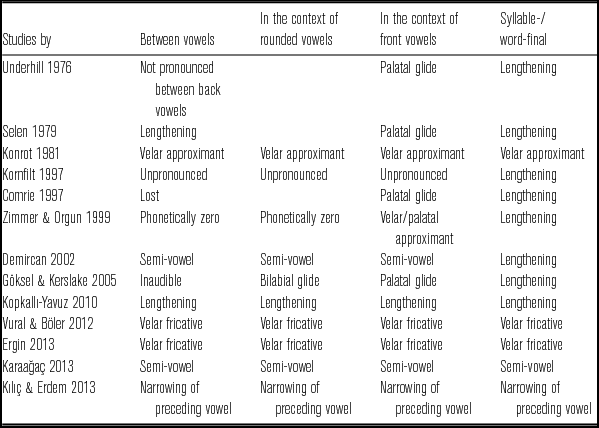
In addition to different phonemic transcriptions of /ğ/, its phonetic realization has also been subject to substantial variation. In Table 2 we provide an overview of its different pronunciation variants and their descriptions, remaining as faithful as possible to the original sources. Note that different authors use different terms for describing the same variant. For instance, if the /ğ/ is not phonetically realized, it is dubbed ‘inaudible’, ‘unpronounced’, ‘phonetically zero’, or ‘lost’.
Overview of pronunciation variants of <ğ> in different contexts.

As can be seen in Table 2, the phonetic realization of /ğ/ is at least controversial. While some authors have suggested that soft ‘g’ is not pronounced at all (e.g. Kornfilt Reference Kornfilt1997; see Table 2), others have reported a large degree of contextual variation. According to Zimmer & Orgun (Reference Zimmer and Orgun1999: 154) the fricative /ɣ/ is realized ‘as a weak front-velar’ or a palatal approximant between front vowels. In addition, /ğ/ is realized as a vocalic element, i.e., a lengthening of the preceding vowel in word-final position or when followed by a consonant (/Vğ#/ → [Vː], /Vğ.C/ → [VːC]). This controversy is especially striking when /ğ/ occurs in intervocalic position: while some scholars have claimed that /ğ/ is ‘simply lost’ (e.g. Comrie Reference Comrie and Kaye1997: 885), others have maintained that it is realized either as a fricative (e.g. Vural & Böler Reference Vural and Böler2012) or as an approximant (e.g. Konrot Reference Konrot1981; see also Section 3 below).
The amount of variation reported in the realization of /ğ/ is impressive and challenging to explain. Factors such as coarticulation as well as dialectal and social aspects have not been studied intensively and may therefore have contributed to the phonetic variation reported previously. For instance, Underhill (Reference Underhill1976), Kornfilt (Reference Kornfilt1997), and Göksel & Kerslake (Reference Göksel and Kerslake2005) have noted that /ğ/ is pronounced as a voiced velar fricative [ɣ] in some dialects without specifying which ones. Furthermore, the realization of /ğ/ may be particularly prone to coarticulatory processes and therefore changes with respect to the position within the word (word-medial position: /V.ğV/, /Vğ.C/ and word-final position: /Vğ#/). In fact, substantial contextual variations have been identified for velar stops in different languages, e.g. Swedish and American English (Löfqvist & Gracco Reference Löfqvist and Gracco1994), German (Mooshammer, Hoole & Kühnert Reference Mooshammer, Hoole and Kühnert1995), German and Hungarian (Geng Reference Geng2010); they depend on changes in the surrounding vowel along the front–back dimension.
Another factor which may cause difficulty in creating a homogeneous description of /ğ/ may be that most studies are based on the authors’ impressionistic observations. There are only a few phonetic studies investigating soft ‘g’ in Modern Turkish with different amounts of detail.
One of the first acoustic studies was carried out by Selen (Reference Selen1979). On the basis of spectrograms she observed that /ğ/ is produced as lengthening of the preceding vowel. She also pointed out that in the context of front vowels /ğ/ can turn into a palatal glide.
Konrot (Reference Konrot1981) compared the production of word pairs differing in terms of the presence or absence of <ğ>. The main finding of the study was that words with /ğ/ have a longer preceding vowel. Konrot also noticed that the second and the third formants converge during the realization of /ğ/, which he interpreted as an indication of there being a velar. In conclusion, Konrot (Reference Konrot1981: 20) claimed that the ‘phonetic value of the so-called “soft-g” cannot be said to be [∅] totally’. In a follow-up perception study, he provided evidence that vowel lengthening is a sufficient auditory cue to perceive the underlying /ğ/.
Furthermore, Kopkallı-Yavuz et al. (Reference Kopkallı-Yavuz, Koçak, Topbaş and Cangökçe-Yaşar2008) ran an acoustic and a videofluoroscopic experiment. In both experiments participants were recorded while reading word pairs with and without /ğ/. The results of the acoustic experiment revealed that speakers did not realize a velar consonant and the vowel durations in words containing /ğ/ were almost twice as long as those of vowels appearing in words without /ğ/. However, the results were not statistically tested. In the videofluoroscopic experiment the following articulatory movements were observed in words containing /ğ/ (but not in those without): (i) velar elevation, (ii) stronger velopharyngeal closure, and (iii) more pharyngeal tension. Kopkallı-Yavuz et al. (Reference Kopkallı-Yavuz, Koçak, Topbaş and Cangökçe-Yaşar2008) interpreted these movements as evidence for an increase in the tenseness of the preceding vowel.
Lastly, in Kılıç & Erdem (Reference Kılıç and Erdem2013) the acoustic and perceptual properties of soft ‘g’ were investigated. The participants produced words in which /ğ/ occurred in all possible word positions and vowel contexts. Spectrographic inspections mainly revealed that /ğ/ was realized as a velar consonant, that it was often affected by the surrounding vowel context, and that it varied a great deal. In a perception test they used real and nonce words and manipulated their duration, pitch, intensity, and formant frequency. They claim that in the perception of artificially lengthened vowels several factors contribute to the perception of /ğ/: (i) increased f0, (ii) decreased F1, as well as (iii) decreased intensity of the second part of the lengthened vowel. However, just prolonging the vowel was also enough to perceive /ğ/ in a given word. Because Kılıç & Erdem (Reference Kılıç and Erdem2013) do not present their method in sufficient detail and do not provide any statistics, it is hard to quantify the effect of these three factors and their contributions to the perception of /ğ/.
2 Aims and structure of the paper
In light of the lack of consensus regarding soft ‘g’, the primary aim of this paper is to deepen our understanding of the phonetic and phonological status of this sound in Modern Turkish. In contrast to previous studies we investigate /ğ/ from both a diachronic and a synchronic perspective in order to develop a comprehensive view of the matter.
In Section 3, we investigate the origin of the letter <ğ> in the Ottoman script. A diachronic perspective is helpful in understanding why the letter <ğ> was added to the Modern Turkish alphabet during the orthography reform of 1928. This also allows us to better comprehend which Ottoman letters it was originally based upon.
In Section 4, we study /ğ/ from a phonological perspective. We make use of the grapheme–phoneme correspondence in Turkish and report the results of a dictionary search aimed at providing a comprehensive overview of contexts in which /ğ/ occurs. Such an analysis will shed some light on the controversy concerning the phonemic versus allophonic status of soft ‘g’ and its potential complementary distribution with [ɡ]. The online dictionary search is therefore used to test the phonological status of /ğ/ and its distribution.
In Section 5, we provide evidence from two experiments which examine the phonetic realization of /ğ/ in different vowel contexts and positions within the word. In addition, we analyse synchronic changes in the production of soft ‘g’ between a younger and a more elderly population of speakers to investigate whether the pronunciation variation reported in the literature could be due to a potential sound change.
Finally, in Section 6 we offer a phonetic explanation of the change under discussion by considering similar processes from a cross-linguistic perspective.
3 Historical background: From Ottoman script to the Modern Turkish alphabet
The appearance of soft ‘g’ is closely related to that of the voiced velar stop /ɡ/, whose diachronic development is shown in Figure 1.
Stages of sound change affecting /g/.

From a historical perspective, soft ‘g’ originated from the phoneme /ɡ/. This phoneme underwent a change to [ɟ] in the context of front vowels (Vfront_), but remained [ɡ] in the context of back vowels (Vback_). Over time, [ɡ] and [ɟ] underwent changes in weak positions, i.e. word-medially (intervocalically and syllable-finally) and word-finally: [ɡ] turned into [ɣ] in the context of back vowels whereas [ɟ] turned into [j] in the context of front vowels. In the Ottoman script, these two sounds were represented with two different letters. While <غ> (pronounced as [ɣ]) was used in the context of back vowels, <گ> (pronounced as [j]) was used in the context of front vowels. Redhouse (Reference Redhouse1884: 39) compared Arabic <غ> with French <r>, specifically the so-called r grasseyé (i.e. the uvular trill), and claimed that the Turkish version of this sound is lenited and is practically disappearing from the pronunciation.
In 1928, an orthography reform took place in Turkey replacing the Ottoman script with a version of the Latin alphabet. During this reform a clear grapheme-to-phoneme relation was constructed resulting in the use of a single letter for each phoneme (see e.g. Kısıklı Reference Kısıklı2012: 688–689), and soft ‘g’ was assigned the letter <ğ> in the Turkish orthography. This reform obliterated vowel context differences by replacing different letters, <گ> and <غ>, with one letter, <ğ>.
4 Evidence from a Turkish dictionary: Phonological status and contextual distributions
The directness of the relation between graphemes and phonemes in Turkish orthography discussed above allows us to search for the contextual environment of /ğ/ by using a Turkish dictionary.
In light of the historical development and discussion in previous studies concerning soft ‘g’ and its phonological status, we investigated the contexts in which /ğ/ and /ɡ/ occur in Modern Turkish; see Figure 1. Context effects were analysed with respect to the adjacent phonemes and position within a word.
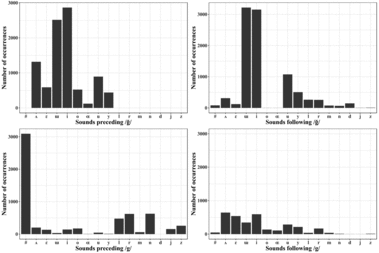
We searched for the contextual environment of /ğ/ and /ɡ/ using the online Turkish dictionary by Büyük Türkçe Sözlük (Reference Sözlük2010). This dictionary consists of 62,593 Turkish words, 9,957 of which contain /ğ/ and 5,657 of which contain /ɡ/. Note that proper nouns, suffixed and compound words were included in our database. The text-editor Sublime Text 2 (2.0.2, 2013; http://www.sublimetext.com, accessed 8 July 2013) was used to extract all tokens containing /ğ/ and /ɡ/, and the distribution analyses were carried out with R (version 2.15, R Development Core Team 2013). These analyses allowed a better understanding of the phonological status of /ğ/ and /ɡ/, as we not only searched for examples for each case, but also extracted the frequency distribution of both graphemes based on the entries in the dictionary (Figure 2).
Lexical distribution of phonemes preceding and following /ğ/ and /g/ (words with fewer than 50 occurrences have been excluded from all conditions).

The exact frequency values and contextual environment of /ğ/ and /ɡ/ are provided in Appendix A and B. Note that in Figure 2 the preceding and following contexts are treated independently, i.e. they do not always pertain to the same word. For a better understanding of the phonological environment, we show phonemes instead of graphemes in Figure 2.
Our results indicate that:
1. /ğ/ never occurs in word-initial position.
2. /ğ/ is always preceded by vowels (graphemes that correspond to /i ɯ ʌ u ɛ o y œ/)Footnote 2 and is followed either by vowels or by sonorants, i.e. the lateral approximant /l/, the tap /ɾ/, and the nasals /m n/ (see Figure 2). When /ğ/ is followed by a sonorant consonant, they are separated by a syllable boundary (/Vğ.CV/).
3. /ğ/ never occurs adjacent to obstruents, with the exception of a few loan words (e.g. <ağda> ‘wax’) and suffixes (e.g. <bağ-cı> ‘vinedresser’).
4. /ğ/ is found most frequently in the context of high unrounded vowels, either front /i_i/ or back /ɯ_ɯ/.
5. The occurrences of /ğ/ after rounded vowels (/o œ u y/) are considerably less frequent, but still present. The reason for this distribution might be another sound change that soft ‘g’ has undergone. In some verbs, /ğ/ preceded by round vowels and followed by back vowels or consonants changed to weak [v] or [w]. For instance, since the orthography reform in 1928 the verbs historically written as <döğmek> ‘to beat’, <öğmek> ‘to praise’, and <koğmak> ‘to chase away’ are written as <dövmek>, <övmek>, and <kovmak>, where <v> is pronounced as [v] (Lewis Reference Lewis2000: 5), or as [ʋ] (Kopkallı-Yavuz Reference Kopkallı-Yavuz, Yavaş and Topbaş2010: 31).
6. There are very few pairs with either /ğ/ or /ɡ/ in intervocalic position, but they have the same meaning and can be used interchangeably, e.g. <öğe> ‘element’ and <öge> ‘element’.
In brief, our search of the dictionary of Modern Turkish shows that /ğ/ never appears in word-initial position, where /ɡ/ is found instead. More importantly, <ğ> is always preceded by a vowel, and followed by either a vowel or less frequently by a sonorant. It occurs more frequently in the context of high unrounded vowels.
Next, we investigated the potential allophonic status of soft ‘g’ with respect to /ɡ/, which itself is a controversial issue in Turkish phonology. For instance, while Konrot (Reference Konrot1981) argues that soft ‘g’ is still an allophone of /ɡ/, Kornfilt (Reference Kornfilt1997: 488) attributes phonemic status to this segment. Like Konrot (Reference Konrot1981), Underhill (Reference Underhill1976) also argues that the distribution of soft ‘g’ and /ɡ/ must be complementary since they do not appear in the same position. This is also – to some extent – in agreement with the results from our dictionary search which revealed that /ɡ/ is found (i) word-initially (/#gV/) and (ii) word-medially: syllable-initially when preceded by a consonant (/C.gV/) (Figure 3). In contrast, /ğ/ is found (i) word-medially: in the intervocalic position (/V.ğV/), and syllable-finally when followed by a consonant (/Vğ.C/), and (ii) word-finally (/Vğ#/). However, as shown in Figure 3, there are also items with /ɡ/ in the V._V context (489 items in total), the V_.C context (281 items), and the V_# context (48 items). A closer inspection of the data revealed that these items are loan words which, however, have been assimilated into the Turkish native vocabulary via different morpho-phonological rules. For example, the stem-final consonants /p t k tʃ/ change to their voiced counterparts before a vowel-initial suffix with the exception of /k/ which changes to [ğ] (Göksel & Kerslake Reference Göksel and Kerslake2005: 14). The native word <ekmek> ‘bread’, for instance, changes to <ekmeğ-in> ‘of the bread’ and similarly, the loan word <elektrik> ʻelectricity’ changes to <elektriğ-in> ‘of the electricity’. In some recent loans, final /ɡ/ is either retained or it changes to soft ‘g’ before a vowel-initial suffix, e.g. <jeolog> ‘geologist’ changes to <jeoloğ-un> ‘of the geologist’ (Comrie Reference Comrie and Kaye1997: 892).
Distribution of /g/ versus /ğ/ according to their position and vocalic or consonantal context in a word. _V: word-initial, V._V: intervocalic, C._V: following a consonant and preceding a vowel, V_.C: following a vowel and preceding a consonant, V_: syllable-final.

To summarize, the dictionary search revealed that /ɡ/ and /ğ/ are not necessarily in complementary distribution if loan words are taken into account. Since Modern Turkish has many loanwords from Arabic, Persian and more recently ones from languages of western Europe and the Balkans (Comrie Reference Comrie and Kaye1997: 883) it is hard to exclude them from Turkish vocabulary since they are well integrated and widely used. For instance, many occupation names such as <psikolog> ‘psychologist’ and <kardiolog> ‘cardiologist’ are recent loan words but they are widely accepted and used by Modern Turkish speakers. Therefore, the phoneme /ɡ/ is found in word-final positions almost as often as /ğ/, in our dictionary search.
5 Phonetic realization of soft ‘g’
In this section, we present two acoustic experiments investigating the current phonetic realization of /ğ/ in Modern Turkish. The aim of these studies is to search for empirical evidence for the phonetic realization of /ğ/ and to extend previous studies by examining a comprehensive set of data elicited from a larger number of speakers than in previous studies and by investigating different age groups.
5.1 Hypotheses
We pose the following hypotheses about the phonetic realization of /ğ/:
• Hypothesis 1: The major acoustic property of the phonetic realization of /ğ/ is the lengthening of the preceding vowel.
This hypothesis is grounded in phonetic studies, in particular by Kopkallı-Yavuz et al. (Reference Kopkallı-Yavuz, Koçak, Topbaş and Cangökçe-Yaşar2008). With two acoustic experiments, we aim to further substantiate whether the preceding vowel is lengthened or whether acoustic properties of a velar gesture can be found. If /ğ/ is produced with a velar gesture, we expect a decrease in F1, an increase in F2, and a decrease in F3 from the preceding vowel to the velar (Stevens Reference Stevens1998: 367). If the vowel is only lengthened, we expect a continuation of the formant frequencies of the respective vowel.
• Hypothesis 2: /ğ/ shows different realizations depending on the vowel context.
Since soft ‘g’ has been described as a sound with considerable variation, its realization might be dependent on vowel context, as has been shown for velar stops in general (Löfqvist & Gracco Reference Löfqvist and Gracco1994, Mooshammer et al. Reference Mooshammer, Hoole and Kühnert1995). Moreover, our historical analysis revealed that before the orthography reform took place two different letters were used in the Ottoman script, one for the front vowel and one for the back vowel context. Hence, vowel context may be a good indicator of different realizations of /ğ/.
• Hypothesis 3: /ğ/ shows different realizations depending on its position in the syllable and the word.
Most of the previous acoustic studies investigated one position, based upon which conclusions concerning other positions were derived. However, different positions can affect the acoustic properties of soft ‘g’. This could contribute to the variety of /ğ/ realizations reported in the literature.
• Hypothesis 4: Elderly speakers realize /ğ/ as a velar fricative, while younger speakers lengthen the preceding vowel.
This hypothesis investigates the possibility of an ongoing sound change from a velar stop (as shown by the historical and lexical analysis) towards a long vowel (as frequently observed phonetically).
5.2 Experiment 1
In Experiment 1 particular emphasis was placed on testing Hypothesis 1 that /ğ/ is phonetically manifested as lengthening of the preceding vowel. We tested word pairs which differed in the presence vs. absence of /ğ/. We expected that words with /ğ/ would have a longer preceding vowel in comparison to their counterparts without /ğ/. Furthermore, two different vowel contexts were used so as to investigate Hypothesis 2, and speakers of two generations were recorded to test Hypothesis 4. The word pairs were restricted for position; hence Hypothesis 3 is not tested in Experiment 1.
5.2.1 Participants
Experiment 1 was conducted with 16 young (age range: 19‒29 years; nine females) and eight elderly participants (age range: 72‒91 years; four females). All participants were native speakers of Turkish without any known speech, language, or hearing disorders. Three phonetically trained native speakers of Turkish were asked to listen to the recordings of our participants and make a binary choice by classifying the speakers as: (i) using Modern Turkish or (ii) speaking with a regional accent. The three listeners agreed that all participants spoke Modern Turkish. Young participants were recorded on DAT in a soundproof booth with a Sennheiser ME64 cardioid microphone. However, because of mobility or location problems, the elderly participants were recorded in their homes. A TASCAM PCM Recorder (DR-05) and the same Sennheiser microphone were used for the elderly participants.
5.2.2 Materials and procedure
The materials consisted of 20 word pairs (Condition A: words without /ğ/; Condition B: words with /ğ/), as exemplified in (1):
(1)


All tested pairs are listed in Appendix C. Target words were embedded in sentences to avoid prosodic influences that may occur at the beginning or end of a sentence.
Pairs of words with and without /ğ/ were only available for the syllable-final, word-medial position (e.g. <de-mek> ‘say’, <değ-mek> ‘touch’). It was impossible to find word pairs with and without /ğ/ intervocalically due to phonotactic restrictions.Footnote 3 To test the effects of front versus back vowel contexts, we only used word pairs in which /ğ/ was preceded by either /ʌ/ or /ɛ/.
The participants were asked to use a normal speech rate and read aloud five lists (three elderly participants read only three lists) composed of sentences with different randomizations. In each list, 20 experimental sentences were mixed with 20 filler sentences. Including a relatively large number of fillers allowed us to obtain the most natural results. For elderly participants the number of fillers was decreased by half to avoid fatigue.
In total 2,212 tokens were analysed for the purposes of the present study. Prior to the analysis 34 data points for the young and 14 data points for the elderly participants were discarded due to misreading, technical problems, or annotation difficulties.
5.2.3 Measurements and statistical analyses
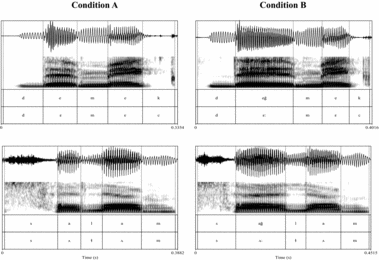
All acoustic analyses were carried out using Praat (version 5.3.53, Boersma & Weenink Reference Boersma and Weenink2013). Visual inspection of the spectrograms showed that the phonetically realized soft ‘g’ could not be separated from the preceding vowel so that only the onset and offset of the vowel were labelled (see Figure 4). We measured the duration and the first three formants of the temporal interval from onset of the vowel to offset of soft ‘g’. In Figure 4 this temporal interval corresponds to the first vowel.
Example of spectrograms comparing Condition A (without /ğ/: left column) and B (with /ğ/: right column). Black vertical lines show the boundaries of each sound. In the presence of /ğ/ (Condition B) the vowel preceding /ğ/ and the realization of /ğ/ are annotated as one segment.

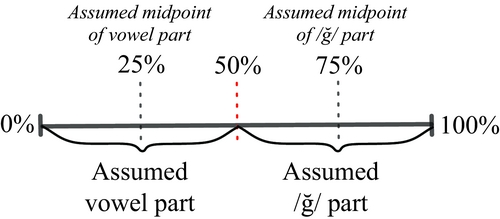
Two types of statistical analysis were carried out. Our first analysis focused on a comparison of the respective mean values of the duration, F1, F2, and F3 between conditions A and B (Hypothesis 1). In the second statistical analysis, we focused only on formant values at the 25% and 75% time points in Condition B, and analysed differences between these time points during the production of the segments (Figure 5). We assumed that the values at the 25% time point of the segment duration in Condition B would correspond to the midpoint of the vowel preceding /ğ/, while the 75% time point would correspond to the midpoint of the /ğ/ part. If /ğ/ is realized as a velar consonant, we should be able to find a trace of it by comparing formants at the assumed midpoint of the preceding vowel with those at the assumed midpoint of the /ğ/ realization. Additionally, such an analysis could reveal whether words with /ğ/ behave differently depending on vowel context and speaker age (Hypothesis 2 and Hypothesis 4, respectively).
Visualization of compared data points at 25% and 75% of the annotated segment duration in Condition B.

To test the differences in the formant values in both analyses we ran linear mixed-effects models (Pinheiro & Bates Reference Pinheiro and Bates2000, Gelman & Hill Reference Gelman and Hill2007, Baayen Reference Baayen2008) using the lme4 package (Bates et al. Reference Bates, Maechler, Bolker and Walker2013) in R (R Development Core Team 2013). We included condition (A, B), age (young, elderly), gender (male, female), and vowel (ʌ, ɛ) as fixed effects as well as participant and item as random effects for the first analysis. Random slopes by speaker were also added to the model. We used sum contrast with values of –0.5 and +0.5 in our model to make the interpretations of coefficients more transparent. Significance levels were calculated using Satterthwaite’s approximation for degrees of freedom in the lmerTest package (Kuznetsova, Brockhoff & Christensen Reference Kuznetsova, Brockhoff and Christensen2014).
We included standardized duration ([duration-mean(duration)]/SD(duration)) and excluded condition as a fixed effect for the second statistical analysis concerning the comparison of different time points in Condition B.
5.2.4 Results of Experiment 1
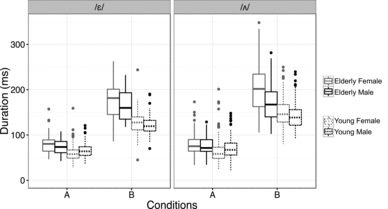
Duration values of the annotated segments split by condition, preceding vowel, age, and gender are presented in Figure 6. The results of the durational analysis provide an answer to Hypothesis 1. They show that in Condition B the duration of the annotated segments was twice as long as in Condition A (β = 87 ms, SE = 3.2 ms, t = 26.8). Our results therefore support Hypothesis 1 that /ğ/ is realized as a lengthening of the preceding vowel.
Duration of target items in Experiment 1 under the conditions A (without /ğ/) and B (with /ğ/), age, gender, and vowels.

Additionally, our analysis revealed that the duration of the segments produced by the younger group was shorter than that of those produced by the elderly group (β = –31 ms, SE = 6.6 ms, t = –4.6). This difference was most pronounced in Condition B as revealed by an interaction between condition and age (β = –34 ms, SE = 6.4 ms, t = –5.3).
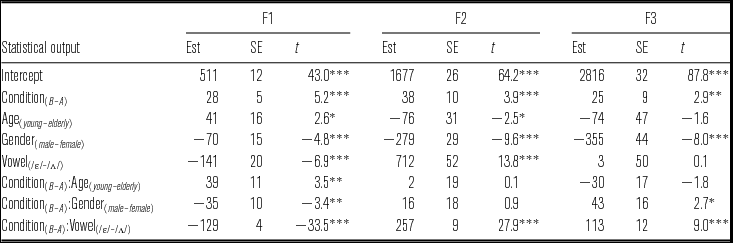
Table 3 summarizes the results for Hypotheses 1, 2, and 4. The intercepts of F1, F2, and F3 are shown with respect to the reference level, i.e. the estimates of formants for elderly female participants pronouncing words with the back vowel /ʌ/ in Condition A. If the lengthening of the preceding vowel were the major acoustic correlate of soft ‘g’ (Hypothesis 1), we would not expect significant differences in the formant values. However, in Condition B where /ğ/ is present, F1 values were higher than those in Condition A. In addition, the second and the third formants revealed an effect of condition. Thus, the first three formants indicate more peripheral positions and correspond to a larger vowel space when /ğ/ is present. However, they do not provide evidence for the presence of a velar gesture. The presence of any kind of velar gesture in a certain vowel context would support Hypothesis 2, but we did not find evidence for it in this dataset.
Analysis of the formant means as a function of condition, age, gender, and vowel. Linear mixed model coefficients, standard errors, and corresponding t-values. Different factor levels are set in parentheses.

t-values correspond to: *** p < .001, ** p < .01, * p < .05
According to Hypothesis 4, we expected that the young and elderly groups would differ with respect to the realization of Conditions A and B: the young participants should show no formant changes in the condition where /ğ/ is present while we would expect significant changes for the elderly. Age showed an interaction with condition for F1 only, i.e. in Condition B when /ğ/ was present, the young participants produced higher F1 values, i.e. lower vowels than in Condition A.
The formant values reveal significant differences for the factor condition, which might suggest differences between pairs including or excluding /ğ/. However, comparing means of all F1, F2, and F3 values (as calculated by averaging all formant values in the vowel ± soft ‘g’ time window) in Conditions A and B may give us misleading information, since the transition of the formants to the surrounding context is included. In all of our pairs, /ğ/ is followed by one of the alveolar consonants /d dʒ n l ɾ/, except for two pairs in which it is followed by /m/ (see Appendix C). Also, formant values may be more extreme, because there is more time for the tongue to move to the periphery of the vowel space due to the longer duration of the vowel. Thus, to confirm our results in Table 3, we calculated F1, F2, and F3 values at 25% and 75% of the annotated segment duration in Condition B (see Figure 5 above) and then analysed the differences (Table 4). Selecting the two time points excluded any potential bias due to transitions. Furthermore, we added standardized duration to the model as a fixed effect to control for the potential role of more peripheral tongue movements with longer duration.
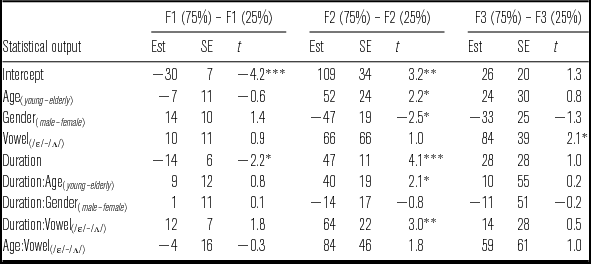
Linear mixed model coefficients, standard errors (SE), and t-values of the difference in formant frequencies between the 75% and 25% time points in Condition B. Different factor levels are set in perentheses.

t-values correspond to: *** p < .001, ** p < .01, * p < .05
The results in Table 4 show that many factors that had a significant effect on formants (see Table 3) did not have an effect on the change in formants over time in Condition B (see Figure 5). However, the intercepts in Table 4 show a significant overall decrease in F1 (75–25%), as well as an increase in F2 (75–25%). If the production of the soft ʻgʼ involved a velar gesture, we would have expected to also find a significant decrease in F3 (Stevens Reference Stevens1998). However, we did not find any significant changes in F3, which supports our Hypothesis 1 that the major acoustic property of the phonetic realization of /ğ/ is the lengthening of the preceding vowel. In order to test the reason for the formant changes, we conducted the same statistical analysis for the formants in Condition A, where /ğ/ is not present. We found a significant decrease in F1 over time in Condition A as well (β = –19 ms, SE = 7.9 ms, df = 12.8, t = −2.4*). Based on these results, combined with the effects of duration and coarticulation due to the following alveolar consonants (except for two pairs), it is not possible to claim that soft ‘g’ is produced with a velar gesture.
As shown in Table 4, there is a difference between the time points in F2, which is higher for young participants compared to the elderly group. However, it is still impossible to argue in favour of Hypothesis 4 since we did not find any differences in F1 and F3.
In summary, Experiment 1 provided some crucial findings for our understanding of the phonetic realization of /ğ/. By comparing the duration and the mean values of formants, we found significant differences between the presence and absence of /ğ/. However, the additional analysis (Table 4) revealed that formant changes do not support a velar gesture when comparing the difference between the preceding vowel and /ğ/. Thus, we can claim that soft ‘g’ completely takes on the spectral properties of the preceding vowel and lengthens it (Hypothesis 1). There was no evidence for a velar gesture in either the front or the back vowel context (Hypothesis 2). Furthermore, the results highlight the importance of duration and indicate that formant values in longer temporal windows move towards the periphery of the acoustic vowel space.
So far we have only analysed one specific word position and two vowel contexts in which /ğ/ occurs. In the following section we present the results of our second experiment, which extends the vowel context investigated so far (Hypothesis 2) and tests different word positions (Hypothesis 3). As in Experiment 1, we again analyse a younger as well as an elderly speaker group (Hypothesis 4).
5.3 Experiment 2
5.3.1 Participants
The second experiment was performed with eight young (age range: 19‒29 years; four females) and eight elderly (age range: 72‒91 years; four females) monolingual native speakers who had also participated in the first experiment.
5.3.2 Speech stimuli and procedure
The speech stimuli in Experiment 2 were selected in order to obtain more information about the phonetic realization of /ğ/ in different word positions and in all possible vowel environments (e.g. in the context of front, rounded, or back vowels) independently of the existence of word pairs without /ğ/. Thus, in Experiment 2, we have no comparison between words with and without /ğ/, but instead focus on words with /ğ/ in a variety of contexts (see Hypotheses 2 and 3). Four different phonetic environments were chosen: (i) /ğ/ between identical vowels (V1_V1), (ii) /ğ/ between different vowels (V1_V2), (iii) /ğ/ in syllable-final, word-medial position (SF), and (iv) /ğ/ in word-final position (WF). All tested words are listed in Appendix D.
To avoid prosodic influences, 24 target words and 24 fillers were placed in sentences, as shown in (2):
(2)

Fillers were reduced to half for the elderly participants. In total, 1,730 tokens were analysed following the same procedure for randomization as in Experiment 1.
As in Experiment 1 all young participants were recorded in a soundproof booth while elderly participants were recorded in their homes. All informants took part in both experiments on the same day and had a one hour break in between.
5.3.3 Measurement and data analysis
Similarly to Experiment 1, soft ‘g’ and the preceding vowel were annotated as one segment. For the words where /ğ/ was surrounded by vowels, the segment starting from the onset of the preceding vowel to the offset of the following vowel was labelled as one item.
For the statistical analyses of Experiment 2, we created two subsets of data according to the word positions in which /ğ/ occurred. The first subset consisted of words with intervocalic /ğ/. For the identical-vowel contexts and different-vowel contexts, we calculated F1, F2, and F3 values at the time point at 25%, 50%, and 75% of the duration of the segment spanning both vowels and /ğ/. These time points correspond to the assumed midpoints of the first vowel, /ğ/, and the second vowel, respectively.
In the statistical model, differences in the formants were represented by orthogonal successive differences contrasts, where one contrast encoded the difference in formant values between the 25% and the 50% time points, and the other between the 50% and the 75% time points. We further included age, gender , and standardized duration as fixed effects, and varying intercepts by participant and item , as well as by-participant varying slopes for duration .
The second subset consisted of a comparison of /ğ/ in word-medial position (i.e. syllable-final position) and word-final position. For this subset, we used a statistical model to compare the F1, F2, and F3 values at the 25% and 75% time points (corresponding to the assumed midpoint of the first vowel and the assumed midpoint of the /ğ/ realization), similarly to Experiment 1.
5.3.4 Results of Experiment 2
Figure 7 shows the means and standard errors of F1, F2, and F3 at the 25%, 50%, and 75% time points of the annotated segment duration for identical vowels.
The mean and standard error of F1, F2, and F3 at the 25%, 50%, and 75% time points of the annotated segment duration under the identical vowel condition.

Formants are relatively stable over time (see Figure 7). Only few, small F2 changes are visible from the 50% to the 75% time landmarks (ʌ_ʌ and ɛ_ɛ). These changes could be due to coarticulation of the last vowel with the following sound. When /ğ/ is preceded and followed by /u/ (u_u), F2 rises slightly in the assumed /ğ/ part (at the 50% time point). However, F3 remains stable in this environment. The small changes we found cannot be attributed to a velar gesture. We interpret these changes as an artefact of more peripheral articulation: the tongue continues its movements towards the periphery of the vocal tract when more time is available. Adding duration to the statistical model confirmed this idea.
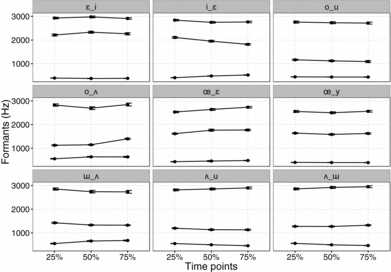
Similar plots are shown in Figure 8 below, with soft ‘g’ in different vowel contexts. Small changes in the formants are visible, although the vowels which surround soft ‘g’ are different. For instance, in the ʌ_u, ʌ_ɯ, ɛ_i, o_u, and œ_y contexts, formants are quite stable across the entire VCV sequence. The likely underlying reason for this is that in some cases there is anticipatory vowel coarticulation, such as, for example, in <değil> /dɛğil/ which is typically pronounced as [diːil].
Means and standard errors of F1, F2, and F3 at the 25%, 50%, and 75% time points of the annotated segment duration under the different vowel condition.

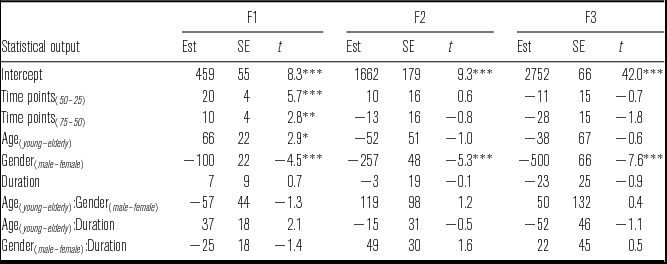
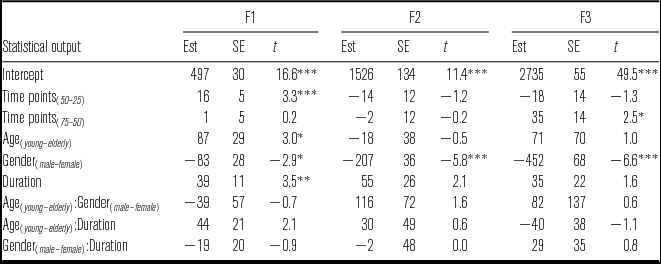
The results for the formant values are presented in Tables 5 and 6 below. They show the effect of different time points, age, gender, and standardized duration on the F1, F2, and F3 values between identical vowels and different vowels.
Linear mixed model coefficients, standard errors (SE), and t-values of F1, F2, and F3 as a function of values at different time points, age, gender, standardized duration, and interactions with duration of identical vowel contexts for Experiment 2. Different factor levels are set in parentheses.

t-values correspond to: *** p < .001, ** p < .01, * p < .05
Linear mixed model coefficients, standard errors (SE), and t-values of F1, F2, and F3 as a function of values at different time points, age, gender, standardized duration, and interactions with duration of different vowel contexts for Experiment 2. Different factor levels are set in parentheses.

t-values correspond to: *** p < .001, ** p < .01, * p < .05
In the identical vowel contexts (Table 5) we see F1 values increase continuously over time, but none of the coefficients had an effect on F2 and F3, thereby supporting Hypothesis 1. This finding is similar to what was found in the previous experiment.
In the different vowel contexts (Table 6), the results are comparable. We found a marginally increased F1 at the 50% time point of the annotated segment duration compared to the 25% time point. F3 increased from the 50% to the 75% time point. In addition, we found an effect of age on F1 only in the sense that young participants had slightly increased values for F1, but no evidence could be provided for Hypothesis 4 that the elderly realize /ğ/ as a velar and the younger generation as a lengthening of the preceding vowel.
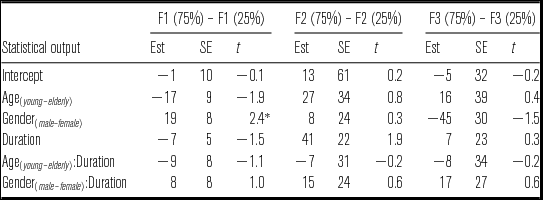
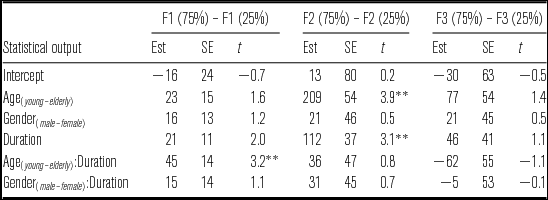
The results, presented in Tables 7 and 8, do not support Hypothesis 3, i.e. different realizations with respect to word position. With the exception of gender, none of the coefficients has an effect on the formants in word-medial position (syllable-final) (Table 7). In word-final position the results are similar except for an effect of age and duration on F2 (Table 8). Additionally, F1 differences are higher for young participants. However, none of the results point to consistent differences inherent to the word-medial (syllable-final) position and word-final position.
Linear mixed model coefficients, standard errors (SE), and t-values of difference between the 25% and 75% time point formants of syllable-final, word-medial position for Experiment 2. Different factor levels are set in parentheses.

t-value corresponds to: * p < .05
Linear mixed model coefficients, standard errors (SE), and t-values of difference between the 25% and 75% time point formants of word-final position for Experiment 2. Different factor levels are set in parentheses.

t-values correspond to: ** p < .01
In summary, the examination of the phonetic realization of /ğ/ in Modern Turkish revealed most consistently that /ğ/ is realized as a lengthening of the preceding vowel, independently of the surrounding vowel environment, syllable and word position, and participant age. In the first experiment, we compared word pairs with and without /ğ/ and data restricted to words with a consonant following /ğ/. In the second experiment, we focused on the realization of /ğ/ in different word positions and vowel contexts. The results of the two experiments showed that speakers of Modern Turkish do not realize acoustic properties of a velar gesture, but extensively lengthen the preceding vowel consistently across all varied conditions. Such lengthening can lead to slight formant changes moving towards the periphery of the vowel space, but these formant changes could not plausibly be attributed to a velar gesture. In line with other studies on the effect of lengthening on vowels due to prominence (de Jong Reference de Jong1995), we suggest that the tongue continues its movements towards the periphery of the vocal tract when more time is available.
6 Discussion
6.1 Phonetics and phonology of soft ‘g’
In the two experiments reported in the present paper, we tested how <ğ> is phonetically realized in Modern Turkish and answered the question whether or not any traces of sound changes that originally affected /ğ/ could be detected in the current realizations of this sound. In accordance with previous phonetic studies (Selen Reference Selen1979, Kopkallı-Yavuz et al. Reference Kopkallı-Yavuz, Koçak, Topbaş and Cangökçe-Yaşar2008), we hypothesized that /ğ/ would generally be produced as the lengthening of the preceding vowel. However, we also expected productions of /ğ/ could vary depending on a front versus back vowel environment as the development to [j] and [ɣ] would suggest. Moreover, /ğ/ realizations in different syllable and word positions were examined, since lenition processes are strongly position dependent (Krakow Reference Krakow1999). Finally, we expected traces of a velar gesture in elderly speakers in comparison to younger ones which could reveal that a sound change is still in progress. Our results for Modern Turkish provided evidence that neither the fricative [ɣ] nor the approximant [j] is the phonetic realization of /ğ/ but instead the preceding vowel is lengthened. Formant values were relatively stable, even with different vowels across syllables.
One reason why we did not find acoustic equivalents of a velar gesture in our studies may also be that the subjects were unaware of the topic of the study, since we included a large number of fillers. As noted earlier, we believe that such an experimental design allowed us to obtain the most natural results for Modern Turkish; awareness of the task could have led some speakers to exaggerate the pronunciation of /ğ/, as a velar approximant, for instance.
Our findings from the younger and elderly speakers reveal that in Modern Turkish the original sound changes that affected soft ‘g’ are no longer active. Although the results for the two generations differ slightly, these differences can be attributed to speech rate or changes in F1, which are typical characteristics of aging (Winkler Reference Winkler2009, Reubold, Harrington & Kleber Reference Reubold, Harrington and Kleber2010). In summary, our empirical results for Modern Turkish show that /ğ/ is realized as vowel lengthening.
A supporting piece of evidence for our conclusions is provided by the results of a study conducted with 60 children in the age from 3;2 (three years; two months) to 8;11 by Nakipoğlu-Demiralp, Üntak & Furman (Reference Nakipoğlu-Demiralp, Üntak, Furman, Güven, Akar, Öztürk and Kelepir2016) who found that Turkish children treat stems ending with soft ‘g’ as if they were vowel-final. Consequently, they use, e.g. the possessive morpheme /-ji/ reserved for vowel-final stems and not the morpheme /-l/ typically attached to consonant-final stems. This study shows that soft ‘g’ is realized as a vocalic element.
From a phonological point of view, we postulate that /ğ/ is a phoneme of Turkish. This conclusion is based on our dictionary search which does not speak for a complementary distribution of /ğ/ vs. /ɡ/ when assimilated load words are also taken into account.
Furthermore, /ğ/ takes part in several phonological processes. For instance, in suffixation processes /ğ/-final roots are treated in exactly the same way as other words ending in consonants. This is to say that suffixes remain as one vocalic segment if the root ends in a consonant (e.g. <dal-I> is pronounced as [dʌɫɯ] ‘branch, Acc’), including <ğ> (e.g. <dağ-I> is pronounced as [dʌːɯ] ‘mountain, Acc’), whereas vowel-final roots take y-, n-, or s-initial suffix variants (/kiraː-I/ [kira-yɯ] ‘rent, Accʼ); see Kabak (Reference Kabak2007: 1380f.).Footnote 4 Considering the fact that long vowels are not part of the Turkish vocalic system, this example shows that /ğ/ is present underlyingly, and it should be interpreted as a consonant. For such cases, Clements & Keyser (Reference Clements and Keyser1983: 67–73) postulate an underlying slot for a segment (the so-called C (consonantal) element, corresponding to /ğ/ in our study), which is deleted and filled by the vocalic element. This process, in which one underlying segment is deleted and the adjacent segment is lengthened, is an example of a compensatory lengthening, a process taking place cross-linguistically. Finally, as our acoustic study reveals, /ğ/ is realized as lengthening of the preceding vowel, hence it is not phonetically similar to [g], which can be taken as an additional argument for the phonemic status of the sound. For this reason, as well as the phonological behaviour of /ğ/, it is difficult to argue in favour of /ğ/ being an allophone of /ɡ/. Therefore, we suggest that /ğ/ belongs to the phonemic inventory of Modern Turkish.
6.2 Sound changes affecting soft ‘g’ from a cross-linguistic point of view
Our study investigated different stages of a sound change process in which /ğ/ has been involved. What happened in Turkish is a palatalization process /ɡ/ → [ɟ] and series of lenition processes affecting [ɟ] and [ɡ] resulting in [j] and [ɣ], respectively. In Modern Turkish, as our results indicate, neither the fricative [ɣ] nor the glide [j] is pronounced any more but instead the preceding vowel is lengthened. The parallel development of /ɡ/ which eventually led to its deletion is schematized as following:
(3)

From a typological point of view Turkish follows well-established sound change patterns. The fact that /ɡ/ (and not, for example, /k/) underwent a change to other sounds is rather unsurprising. Ohala (Reference Ohala and MacNeilage1983) related the instability of [ɡ] and its relative rarity of occurrence in comparison to [k] (and other stops) to the difficulty of maintaining the aerodynamic requirements for phonation when the cavity behind the supraglottal constriction is short. The presence of high vowels triggers palatalization of /ɡ/ resulting in [ɟ], a process that takes place cross-linguistically in the context of front vowels (see Bhat Reference Bhat, Greenberg, Ferguson and Moravcsik1978). By contrast, low vowels do not trigger palatalization, which is reflected in the fact that /ɡ/ did not change in the context of low vowels in Turkish (see also Hall & Żygis Reference Hall, Żygis, Fuchs, Toda and Żygis2010 for a cross-linguistic overview of palatalization and affrication processes in different vowel contexts).
It is also well known and cross-linguistically attested that stops undergo palatalization and affrication processes more often in the context of front vowels than of back vowels (see Bhat Reference Bhat, Greenberg, Ferguson and Moravcsik1978). One possible reason for this asymmetry is the coarticulation effect with the following vowel and also the fact that voiceless stops are produced with a longer voice onset time (VOT) in the context of front vowels in comparison to low vowels (Maddieson Reference Maddieson, Hardcastle and Laver1997). In the next stage, palatalized stops with a longer VOT change to affricates (see e.g. Hall, Hamann & Żygis Reference Hall, Hamann and Żygis2006). However, in the case of Turkish [ɟ], affrication did not happen, but instead [ɟ] changed to the approximant [j] in the so-called prosodically weak position, i.e. word-medially (intervocalically, syllable-finally) and word-finally. In our view, the reason affrication never occurred could have been a strong influence from intervocalic contexts. As shown by Kirchner (Reference Kirchner2001) (see also Lavoie Reference Lavoie2001), the intervocalic context frequently triggers lenition: intervocalic /ɡ/ changes to a fricative, a glide or is deleted in several typologically different languages (see e.g. Krakow Reference Krakow1999). Such processes are attested in Ptolemaic Greek (Teodorsson Reference Teodorsson1997), Northern Corsican (Oftedal Reference Oftedal1985), Spanish (Gallego Reference Gallego1996), West Tarangan (Nivens Reference Nivens, Burquest and Laidig1992), Tatar (Poppe Reference Poppe1963), Modern Welsh (Halle & Clements Reference Halle and Clements1983), and others (see Kirchner Reference Kirchner2001 for an overview). The intervocalic context has been identified as a primary lenition context in the literature; see Lass & Anderson (Reference Lass and Anderson1975). From a phonetic point of view it is the greater aperture of adjacent segments, i.e. vowels, which influences the closure of stops, leading to their lenition. Moreover, this lenition of stops is typically more extreme if the vowels are low, due to their greater aperture (see Kirchner Reference Kirchner2001). Thus, we assume that in Turkish an intervocalic context initially triggered the lenition of [ɟ] and [ɡ] to [j] and [ɣ], respectively. In the next stage, as our results indicate, both [j] and [ɣ] are realized as a lengthening of the preceding vowel, which can be interpreted as the final stage of the sound change process, i.e. the initial /ɡ/ is now phonetically unattested. At the same time, we postulate that /ğ/ is underlyingly present in Modern Turkish (although its exact phonological representation in terms of features is unclear) and that this abstract phoneme is phonetically realized as a lengthening of the vowel. Hence, the process of compensatory lengthening takes place. Further developments, or a lack thereof, will show whether this lengthening is indeed the ultimate stage in this long sound change process.
7 Conclusion
Soft ‘g’ has been a point of contention in Turkish linguistics, with both the phonetic realization of /ğ/ and its phonological status being disputed. We investigated the results of the orthographic reform that introduced the letter <ğ> and examined trends in Modern Turkish spelling in order to determine whether the context in which it occurs is different from that of /ɡ/ (of which it is sometimes considered to be an allophone).
This investigation showed that Modern Turkish <ğ> was historically represented by two Ottoman letters: <غ>, pronounced as [ɣ], was used following back vowels and <گ>, pronounced as [j], was used following front vowels. In the 1928 orthography reform, the differences between the two vocalic contexts were obscured by replacing the two Ottoman letters with a single letter, <ğ>.
Our study of Modern Turkish spelling conventions suggest that /ɡ/ and /ğ/ are not in a complementary distribution (depending on their positions of occurrence) when well-assimilated loan words are taken into account. Moreover, the phonological behavior of soft ‘g’ in phonological processes strongly suggests that the sound is part of the phonemic inventory of Turkish.
Our phonological analysis was complemented by two phonetic experiments whose aim was to determine how soft ‘g’ is realized in different contexts and by speakers of different ages. They revealed that /ğ/ is phonetically manifested in the lengthening of the preceding vowel (/Vğ/→ [Vː]) independently of the surrounding vowel environment, word position, and participant age.
Altogether this evidence leads us to propose that in Modern Turkish soft ‘g’ (i) is a phoneme, not an allophone of /ɡ/ and (ii) it is phonetically realized as the lengthening of the preceding vowel.
Acknowledgements
We would like to thank our informants for participating in the experiment, Pavel Logačev for programming assistance, Joerg Dreyer for technical expertise, and Tracy A. Hall for comments and proofreading. We also thank the maintainer of Mark’s Speechblog for the invaluable Praat scripts. This research has been supported by a grant (01UG1411) from the Ministry for Education and Research (BMBF, Germany) to Susanne Fuchs and Marzena Żygis and from the Council of Higher Education in Turkey to Özlem Ünal-Logacev.
Appendix A. The occurrence of /ğ/ in the dictionary

Appendix B. The occurrence of /ɡ/ in the dictionary

Appendix C. Speech stimuli for Experiment 1

Appendix D. Speech stimuli for Experiment 2