Introduction
The supply of conventional feed resources is a major issue for the poultry industry all over the world. Many traditional ingredients used in poultry diets are forecast to be in short supply within the next few years, mainly due to an increase in the human population, competition with new markets, e.g. biofuel and unfavourable climatic conditions (Cribb, Reference CRIBB2010). Fish meal and soybean meal, which have been used as protein sources, are becoming expensive and less available for poultry diets. This has compelled nutritionists to explore the usefulness of several non-traditional protein sources.
Snails, members of the Mollusca phylum found in fresh water, sea and land, are common during spring and autumn when rainfall is abundant (Thompson and Cheney, Reference THOMPSON and CHENEY1996). There have been reports on the use of snails as protein supplements in poultry (Ali and Leeson, Reference ALI and LEESON1995; Serra, Reference SERRA1997; Diomandé et al., Reference DIOMANDÉ, KOUSSEMON, ALLOU and KAMENAN2008) and aquaculture diets (Sogbesan and Ugwumba, Reference SOGBESAN and UGWUMBA2008). In regions where snails are not delicacies for humans, meal could be made commercially available for poultry feeding through controlled breeding. The present paper reviews the nutritive composition of snail meal, its feeding to poultry and dietary recommendations in rations for egg and meat-type chickens. Major factors limiting the use of snail meal as protein supplement in poultry rations are highlighted.
Nutritive composition of snail meal
There is a large body of literature on the nutrient content of snail meal although there is a wide range in values. Fresh snail is characterised by high moisture and low dry matter, with levels of 16 (Zymantiene et al., Reference ZYMANTIENE, JUKNA, JUKNA, ZELVYTE and OBERAUSKAS2008) and 20% (Avanjina, Reference AVANJINA2004) dry matter reported for fresh snails, while the meal is reported to have a dry matter content of 88-89% (Ali and Leeson, Reference ALI and LEESON1995; Diomandé et al., Reference DIOMANDÉ, KOUSSEMON, ALLOU and KAMENAN2008). The protein content of snail meal ranges from 37.8% (Kalio and Etela, Reference KALIO and ETELA2011) to 53-83% (Ali and Leeson, Reference ALI and LEESON1995; Ligaszewski et al., Reference LIGASZEWSKI, ŁYSAK and SURỎWKA2005; Diomandé et al., Reference DIOMANDÉ, KOUSSEMON, ALLOU and KAMENAN2008) and is rich in essential amino acids including lysine, leucine, isoleucine and phenylalanine (Imevbore and Ademosun, Reference IMEVBORE and ADEMOSUN1988; Ali and Leeson, Reference ALI and LEESON1995; Dragićević and Baltić, 2005; Sogbesan and Ugwumba, Reference SOGBESAN and UGWUMBA2008). Apart from low methionine (Mead and Kemmerer, Reference MEAD and KEMMERER1953; Creswell and Kompiang, Reference CRESWELL and KOMPIANG1981; Dragićević and Baltić, 2005), the amino acid profile of snail meal is comparable to or better than fish meal.
Snail meal protein and amino acids are known to have high true digestibility values. Ali and Leeson (Reference ALI and LEESON1995) observed 88-91% true digestibility of snail meal protein and amino acids respectively. Although snail meal is generally low in fat, ranging from 0.4% (Zymantiene et al., Reference ZYMANTIENE, JUKNA, JUKNA, ZELVYTE and OBERAUSKAS2008) to 4.3% (Diomandé et al., Reference DIOMANDÉ, KOUSSEMON, ALLOU and KAMENAN2008), the fat is characterised by its high (34-57%) polyunsaturated fatty acids content (Milinsk et al., Reference MILINSK, PADRE, HAYASHI, SOUZA and MATSUSHITA2003; Çağıltay et al., 2011). Essential fatty acids such as linoleic, linolenic, and arachidonic acids are found in good proportions in snail fat (Dragićević and Baltić, 2005; Özogul and Olgunoglu, Reference ÖZOGUL and OLGUNOGLU2005; Çağıltay et al., 2011). Snail meal is a good source of essential minerals (Avanjina, Reference AVANJINA2004; Babalola and Akinsoyinu, Reference BABALOLA and AKINSOYINU2009) much of which is present as calcium (Diomandé et al., Reference DIOMANDÉ, KOUSSEMON, ALLOU and KAMENAN2008). From a human intake point of view, land snails Helix and Achatina spp. are the major edible species (Joachim and Felicitas, Reference JOACHIM and FELICITAS2000) with China, France, Greece, Spain and Italy being the world's leading importers of snails (ITC, 2003).
Several factors, including species (Gomot, Reference GOMOT1998; Fagbuaro et al., Reference FAGBUARO, OSO, EDWARD and OGUNLEYE2006; Eneji et al., Reference ENEJI, OGOGO, EMMANUEL-IKPEME and OKON2008), management (Ikauniece et al., Reference IKAUNIECE, JEMELJANOVS, STERNA and STRAZDINA2014), environmental conditions (Gomot, Reference GOMOT1998), and processing (Serra, Reference SERRA1997) affect the composition of snail meal. Protein contents of 53% (Barcelỏ and Barcelỏ, 1991; Ali and Leeson, Reference ALI and LEESON1995), 60% (Creswell and Kompiang, Reference CRESWELL and KOMPIANG1981), 71% (Sogbesan and Ugwumba, Reference SOGBESAN and UGWUMBA2008) and 83% (Ademolu et al., Reference ADEMOLU, IDOWU, MAFIANA and OSINOWO2004) have been reported for Pila globosa, Achatina fulica, Limicolaria aurora, and Archachatina marginata spp. of snail respectively. Ikauniece et al. (Reference IKAUNIECE, JEMELJANOVS, STERNA and STRAZDINA2014) observed an increase in the protein content of home reared compared to wild Helix pomatia species. Wide differences in protein content of Archachatina marginata fed different nitrogen sources have been observed (Ademolu et al., Reference ADEMOLU, IDOWU, MAFIANA and OSINOWO2004), with an improved growth and higher protein content of snails fed diets containing poultry litter compared to soybean, fish, and urea nitrogen. As snails are mainly foragers (Harry, Reference HARRY1950) environmental differences in the distribution and composition of feedstuffs materials will affect the final body composition of the snail. In a trial with giant African snails Achatina fulica, Kalio and Etela (Reference KALIO and ETELA2011) reported higher crude protein and lower cholesterol in snails fed papaya leaf compared to those fed a commercial broiler diet, water leaf and Centro leaf. The highest fat was observed in snails fed Centro leaf while the ash content was increased in those fed a commercial feed.
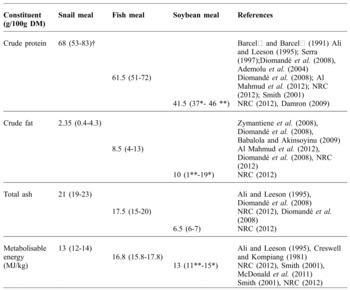
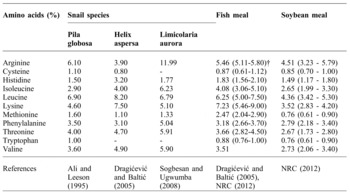
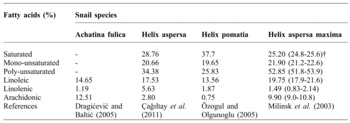
Serra (Reference SERRA1997) reported higher protein in uncooked compared to cooked snail meal probably due to destruction of protein by heat. Because snail meal contains variable amounts of carbohydrates (Joachim and Felicitas, Reference JOACHIM and FELICITAS2000; Dragićević and Baltić, 2005), the loss of protein through formation of complexes with the carbohydrate fractions at high temperatures could also be envisaged. This suggests the need for research into appropriate heating temperature and duration that will minimise the loss of nutrients in the processed meal. The composition (proximate, amino acids, and fatty acids profile) of snail meal is presented in Tables 1, 2, and 3 respectively.
Composition of snail meat, fish and soybean meals for selected proximate analysis and metabolisable energy.

*: whole seed; **: solvent extracted meal.
†: Values in parenthesis are ranges.
Amino acid composition of meals from three snail species, fish meal and soybean meal.

†: Values in parenthesis are ranges.
Fatty acid composition of snail meal from selected species.

†: Values in parenthesis are ranges.
Anti-nutritive properties of snail meal
Despite the promising nutritional composition of snail meal, the presence of cyanide has been reported (Ravindran, Reference RAVINDRAN1987) probably via ingestion during foraging on different plant materials. In a recent study on the feeding preferences of the giant African snail (Kant and Diarra, Reference KANT and DIARRA2014) it was observed that snails had preference for papaya leaves than tomato leaves, which can influence the levels of potential toxins ingested. However, during cooking, heat labile cyanide will be destroyed. Creswell and Kompiang (Reference CRESWELL and KOMPIANG1981) observed depressed growth in broiler chickens when unprocessed snail meal was included in diets at levels above 10%. The authors reported that boiling the snails for 15 to 20 min prior to processing completely overcame this depression. Barceló and Barceló (Reference BARCELÓ and BARCELÓ1991) observed that broiler chickens ate more cooked than raw snail meal based diets, confirming the negation of toxic or unpalatable compounds during heat treatment. Snails collected from environments contaminated with heavy metals have been found to contain such metals. Ebenso and Ebenso (Reference EBENSO and EBENSO2011) reported the presence of lead in the body of snails collected around a battery factory, where lead is a major manufacturing component. Snails from such industrial areas may therefore not be safe for use as food or in feed.
Poultry feeding trials
Although feeding of snail meal to broiler chickens is well documented, recommendations have varied probably due to variations in composition. Creswell and Kompiang (Reference CRESWELL and KOMPIANG1981) observed that broiler chickens grown to 28 days on diets containing 15% dietary boiled giant African snail meal had weight gains similar to a control diet, but increasing the inclusion level to 20% depressed growth. This growth depression was overcome by the addition of 0.25% DL-methionine. The improved performance with methionine addition was considered to be due to the low level of this amino acid in snail meal and its role in detoxification, as observed by Enriquez and Ross (Reference ENRIQUEZ and ROSS1967). In further experiments the same authors indicated that maximum performance of broiler chickens fed 20% snail meal could be achieved with 0.2 or 0.3% DL-methionine supplementation. They also recorded a significant improvement in growth by the addition of 5 or 10% of either fish meal or snail meal to a corn-soybean meal diet. They attributed this improvement to the presence of unidentified growth factors in snail meal, as has been suggested for fish meal (Bjornstad et al., 1974; Andrews and Jimmy, Reference ANDREWS and JIMMY1972).
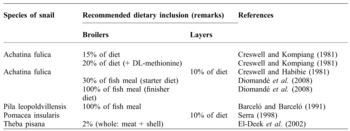
In studies using the same species of snail, Diomandé et al. (Reference DIOMANDÉ, KOUSSEMON, ALLOU and KAMENAN2008) observed that fish meal could be replaced with snail meal at 30 to 100% in broiler starter and finisher diets respectively without adverse effects on growth, carcass yield and meat sensory quality. El-Deek et al. (Reference EL-DEEK, AL-HARTHI, ATTIA, HWEDEY and and SHERIF2002) fed whole (including shells) dried giant snail (Theba pisana) meal up to 6% of broiler diet and obtained the best performance at 2% inclusion. Barceló and Barceló (Reference BARCELÓ and BARCELÓ1991) reported poorer weight gain and feed conversion ratio in broiler chicks grown to 28 days on diets based on raw or cooked snail (Pila leopoldvillensis) meal compared to fish meal. Weight gain and feed conversion ratio were again improved with cooking compared with feeding the raw snail, confirming the presence of some heat-labile anti-nutrients as earlier observed by Creswell and Kompiang (Reference CRESWELL and KOMPIANG1981), and Ravindran (Reference RAVINDRAN1987). Feeding whole snail meal in diets for laying hens may be beneficial in view of the higher requirement of calcium for eggshell synthesis which will reduce the need for calcium and phosphorus supplementation. However, reports on feeding snail to layers are limited. Creswell and Habibie (Reference CRESWELL and HABIBIE1981) observed no adverse effects of 10% dietary Achatina fulica snail meal on egg production and quality. Recommendations of snail meal in diets for meat and egg-types chickens are presented in Table 4.
Recommendations of cooked snail meal from different species in diets for broilers and layers.

Major issues in effective harnessing of snail meal for poultry feeding
Snails are only abundant during the moist season of the year, and seasonal available is an issue regarding usage in diets. Under drier conditions they are known to bury themselves into the ground, decrease their metabolism and enter a period of aestivation (Estebenet and Martin, 2002). Although snail farming is increasingly receiving attention in most regions of the world, snail meat is valued in human diets to such an extent that it might not be available at economic prices for poultry feed production in certain regions. Where snails are major agricultural pests however, they could be harvested and used for on-farm feed production. This will reduce feed cost as well as provide an environmentally friendly and cost effective method of snail control.
The variability in nutrients and potential presence of toxic contents in snail meal is another issue when considering its inclusion in diets. There is therefore, the need to analyse snails for nutritional properties, although the cost of such analysis might be high in regions where snails are readily available for feeding poultry. The very low dry matter content of fresh snail is another obstacle to the production of snail meal in commercial quantities.
Research needs
The need for research into the nutritional and anti-nutritional composition of snail from different species, environments, and management systems is eminent. Methionine, apart from its functions as methyl donor and many other physiological processes, has role in detoxification (Enriquez and Ross Reference ENRIQUEZ and ROSS1967). This suggests the need for research into appropriate levels of dietary methionine supplementation that will maximise performance of birds on diets based on snail meal. Since cooking is recommended for the production of safe snail meal, cooking temperature in different snail species must be determined. Controlled breeding techniques that will promote year round availability of snails without becoming a pest concern in regions where they are not delicacies in human diets needs to be researched.
Conclusions
Snail meal has useful nutritive qualities (protein and essential amino acid contents, profile in essential fatty acids and minerals) that make it a suitable protein supplement in poultry diets. However, the variability in distribution of these nutrients in snail meal and the likely presence of toxins are major issues affecting its recommendations in poultry rations. Heat processed snail meals can be included at 10% in the diet of meat and egg-type chickens but raw snail meal is not recommended. Whole snail meal (meat and shell) is not recommended above 2% in rations for meat type birds, but higher levels may be used to reduce the need for calcium and phosphorus supplementation in laying hens’ diets. The seasonal availability of snails may hinder its’ use in large scale feed production, but the meal could be efficiently used in practical on-farm diets to reduce cost.