INTRODUCTION
The Champsodontidae, a monogeneric family, comprises 13 species distributed throughout the Indian Ocean and western Pacific (Nemeth, Reference Nemeth1994; Eschmeyer & Fong, Reference Eschmeyer and Fong2013). Some species are restricted to certain areas, such as C. snyderi Franz, 1910, to the China Sea, C. sechellensis Regan, 1908, to the Seychelles and C. omanensis Regan, 1908, to the northern Arabian Sea; while others have a wide range of distribution, such as C. capensis Regan, 1908, which was reported from South Africa, the East China Sea and Yellow Sea, and C. nudivittis (Ogilby, Reference Ogilby1895), reported from eastern Australia to the Red Sea (Nemeth, Reference Nemeth1994; Manilo & Bogorodsky, Reference Manilo and Bogorodsky2003; Lu et al., Reference Lu, Zhu and Lin2010; Goren et al., Reference Goren, Stern, Galil and Diamant2011; Shan et al., Reference Shan and Jin2011; He et al., Reference He, Zhang, Xu and Jin2012; Froese & Pauly, Reference Froese and Pauly2013). Recently, two species, Champsodon vorax (Günther, Reference Günther1867) (type species of the genus) and C. nudivittis, were reported from the eastern Mediterranean (Çiçek & Bilecenoglu, Reference Çiçek and Bilecenoglu2009; Bariche, Reference Bariche2010; Kalogirou & Corsini-Foka, Reference Kalogirou and Corsini-Foka2012).
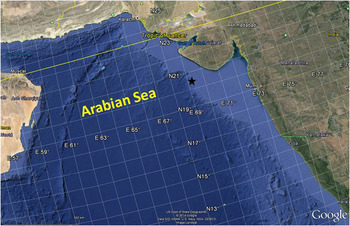
In the course of a fishery survey, carried out at the margins of the continental shelf of the north-eastern Arabian Sea (Figure 1) by the bottom trawler FORV ‘Sagar Sampada’, specimens of two species, C. vorax and C. nudivittis, were collected. Both are new records for the region. Champsodon nudivittis had been known so far from Australia, the Indo-Pacific archipelago, Madagascar, the Red Sea and the Mediterranean (Nemeth, Reference Nemeth1994; Goren et al., Reference Goren, Stern, Galil and Diamant2011). Champsodon vorax had been known so far from the China Sea, Australia, the Indo-Pacific archipelago, the Maldives (~2400 km from present finding) and the Mediterranean (Nemeth, Reference Nemeth1994; Bariche, Reference Bariche2010; Kalogirou & Corsini-Foka, Reference Kalogirou and Corsini-Foka2012).
Arabian Sea (Google Maps). The asterisk marks the collection site.

Abbreviations: GB, fish collection of the Marine Biodiversity Museum of the Central Marine Fisheries Research Institute (CMFRI), Kochi; TAU, fish collection of the Zoological Museum, Tel Aviv University.
SYSTEMATICS
Champsodon vorax Günther, Reference Günther1867
(Figures 2, 3 & 6A)
Champsodon vorax Günther, Reference Günther1867: 102. Type locality: ‘China Seas’.
Champsodon vorax (TAU P 15148, standard length 64 mm) from the Arabian Sea (photograph: M. Goren).

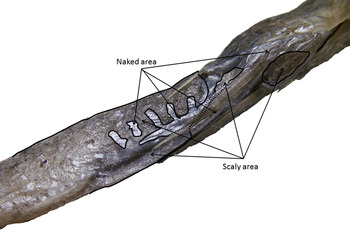
Ventro-lateral aspect of Champsodon vorax (TAU P- 15148, standard length 64 mm) from the Arabian Sea (photograph: M. Goren).

MATERIAL EXAMINED
TAU P 15148, 1 spec. standard length (SL) 64 mm; collected from the north-eastern Arabian Sea 20°35′N 69°18′E, depth: 282–393 m., FORV ‘Sagar Sampada’ 24 August 2013.
DIAGNOSIS
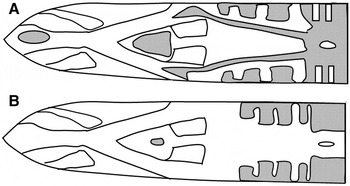
A species of Champsodon differing from all other species of the family by the combination of the following characteristics: chin scaled; breast fully scaled (Figures 3 & 6A); belly scaled to about midway between anus and origin of pelvic fins; a patch of scales behind origin of pelvic fins, connected by a narrow scaly band to belly scales (Figure 3). Eleven gillrakers on first gill arch. A single gillraker on upper limb, one at the angle and 9 on lower limb.Ventral margin of eye pupil indented by a flap of iris.
BRIEF DESCRIPTION
Body elongate and laterally compressed. Mouth oblique; maxilla extending to below mid- eye; eye large; pupil of eye round; a flap of iris on ventral margin of pupil. Two nostrils (on each side) on anterior part of snout. Two parallel rows of 3 elongated crests (each) on upper part of head. Scales small and spiny, not overlapping. No melanophores along the pectoral fin rays
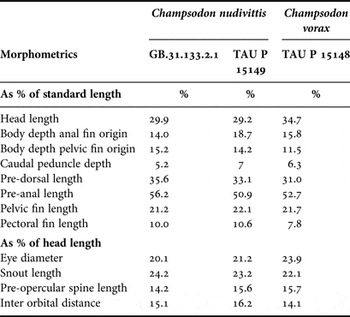
First dorsal fin with 5 spines, second with 20 rays; anal fin with 17 rays; pectoral fin with 12 rays and pelvic fin with 6 rays. Selected body proportions (as % of SL): head length 31%; body depth 21; pre-dorsal length 31.0; pre-nnal length 39.8; pelvic fin length 21.7; pectoral fin length 7.5; body depth at anal fin origin 15.8; body depth at pelvic fin origin 11.5; caudal peduncle depth 6.3; (as % of head length): eye diameter 23.9; snout length 22.1; maxilla length 42.3; inter- orbital distance 14.1.
Champsodon nudivittis (Ogilby Reference Ogilby1895)
(Figures 4, 5 & 6B)
Centropercis nudivittis Ogilby, Reference Ogilby1895: 320. Type locality: Maroubra Bay, New South Wales, Australia.
Champsodon nudivittis (TAU P- 15149, standard length 53.1 mm) from the Arabian Sea (photograph: M. Goren).

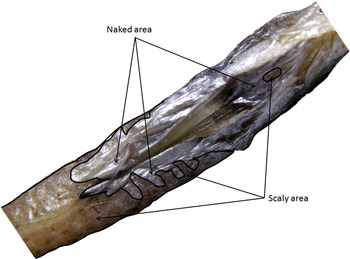
Ventral view Champsodon nudivittis (TAU P 15149, standard length 53.1 mm) from the Arabian Sea (photograph: M. Goren).

Schematic drawing of ventral view of Champsodon vorax (A) and Champsodon nudivittis (B). Scaly areas are shaded.

MATERIAL EXAMINED
TAU P 15149, 1 spec. SL 53.1 mm; GB.31.133.2.1, 1 spec. SL 56.67 mm; both collected from the north-eastern Arabian Sea 20°35′N 69°18′E, depth: 282–393 m, 24 August 2013.
DIAGNOSIS
A species of Champsodon differing from all other species of the genus by the combination of the following characteristics: a small patch of scales on the breast (Figure 4); chin completely naked; mid-belly (from anus to origin of pelvic fins) not scaled (Figures 4 & 6B); a single gill raker on upper limb of first gill; sensory papillae between eyes not arranged in a semicircle, ventral margin of pupil indented by flap of iris. Maxilla extending to below rear margin of eye.
BRIEF DESCRIPTION
Body elongate and laterally compressed. Mouth oblique; maxilla extending to below posterior margin of eye; eye large with a round pupil; ventral margin of pupil indented by a flap of iris. Two nostrils (on each side) on anterior part of snout. Two parallel rows of 3 elongated crests (each) on upper part of head. Scales small and spiny, not overlapping. No melanophores along the pectoral fin rays.
First dorsal fin with 5 spines, second with 19 rays; anal fin with 17 rays; pectoral fin with 14 rays and pelvic fin with 6 rays. Selected body proportions are presented in Table 1.
Morphometric ratios of Champsodon nudivittis and Champsodon vorax.

DISCUSSION
The only Champsodon species known so far from the northern Arabian Sea is C. omanensis Regan, 1908 (Nemeth, Reference Nemeth1994; Manilo & Bogorodsky, Reference Manilo and Bogorodsky2003). This species can easily be distinguished from C. nudivittis and C. vorax by its fully scaled belly and breast. In addition, C. omanensis differs from C. nudivittis by its scaly chin and from C. vorax by the possession of melanophores along the pectoral fin rays.
The present finding increases the number of Champsodon species found in the Arabian Sea to three. This expansion of the known natural distribution of the two species, which were recently reported from the eastern Mediterranean, significantly shortens the distance between their previously known distribution and the Red Sea, and thus strengthens the assumption that both species entered the Mediterranean through the Suez Canal and were not introduced in ballast water, as suggested by Çiçek & Bilecenoglu (Reference Çiçek and Bilecenoglu2009) and Bariche (Reference Bariche2010). Since C. nudivittis has been recently reported from the Red Sea (Goren et al., Reference Goren, Stern, Galil and Diamant2011) it is likely that it entered the Mediterranean through the Suez Canal.
Champsodon vorax has not yet been reported from the Red Sea. However, it has been reported from the Mediterranean (Bariche, Reference Bariche2010). Therefore we cannot rule out the possibility that it exists in the Red Sea and entered the Mediterranean through the Suez Canal. From a recent examination of Champsodon specimens from the Red Sea it is clear that some reports on the presence of various Champsodon species in the Red Sea are based on misidentifications (Goren et al., Reference Goren, Stern, Galil and Diamant2011). Thus, reexamination of all reported Red Sea specimens (as well as from other parts of the western Indian Ocean) is required in order to verify their identity.
ACKNOWLEDGEMENTS
U.G. and P.T.J. acknowledge the financial support from CMLRE/Ministry of Earth Sciences, Government of India, in carrying out the work and the facilities offered on-board FORV ‘Sagar Sampada’ for the surveys. We thank Ms N. Paz for editing the manuscript.