Indiscriminate attachment behavior is one term used to refer to a form of attachment disturbance among children under age 5 classified in the Diagnostic and Statistical Manual of Mental Disorders—Fourth Edition (DSM-IV) of the American Psychiatric Association (2000) as a reactive attachment disorder (RAD). According to DSM-IV, RADs exist in two forms: the disinhibited or indiscriminate form, which is of interest here, and the inhibited form, which has received less research attention and will not be discussed further. Indiscriminate/disinhibited behavior is defined as a disturbance in social relatedness marked by “indiscriminate sociability or a lack of selectivity in the choice of attachment figures” (American Psychiatric Association, 2000, p. 116). This construct has been operationalized by interviewing caregivers about the salience of such behaviors as willingness to leave a familiar caregiver and go off with a stranger, failure to check with a familiar caregiver in an anxiety-provoking situation, or lack of differentiation between adults, including seeking close physical contact or being inappropriately affectionate with strangers. However, as Zeanah, Smyke, and Dumitrescu (Reference Zeanah, Smyke and Dumitrescu2002) point out, the standard DSM-IV and ICD-10 (World Health Organisation, 1992) definitions of disinhibited/indiscriminate attachment behavior have little associated validity data. Therefore, reliable and valid measures of the socially indiscriminate behavioral presentation constituting this disorder are needed.
Disinhibited or socially indiscriminate behavior was first described among children reared in institutions (Tizard & Rees, Reference Tizard and Rees1975). Subsequently, researchers operationalized these descriptions in interview protocols for adoptive parents of institutionally reared children (Chisholm, Reference Chisholm1998; O'Connor, Rutter, and the English and Romanian Adoptees [ERA] Study Team, Reference O'Connor and Rutter2000; Zeanah et al., Reference Zeanah, Smyke and Dumitrescu2002). However, Chisholm's (1998) results suggested that adoptive parents often do not consider overly friendly behavior toward strangers to be problematic, and thus could be underreporting them in interviews or self-report questionnaires. In addition, caregiver report increases the likelihood of informant bias, especially in relation to outcomes based on other caregiver report measures such as behavior problem scales (Zeanah et al., Reference Zeanah, Smyke and Dumitrescu2002). Finally, O'Connor, Bredenkamp, Rutter, and the ERA Study Team (1999) found an elevated level of indiscriminate behavior by caregiver report among a nondeprived British control group, which was presumed to reflect methodological error. They pointed out that the finding “underscored a potential difficulty of assessing attachment disturbances using semistructured parent interviews” (p. 704).
To date, a reliable observational procedure for assessing socially indiscriminate forms of attachment behavior has not been developed. However, several studies have reported anecdotally on forms of indiscriminate behavior appearing in the Strange Situation procedure (SSP; Chisholm, Reference Chisholm1998; Goldberg, Marvin, Sabbagh, & Marcovitch, Reference Goldberg, Marvin, Sabbagh and Marcovitch1996; O'Connor, Marvin, Rutter, Olrick, Britner, and the ERA Study Team, 2003; Zeanah, Smyke, Koga, & Carlson, Reference Zeanah, Smyke, Koga and Carlson2005). As noted by O'Connor et al. (Reference O'Connor, Marvin, Rutter, Olrick and Britner2003), “qualitative and clinical impressions of the children indicated that, for example, there was a noteworthy tendency of insecure–other children to show attachment-related behaviors toward the stranger, sometimes vacillating with similar behaviors toward the parent” (p. 33). These repeated observations suggest that there may be additional aspects of the child's behavior in the SSP that are not captured by traditional attachment coding and raise the possibility that the SSP may be an appropriate setting for a direct observational assessment of the child's relative engagement with caregiver and stranger.
Social Contexts of Indiscriminate Attachment Behavior
Socially indiscriminate behavior has been described repeatedly among institutionally reared children (Chisholm, Reference Chisholm1998; O'Connor et al., Reference O'Connor, Bredenkamp and Rutter1999; Tizard & Rees, Reference Tizard and Rees1975; Zeanah et al., Reference Zeanah, Smyke and Dumitrescu2002, Reference Zeanah, Smyke, Koga and Carlson2005). Moreover, a dose–response relation has been found between duration of institutional rearing and severity of indiscriminate behavior (O'Connor et al., Reference O'Connor and Rutter2000, Reference O'Connor, Marvin, Rutter, Olrick and Britner2003).
A variety of theories have been advanced regarding possible mechanisms contributing to this association. Socially indiscriminate attachment behavior has been thought to be an outcome of neglect (Zeanah, Reference Zeanah2000), in which there is a lasting breakdown in the regulation of attachment and affiliative behavior occurring in the first year of life. O'Connor et al. (Reference O'Connor, Marvin, Rutter, Olrick and Britner2003) further theorize that indiscriminate behavior reflects a primary disturbance in the organization of the attachment system. Among normally developing infants, secure base behavior, affiliation, wariness, and exploratory behavior are combined in coherent organizations of behavior in relation to preferred caregivers. They speculate that emotional deprivation in early life can interfere with this organizational process and result in the uncoupling of these normally interrelated behavioral systems. Alternately, Chisholm (Reference Chisholm1998) has speculated that indiscriminate attachment behavior develops as a response that is adaptive in engaging detached caregivers, particularly in institutional settings with rotating staff.
However, Zeanah et al. (Reference Zeanah, Smyke, Koga and Carlson2005) assessed observed quality of care in the orphanage among institutionally reared children aged 12 to 31 months and, contrary to prediction, variations in socially indiscriminate patterns of relatedness were not associated with variations in quality of care in the orphanage. In studies involving institutionalized children, the child has typically experienced inadequate care from different caregivers, whereas the comparison sample has experienced adequate care from a stable caregiver. This makes it difficult to discriminate between the effect of poor-quality care and the effect of multiple caregivers on the development of indiscriminate behavior. However, Boris et al. (Reference Boris, Hinshaw-Fuselier, Smyke, Sheeringa, Heller and Zeanah2004) found a significantly higher rate of indiscriminate behavior displayed by children living with their mothers in a homeless shelter, in comparison to children recruited from Head Start classes. Zeanah et al. (Reference Zeanah, Scheeringa, Boris, Heller, Smyke and Trapani2004) found similar results among maltreated children and controls. They concluded that deprivation of care may be associated with socially indiscriminate attachment behavior even when a child lives with a stable biological caregiver.
Indiscriminate Attachment Behavior and Social Adaptation
Both children reared in institutions and maltreated home-reared children exhibit elevated rates of behavior problems (Cicchetti, Lynch, Shonk, & Todd-Manly, Reference Cicchetti, Lynch, Shonk, Todd-Manly, Parke and Ladd1992; Tizard & Rees, Reference Tizard and Rees1975). O'Connor et al. (Reference O'Connor and Rutter2000) have reported a particular relation at 6 years between extent of indiscriminate behavior and both disruptive and hyperactive behavior problems, a link that could not be explained by a common relation to length of institutional rearing. Further, Chisholm (Reference Chisholm1998) found a significant association between two extreme indicators of indiscriminate attachment behavior (i.e., “Child wanders without distress” and “child would be willing to go home with a stranger”) and externalizing and internalizing scores on the Child Behavior Checklist among a group of institutionally reared adopted children (Achenbach, Reference Achenbach1991). However, Zeanah et al. (Reference Zeanah, Smyke and Dumitrescu2002) found no relation between indiscriminate behavior assessed by caregivers and caregiver-reported aggressive behavior. Children in the latter study had a mean age of 36 months but were also quite developmentally delayed, which may have contributed to the absence of findings.
Disorganized attachment patterns are also related to future behavior problems, especially aggressive behavior toward peers (Lyons-Ruth, Alpern, & Repacholi, Reference Lyons-Ruth, Alpern and Repacholi1993; van IJzendoorn, Schuengel, & Bakermans-Kranenburg, Reference van IJzendoorn, Schuengel and Bakermans-Kranenburg1999). To date, no study has assessed the incremental longitudinal prediction of behavior problems contributed by socially indiscriminate attachment behavior, with other forms of insecure attachment behavior controlled.
Relations Between Indiscriminate Attachment Behavior and Traditionally Assessed Attachment Insecurity
Several studies have also assessed traditional attachment behavior toward the preferred caregiver exhibited by orphanage-reared children in the SSP (Ainsworth, Blehar, Waters, & Wall, Reference Ainsworth, Blehar, Waters and Wall1978). Observing children in institutions aged 12 to 31 months of age, Zeanah et al. (Reference Zeanah, Smyke, Koga and Carlson2005) found no relation between indiscriminate behavior by caregiver report and attachment classification in the SSP. A new 5-point scale developed by Carlson (Reference Carlson2002) for “nonattachment to the caregiver” was also applied to the infant's strange situation behavior. This scale rated child behavior indicative of partial or complete absence of attachment behavior toward the caregiver in the SSP assessment. The “nonattachment” scale focused primarily on behavior toward the caregiver rather than the stranger. The scale rated behavior ranging from full seeking of physical closeness and comfort from the caregiver, through incomplete attachment behavior at the midrange, to no evidence of attachment behavior toward the caregiver. Seventy-eight percent of institutionalized children rated “secure” in the SSP also had high ratings on the “nonttachment to caregiver” scale. Zeanah et al. (Reference Zeanah, Smyke, Koga and Carlson2005) concluded that attachments classified “secure” in the institutional group were not comparable to the secure attachments observed among noninstitutionalized children. Unfortunately, the correlation between nonattachment to caregiver in the SSP and socially indiscriminate behavior toward others was not reported.
Previous studies by Chisholm (Reference Chisholm1998) and by Goldberg and colleagues (1996; Marcovitch et al., Reference Marcovitch, Goldberg, Gold, Washington, Wasson, Krekewich and Handley-Derry1997) of older children adopted from institutional settings have also suggested that indiscriminate attachment behavior and security of attachment as traditionally assessed may be independent constructs with little overlap. In the Chisholm (Reference Chisholm1998) study of young children aged 17 months to 76 months adopted from Romanian orphanages, mothers reported increased secure base behavior over time, but also reported a continuation of socially indiscriminate behavior (Chisholm, Reference Chisholm1998; Chisholm, Carter, Ames, & Morison, Reference Chisholm, Carter, Ames and Morison1995). In the Goldberg et al. (Reference Goldberg, Marvin, Sabbagh and Marcovitch1996) study, nearly half of the adoptees classified secure in the SSP at ages 3 to 5 years also exhibited socially indiscriminate attachment behavior to the stranger in the same observation. None of the securely attached control children did so. Finally, Marvin and O'Connor (Reference Marvin and O'Connor1999) also reported the coexistence of secure attachment as measured in the home and socially indiscriminate behavior by parent report from 4 to 6 years of age. Marvin and O'Connor (Reference Marvin and O'Connor1999) also questioned the validity of the secure classification in this population.
Zeanah et al. (Reference Zeanah, Smyke and Dumitrescu2002) also investigated the question of the coexistence of socially indiscriminate behavior and preference for a particular institutional caregiver by developing a caregiver interview that included probes both for socially indiscriminate behavior and for secure base behavior (having a preferred caregiver to whom the child turned selectively for comfort). Among 61 children aged 11–70 months living in Romanian orphanages, having a preferred caregiver did not preclude high levels of socially indiscriminate attachment behavior, with a majority of children who received standard orphanage care both having a preferred institutional caregiver and showing high levels of indiscriminate behavior.
Disorganized attachment behavior toward the preferred caregiver, rather than organized forms of attachment security or insecurity, has also been associated in the literature with maltreatment and inadequate care and with child and adolescent psychopathology (van IJzendoorn et al., Reference van IJzendoorn, Schuengel and Bakermans-Kranenburg1999). Disorganized attachment behavior is characterized by momentary confusion, conflict, fear, or disorientation upon reunion with a caregiver. This disorganized behavior often coexists with secure base behavior as well (Main & Solomon, l990). Boris et al. (Reference Boris, Hinshaw-Fuselier, Smyke, Sheeringa, Heller and Zeanah2004) investigated the relation between disorganization of attachment and parent report of socially indiscriminate attachment behavior and failed to find a relation. O'Connor et al. (Reference O'Connor, Marvin, Rutter, Olrick and Britner2003) found an association between socially indiscriminate attachment behavior as reported by caregivers and “insecure–other” attachment classification on the Preschool Attachment Classification System (Cassidy, Marvin, & the MacArthur Working Group on Attachment, Reference Cassidy and Marvin1992). However, the definition of insecure–other attachment classification currently lacks clarity and consistency in the standard coding manual. O'Connor and colleagues (2003) also reported anecdotally that a number of children classified insecure–other at 4–6 years showed attachment-related behaviors toward the stranger in the SSP. O'Connor et al. (Reference O'Connor, Marvin, Rutter, Olrick and Britner2003) specifically noted regarding the SSP that “focus on the child's behavior toward the experimenter (i.e., the ‘Stranger’) . . . was essential because it was in that interaction setting, more so than in the child's behavior toward the parent, that disturbances were most evident” (p. 35).
Taken together, these studies suggest that it will be important to assess patterns of relatedness to the stranger in the SSP, as well as assessing patterns of relatedness toward the primary caregiver. One could then evaluate statistically through multivariate regression analysis whether indiscriminate behavior toward the stranger adds predictive information independent of that contributed by the standard attachment classifications of secure–insecure or organized–disorganized.
Study Aims and Hypotheses
The first aim of the current study was to assess whether a form of socially indiscriminate behavior toward strangers could be defined and coded reliably using the standardized observational procedure of the Strange Situation. With this aim, a Rating of Infant–Stranger Engagement (RISE; Riley, Atlas-Corbett, & Lyons-Ruth, Reference Riley, Atlas-Corbett and Lyons-Ruth2005) was developed that weighted both the equivalence of engagement toward stranger and caregiver over all episodes of the SSP, as noted by Goldberg et al. (Reference Goldberg, Marvin, Sabbagh and Marcovitch1996; Marcovitch et al., Reference Marcovitch, Goldberg, Gold, Washington, Wasson, Krekewich and Handley-Derry1997), and the display of nonnormative forms of physical closeness and comfort seeking toward the stranger, as captured in other descriptions of socially indiscriminate behavior (e.g., Chisholm et al., Reference Chisholm, Carter, Ames and Morison1995; Tizard & Rees, Reference Tizard and Rees1975; Zeanah, Reference Zeanah2000).
The second aim was to validate the new measure of socially indiscriminate behavior in a home-reared sample in relation to early caregiving risk and in relation to later behavior problems assessed in kindergarten. It was predicted that higher levels of socially indiscriminate attachment behavior would be associated with greater caregiving risk and would predict higher levels of behavior problems as rated by teachers. Use of a home-reared sample ruled out rotating caregivers as a potential source of risk for indiscriminate behavior.
The third aim was to assess the discriminant validity of the measure in relation to standard assessments of insecure and disorganized attachment behavior toward the caregiver. It was predicted that, even after controlling for variance related to insecure and disorganized attachment behavior, higher levels of socially indiscriminate behavior would account for independent variance both in severity of caregiving risk and in higher levels of teacher-rated behavior problems.
Finally, change in indiscriminate attachment behavior from 12 to 18 months was evaluated for its relation to caregiving risk and later behavior problems. Because no prior studies have examined the developmental course of socially indiscriminate attachment behavior over this age range, no hypotheses regarding change were advanced a priori.
Method
Participants
The sample consisted of 75 mother–infant dyads, 39 referred to a clinical infant service because of problematic caregiving and 36 from socioeconomic status-matched families in the community screened for caregiving problems. All families were required to meet federal poverty levels designating eligibility for government assistance. Dyads were recruited between birth and 18 months infant age. Ten families in the referred group had engaged in state-documented maltreatment. None of the infants in the study had experienced prolonged (>1 month) periods of out-of-home care or separation from the mother, and no infant had been severely physically abused to the knowledge of clinical staff of the study or state protective service workers. Parents who did not retain custody of their infants were not eligible to participate. Among the families with documented maltreatment, only one infant experienced a brief period of out-of-home care. That infant had weekly visits with his mother during the 3 weeks of foster care. A second infant suffered from failure to thrive syndrome and was hospitalized twice during the first 6 months of life but not subsequently. Older children in this family had been permanently placed in foster care secondary to physical abuse, but physical abuse was not observed toward this infant and the mother retained custody. A third infant was hospitalized briefly at 4 months of age for an illness, and a maltreatment petition was filed when parents were observed tying the child to the bed in the hospital. A fourth infant was repeatedly brought to emergency rooms for a variety of complaints and underwent surgery for esophageal reflux at 12 months of age before mother was diagnosed with Munchhausen by proxy syndrome. In four other cases, mothers were hospitalized for brief periods during the infant's first year for substance abuse or psychiatric illness, resulting in periods of separation while the infant was cared for by other family members. As can be seen, there were a number of short-term separations of mother and baby that occurred over the first year, and the types of deviations in adequate care that were observed clinically were heterogeneous but did not involve physical battering. It should also be noted that the participating families comprised all families in our state-defined mental health service area who were identified as needing parent–infant services during the 18-month intake period for the study and who retained custody of their infants. So the participating families were representative of families with infants needing services in an urban, low-income community.
Mothers in the community comparison group were matched to clinically referred mothers on per-person family income; mother's education, age, and race; and infant's age, gender, and birth order. Mothers in this latter group had never been reported to state child protective services, had never been referred to clinical services oriented toward parenting, and were not observed to display problematic parenting behavior during a 1-hr home observation.
Eighty percent of mothers in the study were Caucasian, non-Hispanic; the remaining were African American or Hispanic. Further details are available in Lyons-Ruth, Connell, Grunebaum, and Botein (Reference Lyons-Ruth, Connell, Grunebaum and Botein1990). Based on age of entry into the study, 44 dyads were videotaped at both 12 and 18 months of age, and 26 were taped at 18 months only. Five additional infants were seen at 12 months who did not have 18-month data. This yielded a total of 49 taped episodes at 12 months, and 70 at 18 months. One 18-month tape could not be coded for indiscriminate behavior because of deterioration of the tape. Sixty-two children were followed up in kindergarten (mean age = 59 months, range = 49–71 months, males = 37). Of the families who did not have kindergarten data, two families did not have teacher data because their children were not in preschool, 2% had moved too far away, 11% could not be relocated, and 5% refused to participate (Lyons-Ruth et al., Reference Lyons-Ruth, Alpern and Repacholi1993).
Measures
Cumulative demographic risk
Mother's demographic risk score ranged from 0 to 5 and summed the number of the following five characteristics present: mother had no high school education, government aid recipient, no partner in home, mother under 20 at birth of first child, and more than two children under age 6.
Caregiving risk
Caregiving risk was represented by a 3-point ordinal scale, with the following levels: 3 = presence of maltreatment petition and/or inpatient psychiatric treatment of mother; 2 = clinical level of maternal depression on the Center for Epidemiological Studies Depression Scale (CES-D; see below) but neither inpatient psychiatric treatment nor maltreatment petition; and 1 = absence of clinical level of depression, psychiatric inpatient treatment, and maltreatment petition.
Infant attachment insecurity
Mothers and infants were videotaped in the SSP (Ainsworth et al., Reference Ainsworth, Blehar, Waters and Wall1978) at both 12 and 18 months. In this procedure the infant is videotaped in a playroom during a series of eight structured 3-min episodes involving the baby, the mother, and a female stranger. During the observation the mother leaves and rejoins the infant twice, first leaving the infant with the female stranger, then leaving the infant alone to be rejoined by the stranger. The procedure is designed to be mildly stressful to increase the intensity of activation of the infant's attachment behavior. Videotapes were coded for traditional organized and disorganized attachment behavior (Ainsworth et al., Reference Ainsworth, Blehar, Waters and Wall1978; Main & Solomon, Reference Main, Solomon, Greenberg, Cicchetti and Cummings1990). The three original attachment classifications (secure, avoidant, and ambivalent) were assigned by both a computerized multivariate classification procedure developed on the original Ainsworth data (Connell, Reference Connell1976; Lyons-Ruth et al., Reference Lyons-Ruth, Connell, Grunebaum and Botein1990; see also reference in Richters, Waters, & Vaughn, Reference Richters, Waters and Vaughn1988) and by a coder trained by M. Main. Agreement between the two sets of classifications was 86%. Agreement on the disorganized classification between M. Main and a second coder for 32 randomly selected 12- and 18-months tapes was 83% (κ = .73). No coder coded the same infant at both ages and coders were naive to all other data from the study. Infant attachment coding had been carried out in an earlier phase of the study prior to and independent of the later coding for indiscriminate attachment behavior.
There were no infants who displayed organized ambivalent attachment patterns in this sample. All four infants classified as ambivalent at 18 months and both infants classified ambivalent at 12 months also met criteria for the disorganized category and were classified as disorganized. Attachment distribution at 12 months was as follows: 24 secure, 14 avoidant, and 11 disorganized; at 18 months, the distribution was 23 secure, 15 avoidant, and 32 disorganized.
RISE
Attachment-related forms of engagement with the stranger by the infant over all episodes of the SSP were coded from videotape by independent raters with the newly developed RISE (see Appendix A; Riley et al., Reference Riley, Atlas-Corbett and Lyons-Ruth2005). Using this scale, each infant was assigned a rating of 1 to 9, evaluating both the extent of the infant's affective engagement with the stranger compared to the mother and the extent to which the infant displayed nonnormative acceptance of physical contact or response to soothing by the stranger. A score of 5 indicates at least equal engagement with the stranger compared with the mother, and higher scores indicate nonnormative forms of affective engagement and attachment behavior with the stranger. The scale was developed a priori after extensive review of the literature on indiscriminate attachment behavior (Chisholm, Reference Chisholm1998; Marcovitch et al., Reference Marcovitch, Goldberg, Gold, Washington, Wasson, Krekewich and Handley-Derry1997; O'Connor et al., Reference O'Connor and Rutter2000; Tizard & Rees, Reference Tizard and Rees1975). The scale was then applied blind to all other data on 12 randomly selected videotapes, 5 at 12 months and 7 at 18 months, to more fully develop the scale point descriptions and resolve coding issues that emerged. Reliability assessed on 41 tapes yielded an intraclass coefficient of ri = .72. Coders were naive to the criteria for coding attachment behaviors according to Ainsworth et al. (Reference Ainsworth, Blehar, Waters and Wall1978) and Main and Solomon (Reference Main, Solomon, Greenberg, Cicchetti and Cummings1990). Each coder coded half of the 12- month tapes and half of the 18-month tapes; no coder coded the same infant at both ages. Coders were naive to all other data from the study.
Disrupted maternal affective communication
Disrupted maternal communication with the infant had been coded earlier in the study over all episodes of the Strange Situation at 18 months by separate coders using the AMBIANCE coding system (Lyons-Ruth, Bronfman, & Parsons, Reference Lyons-Ruth, Bronfman and Parsons1999). Coders were naive to the criteria for coding both disorganized attachment behavior and indiscriminate attachment behavior, as well as to all other data from the study. The AMBIANCE coding protocol was developed to assess disrupted forms of mother–infant affective communication theoretically expected to be related to infant disorganization. Five such classes of atypical maternal behavior were included as follows: (a) affective communication errors (e.g., giving contradictory cues; nonresponse or inappropriate response to clear infant cues), (b) role confusion (e.g., self-referential or sexualized behavior), (c) negative–intrusive behavior (e.g., verbal negative remarks or physical intrusiveness), (d) disorientation (e.g., appearing frightened by infant; disoriented wandering), and (e) withdrawal (e.g., failing to greet infant; backing away from infant approach). The AMBIANCE also yields an overall scaled score (1–7) for extent of disrupted communication, with a score of 5 or greater leading to classification as disrupted. Fifteen randomly selected tapes were coded by two coders to assess reliability. The reliabilities were as follows: level of Disrupted Communication Scale, κ = .93; disrupted classification, κ = .73; total atypical behavior score, ri = .75, affective communication errors subscore, ri = .75; role confusion subscore, ri = .76; negative–intrusive behavior subscore, ri = .84; disorientation subscore, ri = .73; withdrawal subscore, ri = .73.
In a recent meta-analysis, the AMBIANCE coding system was shown to be stable for periods ranging from 6 months to 5 years, with an overall stability coefficient of .56 (N = 203). Concurrent and predictive validity was also demonstrated in relation to infant disorganization (r = .35, N = 384) whether or not the AMBIANCE was coded in the SSP or in a separate free-play assessment (Madigan et al., Reference Madigan, Bakermans-Kranenburg, van IJzendoorn, Moran, Pederson and Benoit2006).
Assessment of infant cognitive development
Infants were assessed both at 12 and 18 months on the Mental Development Index of the Bayley Scales of Infant Development (Bayley, Reference Bayley1969) administrated by an experienced psychologist.
Preschool Behavior Questionnaire (PBQ, age 5)
The PBQ (Behar & Springfield, Reference Behar and Springfield1974) was completed by teachers for the 62 children in the follow-up study and the three same-gender classmates nearest in age to the study child. A single mean classmate control score was computed for each study child to control for possible differences in teacher baseline for rating problem behavior across classrooms. The PBQ represents a modified version of Rutter's (Reference Rutter1967) Children's Behavior Questionnaire, developed for children in the 3- to 6-year-old age range. Total score ranges from 0 to 60. Test–retest values, interrater reliabilities, and standardization sample characteristics are all acceptable (see Behar & Springfield, Reference Behar and Springfield1974). Factor analytic studies extracted three factors: hostile, anxious, and hyperactive (Behar, Reference Behar1977; Behar & Springfield, Reference Behar and Springfield1974). Cutoff scores that maximally discriminated normal and disturbed groups indexed the upper 10% of scores among the normal validation group. Scores over the cutoff point cannot be considered comparable to a clinical disorder but merely denote deviance from normative behavior.
Results
Control variables: Age, gender, demographic risk, and cognitive development
Mean RISE scores were 4.65 (SD = 2.07, range = 1–8) at 12 months and 4.34 (SD = 2.26, range = 1–9) at 18 months. There was no significant relation between family demographic risk and socially indiscriminate behavior at 12 months, r (49) = −.26, ns, or at 18 months, r (70) = −.06, ns. Indiscriminate behavior was also unrelated to child gender both at 12 months, F (1, 48) = .02, ns, and at 18 months, F (1, 69) = .01, ns. There was also no significant association between the Mental Development Index on the Bayley scales and socially indiscriminate attachment behavior either at 12 months (r = .16, ns) or at 18 months (r = −.12, ns).
Stability of indiscriminate behavior
Indiscriminate behavior was moderately stable between 12 and 18 months, r (44) = .31, p = .05. Inspection of the data revealed no evidence that this moderate stability was primarily a function of stability in extreme high scores on the RISE at 12 months. Among the 10 children who scored 7 or greater on the RISE at age 12, only 2 scored in the same range at age 18 months. Among the 9 children with extreme scores at 18 months, only 2 were also extreme at 12 months. There was also no evidence that the modest stability of the RISE was a function of stability in low RISE scores among the group classified secure at both ages. Among the 15 infants classified as securely attached both at 12 and 18 months, RISE scores were evenly distributed across the range from 1 to 9 at both ages. There was no correlation (r = .09) between 12 and 18 months RISE scores among the stable secure group. Therefore, consistent with previous literature, infants classified as secure in this high-risk cohort could also earn high scores on the RISE, and stability in indiscriminate behavior over time could not be explained as stemming from consistently low scores among secure infants.
Socially indiscriminate behavior and traditional attachment behavior toward the caregiver
Preliminary analysis revealed significant associations between infant attachment classification in relation to the caregiver (secure, insecure, disorganized) and indiscriminate attachment behavior toward the stranger, both at 12 months, F (2, 46) = 3.85, p = .05, and 18 months, F (2, 66) = 7.37, p = .01. At 12 months, Tukey's post hoc analyses revealed that insecure–organized children (M = 5.57, SD = 1.45, n = 14) showed higher rates of socially indiscriminate attachment behavior than secure children (M = 3.88, SD = 2.15, n = 24). At 18 months, similar post hoc analyses indicated that both insecure–organized (M = 5.78, SD = 2.12, n = 14) and disorganized children (M = 4.56, SD = 2.27, n = 32) showed higher rates of socially indiscriminate attachment behavior compared to secure children (M = 3.13, SD = 1.79, n = 23).Footnote 1
Given these findings, in the remainder of the analyses the discriminant validity of indiscriminate attachment behavior was assessesd both in relation to infant avoidance or resistance and in relation to infant disorganization. This was operationalized by conducting hierarchical regression analyses with two orthogonal contrasts entered as control variables in all analyses: (a) one contrast between all infants with a primary or secondary categorization as secure versus insecure (avoidant or resistant), and (b) one contrast between all organized infants and all disorganized infants. These controls assessed the discriminant validity of indiscriminate behavior in relation to organized and disorganized forms of traditionally assessed insecurity of attachment. (Similar hierarchical regression analyses contrasting secure and insecure classifications among the subset of organized infants, with disorganized infants excluded, yielded similar findings, but are not reported here.)
Caregiving risk and socially indiscriminate attachment behavior
Convergent validity of the RISE scale was first assessed in relation to problems in early care, with traditional attachment classifications controlled. Three variables indexed caregiving problems. The first was referral group status (clinical referral/matched community comparison). This variable has high ecological validity, but is difficult to operationalize and replicate. The second variable was a more easily replicable measure of severity of caregiving risk (score of 2 = maltreatment or psychiatric history, 1 = high depressive symptoms only, 0 = neither). Referral group status was strongly correlated with severity of caregiving risk, r = .63, p = .001, with all mothers at the highest level of risk (maltreatment or psychiatric history) being from the referred group (n = 17), 14 of 22 with depression only from the referred group, and 8 of 36 without these risk factors from the referred group. The third caregiving variable was directly observed level of maternal disrupted affective communication with the infant, coded from the laboratory videotaped session.
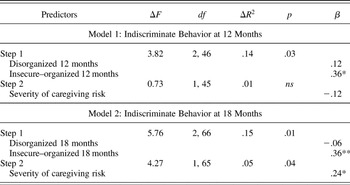
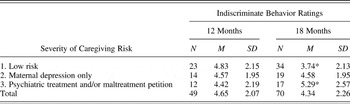
Referral group status was not predictive of infant indiscriminate behavior at either 12 months, F chg (1, 45) = .76, ns, or 18 months, F chg (1, 65) = .60, ns, with insecure and disorganized attachment classification controlled. However, the severity of maternal caregiving risk was significantly associated with infant indiscriminate attachment behavior at 18 months, F chg (1, 65) = 4.2.7, p = .04, β = .26, after controlling for other forms of attachment behavior, while indiscriminate behavior at 12 months was not, F chg (1, 45) = .73 (see Tables 1 and 2). Follow-up contrast tests comparing the maltreatment/psychiatric history group and the depressed-only groups separately to the low-risk group revealed that only infants in the maltreatment/psychiatric history group (n = 17) displayed significantly more indiscriminate attachment behavior at 18 months than infants in the low-risk group (n = 34), t (67) = −2.38, p = .05, with means of 5.29 (SD = 2.1), 4.58 (SD = 2.0), and 3.74 (SD = 2.6), respectively.
Socially indiscriminate behavior at 12 and 18 months as a function of severity of caregiving risk, controlling for other forms of attachment behavior

*p < .05. **p < .01.
Means and standard deviations of socially indiscriminate behavior ratings at 12 and 18 months of age by severity of caregiving risk

*Differ at p < .05.
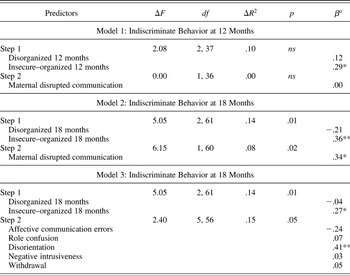
Given this significant finding, level of maternal disrupted affective communication at 18 months was also examined, to explore further how the observed process of mother–infant interaction might contribute to infant socially indiscriminate behavior. Infant indiscriminate behavior at 18 months was related to level of disrupted affective communication independently of traditional attachment classification, whereas indiscriminate behavior at 12 months was not, as shown in Table 3. Given this significant overall finding, the five subtypes of disrupted maternal communication were also evaluated. Only maternal disorientation was significantly associated with infant indiscriminate attachment behavior, with other forms of attachment behavior and maternal behavior controlled (see Table 3), suggesting some specificity to the pattern of caregiving behavior associated with socially indiscriminate behavior.
Socially indiscriminate behavior at 12 and 18 months as a function of maternal disrupted communication and its subtypes, controlling for other forms of attachment behavior

Note: N = 64.
aIndicates the unique contribution of each variable to the final model rather than to each step.
*p < .05. **p < .01.
Maternal disorientation was also significantly associated with severity of caregiving risk (β = .31, p = .05). Therefore, the disorientation score was tested as a potential mediator of the relation between severity of caregiving risk and infant indiscriminate attachment behavior. Results of the mediational analyses indicated that maternal disorientation was a significant mediator of the relation between maternal caregiving risk and infant indiscriminate behavior. With other forms of attachment behavior controlled as before, introduction of maternal disorientation to the regression model was associated with a decrease in the variance explained by severity of caregiving risk (β = .27, p = .05, to β = .19, ns), and the Sobel test indicated that this decrease was significant (Sobel test = 1.96, p = .05). Disorientation continued to be significantly related to indiscriminate behavior with caregiving risk controlled (β = .31, p = .01).
Indiscriminate attachment behavior and teacher-rated behavior problems in kindergarten
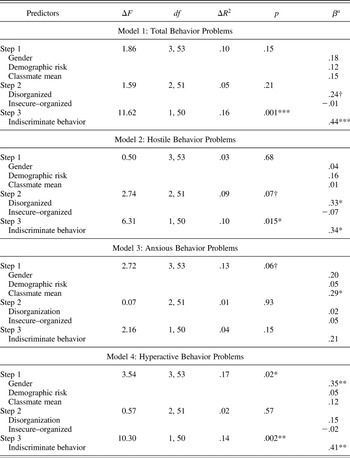
The final aim was to evaluate the relation between indiscriminate attachment behavior and total behavior problems, hostile behavior problems, anxious behavior problems, and hyperactive behavior problems on the PBQ as reported by teachers at age 5. Hierarchical regression analyses were computed, controlling for gender, demographic risk, and insecure–organized and disorganized attachment. Teachers' ratings of classmates were also included to control for potential baseline differences across teachers in use of the rating scales. Socially indiscriminate behavior at 18 months independently predicted total behavior problems, hostile behavior problems, and hyperactive behavior problems, as shown in Table 4. There was no association with anxious behavior.
Prediction of behavior problems at age 5 by indiscriminate attachment behavior at 18 months, controlling for other forms of attachment behavior

Note: N = 57.
aIndicates a contribution to each step.
†p < .10. *p < .05. **p < .01. ***p < .001.
Neither insecure–organized nor disorganized attachment were significant predictors of overall behavior problems, anxious behavior, or hyperactive behavior, consistent with an earlier report (Lyons-Ruth et al., Reference Lyons-Ruth, Alpern and Repacholi1993). However, attachment disorganization remained a predictor of hostile behavior, even with socially indiscriminate behavior included in the regression model.
In follow-up analyses to assess whether indiscriminate behavior was also related to clinically significant levels of behavior problems, behavior problem scores were dichotomized at the cutoff validated on the PBQ for problems of clinical concern. Logistic regression analyses, controlling for the same variables as above, confirmed that indiscriminate attachment behavior was also predictive of clinically significant levels of hostile, hyperactive, and total behavior problems, yielding results essentially identical to those in Table 4 (total problems: Wald = 8.77, p = .003; hostile: Wald = 4.27, p = .04; hyperactive: Wald = 6.80, p = .01).
There were no relations between indiscriminate behavior at 12 months and later behavior problems, with the exception of a marginally significant relation between indiscriminate behavior and clinically significant total behavior problems (Wald = 3.11, p = .08, N = 39) with other forms of attachment behavior controlled.
Change from 12 to 18 months in socially indiscriminate behavior as a correlate of caregiving risk and later behavior problems
Given the greater prediction associated with indiscriminate behavior at 18 months, a final set of regression analyses assessed whether change from 12 to 18 months was critical to the obtained association of indiscriminate attachment with caregiving risk and later behavior problems. The previous 18-month regression analyses were repeated with 12-month indiscriminate behavior controlled before entering 18 month ratings. These analyses also controlled for the moderate correlation between indiscriminate behavior ratings at the two ages and further assessed whether the pattern of findings in the 18-month sample was a function of the larger and somewhat different sample at that age (N = 70) or was also evident in the longitudinal group with data at both 12 and 18 months (N = 44).
Results at 18 months were similar after controlling for the infant's socially indiscriminate behavior at 12 months, as well as all other control variables. Increase in socially indiscriminate attachment behavior from 12 to 18 months of age was related to extent of caregiving risk (β = .36, p = .05) and to maternal disorientation (β = .35, p = .05). Increase in indiscriminate behavior scores from 12 to 18 months also predicted overall behavior problems and hyperactive behavior at 5 years (β = .57, p = .01; β = 57, p = .01, respectively). In addition, increase in socially indiscriminate behavior from 12 to 18 months predicted anxiety at age 5 (β = .39, p = .05). Only hostile behavior at age 5 was not predicted by 18 months behavior with 12 months behavior controlled (β = .21, ns), suggesting that continuity in indiscriminate behavior from 12 to 18 months was more important in the prediction of hostile behavior.
Discussion
The objective of the present study was to develop and validate a laboratory-based measure of socially indiscriminate attachment behavior. The good interrater reliability and the significant 6-month test–retest stability indicate that the coding instrument itself is reliable. In addition, discriminant validity was found in relation to infant gender, demographic risk, mental development, and, most importantly, in relation to both attachment insecurity and attachment disorganization. With other dimensions of attachment behavior controlled, socially indiscriminate attachment behavior was associated with independent variance in caregiving risk and in later hostile and hyperactive behavior problems.
Both a strength and limitation of the current work is that indiscriminate behavior toward the stranger was assessed in the same situation as traditional forms of attachment behavior toward the caregiver. This raises the concern that common methods variance could be playing a role in these results. However, any common methods variance would spuriously inflate the correlation between indiscriminate behavior and traditional attachment patterns and work against finding discriminant validity of indiscriminate behavior in relation to other aspects of attachment. In contrast, results indicated that the RISE codes explained statistically independent variance in caregiving risk and clinically significant behavior problems beyond the variance accounted for by traditional attachment assessments. This discriminant validity indicates that behavior toward the stranger in the strange situation may be conceptually separable from traditional attachment behavior toward the caregiver.
It is important to note that, in the SSP, mother and stranger are in the room together only in the preseparation episode when the infant is generally engaged in playing with the toys (when the stranger chats with mother then attempts to engage the infant), and for a few seconds at the beginning of each reunion when mother enters and stranger leaves. The majority of time the infant spends with the stranger occurs in Episodes 4 and 7 when the stranger is alone with the infant, and the coding judgment rests primarily on these interactions. In contrast, presence of an avoidant or disorganized attachment strategy is primarily judged in the presence of the caregiver at reunions (Ainsworth et al., Reference Ainsworth, Blehar, Waters and Wall1978; Main & Solomon, Reference Main, Solomon, Greenberg, Cicchetti and Cummings1990). A child who displays no codable insecure or disorganized behavior toward the caregiver during the reunions is unlikely to be classified insecure or disorganized, even if the child is unusually emotionally engaged with or physically close to the stranger (e.g., Goldberg et al., Reference Goldberg, Marvin, Sabbagh and Marcovitch1996; O'Connor et al., Reference O'Connor, Marvin, Rutter, Olrick and Britner2003). Overlap between the coding systems for indiscriminate behavior and for traditional forms of insecure behavior potentially could occur, however, if the infant displayed preferential behavior toward the stranger as the mother was entering and the stranger was leaving at the moments of reunion. Such potential common methods variance was addressed by controlling for traditional attachment classification in these analyses. However, future work could further evaluate this issue directly by assigning three ratings: one for episodes involving the stranger only, one for reunion episodes, and a final overall rating.
These findings converge with previous studies using caregiver report measures in indicating that indiscriminate behavior may index a construct that is largely orthogonal to the construct of security of attachment (Chisholm, Reference Chisholm1998; Chisholm et al., Reference Chisholm, Carter, Ames and Morison1995; Goldberg et al., Reference Goldberg, Marvin, Sabbagh and Marcovitch1996; Marvin & O'Connor, Reference Marvin and O'Connor1999; Zeanah et al., Reference Zeanah, Smyke, Koga and Carlson2005). What has not been demonstrated here is whether this new laboratory-based observation of socially indiscriminate behavior in infancy is indexing the same construct as that assessed using caregiver report among somewhat older institutionalized children. Additional work applying this assessment to infants and young children in institutional care settings, with convergent caregiver reports of indiscriminate behavior, is now needed.
As suggested by O'Connor et al. (Reference O'Connor, Marvin, Rutter, Olrick and Britner2003), it is possible that socially indiscriminate attachment reflects a qualitatively different and more severe disturbance than disorganization of attachment. The present results indicate that socially indiscriminate attachment behavior is associated with serious concurrent caregiving risk and predicts more pervasive behavior problems than disorganization of attachment alone. Therefore, these results are in line with the view that indiscriminate behavior may index a more serious form of disturbance.
Several authors have advanced theories regarding the underlying mechanisms that might contribute to the emergence of indiscriminate attachment behavior. In one conceptual framework, attachment disorganization is thought to be the result of an internal conflict between perceptions of the parent as a source of fear and as a haven of safety (Main & Hesse, Reference Main, Hesse, Greenberg, Cicchetti and Cummings1990). Reasoning from this framework, O'Connor and colleagues (2003) have suggested that indiscriminate attachment may be the result of an internal representation of the parent as being solely a source of fear. Such an internal model should be associated with more severe disturbances in children. However, an important difference between the coding schemes for disorganization and for indiscriminate behavior is that the disorganized scale primarily indexes disorganized behavior toward the caregiver during reunions while the current indiscriminate attachment measure primarily indexes the quality of engagement with the stranger during other episodes of the strange situation when the mother is not present. Fear of the mother would not in itself explain the child's readiness to engage with, and often seek close contact with, the stranger.
Alternatively, Zeanah et al. (Reference Zeanah, Smyke and Dumitrescu2002) have suggested that socially indiscriminate behavior is produced by severe neglect. This hypothesis would also predict that developmental delay related to neglect would be related to socially indiscriminate attachment. However, delayed cognitive development was not associated with the display of socially indiscriminate behavior in this sample nor in the prior work of Zeanah et al. (Reference Zeanah, Smyke, Koga and Carlson2005) and O'Connor et al. (Reference O'Connor and Rutter2000), indicating that serious physical neglect per se may not explain indiscriminate behavior.
Chisholm (Reference Chisholm1998) has suggested that socially indiscriminate behavior may be an adaptive response to an institutional system of rotating caregivers. However, Zeanah et al. (Reference Zeanah, Scheeringa, Boris, Heller, Smyke and Trapani2004) found indiscriminate attachment behavior in a sample of maltreated children living in foster care. These children lived with a single primary caregiver, prior to and after foster placement, in contrast to children in Romanian institutions, suggesting that the quality of caregiving per se rather than rotating shifts of caregivers was responsible for the indiscriminate behavior. The current study adds further evidence that directly observed quality of interaction is related to indiscriminate behavior observed among home-reared infants, so that caregiver rotation does not appear to be necessary to its emergence.
In the current study, indiscriminate attachment was related to the most serious forms of caregiving risk involving maltreatment or maternal psychiatric problems, rather than to maternal depressive symptoms alone. Boris and colleagues (2004) also reported that maternal psychiatric disorder was a correlate of infant indiscriminate attachment behavior among home-reared infants. A pressing question, then, concerns what aspects of day to day caregiving might be particularly associated with the emergence of indiscriminate behavior. Given the partial independence of indiscriminate behavior from insecure or disorganized behavior, it is likely that this dimension of caregiving is distinct from the insensitive or frightening behavior that has been linked to traditional forms of attachment insecurity.
A striking specificity emerged in the present results regarding the aspect of directly observed maternal disrupted communication most associated with infant indiscriminate behavior, namely, maternal disorientation. Furthermore, maternal disorientation mediated the association between maternal maltreatment or psychiatric hospitalization and infant indiscriminate attachment.
One methodological caveat is that the measure of maternal disrupted communication was also assessed in the SSP. However, maternal disrupted communication was examined only as a follow-up to the primary finding of a relation between indiscriminate behavior and independently assessed severity of caregiving risk. Maternal disrupted communication itself was also related to severity of caregiving risk and mediated the relation between caregiving risk and indiscriminate behavior. Therefore, the association between maternal disrupted communication and indiscriminate behavior appears to reflect real variance in caregiving captured by the disrupted communication coding and not simply an artifactual association with the RISE because of a common assessment situation. However, more work is needed assessing caregiving behavior related to the RISE in stressful situations outside the SSP.
Mothers who received high scores on disorientation, and whose infants received high scores on indiscriminate attachment behavior, had certain behavioral characteristics in common. Four tapes were reviewed to yield a description of the overall organization of disoriented maternal behavior. The tapes revealed that mothers with high disorientation scores made some attempts to approach and engage their children, but appeared awkward and hesitant when trying to play with them. There was physical tension in the mothers' bodies and they would stumble over their words when speaking positively to their children. Mothers high in disorientation also tended to set up a circle of toys around the infant that was both overstimulating and entrapping, and then sit down and pay little further attention to them. They would not engage or talk with the child in a comfortable and sustained way; their comments were either commands or simple rhetorical questions, with little possibility for elaboration, and the child would turn away from seeking their attention. This behavior pattern seemed to serve the goal of distracting the child and turning his attention away from the parent as quickly as possible. The results also indicate that parents of indiscriminate infants were not hostile, intrusive, role confused, or completely withdrawn. Instead, they appeared uncomfortable, awkward, and quick to disengage in their attempts to relate to their infants. There was the sense that they did not know their infants well and were not confident in how to interact with them. It is possible that this observed organization of behavior has similarities to that displayed by busy and overloaded workers in understaffed institutional care.
Smyke, Dumitrescu, and Zeanah (Reference Smyke, Dumitrescu and Zeanah2002) found that institution-reared children who were participating in a Romanian pilot project involving more stable caregivers and smaller caregiver–child ratios presented significantly less indiscriminate behavior than children in regular institutions. They also found that children identified as staff members' favorites presented less indiscriminate behavior. We speculate that staff members who spend more time with a smaller number of children or who are emotionally drawn to the children they are caring for will interact at greater length, be more emotionally engaged, and will present a less detached caregiving stance. Smyke and colleagues (2002) further suggested that children who do not receive true emotional engagement from their caregivers might develop indiscriminate attachment behavior as a mechanism to engage an adult who will fill this need. Therefore, indiscriminate behavior toward others may have more to do with the depth of emotional engagement of caregivers during critical early periods of attachment formation than with the presence of physical neglect or rotating caregivers per se. In addition, depth of emotional engagement may be somewhat independent of the insensitive or frightening caregiver behavior typically associated with traditionally assessed forms of insecure infant attachment.
This hypothesis about depth of engagement is also consistent with the finding that indiscriminate behavior was present in the current home-reared at-risk sample, even though the sample was not characterized by out of home placement or by severe physical abuse. In addition, whereas the deleterious effects of hostile and intrusive interactions have been previously documented in this sample (Lyons-Ruth et al., Reference Lyons-Ruth, Alpern and Repacholi1993; Lyons-Ruth, Easterbrooks, & Cibelli, Reference Lyons-Ruth, Easterbrooks and Cibelli1997), those were not the parenting interactions associated with indiscriminate behavior. Therefore, this does not seem to be a syndrome associated with hostility and physical abuse per se, but a syndrome more specific to emotional and behavioral distance.
Although formal study of indiscriminate attachment behavior has concentrated on orphanage populations, clinicians working on both inpatient and outpatient child psychiatric services also routinely observe such behavior (e.g., asking to go home with the clinician). The current scale was developed because of such anecdotal evidence from both clinical experiences and from infant behavior observed among the current study sample. Therefore, such behavior is likely to be more prevalent than previously assumed among children receiving deviant care at home. The availability of reliable and valid assessment tools would open the way for more systematic assessment of such socially atypical behavior in a variety of child populations, as well as more detailed study of how such behavior may be differently configured and contextualized in response to different rearing conditions.
Socially indiscriminate attachment behavior was also associated with clinically significant behavior problems by age 5, including both hostile and hyperactive behavior. These relations were independent of the presence of insecure or disorganized behavior toward mother. O'Connor et al. (Reference O'Connor and Rutter2000) also reported a specific link between indiscriminate behavior and disruptive and hyperactive behavior problems that was independent of the length of institutional rearing. Kraemer (Reference Kraemer1992) has also shown a link in macaques between peer rearing, in which there is a stimulating environment but no maternal figure, and later hyperactive behavior. Notably, the infant's indiscriminate behavior as rated in the current study had little to do with the activity level or distractibility of the child. Instead, the coding scale indexed the child's level of affective engagement, physical proximity, and comfort sought in interaction with the stranger compared to the mother throughout the Strange Situation. Therefore, the early development of indiscriminate behavior may confer long-term risk beyond that associated with disorganized attachment alone.
Finally, results indicated that indiscriminate attachment behavior observed at 18 months was more strongly related to both caregiving risk and later behavior problems than was indiscriminate attachment behavior observed at 12 months. This was not because of an overall increase in severity of indiscriminate behavior over this age range. Instead, among home-reared infants, there was considerable flux in indiscriminate behavior from 12 to 18 months as this behavior became more strongly reflective of degree of caregiving risk. Using a randomized design, Zeanah (Reference Zeanah2007) reported that orphanage-reared children placed in responsive foster care before 24 months of age showed less indiscriminate behavior than controls, whereas those placed after 24 months did not. O'Connor et al. (Reference O'Connor and Rutter2000) also found a dose–response relation between indiscriminate behavior and duration of institutional care among Romanian adoptees in Britain. Therefore, there seems to be a period of plasticity up to approximately 24 months in which indiscriminate behavior remains responsive to environmental influence. In a home setting, some detached parents may become relatively more responsive to the child between 12 and 18 months as the child becomes more mobile and able to reach out actively to engage the parent. If this is the case, only infants of the most unresponsive parents would continue to exhibit indiscriminate behavior by 18 months. Therefore, clinical caution is needed in interpreting indiscriminate behavior during the first year of life.
Finally, and most importantly, the results of the current work suggest the viability of developing a standardized observational procedure for assessing indiscriminate forms of attachment behavior. An important next step will be to replicate these findings and assess how well the current scale in infancy predicts caregiver report and later adaptive behavior in an institutional or adoptive sample. The scale should also prove useful in exploring the early emergence of indiscriminate attachment behavior, because it relies on the standardized conditions of the SSP, where preferential engagement with the primary caregiver as a comforting figure is known to be strongly normative from 12 months to 24 months of age.
Although such reliable and validated assessment procedures are needed, a laboratory assessment provides only a limited window onto how socially indiscriminate behavior expresses itself in the wider social world of the child. Any diagnostic evaluation leading to a diagnosis of disinhibited RAD would require a multimethod, multi-informant assessment integrating caregiver and teacher report. Development of such a comprehensive multimethod early assessment procedure for indiscriminate attachment behavior has some urgency, however, as both O'Connor et al. (Reference O'Connor and Rutter2000) and Zeanah (Reference Zeanah2007) have found that there is a developmental threshold after which children displaying indiscriminate attachment behavior do not develop healthy attachments.
Appendix A
Rise
1. Infant is not comfortable engaging with the stranger and exhibits clear positive engagement with caregiver as seen by such behaviors as not accepting contact from the stranger, not initiating play with the stranger, moving away from proximity to the stranger, and showing brighter affect with caregiver than stranger. Clear differential attachment behavior is shown toward caregiver.
2–3. Infant is clearly wary of stranger but less so than in rating 1, for example, infant may play with stranger in caregiver's presence or be less highly vigilant and reactive regarding caregiver's availability.
4. Infant responds more positively to caregiver than stranger but shows less differential behavior, for example, may be calm and occupied by toys in presence of stranger, may display interest in stranger when caregiver is present, may allow self to be picked up but does not cling to stranger, and may show relatively muted attachment responses to caregiver.
5. Equal treatment of caregiver and stranger, but none of the differential affective engagement or attachment behavior with stranger shown at higher scale levels, for example, may show breakthrough crying with both caregiver and stranger, may show equal positive affective engagement with caregiver and stranger, may show little response to either adult.
6. Some indication of differential positive engagement with stranger, for example, brighter affect with stranger, more physically relaxed with stranger, approaches stranger to play, maintains closer proximity to stranger.
7. More marked indications of greater engagement with stranger, including display of attachment behavior toward stranger, for example, calms more quickly with stranger than caregiver, seeks more physical contact with stranger, more positive greeting behavior toward stranger than caregiver when each enters the room.
8–9. Striking indicators of attachment behavior toward stranger, for example, calmed quickly by stranger, relaxed being held or sitting in stranger's lap, cuddles into stranger, markedly more positive animation and engagement with stranger then caregiver.