Since the original report of surgical construction of the Fontan circulation in 1971,Reference Fontan and Baudet1 procedures producing the same physiological outcome have undergone continuing evolution. Because of uncertainty about late outcomes, Fontan and Kirklin, with their associates,Reference Fontan, Kirklin and Fernandez2 published a classic paper in 1990, identifying characteristics of a “perfect” operation, and the predicted long-term outcome under these “ideal” conditions. This analysis has often been cited as the benchmark for what can be achieved with the Fontan circulation, both as a guide for comparison with alternative therapeutic strategies, and as a reference for discussion of expectations with families and patients. At the University of Alabama in Birmingham, we evolved to a nearly uniform practice of using a polytetraflouroethylene tube to connect the inferior caval vein to the pulmonary arteries, initially as an internal connection within the right atrium, and more recently as an external conduit. After nearly 18 years of experience with this method, we analysed our results to examine the hypothesis that the “perfect” Fontan operation, as articulated by Fontan, Kirklin, and their colleagues,Reference Fontan, Kirklin and Fernandez2 is routinely achievable with current surgical methods and strategies.
Population studied
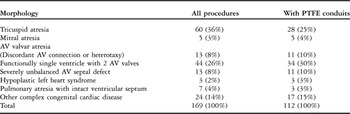
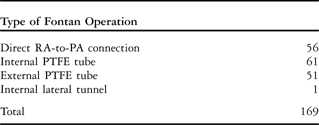
Between 1988 and 2005, we constructed the Fontan circulation in 169 patients at the University of Alabama at Birmingham. Of these, we did not insert tubes in 57 patients, including 56 patients in whom we created a direct anastomosis from the right atrium to the pulmonary arteries, and 1 patient with a lateral tunnel repair. A polytetraflouroethylene tube was used as part of the repair in 112 patients. The first repair using this tube occurred in 1988, and this rapidly became the standard operation at our institution. The last procedure not involving a tube occurred in 1997, and for the past 10 years polytetraflouroethylene tubes have been our sole technique for the completion of the Fontan circulation. The anatomic subsets included in this experience are listed in Table 1.
Fontan operations; UAB Jan 1988–Dec 2005 Morphology of Fontans.

Methods
Survival
The formal period of follow-up began on August 1, 2006. After appropriate approval from our Institutional Review Board for the follow-up, attempts were made to contact each of the 125 surviving patients using a standardized interview form. All relevant medical records were reviewed for operative and follow-up information. Among patients unable to be contacted, the last documented medical encounter at University of Alabama at Birmingham or elsewhere was utilized to obtain follow-up information. Patients were censored at the time of last follow-up, and no patient was assumed to be alive past that point of documentation. Among all surviving patients, the median follow-up was 7.3 years, and among the 112 patients with polytetraflouroethylene tubes, the median follow-up of 93 surviving patients was 6.2 years, with a maximum of 17 years.
Survival was analyzed via standard Kaplan-Meier techniques as well as parametric hazard function methods. The survival curve and hazard function generated from the analysis for the optimal patient, anatomic, and surgical variables (Appendix 1 and 2)Reference Fontan, Kirklin and Fernandez2 was compared to the survival and hazard function generated for the entire cohort of patients receiving a polytetraflouroethylene tube as part of the repair. Additional analyses compared the shape of the early, constant, and late hazard in the analysis of the “perfect” outcome to the overall experience at University of Alabama at Birmingham using polytetraflouroethylene tubes.
Other adverse events
Documented arrhythmia was defined as any documented treatment of a disturbance of rhythm following initial hospitalization, and/or recollection of such treatment by family members during telephone interview.
Reoperations, including revision of the Fontan circuit or tube, take-down of the circuit, additional cardiac procedures, implantation of pacemakers, and cardiac transplantation were documented for each patient.
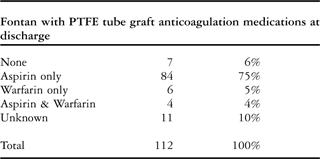
Thrombosis and thromboembolism included two subsets: first any cardiac or extra-cardiac thromboembolic episode documented during follow-up, and second any episode of thrombosis within the polytetraflouroethylene tube or the Fontan pathway. All patients were routinely discharged on aspirin as the only anticoagulant unless there was prior history of thromboembolic episodes, in which case warfarin was added. The addition of warfarin at the time of hospital discharge or during follow-up was documented for each patient.
Bidirectional Glenn procedures
A preliminary bidirectional Glenn procedure has become a standard accompaniment of most procedures producing the Fontan circulation. Between 1988 and 2005, 158 patients underwent a bidirectional Glenn procedure, of which 116 subsequently underwent completion of the Fontan circuit during the period of study. The 42 patients who did not proceed to completion of the Fontan circuit during the period of study have been excluded from further analysis.
Multi-variable analysis
A multi-variable risk factor analysis for survival in the hazard function domain was performed using the variables in Appendix 3. Specific analyses examined the possible presence of an early, constant, and late increasing phase of risk, as identified in the initial paper.Reference Fontan, Kirklin and Fernandez2
Results
Evolution of the Fontan technique
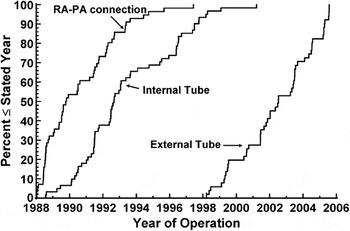
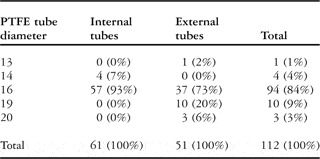
During this 18 year experience, three basic methods were used to construct the Fontan circulation (Table 2). A direct connection from the right atrium to the pulmonary arteries was the major technique utilized from 1988 to 1992, after which polytetraflouroethylene tubes, either internal or external, were used primarily to connect the inferior caval vein to the right or left pulmonary artery (Fig. 1). An extracardiac tube was used exclusively to complete the circuit over the last 8 years of our experience. A preliminary bidirectional Glenn shunt was used almost exclusively since 1992. Of the patients, in 96% we inserted a polytetraflouroethylene tube of 16 millimetres diameter or greater (Table 3).
Fontan Operation; UAB 1988–2005 (n = 169).
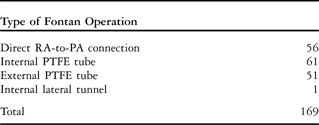
RA, right atrium; PA, pulmonary artery; PTFE, polytetrafluoroethylene.
Cumulative frequency distribution of the type of operative procedure according to year at operation.

Fontan Operation; UAB 1988–2005 (n = 112)

Survival
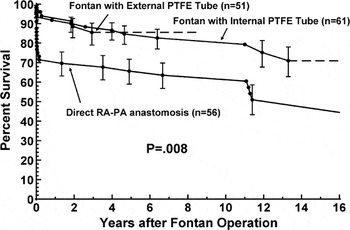
The actuarial survival after completing the Fontan circuit with a polytetraflouroethylene tube is compared to patients undergoing a direct anastomosis of the right atrium to the pulmonary arteries in Figure 2. No difference in survival was identified between internal and external polytetraflouroethylene tubes.
Actuarial survival stratified by the type of operative procedure. PTFE, polytetraflouroethylene.

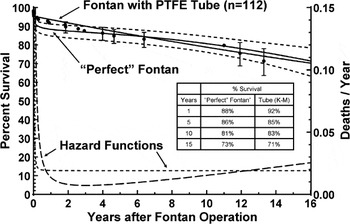
The nomogram depicting the solution to the multivariable equation for the idealized patientReference Fontan, Kirklin and Fernandez2 (Appendix 1 and 2) predicted a 1 year survival of 88%, and a 10 year survival of 81%. The survival curve with its associated hazard function for our entire experience using the polytetraflouroethylene tube is essentially superimposable on the “perfect” depiction (Fig. 3). The 1 and 10 year survival after use of the polytetraflouroethylene tube was 92%, and 83%, respectively.
Actuarial survival of the entire cohort of patients with polytetraflouroethylene tubes, superimposed upon the parametric depiction of the “perfect” operation as determined in the initial analysis.Reference Fontan, Kirklin and Fernandez2 The dashed lines depict the 70% confidence limits and the parametric estimate. The error bars indicate ±1 standard error. The hazard functions are depicted below, in which the long dashes indicate the hazard for the “perfect” procedure, and the short dashes indicate the hazard function for the experience with polytetraflouroethylene tubes. PTFE, polytetraflouroethylene; K-M, Kaplan-Meier estimate.

Analysis of risk factors
A multivariable analysis in the hazard function domain was performed to identify potential risk factors for mortality after completion of the Fontan circuit using polytetraflouroethylene tubes. The variables in the analysis are included in Appendix 3. In contrast to the findings of the analysis in 1990,Reference Fontan, Kirklin and Fernandez2 no specific risk factors were identified that predicted mortality in the early or constant phase. The following sections discuss univariate, or risk unadjusted, analyses of potential risk factors of interest which were not significant in this analysis, adverse events, and functional outcome.
Age at completion of the Fontan circuit
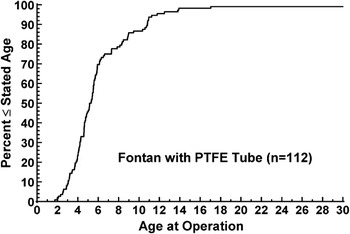
The age distribution of patients was similar for those undergoing a direct anastomosis between the right atrium and the pulmonary arteries, or use of internal or external polytetraflouroethylene tubes in the most recent era. The median age at completion of the circuit was 5 years (Fig. 4), and age at completion was not a risk factor for mortality. It should be noted, however, that this experience contains few patients who underwent completion of the circuit following first or second stage palliations for hypoplastic left heart syndrome.
Cumulative distribution frequency for age at the time of completion.

Size of the polytetraflouroethylene tube
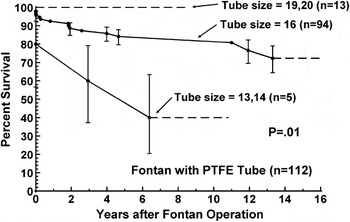
Actuarial survival stratified by size of the tube is depicted in Figure 5. A small number of internal tubes smaller than 16 millimetres diameter were used early in the experience, with a high associated mortality. By direct examination of each cause of death, no apparent relationship existed between early mortality and the use of a potentially undersized tube. In the current era of routine use of extracardiac tubes, we have always inserted tubes of 16 millimetre diameter or larger. The experience with extracardiac tubes includes approximately three-fifths of tubes containing external annular reinforcement, and two-fifths with non-ringed polytetraflouroethylene.
Actuarial survival curve, stratified by polytetraflouroethylene tube size at the time of completion of the Fontan circulation.

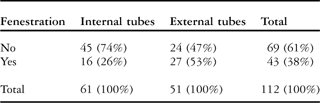
Fenestration of the circuit
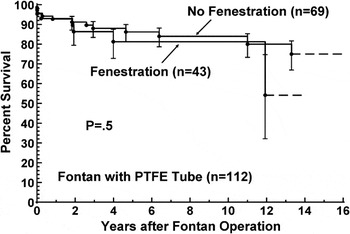
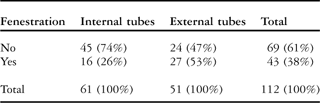
Fenestration at the time of completion of the Fontan circulation (Table 4), making a hole of 4 millimetres punched into the polytetraflouroethylene tube, did not impact long-term survival (Fig. 6). Closure of the fenestration in the catheterization laboratory was accomplished in 3 patients during this experience.
Actuarial survival stratified by the presence or absence of fenestration at the time of completion of the Fontan circulation.

Fontan Operation; UAB 1988–2005 (n = 112)
P = .004
Additional sources of flow of blood to the lungs following the bidirectional Glenn anastomosis
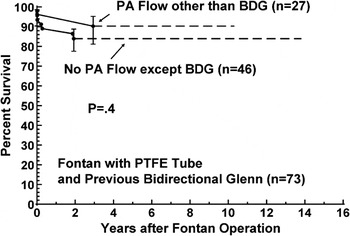
There was no consistent protocol during this experience regarding maintenance of additional sources of flow of blood to the lungs following the bidirectional Glenn procedure. In general, an additional source of pulmonary flow was maintained if the pulmonary arteries were small, or if important desaturation persisted in the operating room following the bidirectional Glenn procedure. The age at the time of construction of the bidirectional Glenn anastomosis was similar in patients with and without maintenance of additional sources of pulmonary blood flow. Survival following the subsequent completion of the Fontan circulation did not differ according to the presence or absence of such additional sources of pulmonary blood flow (Fig. 7).
Actuarial survival stratified by the presence or absence of additional sources of pulmonary blood flow maintained following the bidirectional Glenn procedure. BDG, bi-directional Glenn shunt; PA, pulmonary artery.

Reoperations following the Fontan procedure
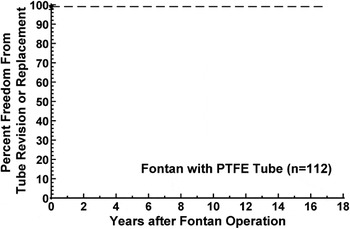
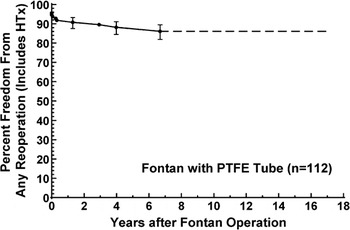
During this 17 year experience using polytetraflouroethylene tubes, only 1 revision or replacement was required. This single instance resulted from a technical problem at the time of completion of the Fontan circulation, requiring reoperation the following day. The actuarial freedom from revision or replacement of the tube exceeded 98% at 15 years (Fig. 8). The freedom from any reoperation, including transplantation, was 85% at 16 years (Fig. 9).
Actuarial freedom from revision or replacement of the tube.

Actuarial freedom from any reoperation, including transplantation.

Thromboembolic events
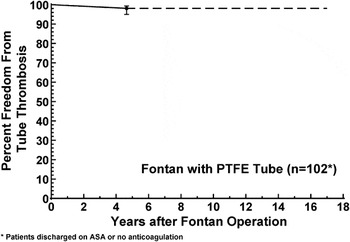
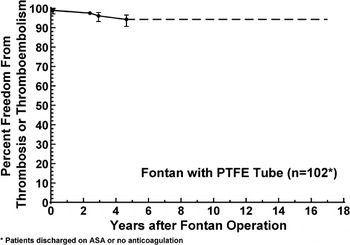
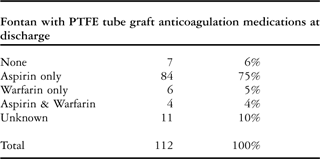
The standard protocol during our experience incorporated aspirin alone for anticoagulation (Table 5). Warfarin was added if specific indications existed. At the time of last follow-up, 71 of 93 (76%) surviving patients were receiving aspirin alone, 5 (5.3%) were taking coumadin, 11 (11%) were on no medications, and 6 patients had no available data regarding medications. Documented thrombosis of the tube, or other thromboembolic episodes, has been rare. Freedom from documented thrombosis was 99% out to 15 years (Fig. 10). The 15 year actuarial freedom from any thrombotic or thromboembolic event was 95% (Fig. 11).
Actuarial freedom from thrombosis of the tube following the Fontan procedure.

Actuarial freedom from any thrombosis or thromboembolic episode following the Fontan procedure.

Fontan Operation; UAB 1988–2005 (n = 112)
Arrhythmias
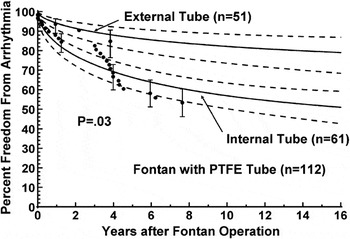
Arrhythmias as we have defined them were significantly less common when extracardiac tubes were inserted compared to internal tubes (Fig. 12). Implantation of a pacemaker was required in 5 patients, 3 of whom had internal tubes, and in 2 with external tubes.
Actuarial and parametric freedom from any documented arrhythmia, stratified by location of tube placement during the Fontan procedure. The dashed lines indicate the 70% confidence limits. The error bars indicate ±1 standard error.

Functional state
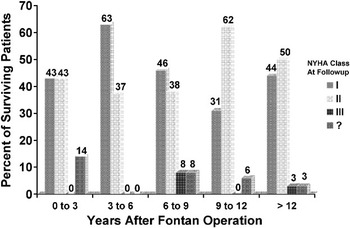
The vast majority of surviving patients were reported to have only mild limitation of physical activities. At the time of last follow-up, greater than 90% of surviving patients 3 to 15 years following completion of the Fontan circulation were in the first or second classes of the categorization of the New York Heart Association (Fig. 13).
Functional state as approximated by the classification of the New York Heart Association at follow-up.

Risk during the late phase
The initial analysis in 1990Reference Fontan, Kirklin and Fernandez2 demonstrated a late phase of risk for mortality, which became apparent after about 12 years (see again Figure 3). Although the hazard functions are not significantly different, the model for our recent experience over 17 years identifies only an early and a constant hazard, without a late increasing phase.
Discussion
Survival after completion of the Fontan circulation has progressively improved over the past 30 years,Reference Jacobs3–Reference Petrossian, Reddy and Collins8 using multiple techniques of reconstruction. The excellent late survival achieved by inserting an extracardiac polytetraflouroethylene conduit is comparable to other methods.Reference Petrossian, Reddy and Collins8 In the classic analysis by Fontan and colleagues,Reference Fontan, Kirklin and Fernandez2 the solution to the multivariable hazard function equation predicted optimal survival with a patient aged 5 years at Fontan, no left atrioventricular valvar atresia, absence of hypertrophy of the dominant ventricle, a ratio for the pulmonary arteries of 2.2, and mean pulmonary arterial pressure of 10. The neutralization of many of the risk factors identified in the initial analysis is suggested by the absence of identifiable risk factors in our experience of 17 years using polytetraflouroethylene conduits. Similar neutralization of risk factors was noted in the experience of those working in Stanford using the same basic method of construction.Reference Petrossian, Reddy and Collins8 Of course, interpretation of this “neutralization of risk factors” is confounded by the evolving, and now nearly uniform, practice of preliminary construction of a bidirectional Glenn anastomosis prior to completion of the Fontan circulation. It is evident that some patients with suboptimal anatomic or physiologic conditions after the bidirectional Glenn anastomosis would currently not be subjected to completion of the Fontan circuit. Such patients account for about one-sixth of our population. Despite these issues, the finding that our entire cohort of patients corrected using a polytetraflouroethylene tube experienced survival which was superimposable upon that of the purported “perfect” patient in the 1990 analysisReference Fontan, Kirklin and Fernandez2 is a tribute to the continuing advancements in this field, and the current expectation of nearly uniformly good outcomes following creation of the Fontan circulation.
Our analysis also addressed potential disadvantages of using an artificial polytetraflouroethylene tube for connecting the inferior caval vein to the pulmonary arteries, be the tube placed in intracardiac or extracardiac position. Throughout this experience, we have employed a general strategy of deferring operation until the age of about 3 years, with a targeted weight of 12 to 15 kilograms, in order to allow placement of a conduit measuring 16 millimetres or greater in diameter. This is consistent with the protocol articulated by Petrossian and colleagues.Reference Petrossian, Reddy and Collins8 Our policy of using tubes of this size has produced an extremely low incidence of reoperation for revision or replacement (see again Figure 8) out to 16 years. We do not, however, have routine follow-up studies to examine late flow characteristics within these conduits or inferior caval venous pressures.
The issue of generation of thrombus in the tube, and thromboembolic events following completion of the Fontan circulation, has been the subject of numerous studies.Reference Jacobs3–Reference Coon, Rychik, Novello, Ro, Gaynor and Spray5, Reference Konstantinov, Puga and Alex-Meskishvili9, Reference Monagle, Cochrane, McCrindle, Benson, Williams and Andrew10 Available evidence has not allowed secure recommendations regarding the advisability of specific anticoagulation protocols. Our very low incidence of thromboembolic events, or thrombus in the tube, supports our policy of using aspirin alone without the addition of warfarin in the majority of patients. We, like others, have selectively used warfarin when special risk factors for thromboembolic episodes are present.
Our experience does not shed light on the potential advantages or disadvantages of fenestration. Approximately two-fifths of the patients underwent fenestration, with no apparent impact on the incidence of thromboembolic episodes, late functional outcome, or survival. Despite the lack of clear benefit, our current policy is routine fenestration in the absence of factors which would predict desaturation after completion of the Fontan circulation.
The good late functional outcomes are in keeping with other studies,Reference Petrossian, Reddy and Collins8, Reference Ono, Boethig, Goerler, Lange, Westhoff-Bleck and Breymann11 and are in concert with the presumption that direct cavopulmonary connections promote improved haemodynamics. The absence of any discernable adverse effects of maintaining additional sources of flow of blood to the lungs between the time of construction of the bidirectional Glenn anastomosis and completion of the Fontan circulation suggests that this degree of “volume overload” for the short term is not deleterious to long-term survival or functional outcome.
Finally, we are not able to assess accurately the possibility that the late increasing phase of risk, apparent in the initial study,Reference Fontan, Kirklin and Fernandez2 has been neutralized by current techniques of completing the Fontan circulation. The absence of a late hazard phase in our analysis is encouraging, but the relatively small number of patients available for late follow-up does not preclude the existence of a late rising hazard after about 12 years. This issue will certainly become clarified during the next 5 years or so of follow-up.
In conclusion, in the current era of congenital heart surgery, expected survival after completion of the Fontan circulation, currently with a prior bidirectional Glenn anastomosis, and using a polytetraflouroethylene tube of 16 to 20 millimetres diameter, is about 93% at one year, and 83% at 10 years. These results for the entire cohort are superimposable on predicted survival of an “ideal” patient identified in a prior analysis by Fontan and colleagues.Reference Fontan, Kirklin and Fernandez2 In the current era, no specific risk factors were identified which predict mortality, likely reflecting the maturing of the anatomic and physiologic indications for construction of the Fontan circulation, and improved techniques of construction of the pathways. Using a polytetraflouroethylene tube of diameter 16 to 20 millimetres, reoperation for revision or replacement is rare out to 15 years.
Given the low incidence of late thrombosis or thromboembolic events using only aspirin anticoagulation, the addition of warfarin does not appear indicated without specific additional risk factors for thromboembolic events. This experience cannot answer securely the possibility that current techniques for completion of the Fontan circuit may neutralize the increasing late hazard of cardiac failure noted after 12 to 15 years in the initial analysis.Reference Fontan, Kirklin and Fernandez2
Appendix I
Incremental risk factors for death after Fontan operation (n = 334)

Appendix II
Incremental risk factors for death after Fontan operation. Values for “Perfect” Fontan solution

Appendix III
Fontan operation; UAB 1988–2005