Introduction
In recent decades, scientists have accumulated a great deal of data about the evolution of the East Antarctic Ice Sheet. However, evidence of ice sheet fluctuations is derived mainly from deep ice core drilling inland, seismic surveys at the Antarctic continental margin, geological and topographical features of the ice sheet margin near the coast, ocean-based drilling on the continental shelf and in the Southern Ocean, and numerical ice sheet and climate models (Florindo & Siegert Reference Florindo and Siegert2009). The direct onshore geological record of Antarctic glaciation is sparse and incomplete.
In the 1980s, the discovery of Nothofagus plant fossils and reworked marine diatoms from the Sirius Group, a Cenozoic terrestrial glacigenic succession in the Transantarctic Mountains, provided possible evidence for a dynamic ice sheet during the Pliocene and led to a great deal of controversy (Webb et al. Reference Webb, Harwood, McKelvey, Mercer and Stott1984, Webb & Harwood Reference Webb and Harwood1987). Reworked marine diatoms recovered from these deposits suggested a late Pliocene–Pleistocene age (Webb et al. Reference Webb, Harwood, McKelvey, Mercer and Stott1984). However, much debate surrounds the emplacement of these diatoms in the Sirius Group, with suggestions that the diatoms were likely introduced into these deposits as aeolian contaminants (Stroeven et al. Reference Stroeven, Prentice and Kleman1996). The resolution of questions about past stability of the East Antarctic Ice Sheet has been hindered by the lack of well dated terrestrial evidence.
The Cenozoic Pagodroma Group cropping out along the western margin of the Lambert Graben in the northern Prince Charles Mountains is regarded as the East Antarctic equivalent of the Sirius Group in the Transantarctic Mountains (Bardin & Belevich Reference Bardin and Belevich1985, Hambrey & McKelvey Reference Hambrey and McKelvey2000 Reference Hambrey and McKelveya, 2000b, McKelvey et al. Reference McKelvey, Hambrey, Harwood, Mabin, Webb and Whitehead2001). The Lambert Graben is occupied by the world's largest fjord system, the Lambert Glacier-Amery Ice Shelf, which covers an area of 106 km2 and represents 7% of the area of the entire Antarctic ice sheet (Higham et al. Reference Higham, Craven, Ruddell and Allison1997). The Pagodroma Group records a part of the history of the East Antarctic Ice Sheet. Therefore, this region has become a major source of information to help resolve divergent interpretations regarding Cenozoic glacial and climate history.
The Pagodroma Group is a succession of glaciomarine sediments up to several hundred metres thick, which were deposited in fjordal settings in the Lambert Graben during retreating phases of the Lambert Glacier (Hambrey & McKelvey Reference Hambrey and McKelvey2000b). The Pagodroma Group, unlike the Sirius Group, contains in situ diatom assemblages that can be used to date the formations directly (Whitehead et al. Reference Whitehead, Harwood and McMinn2003, Reference Whitehead, Harwood, McKelvey, Hambrey and McMinn2004). The in situ nature of the marine diatoms is demonstrated by their association with foraminifera, radiolaria, and fossil molluscs preserved in growth position (Bardin & Chepaljiga Reference Bardin and Chepaljiga1989, Laiba & Pushina Reference Laiba and Pushina1997, McKelvey et al. Reference McKelvey, Hambrey, Harwood, Mabin, Webb and Whitehead2001, Whitehead et al. Reference Whitehead, Harwood and McMinn2003, Reference Whitehead, Harwood, McKelvey, Hambrey and McMinn2004). Detailed stratigraphic architecture and facies analysis supports the viewpoint of a dynamic ice sheet lasting until the late Pliocene (Hambrey & McKelvey Reference Hambrey and McKelvey2000b, McKelvey et al. Reference McKelvey, Hambrey, Harwood, Mabin, Webb and Whitehead2001, Whitehead & McKelvey Reference Whitehead and McKelvey2001, Whitehead et al. Reference Whitehead, Harwood and McMinn2003, Reference Whitehead, Harwood, McKelvey, Hambrey and McMinn2004).
The paucity of Cenozoic outcrop has hindered our understanding of the patterns of changing diversity and the nature of the vegetation in this region. Cenozoic sediments of the Antarctic continent need to be studied in detail to provide a better basis for interpreting the vegetation history of Antarctica during the Cenozoic. Palynological investigations of the Pagodroma Group were designed with the aim of providing information on the palaeovegetation of East Antarctica and determining the palaeoenvironment under which deposition occurred. These palaeoenvironmental reconstructions are crucial not only for understanding climatic changes connected with advances and retreats of the East Antarctic Ice Sheet, but they are also important for modelling future climatic change in East Antarctica.
Field setting and stratigraphy
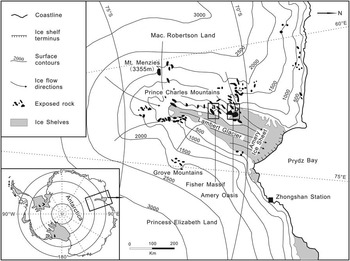
The northern Prince Charles Mountains (70°30′–72°S, 60°–70°E) comprise a series of nunataks, mountain peaks, and flat-topped massifs along the western margin of the Lambert Graben. The basement rocks of the northern Prince Charles Mountains are mainly layered and massive felsic gneisses and metasediments, with minor mafic granulites. These are partially draped with Cenozoic glaciomarine sediments of the Pagodroma Group, which comprises at least the following four geographically separated formations: the Mount Johnston, Fisher Bench, Battye Glacier and Bardin Bluffs formations (McKelvey & Stephenson Reference McKelvey and Stephenson1990, Hambrey & McKelvey Reference Hambrey and McKelvey2000 Reference Hambrey and McKelveya, 2000b, McKelvey et al. Reference McKelvey, Hambrey, Harwood, Mabin, Webb and Whitehead2001, Whitehead et al. Reference Whitehead, Quilty, McKelvey and O'Brien2006). The Pagodroma Group has been largely eroded but not totally removed by subsequent glacial advances, because tectonic uplift raised these strata to progressively higher levels, clear of later advancing ice. Remnants of the Pagodroma Group total more than 800 m in thickness, and occur in several ice-free areas, notably the Fisher Massif and the Amery oasis (Fig. 1).
Geological sketch map of the Prince Charles Mountains indicating positions of Fisher Massif and Amery oasis within the Lambert Glacier-Amery Ice Shelf fjord system. Boxes labelled a and b are the study areas, the Fisher Massif and Amery oasis, which lie on the western flank of the Lambert Glacier-Amery Ice Shelf system. Revised from Hambrey & McKelvey (Reference Hambrey and McKelvey2000 Reference Hambrey and McKelveya, 2000b).

Fisher Massif is an isolated uplifted highland block of c. 300 km2 with a north-east–south-west orientation, located at the southern end of the northern Prince Charles Mountains. Erosional remnants of the Pagodroma Group in Fisher Massif are stratified and flat-lying and subdivided into two units, the Fisher Bench Formation and the Mount Johnston Formation, both of which unconformably overlie Proterozoic metamorphic basement. The Mount Johnston Formation mainly contains undifferentiated massive clast-rich sandy diamict, boulder gravel, and boulder gravel sand. This formation is at c. 1400 m above sea level, and its age is Oligocene–early Miocene based on diatom biostratigraphy (Whitehead et al. Reference Whitehead, Harwood, McKelvey, Hambrey and McMinn2004). The Fisher Bench Formation includes massive clast-rich sandy diamict, boulder gravel, sandy gravel, minor pebble gravel, sand and laminite, and has been uplifted at least 500 m above sea level (Hambrey & McKelvey Reference Hambrey and McKelvey2000a). The late middle–late Miocene age of the Fisher Bench Formation is also based on diatoms (Laiba & Pushina Reference Laiba and Pushina1997, McKelvey et al. Reference McKelvey, Hambrey, Harwood, Mabin, Webb and Whitehead2001, Whitehead et al. Reference Whitehead, Harwood, McKelvey, Hambrey and McMinn2004).
The Amery oasis is an ice-free area of c.1800 km2, and its stratigraphy is unique to East Antarctica in embracing three major phases of geological evolution. The basement consists mainly of gneiss and granulite of Proterozoic age. A major normal fault separates these rocks from Permian–Triassic fluvial strata of the Amery Group (McKelvey & Stephenson Reference McKelvey and Stephenson1990). Unconformably overlying Proterozoic basement or the Amery Group are two geographically separate Cenozoic glaciomarine units, the Battye Glacier Formation and the Bardin Bluffs Formation. The Battye Glacier Formation consists largely of massive clast-rich sandy diamict, boulder gravel, gravelly sand, minor laminated sand and muddy weakly-stratified diamict (Hambrey & McKelvey Reference Hambrey and McKelvey2000b, McKelvey et al. Reference McKelvey, Hambrey, Harwood, Mabin, Webb and Whitehead2001). The Battye Glacier Formation is of similar elevation to the Fisher Bench Formation and, based on diatom biostratigraphy, is of similar late middle–late Miocene age (Whitehead et al. Reference Whitehead, Harwood and McMinn2003, Reference Whitehead, Harwood, McKelvey, Hambrey and McMinn2004). The Bardin Bluffs Formation overlies, with angular unconformity, the upper Permian Radok Conglomerate and Bainmedart Coal Measures of the Amery Group. This formation consists of massive or weakly stratified diamict, massive gravelly sand, minor laminite and silty fine sandstone. The Pliocene–early Pleistocene age of the unit, which occurs at the lowest topographic level, is based on diatoms, foraminifera and radiolaria (Bardin & Belevich Reference Bardin and Belevich1985, McKelvey & Stephenson Reference McKelvey and Stephenson1990, Whitehead & McKelvey Reference Whitehead and McKelvey2001, Whitehead et al. Reference Whitehead, Harwood, McKelvey, Hambrey and McMinn2004).
Materials and methods
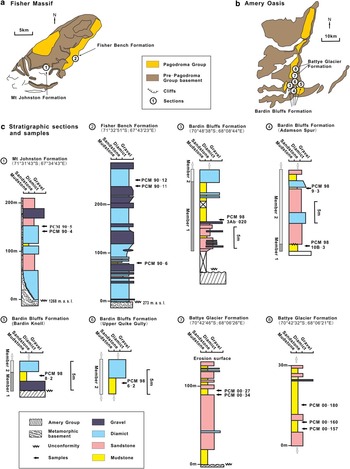
The fifteen samples of the Pagodroma Group described in this paper were collected from Fisher Massif and Amery oasis by B. McKelvey, M.J. Hambrey, D.M. Harwood and J.M. Whitehead during Australian National Antarctic Research Expeditions (ANARE) in 1990, 1998 and 2000, and have been documented in papers by these authors (see especially Whitehead et al. Reference Whitehead, Harwood, McKelvey, Hambrey and McMinn2004). The geographical and stratigraphic positions of the samples are indicated in Fig. 2.
Location of Pagodroma Group sections at a. Fisher Massif, and b. Amery oasis. c. Stratigraphic sections labelled and numbered as follows: 1 = Mount Johnston Formation and sample positions (Whitehead et al. Reference Whitehead, Harwood, McKelvey, Hambrey and McMinn2004), 2 = Fisher Bench Formation and sample positions (Whitehead et al. Reference Whitehead, Harwood, McKelvey, Hambrey and McMinn2004), 3, 4, 5 & 6 = Bardin Bluffs Formation and sample positions (Whitehead & McKelvey Reference Whitehead and McKelvey2001), 7 & 8 = Battye Glacier Formation and sample positions (Whitehead et al. Reference Whitehead, Quilty, McKelvey and O'Brien2006). m.a.s.l. = metres above sea level.

Palynological processing was carried out at the Institute of Geological and Nuclear Sciences (GNS Science), Lower Hutt, New Zealand. The laboratory has a filtered, positive-pressure air supply to exclude ambient airborne pollen influx, and reagents and techniques designed to minimize modern contamination. All samples from this study were processed using a standard palynological technique suited for Antarctic Cenozoic sediments. Large amounts of sample were processed, between 66 g and 136 g (dry weight). Samples were treated initially with hydrochloric acid to remove any carbonate present, then hydrofluoric acid to dissolve silicates. A five minute oxidation with nitric acid removed pyrite overgrowths on some of the palynomorphs. Palynomorphs were floated from the remaining mineral residue using sodium polytungstate solution with a specific gravity of 1.6. This low specific gravity was used to remove as much re-deposited Permian–Triassic coal as possible. Samples were sieved through a 260 μm mesh sieve to remove remaining coarse mineral grains and other debris. In samples PCM 90-5, PCM 98-3Ab-20, and PCM 98-10B-3 fine debris was removed and the palynomorphs further concentrated using a 10 μm mesh sieve. Strew-mount microscope slides were made with glycerin jelly medium. The slides have been preserved by sealing with nail varnish and are housed at GNS Science, Lower Hutt, New Zealand.
Autofluorescence of palynomorphs under blue-violet illumination can be used to help discriminate palynomorph populations (e.g. Raine Reference Raine1998), but suitable modern equipment was not available during this study. Palynomorphs were analysed using an Olympus BX51 microscope at 60x or 100x magnification under oil immersion for better microscopic definition. Images were captured using an Olympus DP25 digital camera. Because of the varied techniques applied to samples and greatly varying yields of residue, no attempt was made to prepare material in a strictly quantitative manner which would have permitted absolute abundance data to be calculated. A total of 33 slides were prepared for examination. Palynomorph counts are based on a full examination of the slides prepared, and can be used for qualitative comparisons.
Results
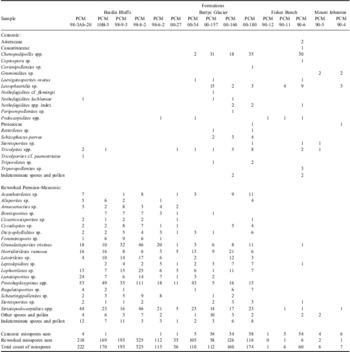
A sparse terrestrial palynomorph flora of limited diversity was recorded. Thirty-three slides have been examined from the 15 samples, and 228 grains of Cenozoic palynomorphs (21 genera) and 1474 grains of reworked miospores were identified. Table I lists counts of specimens observed.
Counts of terrestrial palynomorphs from the Pagodroma Group.

Bardin Bluffs Formation
Five samples were analysed from this formation: PCM 98-3Ab-20, PCM 10B-3, PCM 98-9-3, PCM 98-8-2, and PCM 98-6-2. Spores and pollen of Permian–Mesozoic age are relatively abundant and comprise a comparatively large number of taxa, including Striatopodocarpites, Protohaploxypinus, Granulatisporites, Alisporites, Horriditriletes, and Scheuringipollenites etc.
Cenozoic specimens are either very rare or absent in these samples, but include one grain of Podocarpites (Podocarpites sp.1, Fig. 3h), three grains of Tricolpites spp. (Tricolpites sp.2, Fig. 4g), one grain of Nothofagidites lachlaniae (Couper) Pocknall & Mildenhall, and one grain of Tricolporites cf. paenestriatus Stover (Fig. 4l). The pollen grains have a slightly darker exine colour than Cenozoic pollen grains from the Battye Glacier Formation.
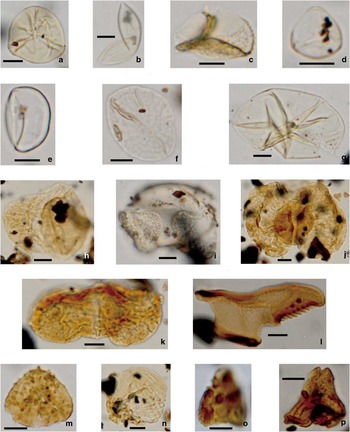
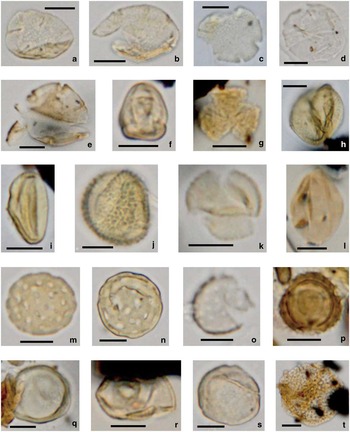
Photomicrographs of selected miospores from the Pagodroma Group. Each scale bar = 10 μm. a. Triporoletes sp., sample PCM 00-180, slide L22505/2, England Finder co-ordinates U46(3), maximum dimension 29 μm. b. Leiosphaeridia sp., PCM 00-157, L22503/1, V16(2), 30 μm. c. Retitriletes sp., PCM 00-157, L22503/2, H22(2), 30 μm. d. Stereisporites sp., PCM 00-180, L22505/1, U58(2), 15 μm. e. Laevigatosporites ovatus, PCM 00-34, L22502-2, J24(0), 26 μm. f. Coptospora sp., PCM 90-6, L22495/1, R24(0), 40 μm. g. Schizophacus parvus, PCM 00-160, L22504/3, W28(0), 58 μm. h. Podocarpidites sp.1, PCM 98-6-2, L22500/2, P44(2), 45 μm. i. Podocarpidites sp.2, PCM 00-34, L22502/1, E20(3), 55 μm. j. Striatopodocarpidites sp., PCM 98-6-2, L22500/2, R40(2), 75 μm. k. Protohaploxypinus sp., PCM 98-8-2, L22499/1, Q32(1), 66 μm. l. Mouth part of polychaete worm, PCM 00-180, L22505/2, U44(4), 68 μm. m. Horriditriletes ramosus, PCM 00-157, L22503/1, O52(2), 30 μm. n. Cicatricosisporites sp., PCM 98 3Ab-020, L22496/1, Y43(3), 48 μm. o. Corsinipollenites sp., PCM 00-180, L22505/2, H29(1), 25 μm. p. Forcipites sp., PCM 00-180, L22505/2, T41(0), 25 μm.

Photomicrographs of selected spores and pollen from the Pagodroma Group. Each scale bar = 10 μm. a. Nothofagidites lachlaniae, PCM 00-157, L22503/3, M63(1), 23 μm. b. Nothofagidites lachlaniae, PCM 00-160, L22504/2, N46(2), 25 μm. c. Nothofagidites sp.1, PCM 00-180, L22505/2, H25(0), 24 μm. d. Nothofagidites sp.2, PCM 90-6, L22495/1, G44(4), 28 μm. e. Nothofagidites cf. flemingii, PCM 00-157, L22503/1, V37(0), 27 μm. f. Tricolpites sp.1, PCM 90-6, L22495/1, U38(4), 14 μm. g. Tricolpites sp.2, PCM 00-160, L22504/3, O43(0), 16 μm. h. Tricolpites sp.3, PCM 00-160, L22504/1, R57(3), 26 μm. i. Tricolpites sp.4, PCM 00-180, L22505/2, K55(3), 20 μm. j. Tricolpites sp.5, PCM 00-34, L22502/2, W31(0), 24 μm. k. Tricolpites sp.6, PCM 00-180, L22505/1, O42(4), 16 μm. l. Tricolporites cf. paenestriatus, PCM 98-3Ab-20, L22496/2, Z25(0), 25 μm. m. Chenopodipollis sp.1, PCM 00-157, L22503/2, D32(1), 20 μm. n. Chenopodipollis sp.2, PCM 00-160, L22504/3, V33(0), 24 μm. o. Chenopodipollis sp.3, PCM 90-6, L22495/1, W58(1), 18 μm. p. Asteraceae, PCM 90-6, L22495/1, E52(1), 18 μm. q. Casuarinaceae, PCM 90-6, L22495/1, U63(0), 26 μm. r. Graminidites sp., PCM 90-4, L22491/1, L55(4), 22 μm. s. Triporopollenites sp., PCM 90-6, L22495/1, O51(0), 22 μm. t. Periporopollenites sp., PCM 00-160, L22504/3, O34(0), 28 μm.

Battye Glacier Formation
Five samples were studied: PCM 00-27, PCM 00-34, PCM 00-157, PCM 00-160 and PCM 00-180, of which the three last are matched by only one of the Fisher Bench Formation samples for abundance and diversity of Cenozoic palynomorphs. Permian–Mesozoic reworked miospores are similar in their composition and abundance to those of the Bardin Bluffs Formation. Relatively high total counts of Cenozoic palynomorphs are mostly due to high levels of Chenopodipollis spp. Other angiosperm taxa include Nothofagidites spp., Tricolpites spp., Corsinipollenites sp. (Fig. 3o), Periporopollenites sp. (Fig. 4t), and Proteaceae. One Podocarpidites specimen (Podocarpidites sp.2, Fig. 3i) occurs. Rare pteridophyte spores include Laevigatosporites ovatus Wilson & Webster (Fig. 3e) and Retitriletes sp. (Fig. 3c). Bryophytic spores, Triporoletes sp. (Fig. 3a) and Stereisporites sp. (Fig. 3d) were identified in trace numbers. Relatively high numbers of the acritarchs Leiosphaeridia sp. (Fig. 3b) and Schizophacus parvus (Cookson & Dettmann) Pierce (Fig. 3g) were noted. Some samples have abundant organic detritus, including mouth parts of polychaete worms (Fig. 3l).
Chenopodipollis spp. pollen grains (Fig. 4m–o) in the three most productive samples are present with a frequency of over 50%. Other angiosperm pollen grains are sparse. Seven grains of Nothofagus species are identified as Nothofagidites lachlaniae (Fig. 4a & b), Nothofagidites cf. flemingii (Couper) Potonié (Fig. 4e), and Nothofagidites spp. (Fig. 4c & d). These Nothofagidites pollen grains are broken, folded, or eroded. Tricolpites spp. pollen grains occur throughout the section.
Fisher Bench Formation
Two of the three samples (PCM 90-11and PCM 90-12) were relatively unproductive, but in the other sample (PCM 90-6) a greater number of Cenozoic miospores were identified. Reworked Permian–Mesozoic miospores are present in very low numbers, only seven grains. The Cenozoic miospores of the Fisher Bench Formation are similar to those encountered in the Battye Glacier Formation, but total numbers of recovered taxa and specimens remain very low. The Fisher Bench Formation PCM 90-6 spore-pollen assemblage is also dominated by Chenopodipollis spp., with sparse Podocarpidites and Tricolpites pollen grains. Only a single grain of Nothofagidites pollen was recovered. Other angiosperm pollen grains observed in the Fisher Bench Formation include those affiliated with Asteraceae (Fig. 4p) and Casuarinaceae (Fig. 4q), in addition to Triporopollenites sp. (Fig. 4s). A single grain of Laevigatosporites ovatus was recorded. Bryophytic spores of Coptospora sp. (Fig. 3f) and Stereisporites sp. were identified. The acritarch Leiosphaeridia occurs consistently.
Mount Johnston Formation
Very rare Cenozoic miospores were found in two samples of the Mount Johnston Formation, PCM 90–4 and PCM 90–5. Angiosperm pollen is confined to four Graminidites sp. (Poaceae) grains (Fig. 4r), and single grains of Tricolpites sp. and Proteaceae. No Chenopodipollis pollen was found. Other probable Cenozoic miospores include one grain of Stereisporites sp. and three grains of Leiosphaeridia sp. One grain of reworked Permian pollen was also seen.
Discussion
Palaeovegetation and palaeoenvironmental significance
The Cenozoic palynomorphs include presumed contemporaneous and reworked specimens. The former are mostly light yellow to yellow in colour, the latter have a deeper (yellow-orange) hue and most of these are presumed to be reworked from older Cenozoic sediments. Very rare modern pollen grains were identified as contaminants by their fresh appearance and excellent preservation.
The low number of in situ terrestrial palynomorphs recovered from the Pagodroma Group is interpreted to be due principally to the scarcity of terrestrial vegetation in the adjacent land areas during the late Oligocene–Pliocene or Pleistocene. Extreme dilution under rapid sediment accumulation is another possible factor, as mentioned by Harland et al. (Reference Harland, Pudsey, Howe and Fitzpatrick1998). Although the abundances and species of the miospores found in the Pagodroma Group are not enough to reconstruct their original plant communities, they do provide some information about the terrestrial palaeovegetation, at least for the Miocene localities. The miospores provide only limited age information and in this discussion the biostratigraphic dating of Whitehead et al. (Reference Whitehead, Harwood, McKelvey, Hambrey and McMinn2004) is accepted.
The few Cenozoic pollen grains recovered from the Oligocene Mount Johnston Formation are not sufficient to draw any conclusions about palaeoenvironment or palaeoclimate. In the Ross Sea region, the middle Miocene section of the AND-2A core contains the first accepted records of fossil Poaceae pollen grains from Ross Sea drill holes (Taviani et al. 2008–2009), although possible specimens were recorded by Mildenhall (Reference Mildenhall1989) from the CIROS-1 sequence (without stratigraphic context). The specimen of Poaceae recorded from upper Eocene–lower Oligocene at Prydz Bay is considered to be a modern contaminant (Truswell & Macphail Reference Truswell and Macphail2009). The absence of a later record of Poaceae in the productive Prince Charles Mountains samples, together with the absence of more likely Oligocene palynoflora such as Nothofagidites, may mean the Mount Johnston specimens are also contaminants. Palynofloras from the late Pliocene–early Pleistocene Bardin Bluffs Formation contain only extremely sparse, reworked Cenozoic pollen grains.
The more productive assemblages of the late middle–late Miocene Battye Glacier Formation and the Fisher Bench Formation are characterized by the dominance of Chenopodipollis spp. (up to 50%). Chenopodipollis does not occur prior to the Oligocene in Australia (Martin Reference Martin1978). According to previous palynological studies, Chenopodipollis only appears occasionally in the Ross Sea region, but was there regarded as a contemporaneous component. Chenopodipollis chenopodiaceoides (Martin) Truswell was found in CIROS-1 assemblages (Mildenhall Reference Mildenhall1989). Chenopodipollis sp. also occurs in Oligocene–early Miocene sediments of the Cape Roberts Project drill holes CRP-1 and CRP-3 (Cape Roberts Science Team 1998, Raine Reference Raine1998, Raine & Askin Reference Raine and Askin2001). Wilson et al. (Reference Wilson, Roberts, Verosub, Florindo and Sagnotti1998) recorded a Chenopodiaceae pollen grain from Sirius Group strata in the Reedy valley (unofficial name). A small reniform seed of ?Chenopodiaceae or ?Myrtaceae has also been discovered in the Meyer Desert Formation of the Sirius Group at Oliver bluffs (unofficial name), in the Dominion Range, Transantarctic Mountains (Ashworth & Cantrill Reference Ashworth and Cantrill2004). From these stratigraphic data, and its high relative abundance, Chenopodipollis spp. in the Pagodroma Group was not re-deposited from older sediments, but derived from plants living in the Antarctic continent during the late middle–late Miocene. Chenopodipollis spp. may be partly referable to Chenopodiaceae and Amaranthaceae, but also to some Caryophyllaceae genera, notably Colobanthus. Chenopodiaceae and Amaranthaceae are best known from arid regions and as halophytes, for example in coastal salt marshes. Colobanthus is a genus of cushion plants characteristic of modern sub-Antarctic and austral alpine environments, and is one of two flowering plants on the Antarctic continent (Moore & Irwin Reference Moore and Irwin1978).
Angiosperm pollen grains other than Chenopodipollis are uncommon. Sparse and damaged Nothofagidites pollen grains create challenges in determining whether these grains are in situ or reworked from older strata. Nothofagidites pollen grains are the most important component of the Oligocene–early Miocene palynofloras of DSDP Site 274, CRP-1, Cape Roberts drill hole CRP-2A/A and upper CRP-3 core samples of the Ross Sea (Fleming & Barron Reference Fleming and Barron1996, Raine Reference Raine1998, Askin & Raine Reference Askin and Raine2000, Raine & Askin Reference Raine and Askin2001). The absence of Nothofagidites pollen grains may point to an age later than early Miocene for the Battye Glacier Formation and the Fisher Bench Formation. This is consistent with results from diatom dating (Whitehead et al. Reference Whitehead, Harwood and McMinn2003, Reference Whitehead, Harwood, McKelvey, Hambrey and McMinn2004). Nothofagidites lachlaniae is the sole Nothofagidites species reported in the Sirius Group from the Transantarctic Mountains (Hill & Truswell Reference Hill and Truswell1993), but the Pliocene dating of the Sirius Group is controversial (Stroeven et al. Reference Stroeven, Prentice and Kleman1996). The very low frequency of this kind of pollen, which is produced in large quantities by most members of the genus Nothofagus, suggests that it was not part of the local vegetation during deposition of the Battye Formation and Fisher Bench Formation, but rather reworked from older strata or a long-distance wind-borne contribution. Proteaceae pollen grains are deeper yellow, so they are confidently considered to be re-deposited from older sediments. Casuarinaceae occurs in the Eocene McMurdo erratics (Askin Reference Askin2000), and is a characteristic element of the Eocene strata of Australia and New Zealand. Casuarinaceae pollen grains have also been reported from the MSSTS-1, CIROS-1, CRP-1 and CRP-3 of the Ross Sea area (Truswell Reference Truswell1986, Mildenhall Reference Mildenhall1989, Raine Reference Raine1998, Raine & Askin Reference Raine and Askin2001), and were in these drill holes interpreted as reworked elements from older sediments. The single Fisher Bench Formation occurrence is therefore also regarded as representing re-deposition or long-distance dispersal.
Other angiosperm pollen appears to be mainly of herbaceous taxa. Some tricolpate pollen may be related to Ranunculaceae and Gunneraceae etc. Corsinipollenites epiloboides Krutzsch is identified with the herb Epilobium (Onagraceae). Natural affinities of other tricolpate pollen grains are less well known. Two Asteraceae pollen grains lack protoplasm and may be fossil. Asteraceae (Tubuliflorae) pollen grains were encountered at 781.36 and 797.88 m below sea floor within the early Oligocene CRP-3 core (Raine & Askin Reference Raine and Askin2001). Based on the lack of protoplasm, these Asteraceae (Tubuliflorae) pollen grains were also identified as fossil, but the possibility that they were laboratory contaminants was not ruled out. Mildenhall (Reference Mildenhall1989) also recorded several similar specimens in the lower part of the CIROS-1 sequence, but regarded these specimens as contamination. However, Truswell et al. (Reference Truswell, Quilty, McMinn, Macphail and Wheller2005) recorded Asteraceae-Poaceae dominated palynofloras in the late Miocene Drygalski Formation of Heard Island. Asteraceae pollen grains may represent drier environments, as in the late Miocene of Heard Island (Truswell et al. Reference Truswell, Quilty, McMinn, Macphail and Wheller2005).
The podocarp and pteridophyte components of the Battye Glacier and Fisher Bench formations are too sparse to confidently identify them as contemporaneous with sedimentation, although many are well preserved. Podocarpidites sp.2 is similar respectively to Podocarpidites sp.e and Podocarpidites sp.d of CRP-3 in the Ross Sea area (Raine & Askin Reference Raine and Askin2001). Bisaccate pollen grains can be transported over a long distance, so it is possible that these pollen grains were transported over long distances by wind. Retitriletes spp. were recorded previously from the early Oligocene section of CRP-3 and the Oligocene–early Miocene section of ANDRILL Southern McMurdo Sound Project drill hole AND-2A in the Ross Sea (Raine & Askin Reference Raine and Askin2001, Taviani et al. 2008–2009). Retitriletes sp. is probably referable to Lycopodiaceae. Lycopod spore grains assigned to Lycopodiumsporites sp. also occur consistently through the upper part of CRP-3 (Raine & Askin Reference Raine and Askin2001).
Bryophytic spores recorded comprise a single specimen of Coptospora sp. in the Fisher Bench Formation, and specimens of Stereisporites sp. and Triporoletes sp. in the Battye Glacier Formation. Coptospora sp. is an important component of palynological assemblages of the Sirius Group and the Oligocene–early Miocene sequences of the Ross Sea (Prebble et al. Reference Prebble, Raine, Barrett and Hannah2006). Coptospora and Triporoletes are more frequent in Ross Sea Miocene strata than in older deposits of that region and their occurrence in the Battye Glacier and Fisher Bench formations may be penecontemporaneous with sedimentation.
In addition, algal cysts are present in substantial quantities. Leiospheres were the most common in situ palynomorphs in the marine middle Miocene sediments of the ODP site 1165, Prydz Bay (Hannah Reference Hannah2006), but are also abundant in freshwater deposits of the Sirius Group (Lewis et al. Reference Lewis, Marchant, Ashworth, Hedenas, Hemming, Johnson, Leng, Machlus, Newton, Raine, Willenbring, Williams and Wolfe2008). Modern analogues of the Chlorophycean alga Schizophacus parvus inhabit stagnant, shallow freshwater habitats (Van Geel & Van der Hammen Reference Van Geel and van der Hammen1978). Leaf cuticles and vascular fragments were also common in the Battye Glacier Formation, suggesting deposition at no great distance from a vegetation source. These contemporaneous palynomorphs would reflect the composition of the local vegetation surrounding subaquatic depositional environments.
Based on the above analysis, the palynological assemblages of the Battye Glacier Formation and the Fisher Bench Formation in the present study are likely to represent low diversity herbaceous vegetation, dominated by several species of Chenopodipollis spp., along with a few other angiosperms and bryophytes etc. These assemblages probably reflect a herb-tundra vegetation similar in form to that of the present-day cool to cold sub-Antarctic regions (Greene Reference Greene1964).
Prior to the Oligocene, Cenozoic palynofloras of Antarctica were relatively diverse Nothofagus-podocarp-Proteaceae assemblages with a dominance of various types of Nothofagidites. Following a major cooling event around the Eocene–Oligocene boundary, the record of fossil vegetation is sparse. During the early Oligocene, a low shrub or closed Nothofagus-podocarp forest of small stature may have developed, occupying warmer sites on the Antarctic continent (Prebble et al. Reference Prebble, Raine, Barrett and Hannah2006). The Oligocene–early Miocene assemblages of the CRP cores in the Ross Sea are dominated by Nothofagus pollen grains in low diversity, with podocarp, herbaceous and moss taxa, reflecting a tundra vegetation with woody taxa growing in more favourable areas (Raine Reference Raine1998, Askin & Raine Reference Askin and Raine2000, Raine & Askin Reference Raine and Askin2001, Prebble et al. Reference Prebble, Raine, Barrett and Hannah2006). The Nothofagus-dominated spore-pollen assemblage of the Meyer Desert Formation of the Sirius Group in the Transantarctic Mountains area (Askin & Markgraf Reference Askin and Markgraf1986) was also similar to those of the CRP cores. The middle Miocene assemblages of the AND-2A core in the Ross Sea region suggest mossy tundra vegetation with Nothofagus, podocarp, bryophyte, and other angiosperms etc. (Taviani et al. 2008–2009).
Neogene fossil assemblages of the Transantarctic Mountains area suggest that the climate of Antarctica was warm enough to support a moderate diversity of vascular plants until the middle Miocene (Lewis et al. Reference Lewis, Marchant, Ashworth, Hedenas, Hemming, Johnson, Leng, Machlus, Newton, Raine, Willenbring, Williams and Wolfe2008). In contrast, the late middle–late Miocene palynofloras of the Pagodroma Group suggest a lower diversity vegetation at the limits of vascular plant growth, and a more severe climate.
Reworked Paleozoic–Mesozoic palynomorphs
Since at least the beginning of the Oligocene, the Antarctic continent has been shaped by ice sheets, glacial advance and retreat resulting in the reworking of sediments through post-sedimentary transport. Re-deposited palynomorphs may be useful in determining provenance of sediments.
The reworked miospores mainly comprise Permian–Triassic specimens (over 70%) but include a few Jurassic–Cretaceous and Cenozoic palynomorphs. The reworked Permian–Mesozoic miospores are darker, ranging from orange and brown to black, with a few yellow-orange specimens obviously much less affected by thermal metamorphism. Reworked miospores of Permian–Mesozoic age are present frequently in the Bardin Bluffs Formation and the Battye Glacier Formation, but are very sparse in the Fisher Bench Formation and the Mount Johnston Formation. The reworked miospores mainly comprise Permian–Triassic specimens but include a few Jurassic–Cretaceous and Cenozoic palynomorphs. Reworked Jurassic–Cretaceous palynomorphs, such as Cicatricosisporites, occur more sporadically but appear to be restricted to the Amery oasis formations.
Expansion of the ice sheet increases the supply of debris from inland along the length of the Lambert Graben to the shelf edge and slope where it is reworked into the sediments of the drift. The distribution of re-deposited palynomorphs might then be interpreted in terms of distinct large-scale ice streams. A simpler explanation may be that the sediments are derived more locally: in the case of the Amery oasis samples, a possible source of reworked Permian–Triassic miospores is the locally occurring Amery Group. The paucity of re-deposited Permian–Triassic palynomorphs in the Fisher Massif samples is consistent with the absence of strata of this age in this vicinity. Sources of the Jurassic–Cretaceous and possible early Cenozoic re-deposited palynomorphs in the Amery oasis sediments are nevertheless unknown in the present ice-free area, and their presence implies at least some longer-distance transport.
Conclusions
-
1) Contemporaneous spores and pollen are sparse in the Cenozoic Pagodroma Group, but occur in the late middle–late Miocene Battye Glacier Formation and the Fisher Bench Formation.
-
2) Palynological assemblages of the Battye Glacier Formation and the Fisher Bench Formation in the present study represent low diversity herbaceous vegetation, dominated by several species of Chenopodipollis spp., along with a few other angiosperm and bryophytes etc., reflecting a herb-tundra environment and a climate similar to the present-day cool to cold sub-Antarctic regions.
-
3) Reworked Permian–Mesozoic miospores are present in large numbers throughout the Bardin Bluffs Formation and the Battye Glacier Formation, indicating strong local provenance during increased glacial activity and extension of the Amery Ice Shelf in the middle–late Miocene and Pliocene–early Pleistocene.
Acknowledgements
Samples for the present study were collected during several Australian National Antarctic Research Expeditions (ANARE) with support from the Australian Antarctic Programme and the National Science Foundation of the USA (award OPP-0091676), and made available to the authors by Barrie McKelvey, Jason Whitehead, David Harwood and Mike Hambrey. Thanks to Roger Tremain for processing these samples at the GNS Science palynological laboratory. This work was supported by grants from the National Natural Science Foundation of China (No.41206183 and No.41272216), the Chinese Arctic and Antarctic Administration (No.CHINARE 2012-02-02 and No.IC201106), and the New Zealand Marsden Fund and Ministry of Business, Innovation and Employment (Past Antarctic Climates Programme at GNS Science). We are grateful to Pat Quilty and Vanessa Bowman for their reviews and Alan Vaughan for his editorial comments.