

In 1995 the European Federation of Road Traffic Victims (FEVR) and the European Commission, jointly performed a comprehensive study on road traffic injuries to investigate their direct and indirect effects on individuals. Nine European countries comprising of 16 organisations, representing road traffic-injured people, and 10,000 families participated in the study. A number of key findings stood out: 1) injured persons’ information about their legal rights and support organisations was inadequate; 2) most injured persons and their families needed significant emotional, practical and legal support; 3) both injured persons and their families commonly expressed their dissatisfaction with the legal system in place; 4) there was no legal recognition of the long-term impairments caused by head injuries; and that 5) the psychological suffering of the injured person and their families was often extreme and persistent. This suffering often increases over time, and is a frequent cause of serious illness (European Federation of Road Traffic Victims, 1995; European Transport Safety Council, 2007).
Over the years several support organisations have been developed to support persons injured in road traffic accidents. Mothers Against Drunk Driving (MADD) is one of the most, well-known international organisations, which was formed in the United States in 1980, and since then has become a strong performer and opinion-shaper in road traffic sobriety issues, with about 1,200 chapters across the United States (Fell, Reference Fell2006: 195–212). This organisation has now official relations with other international organisations and agencies including Sweden.
In Sweden, a total of 14,816 traffic accidents involving personal injury were reported during 2013. In total 260 individuals were killed, while 2,716 persons were severely injured and 17,543 individuals were slightly injured. Of the drivers who were killed 19 per cent (N = 29) had a higher level of blood alcohol than what is legally accepted (Trafikanalys, 2014). The most common traffic injury in Sweden is WAD (Whiplash Associated Disorders). The incidences of whiplash injuries in Sweden are 80–420/100,000/year (Styrke et al., Reference Styrke, Sojka, Björnstig and Stålnacke2014).
Road traffic injuries and related post-injury conditions including long-term social and psychological consequences of traffic (on-road) accidents have been investigated for many years (Thorson, Reference Thorson1975; Haukeland, Reference Haukeland1996; Lundälv, Reference Lundälv1998; Seynaeve, Reference Seynaeve2001; Andersson, Reference Andersson2003; Franzén et al., Reference Franzén, Björnstig and Jansson2006; Connor and Casswell, Reference Connor and Casswell2009) and include comprehensive studies that focus on psychological and psychiatric consequences for patients injured in road traffic accidents (World Health Organization, 2007; World Health Organization, 2009). However, previous research on the consequences for family and relatives has been limited (Ellis et al., Reference Ellis, Stores and Mayour1998; García-Altés & Puig-Junoy, Reference García-Altés and Puig-Junoy2011; Kenardy et al., Reference Kenardy, Thompson, Brocque and Olsson2008).
This report describes a pilot study aiming at exploring and describing the lived experiences of traffic-injured persons and their family members and friends about the consequences of drunk driving accidents, and derives new hypotheses for further investigation in the field. We sought to explore how road traffic accidents impact on the affected persons’ lives, both in the short and in the long term. In particular, the study aims to shed more light on the individual, social and economic consequences of traffic accidents and injuries in Sweden. This study has the potential to improve our understanding of how accident survivors and their families or friends perceive public social support and care following an accident.
Method
Participants
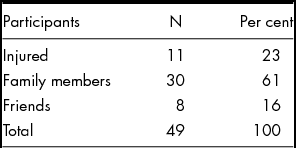
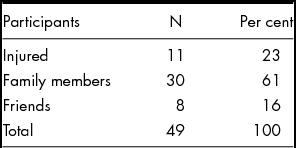
In total, 49 respondents participated in the pilot study, 38 via the web and 11 through postal survey (see Table 1). Most of the respondents were individuals with lived experiences of traffic accidents and injuries occurring between 2000 and 2010. Nineteen people (39%) who participated in the study were involved in, or affected by, an accident during 2000–2010 and 12 of these (63%) had experienced traffic injuries during 2005–2010. For two respondents (4%), the accident had occurred less than 12 months prior to the pilot study (i.e. in 2010).
Study Participants (N = 49)
Data Collection and Procedure
Data were collected using a survey procedure (Bälter et al., Reference Bälter, Bälter, Fondell and Lagerros2005). The survey consisted of a total of 67 questions which was divided into five categories: 1) background and demographic questions such as age and gender; 2) participants’ life status after following an accident/injury; 3) participants’ experiences of social support; 4) information on judicial review and support; and specifically 5) the life situation of injured persons following an alcohol-related road crash.
The format of the survey questionnaire was structured and distributed through mixed-mode delivery including postal and web-based surveys. The two modes of data collection complemented each other and were applied simultaneously to access a large number of people across the country and hence to increase the response rate (Nigel et al., Reference Nigel, Fielding, Raymond and Blank2008; Polit and Tatano Beck, Reference Polit and Tatano Beck2012). The web-based survey was published on a Facebook page for a period of four weeks. The social medium of Facebook provided an information channel for informing people about the study. The Swedish Abstaining Motorists’ Association (MHF) had started a Facebook group in Stockholm in October 2010. For the purpose of this study, a special link was set up between this Facebook group and a dedicated website where interested people could access the research survey and information about the study. The website was secured to ensure the anonymity of visitors (Swedish Research Council, 2014). The Facebook group acquired more than 130,000 followers since its launch in autumn 2010 to spring 2011. When the survey material was collected in autumn 2010 through the web survey, 38 people had voluntarily chosen to participate in the study. The postal survey was also distributed amongst 20 people who were verified by the MHF as having experiences of drunk driving accidents. Eleven people (55%) answered the postal survey.
Data Analysis
The quantitative responses were processed and analysed using descriptive statistics. Results are reported in absolute numbers and percentage as befitting for this small sample exploratory study.
Findings
Findings suggest participating family members and friends (i.e. the social network) of persons involved in drunk driving accidents have been exposed to a range of traumatic experiences including the death or injury of a loved one and/or injury to themselves. They also described other losses such as loss of personal ability/capacity following an accident. Some experienced difficulty concentrating on work and a few had even lost their jobs due to this event. One respondent stated that she no longer has the energy to manage a full-time job. Findings also show that the individuals’ employment changes after the accident, where the percentage of employment has declined from 59% to 48% before and after the accident, respectively. Almost 20% were on sickness/disability benefits after an accident compared with only 2% who used these benefits before an accident happens.
The pilot study further revealed that almost 55% of the participants had received no social support following their accident. Almost 25% of the respondents answered that they would have appreciated and been in need of contact with social services after an accident, but only one or two have had such contact. Further analysis revealed that municipal emergency response programmes have been implemented in exceptional circumstances to provide support to both family members and friends. Three respondents wrote additional comments in the survey that neither they nor their children had received any support in connection with the accident.
Discussion
The Swedish Social Services Act affirms that every municipality has ultimate responsibility for ensuring that all citizens are given the help and support they need (Social Services Act, 2001). This responsibility also extends to children. However, one of the most important findings of the study reflects the need of injured persons and their families and friends for effective care and psycho-social support which is often ignored or marginalised following a road traffic accident. Our findings showed the vulnerability of injured persons and their families to suffering and the lack of support. We found this a remarkable result on the ground that Swedish municipalities spend a considerable amount of resources to employ professionals, and to train them on how to manage emergencies and to provide social support and care in emerging accidents.
Implications for Rehabilitation Practice
Findings suggest that Swedish citizens are relatively unaware of the various forms of social support that are available, such as those provided under the Social Services Act. It seems that the citizens do not know their rights to receive professional support and care from their municipality. In our opinion, the municipalities in Sweden should improve information about its ability to provide support and also make it available to traffic-injured persons as well as their family members and friends.
It would seem that the Swedish local authorities have not taken responsibility under the UN Convention on the Rights of the Child by working to support children in connection with an emergency. The Convention on the Rights of the Child states that every child has the right to life, survival and development.
It is not only the child's physical health that we must uphold, but also the child's mental spiritual, moral and social development (UNICEF, 2007). As the Convention applies to all children in a country, it is important to take into account all the vulnerable groups in society, such as children with disabilities and children from different ethnic backgrounds. Thereby, we also believe that society can prevent vulnerable groups from being double vulnerable. The child's voice and experience must also be taken into account in the development of supportive actions (Socialstyrelsen, 2011).
Trained and qualified emergency management personnel should be available to provide support for people injured in motor vehicle crashes, their families and friends. This could be done by the community by investing more resources with the aim to provide support through hospital social workers, in the acute care as well as in the rehabilitation care. In our opinion, there is also a need for more training in the Swedish social work education (Study Programme in Social Work) and a further higher education of hospital social workers in traffic medicine and in psychosocial care.
Conclusion
This pilot study has several limitations, in particular while the sample size is too small to generalise the findings to a larger population. However, findings are consistent with the related literature and suggest a need for appropriate social support to meet the needs of traffic involved people, their families and socially networked others.
Acknowledgements
This short report has been written as part of a research programme funded by the Stiftelsen Ansvar för Framtiden (Responsibility for the Future Foundation) in Stockholm, Sweden. The authors acknowledge the financial support with thanks.