INTRODUCTION
Understanding the development and growth of ancient communities into spatially, demographically, and sociopolitically complex polities is one of several critical research issues in Mesoamerican archaeology (Clark and Blake Reference Clark and Blake1994; Clark and Cheetham Reference Clark and Cheetham2002; Rosenswig Reference Rosenswig2010; Estrada-Belli Reference Estrada-Belli2011; Lesure Reference Lesure2011; Love and Kaplan Reference Love and Kaplan2011; Chase and Chase Reference Chase and Chase2012; Inomata et al. Reference Inomata, Triadan, Aoyama, Castillo and Yonenobu2013, Reference Inomata, Ortiz, Arroyo and Robinson2014; Joyce Reference Joyce2013). Archaeologists working in the Maya lowlands traditionally rely upon relative chronological assignments derived from regionally distinct ceramic typologies to interpret the timing of these changes and to track the establishment and expansion of large polities (e.g. Adams Reference Adams1971; Sabloff Reference Sabloff1975; Gifford Reference Gifford1976; Andrews Reference Andrews1990; Culbert Reference Culbert1993; Demarest et al. Reference Demarest, Rice and Rice2004). Relative ceramic phases often span hundreds of years, however, and distinguishing ceramic types can overlap several phases preventing precise temporal assignments for discrete events that are essential for documenting patterns of culture change. Independent chronological controls, such as high-resolution accelerator mass spectrometry (AMS) radiocarbon dating, can be combined with relative ceramic-based date estimates to help improve site chronologies in the Maya region, and in Mesoamerica more generally (LeCount et al. Reference LeCount, Yaeger, Leventhal and Ashmore2002; Webster et al. Reference Webster, Freter and Storey2004; Rosenswig and Kennett Reference Rosenswig and Kennett2008; Prufer et al. Reference Prufer, Moyes, Culleton, Kindon and Kennett2011; Culleton et al. Reference Culleton, Prufer and Kennett2012; Inomata et al. Reference Inomata, Triadan, Aoyama, Castillo and Yonenobu2013, Reference Inomata, Ortiz, Arroyo and Robinson2014; Hoggarth et al. Reference Hoggarth, Culleton, Awe and Kennett2014; Overholtzer Reference Overholtzer2014; Lesure et al. Reference Lesure, Carballo, Carabllo, Borejsza and Rodriguez Lopez2014; Huster and Smith Reference Huster and Smith2015).
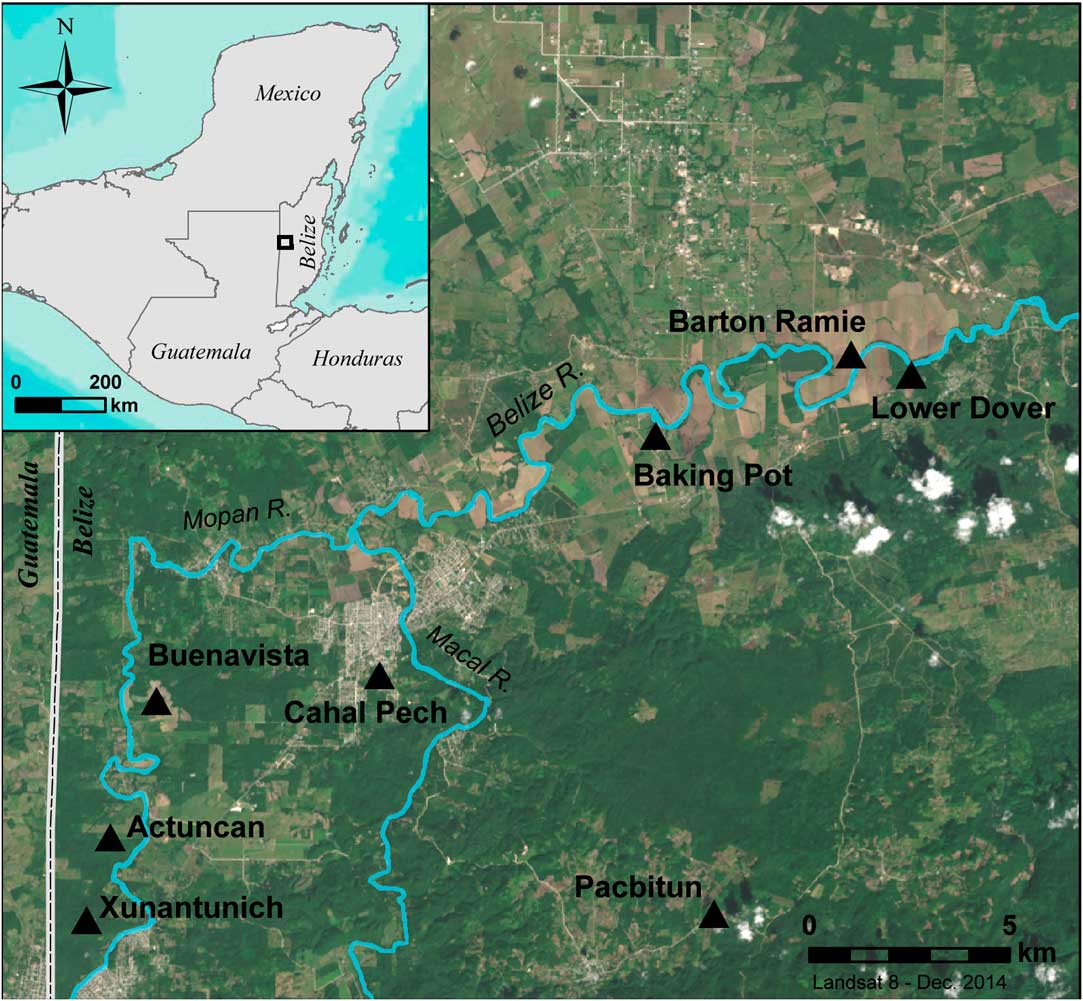
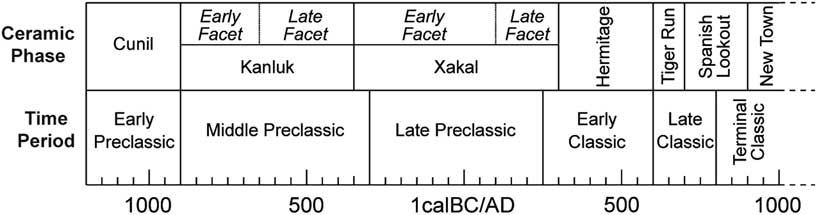
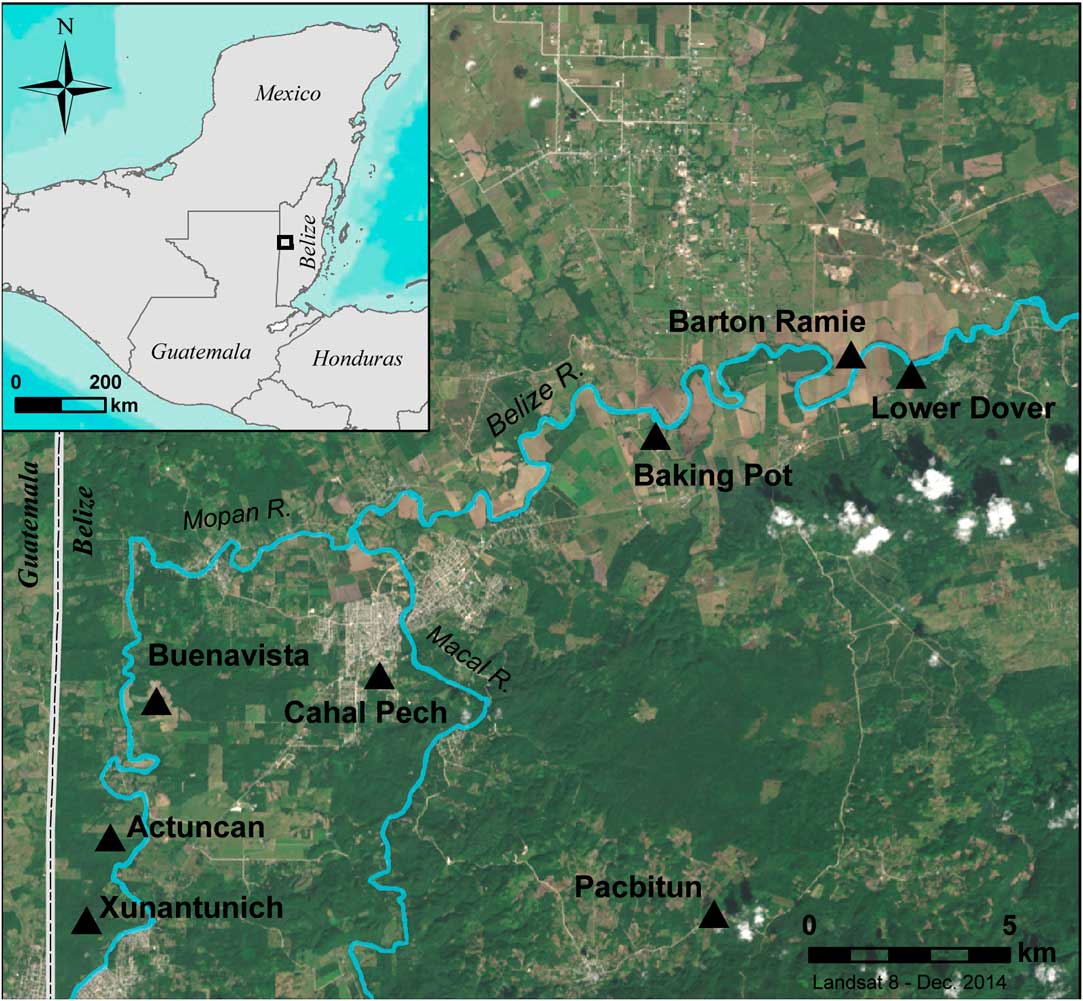
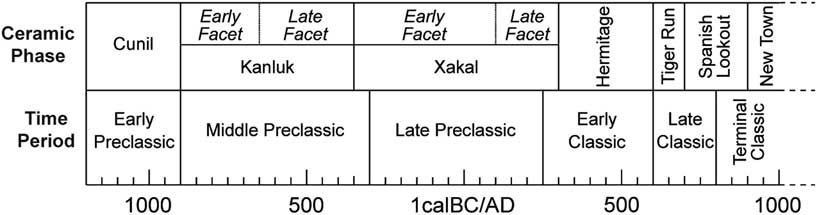
This article reports the results of high-resolution AMS 14C dating from Tzutziiy K’in, a large hinterland house group associated with the major ancient Maya polity of Cahal Pech, located outside the modern town of San Ignacio in the upper Belize Valley of west-central Belize (Figure 1). Cahal Pech provides a unique case study for understanding the development of sociopolitical complexity in the Maya lowlands because of its long occupational history from around 1200 cal BC to cal AD 900 (Figure 2; Awe Reference Awe1992; Healy et al. Reference Healy, Cheetham, Powis and Awe2004a, Reference Healy, Hohmann and Powis2004b). AMS 14C dates recovered from excavations at Tzutziiy K’in were modeled within a Bayesian statistical framework using stratigraphic associations between dates to build an occupational chronology for the site. Combining AMS 14C dates with a priori contextual (i.e. ceramic) and stratigraphic information using a Bayesian approach provides more precise and accurate age determinations to estimate the timing of events including the settlement and growth of the site (Beramendi-Orosco et al. Reference Beramendi-Orosco, Gonzalez-Hernandez, Urrutia-Fucugauchi, Manzanillia, Soler-Arechalde, Goguitchaishvili and Jarboe2009; Bronk Ramsey et al. Reference Bronk Ramsey, Dee, Rowland, Higham, Harris, Brock, Quiles, Wild, Marcus and Shortland2010; Kennett et al. Reference Kennett, Culleton, Voorhies and Southon2011, Reference Kennett, Culleton, Dexter, Mensing and Thomas2014; Prufer et al. Reference Prufer, Moyes, Culleton, Kindon and Kennett2011; Culleton et al. Reference Culleton, Prufer and Kennett2012; Inomata et al. Reference Inomata, Triadan, Aoyama, Castillo and Yonenobu2013, Reference Inomata, Ortiz, Arroyo and Robinson2014; Jazwa et al. Reference Jazwa, Gamble and Kennett2013; Lesure et al. Reference Lesure, Carballo, Carabllo, Borejsza and Rodriguez Lopez2014; Hoggarth et al. Reference Hoggarth, Culleton, Awe and Kennett2014; Smith et al. Reference Smith, Ebert and Kennett2014; Bronk Ramsey Reference Bronk Ramsey2015; Huster and Smith Reference Huster and Smith2015).
Map of the Belize Valley showing the location of Cahal Pech and other major sites mentioned in text. Location of Belize Valley is outlined on the inset map.
Chronological periods for Cahal Pech with associated ceramic phases
As the first directly dated sequence for a residential settlement at Cahal Pech, our results provide an initial framework for understanding the growth and decline of households around the site center, and differences between cultural developments within house groups and the civic-ceremonial site core. We compare our results to previous conventional radiocarbon dates from the Cahal Pech site core sampled from Preclassic contexts (Awe Reference Awe1992; Healy and Awe Reference Healy and Awe1995), and to relatively dated sequences from both the site core and to other hinterland house groups from the Preclassic through Terminal Classic periods. While the sample of 14C dates for the Tzutziiy K’in settlement group is small, the stratigraphic models presented here can be used to guide future research focused on collecting additional 14C samples at the site for undated events, as well as generating comparable data sets from other house groups to reconstruct broader spatial, demographic, and sociopolitical developments at Cahal Pech and in the Belize Valley.
SITE BACKGROUND
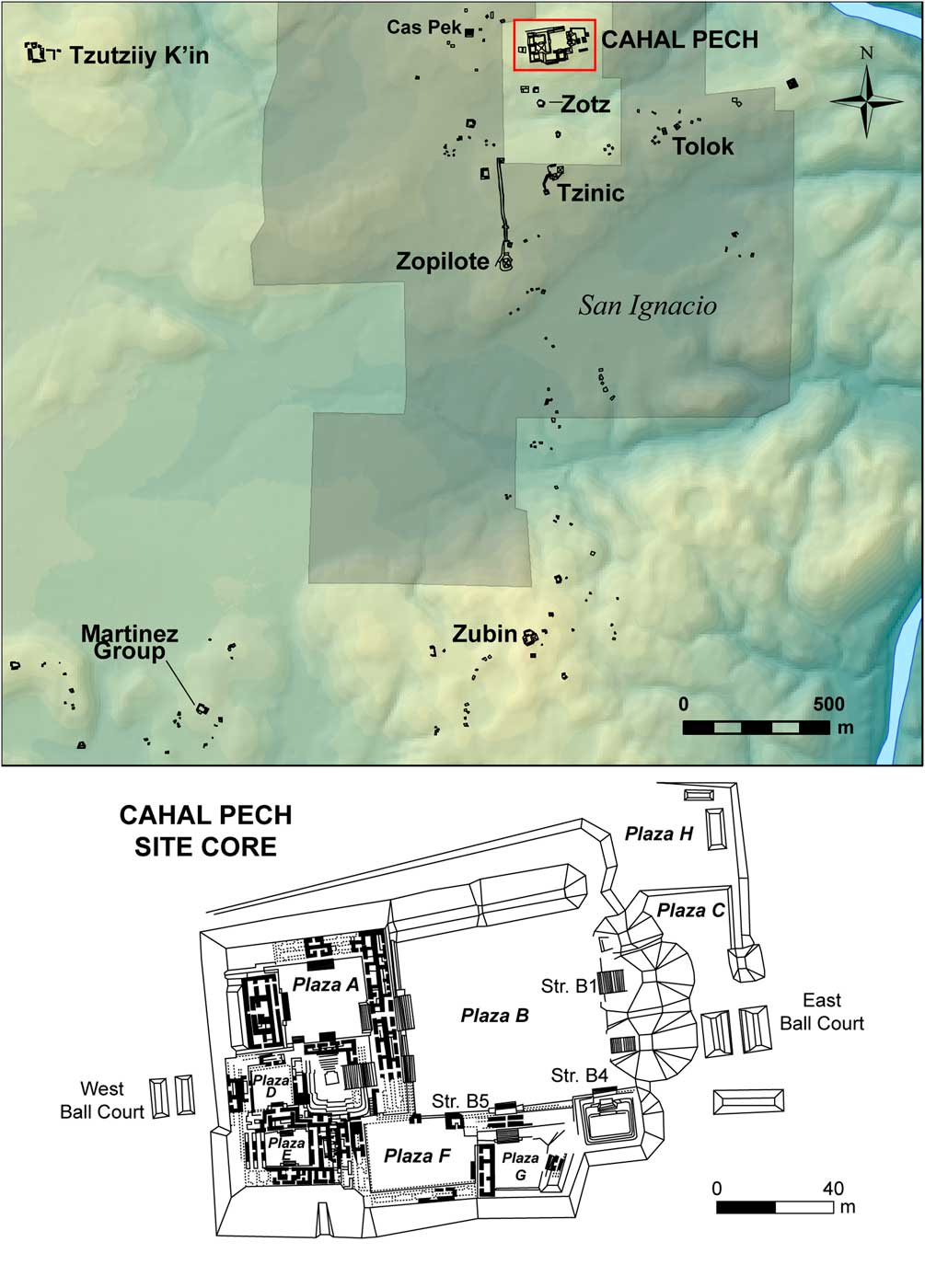
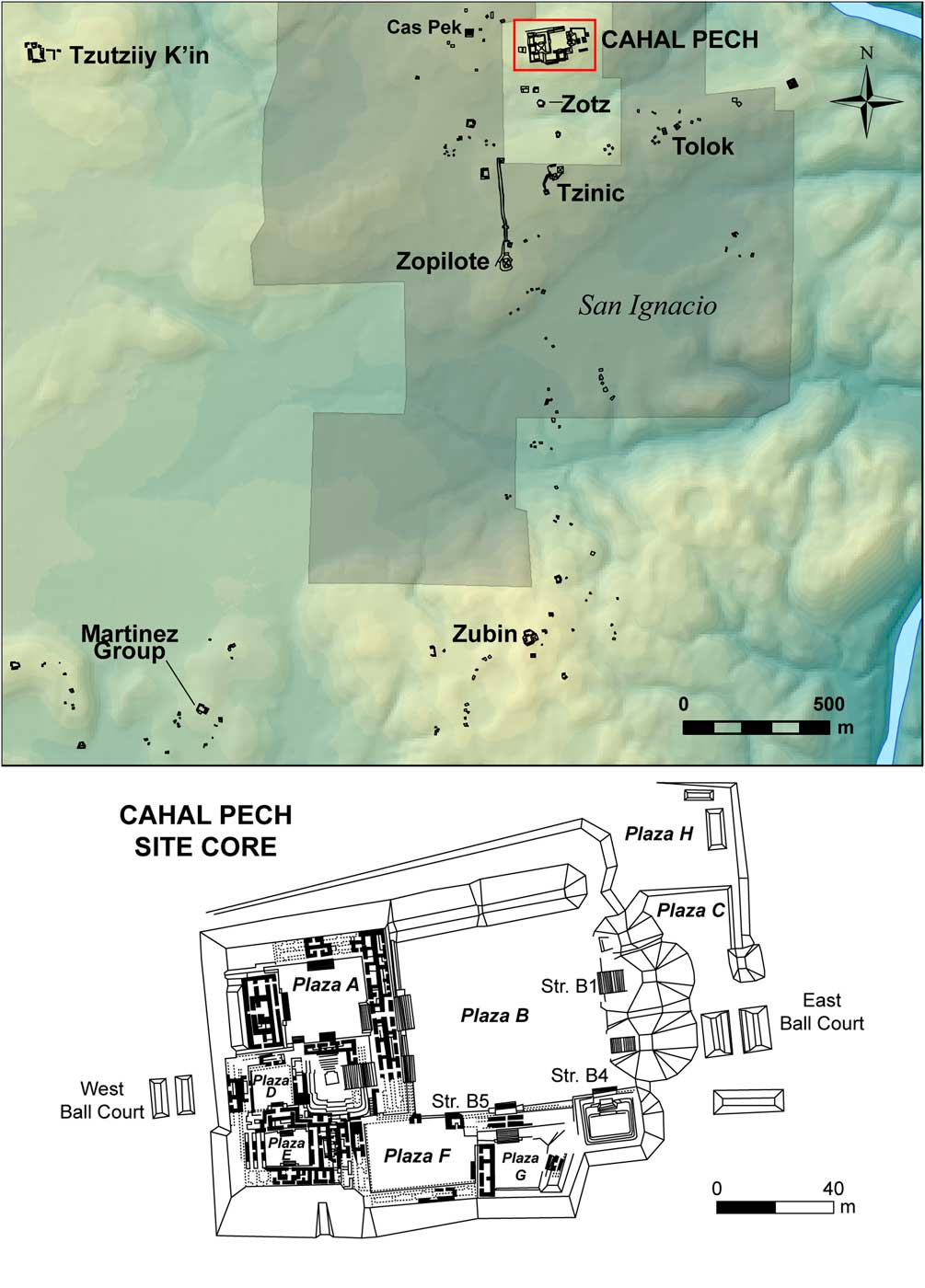
Archaeological investigations at Cahal Pech have been ongoing since the late 1980s under the auspices of the Belize Valley Archaeological Reconnaissance (BVAR) Project (Figure 3). Stratigraphic excavations conducted in the site core in Plaza B identified contexts representing the earliest permanent settlement at Cahal Pech dating to 1200–900 cal BC, associated with the first documented ceramics (Cunil ceramic complex) in the region (Sullivan and Awe Reference Sullivan and Awe2013). During this time, the Maya of the Belize Valley lived in small, relatively egalitarian, and economically autonomous household groups (Awe Reference Awe1992; Healy and Awe Reference Healy and Awe1995; Clark and Cheetham Reference Clark and Cheetham2002). A limited program of 14C dating in the early 1990s was aimed at understanding the timing of the foundation and early growth of Cahal Pech into a major civic-ceremonial center during the Early to Late Preclassic periods (Awe Reference Awe1992; Healy et al. Reference Healy, Cheetham, Powis and Awe2004a; Awe and Helmke Reference Awe and Helmke2005). The clearest evidence for social differentiation at Cahal Pech appeared during the Late Preclassic, when the presence of monumental architecture and the first elaborate tombs suggest it was the seat of power for a small regional polity (Awe Reference Awe1992, Reference Awe2013; Healy et al. Reference Healy, Cheetham, Powis and Awe2004a; Garber and Awe Reference Garber and Awe2008). Other large, formally organized civic centers were also established during the Late Preclassic throughout the Belize Valley including Blackman Eddy, Xunantunich Group E, Pacbitun, Actuncan, and Barton Ramie (Awe Reference Awe1992; Garber et al. Reference Garber, Brown, Awe and Hartman2004; Healy et al. Reference Healy, Hohmann and Powis2004b; Brown et al. Reference Brown, McCurdy, Lytle and Chapman2013). During the Early and Late Classic periods, Cahal Pech was one of the largest centers in the region, whose geographic position afforded it control over households in the fertile alluvial plains below the site, as well as command of the Belize River as a natural exchange route linking the central Petén of modern-day Guatemala to the Caribbean Sea (Awe Reference Awe1992).
Map of Cahal Pech showing the relationship between the site core and known house groups (top), and detail of site core (bottom).
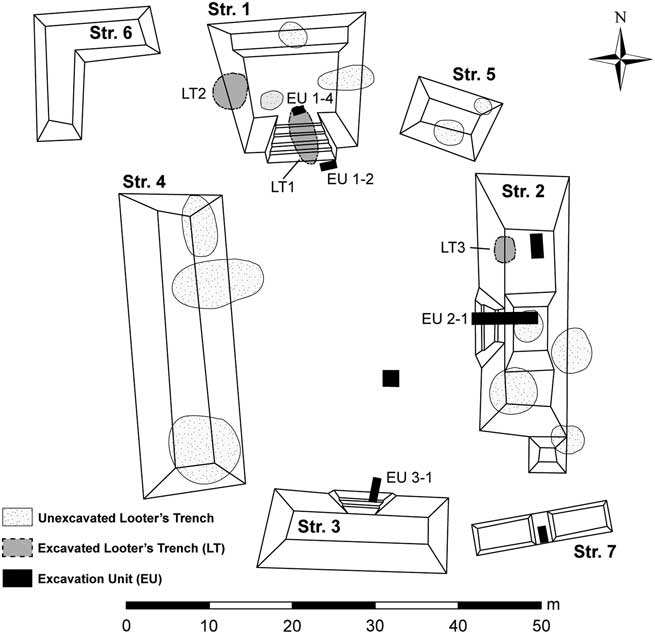
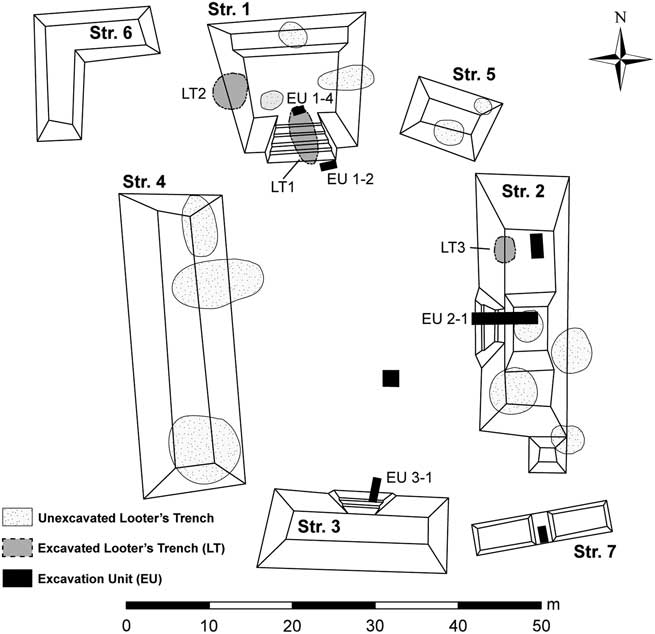
In this paper, we focus on understanding the settlement and growth of Tzutziiy K’in (roughly translating to “sunset” in Yucatec Mayan), a large house group located atop a small hill approximately 1.8 km directly west of the Cahal Pech site core (Figure 4). A total of seven structures surround the main plaza of Tzutziiy K’in, many of which have been heavily looted. Stratigraphic excavations were conducted in Structures 1, 2, and 3 within the main plaza at Tzutziiy K’in (Ebert and Dennehy Reference Ebert and Dennehy2013). Structure 1, the northern-most structure in the main plaza, was the most heavily looted at the site. Salvage excavations were conducted in looter’s trenches (LT1 and LT2) and profiles exposed by looters were cleared to ascertain the stratigraphy of the construction sequences. Structure 2 is located on the eastern side of the main plaza at Tzutziiy K’in. Three excavation units were placed along the centerline of Structure 2 (Units 2-1, 2-2, and 2-3) and a single unit was positioned on the north side of the summit (Unit 2-4). Salvage excavation was conducted in a looter’s trench located on the west side of the building (LT3) with the goal of recovering additional stratigraphic information about the building. Excavations on Structure 3 consisted of a single 1×3 m axial trench placed at the center of the structure and extending into the plaza. Because this structure suffered the least damage from looting at the site, the goal of excavation was to identify chronologically secure contexts. Based on ceramic evidence for the earliest cultural levels at the site, Tzutziiy K’in was likely a small settlement during the end of the Middle Preclassic period (Kanluk ceramic phase). Beginning in the Late Preclassic, people living in this settlement started to build large elaborate architecture and import exotic materials, including obsidian and jade, perhaps demonstrating elevated status based on connections to broader regional trade networks (Ebert and Dennehy Reference Ebert and Dennehy2013).
Map of Tzutziiy Ki’n showing locations of test excavations and excavated looter’s trenches.
METHODS
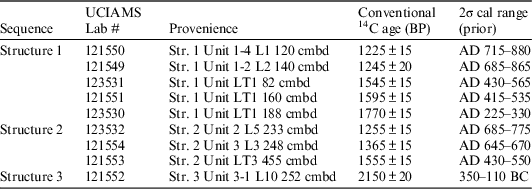
Carbonized twig samples for AMS 14C dating were recovered from stratified contexts during excavations at Tzutziiy K’in Structures 1, 2, and 3. Samples were collected in situ from isolated features, construction fill, and in association with plaster floors. Samples were prepared along with standards and backgrounds at the Pennsylvania State University Human Paleoecology & Isotope Geochemistry Lab and the University of California-Irvine Keck Carbon Cycle AMS Facility (UCI KCCAMS) following standard practices as described by Kennett et al. (Reference Kennett, Culleton, Dexter, Mensing and Thomas2014). Short-lived twig samples were selected for dating to reduce erroneous age assignments from the “old wood effect” (Schiffer Reference Schiffer1986; Kennett et al. Reference Kennett, Ingram, Southon and Wise2002). All 14C ages reported in Table 1 are conventional 14C ages corrected for fractionation with measured δ13C following Stuiver and Polach (Reference Stuiver and Polach1977). Date calibrations and stratigraphic models were produced in OxCal v 4.2 (Bronk Ramsey Reference Bronk Ramsey2009) using the IntCal13 Northern Hemisphere atmospheric curve (Reimer et al. Reference Reimer, Bard, Bayliss, Beck, Blackwell, Bronk Ramsey, Buck, Cheng, Edwards, Friedrich, Grootes, Guilderson, Haflidason, Hajdas, Hatté, Heaton, Hoffmann, Hogg, Hughen, Kaiser, Kromer, Manning, Niu, Reimer, Richards, Scott, Southon, Staff, Turney and van der Plicht2013). Calibrated and modeled date ranges are reported at the 2σ level.
Calibrated AMS 14C dates from Tzutziiy K’in. Depth below a datum point in cm is denoted by cmbd.

We developed Bayesian stratigraphic models to understand the occupational history of Tzutziiy K’in. Traditional statistical analysis of 14C dates from archaeological contexts has relied on probability distributions to determine the likelihood that two dated events were sequential or contemporaneous. The Bayesian approach, on the other hand, incorporates a priori contextual and stratigraphic information obtained in the field within modeled sequences of 14C dates to constrain probability distributions (Buck et al. Reference Buck, Kenworthy, Litton and Smith1991; Bayliss and Bronk Ramsey Reference Bayliss and Bronk Ramsey2004; Bronk Ramsey et al. Reference Bronk Ramsey, Dee, Rowland, Higham, Harris, Brock, Quiles, Wild, Marcus and Shortland2010; Culleton et al. Reference Culleton, Prufer and Kennett2012; Inomata et al. Reference Inomata, Triadan, Aoyama, Castillo and Yonenobu2013, Reference Inomata, Ortiz, Arroyo and Robinson2014; Douka et al. Reference Douka, Higham, Wood, Boscato, Gambassini, Karkanas, Peresani and Ronchitelli2014; Higham et al. Reference Higham, Douka, Wood, Bronk Ramsey, Brock, Basell, Camps, Arrizabalaga, Baena, Barroso-Ruíz, Bergman, Boitard, Boscato, Caparrós, Conard, Draily, Froment, Galván, Gambassini, Garcia-Moreno, Grimaldi, Haesaerts, Holt, Iriarte-Chiapusso, Jelinek, Jordá Pardo, Maíllo-Fernández, Marom, Maroto, Menéndez, Metz, Morin, Moroni, Negrino, Panagopoulou, Peresani, Pirson, de la Rasilla, Riel-Salvatore, Ronchitelli, Santamaria, Semal, Slimak, Soler, Soler, Villaluenga, Pinhasi and Jacobi2014; Kennett et al. Reference Kennett, Culleton, Dexter, Mensing and Thomas2014; McClure et al. Reference McClure, Podrug, Moore, Culleton and Kennett2014; Bronk Ramsey Reference Bronk Ramsey2015; Huster and Smith Reference Huster and Smith2015).
Eight AMS 14C dates from Structure 1 (n=5) and Structure 2 (n=3) at Tzutziiy K’in were modeled stratigraphically within two ordered sequences within OxCal. Strata that separate directly dated deposits were modeled as single boundaries (i.e. events that were not directly dated). Additional boundaries were placed at the beginning of each sequence to represent the beginning of activity at a structure (Structure 1) or the deepest cultural levels reached during excavations (Structure 2). Boundaries were also placed at the end of each sequence that provide an approximate time range for the termination of structure use. The difference command was used to estimate the length of time represented by directly dated elements of a sequence (i.e. how long a structure was used before being remodeled; Culleton et al. Reference Culleton, Prufer and Kennett2012:1577). Stratigraphic models generate agreement indices (A) for the posterior distributions of each 14C date in a model to determine how well the modeled dates fit with the available contextual data (Bronk Ramsey Reference Bronk Ramsey2009). Individual agreement indices are combined (Amodel) to see if the model as a whole is likely given the data. The model for Structure 1 generated an agreement index of 92.6% and Structure 2 generated an agreement index of 93.5%.
RESULTS
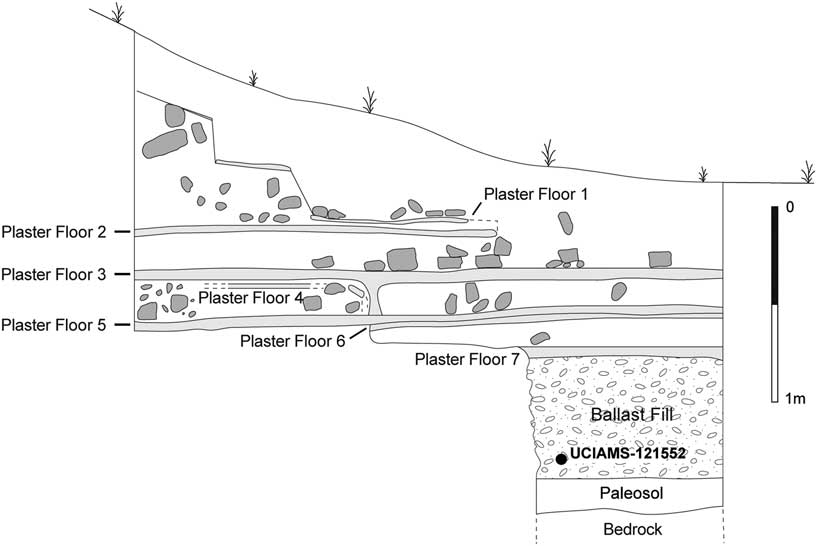
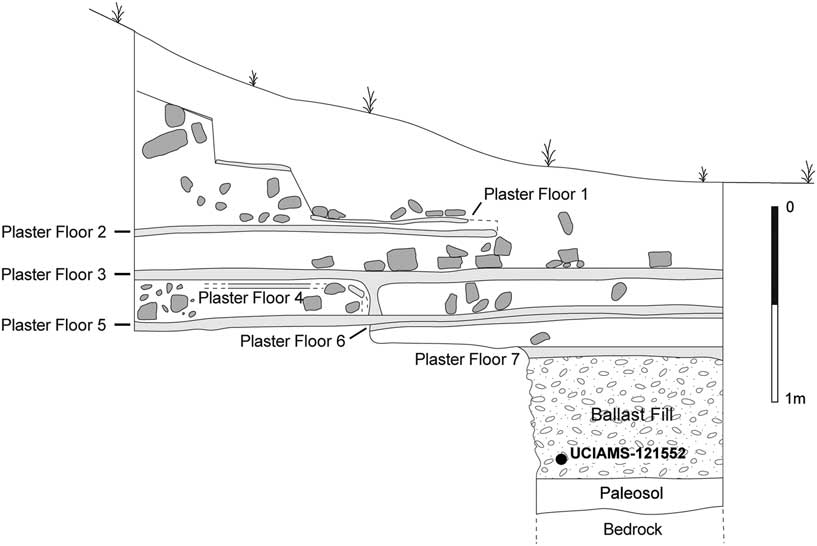
Excavations and AMS 14C dating indicate that Tzutziiy K’in was settled by the beginning of the Late Preclassic period and was inhabited continuously through the Terminal Classic period. The earliest 14C date from Tzutziiy K’in dates to 325–110 cal BC (UCIAMS-121552), and comes from a layer of fill at Structure 3 that was placed on top of a black paleosol resting directly on bedrock at the site (Figure 5). The fill deposit contained high concentrations of late Middle and Late Preclassic period ceramics primarily dating to the Kanluk (Savanna Orange) ceramic and Xakal (Sierra Red, Polvero Black) ceramic phases. The layer of fill also contained household debris such as obsidian and chert used for tools, freshwater shell, and fragments of ground stone tools (Ebert and Dennehy Reference Ebert and Dennehy2013). The placement of the fill was likely used to level out the uneven hilltop prior to initial construction at the site. Settlement at Tzutziiy K’in may have occurred earlier in the Middle Preclassic, however, based on the large volume of ceramics and residential debris within the midden fill. Subsequent construction at Structure 3 spans from the Late Preclassic through Late to Terminal Classic periods. Middle to Late Preclassic ceramics from the Kanluk and Xakal phases are present in strata below Floor 3. The fill between Floors 2 and 3 contained Floral Park and Mount Hope complex ceramics, representing the Late Preclassic to Early Classic use of the structure. Spanish Lookout and Tiger Run complex ceramics (Belize Red, Mount Maloney Black, Juleki Cream Polychrome) dating from the Late to Terminal Classic (primarily Belize Red types) were recovered in strata above Floor 2. Late and Terminal Classic ceramics represent the final construction and use of Structure 3.
Profile of EU 3-1 at Tzutziiy K’in Structure 3, showing location of earliest 14C sample for the site. Subsequent occupational surfaces are also depicted.
Structure 1 Sequence
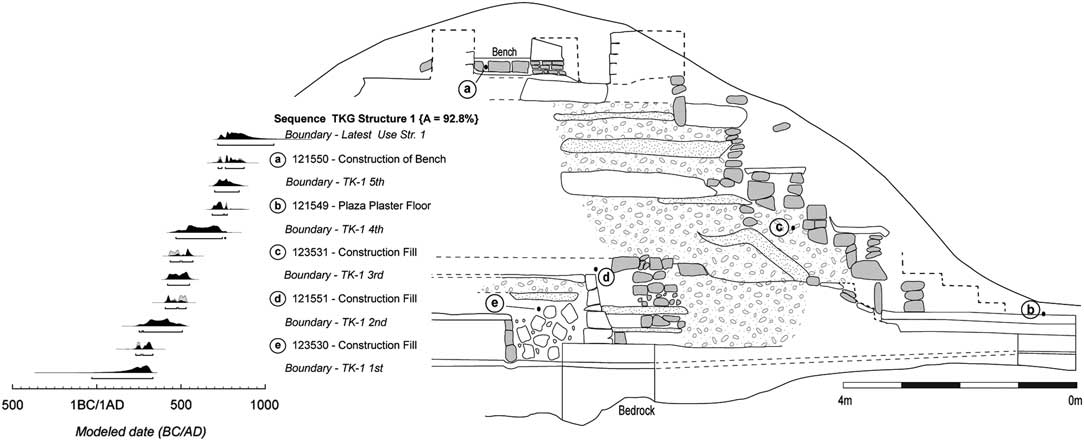
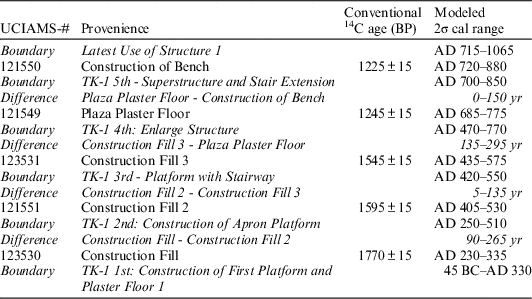
AMS 14C dates from Structure 1 were modeled within a sequence using stratigraphic and contextual data to estimate the timing of events not directly dated, and to understand the nature and timing of the construction phases for the structure (Figure 6 and Table 2). Five major construction events were modeled following the first construction phase for the structure, which was the placement of Plaster Floor 1. All of these events involved the construction of platforms and structures and are labeled sequentially as TK-1 # (i.e. Tzutziiy K’in Str. 1):
-
∙ TK-1 1st: The earliest building was a small, low platform placed on top of Plaster Floor 1. The platform was likely constructed in the Late Preclassic between 45 cal BC and cal AD 330. The ceramic assemblage associated with TK-1 1st is primarily composed of ceramics dating to the Xakal phase, with a smaller number of Kanluk phase ceramics present.
-
∙ TK-1 2nd: Subsequent activity consisted of the placement of a low apron-molded platform that was built during the very end of the Late Preclassic or during the Early Classic period. The interior of the structure was composed of a rubble construction fill (cal AD 230–335; UCIAMS-123530). A 14C sample was collected from within construction fill outside of TK-1 2nd, and dates to cal AD 405–530 (UCIAMS-121551). The span of time between the dates from the inside and outside fill, representing the use TK-1 2nd, is estimated between 90–265 cal yr. The structure was likely used throughout the Early Classic period.
-
∙ TK-1 3rd: A larger platform, approximately 2 m tall, was constructed at the end of the Early Classic period (cal AD 420–550), and was composed of a series of fill episodes interspersed with construction floors to shape the final façade of the building. During this event, a stairway facing the plaza was also added to the south side of TK-1 3rd. The span of time estimated between construction of TK-1 3rd and TK-1 4th is estimated between 5–135 cal yr, indicating that the platform was used for a shorter period of time compared to previous buildings.
-
∙ TK-1 4th: The penultimate phase of construction consisted of a series of fill episodes interspersed with construction floors that were used to remodel and enlarge Structure 1. The fill within this phase of construction dates to cal AD 435–575 (UCIAMS-123531), at the end of the Early Classic period. A plaster floor located within the plaza in front of Structure 1 corresponds to this construction phase. A 14C sample collected from directly on top of the floor suggest that it was used during the beginning of the Late Classic period (cal AD 685–775, UCIAMS-121549). The span of time estimated between the placement of fill for TK-1 4th and the use of plaza plaster floor is estimated between 135–295 cal yr.
-
∙ TK-1 5th: The final building included placement of a small superstructure on top TK-1 4th. This may have occurred relatively quickly between 0 and 150 cal yr. The superstructure contained a plastered bench running east-to-west across the back of the room. A 14C sample recovered from deposits that postdate the construction of the superstructure produced a 2σ date range of cal AD 720–880 within the sequence. The final boundary for the Structure 1 sequence represents the terminal use and abandonment of the structure, and is estimated to date to between cal AD 715–1065 during the Terminal Classic period.
Profile of Tzutziiy K’in Structure 1 showing location of AMS 14C samples and modeled calibrations
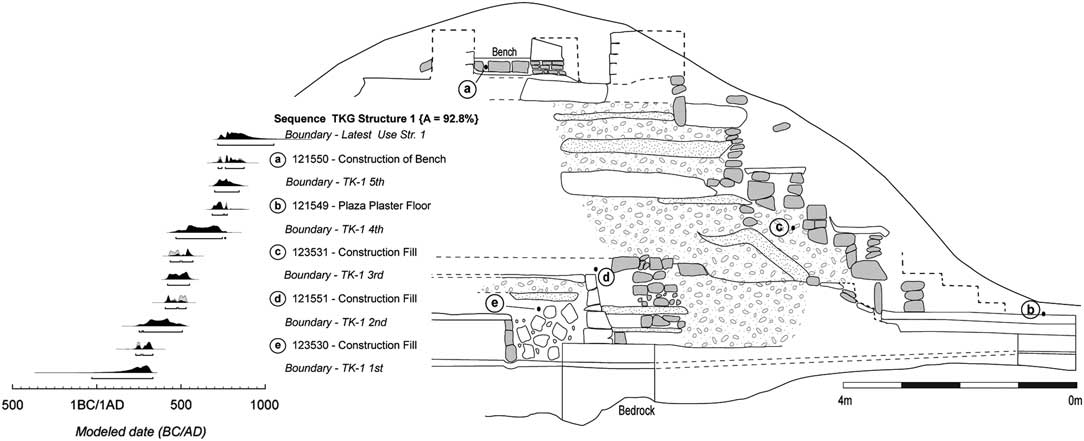
Modeled radiocarbon sequence for Structure 1.

Structure 2 Sequence
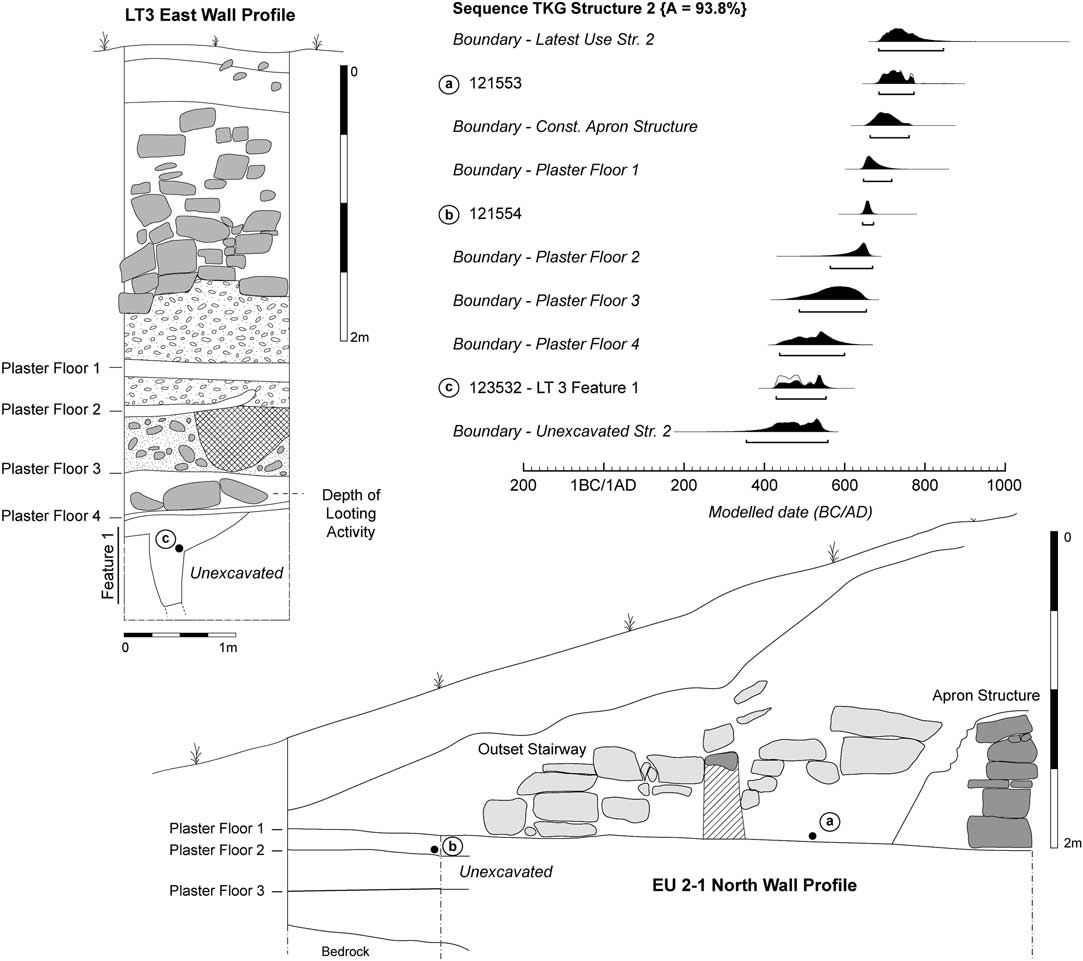
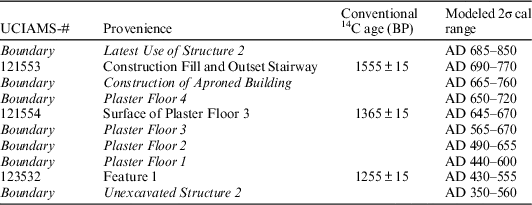
The sequence for Structure 2 includes several construction events dating from the Early to Terminal Classic periods (Figure 7 and Table 3). Excavations at Structure 2, however, did not expose the complete construction sequence for the building, and the earliest boundary in the sequence represents the earliest observed activity at the building in the Early Classic period (cal AD 350–560). Activity that extends further back into the Early Classic or Late Preclassic periods is, however, likely. The first 14C date in the Structure 2 sequence was recovered from LT3 Feature 1 and dates to the Early Classic Period (cal AD 430–555; UCIAMS-123532). Feature 1 contained several bone fragments and two human teeth, and may represent a cache or secondary burial typically associated with eastern shrine buildings in the Belize Valley (Awe Reference Awe2008). Only three diagnostic ceramics were recovered from Feature 1, including one Actuncan Orange Polychrome sherd (Early Classic Hermitage phase). Four plaster floors, visible in profile in LT3 and Unit 2-1, were placed above Feature 1 and are represented as separate boundaries in the Structure 2 sequence. The placement of the first floor in the series (Plaster Floor 4) occurred at cal AD 440–600, and perhaps was contemporaneous with the use of Feature 1. A 14C sample collected from the surface of Plaster Floor 2 dates to cal AD 645–670 (UCIAMS-121554), falling wholly within the Tiger Run ceramic phase at the beginning of the Late Classic period. The superimposing Plaster Floor 1 was likely placed soon after at cal AD 650–720.
Profiles of EU 2-1 and LT3 at Tzutziiy K’in Structure 2, showing locations of 14C samples and modeled calibrations.
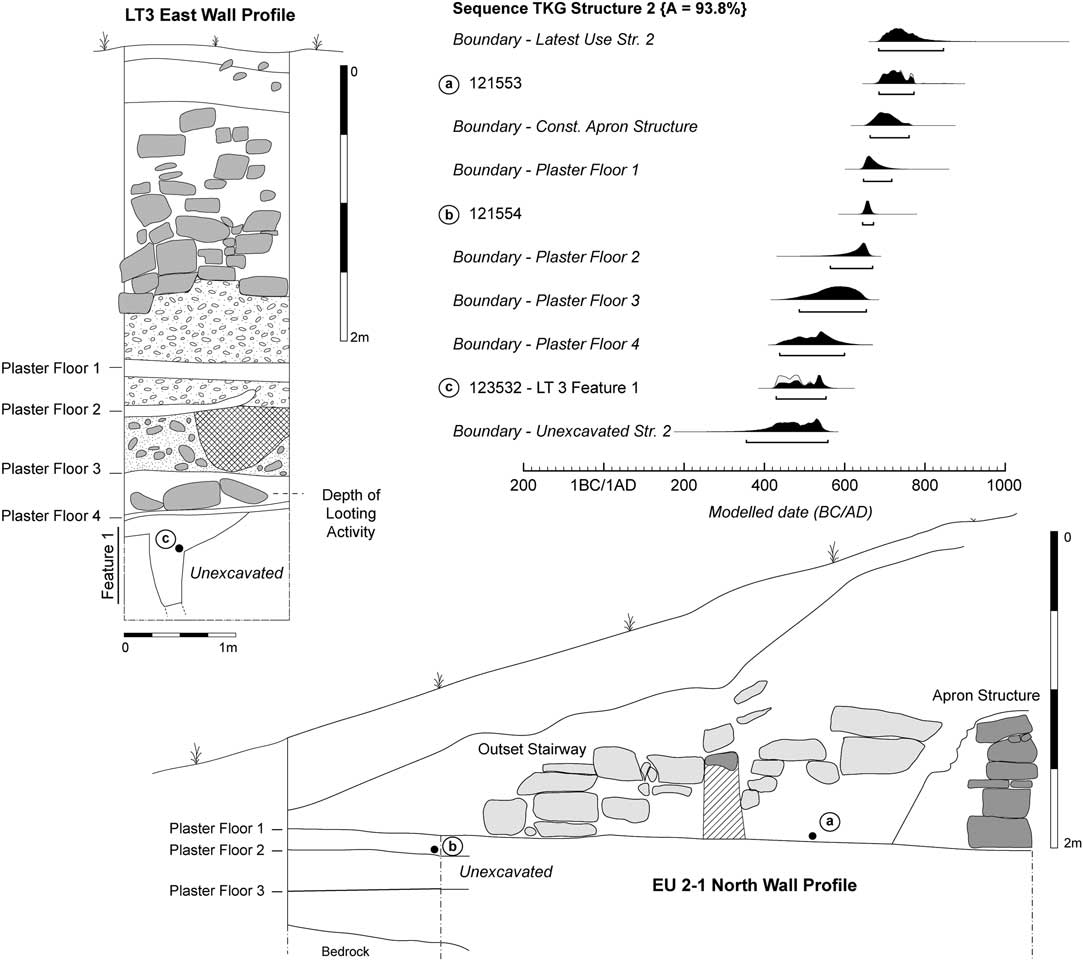
Modeled radiocarbon sequence for Structure 2.

Several discrete construction events were documented through excavations after the placement of the series of plaster floors above Feature 1. During the middle of the Late Classic (cal AD 665–760), a low platform with an aproned façade was placed directly on top of Plaster Floor 1. This was followed by the placement of two parallel walls in front of the aproned building. The space between the walls was filled with rubble to enlarge Structure 2. This rubble fill was put in place between cal AD 690–770 (UCIAMS-121553). Once the fill was in place, a stairway leading into the plaza was built in front of the structure. The placement of the stairway may have occurred concurrently with enlargement of the rest of the structure. The latest use of the Structure 2 occurred between cal AD 685–850, during the Late to Terminal Classic periods. This boundary estimate is confirmed by the presence of Tiger Run and Spanish lookout phase ceramics associated with the terminal architecture of Structure 2.
DISCUSSION
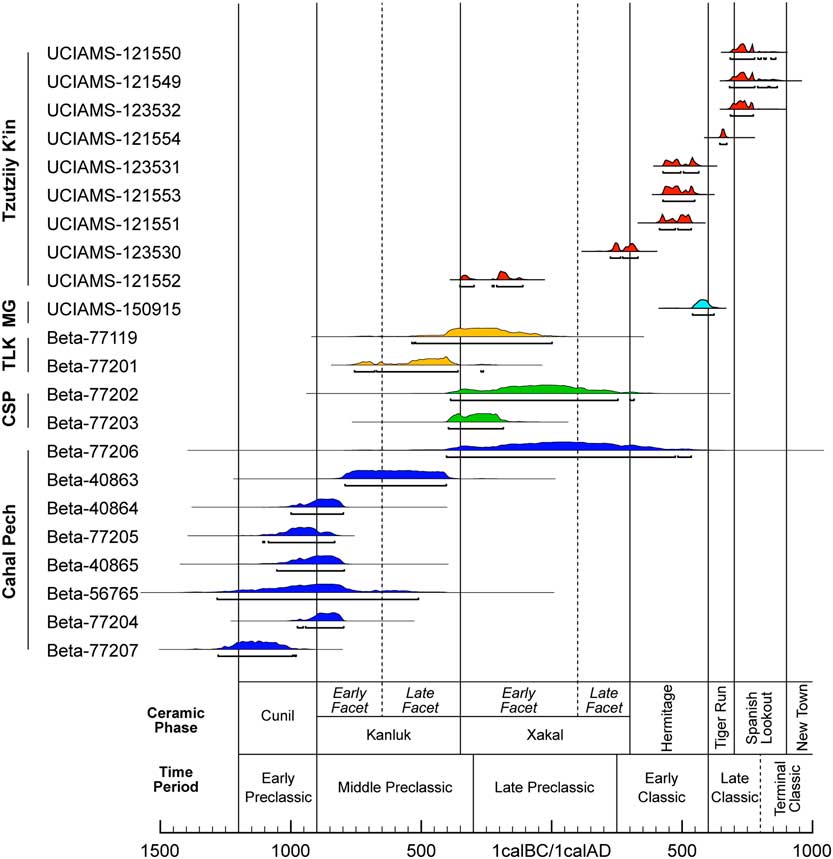
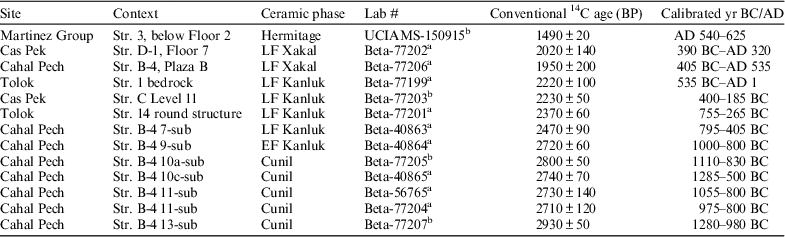
AMS 14C dating and stratigraphic modeling from Tzutziiy K’in provide new information about the nature and timing of settlement expansion during the Preclassic through Terminal Classic periods at Cahal Pech. High-resolution AMS 14C for Tzutziiy K’in have error ranges between 15–20 14C yr, allowing for more precise age determinations compared to relative ceramic dating, which often places the length of occupational and construction sequences within large blocks of time that sometimes exceed 500 yr. Stratigraphic models developed here for Tzutziiy K’in provide a framework for understanding the chronology of this large house group in relation to the spatial, demographic, and political growth of Cahal Pech site core and settlement system (Figure 8 and Table 4). At least three periods of settlement and growth at Tzutziiy K’in are represented by modeled 14C dates, including (1) Late Preclassic period settlement, (2) increased construction activity and expansion of the site in the Early Classic period, and (3) Late to Terminal Classic period remodeling and termination of site occupation.
Calibrated 14C date distributions from the Cahal Pech site core and hinterland house groups listed in Table 4 (CSP – Cas Pek; TLK – Tolok; MG – Martinez Group).
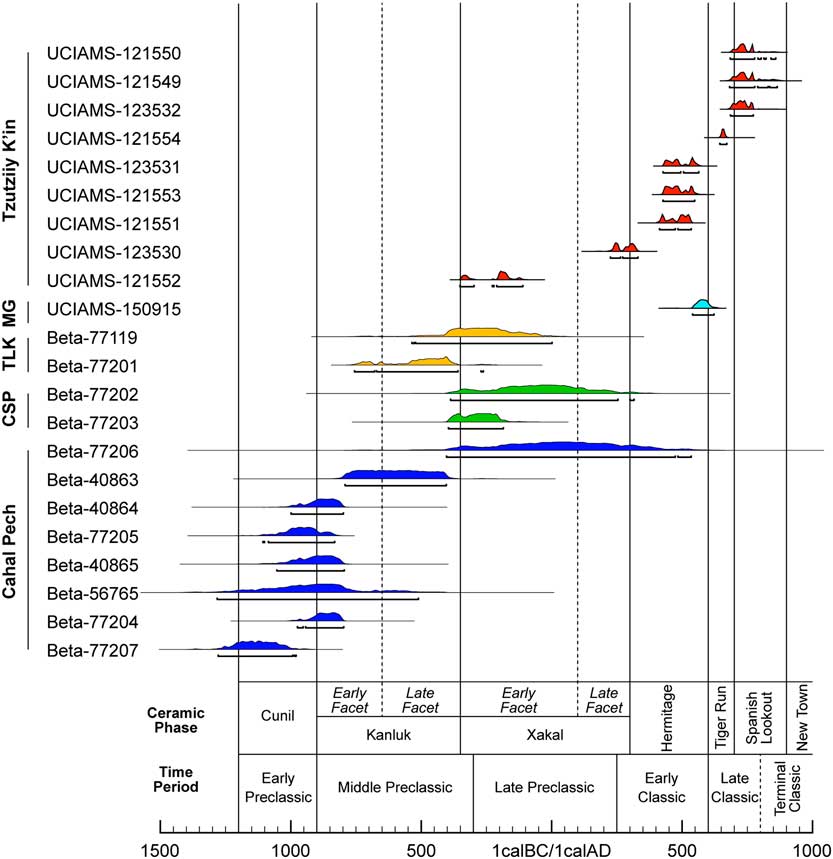
Previous 14C age determinations from Cahal Pech and the peripheral house groups of Cas Pek, Tolok (after Awe Reference Awe1992:Table 1 and Healy and Awe Reference Healy and Awe1995:Table 1), and the Martinez Group (Ebert Reference Ebert2015a). Date ranges are reported at the 2σ level.

a Denotes radiometric measurement.
b Denotes AMS 14C measurement.
Late Preclassic Period Settlement
Current data suggest that initial settlement of this peripheral household group may have occurred as early as the end of the Middle Preclassic period, based on ceramic evidence from some of the earliest deposits at Structures 1 and 3. The first directly dated construction within the Tzutziiy K’in main plaza took place during the beginning of the Late Preclassic period (325–110 cal BC). This is well after the initial Cunil phase settlement at Cahal Pech (1200–900 cal BC; Awe Reference Awe1992; Healy et al. Reference Healy, Cheetham, Powis and Awe2004a), but concurrent with large-scale construction of the first monumental constructions in the Cahal Pech site center (Plazas A and B; Awe Reference Awe1992; Healy et al. Reference Healy, Cheetham, Powis and Awe2004a). Accelerated architectural activity in the core is evident in Plaza A, where Structure A-1 1-Sub reached a height of almost 15 m. Plaza B was raised and enlarged during the Late Preclassic period, and Structure B-4 underwent several modifications (B-4 7-sub –B-4 10-sub) beginning with the construction of a specialized round structure dating to 795–405 BC (Beta-40863; Healy and Awe Reference Healy and Awe1995) likely used for public ceremonies (Aimers et al. Reference Aimers, Powis and Awe2000), and terminating with a large, 4-m-high pyramid that supported a pole and thatch super structure (Awe Reference Awe1992).
Initial construction phases of mounds in several house groups peripheral to the Cahal Pech site core also occurred in the Late Preclassic, indicative of population growth at the site. Associated ceramic materials date the founding of at least five house groups to the Late Middle and Late Preclassic (Willey and Bullard Reference Willey and Bullard1956; Awe Reference Awe1992:207; Cheetham et al. Reference Cheetham, Vinuales, Bisquet and Holgate1993; Iannone Reference Iannone1996; Powis Reference Powis1996). Four 14C dates from two peripheral settlements, Cas Pek and Tolok, date the earliest activity at these groups to 530–400 cal BC, with subsequent larger-scale residential and nonresidential construction occurring after 350 cal BC during the Xakal ceramic phase (Healy and Awe Reference Healy and Awe1995; Healy et al. Reference Healy, Cheetham, Powis and Awe2004a). Ceramic associations suggest that this pattern of Late Preclassic settlement and growth is consistent with events at several other large house groups (e.g. Zubin, Zopilote, and Cas Pek) throughout the hinterlands of Cahal Pech (Awe Reference Awe1992; Iannone Reference Iannone1996).
Early Classic Period Expansion
In the Early Classic period (cal AD 250–600), sites throughout the Belize Valley began to grow in size and complexity. Settlement data document a substantial increase in population beginning in the Early Classic period (e.g. Barton Ramie, Willey et al. Reference Willey, Bullard, Glass and Gifford1965; see also Awe and Helmke Reference Awe and Helmke2005), and an increase in construction activity at Cahal Pech (Awe and Helmke Reference Awe and Helmke2005), Buenavista (Ball and Taschek Reference Ball and Taschek2004), and Pacbitun (Healey et al. Reference Healy, Hohmann and Powis2004b). At Cahal Pech, several structures within Plaza A were remodeled and the plaza resurfaced; Plazas C, D, F, and G grew substantially through the construction of new buildings; and the first phase of the eastern ball court was erected (Awe Reference Awe1992; Awe and Helmke Reference Awe and Helmke2005:Table 1). Some of the most elaborate royal burials from the site date to the Early Classic period based on ceramic associations (Santasilia Reference Santasilia2012; Awe Reference Awe2013; Ishihara-Brito et al. Reference Ishihara-Brito, Can and Awe2013). The Early Classic period also saw the first introduction of Pachuca obsidian from the central Mexican highlands into the Cahal Pech assemblage, as well as at other sites in the Belize Valley (Awe and Helmke Reference Awe and Helmke2005; Ebert Reference Ebert2015b). The presence of exotic artifacts, such as Pachuca obsidian, in royal burials and residential contexts demonstrates the participation of Cahal Pech in larger inter-regional exchange networks within and beyond the Maya region.
Peripheral house groups experienced coeval expansion with the Cahal Pech civic-ceremonial core during the Early Classic period. At the household level, the residents of Tzutziiy K’in began to build larger residential platforms at this time. At Structure 1, TK-1 3rd was constructed at the beginning of the Early Classic and was soon remodeled into TK-1 4th between 5–135 cal yr (mean=65 cal yr). While excavations at Structure 2 did not reach sterile levels, modeled 14C dates place the earliest construction of the building sometime during the Early Classic period at cal AD 350–560. This pattern of site growth is noted at several other house groups around Cahal Pech, where Early Classic components were added to include relatively large domestic and nondomestic architecture (Iannone Reference Iannone1996; Powis Reference Powis1996; Awe and Helmke Reference Awe and Helmke2005). More recent settlement research also suggests that some new residential groups were established in the Early Classic (Ebert Reference Ebert2015a), indicating continued population growth from the Preclassic into the Early Classic period (Awe and Helmke Reference Awe and Helmke2005). A 14C date from some of the earliest cultural contexts at the Martinez Group, south of the Cahal Pech site core, is associated with Dos Arroyos Orange Polychrome ceramics diagnostic of the Early Classic period and date to cal AD 540–625 (UCIAMS-150915; Ebert Reference Ebert2015a).
Late Classic Period Remodeling and Terminal Classic Period Abandonment
By the Late Classic period (cal AD 650–800), the appearance of monumental architecture, hieroglyphic inscriptions, and elaborate burials at large political centers in the Belize Valley, and throughout the Maya lowlands, signals the presence of ruling elite lineages (Martin and Grube Reference Martin and Grube2008). While no Late Classic period deposits have been directly dated from the site core at Cahal Pech, architectural data from excavated contexts indicate that the site reached its maximum size during this time. Buildings within public plazas in the western portion of the site were enlarged, and more restricted access plazas in the eastern sector of the site were constructed to function as royal residences (Awe Reference Awe1992, Reference Awe2008). The Cahal Pech settlement system also became increasingly stratified and complex during the Late Classic period. Over 140 house groups and single residential mounds have been documented around the site core, most of which possess evidence for Late Classic occupation (Awe Reference Awe1992; Awe and Brisbin Reference Awe and Brisbin1993; Dorenbush Reference Dorenbush2013; Ebert and Awe Reference Ebert and Awe2014; Ebert Reference Ebert2015a). Some house groups became larger and more elaborate, and contained both public and ritual architecture. These elite house groups were surrounded by smaller, less elaborate residential settlements (Awe Reference Awe1992), indicating increasing centralization of political economic power for some households within the local community.
Tzutziiy K’in was one of the largest hinterland house groups during the Late Classic period (Ebert and Dennehy Reference Ebert and Dennehy2013). AMS 14C dating of extensive and elaborate multicomponent construction episodes at Tzutziiy K’in Structures 1 and 2 indicate that between cal AD 500 and 900 the residents of the group possessed the resources needed to remodel large buildings on a regular basis. The end of the Classic period witnessed the largest construction episodes at Structure 1, which included the erection of a superstructure that contained a ceremonial bench (cal AD 720–875). Restricted rooms with benches served as potent political symbols in Classic period Maya society, and these contexts were often focal points of tribute and gift presentation (Awe Reference Awe2008). New styles of public architecture also began to dominate large public plazas of house groups at Cahal Pech, especially triadic eastern shrines (Aimers Reference Aimers1998; Awe Reference Awe2008). The triadic eastern shrine at the house group of Zubin was associated with several Late Classic burials and construction episodes (Iannone Reference Iannone2003). Structure 2 at Tzutziiy K’in also resembles a triadic eastern shine. Several bone fragments and two human teeth were recovered from Feature 1 at Structure 2, which may have functioned as a cache or secondary burial. Recent excavations on the northern end of Structure 2 conducted in June 2015 uncovered a small altar stone placed directly on top of a wall. The presence of ideologically significant artifacts and features indicates the social importance of the structure and may also reflect the sociopolitical status of the residents of Tzutziiy K’in in the Late Classic period (Ebert and Dennehy Reference Ebert and Dennehy2013).
The Maya “collapse” at the end of the Terminal Classic period (AD 800–900) was characterized by the cessation of political institutions and economic relationships centered upon divine kings living at large polities (Demarest et al. Reference Demarest, Rice and Rice2004; Aimers Reference Aimers2007; Kennett et al. Reference Kennett, Breitenbach, Aquino, Asmerom, Awe, Baldini, Bartlein, Culleton, Ebert, Jazwa, Macri, Marwan, Polyak, Prufer, Ridley, Sodemann, Winterhalder and Haug2012; Webster Reference Webster2012; Ebert et al. Reference Ebert, Prufer, Macri, Winterhalder and Kennett2014). Polities and populations were also impacted by severe drought, which has been associated with a decline in agricultural productivity, increased interpolity warfare, and the collapse of elite socioeconomic networks across the Maya lowlands (Curtis et al. Reference Curtis, Hodell and Brenner1996; Hodell et al. Reference Hodell, Curtis and Brenner1995, Reference Hodell, Brenner and Curtis2005; Webster et al. Reference Webster, Brook, Railsback, Cheng, Edwards, Alexander and Reeder2007; Dunning et al. Reference Dunning, Beach and Luzzadder-Beach2012; Kennett et al. Reference Kennett, Breitenbach, Aquino, Asmerom, Awe, Baldini, Bartlein, Culleton, Ebert, Jazwa, Macri, Marwan, Polyak, Prufer, Ridley, Sodemann, Winterhalder and Haug2012; Medina-Elizalde and Rojling Reference Medina-Elizalde and Rojling2012; Iannone et al. Reference Iannone, Yaeger and Hodell2014). In the Belize Valley, some large polities (e.g. Cahal Pech, Awe Reference Awe1992, 2006; Buenavista, Ball and Taschek Reference Ball and Taschek2004; and Pacbitun, Healey et al. Reference Healy, Hohmann and Powis2004b) may have been abandoned as early as AD 800 (Awe and Helmke Reference Awe and Helmke2007). Archaeological and epigraphic evidence from dated stone monuments indicate that the sites of Xunantunich (LeCount et al. Reference LeCount, Yaeger, Leventhal and Ashmore2002) and Caracol (Chase and Chase Reference Chase and Chase2004; Martin and Grube Reference Martin and Grube2008) experienced a brief surge in elite activity between AD 820 and 860 (Ebert et al. Reference Ebert, Prufer, Macri, Winterhalder and Kennett2014). Recent 14C dating of burials from Baking Pot document a hiatus in activity at that site during the Early Postclassic (cal AD 900–1200) with subsequent reoccupation in the Late Postclassic (cal AD 1280–1420; Hoggarth et al. Reference Hoggarth, Culleton, Awe and Kennett2014).
Based on interpretations of ceramic data, the end of political activity at Cahal Pech in the Terminal Classic period likely occurred prior to the end of the Spanish Lookout ceramic phase (approximately AD 800; Awe Reference Awe1992, Reference Awe2012). Several “terminal deposits” documented at the site core are associated with Spanish Lookout phase ceramics, and have been interpreted as indicators of the final activities in elite ceremonial contexts (Awe Reference Awe2012). Additionally, only one high-status burial has been associated with Terminal Classic contexts (Burial H1 in Plaza H; Awe Reference Awe2013), indicating a decline in elite mortuary activity in the site core at the end of the Classic period. Direct dating of construction activity at Tzutziiy K’in documents a similar decline in activity at the beginning of the Terminal Classic, and evidence for continued construction after the Terminal Classic is not supported by current chronological data. The latest 14C date for Structure 1 (cal AD 720–875) falls within the Terminal Classic period, and the latest date for Structure 2 overlaps with the date ranges for the Late and Terminal Classic periods (cal AD 690–770). A large number of Terminal Classic Spanish Lookout phase ceramics have been identified in the latest deposits at Structures 1, 2, and 3. These were recovered from mixed deposits above the final occupational surfaces of each structure, and may represent the latest occupation of Tzutziiy K’in. A continued program of direct dating of terminal deposits and architecture from the Cahal Pech site core and within household contexts will help to clarify the timing and nature of sociopolitical and demographic change during the Terminal Classic period.
CONCLUSION
High-resolution AMS 14C dating and stratigraphic modeling for Tzutziiy K’in provides the first absolute chronology spanning the occupational sequence at Cahal Pech and surrounding settlements. Previous efforts to understand the nature and timing of occupation and cultural change within the settlement at Cahal Pech, as well as in the civic-ceremonial site core, have been primarily dependent upon age estimates derived from ceramic typologies. Our chronological data, combined with temporal data from ceramics, provide finer-grained temporal control needed to understand household settlement and growth. Three primary phases of occupation were found within the sequence for Tzutziiy K’in. The house group was settled by the Late Preclassic (325–110 cal BC) as a small farming household, as population was expanding around Cahal Pech and throughout the Belize Valley. Multiple masonry platforms were constructed in the main plaza at Tzutziiy K’in during the Early Classic period (cal AD 350–650), perhaps in response to changing social and economic conditions in the Cahal Pech site core. Tzutziiy K’in became one of the largest hinterland house groups associated with Cahal Pech during the Late and Terminal Classic periods (cal AD 650–900), suggesting that a politically and economically important lineage resided at this location. Limited evidence for occupation of the group during the Terminal Classic period, between cal AD 850–900, may indicate that the political “collapse” of Cahal Pech may have similarly impacted large high-status house groups like Tzutziiy K’in. This study highlights the need for additional AMS 14C dating at Cahal Pech, both in the site core and house groups, to establish a more a precise and accurate chronology for the sociopolitical development and decline of this important Maya center.
ACKNOWLEDGMENTS
Research at Tzutziiy K’in was conducted under the auspices of the Belize Valley Archaeological Reconnaissance (BVAR) Project directed by Jaime Awe. We thank Dr Julie Hoggarth (Assistant Director, BVAR Project) and Jorge Can for their assistance in the field, and the Belize Institute of Archaeology for their assistance and permitting of our fieldwork. We would also like to thank two anonymous reviewers for their constructive comments that strengthened this paper. Financial support for this research was provided by the National Science Foundation under a Graduate Research Fellowship (Grant No. DGE1255832, CEE) and a Dissertation Improvement Grant (BCS-1460369, CEE and DJK), and the Penn State Department of Anthropology Hill Fellowship for graduate student research. Additional funding support for the BVAR Project was provided by the Tilden Family Foundation, San Francisco, California. Funding for laboratory at Penn State was provided by the NSF Archaeometry program (BCS-1460369, DJK and BJK).