Introduction
Advances in medicine and a shift to patient-centered care have brought greater attention to the final stages of life. End of life (EOL), measured in months, poses unique physical and emotional challenges to both patients and their caregivers (Kutner and Kilbourn, Reference Kutner and Kilbourn2009). In traditional societies, this final phase occurs at home. In industrialized societies, EOL location transitioned to hospitals (Broad et al., Reference Broad, Gott and Kim2013). A recent decline in death rates at hospitals was accompanied by a concomitant rise in hospitalization during the last 90 days of life (Teno et al., Reference Teno, Gozalo and Trivedi2018). Medical health professionals (MHP) who provide most of the patients’ medical and physical care witness their emotional and physical distress. Continuous exposure to EOL is a reminder of one's own mortality; it raises anxiety and unease (Peters et al., Reference Peters, Cant and Payne2013) and impedes professionalism. Many MHP perceive their job as healing and battling death (Gellie et al., Reference Gellie, Mills and Levinson2014). Patient deaths can create feelings of powerlessness, failure, self-doubt, and guilt, leading to distancing and withdrawal, medical errors, and lower patient satisfaction (Sanchez-Reilly et al., Reference Sanchez-Reilly, Morrison and Carey2013). The effects on personal well-being include higher anxiety levels, irritability at home, feeling disconnected from family and friends, and general desensitization toward death (Pascual, Reference Pascual2011; Granek et al., Reference Granek, Bartels and Scheinemann2015).
Prior research regarding the effects of EOL care on MHP highlighted challenges associated with the very essence of their job — constant exposure to death, perceived inadequate time with dying patients, communication difficulties with patients and relatives, rising workloads and number of deaths, identification with patients, feelings of inadequacy, coping with their own emotional responses, the need to carry on “as usual” in the wake of patient deaths, the inability to live up to high standards of providing a “good death”, depression, grief, and guilt (Kearney et al., Reference Kearney, Weininger and Vachon2009).
This study offers a novel approach by applying a dialectical lens whereby processes that are seemingly opposed simultaneously coexist and exert their influence. Recognizing attendant complexities when proving EOL care, yet simultaneously considering the benefits as well. Informed by the theoretical and empirical literature from the caring professions, we focus on two constructs chosen to represent the dialectical conceptualization: secondary traumatic stress (STS) and post-traumatic growth (PTG). The first reflects the cost of caring and, the second, an emerging construct for recognizing benefits following adversities.
Secondary traumatic stress
Losing a patient, whether suddenly or following continuous care, can be experienced as traumatic, leading to STS (Stamm, Reference Stamm2010). STS symptoms resemble post-traumatic stress: extreme anxiety disturbing mood, thought, behavior and physiology, disturbed sleep, irritability, outbursts of anger, avoiding reminders associated with patient suffering/death, psycho-physiological distress in response to reminders, intrusive thoughts/dreams, and changes in perceived meaning and hope (Kearney et al., Reference Kearney, Weininger and Vachon2009). In medical surroundings, this manifests as energy absence, proneness to accidents, apathy, unresponsiveness, callousness and indifference toward patients, poor judgment, disinterest in introspection, and a finally desire to quit (Coetzee and Klopper, Reference Coetzee and Klopper2010).
Post-traumatic growth
The effects of EOL care on MHP are not all negative. MHP providing EOL care were shown to foster deeper and more meaningful feelings of connectedness with colleagues, family and communities, derive greater meaning from work and life, develop a profound sense of spirituality and gratitude, greater self-awareness and engagement in self-care activities (Boston and Mount, Reference Boston and Mount2006; Jackson et al., Reference Jackson, Mack and Matsuyama2008; Taubman-Ben-Ari and Weintroub, Reference Taubman-Ben-Ari and Weintroub2008; Sansó et al., Reference Sansó, Galiana and Oliver2015). These effects are understood within the framework of PTG, defined by Tedeschi and Calhoun (Reference Tedeschi and Calhoun1995) as the process of psychological growth following the struggle with challenging life events and proposing five domains: greater life appreciation, warmer relationships, greater sense of personal strength, recognition of new opportunities, and spiritual development. PTG has been documented among MHP (Shiri et al., Reference Shiri, Wexler and Alkalay2008; Taubman-Ben-Ari and Weintroub, Reference Taubman-Ben-Ari and Weintroub2008).
This study expands knowledge of PTG resulting in EOL care and examines its relationship with STS. It is based in part on trauma and PTG-informed literature that offers a different perspective. It examines the relationship between the proposed dialectical response and three other relevant constructs, such as burnout, compassion satisfaction, and social support, all shown to effect MHP both personally and professionally.
Other effects of EOL care
Burnout
MHP are at high risk for professional burnout, defined as chronic emotional and interpersonal stressors experienced at work (Maslach et al., Reference Maslach, Schaufeli and Leiter2001). This engenders a sense of reduced effectiveness, decreased motivation, and the development of dysfunctional attitudes and behaviors at work (Ruotsalainen et al., Reference Ruotsalainen, Verbeek and Mariné2014). In comparison with other professional populations, MHP experience higher stress levels leading to burnout (Shanafelt et al., Reference Shanafelt, Boone and Tan2012, Reference Shanafelt, Hasan and Dyrbye2015; Waddill-Goad, Reference Waddill-Goad2016). MHP burnout is associated with reduced professionalism and quality of care, increased risk for medical errors (Shanafelt et al., Reference Shanafelt, Boone and Tan2012, Reference Shanafelt, Gradishar and Kosty2014), and less attention given to patient safety (Hall et al., Reference Hall, Johnson and Watt2016). MHP pay a personal toll for burnout, including depression (Wurm et al., Reference Wurm, Vogel and Holl2016), psychosomatic-health complaints (Khamisa et al., Reference Khamisa, Peltzer and Oldenburg2013), alcohol abuse (Oreskovich et al., Reference Oreskovich, Shanafelt and Dyrbye2015), suicidal ideation (Shanafelt et al., Reference Shanafelt, Balch and Dyrbye2011), work-life balance dissatisfaction (Dyrbye et al., Reference Dyrbye, West and Satele2011), broken family relationships, work hour reduction, and early retirement (Shanafelt et al., Reference Shanafelt, Boone and Tan2012). MHP burnout is now recognized as a major global health care crisis, leading to inferior patient care, reduced job satisfaction, and MHP quality of life (Shanafelt et al., Reference Shanafelt, Hasan and Dyrbye2015; Lee et al., Reference Lee, Kuo and Chien2016).
Compassion satisfaction
Compassion satisfaction reflects pleasure derived from the work of helping others (Stamm, Reference Stamm2002). Preliminary evidence suggests that the presence of compassion satisfaction may decrease the probability of compassion fatigue among MHP (Sorenson et al., Reference Sorenson, Bolick and Wright2016). EOL care including palliation, emotional support, and facilitation of “a good death” may enhance compassion satisfaction (Kearney et al., Reference Kearney, Weininger and Vachon2009; Slocum-Gori et al., Reference Slocum-Gori, Hemsworth and Chan2013).
Personal and professional social support
Social support is a positive coping resource against stressful conditions (Cobb, Reference Cobb1976; Nie et al., Reference Nie, Jin and He2015; Woodhead et al., Reference Woodhead, Northrop and Edelstein2016). It is defined as assistance received from significant others, including family, friends, or coworkers. It may be emotional, practical, or informational and need not be received, but only perceived as accessible (Thoits, Reference Thoits2010). Social support has been shown to foster self-esteem (Veselska et al., Reference Veselska, Madarasova Geckova and Gajdosova2010), improve health and alleviate diseases (Cohen et al., Reference Cohen, Underwood and Gottlieb2000), promote mental health (Shavitt et al., Reference Shavitt, Cho and Johnson2016), decrease vulnerability to stress, and facilitate successful use of other coping strategies (Narayanan et al., Reference Narayanan, Onn and Cheang2016). Family and friends’ social support can reduce a sense of emotional exhaustion and increase a sense of accomplishment (Woodhead et al., Reference Woodhead, Northrop and Edelstein2016). Among MHP, social support reduces burnout and occupational stress (Jenkins and Elliott, Reference Jenkins and Elliott2004; Sochos et al., Reference Sochos, Bowers and Kinman2012), improves communication and patient trust (Ommen et al., Reference Ommen, Thuem and Pfaff2011), raises morale among colleagues, offers better learning opportunities, and assists in coping with long working hours and demanding schedules (Brown et al., Reference Brown, Tucker and Rapport2010).
The current study
This paper offers a revised perspective on the relationship between STS and PTG among MHP which, to date, has not been presented consistently in the literature (Manning-Jones et al., Reference Manning-Jones, de Terte and Stephens2017). Based on a conceptualized dialectical response in the context of EOL care, we suggest a classification of four possible combinations of high/low reports of STS and PTG: (1) Dialectical-impact, high STS/high PTG, (2) Growth-dominant, high PTG/low STS, (3) Stress-dominant, high STS/low PTG, and (4) Limited-impact, low STS/low PTG.
The research explored the proposed profiles using an ecological approach including all employees at a pediatric medical center. Working in a multi-disciplinary environment affects the institutional climate influencing the attitudes and reactions of MHP to STS, PTG, burnout, compassion satisfaction, and social support. Additionally, results of a large recent survey of the entire public health system in Israel (N = 143,880) demonstrated that “exposure to death and illness” was the leading patient-care related cause associated with increased burnout (The Israeli Ministry of Health, 2018). Therefore, we assessed the prevalence of the four proposed profiles in all personnel, including physicians, nurses, para-medicals, administrators, and service providers.
The current study explored the occurrence of the four profiles among the MHP, expecting the Dialectical-impact profile (high STS and PTG) to be most frequent. More specifically, we examined the prevalence of these four profiles among MHP providing EOL care. Finally, we examined the associations of the various profiles with three related factors: burnout, compassion satisfaction, and social support.
Methods
Participants
In a larger study, all MHP of a pediatric medical center in the Tel-Aviv area were surveyed (Hamama et al., Reference Hamama, Hamama-Raz and Stokar2019). The total number of MHP was 1,123 with a response rate of 37% (n = 412). Compared with other large surveys in the field of MHP burnout with response rates ranging from 17 to 43%, this response rate was satisfactory (The Israeli Ministry of Health, 2018; Shanafelt et al., Reference Shanafelt, West and Sinsky2019; Agrawal et al., Reference Agrawal, Plantinga and Abdel-Kader2020). Participants represented all four professional sectors: physicians (18.54%), nurses (37.8%), para-medical professionals (22.44%), and service providers (19.27%). Eight employees (1.95%) did not mark profession. All medical departments were represented. Regarding EOL care, 25.7% noted that they treated 1–2 patients who died in the past year, 25% treated 3–4 patients, and 18.8% treated between 6 and 35, 30.5% reported not treating patients at EOL, and 29% did not respond. For additional participant information, see Table 1.
Demographic and work characteristics of participants

a Physicians: senior (n = 64) and residents (n = 12).
b Para-medical professionals: occupational therapists (n = 15), physiotherapists (n = 4), social workers (n = 3), psychologists (n = 27), speech therapists (n = 4), nutritionists (n = 20), and educators (n = 19).
c Service providers: orderlies (n = 2), technologists (n = 17), medical secretaries (n = 10), administrators (n = 17), and lab/pharmacy (n = 33).
d The actual number of participants included in the specific item out of the total number of participants n = 412 which were included in this study. For the treatment of missing data, see above.
Procedure
Following the Institutional Review Board and Ethics Committee exemption on grounds of a one-time anonymous survey, self-report questionnaires were distributed to personal boxes and at staff-meetings. A cover letter stated the survey's purpose assuring anonymity, confidentiality, and voluntary participation. Distribution and retrieval occurred in June–August 2016.
Measures
Demographics
Personal and professional items included gender, age, marital status, place of birth, religious sector, years of education, occupation, department, and the number of patients who died under their care.
Secondary traumatic stress
Evaluates the presence of traumatic symptoms attributable to traumatic content exposure through caregiving and connections made with patients in one's current occupation. A Hebrew version (Ben-Porat and Itzhaky, Reference Ben-Porat and Itzhaky2009) is based on the Secondary Traumatic Stress Scale (STSS; Bride et al., Reference Bride, Robinson and Yegidis2004). The total score sum of 17-items (α = 0.93). Alpha for study, overall (α = 0.9), subscales: intrusion (α = 0.73), avoidance (α = 0.79), and arousal (α = 0.8).
Post-traumatic growth
The Post-traumatic Growth Inventory (PTGI; Hebrew version: Tedeschi and Calhoun, Reference Tedeschi and Calhoun1996; Pat-Horenczyk et al., Reference Pat-Horenczyk, Perry and Hamama-Raz2015) measures five interrelated subscales reflecting perceived positive outcomes after traumatic events: (a) realization of new possibilities (α = 0.87, current study α = 0.82); (b) increased sense of personal strength (α = 0.80, current study α = 0.79); (c) greater appreciation of life (α = 0.84, current study α = 0.75); (d) increased sense of closeness with others (α = 0.86, current study α = 0.84); and (e) spiritual growth (α = 0.76, current study α = 0.56). The total score sum of 21-items (α = 0.94, current study α = 0.94), dichotomized (1 = low, 2 = high) using mean split for analysis.
Burnout
Maslach and Jackson's (Reference Maslach and Jackson1981) Burnout Inventory (MBI) was developed for human service professionals. Hebrew translation (α = 0.87) (Etzion, Reference Etzion1984) includes three dimensions: exhaustion (α = 0.89), depersonalization (α = 0.78), and accomplishment (α = 0.76).
Compassion satisfaction
Professional Quality of Life Scale (ProQOL) measures the quality of life one feels in relation to one's work as a helper based on positive (compassion satisfaction) and negative effects (burnout, STS) (Stamm, Reference Stamm2010). To avoid repetition, only the 10-items of compassion satisfaction were used. Hebrew version (Stamm, Reference Stamm2006) may be obtained at the ProQOL Web site (α = 0.87).
Personal social support
Multidimensional Scale of Perceived Social Support (MSPSS; Zimet et al., Reference Zimet, Dahlem and Zimet1988) subjectively assesses mental and social support provided by family, friends, and significant others. The total score based on 12-items (α = 0.88), current study (α = 0.95), subscales: family (α = 0.93), friends (α = 0.97), and significant other (α = 0.91).
Professional social support
Work Stress and Social Support Questionnaire (House, Reference House1981) designed to yield indexes of social support from supervisors, coworkers, spouses, and friends or relatives. This study focused on the coworker subscale alone to avoid repetition. The total score sum of 9-items (α = 0.95), current study (α = 0.95).
Prior to the analysis, two aged volunteers (88 and 93, respectively) were removed. No substantial amount of missing values was observed in relation to sample size, and no distinct patterns were found regarding missing data. Pearson correlations were performed with pairwise deletion.
Data analyses
The four profiles were identified on the basis of STS severity (high/low) and the level of PTG (high/low). High STS was based on the recommended cutoff point of 38 and above, including all reports of moderate, high, or severe symptomology (Bride, Reference Bride2007). A PTGI mean score of 63 or above was used to categorize all reports of moderate to high levels (Jansen et al., Reference Jansen, Hoffmeister and Chang-Claude2011). The differences in demographic variables were analyzed using ANOVAs and Chi-square tests of independence. Standardized residuals were used for post hoc tests (Beasley and Schumacker, Reference Beasley and Schumacker1995). Alpha of 0.05 was observed and adjusted based on post hoc corrections to minimize type I error. Multivariate analysis of variance (MANOVA) was performed to test differences between the four profiles and research variables (burnout, compassion satisfaction, and social support), with post hoc Least Significant Difference tests. The data were processed using SPSS 25 (IBM, 2017).
Results
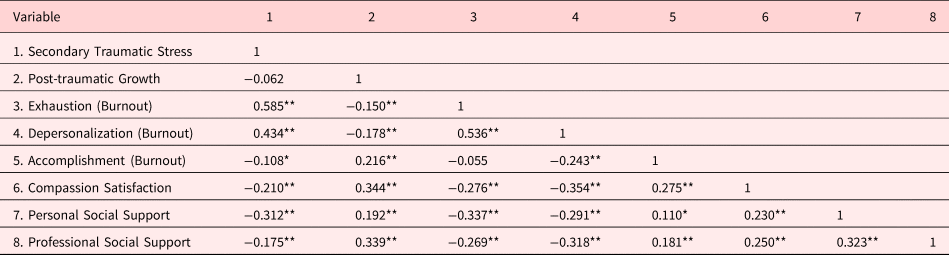
The study variables with Pearson correlations are presented in Table 2. The two central constructs of STS and PTG were not correlated (r = −0.062, p = 0.222). The remaining variables, STS and burnout (exhaustion, depersonalization), representing negative effects of EOL care, were positively and moderately correlated. STS and burnout were negatively correlated with variables, representing positive effects of EOL care, PTG, accomplishment (burnout), compassion satisfaction, and personal and professional social support, with weak positive correlations between them.
Pearson correlations of all study variables

* p < 0.05.
** p < 0.01.
Based on the proposed profile classification, the largest profile identified was Growth-dominant: low STS/high PTG, comprising 46.3% of the sample (n = 190). The second was Stress-dominant: high STS/low PTG, 11.5% of the sample (n = 47). The Dialectical-impact, high STS/PTG, comprised 18.5% of the sample (n = 76) and Limited-impact: low STS/PTG, with 19% (n = 78).
The effect of EOL care was analyzed using a dichotomized variable for reporting on providing or not providing EOL care in the past year. A Chi-square test of independence showed that these two groups were distributed unevenly among the four profiles (Figure 1): χ 2 (3,391) = 18.35, p < 0.000. Standardized residual post hoc tests showed that MHP reporting EOL care were significantly overrepresented in the Dialectical-impact profile (χ 2(3) = 11.56, z = 3.8, p < 0.000) and significantly underrepresented in the PTG-dominant profile (χ 2(3) = 14.44, z = −3.4, p < 0.000).
Representation of MHP reported EOL care vs. no reported EOL care according to the proposed four profiles. ***p < 0.000. DI, Dialectical-impact; GD, Growth-dominant; SD, Stress-dominant; LI, Limited-impact.

Univariate ANOVA tests for continuous variables and crosstabs with Chi-square tests of independence for categorical variables showed no significant difference between the four profiles regarding age, gender, years of education, and seniority in profession. A significant effect was found regarding profession and the four profiles, χ 2 (9,384) = 33.02, p < 0.000. Post hoc tests using standardized residuals showed that physicians were significantly overrepresented in the Stress-dominant profile (χ 2(9) = 6.25, z = 2.4, p < 0.01) and underrepresented in the Growth-dominant profile (χ 2(9) = 11.56, z = −3.4, p < 0.000). Nurses were found to be significantly overrepresented in the Dialectical-impact profile (χ 2(9) = 6.76, z = 2.6, p < 0.01) and underrepresented in the Limited-impact profile (χ 2(9) = 14.44, z = −3.8, p < 0.000). The para-medical professionals overrepresentation in the Limited-impact profile was also found to be significant (χ 2(9) = 4, z = 2.2, p < 0.05). The para-medical professionals and service providers were both significantly underrepresented in the Dialectical-impact profile (χ 2(9) = 4.41, z = −2.1, p < 0.04) and (χ 2(9) = 4.41, z = −2.1, p < 0.04).
Multivariate analysis of variance (MANOVA) using a listwise method for the four profiles revealed a significant effect in the combination of the six additional study variables: exhaustion (burnout), depersonalization (burnout), accomplishment (burnout), compassion satisfaction, personal and professional social support, Wilk's Ʌ = 0.621, F(18, 1049) = 10.68, p < 0.000, η 2 = 0.15, indicating that the four profiles may be significantly distinguished by MHP response to EOL care.
The multivariate analysis was followed by univariate ANOVA tests on all six variables, showing significant differences between the four profiles: exhaustion [F(3,380) = 36.18, p = 0.000, η 2 = 0.22], depersonalization [F(3, 380) = 25.31, p = 0.000, η 2 = 0.17], accomplishment [F(3, 380) = 5.54, p = 0.001, η 2 = 0.04], CS [F(3, 380) = 21.51, p = 0.000, η 2 = 0.15], personal social support [F(3, 380) = 10.34, p = 0.000, η 2 = 0.08], and professional social support [F(3, 380) = 14.45, p = 0.000, η 2 = 0.10].
Post hoc comparisons comparing the dialectical response to the other responses, using the Least Significant Difference correction, are presented in Table 3. Comparisons show that Stress-dominant and Growth-dominant profiles were consistently distinguishable from each other, whereas Dialectical-impact and Limited-impact profiles presented differently in different variables. Regarding negative effect variables, exhaustion and depersonalization (burnout), the Dialectical-impact profile presented similar to the Stress-dominant profile. Regarding positive variables of accomplishment (burnout) and compassion satisfaction, the Dialectical-impact profile presented similar to the Growth-dominant profile. There was no clear trend regarding social support. Concerning personal social support, the Dialectical-impact profile presented like the Stress-dominant profile, but concerning professional social support, the Dialectical-impact profile presented like the Growth-dominant profile.
Post hoc comparisons of the four MHP profiles with the additional study variables

Groups marked equal (=) were not found to be statistically significantly different. Groups marked smaller/larger than each other (</>) were found to be statistically significantly different.
* p < 0.05.
** p < 0.01.
*** p < 0.001.
Discussion
This study applied a dialectical lens to examine the effects of EOL care on both the professional and personal well-being of MHP. This perspective is based on the premise that this phenomenon is neither fully recognized nor described. Previous studies have focused mainly on the challenges that MHP may face when providing EOL care, including professional and personal burdens. More recent work also explored positive outcomes of EOL care. However, we argue that a dialectical perspective combining both positive and negative aspects of the multifaceted reality that MHP face when providing EOL care, provides a more comprehensive and integrated understanding of the phenomenon. Introducing a dialectical way of thinking can improve the coping process of MHP providing EOL care.
Since working in multi-disciplinary medical teams has become common practice, we examined the phenomenon of EOL care in a broad ecological setting including all MHP working in a large pediatric medical center. Adopting an inter-disciplinary perspective and not singling out a specific profession or medical specialty a priori provides a new understanding of the hospital climate. These insights are useful for planning effective and better tailored institutionalized interventions and will influence policy making aimed at reducing burnout, STS, and compassion fatigue, contributing to the overall well-being of the MHP.
The dialectical perspective was applied by distinguishing between four theoretical MHP profiles based on the four possible combinations of high or low STS and PTG levels. The findings regarding the existing levels of work-related STS and PTG among MHP were consistent with previous clinical descriptions (Zoellner and Maercker, Reference Zoellner and Maercker2006; Sinclair et al., Reference Sinclair, Raffin-Bouchal and Venturato2017). High levels of both STS and PTG were reported by nearly 20% of the MHP, consistent with our hypothesis concerning a dialectical response profile. Finding no correlation between STS and PTG further substantiates the tenet that these two constructs are not mutually exclusive.
According to Tedeschi et al. (Reference Tedeschi, Park and Calhoun1998), the ability to use dialectical thinking, and cope with paradoxes while dealing with trauma leads to “greater wisdom.” This is the ability to view an event from a broader perspective, including the pain it causes, yet at the same time allow the realization of completion and contentment. Perhaps the dialectical profile reflects this type of “wisdom,” suggesting that MHP may benefit from coping with challenges by learning to integrate their stress and distress while acknowledging the potential for growth and additional meaning gained from these challenges. Thus, identifying a dialectical response profile to EOL care creates an opportunity for MHP to expand their sense of wisdom, leading to deeper life experiences.
No significant differences were found regarding age, gender, educational level, and professional experience. This supports our premise that the four profiles, including the proposed dialectic profile, reflect the diversity of the phenomenon. Notably, physicians had higher representation in the Stress-dominant profile and lower representation in the Growth-dominant profile. This may be attributed to the fact that physicians are more often involved in EOL decision making and so more likely to take responsibility for a patient's death (Granek et al., Reference Granek, Tozer and Mazzotta2012). The sense of responsibility, or perhaps related guilt, may be associated with negative responses including STS. Conversely, nurses usually take the essential role of caring alleviating discomfort and pain, perhaps explaining their higher representation in the Dialectical-impact profile (Henderson, Reference Henderson1964).
Notwithstanding our prediction, the Growth-dominant profile was found to be most prevalent among the entire cohort. This suggests that despite many challenges stemming from working at a large hospital, the personal and professional well-being of the majority of the MHP were positively affected. However, introducing EOL care provision enabled a more nuanced interpretation. Among those MHP who provided EOL care, there was a relatively high proportion of MHP classified as Stress-dominant or Dialectical-impact. In other words, providing EOL care raised the prevalence of clinically recognized traumatic stress levels but did not subtract from the high PTG levels previously noted, thus generating the Dialectical-impact profile. This is a noteworthy finding since it demonstrates that the Dialectical profile exists twice as often among EOL care providers. Recognizing this sheds new light on ways that MHP are affected when providing EOL care. From a “glass half empty” perspective, EOL care continues to be a considerable risk factor to MHP well-being. However from a “glass half full” perspective, EOL care offers an opportunity for growth.
Finally, we examined the relationship between the four profiles to other relevant aspects of MHP's well-being: burnout, compassion satisfaction, and social support. We found that MHP who were classified as Growth-dominant fared best. They suffered from the lowest burnout rates (exhaustion and depersonalization), exhibited highest PTG, professional accomplishment, compassion satisfaction, and both personal and professional social support. MHP classified as Stress-dominant were the worst-off with the most burnout and traumatic stress, least compassion satisfaction and accomplishment, and least support in and out of work.
The newly defined dialectical profile showed a more complex and mixed clinical picture. The dialectical profile, similar to the Stress-dominant profile, showed high negative effects of EOL care, STS and burnout. Simultaneously, those identified with the dialectical profile also showed similarity to the Growth-dominant profile, positive effects of EOL care, PTG and compassion satisfaction. Only regarding the ability to feel supported by others was the dialectical profile found to be similar to the Stress-dominant profile's level of support from family and friends, yet similar to the Growth-dominant profile in the level of coworkers’ support. This combination found to characterize the MHP with a dialectical profile is an example of its unique quality. Further research might focus on the potential associations between high levels of stress and growth in order to develop specific and effective interventions for this newly defined group of MHP.
The proposed profiles point toward a more general trend beyond the specific stress or growth responses. As shown above, a dominant or dialectical response may reflect a broader tendency to ways that MHP are affected by their work. Assessing stress and growth responses as a way of assigning MHP to the suitable profile may be a concise method for gaining understanding into the overall well-being of the MHP.
Using the four profile classification highlights a necessity for the development of differential interventions for each of the four types, especially for the newly defined dialectical-impact profile and for the specific needs of those providing EOL care. Recognizing different profiles emphasizes the complexity of EOL care. It serves to facilitate more specific interventions utilizing human and financial resources more economically. Tailored interventions should be offered to broad and diverse MHP representing a range of backgrounds. These interventions need not be limited to mitigating traumatic stress symptoms or to strengthening coping and enhancing growth. Rather, they should involve creative methods to broaden MHP personal and professional resources. A good such example is the “3 wish project,” a palliative care intervention wherein clinicians realize the final wishes of dying ICU patients (Neville et al., Reference Neville, Agarwal and Swinton2019). Shifting the focus to the quality of EOL care provided, helped MHP enhance their sense of meaning and satisfaction from work.
Limitations
All MHP at a large pediatric medical center were sampled. The diversity of MHP strengthens the understanding that the dialectical EOL care hypothesis reveals aspects relating to human nature, and not to specific professional characteristics. However, establishing the dialectical EOL care hypothesis warrants inclusion of additional medical centers and MHP in other care facilities.
Data were retrieved from a cross-sectional sample of MHP self-reports. Reaffirmation of the EOL care dialectical response theory would have it examined from additional perspectives. Longitudinal studies and the use of qualitative methods may be used to examine further changes over time yielding additional insights.
Another limitation concerns the survey item relating to the number of patients who died while under MHP care. Two hundred and ninety-two participants responded, making it the only item almost a third did not answer. Though possibly arbitrary it is possible that the question's direct phrasing caused MHP to skip it. Future studies should give additional thought to ways of presenting emotionally charged questions.
Lastly, the research variables were limited. STS was chosen to represent the negative effects of EOL care emphasizing the traumatic component assumed to be an epiphenomenon. Recently, empathy-based-stress was proposed to link STS, compassion fatigue, and vicarious traumatization (Rauvola et al., Reference Rauvola, Vega and Lavigne2019). In hindsight, we believe that an empathy-based questionnaire representing all three constructs would have better served our purpose.
Acknowledgments
The authors thank the Center for Dignified End of Life at the Hebrew University of Jerusalem for their generous support of this study. This research would not have been possible without the initiative and continuous support of Dr. Cathy Lawi of the International Trauma Healing Institute and Prof. Danny Brom of Metiv, the Israel Psychotrauma Center in Jerusalem. We thank the team at Schneider Children's Medical Center led by Dr. Efrat Bron-Harlev, Maskit Shochat, and Tal Zilberstein for their partnership in and dedication to this study. We thank Prof. Liat Hamama and Prof. Yaira Hamama-Raz for their contribution to the research design and to Guy Friedman for his statistical consultation.
Funding
This research benefited from a grant awarded by the Center of Dignified End of Life at the Hebrew University of Jerusalem.
Conflict of interest
The authors declare no potential conflicts of interest with respect to the research, authorship, and/or publication of this article.