INTRODUCTION
Learning is a fundamental aspect of animal behaviour, both from the evolutionary and ecological perspectives. This concept refers to behavioural changes observed in individuals over time and elicited in reaction to environmental changes (Lehner, Reference Lehner1996). The process of gaining experience while ageing is expected to modify the individual's behaviour (Kieffer & Colgan, Reference Kieffer and Colgan1992). Moreover, temporal and/or spatial environmental heterogeneity may favour behavioural flexibility, and individuals living in unstable environments should be able to alter their behaviour (Mery & Burns, Reference Mery and Burns2010).
The pelagic environment is considered to be a hostile habitat for many fish species due to seasonal variations in chemical and physical parameters (e.g. temperature, dissolved oxygen and salinity) (Clarke, Reference Clarke1992; Bakun, Reference Bakun, Pitcher, Hart and Pauly1998) along with seasonal or spatial changes in prey availability (Furukawa et al., Reference Furukawa, Kawabe, Ohshimo, Fujioka, Nishihara, Tsuda, Aoshima, Kanehara and Nakata2011). Consequently, learning should play an important role in the foraging experience in pelagic fishes, to the extent that foraging experience can influence diet choices, capture success (Dill, Reference Dill1983) and energy trade-offs.
Studying pelagic fish species in their natural environment represents a great challenge due to methodological constraints imposed by open water observation of individuals. As a consequence, there are few studies reporting the feeding behaviour of pelagic species, even when the referred group is extremely sought after by recreational, artisanal and industrial fisheries worldwide (Costa et al., Reference Costa, Olavo, Martins, Costa, Martins and Olavo2005; Klippel, Reference Klippel, Costa, Martins and Olavo2005).
An important pelagic fishery resource is the circumtropically distributed common dolphinfish, Coryphaena hippurus (Carvalho-Filho, Reference Carvalho-Filho1999). Juveniles of the common dolphinfish may approach the coast, while adults can be found in open waters as solitary individuals, in pairs or in small groups (Froese & Pauly, Reference Froese and Pauly2014). Studies on dolphinfish's diet demonstrated that they use a wide array of food items, including flying fishes (Exocoetidae), needle fishes (Hemiramphidae) and invertebrates (Oxenford, Reference Oxenford1999; Vaske & Lessa, Reference Vaske and Lessa2004) along with juveniles of large oceanic epipelagic species. Oxenford (Reference Oxenford1999) suggests that dolphinfish probably forage opportunistically rather than selectively, a feeding strategy that is commonly used by tropical pelagic species.
The aim of the present study is to contribute to the current knowledge on feeding behaviour of pelagic fishes. We describe the repertory of observed in situ foraging strategies for the dolphinfish during its effort to capture prey in an open water habitat, and also investigate whether differences in foraging strategies could be associated with fish size. Considering the opportunistic feeding behaviour as a good approach for pelagic fishes in their unstable habitats (with a low prey availability), the dolphinfish is expected to have a great diversity of foraging strategies, with adult individuals showing more complex strategies due to their greater experience.
MATERIALS AND METHODS
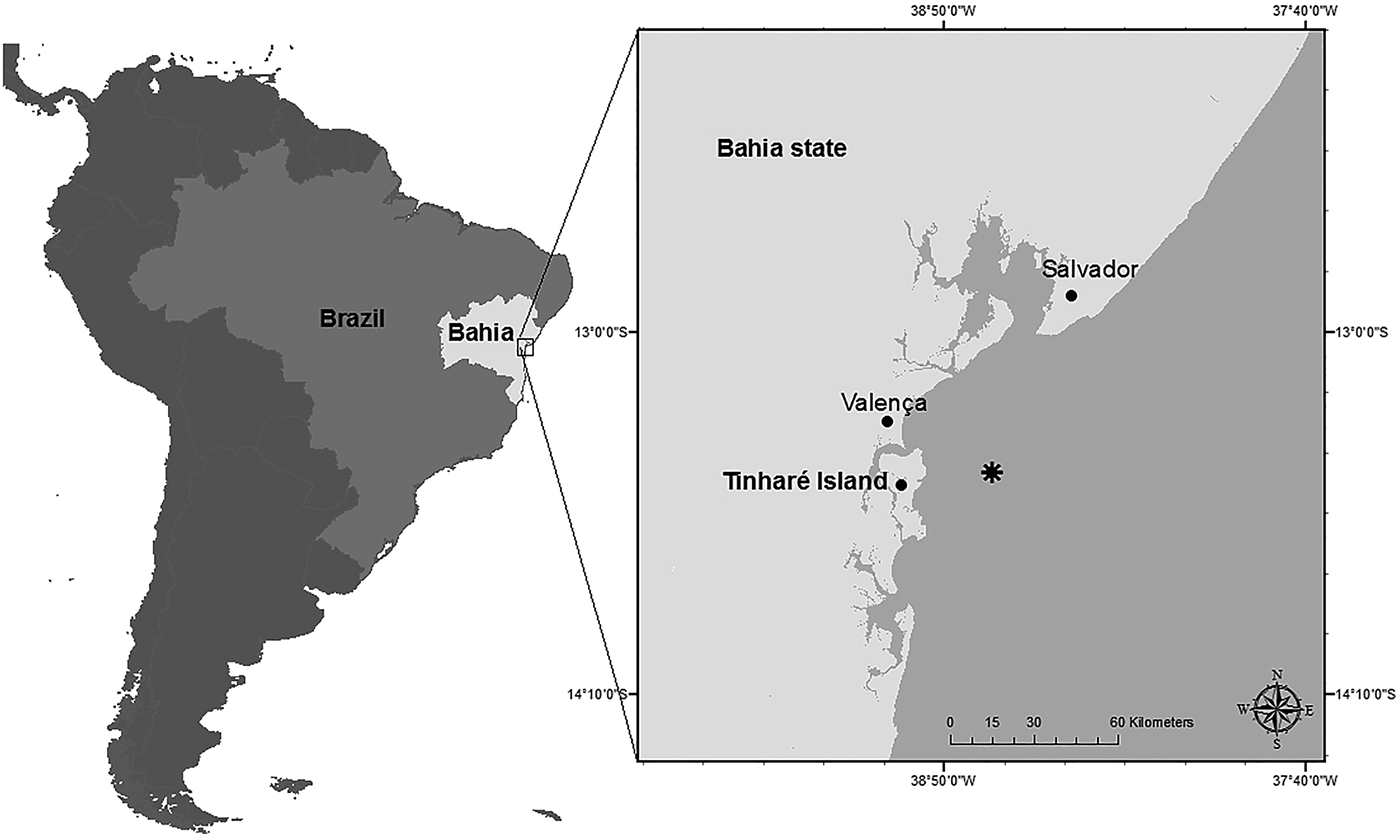
Common dolphinfish (Coryphaena hippurus, Linnaeus, 1758) were observed from an oil platform (13°22′–13°40′S 38°51′–39°03′W; Datum SAD 69) located 7 miles away from Tinharé Island, in the state of Bahia, north-east Brazil (Figure 1). The study area was 54 m deep and it was located less than two miles away from the deep reefs where artisanal fishery activities take place. A trained observer was positioned 15 m above sea level and carried out the observations. The observer scanned the sea surface using binoculars on a daily basis between 8 am to 5 pm (with the exception of 1 h for lunch), on 45 days from November 2008 to February 2009.
Map showing the study area. Asterisk (*) indicates the exact position of the oil platform (located 7 miles away from the coastline of Bahia state, Brazil) used as an observatory station during this study.

Whenever a fish was seen on the surface, the focal animal or focal group methodology was applied to describe different foraging strategies, and all occurrences were recorded (Lehner, Reference Lehner1996). If, by any chance, during the observation, a dolphinfish started a dive or swam too far away (>50 m) from the oil platform, the observer would stop the current observation. Fish length was visually estimated, grouping observed fish into three size classes: less than 90 cm (<90 cm), ~100 cm (100 ± 10 cm), and larger than 110 cm (>110 cm). These size classes were then associated to fish age following Oxenford (Reference Oxenford1999), where <90 cm individuals were estimated to be less than 4 months old, medium size individuals were estimated to be between 5 and 8 months old, and larger individuals were estimated as being more than 8 months old.
From the in situ collected data, proportions between different categories of foraging strategies (as one factor) were compared, considering each of the fish size classes or all fish size (as another factor), using a Goodman test (Goodman, Reference Goodman1965). Proportions of each foraging strategy among fish size class were compared using a Goodman test (Goodman, Reference Goodman1964) as an independent variable. In this statistical design, the analysis considers that the sampling unit is the fish itself, and its specific foraging strategy is considered a category, with each category being mutually exclusive. Thus, for each fish, the displayed foraging strategy (just one) was recorded. A significance level (α) of 0.05 was considered in this analysis.
RESULTS
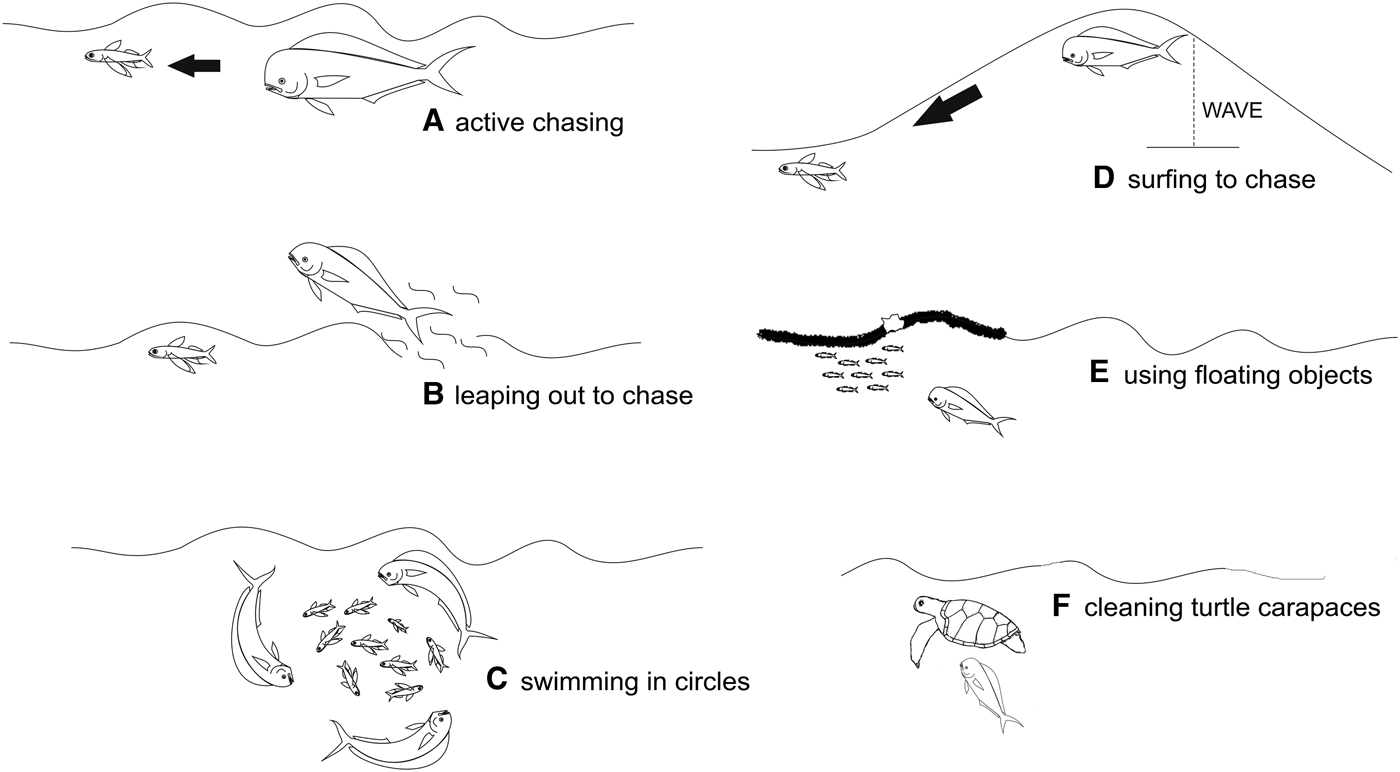
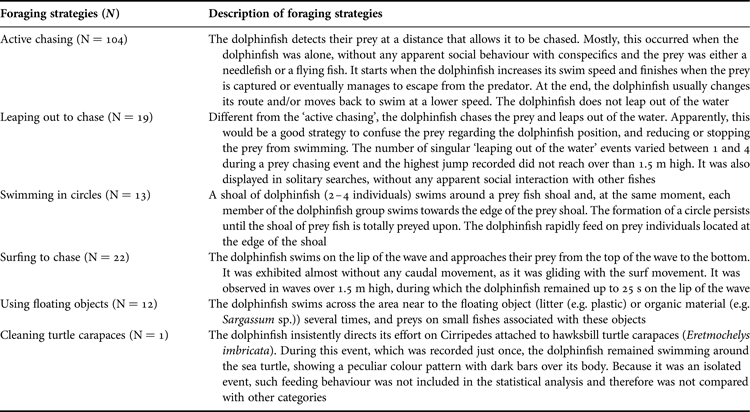
The total observation effort covered 360 h and 170 feeding behaviour occurrences were recorded. These total occurrences were grouped into the following six distinct foraging strategies: active chasing, leaping out to chase, swimming in circles, surfing to chase, using floating objects and cleaning turtle carapaces (Table 1; Figure 2).
Feeding strategies used by the common dolphinfish identified from an oil platform: (A) active chasing; (B) leaping out to chase; (C) swimming in circles; (D) surfing to chase; (E) using floating objects; (F) cleaning turtle carapaces.
Categories, descriptions and frequencies of occurrence (N) of the foraging strategies of the common dolphinfish, Coryphaena hippurus.
Feeding behaviour and fish size classes
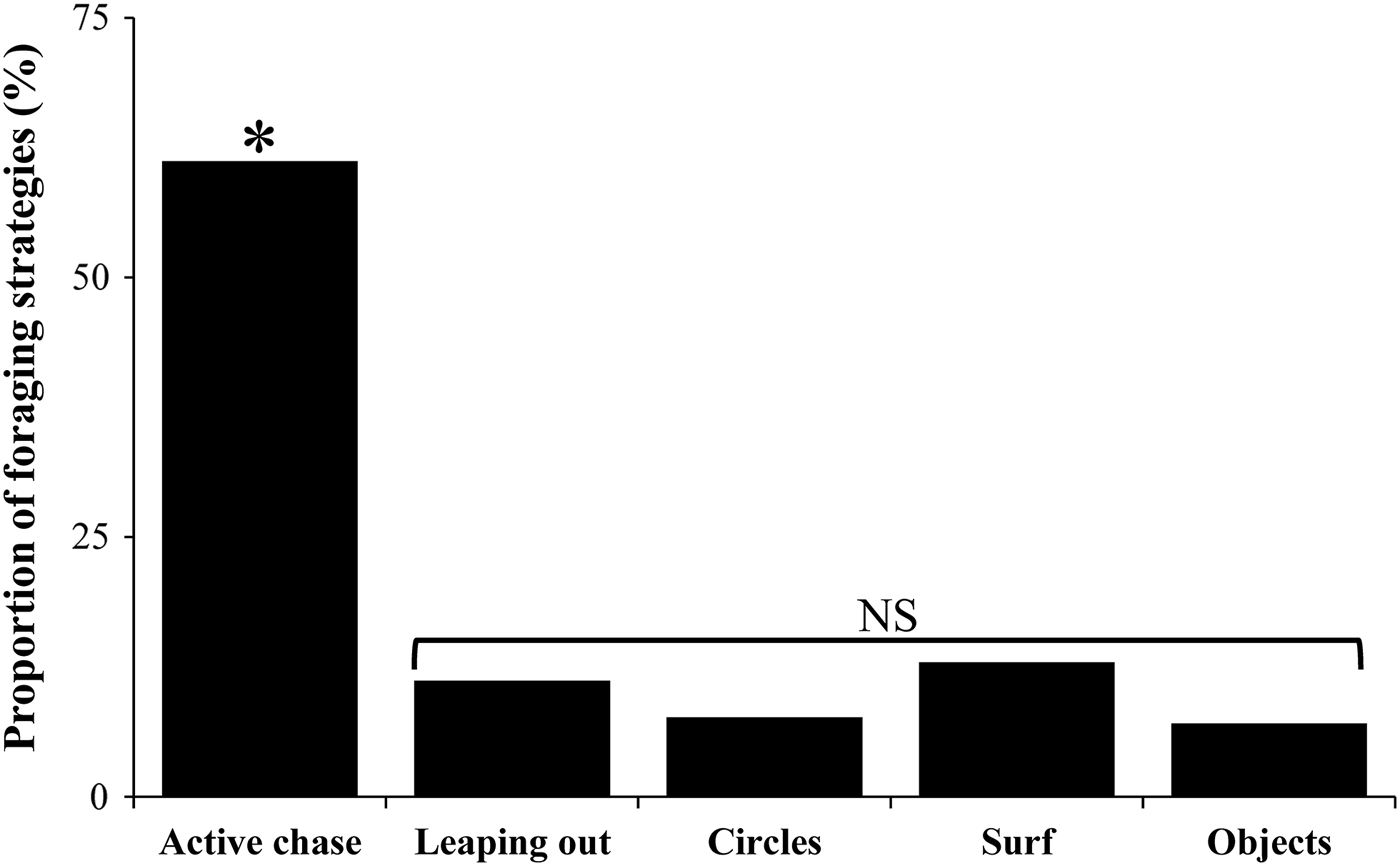
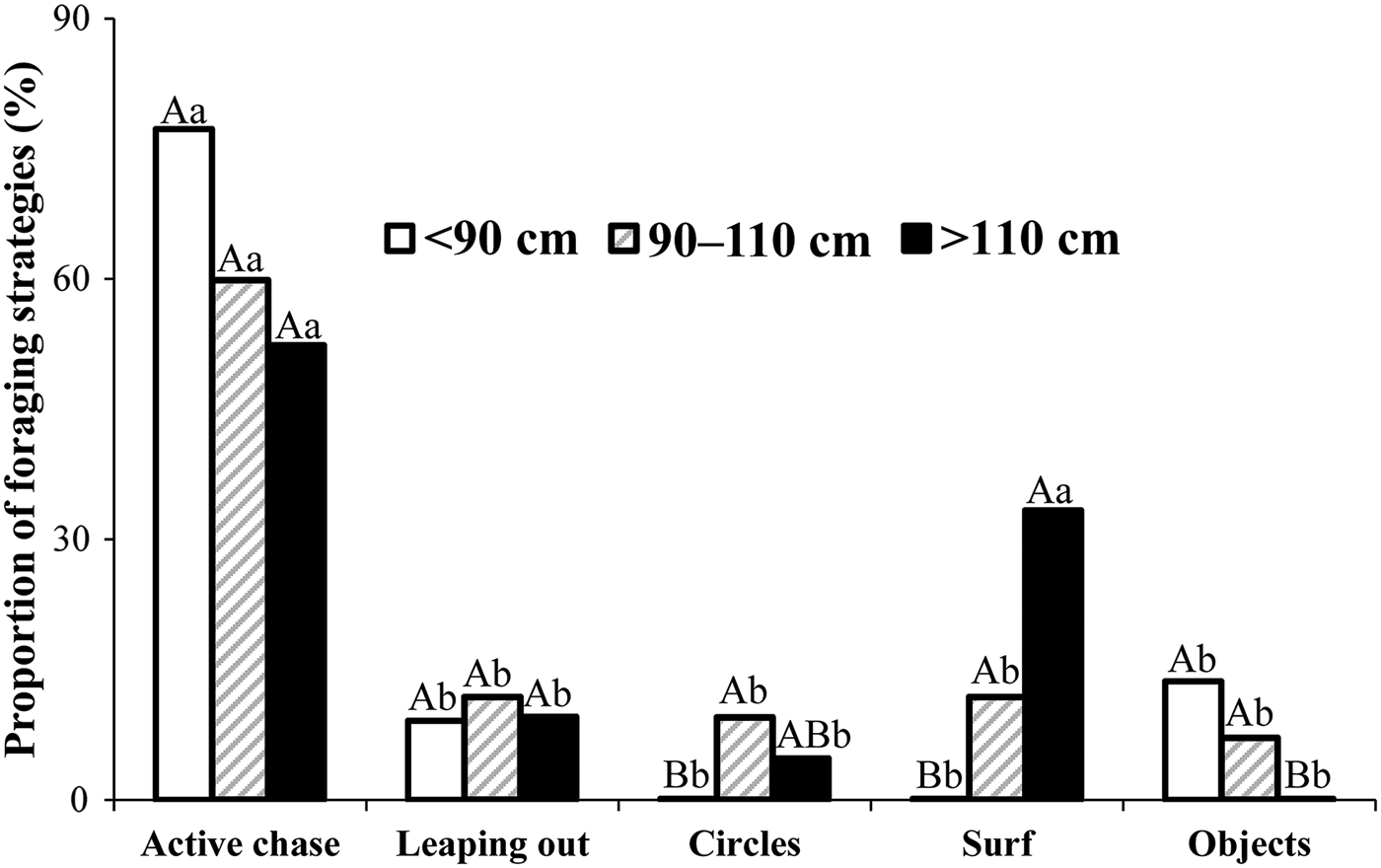
The most frequent foraging strategy shown by the common dolphinfish in this study was ‘active chasing’ (Figure 3) and no statistical differences were found between size classes (Figure 4). Analysing each size class separately, ‘active chasing’ was also the most frequent strategy for individuals <90 cm and for 90–110 cm (Figure 4). However, this pattern was not observed in larger fish, from the upper size class, which performed the ‘active chasing’ as frequently as the ‘surfing to chase’ strategy (Confidence Interval does not include zero for A crit = 9.76 by Goodman test (Goodman, Reference Goodman1965) for P < 0.05). Smaller individuals did not perform ‘swimming in circles’ and ‘surfing to chase’, while larger individuals did not use the ‘using floating objects’ strategy (Figure 4). ‘Cleaning turtle carapaces’ was observed only once in the present study by an individual <90 cm.
Proportion of foraging strategies exhibited by the common dolphinfish. Asterisk (*) indicates a significantly higher proportion when compared with the other proportions of foraging strategy (Confidence Interval does not include zero for A crit = 9.76; Goodman test (Goodman, Reference Goodman1965); P < 0.05). ‘NS’ indicates that there is a non-significant difference among proportions of foraging strategies.
Proportion of foraging strategies performed by common dolphinfish for each size class of fish. Different capital letters denote different proportions of each foraging strategy among fish size class (G calc > G crit = 2.93; Goodman test (Goodman, Reference Goodman1964); P < 0.05). Different small case letters denote different proportions among foraging strategies for each fish size class (Confidence Interval does not include zero for A crit = 9.76; Goodman test (Goodman, Reference Goodman1965); P < 0.05).
DISCUSSION
Studies on the feeding behaviour of large predatory pelagic fishes are frequently problematic due to the difficulty of observations made in the open ocean (Furukawa et al., Reference Furukawa, Kawabe, Ohshimo, Fujioka, Nishihara, Tsuda, Aoshima, Kanehara and Nakata2011; Ralph & Kawamura, Reference Ralph and Kawamura2002). Our study provided insights into the feeding behaviour of an important pelagic species, and despite the constraints of observations made from an elevated point above the sea surface, it was possible to record different strategies used by the common dolphinfish when foraging.
We have also observed that there is an effect of fish size on foraging strategy. The strategies used are likely to be driven by different levels of experience, with larger and mature individuals exhibiting more complex strategies, maybe as a result of an enhanced learning in adult/large individuals. Despite variations in dolphinfish size classes, the species mostly fed on small prey, caught close to the water surface. Although the focus was not on the type of captured prey, dolphinfish feeding on Clupeids shoals, needle-fish (Hemiramphidae) and flying fish (Cypselurus sp.) were observed. This finding is consistent with other records showing that adult dolphinfish frequently feed on neritic fishes, especially Cypselurus sp. off the northern Brazilian coast (Vaske & Lessa, Reference Vaske and Lessa2004).
It is important to highlight that the sampling design used in this study presents some caveats. The data collection during fieldwork, with no tagging of individuals, could lead to the resampling of an individual and consequent pseudo-replication. Nevertheless, the probability of resampling the same individual is low, since dolphinfish are capable of travelling distances of up to 440 km, at speeds up to 20 km per day (Kingsford & Defries, Reference Kingsford and Defries1999). Dolphinfish are presumed to be highly migratory (Oxenford, Reference Oxenford1999; Schwenke & Buckel, Reference Schwenke and Buckel2008), exhibiting a vast home range (Chang et al., Reference Chang, DiNardo, Farley, Brodziak and Yuan2013). This species has been intensely harvested by the Brazilian southern coast fisheries between 2001 and 2005 (Dallagnolo & Andrade, Reference Dallagnolo and Andrade2008), reducing population numbers. Although it is a fairly abundant fish, these reasons would probably decrease the chance of resampling the same individual. Moreover, resampling does not represent a major issue in this study, since the sampling unit is the observation of the foraging strategy itself, and not the individual, thus foraging strategies being mutually exclusive.
Feeding behaviour
‘Active chasing’ was the most frequently observed foraging strategy. This strategy is widespread and naturally performed by most of the predators in the animal kingdom. Many predators in open oceans exhibit this kind of chasing strategy, due to a lack of obstacles (complex structures, e.g. reef roughness on coral reefs), swimming ability of predators, and also due to the great visibility available near the surface of tropical waters, and this is the case of the dolphinfish in this present study.
‘Leaping out to chase’ behaviour is likely to confound prey during chasing events. In fact, the common name of C. hippurus, dolphinfish, refers to the behaviour exhibited by dolphins when they leap out of the water during unrelenting pursuits of small pelagic fishes (Olavo & Sampaio, Reference Olavo, Sampaio, Marcovaldi and Fernandes2006). Cetaceans use this foraging strategy to confound and trap their prey fish, through sounds and bubbles nets produced when leaping out of the water (Leighton et al., Reference Leighton, Finfer and White2009), however it is difficult to know whether the fish uses this strategy with the same purpose of cetaceans. We believe that this strategy is associated to reduce drag and gain more speed (as dolphins; Fish, Reference Fish1996) as well as to confuse the prey by the temporary visual loss of the predator.
‘Swimming in circles’ occurred when fish were foraging in pairs or small groups. This behaviour is more used by predators that have a low individual capture success, and thus are expected to benefit from group foraging (in comparison to predators with high individual capture success; Eklöv, Reference Eklöv1992). Other pelagic predators that forage in small groups are the green jack Caranx caballus (Günter, 1868) and the black skipjack Euthynnus lineatus (Kishinouye, 1920). Those species hunt in groups of approximately two predators (Parrish, Reference Parrish1993). The lack of data on relatively larger groups of predators hunting together, as highlighted by Schmitt & Strand (Reference Schmitt and Strand1982), Potts (Reference Potts1980) and Buckel & Stoner (Reference Buckel and Stoner2004) suggests that this foraging strategy might be highly costly for some pelagic fish predators. Indeed, Buckel & Stoner (Reference Buckel and Stoner2004) showed that for the bluefish Pomatomus saltatrix (Linnaeus, 1766), hunting in larger groups had a significantly negative effect on feeding rates in which food consumption per individual was calculated. Although this study was conducted in a large experimental arena, larger group sizes of this species occur in nature, and the authors concluded that foraging costs must be outweighed by the benefits of being in a group. Thus, according to the Optimal Foraging Theory, there must be a number (or a range) that leverages the benefits due to the cost of this aggregation behaviour and, in the present study, this number is around 2–4. Being associated in larger groups includes the formation of circles while feeding. This strategy is likely to require organization and previous experience from at least some individuals from the group (Mathis et al., Reference Mathis, Chivers and Smith1996), thus we believe to be more common among large individuals and therefore older fish, as discussed in the following topic.
The ‘surfing to chase’ strategy might save energy during feeding activities, and also be an important feature for constantly swimming fish species, living in such a food-impoverished environment as the deep oceans (Murchison & Magnuson, Reference Murchison and Magnuson1966). According to these authors, when dolphinfish are surfing, the fish swims downstream, just beneath the surface, positioning itself in front of a wave crest. Similarly, due to low availability of prey and having to chase their prey most of the time (Table 1, Figures 2, 3), using such a strategy is very important for the fish to save some energy.
‘Using floating objects’ is apparently an opportunistic foraging strategy. Luiz et al. (Reference Luiz, Madin, Robertson, Rocha, Wirtz and Floeter2012) mentioned that the pelagic-dispersal potential is influenced by the ability of species to raft with floating debris in the open ocean. Marine organisms that raft as juveniles or adults are capable of crossing large distances in the ocean (Jokiel, Reference Jokiel1990). Rafting may be an important mechanism since it facilitates the dispersal of multiple life-stages (e.g. juvenile to adult) and it is not dependent on the duration of the pelagic larval phase (Luiz et al., Reference Luiz, Madin, Robertson, Rocha, Wirtz and Floeter2012). The fishes using floating objects cannot stay away from these objects, due to the depth and a lack of references to locate themselves in the open ocean. Leaving the raft object also means becoming a vulnerable target for other predators, which have excellent capabilities in detecting and attacking their prey. We also believe that the floating objects provide feeding opportunities and protection for dolphinfish since we observed that smaller individuals use this strategy more than the larger ones, as discussed later.
‘Cleaning turtle carapaces’ was the first documented occurrence of a marine turtle being cleaned by an oceanic pelagic predator. Marine turtles have already been observed interacting with facultative or obligatory cleaner fishes (Smith, Reference Smith1988; Sazima et al., Reference Sazima, Moura and Sazima1999, Reference Sazima, Grossman and Sazima2010; Grossman et al., Reference Grossman, Sazima, Bellini and Sazima2006; Maia-Nogueira et al., Reference Maia-Nogueira, Medeiros, Jardim, Nunes and Sampaio2010), but this symbiosis is generally associated with reef environments. Klink (Reference Klink1995) mentioned that sharks were scratching the hulk of a ship to release the Cirripedes attached to them, aiming to attract dolphinfish and prey on them. Recently, Alonso et al. (Reference Alonso, Estrades, Scarabino and Calcagno2010) registered the presence of the Cirripede Conchoderma virgatum (Spengler, 1790) attached to the bottom part of a Chelonia mydas (Linnaeus, 1758) carapace. As dolphinfish are attracted to Cirrepedes, encrusted on a turtle's carapace, this event is associated with the attraction for this particular food item. During the event of ‘cleaning turtle carapace’ we observed a dolphinfish with a peculiar colour pattern (dark bars) over its body. Gibbs & Collette (Reference Gibbs and Collette1959) and Strasburg & Marr (Reference Strasburg and Marr1961) have also observed banded colour patterns, commonly associated with feeding on several species, including in C. hippurus and it is probably associated with a communicative function. This banded colour pattern was also observed when a fish was inserted in a tank with a C. hippurus that had not fed for 10 days (Murchison & Magnuson, Reference Murchison and Magnuson1966). It is well accepted that alterations in colour pattern are involved with stress, aggressive displays and social status in other fish species (Höglund et al., Reference Höglund, Balm and Winberg2000; Suter & Huntingford, Reference Suter and Huntingford2002; Nilsson Sköld et al., Reference Nilsson Sköld, Aspengren and Wallin2013; Freitas et al., Reference Freitas, Negrão, Felício and Volpato2014). Cleaner fish usually signal through specific behaviours to prevent agonistic displays coming from the client (Sazima et al., Reference Sazima, Moura and Sazima1999; Grutter, Reference Grutter2004). As in cleaning a mutualistic interaction exists with a stress response elicited by the cleaner fish (Soares et al., Reference Soares, Bshary, Cardoso, Côté and Oliveira2012), a stress response that changes the body colour should also have a role in communication to avoid agonistic behaviour from the client fish or ensure that the client fish does not go away.
The role of the lifespan
The high frequency of foraging strategies that use visual cues as a primary sensory modality in detecting prey (e.g. ‘active chasing’) enable the common dolphinfish to be classified as visual predators, similar to tuna, Thunnus sp. (Nakamura, Reference Nakamura1968). In fact, vision is one of the most important sensory systems for oceanic fish to search for food in the pelagic environment (Ralph & Kawamura, Reference Ralph and Kawamura2002). The non-significant differences found in the proportion of the ‘active chasing’ strategy among the three distinctive fish size-classes indicate that this modality of behaviour is used by the dolphinfish throughout its life cycle. ‘Active chasing’ therefore constitutes an intrinsic strategy of a mobile predator that does not depend on social learning interactions.
Smaller dolphinfish did not perform the ‘swimming in circles’ and ‘surfing to chase’ strategies, probably because they chase smaller prey that could have different and simpler escape strategies. Unlike the ‘active chasing’, we believe that these two quite complex modalities of feeding behaviour require learning (through social interactions with conspecifics) and time experience (practicing), acquired at later stages of development. It is known that fish learn by observing the behaviour of other fish (Oliveira et al., Reference Oliveira, McGregor and Latruffe1998). Attention plays an important role in the formation of simple stimulus associations and in the development of foraging skills that contributes to learning and thus improves foraging performance (Warburton, Reference Warburton, Brown, Laland and Krause2006). Moreover, background experience may affect the foraging efficiency and competitive success of individuals (Kieffer & Colgan, Reference Kieffer and Colgan1991). For the majority of fish there is great benefit through learning to forage more efficiently, since life is not as short as that of the other organisms such as invertebrates (Hart, Reference Hart and Pitcher1993). As mentioned earlier, ‘surfing to chase’ saves energy, and the larger the animal the greater will be the energy expenditure for locomotion, and it thus explains the higher frequency observed for this strategy for larger individuals.
Larger dolphinfish, on the other hand, were not observed using floating objects while foraging, probably as their considerably larger size allows them to maximize hunting success using alternative behaviours and/or the need of a shelter is much lower (or zero) for them. In contrast, smaller fish were commonly seen foraging using floating objects, indicating their need of being opportunistic feeders. This strategy probably complements the low prey capture from other foraging strategies used by small fish, but large ones should not require such a supplement, as they should have greater capture success enhanced by learning.
Ontogenetic shifts in feeding behaviour were also studied in parrotfish (Bonaldo et al., Reference Bonaldo, Krajewski, Sazima and Sazima2006), cornetfish (Takeuchi, Reference Takeuchi2009) and stingrays (Aguiar et al., Reference Aguiar, Valentin and Rosa2009; Aguiar, Reference Aguiar2010). In the first study, authors concluded that only in the terminal life phase would fish patrol their territories while foraging, while young fish would not exhibit this behaviour. In the western Atlantic Ocean, dolphinfish are believed to reach maturity when around 45–65 cm in length (Oxenford, Reference Oxenford1999; Schwenke & Buckel, Reference Schwenke and Buckel2008; Alejo-Plata et al., Reference Alejo-Plata, Diaz-Jaimes and Salgado-Ugarte2011), so most of the fish sampled in this present study have reached sexual maturity and the difference in the frequency of a particular strategy may not be due to this issue. Takeuchi (Reference Takeuchi2009) attributes this effect to suiting the prey size to the predator size, leading to adaptive changes in behaviour. In fact, ontogenetic changes in prey items are often correlated with the mouth size and the maximum aperture the predator's mouth can have, as seen in St. John (Reference St. John1995). However, in our study this explanation was not empirically tested, due to visual limitations of determining the prey size. Further underwater investigation on size-related behaviour and other dietary characteristics would be highly valuable in investigating these issues. Different environmental pressures were believed to lead to an ontogenetic shift in prey choice in stingrays, Dasyatis americana (Hildebrand & Schroeder, 1928) and habitat use (Aguiar et al., Reference Aguiar, Valentin and Rosa2009). Takeuchi (Reference Takeuchi2009) also suggested that the ontogeny of the predator in relation to prey choice would be strongly related to habitat features in the large cornetfish, Fistularia commersonii (Rüppell, 1838).
Interestingly, the ontogenetic shifts of predators in relation to their foraging strategies observed in this study could be correlated with the results shown by Takeuchi (Reference Takeuchi2009), who states that the cornetfish would increase the diversity of ingested prey items as their size increases. The fish changes its strategy while it increases in size, probably due to a change in prey preference. It is corroborated by the fact that with its increase in size, the proportion of use of floating objects (shelter for smaller sized fish) is lower (Figure 4). Here, this finding was not confirmed, probably due to the different environmental pressures over these two fishes. The cornetfish inhabits coastal rocky-reef while dolphinfish use the pelagic environment and open waters. Further studies could put some light on this phenomenon, however one possible hypothesis is that the open water environment favours animals with several foraging strategies, as few prey items are available. Changing strategies to capture prey in the open ocean could occur together with acquired learning experience, from which more efficient strategies can be developed. By contrast, rocky-reef environments include more complex features and consequently offer numerous strategies, including associative foraging with con- or heterospecifics (see Takeuchi, Reference Takeuchi2009 for details). Thus, reef fish would be favoured to construct adaptive associations to expand foraging strategies, becoming more efficient foragers.
Not much is known regarding the dolphinfish ethology. However, the diversity of foraging strategies exhibited and their relationship with the size classes suggest that pelagic fishes might have the ability to display complex foraging strategies, which are acquired throughout their lifetime (probably through learning from experienced individuals and experience over time). Common dolphinfish show a great plasticity of foraging strategies that are fundamental to maximize their hunting success in open ocean habitats, known for having a low food availability.
ACKNOWLEDGEMENTS
The authors are very grateful to Candelaria Estavilo (Universidade Federal da Bahia, Brasil), Luciana Leite (University of Cambridge, UK), Liliana Colman (University of Exeter, UK) and Antoine Leduc (Universidade Federal da Bahia, Brasil) for reviewing the manuscript, Malva Isabel Medina Hernández (Universidade Federal de Santa Catarina, Brasil) for statistical assistance, Letícia Fernandes for helping with Figure 1 and Carlaine Silva for helping with Figure 2. We also thank Schain Engineering Team, which provided valuable facilities on the oil platform during fieldwork. We appreciate the contribution from anonymous reviewers.