Antisocial behavior (ASB), which is deviant behavior that violates social norms and/or the rights of others, is more common during adolescence than any other point in the life span. Galvanized by the high costs of ASB, both to individual well-being and to society as a whole, considerable research has been devoted to understanding the personal risk factors that underlie adolescent ASB. One constellation of risk factors that predicts adolescent engagement in ASB is disinhibited personality traits, including impulsivity and sensation seeking (e.g., Byck, Swann, Schalet, Bolland, & Mustanski, Reference Byck, Swann, Schalet, Bolland and Mustanski2015; Cooper, Wood, Orcutt, & Albino, Reference Cooper, Wood, Orcutt and Albino2003; Walton et al., Reference Walton, Krueger, Elkins, D`Accordo, McGue and Iacono2016; Zuckerman, Reference Zuckerman2007). Cross-sectional and longitudinal research (Harden & Tucker-Drob, Reference Harden and Tucker-Drob2011; Steinberg et al., Reference Steinberg, Albert, Cauffman, Banich, Graham and Woolard2008) has demonstrated that mean levels of disinhibited traits show marked age-related change during adolescence, and adolescents who show especially rapid increases in disinhibited traits also show more rapid increases in ASB (Harden, Quinn, & Tucker-Drob, Reference Harden, Quinn and Tucker-Drob2012). Previous studies have also shown that ASB is a heterogeneous construct, with childhood characteristics, including early-onset conduct problems and callous–unemotional traits, differentiating more severe forms of ASB that are more likely to persist across the life span (Frick, Ray, Thornton, & Kahn, Reference Frick, Ray, Thornton and Kahn2014, Reference Frick, Ray, Thornton and Kahn2015; Frick & Viding, Reference Frick and Viding2009; Frick & White, Reference Frick and White2008; Moffitt, Reference Moffitt1993). The goal of the current paper is to contribute to an integration of these literatures, by testing the relations among disinhibited traits, callous–unemotional traits, and ASB in two independent samples.
Sensation Seeking and Impulsivity Predict Adolescent ASB
On average, adolescents experience marked age-related personality change, particularly in the personality facets of impulsivity and sensation seeking. For the purposes of the current paper, we define impulsivity as a failure to exert cognitive control over behavioral impulses and a tendency to act without considering potential consequences, whereas we define sensation seeking as the tendency to prefer and seek out novel, exciting, rewarding, and/or dangerous experiences (Steinberg et al., Reference Steinberg, Albert, Cauffman, Banich, Graham and Woolard2008; Whiteside & Lynam, Reference Whiteside and Lynam2001). Impulsivity monotonically declines across adolescent development, while sensation seeking initially increases during early adolescence, but then declines during the transition into adulthood. These divergent patterns of personality change have been documented in both cross-sectional and longitudinal samples, using both behavioral and self-report measures (Cauffman et al., Reference Cauffman, Shulman, Steinberg, Claus, Banich, Graham and Woolard2010; Galvan, Hare, Voss, Glover, & Casey, Reference Galvan, Hare, Voss, Glover and Casey2007; Harden & Tucker-Drob, Reference Harden and Tucker-Drob2011; Lynne-Landsman, Graber, Nichols, & Botvin, Reference Lynne-Landsman, Graber, Nichols and Botvin2011; Shulman, Harden, Chien, & Steinberg, Reference Shulman, Harden, Chein and Steinberg2015; Steinberg et al., Reference Steinberg, Albert, Cauffman, Banich, Graham and Woolard2008).
Personality change during adolescence has been explained in terms of the dual systems model, and the related maturational imbalance model, which posits that adolescent behavioral development is shaped by a “maturity gap” between neurobiological systems (Casey, Reference Casey2015; Shulman et al., Reference Shulman, Smith, Silva, Icenogle, Duell, Chein and Steinberg2016). The cognitive control or “top down” system includes cortical regions that regulate impulse control, while the socioemotional or “bottom up” system includes subcortical regions (e.g., the ventral striatum and amygdala), which are involved in regulating responses to emotional and motivational cues. The cognitive control system has a protracted maturational course throughout adolescence, resulting in slow but steady gains in impulse control. In contrast, the socioemotional system develops rapidly in early adolescence, resulting in a spike in sensation-seeking behavior. This developmental asymmetry between top down and bottom up systems is thought to drive the rise in risk-taking behavior that is typical of adolescence, including antisocial expressions of risk taking.
This model has largely focused on normative adolescent development, in that it seeks to describe personality and behavioral changes that are (a) typical of most adolescents and (b) developmentally unique to adolescence. As a result, the changes in disinhibited traits described by the dual systems model may best account for adolescent-onset trajectories of ASB (Moffitt, Reference Moffitt1993, Reference Moffitt2003, Reference Moffitt, Cicchetti and Cohen2006). That is, the maturational imbalance between sensation seeking and impulse control may characterize the etiology of ASB among teenagers who have minimal histories of behavioral problems in childhood, who first begin to engage in rule-breaking behavior during adolescence, and who engage predominantly in risk-taking (as opposed to aggressive) forms of ASB.
Consistent with this perspective, Harden and Tucker-Drob (Reference Harden and Tucker-Drob2011) demonstrated that, in addition to mean-level patterns of change, there are individual differences in the rapidity of change in impulsivity and sensation seeking across adolescence. Moreover, such individual differences in change predict the development of ASB and related externalizing phenotypes. Specifically, adolescents who show more rapid increases in sensation seeking between ages 12 and 16 also show more rapid emergence of ASB during that same period, a longitudinal association that cannot be accounted for by reciprocal effects of involvement in ASB on subsequent levels of sensation seeking (Harden et al., Reference Harden, Quinn and Tucker-Drob2012). These findings are consistent with a breadth of previous evidence showing elevated sensation seeking among antisocial youth (Byck et al., Reference Byck, Swann, Schalet, Bolland and Mustanski2015; Mann, Kretsch, Tackett, Harden, & Tucker-Drob, Reference Mann, Kretsch, Tackett, Harden and Tucker-Drob2015; Newcomb & McGee, Reference Newcomb and McGee1991; Sijtsema et al., Reference Sijtsema, Veenstra, Lindenberg, van Roon, Verhulst, Ormel and Riese2010; Zuckerman, Reference Zuckerman2007). Previous research has also demonstrated a positive relationship between impulsivity and delinquency (Bechtold, Cavanagh, Shulman, & Cauffman, Reference Bechtold, Cavanagh, Shulman and Cauffman2014; Cooper et al., Reference Cooper, Wood, Orcutt and Albino2003; Frick & Viding, Reference Frick and Viding2009; Giannotta & Rydell, Reference Giannotta and Rydell2015; Moffitt, Reference Moffitt1993; Snowden & Gray, Reference Snowden and Gray2011; Vitacco & Rogers, Reference Vitacco and Rogers2001). Moreover, both impulsivity and sensation seeking have been implicated in the development of related externalizing behaviors in adolescence, including alcohol and substance use (Dick et al., Reference Dick, Smith, Olausson, Mitchell, Leeman, O'Malley and Sher2010; Elkins, King, McGue, & Iacono, Reference Elkins, King, McGue and Iacono2006; Hittner & Swickert, Reference Hittner and Swickert2006; Littlefield & Sher, Reference Littlefield and Sher2010; Littlefield, Sher, & Steinley, Reference Littlefield, Sher and Steinley2010).
Callous–Unemotionality and Life-Course Persistent ASB
While research testing the predictions of the dual-systems model continues to accumulate, a largely separate literature has identified another form of personality risk for ASB: callous–unemotional traits, which reflect “a lack of empathy and affective processing” (Fontaine, McCrory, Boivin, Moffitt, & Viding, Reference Fontaine, McCrory, Boivin, Moffitt and Viding2011, p. 730) and an “interpersonal style characterized by a lack of guilt and empathy and a callous use of others” (Frick & Viding, Reference Frick and Viding2009, p. 1115). In a behavioral genetic analysis of 9-year old twins, Viding, Jones, Paul, Moffitt, and Plomin (Reference Viding, Jones, Paul, Moffitt and Plomin2008) found that callous–unemotional traits distinguished a highly heritable subtype of childhood conduct problems; genetic influences accounted for 71% versus 36% of the variance in conduct problems among children with and without callous–unemotional traits, respectively. In addition, Fontaine et al. (Reference Fontaine, McCrory, Boivin, Moffitt and Viding2011) found that callous–unemotional traits in childhood distinguished a subgroup of antisocial children who had the most negative profile of family risk at age 4 and who showed the worst peer problems, emotional problems, and parent–child relationships at age 12. These results suggest the possibility of differential etiological pathways to ASB among youth high in callous–unemotional traits.
Within Moffitt's (Reference Moffitt1993, Reference Moffitt2003, Reference Moffitt, Cicchetti and Cohen2006) developmental taxonomy, children with high and persistent levels of callous–unemotional traits may be considered a subtype of life-course persistent ASB, characterized by the continuation of behavioral problems across developmental periods. The life-course persistent trajectory is conceptualized as a more virulent strain of ASB. For example, life-course persistent individuals engage in more aggressive and violent acts, with early onset of conduct problems in childhood predicting a lifelong course of aggressive behavior and criminal offending (Lahey et al., Reference Lahey, Loeber, Quay, Applegate, Shaffer, Waldman and Dulcan1998; Lynam, Reference Lynam1996; Odgers et al., Reference Odgers, Caspi, Nagin, Piquero, Slutske, Milne and Moffitt2008). Acknowledging the importance of callous–unemotional traits in the etiology and developmental course of ASB, DSM-5 added a “limited prosocial emotions” specifier to the diagnosis of conduct disorder to characterize youth at heightened risk for a severe subtype of ASB (American Psychiatric Association, 2013).
Integrating Developmental Models of ASB
Although disinhibited personality and callous–unemotional traits have all been established as risk factors for youth ASB, how these traits intersect with one another is less clear. A small number of studies have shown that conduct problems accompanied by callous–unemotional traits are associated with a distinct pattern of personality correlates, as compared to child-onset conduct problems in the absence of callous–unemotional traits. For example, controlling for comorbid conduct problems, callous–unemotional traits were negatively associated with neuroticism, agreeableness, and trait anxiety, whereas conduct problems without callous–unemotional traits were associated with elevated anxiety and neuroticism (Frick, Lilienfeld, Ellis, Loney, & Silverthorne, Reference Frick, Lilienfeld, Ellis, Loney and Silverthorn1999; Lynam et al., Reference Lynam, Caspi, Moffitt, Raine, Loeber and Stouthamer-Loeber2005; Pardini, Lochman, & Powell, Reference Pardini, Lochman and Powell2007; see Frick & Ray, Reference Frick and Ray2014; Frick & White, Reference Frick and White2008, for reviews). Callous–unemotional traits were also uniquely and positively associated with fearlessness and thrill seeking (Essau, Sagawaga, & Frick, Reference Essau, Sasagawa and Frick2006; Frick et al., Reference Frick, Lilienfeld, Ellis, Loney and Silverthorn1999; Pardini, Obradovic, & Loeber, Reference Pardini, Obradovic and Loeber2006). Based on these results, children with callous–unemotional traits were hypothesized to evince a “fearless, thrill seeking, and behaviorally uninhibited temperament” (Frick & Viding, Reference Frick and Viding2009, p. 1116).
Empirical and theoretical work on adult psychopathy has also provided suggestive, but inconsistent, support for a relation between callous–unemotionality and disinhibited traits of impulsivity and sensation seeking. Integrating conceptualizations of psychopathy, the triarchic model conceptualizes adult psychopathy as encompassing three traits: meanness, boldness, and disinhibition (Patrick & Drislane, Reference Patrick and Drislane2015; Patrick, Fowles, & Krueger, Reference Patrick, Fowles and Krueger2009). Meanness, defined by Patrick et al. (2009, p. 913) as “aggressive resource seeking without regard for others,” is clearly related to, although not perfectly synonymous with, the construct of callous–unemotionality. Sensation seeking is an aspect of boldness, defined as “the nexus of social dominance, emotional resiliency, and venturesomeness,” while disinhibition, defined as “propensity toward problems as impulse control,” corresponds to the construct of impulsivity as defined here. Relevant to our current hypotheses, the triarchic model posits that meanness overlaps with both disinhibition and boldness. In particular, the meanness–boldness association is hypothesized to reflect the shared roots of both traits in a diminished physiological sensitivity to threat.
Consistent with the triarchic conceptualization, analyses of the Psychopathy Checklist—Revised (Hare, Reference Hare2003) have found that Factor 1, which captures the interpersonal and affective symptoms of psychopathy and includes callousness and lack of remorse, and Factor 2, which includes impulsivity and irresponsibility, are moderately correlated with one another (~.5; Hare et al., Reference Hare, Harpur, Hakstian, Forth, Hart and Newman1990; reviewed by Patrick et al., Reference Patrick, Fowles and Krueger2009). In contrast, factor analyses of the Psychopathic Personality Inventory in adults (PPI; Lilienfeld & Andrews, Reference Lilienfeld and Andrews1996) found that “cold-heartedness” was uncorrelated with either of the other two PPI factors, which include traits related to impulsivity and fearlessness (Benning, Patrick, Hicks, Bloningen, & Krueger, Reference Benning, Patrick, Hicks, Blonigen and Krueger2003), although the authors suggested that the PPI cold-heartedness scale captures lack of sentimentality, rather than meanness or callousness. Translating the predictions of the triarchic model downward to the youth personality constructs examined here, we hypothesize that youth high on callous–unemotional traits will show elevated levels of both sensation seeking and impulsivity.
In summary, the current study aims to contribute to the integration of two lines of research on the etiology of ASB (the dual–systems model, on the one hand, and callous–unemotional traits, on the other), while also drawing on the adult psychopathy literature in formulating our predictions. Specifically, we pose two questions. First, do youth with low levels of guilt in childhood (a component of callous–unemotional traits) also show higher levels of and more rapid changes in disinhibited traits in adolescence? Put differently, do low levels of guilt in childhood predict individual differences in the development of sensation seeking or impulsivity in adolescence? Second, does low guilt in childhood, or high levels of callous–unemotional traits in adolescence, moderate the relationship between disinhibited traits and ASB in adolescence? That is, do the relationships between disinhibited traits and ASB generalize to youth with low levels of guilt in childhood or who show high levels of callous–unemotional traits in adolescence? We examine these questions using two independent samples. Study 1 uses a large, nationally representative sample of youth followed prospectively from childhood through adolescence. Due to measurement constraints associated with using secondary data, in Study 1 we focus on one aspect of callous–unemotional traits: lack of guilt. In addition, to control for potential confounds, we also simultaneously assessed the role of biological sex and conduct problems in childhood. Study 2 measures callous–unemotional traits more comprehensively in a cross-sectional sample of adolescents.
Based on the small body of previous research describing children with callous–unemotional traits as fearless and thrill seeking, and drawing on theoretical models of psychopathy in adulthood, we hypothesized that youth with low levels of guilt in childhood and high on callous–unemotional traits in adolescence would show higher levels of disinhibited traits and ASB in adolescence. In addition, based on the theory that children with high levels of callous–unemotional traits show more persistent and stable expressions of ASB, we hypothesized that the relationship between disinhibited traits and ASB would be attenuated for youth high on callous–unemotional traits. That is, we hypothesized that youth high on callous–unemotional traits would demonstrate ASB in adolescence regardless of whether or not they experienced high levels of disinhibited personality risk.
Study 1
Method
Participants
Mother generation: The National Longitudinal Survey of Youth (NLSY79)
The Bureau of Labor Statistics designed and funded the NLSY79 in order to study workforce participation in the United States. A complex survey design was used to select a nationally representative sample of 3,000 households containing 6,111 youth, plus an additional oversample of 3,652 African American and Hispanic youth, aged 14–21 years as of December 31, 1978. The response rate for the initial NLSY79 survey was over 90% of the eligible sample, and participants have been reinterviewed annually from 1979 to 1994 and biennially since 1994. Retention rates for follow-up assessments of the NLSY79 sample were greater than 90% for the first 16 waves and greater than 80% for subsequent waves.
Adolescent generation: The NLSY79 Children and Young Adults (CNLSY)
Beginning in 1986, the biological children of the NLSY79 women were assessed biennially (Chase-Lansdale, Mott, Brooks-Gunn, & Phillips, Reference Chase-Lansdale, Mott, Brooks-Gunn and Phillips1991). The initial participation rate was 95%, and the average retention rate through 2006 was approximately 90%. Beginning in 1988, children over the age of 10 completed individual supplemental interviews that assessed their attitudes and behaviors. Finally, beginning in 1994, older children who were age 15 by the end of the survey calendar year (termed young adults by the NLSY survey administrators) were administered a separate interview. As of 2006, 11,466 children were identified as having been born to 6,283 NLSY79 women. After weighting for sample selection, the average NLSY79 woman had 1.9 children as of 2006, which is more than 90% of their ultimate predicted childbearing. The current study uses data from youth who had nonmissing data on conduct problems or lack of guilt in childhood at least once between the ages of 4 and 10, and who reported on delinquent behavior or disinhibited personality at least once between ages 12 and 16.
Measures
Disinhibited personality
Impulsivity was measured by youth self-report on three items: “I often get in a jam because I do things without thinking,” “I think that planning takes the fun out of things,” and “I have to use a lot of self-control to keep out of trouble.” Sensation seeking was measured by youth self-report on the following three items: “I enjoy taking risks”; “I enjoy new and exciting experiences, even if they are a little frightening or unusual”; and “Life with no danger in it would be too dull for me.” These six items comprised a scale intended to measure propensity for risk taking, which were drawn from multiple inventories (Center for Human Resource Research, 2009), and all items were rated on a 4-point scale ranging from strongly disagree to strongly agree. Note that previously published factor analytic work of these items indicates that they comprise distinct factors (Harden & Tucker-Drob, Reference Harden and Tucker-Drob2011). Moreover, the pattern of correlations between sensation seeking, impulsivity, and Big Five personality traits in the full CNLSY sample were consistent with previous empirical research, with significant and positive correlations between sensation seeking and concurrent measures of extraversion and openness, and significant and negative correlations between impulsivity and concurrent measures of conscientiousness and emotional stability (the reverse of neuroticism). The internal consistencies of the impulsivity and sensation seeking scales, averaged across waves, were moderate to high in magnitude (α = 0.52 for moderate, α = 0.69 for high).
Following previously published analyses of these variables (Harden, Quinn, & Tucker-Drob, Reference Harden, Quinn and Tucker-Drob2012), sensation-seeking and impulsivity sum scores were residualized for a variety of demographic and maternal characteristics: socioeconomic status, measured using self-reported total family income (Mdn = $22,500/year), including government support and food stamps but excluding income received by unmarried cohabiting partners, when the mother was 30 years old; maternal cognitive ability, measured in the 1980 assessment using composite scores on the word knowledge, paragraph comprehension, math knowledge, and arithmetic reasoning subtests of the Armed Services Vocational Aptitude Battery; maternal education, measured using maternal report of the number of years of school they had completed (M = 13.4 years, SD = 2.50 years; approximately 9% of the sample reported 11 years or less); and maternal age at first birth (M = 21.9, SD = 4.52, range = 11.7–38.3 years). This process ensures that associations between childhood characteristics and disinhibited traits are not confounded by these household characteristics. It also ensures that the associations between disinhibited traits and ASB are not similarly confounded. Residualized sum scores were then standardized to z scores prior to conducting analyses.
Adolescent ASB
Beginning in 1988, children who were at least 10 years old but not yet 15 were administered the Child Self-Administered Supplement, which included six items from the Self-Report of Delinquency (SRD; Elliott & Huizinga, Reference Elliott and Huizinga1983): hurt someone bad enough to need bandages or a doctor; lied to a parent about something important; took something from a store without paying for it; intentionally damaged or destroyed property that did not belong to you; had to bring your parent(s) to school because of something you did wrong; and skipped a day of school without permission. Beginning in 1994, youth who were 15 years old or older were administered the Young Adult Assessment, which also included the six SRD items. Because of budgetary constraints, the SRD items were dropped from the Young Adult Assessment (but not the Child Self-Administered Supplement) in 2000 only. Each of the SRD items was dichotomized as never versus at least once or more and summed. Symptom counts thus ranged from 0 to 6 (Mdn = 1, M = 1.29, SD = 1.39). Previous analyses of CNLSY data (described in Harden et al., Reference Harden, D'onofrio, Van Hulle, Turkheimer, Rodgers, Waldman and Lahey2009) have tested the criterion validity of the SRD items and found that these items significantly predict, for both males and females, the odds of being convicted for a nontrivial criminal offense (excluding drug possession), controlling for a broad variety of demographic and contextual background variables. The Cronbach α value for the six SRD items was 0.64–0.68 at each assessment wave.
Child conduct problems
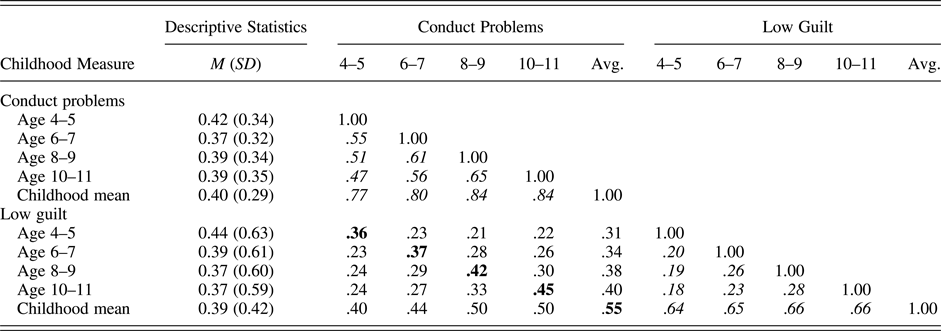
Biennially beginning in 1986, mothers reported on children's conduct problems using nine items: cheats or tells lies; bullies or is cruel/mean to others; breaks things deliberately; is disobedient at school; has trouble getting along with teachers; argues too much; is disobedient at home; is stubborn, sullen, or irritable; and has a strong temper and loses it easily. Items were rated on a 3-point scale ranging from not at all true to very true. The Cronbach α value for the nine items was 0.81–0.83 across assessment waves. A broad composite score for childhood conduct problems was constructed by calculating the mean response across nine items and four age groups: 4–5, 6–7, 8–9, and 10–11 (M = 0.40, SD = 0.29). Table 1 summarizes the stabilities across childhood for conduct problems, descriptive statistics at each age, and the zero-order relations between the composite score and scores at each age. For subsequent analyses, conduct problems scores were standardized.
Descriptive statistics and observed correlations among measures of conduct problems and low guilt in childhood (National Longitudinal Survey of Youth)

Note: Cross-time, same-measure correlations are italic and cross-measure, same-time correlations are bold. All correlations are significantly different than zero at p < .05.
Child lack of guilt
Biennially beginning in 1986, mothers reported on whether their child “does not seem to feel sorry about misbehaving” on a 3-point scale ranging from not at all true to very true. The mean rating on this item across ages 4–5, 6–7, 8–9, and 10–11 (M = 0.39, SD = 0.42) was used to measure average lack of guilt across childhood. Table 2 summarizes the stabilities across childhood (lack of) guilt, sample statistics at each age, and the relations between the composite score and scores at each age. To ease interpretation, lack of guilt scores were standardized for use in subsequent analyses.
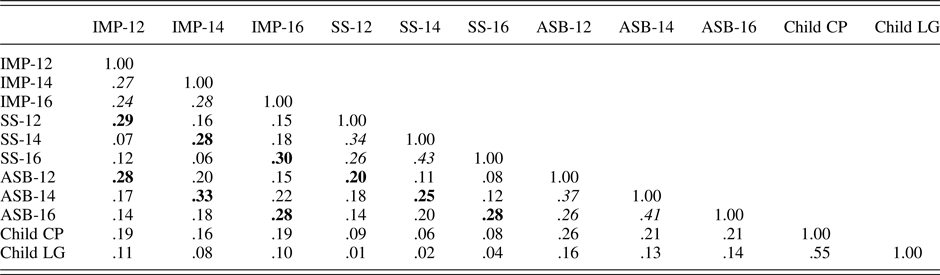
Observed correlations among childhood characteristics, disinhibited personality, and ASB (National Longitudinal Survey of Youth)
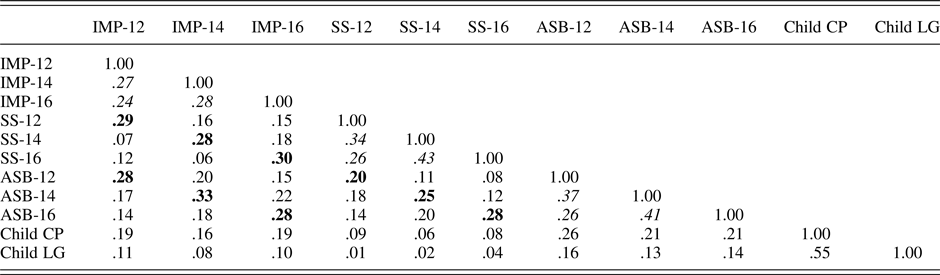
Note: Cross-time, same-measure correlations are italic and cross-measure, same-time correlations are bold. ASB, antisocial behavior; IMP, impulsivity; SS, sensation seeking; CP, conduct problems; LG, low guilt (coded such that higher scores indicate lower levels of guilt). Correlations with an absolute value of <.03 are not significantly different than zero at p < .05 (two tailed).
Analytic methods
Patterns of missing data are complex and are described in detail in the CNLSY user's guide (see http://www.nlsinfo.org/childya/nlsdocs/guide/intro/Retention.htm). Of the 7,106 youth included in the current analysis, 80% contributed data on ASB at ages 12–13, 78% at ages 14–15, and 70% at age 16–17. All models were estimated using full information maximum likelihood, which has been recommended as the preferred method for accounting for missing data (Schafer & Graham, Reference Schafer and Graham2002). In addition, standard errors and model fit statistics were adjusted for nonindependence of data on children from the same family (i.e., sibling clusters; Rabe-Hesketh & Skrondal, Reference Patrick, Fowles and Krueger2006). Data were modeled using a series of latent growth curve models (LGMs; McArdle & Nesselroade, Reference McArdle, Nesselroade, Schinka and Veilcer2003; Meredith & Tisak, Reference Meredith and Tisak1990) in the software program Mplus version 7.11 (Muthén & Muthén, Reference Muthén and Muthén1998–2012). Absolute model fit was evaluated using model χ2 and root mean square error of approximation (RMSEA), which measures the amount of misfit on the model per model degree of freedom (Steiger, Reference Steiger1990). RMSEA values of less than 0.05 indicate a close fit, and values up to 0.08 represent reasonable errors of approximation. Model comparisons were made using change in model χ2 and Akaike information criteria (AIC), which provide a parsimony-adjusted index of predictive fit, with lower values indicating preferred models.
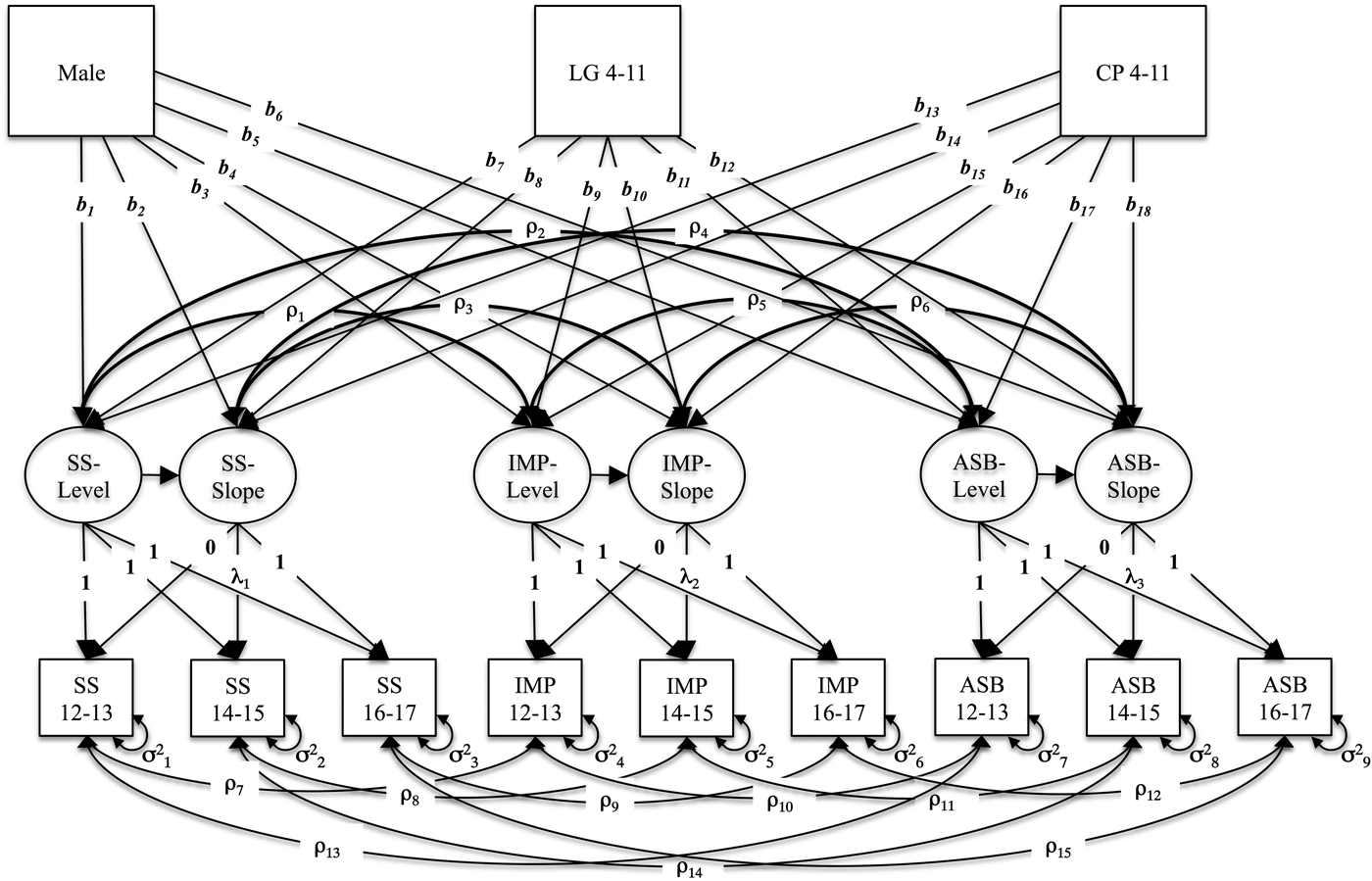
The trivariate growth curve model is depicted in Figure 1. Changes in adolescent ASB, impulsivity, and sensation seeking from ages 12–13 years to 15–16 years were each modeled as a function of a latent intercept factor, representing individual differences in initial levels of each construct, and a latent slope factor, representing individual differences in within-individual change across the three waves of data collection. Consistent with previously published analyses of these data (Harden et al., Reference Harden, Quinn and Tucker-Drob2012), to account for departures from linearity, change was modeled using a “latent basis” model, in which the loadings of each slope factor on the first and last measure of each construct were fixed to 0 and 1, respectively, while the loadings on the intermediate measurements were freely estimated from the data (McArdle, Reference McArdle2009). Next, the latent intercept and slope factors were regressed on three variables: biological sex, child conduct problems, and child lack of guilt. These regressions test whether average levels of childhood conduct problems, lack of guilt, and male sex predict individual differences in the development of disinhibited personality in adolescence.
The trivariate growth curve model (National Longitudinal Survey of Youth).
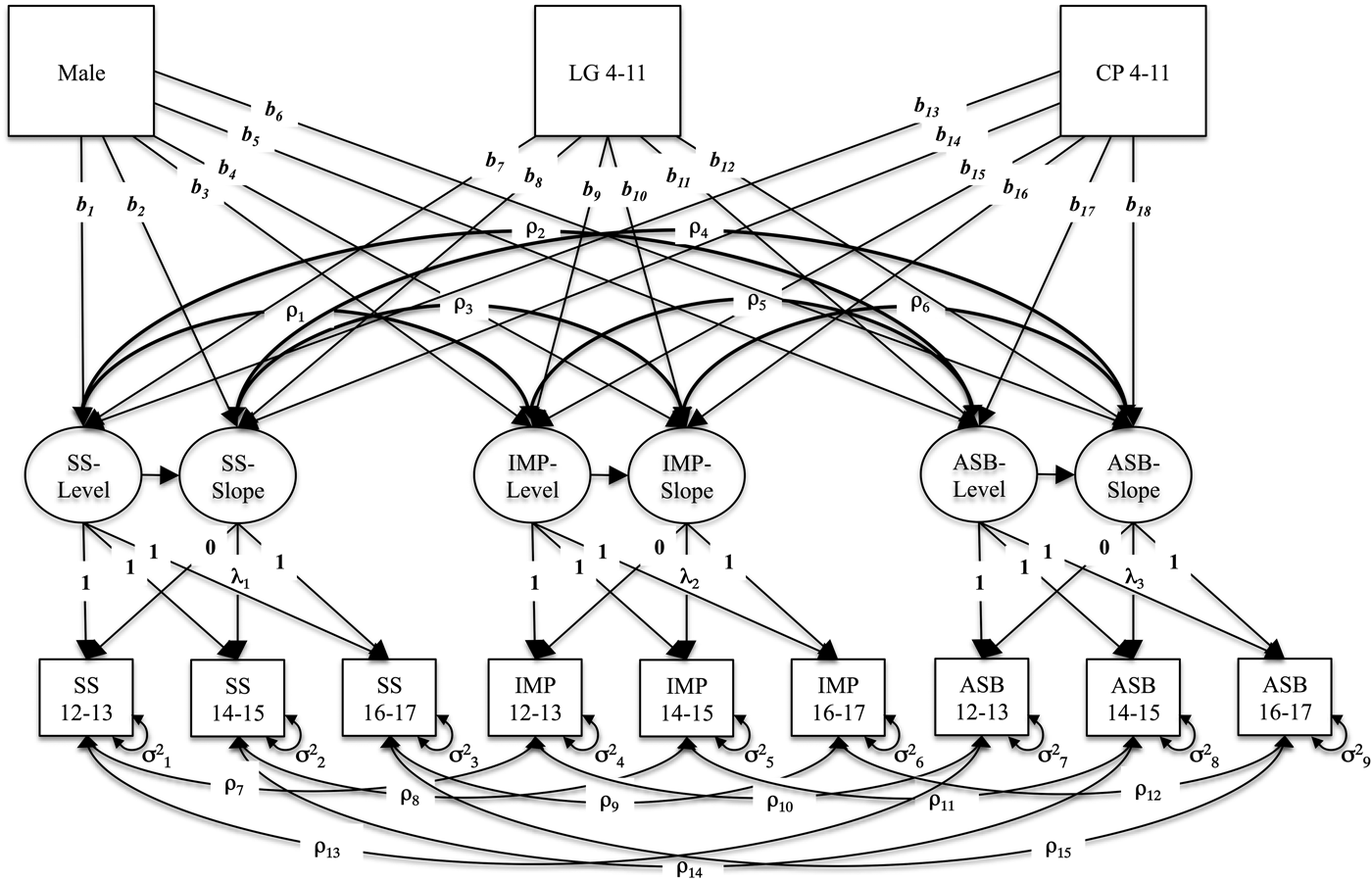
Next, we expanded the trivariate growth curve (main effects) model to a trivariate growth curve (moderation) model that allowed for the correlations among the latent intercept factors and latent slope factors to vary as linear functions of sex, childhood conduct problems, and lack of guilt. This model was used to test whether (level–level and slope–slopeFootnote 1 ) associations between disinhibited personality and ASB are moderated by individual differences in levels of guilt. Because callous–unemotional traits are higher, on average, in males and youth with childhood conduct problems, we included the moderating effect of sex and conduct problems, in order to ensure that any moderating effects of lack of guilt were not artifacts of sex differences or comorbidity with childhood conduct problems. All moderation effects were estimated simultaneously using moderated structural equation modeling (for an overview and detailed example, see Tucker-Drob, Reference Tucker-Drob2009), such that each effect controls for potential moderation by the other covariates. These moderation effects test whether the relations among levels of and changes in disinhibited personality and ASB are consistent across biological sex, as well as individuals with a history of child conduct problems and low levels of guilt. Given the number of moderation effects tested in this model (m = 18), to decrease the chance of Type I errors, we adopted a Bonferroni-corrected threshold for statistical significance (α/m = αcorrected = 0.002), which is more stringent than conventional standards (α = 0.05).
Results of Study 1
Does low levels of guilt in childhood predict the development of disinhibited personality in adolescence?
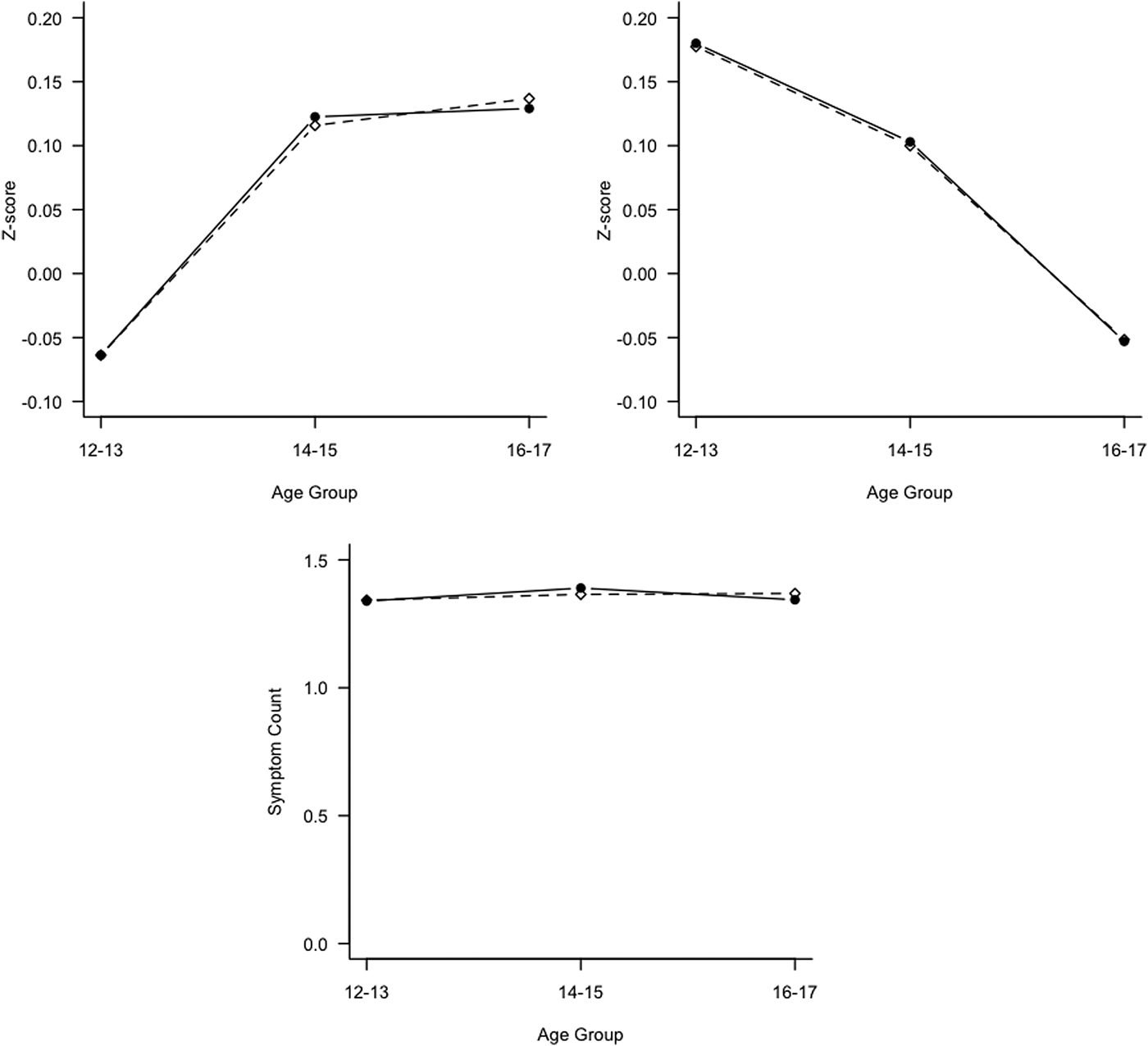
The first LGM fit the data well (χ2 = 101.29, df = 25, p < .001; RMSEA = 0.02, comparative fit index [CFI] = 0.98, AIC = 84,011.71). Figure 2 shows the predicted levels of impulsivity, sensation seeking, and ASB implied by the growth curve model, as compared to the observed means at each age.
The predicted levels of impulsivity, sensation seeking, and antisocial behavior implied by the growth curve model, as compared to the observed means at each age (National Longitudinal Survey of Youth).

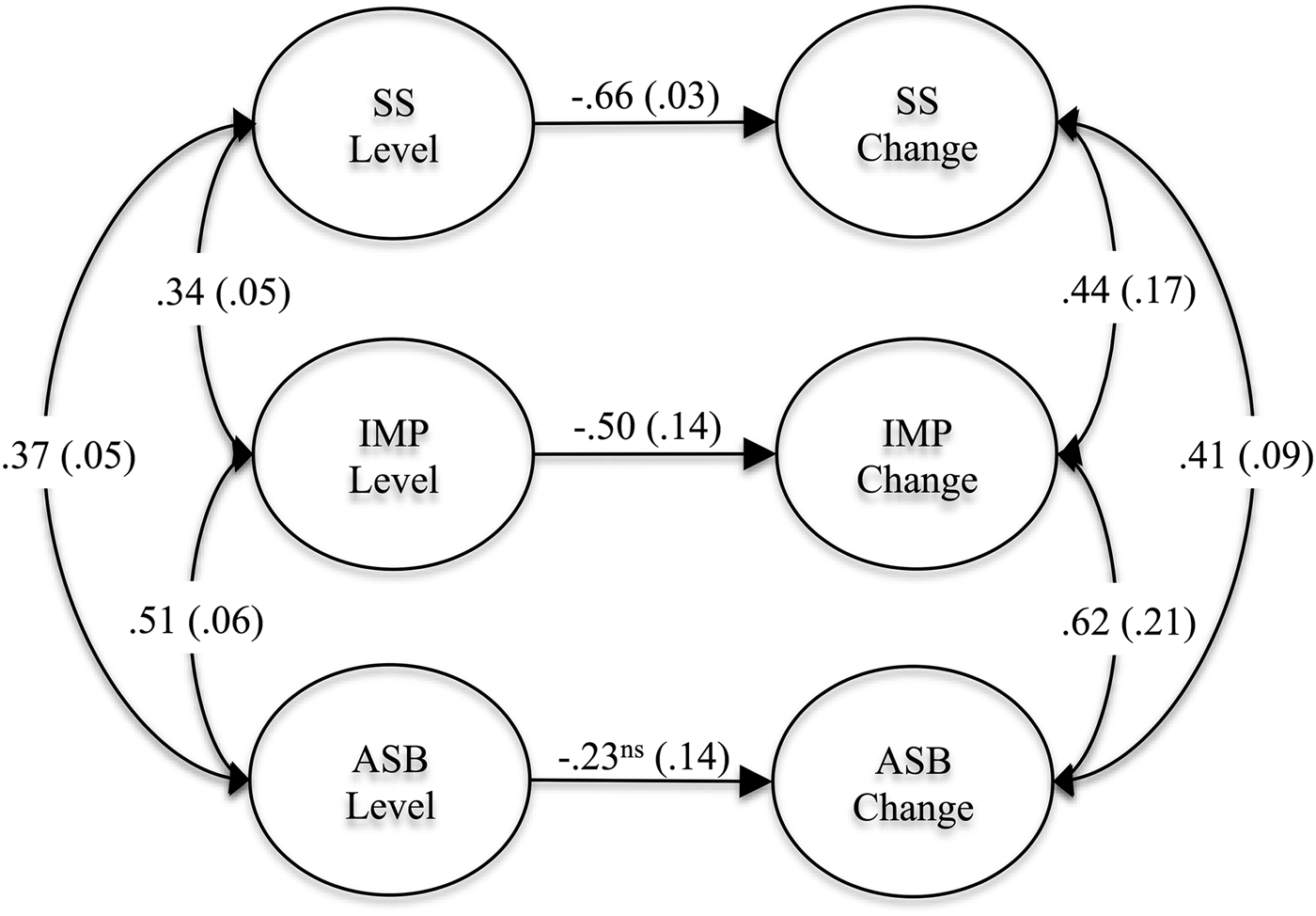
The model captures the observed pattern of mean-level change quite well, accounting for 41%–54% of the observed variance in sensation seeking at each age, 26%–40% of the observed variance in impulsivity, and 39%–42% of the observed variance in ASB. As previously reported (Harden et al., Reference Harden, Quinn and Tucker-Drob2012; Harden & Tucker-Drob, Reference Harden and Tucker-Drob2011), mean changes in sensation seeking and ASB during adolescence were positive, whereas mean change in impulsivity was negative. Figure 3 shows the estimated correlations among the intercept and slope factors for the three constructs.
The estimated correlations among the intercept and slope factors for the three constructs (National Longitudinal Survey of Youth).

There were significant level–level associations among impulsivity, sensation seeking, and ASB: adolescents who were higher, on average, on any one of these phenotypes tended to be higher on all of the others. Moreover, there were significant change-change associations: adolescents who increased more rapidly in sensation seeking also increased more rapidly in delinquent behavior, and adolescents who declined more slowly in impulsivity also showed more rapidly increasing delinquent behavior. Finally, there was an inverse association between level and change for each variable: individuals who had initially higher levels showed, on average, less rapid increases (for sensation seeking and ASB) or more rapid decreases (for impulsivity). Such negative level–slope associations are frequently observed in LGM results. Thus, results of the trivariate latent growth curve model are consistent with previous literature.
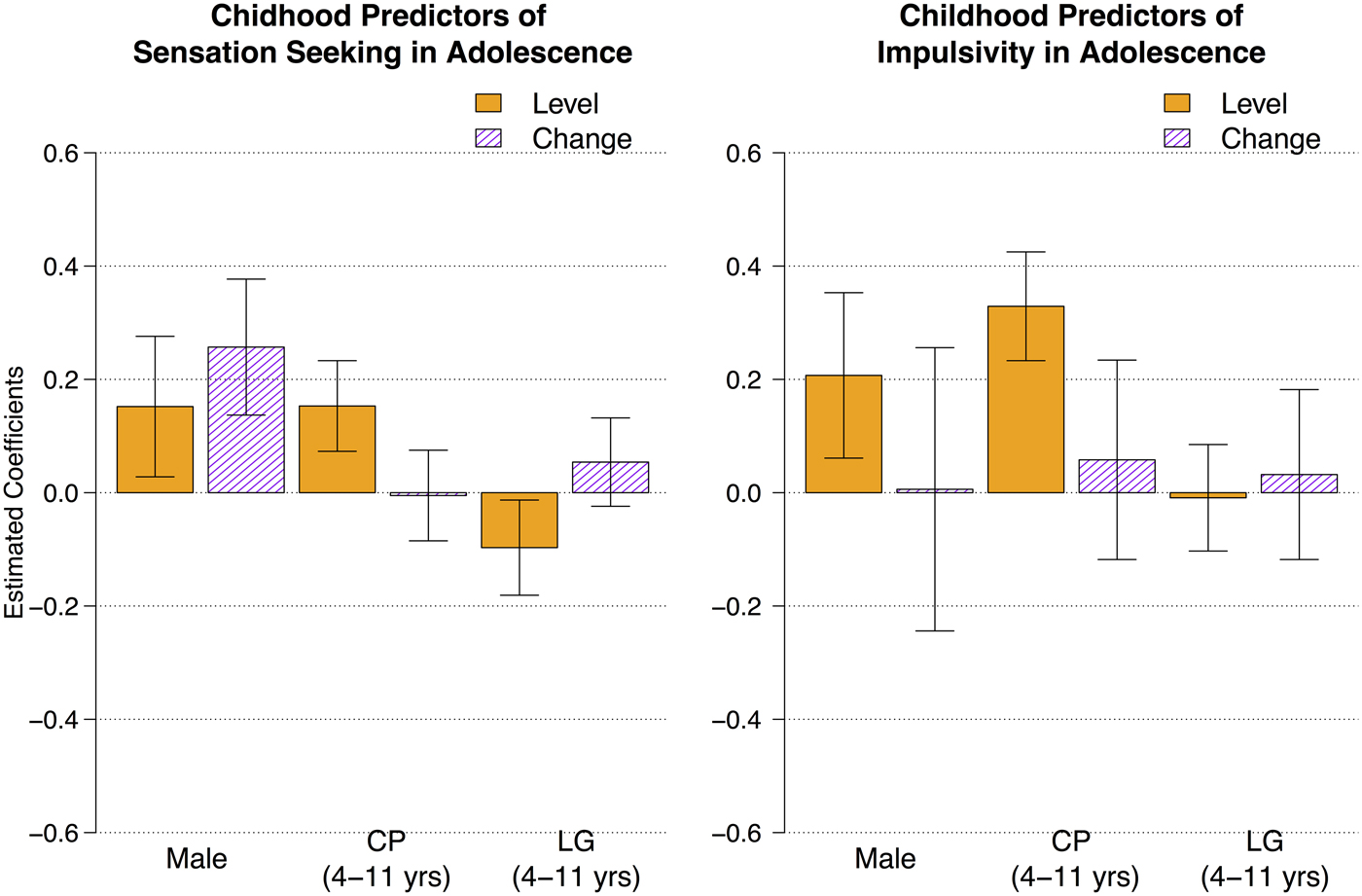
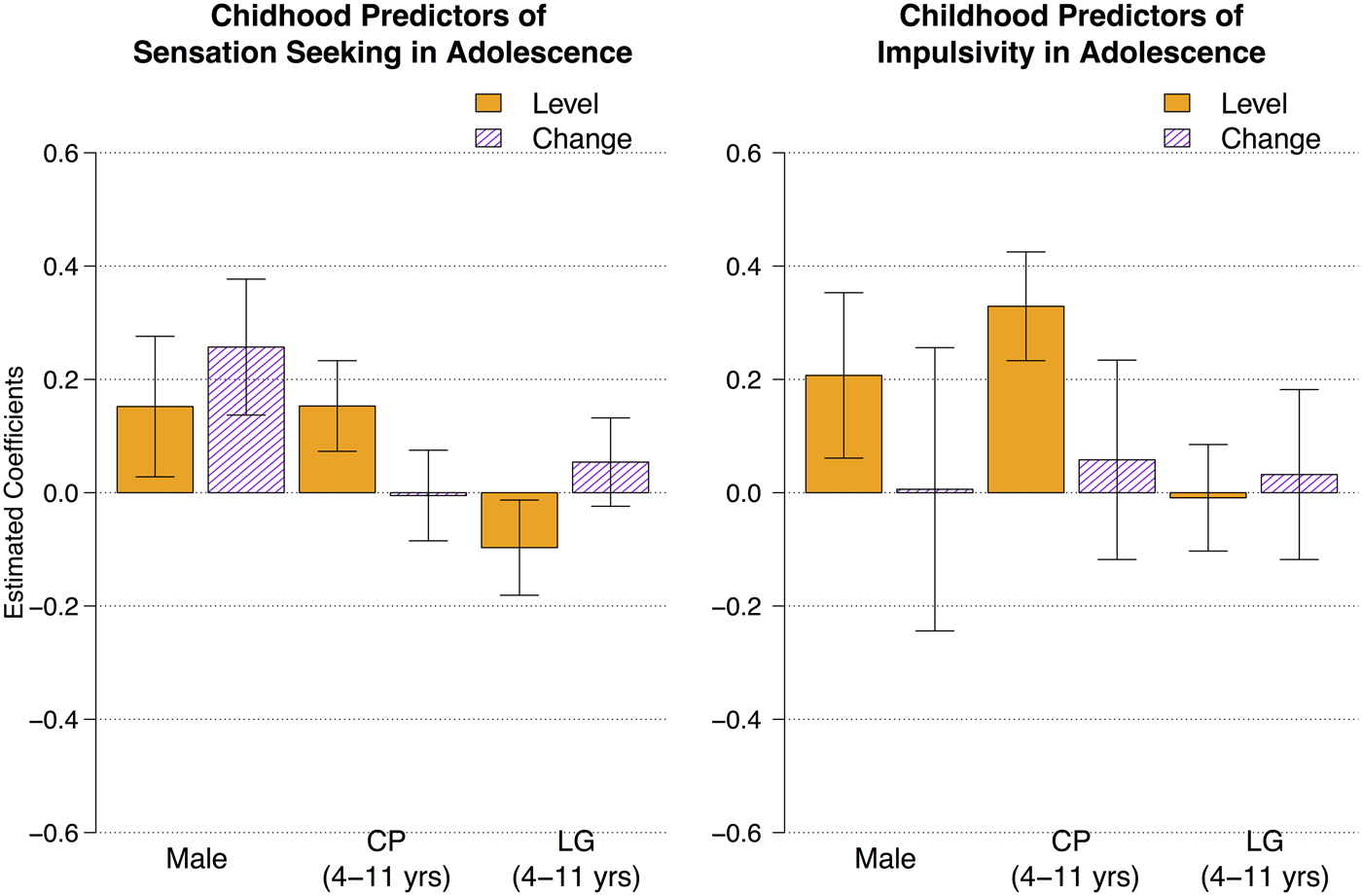
Figure 4 plots the main parameters of interest from Model 1, that is, the standardized regressions of the latent intercept and slope factors on lack of guilt, male sex, and child conduct problems. Regarding the development of sensation seeking (shown in the left panel of Figure 4), male sex and child conduct problems predicted higher levels of sensation seeking, whereas low levels of guilt in childhood predicted lower levels of sensation seeking. In addition, males showed more rapid increases in sensation seeking, compared to females. Neither child conduct problems nor lack of guilt predicted change in sensation seeking. Regarding impulsivity (shown in the right panel of Figure 4), male sex and child conduct problems predicted higher levels of impulsivity, whereas child lack of guilt was unrelated to levels of impulsivity. None of the three variables predicted change in impulsivity. Note that these effects were estimated while simultaneously accounting for associations between disinhibited traits and ASB across adolescence (reported in Figure 5), as well as associations between adolescent antisocial behavior and conduct problems in childhood, lack of guilt in childhood, and biological sex: male sex and child conduct problems, but not lack of guilt, predicted higher levels of ASB in adolescence. However, none of the variables significantly predicted change in ASB (ps > .10). Thus, while biological sex and conduct problems in childhood predicted initial levels of disinhibited traits, individual differences in change in these personality traits were not significantly associated with biological sex, conduct problems, or levels of guilt. Moreover, low levels of guilt in childhood predicted low levels of sensation seeking in adolescence, but did not predict levels of impulsivity or ASB. In other words, higher conduct problems predicted higher sensation seeking, impulsivity, and ASB; controlling for these effects, low levels of guilt predicted lower levels of sensation seeking.
(Color online) The main parameters of interest from Model 1, that is, the standardized regressions of the latent intercept and slope factors on lack of guilt, male sex, and child conduct problems (National Longitudinal Survey of Youth).
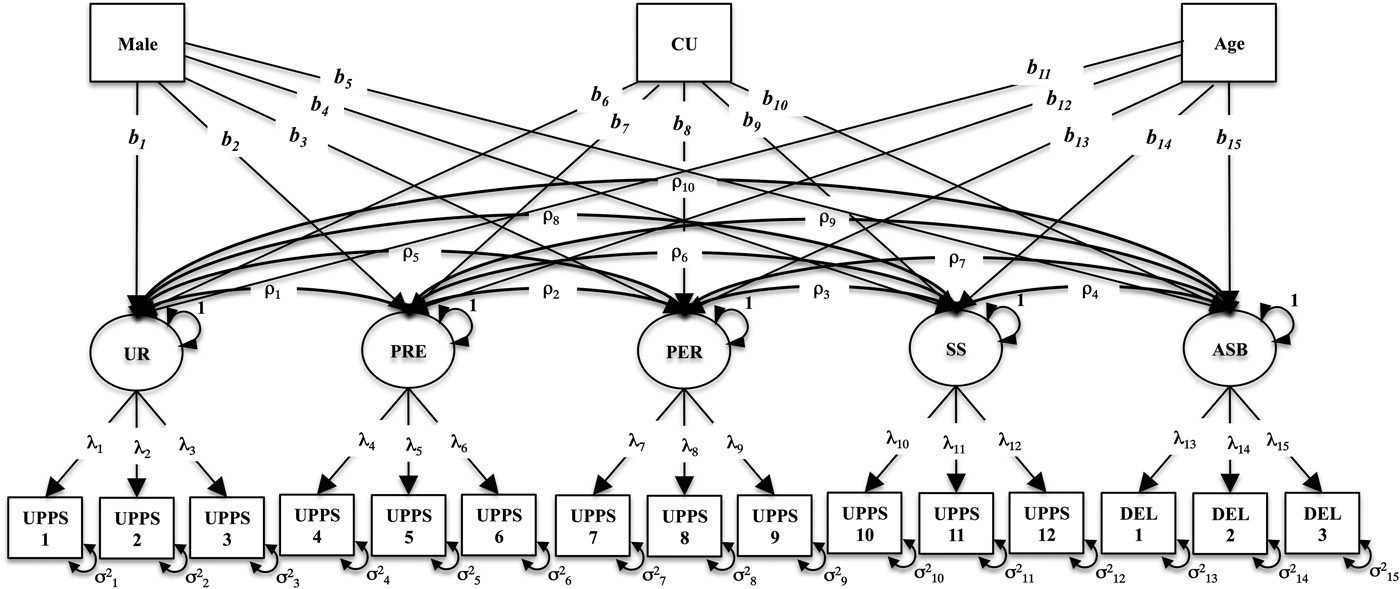
The structural equation model (Texas Twin Project).

Do child conduct problems and lack of guilt moderate associations between disinhibited personality development and ASB in adolescence?
The interaction model (Model 2) fit the data significantly better than Model 1 (Satorra–Bentler scaled chi-square difference test [Δχ] = 36.85, Δdf = 18, p = .005, AIC = 84,004.79). The key parameters of interest from Model 2 are the interaction terms representing whether male sex, child conduct problems, and child lack of guilt moderate the associations among disinhibited personality and ASB in adolescence. The interaction terms are scaled such that they represent the extent to which the level–level or slope–slope associations between two constructs increase or decrease with a 1 SD increase in the moderator or, alternatively, across biological sex.
Four results are notable. First, the associations between disinhibited traits were not moderated by child characteristics: biological sex, child conduct problems, and child lack of guilt all had negligible interaction effects on the level–level and slope–slope associations between impulsivity and sensation seeking. Second, biological sex (b = –0.09, SE = 0.04, p = .04) and childhood conduct problems (b = –0.07, SE = 0.02, p = .007) had interaction effects on the level–level association between impulsivity and ASB, with male sex and greater childhood conduct problems predicting a weaker association between levels of impulsivity and levels of ASB. Third, childhood conduct problems moderated the level–level association between sensation seeking and ASB (b = –0.09, SE = 0.03, p = .008), with higher conduct problems again predicting a weaker association. None of these moderation effects, however, met a Bonferonni-corrected threshold for statistical significance (p < .002). Fourth, the associations between changes in impulsivity, sensation seeking, and ASB were not moderated (ps > .05) by biological sex, child conduct problems, or lack of guilt.
Study 2
Method
Participants
Participants were drawn from the Texas Twin Project (Harden, Tucker-Drob, & Tackett, Reference Harden, Tucker-Drob and Tackett2013). Families were identified using public school rosters and recruited by phone call or mailing to participate in an ongoing study of risk-taking behavior. Parents provided verbal and written consent, and adolescents provided verbal and written assent, before families visited university campus to complete a battery of laboratory assessments, including a number of computerized questionnaires.
The sample consists of 978 adolescents from 481 families ages 13–20 years (M age = 15.76 years). All adolescents were either currently enrolled in high school at the time of participation or had recently graduated from high school, but had not yet begun college and were still living at home with primary caregivers.Footnote 2 Approximately one-third of the participating families had received some form of needs-based public assistance since their children were born. Approximately 6% of participants’ mothers had not received a high school diploma, 6% only graduated high school, 23% had some college or vocational training, 35% had completed college, and 30% had education beyond college. The racial composition of the sample was approximately 60% non-Hispanic White, 18% Hispanic/Latino, 11% African American, 1% Native American, 4% Asian, and 6% mixed-race/other.
Measures
Disinhibited personality
Individual differences in disinhibited personality were measured by adolescent self-report on the urgency, (lack of) premeditation, (lack of) perseverance, and sensation seeking subscales of the UPPS Impulsive Behavior Scale (Whiteside, Lynam, Miller, & Reynolds, Reference Whiteside, Lynam, Miller and Reynolds2005). Ten items measured individual differences in urgency (α = 0.87), including “I have trouble controlling my impulses” and “It is hard for me to resist acting on my feelings.” Premeditation (α = 0.84) and perseverance (α = 0.84) were measured using 12 items each, including “My thinking is usually careful and purposeful” and “I concentrate easily,” respectively. Individual differences in sensation seeking (α = 0.86) were indexed using 11 items, including “I quite enjoy taking risks” and “I welcome new and exciting experiences and sensations, even if they are frightening and unconventional.” All items were rated on a 4-point scale ranging from agree strongly to disagree strongly.
Adolescent ASB
Antisocial behavior was measured by adolescent self-report on 36 items that assessed involvement in a variety of delinquent behaviors (α = 0.88) ranging from relatively minor violations (e.g., “been suspended or expelled from school”) to criminal offenses (e.g., “stolen or tried to steal something worth more than $50”). All items were rated on a 3-point scale (0 = never, 1 = once, 2 = more than once).
Adolescent callous–unemotional traits
Individual differences in callous–unemotional traits (α = 0.78) were measured using 24 items from the Inventory of Callous–Unemotional Traits (Essau et al., Reference Essau, Sasagawa and Frick2006; Kimonis et al., Reference Kimonis, Frick, Skeem, Marsee, Cruise, Munoz and Morris2008). All items were rated on a 4-point scale ranging from 1 = disagree to 4 = agree. Consistent with current methodological recommendations (Ray, Frick, Thornton, Steinberg, & Cauffman, Reference Rabe-Hesketh and Skrondal2015), the Inventory of Callous–Unemotional Traits was not decomposed into component subscales. Instead, a composite scale was created by calculating a mean score of all 24 items.
Analytic methods
Of the 978 adolescents included in the current analyses, 97% to 99% of participants had no missing data across observed indicators of personality and ASB. Analyses were conducted using Mplus version 7.1 (Muthén & Muthén, Reference Muthén and Muthén1998–2012). Given the objectives of Study 2, adolescent twins were analyzed as individuals (as opposed to sibling pairs) with standard errors corrected for the nonindependence of observations using a sandwich estimator (Asparouhov & Muthén, 2006). Data were analyzed using confirmatory factor analysis (CFA) models (Jöreskog, Reference Jöreskog1969; Wirth & Edwards, Reference Wirth and Edwards2007) and moderated structural equation (SEM) models (Kline, Reference Kline2005). Similar to Study 1, model fit was evaluated using model χ2, RMSEA, and AIC.
A CFA model of disinhibited personality was fit to the data. This model was fit to test the performance of the UPPS impulsive behavior scale in the current sample, and confirm that a correlated four-factor model sufficiently recovered observed patterns of variance and covariance among indicators of disinhibited personality. Specifically, each item was specified as a categorical indicator of one of four continuous latent constructs: urgency, (lack of) premeditation, (lack of) perseverance, and sensation seeking. Latent constructs were scaled using unit variance identification. Item-level residual variances, factor loadings, and correlations among latent constructs were freely estimated. Because age trends and sex differences in disinhibited personality and ASB are well documented (Cross, Copping, & Campbell, Reference Cross, Copping and Campbell2011; Cross, Cyrenne, & Brown, Reference Cross, Cyrenne and Brown2013; Harden & Tucker-Drob, Reference Harden and Tucker-Drob2011; Shulman et al., Reference Shulman, Harden, Chein and Steinberg2015), age and biological sex were specified as exogenous covariates in all models.
We then expanded the CFA model to include an additional 36 items that were specified as indicators of an ASB construct. In addition, a standardized measure of callous–unemotional traits was included as an observed covariate of disinhibited personality and ASB (see Figure 5). This model was used to (a) estimate the cross-sectional effects of age, biological sex, and callous–unemotional traits on disinhibited personality and ASB, and (b) test whether (level–level) associations between disinhibited personality and ASB are moderated by individual differences in callous–unemotional traits. Moderation was tested by specifying latent correlations between disinhibited personality and ASB to simultaneously interact with age, biological sex, and callous–unemotional traits. Again, all moderation effects were estimated simultaneously, such that each effect controls for potential moderation by the other covariates. Similar to Study 1, given the number of moderations effects tested in this model (m = 30), to decrease the chance of Type I errors, we adopt a Bonferroni-corrected threshold for statistical significance (α/m = αcorrected = 0.001).
Results of Study 2
The CFA model of disinhibited personality (i.e., Model 1) fit the data well (χ2 = 3,529.67, df = 1,021, p < .001; RMSEA = 0.05, CFI = 0.89). All items showed moderate to high (range = 0.322–0.828) and statistically significant loadings (p < .001) onto their respective constructs. In addition, estimated covariances between latent constructs were consistent with those documented in previous studies (Whiteside & Lynam, Reference Whiteside and Lynam2001; Whiteside et al., Reference Whiteside, Lynam, Miller and Reynolds2005).
What are the cross-sectional associations between callous–unemotional traits, disinhibited personality, and ASB in adolescence?
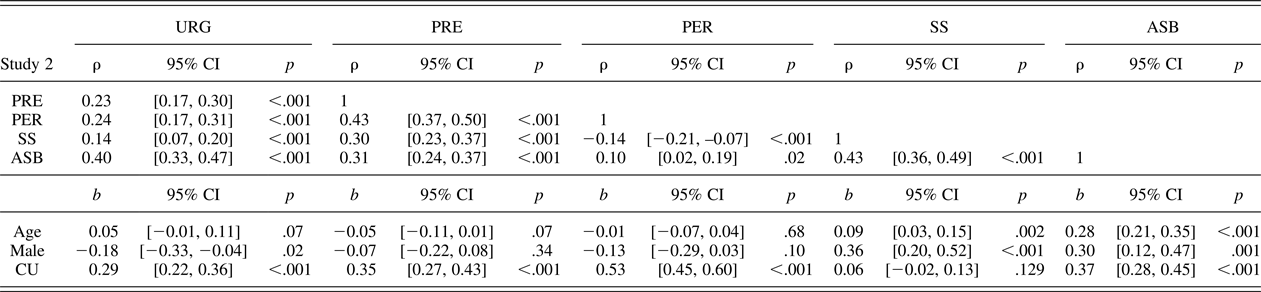
The main effects SEM depicted in Figure 5 fit the data well (χ2 = 5,783.79, df = 3,377, p < .001; RMSEA = 0.03, CFI = 0.87, AIC = 112,958.25). The results are reported in Table 3. The effects of age and biological sex on latent constructs were largely consistent with the age trends and sex differences documented in Study 1. Lack of premeditation decreased, on average, across adolescence, though this trend was not significant, whereas levels of sensation seeking and delinquent behavior significantly increased across adolescence. Male sex was associated with higher levels of sensation seeking and ASB. A lower level of urgency, in contrast, was associated with male sex.
Latent correlations among disinhibited traits and ASB and cross-sectional effects of age, sex, and CU traits on disinhibited traits and ASB (Texas Twin Project)
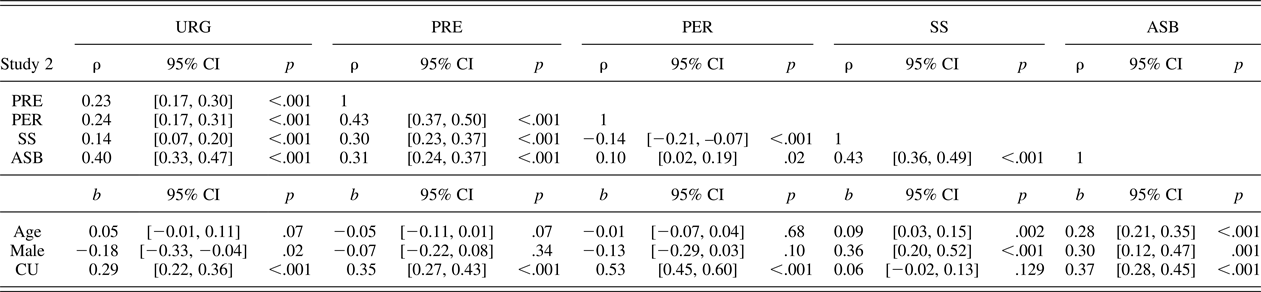
Note: Parameter estimates reported from model depicted in Figure 5. Model estimator was the mean and variance adjusted weighted least squares. ASB, antisocial behavior; CU, callous–unemotional; URG, urgency; PRE, premeditation; PER, perseverance; SS, sensation seeking; b, regression coefficient; ρ, correlation; p, two-tailed probability that estimate ≠ 0. Latent correlations between disinhibited personality and ASB (top) control for the effects of age, biological sex, and CU traits (bottom). Measure of CU traits was standardized prior to model fitting.
Callous–unemotional traits were significantly associated with impulsive traits, such that individuals high on callous–unemotional traits tended to be high on urgency, lack of premeditation, and lack of perseverance. This is in contrast to the estimated association between callous–unemotional traits and the sensation-seeking construct, which was not significant and approached zero. Again, similar to the results of Study 1, ASB was positively and significantly associated with disinhibited personality: higher levels of antisocial behavior were associated with higher levels of urgency, lower levels of premeditation, lower levels of perseverance, and higher levels of sensation seeking. In contrast to the negligible relation with childhood lack of guilt in Study 1, ASB was positively and significantly associated with callous–unemotional traits in adolescence.
Do callous–unemotional traits moderate associations between disinhibited personality and ASB in adolescence?
Model χ2 and AIC led to an equivocal decision regarding whether the interaction SEM fit the data better than the main effects model. A Satorra–Bentler scaled chi-square difference test (Δχ = 48.05, Δdf = 30, p = .019) indicated that the moderation model fit the data better than the main effects model. However, AIC indicated that the main effects model (AIC = 112,958.25) was preferred to the interaction model (AIC = 112,962.154). To adjudicate between these discrepant model fit statistics, we examined additional fit statistics, specifically Bayesian information criteria (BIC) and sample-size adjusted BIC (SSBIC). These additional fit statistics indicated that the main effects model (BIC = 114,473.68, SSBIC = 113,479.62) was preferred to the interaction model (BIC = 114,622.83, SSBIC =113,533.49). Regardless, results of the moderation model provided little to no evidence that correlations among urgency, premeditation, perseverance, sensation seeking, and ASB vary as a function of age, biological sex, or individual differences in callous–unemotional traits. Specifically, biological sex did not significantly moderate correlations among disinhibited personality and ASB (ps > .05). There was weak evidence that individual differences in callous–unemotional traits moderate associations between urgency and ASB (b = –0.07, SE = 0.03, p = .04), as well as between premeditation and sensation seeking (b = –0.09, SE = 0.03, p = .01). Results also provide weak evidence that age moderates the association between premeditation and sensation seeking (b = 0.05, SE = 0.02, p = .04), as well as between premeditation and ASB (b = 0.06, SE = 0.03, p = .04). However, these moderation effects did not reach a Bonferroni-corrected threshold for statistical significance (p < .001).
Discussion
In Study 1, using a large, nationally representative sample of youth followed from early childhood through middle adolescence, we examined whether childhood conduct problems and low levels of guilt predicted patterns of age-related change in disinhibited personality (i.e., impulsivity and sensation seeking) during adolescence, and whether these childhood characteristics moderated the associations between change in disinhibited personality and the development of ASB. We found evidence that childhood conduct problems and lack of guilt do differentially predict initial levels of disinhibited personality traits in adolescence. Conduct problems predicted higher levels of sensation seeking and impulsivity, whereas controlling for biological sex and conduct problems, low levels of guilt predicted lower levels of sensation seeking.
Childhood conduct problems and lack of guilt did not, however, significantly predict change in disinhibited personality or ASB during adolescence. That is, individuals with a history of childhood conduct problems and low levels of guilt did not show more rapid increases in sensation seeking or less rapid decreases in impulsivity. Rather, children higher in conduct problems exhibited higher levels of sensation seeking, poorer impulse control, and higher levels of ASB over the entire course of adolescence. Thus, while there are certainly individual differences in the rapidity of change in disinhibited personality, childhood conduct problems and low levels of guilt do not appear to be the province of these individual differences. Put differently, despite being higher on disinhibited traits across adolescence, the general patterns of personality maturation observed in previous studies (e.g., Harden & Tucker-Drob, Reference Harden and Tucker-Drob2011; Steinberg et al., Reference Steinberg, Albert, Cauffman, Banich, Graham and Woolard2008) hold for adolescents with histories of childhood conduct problems, as well as low levels of guilt. This result is consistent with previous research in neuroscience, using both humans and animal models, which has suggested that age-related changes in impulsivity and sensation seeking may be driven by relatively primitive biological processes (Casey, Jones, & Somerville, Reference Casey, Jones and Somerville2011; Laviola, Macri, Morley-Fletcher, & Adriani, Reference Laviola, Macri, Morley-Fletcher and Adriani2003) and can thus be expected to be broadly applicable across adolescents.
Similarly, neither child conduct problems nor lack of guilt moderated the associations among change in impulsivity, change in sensation seeking, and change in ASB. Again, this suggests that the dual-systems model, which implicates neurological maturation and its effects on adolescent personality as drivers of the emergence of risk-taking behavior (e.g., Somerville, Jones, & Casey Reference Somerville, Jones and Casey2010; Steinberg, Reference Steinberg2008), may be broadly applicable to understanding increases in ASB in adolescence, rather than more narrowly descriptive of just adolescent-limited trajectories. Although there were no significant moderators of the associations between change in personality and change in ASB, child conduct problems did moderate the associations between levels of impulsivity and sensation seeking, on the one hand, and level of adolescent ASB, on the other. That is, initial levels of ASB in early adolescence are less closely tied to initial levels of disinhibited personality among youth with histories of childhood-onset conduct problems. Put differently, initials levels of impulsivity and sensation seeking in adolescence are more closely tied to levels of ASB among youth with adolescent-onset trajectories of ASB.
A key advantage of research with the NLSY data sets is the size and duration of the project. The current study uses data on over 7,000 youth, representing a broad swath of American life, who were assessed biennially from age 4–5 to age 16–17. However, an unfortunate trade-off of large, population representative, panel studies is a corresponding decrement in measurement quality.Footnote 3 Therefore, we sought to replicate results using a data set with complementary strengths. Using a sample of adolescents (N = 978), Study 2 tested similar hypotheses using well-validated and more comprehensive measures of personality. A limitation of Study 2, however, was the use of cross-sectional data. Nevertheless, the level–level associations among impulsivity, sensation seeking, and ASB documented in Study 1 were largely consistent with the results of Study 2. Across both samples, levels of disinhibited personality traits were positively correlated with levels of ASB, and there was little evidence that low levels of guilt or callous–unemotional traits moderated these associations.
The studies also yielded inconsistent results regarding the relationship between callous–unemotional traits (or low levels of guilt) and sensation seeking, and neither result was consistent with our hypothesis that youth higher in callous–unemotional traits would show higher levels of sensation seeking. In Study 1, lack of guilt in childhood predicted lower sensation seeking, and in Study 2 the association between callous–unemotional and sensation seeking was negligible and not statistically significant. In contrast, previous research has documented positive associations between callous–unemotional and thrill-seeking personality traits (Essau et al., Reference Essau, Sasagawa and Frick2006; Frick et al., Reference Frick, Lilienfeld, Ellis, Loney and Silverthorn1999; Pardini et al., Reference Pardini, Obradovic and Loeber2006; reviewed by Frick & White, Reference Frick and White2008). It is unclear whether this discrepancy is due to differing operationalization of the callous–unemotional construct, to differing sample characteristics, or to other factors. Though, given that callous–unemotional traits have been measured using a variety of instruments with varying measurement properties (Frick & Ray, Reference Frick and Ray2014), it seems likely that these differing operationalizations contribute to discrepant results.
One limitation of Study 1 was the use of a single item to measure lack of guilt in childhood. Moreover, lack of guilt is related to, but not synonymous with, the callous–unemotional construct. Specifically, lack of guilt may be considered a component of callous–unemotional traits, which is more closely related to callous behavior than deficits in concern or dampened affect. The item used in Study 1 to measure lack of guilt is similar to an item on the callous subscale of the Inventory of Callous–Unemotional Traits: “I feel bad or guilty when I do something wrong.” Moreover, research has repeatedly indicated that measures of guilt are associated with callous–unemotional traits (Frick et al., Reference Frick, Ray, Thornton and Kahn2014; Lotze, Ravindran, & Myers, Reference Lotze, Ravindran and Myers2010; Pardini & Byrd, Reference Pardini and Byrd2012), and lack of guilt and remorse are often the best indicators of the callous–unemotional construct (Frick, Reference Frick2009).
To help temper the complexity of analyses, in Study 1 we chose to model average levels of guilt and conduct problems in childhood as time-invariant predictors of the development of disinhibited traits and ASB in adolescence, as well as time-invariant moderators of their associations. This may be viewed as a limitation to the current study, given that previous longitudinal work has found evidence for individual differences in early developmental changes in both conduct problems and callous–unemotional traits. For example, Fontaine et al. (Reference Fontaine, McCrory, Boivin, Moffitt and Viding2011) found evidence for four distinct trajectories of callous–unemotional traits across childhood (ages 7 to 12 years old); only a small portion of children showed stable high (4.7%), increasing (7.3%), or decreasing (13.4%) trajectories, and the majority of children (74.6%) showed stable low trajectories. To provide analog to the current study, youth with low average levels of guilt across childhood correspond to youth with high stable trajectories of callous–unemotional traits, high average levels of guilt capture youth with stable low stable trajectories, and youth with moderate levels of guilt correspond to youth with either increasing or decreasing trajectories. Future research may benefit from examining whether such developmental trends in childhood, particularly increasing and decreasing trajectories of callous–unemotional traits, evince differential associations with the development of disinhibited traits and ASB in adolescence.
Over the past several decades, researchers have carefully established that adolescent ASB is a heterogeneous construct that can be meaningfully differentiated according to age of onset (child vs. adolescent onset), continuation across time (adolescent-limited vs. life-course persistent), and the presence of comorbid callous–unemotional traits. Research in personality psychology and behavioral neuroscience have proffered new explanations regarding why adolescence is a unique window of vulnerability for antisocial and risk-taking behaviors. Drawing from both of these literatures, the current paper presents evidence that changes in disinhibited personality during adolescence predict change in ASB, even for youth with childhood characteristics that are markers for life-course persistent trajectories of ASB, including childhood conduct problems and low levels of guilt. Furthermore, in a second sample, levels of disinhibited traits and ASB in adolescence were associated with callous–unemotional traits. There was little to no evidence that the associations among disinhibited traits and ASB varied across levels of callous–unemotional traits.