Introduction
The way policy is coordinated across jurisdictional boundaries is important to understand the functioning of multilevel politics both within and beyond the nation-state. Lower-level governments (provinces, regional governments, or member states) have developed different modes of coordination to solve collective problems non-hierarchically within their own areas of jurisdiction. They range from mere policy emulation, over ad hoc coordination setting up political agreements to formally binding interstate treaties. Accordingly, the literature on multilevel governance has developed conceptual tools to capture these modes (e.g. Scharpf, Reference Scharpf2001). Nonetheless, there are hardly any attempts to specify systematically the conditions under which particular modes of policy coordination are likely to be employed by governments operating in multilevel systems (not to be equated with the density of interaction between governments).
We argue that a particular coordination mechanism might not (or rarely) be applied in a system because (a) governments refuse to use it for political reasons or (b) they find its application difficult. We claim that intra-governmental relations are essential to understand intergovernmental relations in multilevel systems (Benz, Reference Benz2004a: 133). More particularly, the presence and type of power sharing between the executive and legislature within lower-level governments help us to account for their relative willingness and capacity, respectively, to apply particular mechanisms. The mere presence of power sharing shapes the willingness of lower-level governments to enter formally constraining intergovernmental treaties that strongly restrict individual government autonomy. The type of power sharing affects the capacity to enter agreements that presuppose parliamentary approval.
To develop our arguments, we first introduce the core concepts from which we derive two hypotheses following neo-institutionalist, strategic choice approaches (e.g. Scharpf, Reference Scharpf1997; Héritier, Reference Héritier1998). Second, we explore the explanatory power of our hypotheses by comparing policy coordination in four multilevel systems; the United States, Canada, Switzerland, and the European Union (EU), and thus follow those scholars having engaged in comparative analyses of multilevel systems beyond the national sphere (e.g. Scharpf, Reference Scharpf1988; Sbragia, Reference Sbragia1993; McKay, Reference McKay2001; Nicolaidis and Howse, Reference Nicolaidis and Howse2001; Hooghe and Marks, Reference Hooghe and Marks2003; Benz, Reference Benz2004b; Thorlakson, Reference Thorlakson2006). All four systems are composed of comparatively strong lower-level governments in terms of resources and competences. Their general capacity to choose from a variety of non-hierarchical modes of coordination is similarly broad. They vary, however, with regard to the intra-governmental patterns of power sharing and power concentration that gives rise to different modes of policy coordination, which in turn fundamentally shapes the problem-solving capacity of lower-level governments. The paper concludes with a discussion of a major challenge lower-level governments face in each multilevel polity – the challenge to assure efficient policy coordination, while protecting government autonomy and countering centralizing pressure.
Intra-governmental dynamics and non-hierarchical modes of policy coordination
Unlike many theory-guided approaches to multilevel governance (e.g. McKay, Reference McKay2001; Nicolaidis and Howse, Reference Nicolaidis and Howse2001; Hooghe and Marks, Reference Hooghe and Marks2003), we do not consider levels of government as the main units of analysis, but rather individual governments deliberately shifting attention from the vertical to the horizontal axis of multilevel systems. Given that we are interested in governments’ choices of coordination modes – referring to processes within and across levels – an actor-centered approach developed in the context of federalism research (Scharpf, Reference Scharpf1997; Benz, Reference Benz2004a: 133) seems more suitable than alternative perspectives to multilevel dynamics. In a similar vein, we do not set out from the institutional design of the upper or central level of government (e.g. the nature of the second ‘territorial’ chamber of parliament) to also shed light on policy coordination occurring outside central-level institutions (see also the section on rival explanations). We take the internal characteristics of the lower-level governments (in cases of federal systems’ regional governments, in the EU the member states) as the constituent units of the multilevel polity as our starting point (Benz, Reference Benz2004a: 133).Footnote 1 The focus on intra-governmental constraints and interest configurations – which we expect to shape the patterns of intergovernmental coordination – helps us to specify the micro-incentives that drive the choices of government actors underlying macro processes in different institutional settings (Scharpf, Reference Scharpf1997).
Core concepts
This paper focuses on different modes of non-hierarchical policy coordination (which will be embedded in the full range of – also hierarchical – modes of coordination (see Table 2)). Essentially, non-hierarchical coordination cannot be centrally (or otherwise) imposed on any of the participating governments. It captures a particularly demanding form of collective problem solving that is crucial in multilevel systems where competences are dispersed to various independent yet interdependent units. Non-hierarchical coordination may not be equated with ‘horizontal coordination’ (i.e. coordination between lower-level governments only), although horizontal coordination is one important part of the picture often neglected in the literature.
The center can be involved in non-hierarchical coordination, and yet it always depends on the willingness of other governments to enter the process. It can obviously set financial incentives to achieve this, but each government maintains a formal right to refrain from coordination (once an agreement has been entered, it might of course bind participants). Similarly, the involvement of central-level institutions (e.g. the Council of Ministers in the EU) in coordination processes (e.g. the Open Method of Coordination (OMC)) does not make them ‘hierarchical’.
These elaborations provide the foundation for the first core distinctions our hypotheses rest upon, helping to specify the dependent variable in our study: the distinction between highly constraining agreements and weakly constraining agreements.Footnote 2 Highly constraining agreements are mostly both legally binding and enforceable agreements and constitute ‘interstate law’ usually presupposing parliamentary approval. Executive and administrative agreements such as memoranda of understanding fall into the weakly constraining category and include coordination ‘by contract’ and ‘by soft law’ as distinguished by Poirier (Reference Poirier2001: 14–18). Although the latter express different levels of formality, they impose similar constraints; in addition, in the case of contracts, each participating party always retains the explicit option to legislate terms that are contradictory to it (Poirier, Reference Poirier2001: 16).
In federal states, agreements can usually be clearly assigned to one of the categories and legally binding agreements also tend to be enforceable. Our empirical analysis, however, also includes multilevel settings beyond the nation-state, that is, the EU, which explains why we choose the terminology of ‘highly constraining vs. weakly constraining agreements’. Particularly in international law, ‘legally binding’ does not automatically imply ‘legally enforceable’, and thus, litigation in front of a court might not be an option to counter agreement violations. However, in federal systems we find – although rarely – agreements of this type. Since it is enforceability that implies that governments can be effectively sanctioned for agreement violations, we consider legally binding/non-enforceable agreements as ‘weakly constraining’. There are, of course, important agreements in this category that governments comply with.Footnote 3 Still, overall, the likelihood of compliance is higher facing an agreement that is both legally binding and enforceable. Thus, governments might more willingly enter into agreements that are not enforceable, granting them more flexibility later on.
Moving to the explanatory dimension, the distinction between power-concentrating and power-sharing governments refers to the number of partisan or institutional actors whose approval is necessary to make a decision (see Lijphart, Reference Lijphart1999; Tsebelis, Reference Tsebelis2002). Accordingly, one-party majority governments in parliamentary, unicameral settings are considered power concentrating, whereas presidential separation of power structures or multiparty coalitionsFootnote 4 qualify as power sharing. Given that we find power sharing, compulsory power-sharing structures (e.g. the institutional separation of power between branches of government) are formally entrenched and can be considered as exogenous to the strategic choices of the actors that are embedded in them. By contrast, voluntary power-sharing structures (e.g. coalition governments and corporatism) are deliberatively established by the actors; they are endogenous to actor behavior and maintained only when they are sufficiently effective (see Kaiser, Reference Kaiser1997; Birchfield and Crepaz, Reference Birchfield and Crepaz1998).Footnote 5
Two hypotheses on governments’ choice of coordination modes
Each of our two hypotheses rests on one basic rationale why the range, or, put differently, the repertoire of coordination modes (not the density of coordination!) should vary across different multilevel systems. First, governments might, in principle, refuse to apply certain mechanisms. The remaining politically acceptable modes constitute the available repertoire of coordination modes. Second, governments might, in principle, be willing to use a mechanism, but its application might prove difficult for them. This reduces the (theoretically) available repertoire to the effective repertoire. The interplay between the two explains why governments do not necessarily choose the coordination modes most suitable for the problem at hand. The idea of specifying ‘system-specific’ repertoires of coordination modes (compared to repertoires linked to policy types, for instance) rests on the assumption that the choice of a particular mode is driven as much by the political as by the functional considerations that shape a system’s problem-solving capacity.
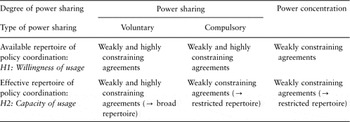
While lower-level governments can generally be assumed to fight for their autonomy (e.g. Lecours, Reference Lecours2004), the relative intensity varies with the incentives governments are exposed to in their home arena. Logically, power-concentrating, one-party governments suffer more from autonomy losses when entering constraining agreements than governments that already share power internally (e.g. through coalition governments or separation of power structures). Simultaneously, they operate in concentrated party systems, where competitive pressure is high. Two-party systems, in particular, constitute ‘zero-sum-dynamics’ where electoral losses most easily translate into loss of government. In coalition systems, in contrast, the link between electoral outcomes and government entry is comparatively weak (see Mattila and Raunio, Reference Mattila and Raunio2004). Maintaining autonomy is thus more important for power-concentrating governments to maintain the flexibility to be able to respond to changes in public opinion. We thus hypothesize:
Power-concentrating governments are less willing to enter highly constraining intergovernmental agreements than power-sharing governments since they are more sensitive to autonomy losses. Footnote 6
One might object that such governments face particularly strong incentives to bind future (potentially rival) governments via constraining agreements if party alternation is very likely, which would lead to the withdrawal from an informal agreement. This argument, however, presupposes that governments are long-term oriented, predominantly policy-seeking, and are for this reason willing to constrain themselves in the first place, presently and potentially in the future (as they would bind future rival governments). This is unlikely in the circumstance described above, especially because in most political systems being in office is one precondition to shape policy effectively.Footnote 7
While we expect that power-sharing governments are in principle willing to enter both weakly and highly constraining agreements, the neo-institutionalist debate on the effects of veto points and players has frequently emphasized that not all power-sharing structures affect actor behavior in the same way (e.g. Birchfield and Crepaz, Reference Birchfield and Crepaz1998). If coalition partners in a parliamentary setting disagree too frequently, to mention one example of voluntary power sharing, the coalition can fall apart. This can provoke new elections and each party risks losing its decision-making power. Actors in voluntary power-sharing structures should therefore avoid using their veto power too often, since their veto positions are constitutionally guaranteed. Simultaneously, compulsory power sharing invites institutional actors (e.g. government branches) to forcefully pursue institutionally defined interests both inside and outside their home arena. Thus, we hypothesize:
Compulsory power-sharing governments (e.g. separation of power structures) are less capable of entering highly constraining agreements which presuppose the approval of both the executive and legislative than non-compulsory power-sharing governments are.
Table 1 sums up the two hypotheses and indicates the available as opposed to the effectively used repertoire of agreement types induced by the different intra-governmental incentives. Assuming that the coordination capacity of a system is more enhanced, the broader the range of effectively used agreement types (note again that we do not refer to the density of coordination!), the conditions that are set by voluntary power-sharing systems for non-hierarchical policy coordination are more favourable.
Expected effects of power concentration and power sharing on choice of agreement types

Case selection: comparing multilevel systems within and beyond the nation-state
To examine our two hypotheses, we compare the United States, Canada, Switzerland, and the EU. The four multilevel systems systematically differ regarding the presence and the type of power sharing in their lower-level governments’ executive–legislative relations, as well as the core factors expected to shape the choice of coordination modes. At the same time, they share crucial similarities. In all four systems, lower-level governments enjoy relatively strong autonomy vis-à-vis the central government. Their general capacity to choose from a variety of non-hierarchical modes of coordination is similarly broad.Footnote 8 In principle, the hypotheses can be applied to any other multilevel system. We contend, however, that the similarities between these three cases in terms of subnational power are more pronounced than between other groups of cases and that they increase the clarity of the hypothesized relationships.
The three federal states correspond more closely to the model of dual federalism than the model of cooperative federalism.Footnote 9 The lower-level governments enjoy a broad range of exclusive jurisdictions and substantial fiscal power. Both factors assure that lower-level governments, depending on their preference, have the freedom to choose whether and how to engage in coordination. A recent assessment of the way jurisdictions are allocated across 10 long-established federal democracies shows that our three systems turn out to be relatively similar in their relative scope of exclusive state jurisdictions (Bolleyer and Thorlakson, Reference Bolleyer and Thorlakson2008). The index used captures the relative percentage of exclusive state jurisdictions over the total of all policy fields allocated in a constitution. Values range from 0 to 1; higher values in each signify a greater amount of exclusive state competences. The scope of exclusive state jurisdictions is 0.178 in the United States, 0.146 in Canada, and 0.136 in Switzerland.Footnote 10 The financial resources available to lower-level governments influence whether they also have the financial means to realize their preferred policies. The revenue shareFootnote 11 of lower-level governments provides a crucial measure for their capacity to act independently in their own spheres of competence.Footnote 12 A recent OECD study points to the special status of these three countries due to their lower-level governments’ exceptional taxing powers. In 2001, the three countries are at the top of the list in terms of their revenue share – with 40.4% in Switzerland, 31.7% in the United States, and 44.1% in Canada (Joumard and Kongsrud, Reference Joumard and Kongsrud2003: 164), increasing their similarity in terms of lower-level power.Footnote 13 Finally, comparative studies of the party structures in federal systems show mostly similar levels of party autonomy in the three systems (Thorlakson, Reference Thorlakson2009: 169), matching the formal autonomy reflected by the distribution of legislative competences.Footnote 14
But how does the EU fit into this? Can this multilevel system be usefully compared to federal states? It is widely acknowledged that the EU corresponds to the ‘federal principle’ without being a ‘federal state’ (e.g. Scharpf, Reference Scharpf1988; Sbragia, Reference Sbragia1993; McKay, Reference McKay2001; Börzel, Reference Börzel2005). Like the United States, Canada, and Switzerland, the EU represents what Hooghe and Marks call Type I of multilevel governance, which is characterized by general purpose jurisdictions. It has a durable jurisdictional architecture in which competencies are bundled and distributed in packages to the constituent governments (2003: 236–237).Footnote 15 The EU’s lack of monopoly over coercive force (as compared to the three federal states) is often highlighted when discussing the adequacy of comparing state and non-state systems, yet it is of minor importance for its working insofar as its supranational institutions wield significant powers of hierarchical coordination (Börzel, Reference Börzel2008). This feature fundamentally distinguishes the EU from other international organizations and makes its comparison to federal systems particularly adequate. It further explains why we refrain from including ‘ordinary’ intergovernmental organizations in our study.
But even if we can compare the EU to federal states, is it conceptually convincing to compare it to dual federal systems? The literature tells us that the EU is an instance of cooperative federalism that resembles Germany rather than the United States, Canada, or Switzerland (e.g. Scharpf, Reference Scharpf1988; Börzel Reference Börzel2005b). These scholars argue that the division of competencies is more functional than dual, since the member states are responsible for the execution of EU laws. We do not argue that this perspective is ‘wrong’. Given our particular research question, however, it simply targets the wrong phenomenon – namely vertical power sharing between the EU as ‘central’ decision-maker and individual member state as implementer – which is not what we are interested in.
Rather, we want to explore the variety of horizontal coordination mechanisms – which can involve the central level or not. As long as the member states – here understood as ‘lower-level governments’ in the European polity – are (irrespective of the patterns of vertical power sharing) sufficiently autonomous to engage in horizontal policy coordination, our hypotheses should be able to account for the coordination modes they employ. Despite the widely studied cooperative–federalist features on the vertical axis, the member states have indeed retained comprehensive legislative powers to engage in coordination (or, of course, to decide unilaterally, if they prefer). There are still a significant number of policy areas in which the EU has only limited competencies (e.g. external security and welfare state policies). Moreover, exclusive competencies of the EU are scarce (external trade and currency), and the member states maintain their rights to enact national legislation in areas of shared competencies, as long as it conforms to EU law. In fact, a comparison of the four systems reveals that the EU has a much weaker center and that the member states constitute much stronger ‘subunits’ (Bartolini, Reference Bartolini2005) than the cooperative–federalist analogy prominent in the literature implies, which is in line with the rationale according to which our cases are selected.Footnote 16
Moving on to the variance on our two independent variables, the four multilevel polities systematically vary with respect to the presence and type of power sharing characterizing executive–legislative relations in lower-level governments. While executive–legislative relations in lower-level governments are not completely homogeneous in our three federal cases, there are dominant patterns. Intercountry variance is clearly more pronounced than intra-country variance (for detailed studies, see Gray and Eisinger, Reference Gray and Eisinger1991; Carty et al., Reference Carty, Erickson and Blake1992; Vatter, Reference Vatter2002).
Canada is composed of one-party majority governments tightly controlling their unicameral parliaments underpinned by strict party discipline, which makes them clear cases of power-concentrating governments.Footnote 17 Looking at the two power-sharing federal systems, Switzerland is, constitutionally speaking, quite similar to the United States. In both Switzerland and the United States, the lower-level executives are directly elected. Nonetheless, Switzerland falls in the category of voluntary power sharing. Because of the proportionality rule voluntarily established by the major Swiss parties, internal government dynamics correspond to oversized coalition governments in parliamentary systems. Scholars have convincingly argued that the threat of opposition parties to block government policy through a facultative referendum has been one important motivation to form oversized, in the ideal case, all-inclusive government coalitions (Neidhart, Reference Neidhart1970). Clearly, the proportional composition of governments would be ineffective if certain parties still dominated others in internal decision-making. In this case, minor government parties would frequently resort to referenda despite being part of the government to compensate for their weak internal position, a situation which the formation of oversized coalitions sought to avoid in the first place. Party linkages connect the different ministries within the cantonal executives as well as cantonal executives and legislatures. Until the 1970s, open elections were exceptions, and thus, in consolidated three- or four-party systems, usually not more candidates were nominated than positions available. Nowadays, open elections are more frequent since parties are pressed to be more transparent to the public, which can undermine party control over executive composition. These constellations, however, form exceptions as the few instances of ‘divided government’Footnote 18 indicate (Vatter, Reference Vatter2002: 65–67). Thus, while Swiss federalism is characterized by voluntary power sharing between parties rather than by the constitutional divides between the branches, in the United States political parties are structurally too weak to bridge compulsory power-sharing structures. State parties vary in their organizational strength, but they share one core weakness: their lack of control over candidate selection due to the legal imposition of primaries, which means that candidates are selected by ordinary voters who enroll in an electoral register, not by party leadership (Katz and Kolodny, Reference Katz and Kolodny1994: 31; for a comparative analysis of party organizational strength, see Thorlakson, Reference Thorlakson2009). Accordingly, processes are fragmented along constitutional lines at both the central and the state levels (Beyle and Dalton, Reference Beyle and Dalton1983: 124; Gray and Eisinger, Reference Gray and Eisinger1991).
Unlike the three federal systems, the EU mixes power-concentrating and power-sharing member states. The EU member states are mostly parliamentary systems that fuse executive and legislative powers. They are either characterized by voluntary power sharing (coalition governments) or, to a far lesser degree, by power concentration (one-party cabinets; see for more detailed analyses Lijphart, Reference Lijphart1999; Blondel et al., Reference Blondel, Mueller-Rommel and Malova2007). As opposed to the American states, compulsory power sharing is absent on the member-state level.
If our hypotheses hold water, the Swiss cantons should be both willing and capable of using informal and formal agreements. In Canada, we should find a preference for weakly constraining agreements, while in the US horizontal coordination should, despite a principled willingness to use highly constraining agreements, suffer from a weakness to enter those due to inter-branch divides. Given the dominance of voluntary power sharing in the EU member states, we expect a greater willingness to enter formal agreements than in Canada. Moreover, since compulsory power sharing is absent on the EU member-state level, the capacity to enter highly constraining agreements should be most similar to Switzerland.
Rival explanations
Before we move to the case studies, potential alternative explanations need to be briefly discussed, namely differences regarding (a) the systems’ second chambers and (b) the number of lower-level governments, (c) country size, and (d) political culture or social structure – all of which might exert an influence on the modes of policy coordination preferred by governments.
Starting with second chambers, the members of the Canadian Senate are appointed and not directly elected, like members of the Swiss and American Senates. However, the latter two are fairly weak in their capacity to represent territorial interests – especially when compared with the German Bundesrat, which is composed of representatives of Länder governments. Accordingly, the common claim that the relative weakness of ‘intra-state federalism’ (i.e. of second chambers) motivates the strengthening of inter-state federalism does not hold. Despite having the weakest second chamber (in competences and capacity to represent territorial interest), Canadian intergovernmental structures are weak in institutionalization and resources when contrasted with corresponding infrastructures in the EU, United States, and Switzerland, as shown below. Moving on to the different number of lower-level governments, if a high number of lower-level governments make it more difficult to enter constraining agreements, Canada does not fit the picture. If, in contrast, a higher number of lower-level governments increases the importance of constraining agreements because compliance with informal agreements is more difficult to ensure (due to difficulties of oversight), we cannot account for the variance between the EU, the United States, and Switzerland, especially not the different uses of US interstate compacts and Swiss concordats. Furthermore, our approach expects similar coordination patterns in Switzerland and the EU despite extensive differences in size. This is not to deny that the small size of the Swiss polity creates additional pressure for cross-jurisdictional coordination – but it is not the density of coordination we attempt to capture but the strategies of coordination that governments tend to choose. The expected similarities between the EU and Switzerland also rule out explanations referring to national political culture since the EU itself is composed of national democracies with very distinct cultural dispositions yet similar patterns of power sharing. Both polities are of course multilingual, but so is Canada.Footnote 19
In sum, if we find the patterns, to be theoretically expected based on our approach, neither of these rival factors provides a convincing alternative account for which modes of policy coordination are preferred by governments and which are not (although they affect coordination density).
Internal power structures and modes of policy coordination in four multilevel systems
This section will apply the two hypotheses empirically. Our four case studies draw on extensive empirical work based on some 100 semi-structured in-depth interviews with intergovernmental actors in the three federal systems and in the EU. All interviewees were intensely involved in the day-to-day management of processes of policy coordination in their respective systems and familiar with the motivations of political actors involved in them. The focus on officials was deliberate to reduce the problem of politically biased responses, while a combination of central- and lower-level officials allowed for triangulating information. Both groups looked at intra- and intergovernmental coordination from a ‘within-government’ perspective that was complemented by a third group of interviewees; employees of intergovernmental arrangements set up in federal systems outside individual governments and staff (not representatives) of EU institutions. They function as a neutral ‘support structure’ looking at government interaction from the outside. Finally, to avoid a regional bias, interviewees have been selected from economically weak and strong lower-level governments of varying sizes. Bringing these perspectives together allowed us to reliably reconstruct (a) which modes of policy coordination (of those formally available) are used in each system and (b) which motives drive governments’ inclinations for particular modes. This assessment was substantiated by an analysis of primary documents (e.g. intergovernmental agreements, government publications, statutes and publications of intergovernmental arrangements) conducted by the authors and complemented by a thorough assessment of the secondary literature (for details, see Börzel, Reference Börzel2002; Bolleyer, Reference Bolleyer2009).
A classification of modes of policy coordination within and beyond the nation-state
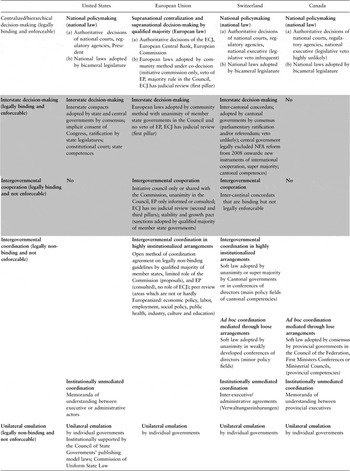
While our two hypotheses were based on the twofold distinction between weakly and highly constraining agreements – both non-hierarchical coordination mechanisms – the following systematization embeds these mechanisms in the full range of coordination modes, including hierarchical modes. This systematization draws on both the literature of intergovernmental relations (IGR) (Cameron, Reference Cameron2001: 125; Painter, Reference Painter2001) and European governance (Scharpf, Reference Scharpf2001; Börzel, Reference Börzel2008). Again, the relative constraints on individual government action imposed by the different modes constitute the main ordering dimension. To solve cross-jurisdictional problems, modes of policy coordination can leave governments next to no leeway for individual action, at one end of the continuum, or grant them maximum autonomy, at the other end. Table 2 gives an overview of the possible modes.Footnote 20
Available repertoires of coordination modes in four multilevel systems

EP, European parliament; ECJ, European Court of Justice; NFA, Neuer Finanzausgleich.
The shaded areas indicate the policy modes that H1 refers to.
To quickly describe the five categories, the most ‘collectivist answer’ to address common challenges is hierarchical or centralized coordination. National policymaking in federal systems and supranational centralization and decision-making by qualified majority voting in the EU fall into this category. Lower-level governments decide to delegate the power to make collective policies to the central level, be it to regulatory agencies or the national legislature. Although they might participate indirectly or directly in central and supranational decision-making processes, lower-level governments do not have an individual veto as a result of which they can be bound without their consent and against their individual opposition. This is also true in the EU despite the fact that the member states are still the ‘Masters of the Treaties’. Like any national government, the European Commission has been empowered by the member states to take authoritative decisions, for example, in competition policy, in which the member states have no say. The same is true for decisions of the European Central Bank (monetary policy) and rulings of the European Court of Justice (ECJ; the entire first pillar).Footnote 21 Next to supranational centralization, individual member states can also be obliged against their will when the Council decides by qualified majority and they are outvoted (decision-making by qualified majority voting).
Interstate decision-making constitutes highly constraining agreements with regard to which each participating government retains a veto. These decisions are binding either for all those governments that are willing to agree (consensus) or if all governments in the system agreed (unanimity). The crucial requirement is that no lower-level government can be bound to new provisions without its consent. Intergovernmental cooperation brings us to a category particularly prominent in multilevel settings beyond the nation-state being at least partially regulated by international law; the category includes agreements that are binding, although there is no third party authority that can legally force parties into compliance which is why, for reasons of parsimony, they are considered as weakly constraining. Intergovernmental coordination refers to weakly constraining agreements that are neither legally binding nor legally enforceable. Finally, policy emulation is the mode of policy coordination that restricts the authority of individual governments the least. It refers to the voluntary and unilateral adoption of measures observed in other jurisdictions without an explicit agreement between different jurisdictions.
In sum, while unilateral policy emulation resolves the tension between individual choice and collective action completely in favor of the former, centralization does exactly the opposite. The middle categories – interstate decision-making, intergovernmental cooperation, and intergovernmental coordination – try to strike a balance: intergovernmental coordination and cooperation with an emphasis on individual government autonomy; interstate decision-making with an emphasis on collective authority. In line with hypothesis 1 (H1), Canada is the only system that exclusively applies intergovernmental coordination, a weakly constraining mode.
Intra-governmental power sharing and modes of horizontal policy coordination
Based on Table 2, the following section analyzes the four cases in greater detail, focusing on the relative willingness of lower-level governments (in the federal systems the regional governments, in the EU the member states) to apply different coordination modes (H1) and on the capacity to use highly constraining modes requiring legislative approval (H2).
In line with our first hypothesis, the power-sharing lower-level governments in the EU, Switzerland, and the United States engage in interstate decision-making, while the Canadian provinces do not. In the EU, European law adopted by the community method with a unanimity of member state governments in the Councils fall into this category (first pillar). While the ECJ has judicial review in these areas, decisions cannot be vetoed by the European Parliament; thus, decision-making is controlled by the member states and qualifies as horizontal. Correspondingly, the Swiss cantons enter into concordats, also a mode of horizontal coordination, which demands unanimity among the participating governments. Concordats overrule cantonal law, are legally binding, and usually (yet not in every case) enforceable. They need to be ratified by cantonal parliaments, or, on occasion, require referenda (Abderhalden, Reference Abderhalden1999).Footnote 22 Similarly, in the United States, we find interstate compacts that create interstate laws, superseding individual state law and presupposing parliamentary ratification. On the administrative level, we find formal agreements whose negotiation require ex-ante legislative authorization (Zimmerman, Reference Zimmerman2002). In the EU, Switzerland, and the United States, lower-level governments do not have to rely on weakly constraining agreements only. This mode has advantages when collectively handling issues that create strong incentives for defection or free riding, for instance when (re)distributive implications are involved. Resource-sharing arrangements constitute a typical case in which governments tend to prefer this very constraining mode.
The Canadian provinces, in contrast, are driven by a strong priority to restrict individual autonomy losses as a result of which they have strongly resisted any modes or structures to support legally binding policy coordination. Similarly, governments shied away from any attempts to reform the federal constitution over the past 20 years, which might have changed the balance of power in the system as a whole. Not only are Canadian provinces left with intergovernmental coordination as the only accepted mode, but also the infrastructures in place to support policy coordination are weak and, mirroring this, governments frequently opt out of informal agreements whenever they consider it as beneficial in the short run (e.g. facing upcoming elections). This is a general disposition, not just a ‘Québec factor’ as interviews indicate, even though smaller provinces would have clearly profited from pooling resources without Québec on a regional basis.
The dominant type of coordination, however, is bilateral and ad hoc. We find an array of agreements on the executive or administrative level, an informal memoranda of understanding. These agreements tend to be problem-oriented and rarely catch the attention of the public. Thus, most coordination occurs institutionally unmediated, which emphasizes the prioritization of flexibility over reliability. While policy coordination that is not institutionally backed up, is not per se less efficient, the need to reform IGR is regularly debated, highlighting the need for stronger infrastructures that are able to stabilize processes (Meekison et al., Reference Meekison, Telford and Lazar2004). Unlike other federal systems, we find intergovernmental secretariats in only a few policy areas, and even where they exist, their staff’s role is limited to providing bureaucratic support. Any involvement in agenda setting is unheard of.Footnote 23 Thus, the intergovernmental structures in place are hardly able to stabilize informal intergovernmental coordination by providing expert advice to depoliticize negotiations or to monitor non-compliance with political agreements. While Canadian ministerial councils are in principle in charge of ‘their’ particular policy fields, whenever a particular policy issue becomes politicized, it can be picked up by intergovernmental institutions at the premiers’ level, such as the Canadian Council of the FederationFootnote 24 (including the provincial and territorial premiers), or the first ministers’ conferences (including the premiers and the federal prime minister). If an issue is taken away from subject specialists in ministerial councils and taken over by heads of government, political maneuvering is bound to dominate. Recognizing the limited effectiveness of intergovernmental coordination, the Canadian federal government made efforts to introduce collective benchmarks and public reporting to generate public pressure to ensure provincial compliance with agreements – similar to the OMC in the EU, which serves as a ‘model’ to harmonize provincial policies (Kennett, Reference Kennett1998).Footnote 25 Yet the attempts of the federal government to impose electoral sanctions by mobilizing the public against non-complying provinces have remained futile. The public interest in IGR was simply too limited to generate serious pressure that can generate compliance.
Weakly constraining agreements play an important role in any multilevel system. Yet in Canada, actors are left with non-binding mechanisms (i.e. intergovernmental coordination), irrespective of the issue at stake. Simultaneously, since governments fiercely reject any restrictions on their autonomy, intergovernmental coordination is less efficient than in other systems. While party political differences between governments can also complicate cooperation, their impact is comparatively weak given the low vertical integration of Canadian parties (Thorlakson, Reference Thorlakson2009). Accordingly, interviewees found electoral pressure and the principled protection of government autonomy more pervasive.
In power-sharing systems, weakly constraining modes – intergovernmental coordination and intergovernmental cooperation – are not only used regularly, but also more often than interstate decision-making mechanisms. This has to do with the negotiation costs, which tend to be higher in interstate decision-making due to unanimity or consensus requirements (in some systems, majority approval suffices to enter intergovernmental coordination). Furthermore, governments are naturally more careful to enter constraining agreements. In some very sensitive areas, they might refuse to be bound altogether.Footnote 26
Looking at intergovernmental coordination in our four systems in more detail, in the EU, member states have made increasing use of this mode with the introduction of the OMC. It rests on soft law mechanisms such as guidelines and indicators, benchmarking and sharing of best practice and allows the coordination of national policies in areas where member states have been unwilling to grant the EU political powers and additional spending capacity, particularly in the field of economic and social policy (Hodson and Maher, Reference Hodson and Maher2001). It has been frequently emphasized that the EU stands out – in terms of vertical coordination – by assuring a particularly strong representation of lower-level governments at the central level, since the member state governments are directly represented in the European Council and the Council of Ministers (Sbragia, Reference Sbragia1993). Yet it is often overlooked that member state governments can use the Council (a formal, central-level institution) to engage in horizontal, legally non-binding coordination excluding the participation of supranational institutions. The OMC is a case in point, which applies in areas such as labor or health policy, where the member states wish to protect their autonomy and choose to coordinate their policies without transferring competencies to the EU. Although the Open Method is treaty-based, the goals and benchmarks agreed upon in these areas are purely voluntary, thus clearly falling into the category of intergovernmental coordination.
Similar to Canada and unlike the EU, in Switzerland too intergovernmental coordination occurs within informal intergovernmental institutions.Footnote 27 In contrast to Canada, however, these institutions tend to be strongly institutionalized and not only support the drafting of highly constraining agreements (i.e. interstate decision-making via concordat) but are also equally able to stabilize coordination via non-binding recommendations (Empfehlungen). Accordingly, coordination tends to be institutionally channeled to a wider extent than in Canada. In the core areas of cantonal competences, we find secretariats with their own personnel and financial resources are able to issue initiatives and to establish common grounds between the respective ministers. They are based on statutes specifying the decision-making rule (usually decisions are made by supermajorities) and the procedures between different organs (e.g. the executive running the conference over the year and a plenary session composed of cantonal representatives making the core decisions).
Overall, weakly constraining agreements are used more often than highly constraining ones. They include institutionally supported recommendations as well as inter-cantonal, administrative agreements that are directly negotiated by the respective cantonal executives. Cantons have no formal obligations to follow them, but experts and interviewees consistently argued that these recommendations tended to be used as a working basis for drafting cantonal legislation. While policy-specific ministerial meetings are in charge of whatever issue falls in ‘their policy field’, in 1993, the Conference of Cantonal Executives was established that took over the overall coordination of cantonal governments as far as cross-sectoral issues (e.g. federal reform) are concerned. By now the conference has built up a reputation, as major channel for cantonal–federal communication and, to a certain extent, took over a coordinating function between the much older policy-specific secretariats. Finally, in 2001, a framework was created that assigned responsibilities and established procedures on how to solve conflicts between them to avoid a mutual weakening of cantonal institutions.Footnote 28
Finally, in the United States, the intergovernmental arena is heavily fragmented as a consequence of power sharing between and within the government branches. The impact of compulsory power sharing becomes most visible in the coexistence of strongly resourced intergovernmental institutions that represent the interests of the different governmental branches separately, such as the National Governors’ Association and the National Conference of State Legislatures (Haider, Reference Haider1974; Arnold and Plant, Reference Arnold and Plant1994). What is more, the same process of institutional dissociation along constitutional lines occurred on the level of regional intergovernmental institutions. As a consequence, they lobby for their members’ interests, but do not function as mediators for collective ‘state action’ in the sense of generating political commitment between states to coordinate policy. Although we find a range of mechanisms such as memoranda of understanding and ad hoc commissions that provide for flexible pathways for interstate coordination (Zimmerman, Reference Zimmerman2002; Purcell, Reference Purcell2007: 92–93), these are not institutionally supported.
At the same time, the United States stands out by providing a strong support structure for policy emulation, the least constraining form of policy coordination in our scheme. Since 1892, the ‘National Conference of Commissioners on Uniform State Laws’ has been actively pressing for equal standards across state borders. The commission is composed of attorneys, judges, and law professors, as well as legislators. The conference attempts to develop uniform state laws in areas where states wish to act independently of the federal government, but where nationwide uniformity is desirable. Furthermore, the Council of State Governments publishes a selection of 40–50 innovative state laws each year of which, on average, between two and four are widely adopted.
Intergovernmental cooperation is a mode that is most common in the EU. Binding yet non-enforceable agreements are possible in some federal states as well. Formally binding Swiss concordats can explicitly exclude litigation, which is, however, rare (Abderhalden, Reference Abderhalden1999). In federal states, if lower level governments go for a legally binding mechanism, enforceability tends to go with it, as is the case in the United States where formal administrative agreements are based on discretionary authority legally assigned via statute by the legislatures to heads of department (Zimmerman, Reference Zimmerman2002: 164).Footnote 29 This pattern points to a systematic difference between state and non-state multilevel systems. The capacity of intergovernmental cooperation to constrain government behavior is located in between interstate decision-making (binding and enforceable) and intergovernmental coordination (non-binding and non-enforceable). In the area of external and internal security, the EU still functions more like a traditional international organization. Member state governments adopt legally binding decisions by unanimity, which are, however, not legally enforceable. The ECJ has no power over decisions taken by the member states under the second and the third pillars (see above). The treaties may provide monitoring and sanctioning mechanisms. However, any enforcement measure requires at least the consent of the majority of the member state governments. The absence of a third party dispute settlement body provides the member states with an exit option in the post-decision stage, which lower-level governments usually do not have in federal states. This may explain why even autonomy-minded, one-party governments, like the United Kingdom, are willing to enter into legally binding agreements. Simultaneously, its stronger constraining capacity explains why intergovernmental coordination, that is, the OMC, is less frequently used than in the other systems.
While it is only in Canada that interstate decision-making, and thus highly constraining agreements are politically rejected by lower-level governments, in the United States, weakly constraining coordination modes are often attractive because they avoid legislative involvement and therefore allow executives to respond to cooperation demands more flexibly. This brings us to our second hypothesis on the relative capacity to engage in highly constraining coordination (or interstate decision-making), which should be reduced by compulsory power sharing in lower-level governments. While we find active attempts to promote formal interstate compacts by the Center for Interstate Compact, a secretariat run by the Council of State Governments, the various actors in American IGR emphasize that compacts merely fill a vacuum and are rarely used in practice. Despite the center’s active efforts and the pronounced willingness of actors to, in principle, use binding mechanisms, if adequate to handle a problem, in 2005, the average time to set up a compact from the first idea to the final enactment was 18–24 months. And despite extensive negotiations, legislative approval often proves difficult (Zimmerman, Reference Zimmerman1990: 145; Reference Zimmerman2002).
While the formal requirements to engage in interstate decision-making are high in all three power-sharing systems, in the United States it is much less often used than in Switzerland or the EU. Because of the separation of the branches of government and the weakness of party linkages (i.e. the dominance of compulsory power sharing), state legislatures forcefully defend their institutional interests, that they perceive as clearly distinct from the interests of their executives. The executives feel less responsible for protecting legislative autonomy than executives in our other systems since they are tied to their parliaments – either institutionally, organizationally (i.e. through party linkages), or both. Interviews consistently confirm that governors are interested in obtaining as much leeway as possible in the implementation phase in order ‘to get things done’, thus to provide services efficiently. The drafting of interstate compacts brings this divide to the fore by outruling contradictory state law once the compact is ratified. It does not help that the terms of these compacts are usually negotiated by executive actors with little legislative involvement and that regulatory commissions (which are often created on the basis of these compacts) are usually run by administrators, thus by ‘the executive branch’. Depending on the problem, compacts tend to be considered as most suitable to solve it, yet the divergence of interests between the branches rooted in compulsory power sharing still undermines their use. Similarly, informal administrative agreements are used more often than formal intergovernmental agreements whose negotiation requires prior legislative authorization (Zimmerman, Reference Zimmerman2002: 213).Footnote 30
In Switzerland, the creation of inter-cantonal law is less problematic since parties are sufficiently strong to establish communicative channels between ministers involved in negotiations and their party’s MPs in parliament. The mere number of formal agreements in each system is telling, in particular considering that both mechanisms were in place since these two federations were created: according to the American Bar Association, 200 compacts were in force in 2002Footnote 31, the most recent inventory of Swiss concordats of the University of Fribourg lists 760 up to early 2006 (Bochsler, Reference Bochsler2009).Footnote 32 While in American federalism the available repertoire of coordination modes is in principle wide, its effective repertoire turns out to be more limited.
Conclusions: non-hierarchical policy coordination and multilevel dynamics
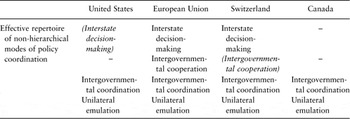
Our paper argues that intra-governmental power sharing in lower-level governments affects whether and how the latter use particular modes of intergovernmental policy coordination. Table 3 sums up the range of coordination modes actively used in each of the four systems analyzed. Available modes, which are only applied irregularly, are highlighted in italics and in brackets – reflecting the distinction between the modes formally available in a system and those effectively used.
Effective repertoires of non-hierarchical modes of policy coordination

Modes in brackets are formally available modes that are rarely used.
In line with the two hypotheses, the EU and Switzerland display the broadest repertoire of effectively used modes of policy coordination. Cantons and member states actively use weakly and highly constraining coordination modes to solve problems non-hierarchically. Their voluntary power-sharing structures limit the endeavor to keep individual autonomy on a maximal level, which generates the willingness to engage in highly constraining agreements. Further, they allow for these instruments’ effective use since inter-branch divides remain moderate. The two multilevel polities, one within and one beyond the nation-state, turn out to be more similar than three national multilevel polities compared to each other, which supports those scholars who have long argued in favor of bringing EU studies and comparative politics research together (see, among many, Sbragia, Reference Sbragia1993; Scharpf Reference Scharpf1988, Reference Scharpf2001; McKay, Reference McKay2001; Benz, Reference Benz2004a, Reference Benzb). This is not to deny the peculiarities of the EU polity but to put them in a systematic context. For instance, unlike federal systems the European Council serves as both an arena for vertical and horizontal policy coordination. This is mainly due to the pillarized structure of the EU. While in the first pillar, the supranational level (e.g. the Commission) is rather strong, in the second and the third pillars the Council is the exclusive legislator. What our analysis highlights is that in these latter areas, the member states largely draw on the Council structure to coordinate their policies through weakly constraining agreements (i.e. intergovernmental coordination), a coordination mode that we find equally in federal systems.
Both the United States and Canada end up with a more restricted repertoire of coordination modes – although for different reasons – with important consequences for federal–state relations. Despite the willingness of state actors in the United States to engage in various forms of coordination, compulsory power sharing complicates the use of interstate compacts, which is a formally available coordination mode that is not effectively used. It leads to a strong emphasis on and conflicts between the ‘institutional interests’ as perceived by executive actors (who want to deliver services) and legislative actors (who want to protect legislative autonomy). Compacts (which tend to be more forceful mechanisms for harmonization and delimit the need for federal regulation) are only infrequently applied.Footnote 33
This is reflected in the intense use of informal administrative agreements (Zimmerman, Reference Zimmerman2002: 212–214) that do not involve the legislatures and are handled by executives with little interest in the protection of ‘state autonomy’ per se. Such intergovernmental coordination (not policy emulation, which is even less reliable) cannot provide feasible alternatives to harmonization via interstate law in terms of effectiveness. The less able states are to solve problems themselves, the easier to justify federal activism. Accordingly, after a rise of formal interstate compacts in the 1960s, the number of compacts declined later on with the rise of federal preemption (Zimmerman, Reference Zimmerman1990; Reference Zimmerman2002). Scholars have argued that state actors accepted the ‘realism of the administrative state’ and cared less about competences than the ‘realities’ of funding and implementation (Arnold and Plant, Reference Arnold and Plant1994: 106). One crucial part of this ‘reality’ is the unequal capacity of the two governmental levels to coordinate as nourished by intra-branch divides. It explains why, in a system that has been long considered as ‘cooperative’, we find so little state resistance to the increasingly coercive nature of federal intervention (Kincaid, Reference Kincaid2008).
The Canadian situation also reflects the downsides of mainly relying on weakly constraining modes such as intergovernmental coordination to solve collective problems – although without reinforcing centralization to similar extents. To protect their legislative autonomy against the federal government is one of the few aspects that lower-level governments agree on – nourished by the comparatively high autonomy losses that are perceived all the more intensively in the face of high electoral pressure. While they do not always successfully fight off federal intrusion in the face of the center’s superior spending power, centralizing tendencies are comparatively moderate. The downside of the dominant drive toward autonomy protection in terms of substantial problem solving is that it does not only affect federal-provincial but also inter-provincial policy coordination. Policy coordination is notoriously weak due to the unreliability of intergovernmental processes, which has been critically debated by academics and politicians for decades (Kennett, Reference Kennett1998; Bakvis and Baier, Reference Bakvis and Baier2005). Given the strong intra-governmental incentives against reforms reducing government autonomy, no solution is in sight.
In Switzerland and the EU, we find neither the problem of intense executive–legislative divides undermining interstate decision-making, nor the principled refusal of highly constraining agreements. This is not to say that consensus or unanimity requirements are not considered burdensome, as indicated by the NFA (Neuer Finanzausgleich), the most recent federalism reform in Switzerland passed in 2004. This reform established ‘new instruments of cantonal cooperation’ applicable in nine areas of cantonal jurisdiction that are both legally binding and legally enforceable.Footnote 34 Their core is an enforcement mechanism that can impose an inter-cantonal agreement favored by a majority of cantons on the opposing minority. This deviation from a consensus requirement corresponds to attempts to expand majority voting in the Council of Ministers. More specifically, a supermajority of cantons can ask the national parliament – which plays the role of a neutral arbiter – to make an inter-cantonal agreement obligatory for an opposing cantonal minority in these areas of cantonal authorityFootnote 35 since formerly concordats remained practically defunct when individual cantons refused to enter them for opportunistic reasons.
These instruments transcend interstate decision-making by abolishing an individual government veto and move inter-cantonal relationships toward interstate decision-making by qualified majority voting in the EU without fully making it into this ‘centralized’ category since federal-level institutions play a very limited role here (see Table 2). Being clearly aware of individual autonomy losses, the cantons expect the ‘shadow of hierarchy’ (in the form of majority voting and federal involvement) to keep otherwise free-riding cantons in line and to make them engage more seriously in the search for consensual solutions beforehand – which might avoid the application of this instrument altogether. And even if not, being outvoted by other cantons is still preferred to the centralization of cantonal competences. As Swiss interviewees consistently argued, horizontal, inter-cantonal coordination needs to become more efficient to counter federal intrusion. While this mirrors the same challenge the American states are confronted with, in the Swiss cantons both executives and legislatures share – despite a separation of power structure – the protection of competences as one priority and are thus more able to counter centralizing pressures.
In recent decades, the scope of problems increasingly transcends jurisdictional boundaries. Assuring effective cross-jurisdictional problem solving, while avoiding the centralization of competences, is thus a pressing challenge for lower-level governments in any multilevel system. It is no surprise that in the EU even voluntary coordination is placed on formal grounds and is clearly specified for particular areas of competence. While this is partially related to the EU’s status as a multilevel system ‘in the making’, member states also try to avoid a dynamic of ‘creeping competencies’ (Pollack, Reference Pollack1994). Even though the OMC does not even entail legal obligations, the member state governments have made it quite clear that any policy coordination, even in an exclusively horizontal mode, needs to be authorized by the member states. This will prevent the European Commission from expanding its activities into sensitive areas, in which the member states want to coordinate their policies without transferring competencies to the EU level.
Non-hierarchical coordination can create a barrier against centralization. Yet, as recent reform debates in federal systems and the EU have shown, non-hierarchical coordination is difficult to implement effectively. To understand multilevel dynamics, we need to understand what drives the choices of those governments forming a composite polity, choices driven as much by political as by functional considerations. Bringing federalism research and EU scholarship together might be one useful strategy toward accounting for these choices.
Acknowledgements
We are thankful to Arthur Benz, Berhard Ehrenzeller, Johanne Poirier, Alberta Sbragia, Fritz Scharpf as well as the three referees for their feedback to earlier versions of this paper.