Organochlorine pesticides (OCs) are persistent organic pollutants which are globally distributed. As top predators, marine mammals are the most vulnerable species to these lipophilic contaminants because they are chronically exposed to them in the marine environment, where they accumulate great concentrations in their thick layer of blubber, through the bioaccumulation and biomagnifications' processes (Tanabe et al., Reference Tanabe, Iwata and Tatsukawa1994; Tanabe, Reference Tanabe2002).
The general features of the accumulation of OCs in marine mammals are fairly well understood. Generally, both males and females tend to accumulate OCs rapidly during the juvenile phase. In males the accumulation continues through life. However, in females the body burden of OCs can stablize or even decrease in older individuals (Wells et al., Reference Wells, Tornero, Borell, Aguilar, Rowles, Rhinehart, Hofmann, Jarman, Hohn and Sweeney2005). This difference in accumulation has been attributed to the capacity for lipophillic pollutants to cross the placenta from the mother to the foetus during pregnancy, and via milk during lactation (Tanabe et al., Reference Tanabe, Iwata and Tatsukawa1994; Wells et al., Reference Wells, Tornero, Borell, Aguilar, Rowles, Rhinehart, Hofmann, Jarman, Hohn and Sweeney2005).
Exposure of newborns to such chemicals is of particular concern, as young animals are immunologically immature and most vulnerable to such effects (Hall et al., Reference Hall, Kalantzi and Thomas2003). Suckling offspring are at critical stages of growth and development and they are, therefore, particularly sensitive to the effects of xenobiotic toxins that are transferred from the mother to them (Ridgway & Reddy, Reference Ridgway and Reddy1995; Reddy et al., Reference Reddy, Reif, Bachand and Ridgway2001). In cetaceans, maternal OC transfer is considered to be significant, especially for the firstborn calf.
Marine tucuxi dolphins, Sotalia guianensis, have shown to be an excellent bio-indicator of the coastal environmental pollution along the Brazilian coast (Yogui et al., Reference Yogui, Santos and Montone2003; Kajiwara et al., Reference Kajiwara, Matsuoka, Iwata, Tanabe, Rosas, Fillmann and Readman2004; Siciliano et al., Reference Siciliano, Alves and Hacon2005). This species is a small dolphin generally associated with shallow and protected estuarine waters, at depths less than 30 m, where it feeds on pelagic demersal and semipelagic prey in the near shore ecosystem, with a lifespan of up to 30 years (Di Beneditto & Ramos, Reference Di Beneditto and Ramos2004). It has a continuous distribution, from Santa Catarina Island, Brazil (27°35′s 48°34′W) to Nicaragua (15°58′N 85°42′W), on the Caribbean coast. Unlike the most of cetaceans and other species of marine mammals, S. guianensis shows a strong pattern of site fidelity (Flores & Bazzalo, Reference Flores and Bazzalo2004).
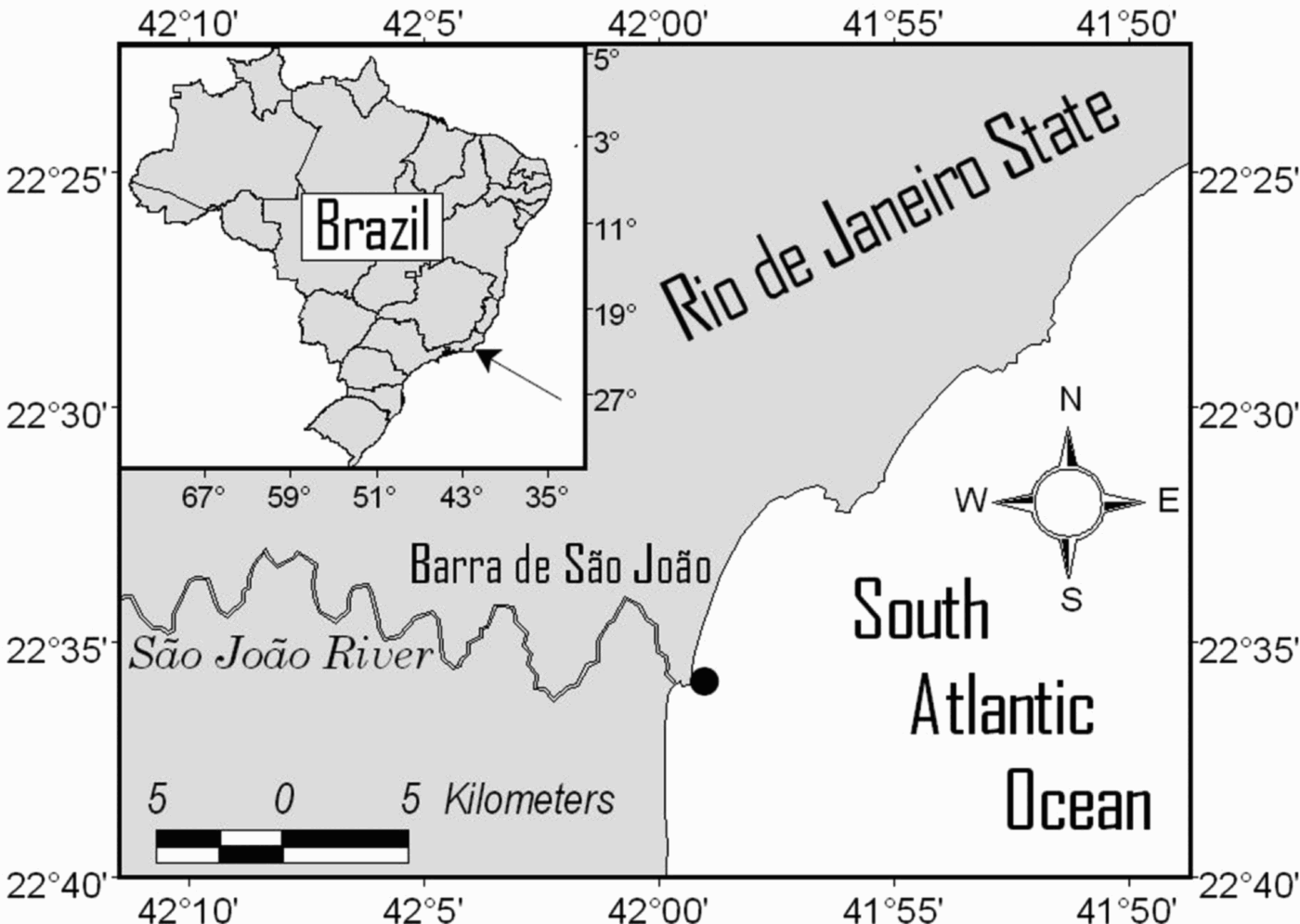
In this note, we present a result of OC concentration obtained in milk collected from a dead lactant female of S. guianensis (191 cm) incidentally captured in gill-net fishery together with its calf (70 cm), in November 2002, at Barra de São João, east coast of Rio de Janeiro State, Brazil (Figure 1). The analytical procedure used was the method described by Prapamontol & Stevenson (Reference Prapamontol and Stevenson1991), modified by Mesquita (Reference Mesquita2001), with the following stages:
Map showing the location of the occurrence of the stranded Sotalia guianensis sampled in this study (•).

Solid phase extraction
To a volume of 1 ml of sample, thawed at 37°C for 20 minutes, are added 5 ml of a mixture of ethyl acetate/methanol/ketone in the proportions of 2:4:4. The mixture is agitated in vortex for 1 minute and sonicated for 20 minutes. After centrifugation for approximately 15 minutes at 2000 rpm, 10 ml of water are added to the organic phase, which is eluted in a SPE PACK C18 column, previously treated with 2 × 1 ml of n-hexane, 2 × 1 ml of ethyl acetate, 2 × 1 ml of methanol and 2 × 1 ml of distilled water. At the end the column is washed with 2 × 1 ml of acetonitrile 25% and then the pesticides retained in the column are eluted with 1 ml of n-hexane. The limits of detection of the analysed organochlorines were lower than 0.03 µg l–1 of milk, calculated as three times the standard deviation of the blank.
Florisil clean-up
The extract is eluted in a pretreated Florisil® column with 10 ml of hexane and 5 ml of ketone/petroleum ether 15%. The total collected volume of 15 ml is evaporated with the internal standard to 0.2 ml and analysed by gas chromatography coupled with electron capture detection. The results are expressed in ng g–1 (ppb) of fat in the milk.
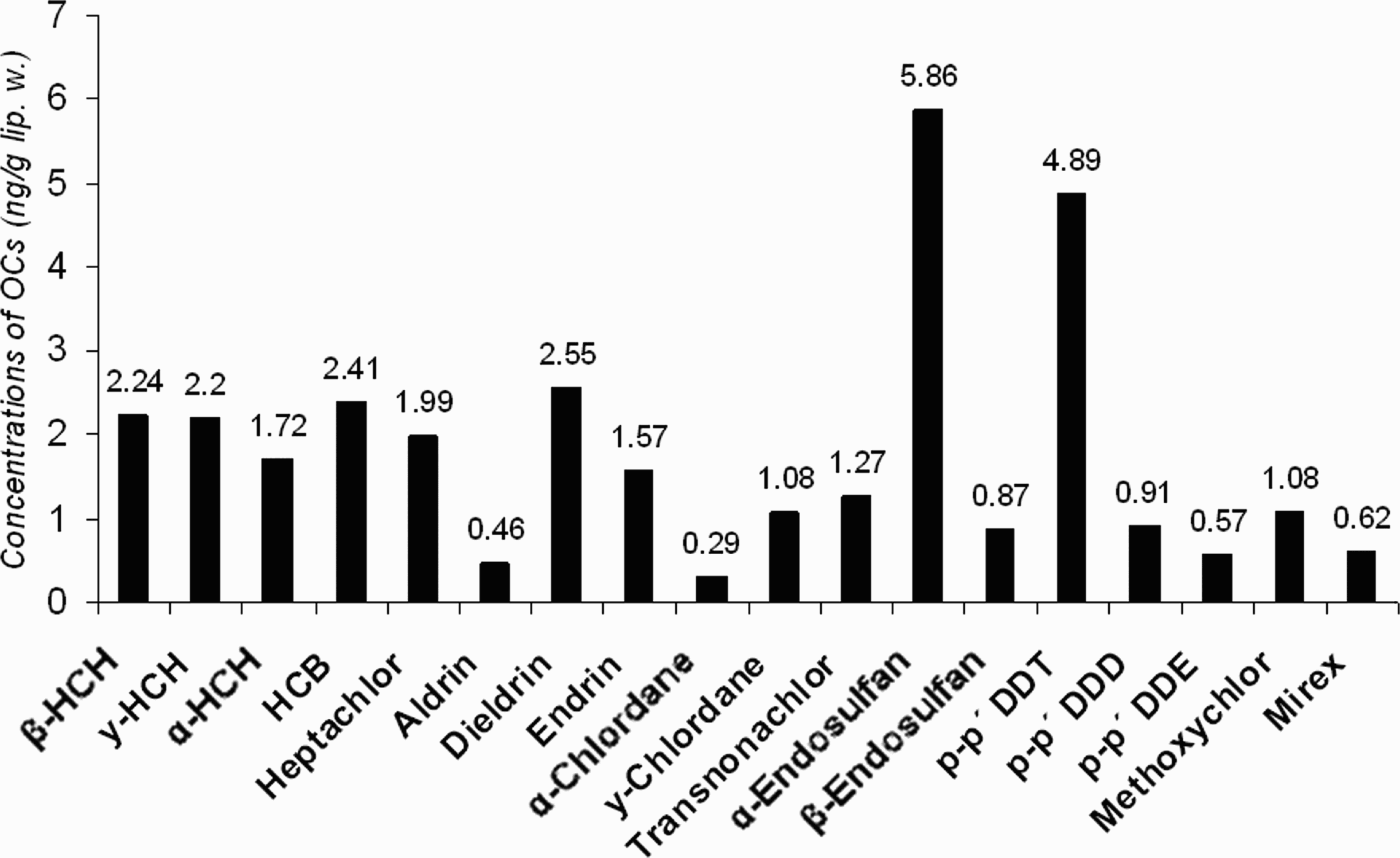
The OCs with the highest concentration were endosulfan1 (5.86 ng g–1), followed by p-p′DDT (4.89 ng g–1), dieldrin (2.55 ng g–1) and HCB (2.41 ng g–1) (Figure 2). Despite the low OC concentration detected in the milk of the captured dolphin, it was not possible to determine if the calf was the first-born of that female. However, females of marine tucuxi dolphins attain sexual maturity at 160 cm and the gestational period is about 11.6 months (Rosas & Monteiro-Filho, Reference Rosas and Monteiro-Filho2002; Di Beneditto & Ramos, Reference Di Beneditto and Ramos2004). This indicates that probably this female sampled (191 cm) was not nursing for the first time. Fukushima & Kawai (Reference Fukushima, Kawai and Fujiyama1981) suggested that the first-born striped dolphin females (Stenella coeruleoalba) receive four times more OCs than subsequent siblings, with more than 90% of the OC load transferred via lactation. Ridgway & Reddy (Reference Ridgway and Reddy1995) analysed OCs in milk samples of bottlenose dolphin (Tursiops truncatus) collected in the Gulf of Mexico. The highest values were found in milk produced by the oldest dolphin (age 34) during what was probably its first lactation and the lowest values were found in milk produced by one of the youngest dolphins (age 16).
Organochlorine pesticides (OC) in the milk of a stranded female marine tucuxi dolphin collected in Barra de São João, RJ, in 2002. All values are presented in ng g–l lipid weight, or ppb.

The endosulfan was the highest organochlorine compound found in the milk sample (Figure 2). According to Grisolia (Reference Grisolia2005) the contaminant endosulfan is extremely toxic to the marine biodiversity and it exhibits a mutagenic function at low concentration. Studies of OC concentration in dolphins in Brazilian waters (Yogui et al., Reference Yogui, Santos and Montone2003; Kajiwara et al., Reference Kajiwara, Matsuoka, Iwata, Tanabe, Rosas, Fillmann and Readman2004) have shown high concentration of p-p′-DDE, the major breakdown/metabolic product of DDT (Aguilar, Reference Aguilar1984), which indicates that DDT input has not been released into the ecosystem. Although it is very difficult to observe trends with only one sample, the low comparable percentage of p-p′-DDE (8.9%) in comparison with the high percentage p-p′-DDT concentration (76.8%) in the related sample of milk (Figure 2) could indicate recent release of DDT into the environment. However, according to Hernández et al. (Reference Hernández, Serrano, Roig-Navarro, Martinez-Bravo and López2000) it should be taken into account that metabolic transformation ability could also influence this ratio. Ridgway & Reddy (Reference Ridgway and Reddy1995) found high levels of p-p′-DDE (32,400 ng g–1) in comparison with p-p′-DDD (1860 ng g–1) and p-p′-DDT (797 ng g–1) respectively in the milk of T. truncatus, and the concentrations tended to vary along the period of lactation. Brito et al. (Reference Brito, Vieira, Torres and Malm2005) found high concentration of non-metabolized DDT in the soil of the Paraíba do Sul River, and they attributed the findings to the recent DDT inputs in the area and its low degradability by physical, chemical and biological activities. The release of OCs in the Paraíba do Sul River may be disseminated in the coastal waters of the north-eastern coast of the Rio de Janeiro State.
In our study the proportion of HCH isomers was almost the same for α-HCH (27.9%), β-HCH (36.3%) and γ-HCH (35.8%). The relatively high proportion of β-HCH is due to the high persistent properties of the HCH isomer (Yogui et al., Reference Yogui, Santos and Montone2003). Low levels of total HCH in tropical regions, such as Rio de Janeiro State, are due to atmospheric transportation of this contaminant from low to mid- and high-latitudes, principally the α-HCH, which was the lower HCH isomer detected. In Brazil, DDT and other persistent organic pesticides were banned for agricultural use in 1985, but were permitted for use in public health campaigns (e.g. against malaria) until 1998. In Rio de Janeiro State, however, there has been no report on the OCs to control insect-borne diseases for decades (Grisolia, Reference Grisolia2005).
The results presented in this report show the persistence of the organochlorine pesticides on the east coast of Rio de Janeiro, demonstrated by the accumulation of these contaminants in the marine tucuxi dolphins.
ACKNOWLEDGEMENTS
The authors are very grateful to the local life-guards and fishermen who provided relevant information described in this note. We also acknowledge the team involved with GEMM-Lagos (Grupo de Estudos de Mamíferos Marinhos da Região dos Lagos) for their help during field work. A special thank you to Anne Marie L.S.F. de Moura for her encouragement in writing this short report.